Introduction
The Diagnostic and Statistical Manual of Mental Disorders, fifth edition (‘DSM-V’), describes autism spectrum disorder as a behavioural condition associated with ‘persistent deficits in social communications and social interaction across multiple contexts, restricted, repetitive patterns of behaviour, interests, or activities, which present early in the developmental period that cause clinically significant impairment in social or occupational functioning’.1 Autism spectrum disorder affects 1 in 54 children worldwide,Reference Maenner, Shaw, Baio, Washington, Patrick and DiRienzo2 and the prevalence has been increasing over the last 10 years.Reference Elsabbagh, Divan, Koh, Kim, Kauchali and Marcín3 This increase in prevalence is thought to be a result of recent changes in the diagnostic criteria, an increase in awareness by medical professionals and the general public, and greater service availability.Reference Hansen, Schendel and Parner4
A diagnosis of autism spectrum disorder is best obtained with the help of a multidisciplinary team,Reference Hayes, Ford, Rafeeque and Russell5 consisting of a paediatrician, a psychiatrist, a speech and language therapist, an occupational therapist, a social worker and a psychologist, among others. Autism spectrum disorder can present as early as 18 months, but is most commonly diagnosed at age 4 years.Reference Baio, Wiggins, Christensen, Maenner, Daniels and Warren6
Children with autism spectrum disorder present to the ENT department at a higher rate than children without autism spectrum disorder.Reference Adams, Susi, Erdie-Lalena, Gorman, Hisle-Gorman and Rajnik7 Children with autism spectrum disorder have higher rates of otitis media with effusion, acute otitis media, mastoiditis and allergic rhinitis.Reference Miyazaki, Koyama, Ota, Swa, Amiya and Mlunde8 As a result of impaired communication and social interactions, children with autism spectrum disorder not only present to the ENT department more frequently, but also present later, with more complications of progressive and untreated disease.Reference Thom, Keary, Palumbo, Ravichandran, Mullett and Hazen9 Difficulties in examining or treating patients with autism spectrum disorder lead to more hospital visits,Reference Vohra, Madhavan and Sambamoorthi10 and more procedures being carried out under general anaesthesiaReference Short and Calder11 with the associated risks.
Attending out-patient services or operating theatres can pose challenges for the child and their caregivers. New and excessive stimuli, such as sound, light touch and pain, particularly affect children with autism spectrum disorder. Busy out-patient waiting rooms, ENT examinations and new environments can cause distress in children with autism spectrum disorder, making the hospital journey more difficult for them and their caregivers. Removing these children from their structured day-to-day routine can induce feelings of upset, confusion and even anger,Reference Wigham, Rodgers, South, McConachie and Freeston12 which can be present during an out-patient or in-patient review.
The literature concerning the peri-operative management of this population is largely focused on anaesthesia and sedation protocol, which attempts to decrease combativeness through medication.Reference Swartz, Amos, Brindas, Girling and Ruth Graham13 Psychosocial interventions have also proven effective in the peri-operative management of children with autism spectrum disorder.Reference Vaz14 Some of these interventions include ‘hospital passports’, social stories and hospital pathways.
The concept of a hospital passport has been introduced in some UK hospitals.15 This is a document sent to parents prior to an elective admission that allows them to highlight their child's specific needs and areas of concern, to reduce stress and anxiety.
A social story is a child-friendly intervention that is used to give children with autism spectrum disorder information in situations where they have social difficulties.Reference Wright, Marshall, Adamson, Ainsworth, Ali and Allgar16 It is a means of communicating information about a concept to children with autism spectrum disorder using diagrams and text. It can be used to introduce patients to the hospital or to help explain a medical procedure.
The Children's Hospital of Philadelphia pathway for the management of behaviours in children with autism spectrum disorder highlights a number of strategies that should be considered in order to improve patient care.17 These strategies include: recognising parents as partners; ‘getting low and going slow’; using social stories, clear, concrete language and/or visual aids where possible; providing choices and praising when relevant; and reducing possible sensitivities such as loud noises, strong lights or too many people. The Children's Hospital of Philadelphia pathway advocates for the use of de-escalation strategies and anxiolytic medication if required. All of these techniques can help to reduce stress and anxiety for children with autism spectrum disorder during their hospital journey.
Our goal was to identify and introduce psychosocial interventions in order to improve the peri-operative care of children with autism spectrum disorder undergoing ENT procedures. Using a questionnaire and a semi-structured interview, we sought to assess areas for improvement in the ENT peri-operative care of children with autism spectrum disorder. We aimed to create a local social story to improve the hospital journey of children with autism spectrum disorder and reduce the need for sedation prior to the surgical period.
Materials and methods
The study involved a consecutive cohort of children with autism spectrum disorder who underwent ENT procedures over a six-month period. Patients’ parents were invited to participate in the study during an out-patient clinic follow-up appointment. Participants were given an 11-item questionnaire (Appendix 1). Answers were graded using a Likert scale ranging from 1–5.Reference Cooper and Johnson18
Semi-structured interviews were carried out after the questionnaire, focusing on the hospital's management of children with autism spectrum disorder. The goal was to highlight areas of strengths and weaknesses within the hospital, regarding the peri-operative management of these patients. The interview expanded on the questions and answers given in the questionnaire. This allowed participants to provide information on potential interventions they would like to see implemented to help ease their child's hospital journey.
An adapted questionnaire was given to hospital staff (Appendix 2), including nurses, surgeons, anaesthetists, paediatricians, healthcare assistants, audiologists and play therapists involved in the management of these patients.
Results were compared between parents and hospital staff. Statistical analysis was conducted using the Kruskal–Wallis test via SPSS® statistical software. Statistical significance was set at p ≤ 0.05.
Ethical approval was obtained from the Clinical Research Ethical Committee at the University Hospital Galway.
Results
Thirty-four questionnaires and interviews were completed. Nine parents and 25 hospital staff participated. The mean age of the children involved was 10.33 ± 2.199 years. All nine children with autism spectrum disorder were male, with varying degrees of clinical severity. Five of the children underwent adenotonsillectomy and four underwent ventilation tube insertion.
Twenty-five hospital staff members involved in the care of children with autism spectrum disorder, consisting of seven nurses, five surgeons, four anaesthetists, three paediatricians, three audiologists, one speech and language therapist, one play specialist, and one healthcare assistant, completed the questionnaire.
Parents (n = 8) and staff (n = 23) believed ‘the parents’ are the experts when it comes to understanding the needs of children with autism spectrum disorder (Figure 1). There was no statistically significant difference in opinion (p = 0.830).
Responses to question assessing parents’ and staff members’ agreement with the statement: ‘parents are the experts when it comes to understanding the needs of their child with autism’.

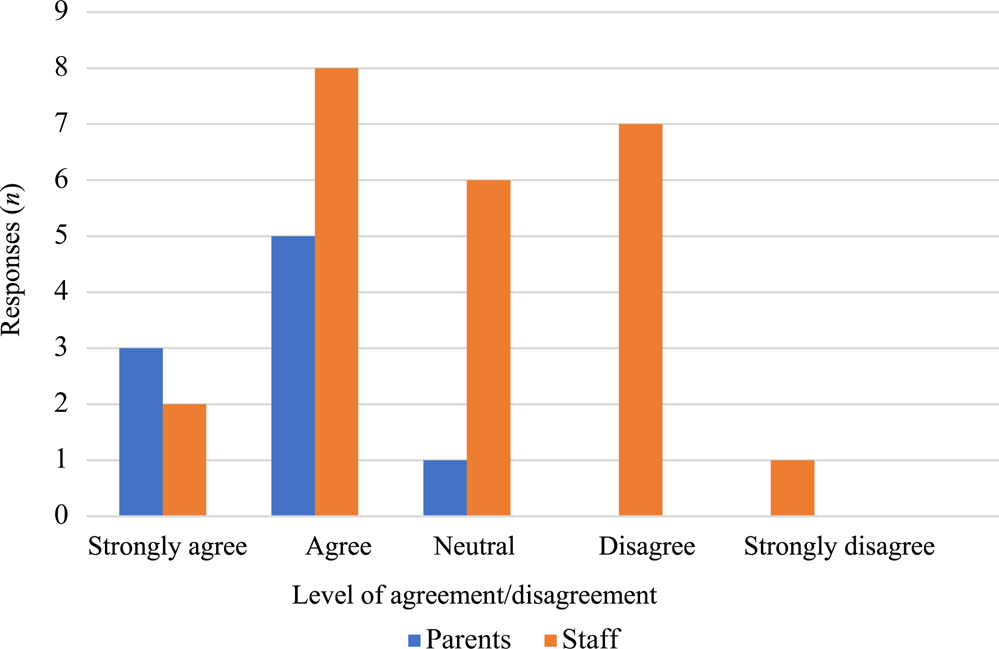
Eighty-nine per cent of parents (n = 8) agreed or strongly agreed that their children had a good experience in hospital. Staff members’ views were significantly different, with only 40 per cent (n = 10) believing children with autism spectrum disorder have a good experience (p = 0.012) (Figure 2).
Responses to question assessing parents’ and staff members’ agreement with the statement: ‘my child had/children with autism have a good experience overall’.

The majority of parents (n = 8) and staff (n = 17) believed the children's needs were taken into account. There was no statistically significant difference in opinion (p = 0.283).
Fifty-six per cent (n = 5) of parents believed their children were not treated differently because they had autism spectrum disorder; 52 per cent of staff felt the children were treated differently (n = 13). There was no statistically significant difference in opinion (p = 0.114).
The majority of parents (n = 7) and staff (n = 11) agreed that the management plan was well explained. There was no statistically significant difference in opinion (p = 0.317).
When asked if their child would be willing to attend for surgery again, parents were unsure, with the majority responding neutral on the Likert scale of 1–5 (n = 5). No parent expressed fears on returning to the operating theatre. Many staff were also neutral (n = 9); however, nine staff members believed children with autism would not be comfortable returning to the operating theatre. There was a statistically significant difference in opinion (p = 0.019).
The majority of parents (n = 8) and staff (n = 18) agreed that staff were understanding of the difficulties children with autism face in regard to their hospital journey. There was no statistically significant difference in opinion (p = 0.600).
The majority of parents (n = 5) believed the hospital's management of children with autism in the peri-operative period was highly satisfactory. The majority of staff members (n = 11) believe the hospital management was satisfactory. There was a statistically significant difference in opinion (p = 0.011).
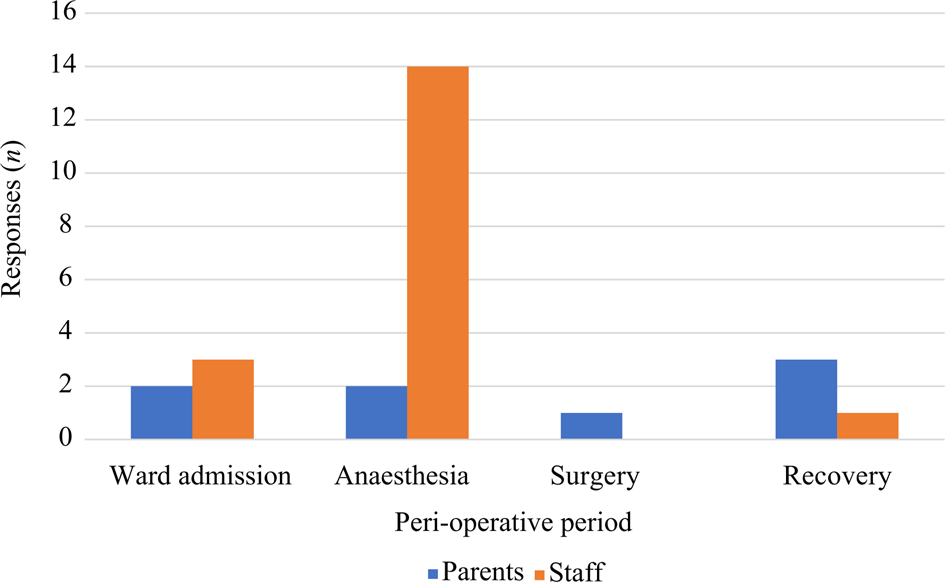
The most difficult part of the peri-operative period according to parents was recovery (n = 3). The most difficult part of the peri-operative period according to staff was anaesthesia (n = 14).
Semi-structured interviews with parents featured several areas of difficulty for children with autism spectrum disorder. These included new environments, multiple transitions, long waiting times, a lack of parking, a lack of staff patience, not adequately describing the hospital journey to the child and a lack of staff knowledge regarding the child's specific requirements.
Interviews mentioned a number of potential methods for improvement. These included the use of distractions, visual aids and social stories, quieter environments, separate rooms for admission, and more accurate waiting times.
Discussion
Overall, parents and staff were largely in agreement; however, there were some differences between the two groups. Of note, parents believed staff did not treat their child differently because of their diagnosis, yet staff believed they did. These children are in a new location with a large number of stimuli, which is a recognised problem for patients with autism spectrum disorder.Reference Marco, Hinkley, Hill and Nagarajan19 Interventions can be put into place to reduce stimuli and improve their hospital stay if we are aware of the child's diagnosis in advance.
The most difficult part of the peri-operative period for children according to their parents was recovery; however, the majority of staff members believe the most difficult part to be anaesthesia (Figure 3). This discrepancy highlights a potential weakness in our care, as only one staff member identified recovery to be the most difficult part of the peri-operative period. Greater awareness of the difficulties the children are facing in recovery is a potential area for improvement.
Parents’ and staff members’ responses to question: ‘what part of the peri-operative period was most difficult for your child/is most difficult for children with autism?’

During the interviews, the parents were asked if children with autism spectrum disorder should be treated differently because of their diagnosis. The opinions varied from parent to parent. Some parents believe their child should be treated like any other child, regardless of the autism spectrum disorder diagnosis, because ‘there's nothing wrong with them’. Others thought it was ‘nice to be treated equally’. Other parents felt that their child ‘probably’ should be treated differently, or that ‘special accommodations be made for children’ with autism spectrum disorder. One parent mentioned the option to ‘self-identify as someone with hidden disabilities like a lanyard’ as it may make other patients and staff more understanding of a child ‘acting out’ or having difficulties in hospital. This discrepancy in opinions may make it difficult to create interventions suitable for all children, which is why it is important to respect parents as experts in their children's needs and to provide patient-centred care for each child.
There were multiple areas of improvement mentioned during the interviews that would positively impact a children's journey through hospital. One of the major issues mentioned by multiple parents is the challenge of a new environment. This is an issue that causes distress to many people with autism spectrum disorder, as they are strict in their routine and have a resistance to change.Reference Fisher, Felber, Phillips, Craig, Paden and Niemeier20 This, coupled with excessive stimuli, can create difficulties when bringing children into the hospital and into the waiting room, while also causing stress to the child. Some children with autism spectrum disorder are visual learners;Reference Roser, Aslin, McKenzie, Zahra and Fiser21 the coloured dots and lines on the ground, directing to different locations of the hospital, can be quite helpful and reassuring to a child.
Several parents mentioned multiple transitions as an area of difficulty. This included transitions from reception to the waiting room, from the waiting room to the examination room, from the examination room back to the waiting room, from the waiting room to audiology, and so on. These transitions are practically unavoidable in a busy out-patient clinic. Nevertheless, they are stressful for the child as they break their routine and increase the unknown. This issue is also evident in the peri-operative period, with the child moving from multiple examination rooms prior to the operating theatre, and then waking up in recovery in a new previously unseen environment. Reducing the number of transitions would limit the number of new environments and greatly reduce patient stress.
Another difficulty mentioned was long waiting times. Crowded, noisy environments, such as busy hospital waiting rooms, can be difficult for children with autism spectrum disorder. Parents recommended a separate room for children with autism spectrum disorder to wait in. Other recommendations included having a ‘restaurant like buzzer’ that alerts the patient when they are ready to be seen, allowing the patient to avoid busy environments and potentially providing time for a walk to relax. Other parents recommended having: a ‘ticket-based queueing system’, a visual schedule to help visual learners, or reception give a warning regarding long waiting times or advise to ‘come back in an hour’. All of these techniques reduce the number of uncomfortable stimuli to the child, making their experience in hospital more bearable.
• Children with autism spectrum disorder are a special cohort with unique needs
• Given impaired social behaviour and sensory differences, coming to hospital can be particularly stressful
• The importance of listening to and involving caregivers is a fundamental tenet; parents must be recognised as the experts
• The care of each child requires an individualised, parent-led plan, with social stories, hospital passports and behavioural techniques
• Uncertainty must be kept to a minimum, with clear communication in a structured, low-arousal environment for these children
• We have listened to parents and staff, and developed a social story
Another issue mentioned by a number of parents was the difficulty in finding parking. This makes the child unsettled prior to attending hospital, which makes all the other issues more stressful. For some parents, it is challenging to get their child from the car park to the hospital entrance. If parking is unavailable, patients must present to hospital earlier than necessary, therefore increasing the length of the hospital stay, which is undesirable for the child. One possibility is dedicated parking spaces for the parents of children with special needs.
Several parents described a lack of patience and understanding from hospital staff. When staff were busier, parents observed that their understanding and patience deteriorated. One interviewee described it as ‘can you not get him to do what we want faster?’.
A number of parents (n = 7) were happy that the management plan was adequately explained to them. One parent mentioned that they would like the management plan to not only be told to the parents, but to the child, to keep them involved in their own care. This would allow the parents and child ‘choice where possible’, leading to more patient-centred care.
Given the nature of autism spectrum disorder, many children have specific requirements that can put them at ease; this could be something as simple but important as a comfort toy. Knowledge of these requirements can provide a better clinical journey for the patient and avoid areas of difficulty. Some requirements include food preferences, what they like to be called, how they like to communicate, how they experience and communicate pain, or specific sensory issues that may cause distress. Prior knowledge of these requirements can prevent stressful encounters. Some hospitals worldwide have circumvented these issues by introducing ‘hospital passports’, which can be filled out by the child and parent and given to healthcare staff to make them aware of any special requirements.15
We asked parents how we could improve the hospital journey. One recommended improvement tool was the use of distractions to keep the child occupied. This diverts the child's attention from stressful stimuli and allows them to focus on a task they enjoy. Some distractions mentioned were the use of phones, colouring books and food. Often, during the interviews, the children were on a phone or tablet watching videos. The use of tablets has been shown to reduce exposure to environmental stimuli and increase learning in children with autism spectrum disorder.Reference Allen, Hartley and Cain22
Many parents had knowledge about the use of social stories for children with autism spectrum disorder. Visual and social stories allow children with autism spectrum disorder to get acquainted with new environments, new equipment and new people. This makes their hospital journey easier, as the children are more prepared on entering the hospital.
A social story was created during this project and given to the child prior to their day of surgery. The social story provided pictures of the entrance to the hospital, the waiting rooms, the examination rooms, patient rooms, the paediatric playroom, operating theatre, surgeon, operating bed, mask for anaesthesia and recovery room. The child was able to get accustomed to the images prior to admission and had an uneventful day prior to surgery. Widespread use of this social story could assist more patients with autism spectrum disorder, with negligible cost. In the months since the completion of the study, our social story has been met with praise from caregivers and staff.
Much of the literature discussing the peri-operative management of children with autism spectrum disorder focuses primarily on sedation protocols. One parent mentioned an interest in using sedation prior to the procedure, as they thought it would make the day easier for the child and they would ‘ask for it next time’. Sedation is sometimes necessary in the peri-operative management of autism spectrum disorder,Reference Seid, Sherman and Seid23 although the risks can be avoided in many cases with appropriate psychosocial interventions.Reference Biyani, Morgan, Hotchkiss, Cecchini and Derkay24
Conclusion
Children with autism spectrum disorder are a special cohort with unique needs. In light of impaired social behaviour and sensory differences, changes in environment or routine, such as hospital attendance, can be particularly stressful.
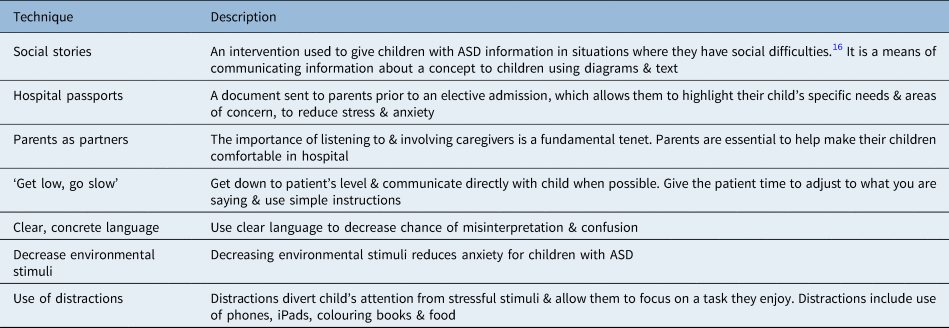
The care of each child requires an individualised, parent-led plan, which can be facilitated by many of the methods outlined in this paper (Table 1).
Techniques to improve hospital journey for children with ASD

ASD = autism spectrum disorder
Simple changes, many which are no cost or low cost, can help greatly with the hospital journey. Uncertainty must be kept to a minimum, with clear communication in a structured, low-arousal environment. We have listened to parents and staff, and are making positive changes. We have developed a social story, including augmentative and alternative communication systems. Through techniques such as ‘get low, go slow’, social stories and decreasing environmental stimuli, a pathway can be created to improve the peri-operative journey of children with autism spectrum disorder. The importance of listening to and involving caregivers is a fundamental tenet. As healthcare workers, we must acknowledge parents as the experts when it comes to the peri-operative care of their children with autism spectrum disorder.
Acknowledgement
The authors would like to acknowledge St Bernadette's Children's Ward, University Hospital Galway, Ireland.
Competing interests
None declared
Appendix 1 Peri-operative management of children with autism
Parent's questionnaire
Directions: Please indicate your level of agreement or disagreement with each of these statements regarding the peri-operative (ward admission, anaesthesia, surgery, and recovery) management of your child. Place an "X" mark in the box of your answer.
1. My child had a good experience overall
2. My child's needs were taken into account
3. My child was treated differently because they had autism
4. The management plan was well explained to me and my child
5. My child would be comfortable going to surgery again
6. Staff were understanding of the difficulties children with autism face in regard to their hospital journey
7. Parents are the experts when it comes to understanding the needs of their child with autism

Q1: How many times has your child had surgery?
_____________________________________
Q8: How would you rate the hospital's management of your child in the peri-operative period (ward admission, anaesthesia, surgery, and recovery)?
□ Highly satisfactory
□ Satisfactory
□ Neutral
□ Unsatisfactory
□ Highly unsatisfactory
Q9: What part of the peri-operative period was most difficult for your child?
□ Ward admission
□ Anaesthesia
□ Surgery
□ Recovery
Q10: What could we do to make your child's experience better?
_____________________________________
_____________________________________
_____________________________________
Q11: Are you aware of any care techniques specific to improving the peri-operative journey of children with autism? If so, please list them below
_____________________________________
_____________________________________
_____________________________________
Thank you for participating in our research project.
Dr Ronan Fahy – University Hospital Galway – Ear Nose and Throat Department
Professor Ivan Keogh – University Hospital Galway – Ear Nose and Throat department
Contact details: autismresearchuhg@gmail.com
Appendix 2 Peri-operative management of children with autism
Staff member's questionnaire
Directions: Please indicate your level of agreement or disagreement with each of these statements regarding the peri-operative (ward admission, anaesthesia, surgery, and recovery) management of children with autism. Place an "X" mark in the box of your answer.
1. Children with autism have a good experience overall
2. The needs of children with autism are taken into account
3. Children with autism are treated differently because they have autism
4. The management plan was well explained to the parents and child
5. Children with autism would be comfortable going to surgery again
6. Staff were understanding of the difficulties children with autism face in regard to their hospital journey
7. Parents are the experts when it comes to understanding the needs of their child with autism

Q8: How would you rate the hospital's management of children with autism in the peri-operative period (ward admission, anaesthesia, surgery, and recovery)?
□ Highly satisfactory
□ Satisfactory
□ Neutral
□ Unsatisfactory
□ Highly unsatisfactory
Q9: What part of the peri-operative period is most difficult for children with autism?
□ Ward admission
□ Anaesthesia
□ Surgery
□ Recovery
Q10: What could we do to make the experience for children with autism better?
_____________________________________
_____________________________________
_____________________________________
Q11: Are you aware of any care techniques specific to improving the peri-operative journey of children with autism? If so, please list them below
_____________________________________
_____________________________________
_____________________________________
Thank you for participating in our research project.
Dr Ronan Fahy – University Hospital Galway – Ear Nose and Throat Department
Professor Ivan Keogh – University Hospital Galway – Ear Nose and Throat Department
Contact details: autismresearchuhg@gmail.com