In today’s organizations, making a difference takes more than completing the tasks given by the employer. The focus is now on dynamic behaviors that allow individuals to interfere and change aspects of their work, meaning they react to the environment and change it in a proactive manner (Frese et al., Reference Frese, Garst and Fay2007). However, this approach does not restrain only changing the environment (e.g., implementing an individual’s innovative ideas) because change can also be aimed at oneself (e.g., learning new skills to cope with future demands). Thus, success requires employees to influence and shape themselves or the environment proactively in a fast-changing environment.
When employees challenge their present situation and act toward what "could be", feedback becomes essential. Early research studies investigated feedback linked only to performance appraisal (e.g., Ilgen et al., Reference Ilgen, Fisher and Taylor1979). However, Ashford and Cummings (Reference Ashford and Cummings1983) proposed that feedback should go beyond this annual review of performance towards a more expansive understanding of how employees can use feedback. In this vein, feedback-seeking behavior (FSB) becomes a frequent activity that defines the proactive behaviors through which individuals obtain the information they need to achieve change (Ashford & Cummings, Reference Ashford and Cummings1983; Strauss & Parker, Reference Strauss, Parker and Gagné2014).
Anseel et al. (Reference Anseel, Beatty, Shen, Lievens and Sackett2015) conducted the only meta-analysis on the antecedents and outcomes of FSB. Their work was based on the cost-value framework, one of the main theoretical models used to explain FSB manifestation. The general assumption is that employees make a conscious assessment of the costs and values associated with FSB. However, through our present meta-analysis, we switch the perspective to the Job Demands-Resources (JD-R) theory (Bakker & Demerouti, Reference Bakker and Demerouti2017), representing the baseline in assessing the costs and values. Thus, we can better analyze the motivation behind engaging in FSB, as the available resources (i.e., job and personal resources) may motivate them to seek new ones. For example, learning-goal-oriented individuals focus on the value of feedback-seeking for development and are less focused on the cost. In this way, individuals with this type of personal resources will perceive the outcome of seeking feedback as a resource. The motivational mechanism activated by having resources positively influences the employees’ perceptions of the cost and value of seeking feedback. Perceived value is the most critical FSB determinant (Ashford, Reference Ashford1986; VandeWalle & Cummings, Reference VandeWalle and Cummings1997).
One of the previous meta-analysis limits is the studies’ cross-sectional designs, which cannot investigate the dynamics between antecedents and outcomes. Thus, they cannot provide information about the relationship over time between FSB and its variables. Furthermore, the latest studies on different topics (i.e., work engagement, JD-R theory) use longitudinal designs due to this characteristic that enables temporal inferences (Lesener et al., Reference Lesener, Gusy and Wolter2019; Maricuțoiu et al., Reference Maricuțoiu, Sulea and Iancu2017). The results obtained through this design reflect better the reality, as it captures the dynamics over time and identifies patterns.
We contribute to the literature by clarifying the relationship between FSB and resources (i.e., personal resources and job resources) as the antecedents of this behavior. We also provide input on the relationship between FSB and its outcomes. In this way, we can identify if having resources determines the employees to engage in seeking the help of feedback. For example, having job resources (e.g., a positive relationship with the superior) should make the employee more available to seek information about their behavior to adjust proactively. Furthermore, having input from others may generate outcomes, such as completing a task and even positive feelings, contributing to the employees’ work engagement and, in the end, to their well-being. Thus, we highlight FSB’s relevance in the organizational context. This behavior becomes an asset in the continuously changing business environment by allowing employees to adjust their behavior to the requirements. Moreover, FSB may play a role in the motivational process triggered by resources. For classifying the antecedents, we used a coherent theoretical framework (i.e., JD-R theory).
Feedback-Seeking Behavior
FSB is a set of conscious actions through which individuals adjust their behavior to the contextual conditions by gathering information from the environment or others (e.g., colleagues, managers) (Anseel et al., Reference Anseel, Beatty, Shen, Lievens and Sackett2015; Ashford, Reference Ashford1986). According to Ashford and Cummings (Reference Ashford and Cummings1983), there are two main methods of collecting information: Monitoring the environment (i.e., observing behaviors and situations) and inquiry (i.e., it involves gathering information by directly asking others).FSB has an essential role in the process of employee adaptation to workplace requirements because it offers information about the appropriateness and correctness of one’s behavior (Ashford, Reference Ashford1986). Due to the fast-changing environment in which waiting for the annual performance assessment is no longer an option, employees will seek feedback to adjust to the requirements.
Ashford and Cummings (Reference Ashford and Cummings1983) changed the perspective and proposed feedback as an individual resource. This approach calls for motives beyond performance achievement to determine employees’ engagement in FSB (i.e., positive image, boost self-worth).As employees become more visible in the organization through this behavior, they should benefit from more resources to contribute to their work satisfaction. The environment may have an essential role in enhancing FSB since it offers the work context with all related aspects (e.g., job characteristics). More critically, the employees will decide if engaging in FSB is an option based on the available resources. In this context, it is relevant to discuss the antecedents and outcomes of FSB based on the JD-R theory.
Antecedents and Outcomes of Feedback-Seeking Behavior
Antecedents of Feedback-Seeking Behavior
The meta-analysis conducted by Anseel et al. (Reference Anseel, Beatty, Shen, Lievens and Sackett2015) systematized the information regarding the antecedents and outcomes of FSB. Their results suggested that older and experienced employees seek less feedback than the younger and less experienced ones. Moreover, employees who have learning goals or performance goals seek feedback more frequently than those who do not have these types of goals. The same behavior pattern is applied to employees who seek input from external sources (e.g., colleagues) and those who receive frequent positive feedback and have high self-esteem. A possible explanation is that, in this way, employees boost their self-image. However, Anseel et al. (Reference Anseel, Beatty, Shen, Lievens and Sackett2015) used only cross-sectional evidence to investigate the relationship between FSB and the mentioned antecedents. Therefore, the idea of an FSB antecedent is primarily theory-based.
We used the JD-R theory (Bakker & Demerouti, Reference Bakker and Demerouti2017) to classify FSB antecedents and identify what type of resources determines the employees to engage in seeking feedback. Furthermore, FSB can be a means by which employees learn/ seek information about how best to adjust their behavior, considering their job and personal characteristics to optimize their working environment and stay motivated. The JD-R theory proposes a flexible model in which all job characteristics can be divided into the categories of job demands and job resources (Bakker & Demerouti, Reference Bakker and Demerouti2017). Job demands are defined as "those physical, psychological, social, or organizational aspects of the job that require sustained physical and/or psychological effort and are therefore associated with certain physiological and/or psychological costs" (Demerouti et al., Reference Demerouti, Bakker, Nachreiner and Schaufeli2001, p. 501), such as work overload. We identified only one longitudinal study investigating the relationship between job demand (i.e., role ambiguity) and FSB (see Collewaert et al., Reference Collewaert, Anseel, Crommelinck, De Beuckelaer and Vermeire2016). Thus, Collewaert et al. (Reference Collewaert, Anseel, Crommelinck, De Beuckelaer and Vermeire2016) showed that the effect of unclear role expectations on FSB is not significant. As noticed, the longitudinal literature on the relationship between job demands and FSB is not vast; hence, we are unable to analyze this relationship in our meta-analysis. When having sufficient resources, job demands may be diminished and can make the employee more available to seek feedback. The category of job resources is defined as "physical, psychological, social, or organizational aspects of the job that may […] be functional in achieving work goals, reduce job demands and its related costs, or stimulate personal growth and development" (Demerouti et al., Reference Demerouti, Bakker, Nachreiner and Schaufeli2001, p. 501), such as job autonomy.
The JD-R theory components trigger two independent processes, namely the health impairment process and the motivational process. Job demands impact the health impairment process with consequences, such as exhaustion (Bakker et al., Reference Bakker, Demerouti and Schaufeli2003) and health issues. Thus, job demands have different types of outcomes that are not linked with FSB. This may explain the lack of studies on the relationship with FSB. However, job resources impact the motivational process resulting in work engagement, work motivation (Bakker et al., Reference Bakker, Hakanen, Demerouti and Xanthopoulou2007; Bakker & Leiter, Reference Bakker, Leiter, Bakker and Leiter2010), organizational commitment (Schaufeli & Bakker, Reference Schaufeli and Bakker2004). Thus, employees with high job resources are more motivated to engage in feedback-seeking, such as instrumental reasons, to attain different working goals. To achieve the goals, they need to obtain information on adjusting their behavior and have resources to engage more quickly in this behavior.
Furthermore, from the instrumental perspective motive, the credible the source, the higher the value of feedback perceived by employees (Ashford et al., Reference Ashford, Blatt and VandeWalle2003). For example, the managers become a valuable source from which employees will seek feedback. Additionally, having a good relationship with the superior, considered a job resource, enhances the FSB. Therefore, job resources may have a role in behavioral adjustment and goal attaining, and in the end, in employees’ well-being.
Xanthopoulou et al. (Reference Xanthopoulou, Bakker, Demerouti and Schaufeli2007) expanded the JD-R model by including a new resource type (i.e., personal resources). Personal resources are defined as "aspects of the self that are generally linked to resiliency and refer to individuals’ sense of their ability to control and impact upon their environment successfully" (Xanthopoulou et al., Reference Xanthopoulou, Bakker, Demerouti and Schaufeli2007, p.124), such as self-efficacy. Personal resources facilitate goal achievement when facing obstacles. The results emphasized the function of the personal resources within the JD-R theory since they explain variance in exhaustion and work engagement, and in turn, job performance (Tisu et al., Reference Tisu, Lupșa, Vîrgă and Rusu2020; Xanthopoulou et al., Reference Xanthopoulou, Bakker, Demerouti and Schaufeli2007). Going further, previous research studies reported that personal resources enhance the manifestation of FSB (Anseel et al., Reference Anseel, Beatty, Shen, Lievens and Sackett2015; Ashford & Cumming, Reference Ashford and Cummings1985). These personal resources may activate the ego-based motive to defend or enhance one’s ego and the image-based reason to protect or improve the impressions that others hold of one. By having personal resources, the costs of employees’ exposure when seeking feedback are diminished. Thus, they engage in FSB.
Furthermore, the feedback collected about the self-impacts the individuals emotionally. Employees tend to seek positive information about themselves when driven by ego defense and enhancement motives (Ashford et al., Reference Ashford, Blatt and VandeWalle2003). In this way, they make sure their ego remains intact. Besides, being confident about one’s values (i.e., high self-esteem) reflects personal resources and determines employees’ engagement in FSB. This also suggests ego enhancement. It will be harder for individuals not to believe it than the unsolicited one by actively seeking feedback. Driven by ego defense, employees may tend to avoid seeking feedback than seeking it. Having low self-esteem and lacking personal resources may determine employees to seek feedback, even if the input is negative, only to validate their negative self-appraisal.
From an image-defense perspective, it seems that individuals may avoid collecting feedback through inquiry if the information will expose incompetence or insecurity. When image costs are involved, employees will minimize the feedback’s instrumental value (Ashford & Northcraft, Reference Ashford and Northcraft1992). In addition, employees will engage in FSB to boost their self-image and seek positive feedback without instrumental value. When resources are available, individuals may be more inclined to manifest FSB as it will not affect their image. They will seek it in favorable situations and from those with whom they have a good relationship.
We can also consider that seeking feedback may first enhance the resources gain in the JD-R interactions. This behavior exposes the employees to more opportunities; thus, job and personal resources are enriched (Vîrgă et al., Reference Vîrgă, Horga and Iliescu2015). For example, as employees seek feedback, they gain knowledge and are more likely to develop higher-quality relationships with their managers (Dahling et al., Reference Dahling, Chau and O’Malley2012). In this way, the employees will engage again in FSB. Hence, the first research question and hypothesis addressed in the current meta-analysis are linked to the chronologic order between the FSB and its theoretical antecedents, categorized in job and personal resources.
Outcomes of Feedback-Seeking Behavior
Feedback-seeking literature proposes a variety of outcomes. Therefore, we address the relationship between FSB and its outcomes from a systematic review perspective in the present study. Seeking feedback should help employees gain insight on what is expected from them; therefore, they should perform better and socially adapt. Feedback also allows employees to adjust their behavior over time to meet the continuously changing requirements. The socialization literature proposes that newcomers become proactive by seeking feedback. This behavior helps them to develop relationships and integrate into groups by regulating their behavior. This pattern is also valid for employees, as it allows them to adjust over time to changing contexts. Through feedback-seeking, employees will adopt norms and manifest appropriate behaviors accepted in the organization (Morrison, Reference Morrison1993). Therefore, an outcome considered in this paper is social integration. Another aspect of the socialization process is acculturation. By constantly collecting feedback about their working environment and expectations, employees understand their organization’s culture, resulting in acculturation (Morrison, Reference Morrison1993). This will be another outcome discussed in our study. As stated earlier, by seeking feedback and mainly through investigations, the employees actively build relationships, contributing to their social support network. The relationship with co-workers contributes to job satisfaction (Tang et al., Reference Tang, Siu and Cheung2014). We consider job satisfaction as another outcome, even if it is a distal one. In addition, through FSB, employees understand the situation they are facing more thoroughly, and they clarify their responsibilities, which can contribute to job performance. Individuals develop skills and learn appropriate behaviors through instrumental feedback, which should positively relate to performance (Ashford & Black, Reference Ashford and Black1996).
Furthermore, as FSB increases one’s knowledge and understanding, it may sustain creative problem solving and innovation (Ruscio et al., Reference Ruscio, Whitney and Amabile1998). As long as FSB provides valuable information and facilitates the socialization process, individuals are less likely to consider leaving the company and less likely to do it. Employees become invested in what they do, and feedback-seeking helps them create an identity within the organization. Thus, we expect FSB to predict low turnover intentions and determine whether the employees will not leave. In the long run, investing time and effort to seek feedback can lead to organizational commitment and organizational citizenship behavior by giving others feedback and contributing to organizational success. The more comfortable and supported the employees are, the more likely they will be involved and promote the organization. Developing relationships with others, adjusting their behavior to the organizational requirements, and aligning to the job needs may help achieve a sense of fit with the organization and the job. Furthermore, they can seek feedback to enhance the fit (Bauer et al., Reference Bauer, Perrot, Liden and Erdogan2019).
Next, we will briefly list the job resources, personal resources, and FSB’s outcomes. Therefore, in the present meta-analysis, we included the following job resources: Role clarity, perceived similarity in age, education, race/ethnicity, gender, work style, organizational support, career-oriented commitment, competence development activities, leader-member exchange, feedback-seeking climate, and servant leadership. In terms of personal resources, we considered task mastery, active relationship-building tactics, positive framing, and desire of control, job-change negotiation, adjustment, goal orientation, personal control, external feedback propensity, self-efficacy, curiosity (specific and diverse), taking charge, identity centrality, intense positive feelings, and active general socializing.
In the category of outcomes, we reviewed and discussed the following variables, as we identified them in the literature: Social integration, acculturation, job satisfaction, job performance, creative performance, intention to leave the organization and actual turnover, organizational commitment, organizational citizenship behaviors, person-job fit, and person-organization fit. The mentioned outcomes may contribute to the employee’s well-being.
Therefore, one of the first objectives is to classify the FSB’s antecedents from the JD-R theory’s perspective. The second objective is to conduct the meta-analysis using longitudinal evidence regarding FSB’s antecedents. To complement the second objective, we conducted a quality assessment of these longitudinal studies. A quality assessment of the studies offers an overview of the probability that their results will reflect reality. We aimed to radiograph the studies’ data that tested the relationships between FSB and antecedents through this analysis. As a third objective, we discussed the relationship between FSB and its outcomes from a systematic review perspective. The reason is that the longitudinal studies examined such a wide range of outcomes. The studies’ heterogeneous quality included in the meta-analysis is counteracted by the cumulative sample size on which the meta-analytical analysis is made. Based on this evidence and objectives, we formulated our research question and our hypotheses.
Research Question 1: Is there a chronologic order between the FSB and its theoretical antecedents (job or personal resources)?
Hypothesis 1: There will be a positive relationship over time between job resources and FSB.
Hypothesis 2: There will be a positive relationship over time between personal resources and FSB.
Method
Systematic Literature Search
We used four strategies to identify relevant studies. As a first step, we conducted a computerized search in the following databases: American Behavioral Scientist, EmeraldInsight, PsycARTICLES, PsycINFO, ProQuest, SAGE Journals, Scopus, SpringerLink, and Wiley Online Library.
For the online search, we used the following query string: ("FSB" OR "feedback interest" OR "feedback inquiry" OR "feedback monitoring" OR "information-seeking" OR "help-seeking" OR "feedback-seeking behaviors" OR "feedback seeking methods" OR "feedback-seeking" OR "proactive feedback-seeking") AND ("longitudinal" OR "diary" OR "EMA" OR "ecological momentary assessment" OR "multi-wave" OR "panel study" OR "panel design" OR "consecutive days" OR "consecutive weeks" OR "longitudinal studies" OR "longitudinal feedback-seeking") AND ("employees" OR "staff" OR "personnel") NOT ("experiment" OR "experimental" OR "interview" OR "qualitative"). These terms needed to either be keywords or used in the abstract, title, or the articles’ subject heading depending on the database’s search specification options.
As a second step, we searched on conference sites (SIOP and EAWOP) using "feedback-seeking" and "information seeking" as keywords. As a third step, we examined the Open Access Theses and Dissertations siteFootnote 1using the keywords "feedback-seeking" OR "information seeking" AND "longitudinal" AND "employees". Finally, we inspected references of the identified studies to find further longitudinal studies of the FSB. Our search yielded 972 abstracts. After six months, we conducted another search and identified 42 additional records. Thus, we examined 1,014 abstracts.
Selection of Studies
We included in the meta-analysis studies that meet the following criteria: (a) FSB or information-seeking measures; (b) longitudinal design; (c) target group represented by employees. We also considered it relevant to include studies about information seeking that used measurements for this variable originated in Ashford’s (Reference Ashford1986) scale or Ashford and Blak’s (1996) scale for FSB and if the studies separately reported correlations for information seeking about performance appraisal information (e.g., Morrison, Reference Morrison1993).
Considering these criteria, we analyzed the abstracts, and if they were eligible, we accessed full texts. From the first step of the search, we identified 1,014 abstracts, out of which 45 abstracts were identified through other sources (i.e., 14 results from SIOP and EAWOP conference sites; one result from Open Access Theses and Dissertations; 30 results from references). Out of 1,014, we identified 42 abstracts from a new search conducted in June, six months after the first search. After the abstracts’ examination, we excluded 889 abstracts due to different reasons. Thus, we first excluded six journal articles duplicates, along with 871 abstracts, which did not include "feedback", "feedback-seeking", or "information seeking". Additionally, we excluded 16 studies with cross-sectional designs, one review, and one study because the author did not respond. In the full-text analysis, we included 119 studies (i.e., 100 studies included "feedback" or "feedback-seeking"; 19 studies included "information seeking". After full-text analysis, we exclude 106 studies (i.e., 27 studies did not investigate "feedback-seeking behavior"; nine studies did not investigate "information seeking"; three studies measured FSB along with other proactive behaviors as a single construct of "proactive socialization behavior", "proactive behavior", and "proactive adjustment behavior"; 45 studies had cross-sectional designs; 13 articles were reviews; seven articles had students as target groups; two articles were not found published). Moreover, we identified one study (i.e., Collewaert et al., Reference Collewaert, Anseel, Crommelinck, De Beuckelaer and Vermeire2016) that investigated FSB in relationship with personal resources and job demands (i.e., role ambiguity). We only considered the correlations between FSB and personal resources in this meta-analysis. In the final analysis, we included 13 eligible articles. The process of study analysis is presented in Figure 1.
Flow Chart of the Selection of Studies According to the PRISMA Statement (adapted from Moher et al., Reference Moher, Liberati, Tetzlaff and Altman2009)

Coding of Studies
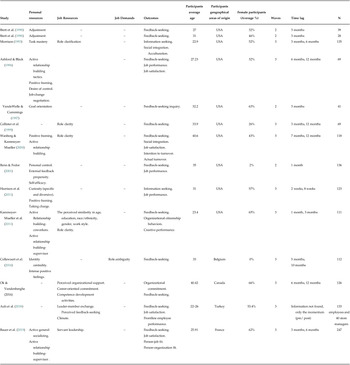
We used a method adapted from Bennett et al. (Reference Bennett, Bakker and Field2018) to code the studies’ characteristics. We coded the following data from each eligible research study: Measurement of the primary variable (i.e., feedback-seeking/information seeking), personal resources, job resources, outcomes, the average age of the participants, the geographical areas of origin of the participants, the average proportion of female participants, the number of waves, the time lag between assessment, and the sample size that responded in all measurement moments. To include the resources in particular categories, we considered the JD-R components’ descriptions and the work of Lee et al. (Reference Lee, Rocco and Shuck2019). In this regard, in Table 2, we explain the variables included in job resources and the outcomes.
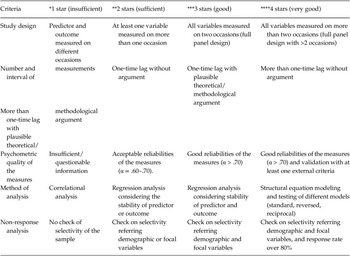
Criteria for Evaluating Quality of Longitudinal Research (Lesener et al., Reference Lesener, Gusy and Wolter2019)

Characteristics of Studies Included in the Meta-Analysis (adapted from Bennett et al., Reference Bennett, Bakker and Field2018)

We did not consider demographic variables and personal characteristics because we wanted to focus on variables that can influence situational cues and underline the possibility of enhancing resources and diminishing demand for the employees to manifest proactive FSB. However, goal orientation, curiosity, the desire for control, self-efficacy were included as personal resources (Greenberger et al., Reference Greenberger, Strasser and Lee1988; Xanthopoulou et al., Reference Xanthopoulou, Bakker, Demerouti and Schaufeli2007) even if there is evidence of the personality traits (e.g., Button et al., Reference Button, Mathieu and Zajac1996). The organizational context can influence these variables because of the challenges that activate them. We selected the information from the Method section of each article and the statistical data from the correlation matrix further in the analysis.
Quality Assessment
For the studies’ quality assessment, we used the scheme from de Lange et al. (Reference de Lange, Taris, Kompier, Houtman and Bongers2003). We considered five criteria: (a) Study design, (b) number and interval of measurements, (c) psychometric quality of the measures, (d) method of analysis, (e) non-response analysis. We rated the studies from one star ("insufficient") to four stars ("very good") for each criterion.
The first criterion, namely, study design, addresses the causality of the relationships that can be identified between variables. Studies that measured the variables more than two times were rated as "very good". The criterion number and interval of measurements is helpful to identify cross-legged effects. The studies with more than one-time lag and a plausible argument were rated as "very good". The criterion psychometric quality of the variables’ measures impacts the validity of the statistical conclusions; thus, we also considered as "very good" the studies with alpha Cronbach coefficient of at least .70 for the FSB variable, and which validated one or more external criteria. The criterion method of analysis refers to the analysis method models used to indicate causal effects. Studies that used SEM and compared different models (standard, reversed, reciprocal) were rated as "very good". The last criterion, namely non-response analysis, addresses possible response selectivity. We focused on the response rate as on controlling the selectivity. If studies controlled for demographic variables (i.e., age, gender) and focal variable (i.e., FSB) and also had a response rate, over 80% were considered as "very good". Information about the criteria is presented in Table 1. Furthermore, details concerning quality assessment results are given in Table 3 in the Results section.
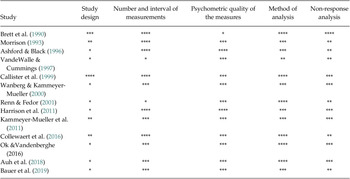
Evaluation of the Identified Studies

Data Analyses
We combined the meta-analytical procedures and structural equation modeling (metaSEM), based on recommendations of Viswesvaran and Ones (Reference Viswesvaran and Ones1995), in the same way as Bennett et al. (Reference Bennett, Bakker and Field2018). Comprehensive Meta-Analysis v.2 (Borenstein et al., Reference Borenstein, Hedges, Higgins and Rothstein2005) was used to analyze data from the correlation matrixes to estimate the average correlation value for each relationship between the coded variables. We used the random-effects model because it can allow us to make statistical inferences beyond the included population in the meta-analysis (Borenstein et al., Reference Borenstein, Hedges, Higgins and Rothstein2011). For assessing between-study heterogeneity, two indices were used (the Q-test-indicates if the observed variability is more significant than we should expect from sampling error, and the I2- heterogeneity index indicates the heterogeneity in percentages). If I2 values up to 50%, it reveals moderate heterogeneity, and if values are above 75%, it means high heterogeneity (Higgins et al., Reference Higgins, Thompson, Deeks and Altman2003). We analyzed the variables considering the moment of measurement (T1, T2) for the simultaneous measurement, based on Dorman and Griffin’s (Reference Dorman and Griffin2015, p. 499) assumption that "over time, a continuous causal process produces both increasing and declining effect sizes".
The next step represented the four-by-four correlation matrices, each with six averaged correlation values. Based on the recommendations of Ford et al. (Reference Ford, Matthews, Wooldridge, Mishra, Kakar and Strahan2014), we computed the average correlation between FSB and our study variables for each measurement moment. More specifically, the relationship between FSB and resources (i.e., personal or job-related) in Time 1 can differ from Time 2.
We used lavaan software to conduct metaSEM (Rosseel, Reference Rosseel2012); thus, we tested three alternative models for each relationship. For example, in the case of job resources, we tested the following models: The independent model (Mindep − auto-regression relationships for FSB and job resources), the FSB as an antecedent model (MFSB – the links from Mindep and a prediction from FSB at T1 to job resources at T2), the job resources as an antecedent model (MJR − the relationships from Mindep and a prediction from job resources at T1 to FSB at T2).
We used Kenny’s (Reference Kenny2015) recommendations regarding model fit and assessed model fit using the comparative fit index (CFI, values below .95 indicate poor fit), the Tucker-Lewis Index (TLI, values below .95 indicate poor fit), and the Root Mean Square Error of Approximation (RMSEA, values above .08 indicate poor fit). To compare the nested models, we used the Δχ2 statistical test.
Results
The final database contained 406 correlations between feedback-seeking/information-seeking and JD-R components (i.e., job resources, personal resources). The studies included personal resources (k=10), job resources (k= 8), or FSB outcomes (k= 9). Two studies (Harrison et al., Reference Harrison, Sluss and Ashforth2011; Morrison, Reference Morrison1993) measured information seeking using items from Ashford’s (Reference Ashford1986) and Ashford and Black’s (Reference Ashford and Black1996) feedback-seeking measures. Therefore, their results are comparable with the rest of the sample, which used the same scale. Based on Collewaert et al.’s (Reference Collewaert, Anseel, Crommelinck, De Beuckelaer and Vermeire2016) study, we analyzed FSB and personal resources correlations. Only one job demand (i.e., role ambiguity) was identified in the Collewaert et al. (Reference Collewaert, Anseel, Crommelinck, De Beuckelaer and Vermeire2016) study; thus, job demands categories were not included in this meta-analysis.
A total of 1,527 participants completed all 3-time measures and had usable data. Most of the studies (k= 10) used the scales developed by Ashford (Reference Ashford1986) and Ashford and Black (Reference Ashford and Black1996) or their adapted versions. Only three studies used different scales:
1. VandeWalle and Cummings (Reference VandeWalle and Cummings1997) used two items that asked about the frequency with which the participants have sought information about their performance from the instructor and colleagues.
2. Auh et al. (Reference Auh, Menguc, Imer and Uslu2018) used the 6-item scale for feedback-seeking from VandeWalleet al. (2000).
3. While Brett et al. (Reference Brett, Feldman and Weingart1990) used four close-ended interview questions from Feldman and Brett (Reference Feldman and Brett1983) and assessed feedback-seeking from supervisor and co-workers.
The sample size included the number of individuals who participated in all the measurements and had usable data. Several waves were between two and three (10 studies out of 13 had three waves). The total number of respondents in the first wave was 3,002, with an average of 231 respondents. Wave 2 had a total sample of 2,065 respondents, with an average of 159. In Wave 3, the full sample was composed of 1,419 respondents, with an average of 142. The minimum time lag was two weeks, and the maximum was 12 months. Auh et al.’s (Reference Auh, Menguc, Imer and Uslu2018) study did not report the number of respondents in each wave, and neither did the time lag between measurements’ waves, only the moment (pre-, post-test). We considered the same sample size in each wave (N = 173). Table 2 summarizes the main characteristics obtained from the Method section of the articles included in the final analyses.
Quality Assessment
Our quality assessment results are present in Table 3, based on the described scheme shown in Table 1. Two independent raters conducted the quality assessment. The inter-rater agreement was Cohens κ = .77. If there were differences between the evaluations, the raters discussed and decided on the most suitable rating. We considered four studies as high-quality studies (30.7%) since they obtained sufficient scores on every criterion. This classification is in line with the recommendation of de Lange et al. (Reference de Lange, Taris, Kompier, Houtman and Bongers2003).
Relationships between Job Resources and Feedback-Seeking Behavior
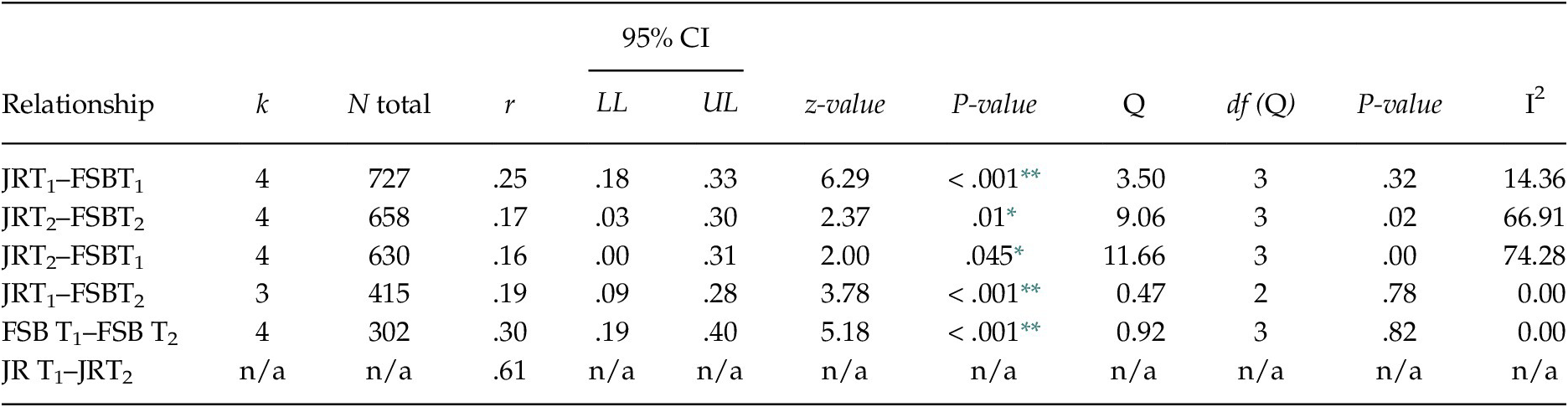
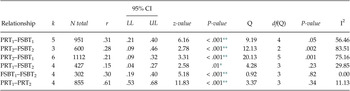
Eight independent research studies reported the relationship between job resources and FSB. For the correlations presented in Table 4, the total number of participants ranged between Ntotal = 302 and Ntotal = 727 (mharmonic = 490). The results show a significantly small effect between FSB (T1) and job resources (T2) (r = .16, k = 4, z = 2.00, p = .045). Also, the meta-analysis results indicate a significant relationship between job resources (T1) and future FSB (T2) (r = .19, k = 3, z = 3.78, p < .001). Because we did not identify at least four independent studies, we used the average correlation of job resources from T1 and T2 (d = .61) from Lesener et al.’s (Reference Lesener, Gusy and Wolter2019) meta-analysis. Therefore, the results support Hypothesis 1. The averaged correlations for these relationships are presented in Table 4.
The Correlation Matrix Used in the SEM Analyses for the Job Resources-FSB Relationship

Note. FSB= feedback-seeking behavior; JR= job resources; n/a= not applicable; k= number of studies; N= number of independent samples included in the analysis; r= averaged correlation values across studies; LL= lower limit; UL= upper limit; Q= heterogeneity test; df= degrees of freedom of the Q test; I2= the percentage of between-studies variance that can be attributed to moderator variables.
* p< .05;
** p< .001.
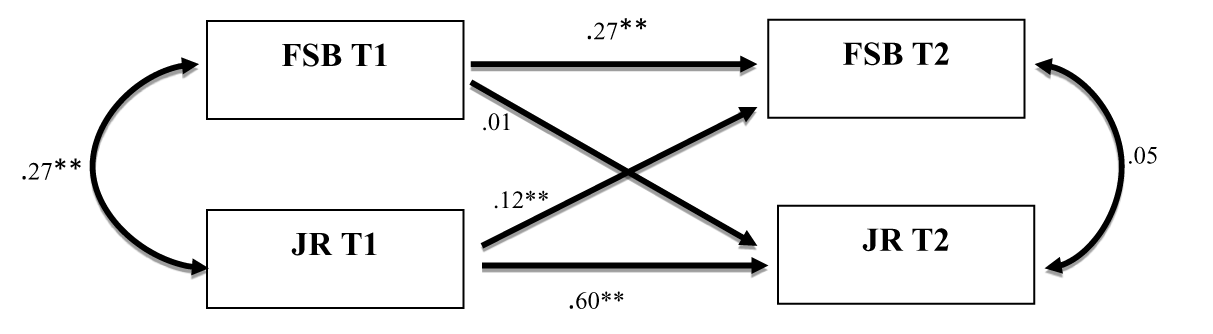
Comparisons between the models (Table 5) indicated that the independent model is not significantly inferior to the FSB as a predictor model (M3 - MFSB). However, the job resources as predictor model (M2-MJR) fitted the data better, Δχ2(1) = 7.68, p = .01. The SEM analysis (Figure 2) indicates a slight positive significant effect of job resources (T1) on FSB(T2) (B = .12, SE = .04, z = 2.78, p < .001). Also, the SEM results (Figure 2) did not reveal a significant relationship between FSB in T1 and future job resources (B = .04, SE = .04, p = .40). The path coefficients for the reciprocal model (job resources and FSB) are also present in Table 6. Taken together, these findings suggested that job resources could be considered an antecedent of future FSB.
Reciprocal Model: Job Resources (JR) and FSB
Note. **p< .001.

Goodness-of-Fit Indices and Comparison of the Competing Models: JR and FSB

Note. df = degrees of freedom; CFI = Comparative Fit Index; TLI = Tucker–Lewis Index;
RMSEA = root-mean-square error of approximation.
** p< .001.
Path Coefficients for Reciprocal Model: JR and FSB

Relationships between Personal Resources and Feedback-Seeking Behavior
Ten independent research studies reported the relationship between personal resources and FSB. For each correlation included in the analyses presented below, the total number of participants ranged between Ntotal = 302 and Ntotal = 1,112 (mharmonic = 539).The average correlation obtained by us for personal resources from T1 and T2 (d = .61) is based on four independent samples. Its value is similar to the findings reported by Lesener et al. (Reference Lesener, Gusy and Wolter2019). They estimated test-retest correlation values between .61 and .65. The averaged results show a small size effect and statistically significant between personal resources (T1) and future FSB (T2) (r = .15, k = 4, z = 2.58, p < .001), and between FSB (T1) and future personal resources (T2) (r = .21, k = 6, z = 2.58, p < .001). Therefore, the results support Hypothesis 2. The averaged correlations for the relationships between personal resources and FSB at different moments are presented in Table 7.
The Correlation Matrix Used in the SEM Analyses for the Personal Resources -FSB Relationship

Note. FSB= feedback-seeking behavior; PR= personal resources, k= number of studies; N= number of independent samples included in the analysis, r= averaged correlation values across studies; LL= lower limit; UL = upper limit; Q= heterogeneity test; df= degrees of freedom of the Q test; I2= the percentage of between-studies variance that can be attributed to moderator variables.
* p< .05.
** p< .001.
Our model comparison analyses presented in Table 8 did not indicate that the alternative models (i.e., personal resources as a predictor of future FSB, FSB as an antecedent of personal resources) are significantly different than assumed the independence of these two variables. Furthermore, the cross-lagged path coefficients also did not reach the statistical threshold in both cases (B = .06, SE = .04, z = 1.45, p = .14 for personal resources as a predictor of future FSB; B = .02, SE = .04, z = 0.68, p = .50 for FSB as an antecedent of personal resources).
Goodness-of-Fit Indices and Comparison of the Competing Models: Personal Resources and FSB

Note. df= degrees of freedom; CFI = Comparative Fit Index; TLI = Tucker–Lewis Index; RMSEA = root-mean-square error of approximation.
Therefore, based on the present evidence, we can conclude that personal resources positively affect FSB. However, metaSEM results indicate that we cannot establish a chronological relationship between these two variables.
Relationships between Feedback-Seeking Behavior and Outcome Variables
Some general observations can be drawn from the literature. First, there is a variety of outcomes linked with FSB. Second, the moderators and mediators may play an essential role in explaining the relationship between FSB and its outcomes. We will offer more details, in the following paragraphs, on each outcome analyzed in the studies selected for this paper. We listed the outcomes in Table 2.
We investigated the debated topic of workplace performance as an outcome of FSB. Thus, four out of nine studies identified analyzed this relationship. Ashford and Black (Reference Ashford and Black1996) investigated the direct effect of FSB on job performance and obtained a non-significant result. Harrison et al. (Reference Harrison, Sluss and Ashforth2011) conducted a similar analysis, and the results also showed a non-significant effect. In contrast, Auh et al. (Reference Auh, Menguc, Imer and Uslu2018) found that employees who seek feedback have a better performance. On the other end, Renn and Fedor (Reference Renn and Fedor2001) showed an indirect relationship between FSB and job performance through the goals established. A possible explanation for these contradictory results may lie in what the employee does with the feedback collected. Although it is important to collect feedback, it is not enough to obtain high performance at work. In the same context of performance, another relationship is investigated, namely FSB and creative performance. The study conducted by Kammeyer-Mueller et al. (Reference Kammeyer-Mueller, Livingston and Liao2011) showed that FSB does not predict creative performance. Therefore, employees who seek feedback are not necessarily inclined to solve problems creatively or innovate. Another four studies examined the relationship between FSB and job satisfaction. Ashford and Black (Reference Ashford and Black1996) obtained a non-significant association. However, the study conducted by Wanberg and Kammeyer-Muller (Reference Wanberg and Kammeyer-Mueller2000) indicates that FSB is related to job satisfaction. Another study conducted by Auh et al. (Reference Auh, Menguc, Imer and Uslu2018) proposed job satisfaction as a moderator of the relationship between FSB and job performance. The results indicated that low job satisfaction moderates this relationship. A possible explanation is that employees who are less satisfied with their jobs find the information from FSB more valuable and will tend to use it to improve their performance. Another study conducted by Bauer et al. (Reference Bauer, Perrot, Liden and Erdogan2019) showed that FSB is positively related to job satisfaction. Once again, we have evidence that the literature on FSB outcomes is diverse. Conversely, a possible explanation for the non-significant results may be that FSB is a critical activity but relatively less important in experimenting with job satisfaction than other proactive behaviors, such as positive framing and building relationships (Ashford & Black, 1996). On the other hand, employees who proactively seek feedback are more satisfied when they see results by using the information collected.
Another controversial result is regarding the relationship of FSB and social integration as an outcome. Two studies obtained different results. For example, Wanberg and Kammeyer-Mueller (Reference Wanberg and Kammeyer-Mueller2000) did not have a significant relationship. However, Morrison (Reference Morrison1993) showed that FSB significantly explains social integration with a modest effect size. A possible reason is that FSB manifestation has different motives, which do not influence social integration. For example, employees may seek feedback to contour a positive image or boost self-worth and not develop relationships by collecting input about the organization and colleagues. Similarly, acculturation requires information about the organizations’ culture, and the employee can obtain this type of information by engaging in FSB. However, Morrison’s (Reference Morrison1993) study showed a non-significant result.
Other FSB outcomes were addressed, such as organizational citizenship behaviors (OCB-O), organizational commitment, person-job fit (P-J fit), person-organization fit (P-O fit), turnover intentions, and actual turnover. From our list of studies, we have singular studies that have investigated these outcomes. For example, Kammeyer-Mueller et al. (Reference Kammeyer-Mueller, Livingston and Liao2011) showed that FSB does not predict OCB-O. This outcome, along with organizational commitment, seems to be in the category of distal outcomes. In support of this statement, the results of Ok and Vandenberghe (Reference Ok and Vandenberghe2016) indicated that FSB does not predict organizational commitment.
Regarding the person’s fit, the study of Bauer et al. (Reference Bauer, Perrot, Liden and Erdogan2019) suggested that when employees engage in FSB, their perception of P-J fit and P-O fit increases. A possible reason is that employees identify with their job and organization as they collect more information. Last but not least, the study conducted by Wanberg and Kammeyer-Mueller (Reference Wanberg and Kammeyer-Mueller2000) showed that FSB is not related to intention to turnover, but higher FSB is associated with lower actual turnover.
Discussion
This research was aimed to investigate the relationship between FSB and its antecedents and its outcomes. Thus, our study’s primary purpose was to examine the chronological effects of job resources and personal resources on FSB. To achieve this goal, we investigated the results of the identified longitudinal studies using meta-analytical procedures and tested different cross-lagged models using meta-path analysis. Another objective was to analyze FSB’s impact on the outcomes, by conducting a systematic review (e.g., job performance, organizational citizenship behaviors, job satisfaction). Furthermore, we evaluated the quality of these studies.
In contrast to the previous meta-analysis conducted by Anseel et al. (Reference Anseel, Beatty, Shen, Lievens and Sackett2015), we focused on two aspects. First, we exclusively considered longitudinal studies to prove the causal relationship between FSB and antecedents based on the JD-R theory. Second, we used a validated scheme from de Lange et al. (Reference de Lange, Taris, Kompier, Houtman and Bongers2003) to radiograph the methodological quality of all studies.
Based on JD-R theory, job resources can increase the likelihood of engaging in FSB (e.g., more opportunities to learn), which may have a decisive role in employees’ engagement, the motivational process. Our results indicated that FSB manifestation is a future outcome of a high level of resources in the present, particularly in job resources and less in personal resources. Thus, job resources predicted FSB over time. For example, if the employees have a good relationship with their superior in the present, they are likely to engage in future FSB. Furthermore, if the job offers the possibility to negotiate its responsibilities, FSB becomes essential to adjust to the new negotiated tasks. The predictor role of job resources can be explained by the fact that FSB is first related to employees’ workplace because of its manifestation’s instrumental motives. Having resources makes employees more available to engage in FSB. The results answer our first research question regarding FSB’s chronological order and resources, as on a longitudinal level, we obtained evidence only for job resources as predictors for FSB.
Furthermore, several studies emphasized the importance of perceived costs and value when seeking feedback (e.g., Anseel et al., Reference Anseel, Beatty, Shen, Lievens and Sackett2015; Fedor et al., Reference Fedor, Rensvold and Adams1992; Renn & Fedor, Reference Renn and Fedor2001; VandeWalle & Cummings, Reference VandeWalle and Cummings1997). In other words, employees will seek feedback if it is valuable for their status quo. However, suppose the cost associated with FSB is higher than the benefit. In that case, it is less likely that they will engage in this type of behavior (e.g., VandeWalle et al., Reference VandeWalle, Ganesan, Challagalla and Brown2000). The available job resources can model employees’ perceptions of their workplace and their situations in this environment. Thus, the more resources they have, the more positive the cost-benefits assessment of engaging in FSB. This aspect is essential because this first assessment of the FSB implications is the primary determinant of the action.
Our results indicate the existence of a positive longitudinal relationship between personal resources and FSB. Thus, when employees have personal resources available, they also manifest FSB in time, but the reasons behind the manifestation are needed to be investigated in more longitudinal studies. However, analyzing the models, we did not find evidence that, on a longitudinal level, they do predict FSB. For example, employees who are socially active or tend to control their environment or even attempt to look on the positive side do not engage in FSB. A possible explanation for this finding is that individuals with high/ low levels of personal resources trigger other types of outcomes (e.g., health) and may be conserved or gained through different types of behaviors, such as recovery behaviors (e.g., Bennett et al., Reference Bennett, Bakker and Field2018).
Our review emphasized positive relationships and contradictions regarding the longitudinal relationship between FSB and outcomes (e.g., job satisfaction, organizational citizenship behaviors, organizational commitment, social integration, acculturation, job performance). For example, when employees manifest FSB, they also experience high job satisfaction levels. Still, based on the literature, we cannot clearly establish if FSB is the predictor for this outcome. However, this finding aligns with other studies’ results (e.g., Anseel & Lievens, Reference Anseel and Lievens2007; Ashford & Black, Reference Ashford and Black1996). The same pattern applies to the relationship with job performance. A possible explanation is that longitudinal studies examined the direct links between FSB and job satisfaction or job performance, thus neglecting to investigate potential mediating variables (i.e., feedback acceptance) that could clarify this relationship.
Furthermore, by investing time and effort to seek feedback, the employees may manifest high organizational commitment. It seems that FSB is how employees collect information, but it remains crucial what they do with it and what their motives are for engaging in such behavior. This suggests once again the need to investigate moderators and mediators’ factors.
Concerning the quality analysis, we found that the quality of the included studies was heterogeneous. The ratings obtained by the studies were between nine stars and 18 stars. One study (7.7%) had a rating of nine stars and was of low methodological quality, whereas four studies (30.7%) obtained good scores on every criterion and were considered high-quality studies. Thus, these aspects need to be considered in the result interpretation. Altogether, we identified 13 studies, which met the inclusion criteria. These studies were very diverse in terms of the sample (from 28 to 247), the investigated resources (e.g., positive framing – personal resource, servant leadership – job resource), and outcomes of FSB (e.g., job satisfaction, organizational citizenship behaviors), and their quality.
Our meta-analysis and systematic review have a set of theoretical implications. It extends the proactivity literature by analyzing the specific proactive behavior of FSB and, more importantly, the dynamics with other variables over time. We are the first to conduct a longitudinal analysis of FSB and the relationship with personal and job resources. Thus, we contribute to the clarification of FSB’s role in the organizational context as results indicated, employees with job resources manifest this behavior. Related to the JD-R theory, we highlighting that job resources motivate employees to fulfill business requirements by changing their behavior and implicitly increasing exposure to different learning contexts.
Furthermore, identifying job resources as rather predictors of FSB contrary to expectations that a proactive behavior is self-initiated and likely determined by personal resources is an important finding. In this regard, we contribute to the literature by adding evidence for the importance of the variables that are not directly in the employees’ control. Also, we contribute to the JD-R literature by identifying less-explored job resources (i.e., competence development activities) and personal resources (i.e., positive framing, identity centrality).
Another contribution of the current paper includes expanding the outcomes of FSB. Our systematic review indicates a controversial association between FSB and a set of outcomes (e.g., job satisfaction, job performance, social integration). These conclusions complement JD-R’s perspective, which promotes well-being; thus, FSB and job resources have a role in the motivational process proposed by the JD-R theory. However, the literature should focus on the outcomes that stem from the act of seeking feedback itself, such as implications for one’s image and the accuracy of one’s self-view.
FSB is a proactive behavior that gives employees important information about the appropriateness and correctness of their workplace behavior. Furthermore, FSB can be positioned in the JD-R theory in the same place as job crafting but as proactive behavior manifests due to available job resources. These behaviors could be studied daily or weekly to capture job characteristics and behavior adjustment changes directly impacting work engagement and performance.
From a management perspective, our study results reinforce the importance of job resources in every role to enable employees to engage in FSB. This behavior provides information on the adequacy of how they act and perform. Our meta-analysis has included the manageable aspects of the employees and the job characteristics to enhance FSB manifestation. The practical implications of our findings are targeted at the organizational interventions level. For example, a participative decision-making strategy was demonstrated to engage employees in FSB from supervisors (Qian & Li, Reference Qian and Li2016). More specifically, the management should provide opportunities for the employees to express their input about their work. Thus, they will gain control over some of their work aspects. Through this participative process, the interactions between employees and supervisors become uninformed, and therefore, the safe context of asking for feedback is created. Hence, a culture of feedback-seeking is promoted to provide the appropriate context for the employees in expressing this type of behavior. However, managers need to continue to focus their efforts on promoting FSB and facilitating job resources.
An example is to develop a positive relationship based on servant leadership. In this way, the managers will prioritize the team members’ needs over their own needs, contributing to their success. This can be achieved through regulars’ meetings in which the expectations and needed support are emphasized. Also, training should be organized for employees to create awareness about the importance of job resources. Moreover, the employees should identify their available resources and acknowledge that FSB can offer them opportunities to obtain immediate outcomes (e.g., an accurate and up-to-date evaluation of oneself regarding their job). The aim is to enhance feedback-seeking for self-improvement.
Our meta-analysis’s first limitation is related to the absence of longitudinal studies investigating the relationship between job demands and FSB. Only one study was identified with this objective. More specifically, Collewaert et al. (Reference Collewaert, Anseel, Crommelinck, De Beuckelaer and Vermeire2016) showed that unclear role expectations are not an antecedent of employees’ decision to engage in FSB. One direction of future research is to investigate more the impact of job demands on FSB. Maybe understanding the context in which job demands will enhance FSB will offer a clearer picture and when job demands will hinder FSB.
Also, the validity of meta-analyses always depends on the empirical studies available. The included studies are based on self-reported research regarding the job and personal resources and FSB. No study used objective measures of these variables, except two studies investigating FSB and job performance (i.e., supervisors’ ratings, employee’s average sales per hour) (see Auh et al., Reference Auh, Menguc, Imer and Uslu2018; Renn & Fedor, Reference Renn and Fedor2001). Therefore, common method bias cannot be ruled out because of the self-reported instruments used (Podsakoff et al., Reference Podsakoff, MacKenzie, Lee and Podsakoff2003).
Furthermore, we could not perform meta-analytical analyses regarding the relationship between FSB and outcomes due to the small number of longitudinal studies. Also, through our systematic review, we cannot offer evidence on FSB’s causal effect on job performance, which remains a debatable subject. This finding calls for more attention from the researchers’ side on the overtime investigation of FSB outcomes and the research of a mediated relationship between FSB and job performance.
Another limitation is that the number of studies identified in the literature is narrow. Additionally, our quality assessment results showed that the research designs’ quality could be improved by including all variables measured on more than two occasions. Future studies should use panel design because out of 13, only two longitudinal studies from our meta-analysis used a rigorous methodology (see Brett et al., Reference Brett, Feldman and Weingart1990; Callister et al., Reference Callister, Kramer and Turban1999); thus, the variables from the other studies were not measured at least two times in the same group. As such, we strongly call for more longitudinal studies, which are needed to gain a deeper insight into the significance and strength of the effects of FBS and outcomes. However, the studies’ heterogeneous quality included in the meta-analysis is counterbalanced by the cumulative sample size on which the meta-analytical analyses are made.
De Lange et al.’s (Reference de Lange, Taris, Kompier, Houtman and Bongers2003) schema used in assessing the studies’ quality was limited to five evaluation criteria. The assessment results highlighted various ratings; thus, other criteria may be helpful, too. In the studies included in this meta-analysis, we had a sample of different sizes. In this concern, the sample size should be considered a criterion for evaluating these studies’ quality. Also, in longitudinal studies, measurement invariance should have evidence if respondents interpret a given variable in a conceptually similar manner.
Another shortcoming is related to the moderation or mediation effects, which we did not test through our analysis option, namely, meta-analytic structural equation modeling. The studies selected did not investigate moderation or mediation effects. Thus, future research should focus on these effects to understand better the FSB relationships with other variables. Furthermore, contextual factors (i.e., supportive or abusive organizational climate) are relevant and should be investigated to facilitate or activate behaviors in the long-term evaluations.
This meta-analysis provides the first overview of FSB’s antecedents, as proactive behavior, from a longitudinal perspective. This approach offers more insights into the role of job and personal resources in predicting FSB and contributes to expanding the JD-R theory literature and proactivity research. We also emphasize the controversial relationship between FSB and its outcomes. Furthermore, we promote high-quality research to reduce potential biases further and increase the validity of longitudinal studies.
Focusing on the fast-changing work environment and globalization, seeking feedback becomes a more valuable behavior for employees and organizations. Nowadays, work characteristics, such as remote work and international team collaboration, significantly impact employees. Thus, they need to be prepared to have initiatives and ask for feedback to adjust and improve. These outcomes are beneficial for both parties (i.e., employees and employers).