1. Introduction
The genus Pygodus was erected by Lamont & Lindström (Reference Lamont and Lindström1957), and Bergström (Reference Bergström, Sweet and Bergström1971) defined the type species Pygodus anserinus proposing an apparatus form with elements of P. anserinus and Haddingodus serrus species. Bergström (Reference Bergström, Sweet and Bergström1971) also mentioned that ‘Tetraprioniodus’ lindstroemi Sweet & Bergström and the form variant ‘Roundya’ pyramidalis Sweet & Bergström are closely similar to the haddingodiform element and probably belong to the apparatus of this genus.
Bergström (Reference Bergström1983) added these two ramiform elements to the apparatuses of P. anserinus and P. serra, and defined the apparatus of P. anitae including P and S elements. Subsequently, Armstrong (Reference Armstrong1997) proposed a quinquimembrate apparatus for Pygodus anserinus, including three P elements, M and Sc elements.
Finally, Zhang (Reference Zhang1998) included and defined two new species, the Pygodus lunnensis which is restricted to the lower part of the E. suecicus Zone and the Pygodus protoanserinus as a transitional form between P. serra and P. anserinus. She also proposed the phylogenetic evolutionary trend of the Pa elements from P. lunnensis to P. anserinus. Ordovician conodont researchers agree that species of Pygodus are beyond doubt composed by two stelliscaphate Pa, two pastinate Pb and three ramiform S (alate Sa, tertiopedate Sb and quadriramate Sd).
Conodont studies of Darriwilian–Sandbian deposits from the Precordillera and San Rafael Block have produced many specimens of Pygodus. The first mention was due to Heredia (Reference Heredia1982), who described and illustrated specimens of P. anserinus from the Ponón Trehué Formation (San Rafael Block) in southern Mendoza. G. Ortega (unpub. Ph.D. thesis, Univ. Nacional de Córdoba, 1987) described and illustrated casts of P. serra from the shaly Los Azules Formation (central Precordillera). Albanesi (Reference Albanesi1998) recorded and described P. anitae from the Gualcamayo Formation in the Cerro Potrerillo section (central Precordillera). Specimens of P. anserinus were recovered from the Las Aguaditas Formation (Lehnert, Reference Lehnert1995) and the Sierra de La Invernada Formation (Ortega et al. Reference Ortega, Albanesi, Banchig and Peralta2008, both in the central Precordillera.
The main purpose of this contribution is to summarize the record of the genus Pygodus in Cuyania, considering the biostratigraphical distribution of its key species, allowing us to record their zones and subzones in the Ordovician stratigraphical succession of Cuyania. The species P. lunnensis and P. protoanserinus are described for the first time for Argentina.
2. Geologic frame
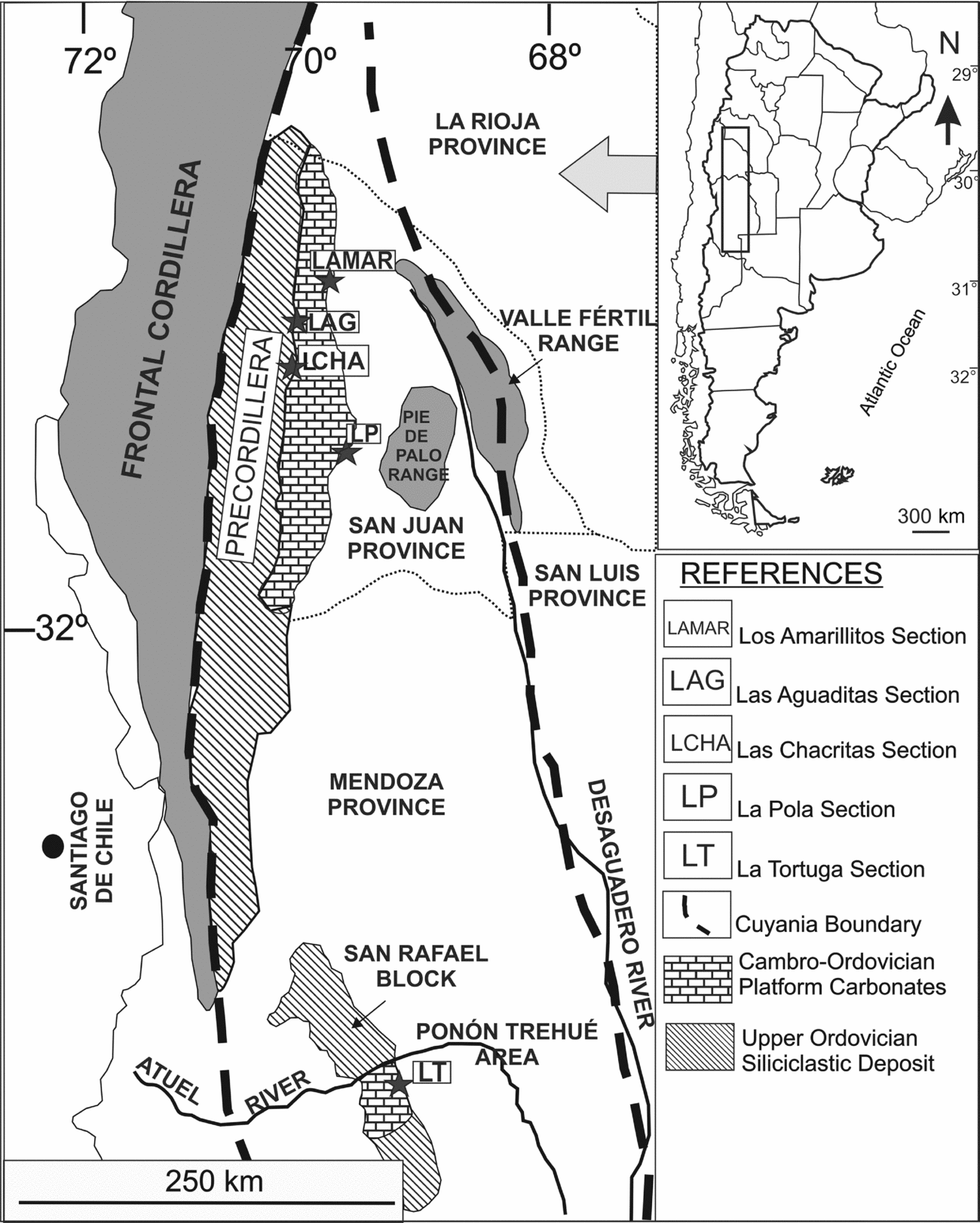
Middle–Upper Ordovician outcrops of the Precordillera terrane extend from 29° S to 33° S, and correlative rocks appear near San Rafael City (35° S, 68° 20′ W) in the south of Mendoza Province, western Argentina (Fig. 1) (in the sense of ‘Cuyania’ of Ramos, Reference Ramos1995; Keller, Lehnert & Bordonaro, Reference Keller, Lehnert and Bordonaro1996). These latter outcrops occur in the Sierra Pintada range, in the San Rafael Block (Criado Roqué & Ibáñez, Reference Criado Roqué and Ibáñez1979). These upper Darriwilian – lower Sandbian clastic carbonate deposits have been studied from different scopes (see Heredia, Reference Heredia2006). On the other hand, middle to upper Darriwilian deposits have been recognized in the Villicum range (eastern Precordillera), Los Amarillitos, Las Chacritas and Las Aguaditas sections (Central Precordillera) in San Juan province.
Location map showing the Las Aguaditas (LAG), Las Chacritas (LCH), Los Amarillitos (LAMAR), La Pola (LP) and La Tortuga (LT) sections in Cuyania, Argentina.

2.a. Ponón Trehué region
The San Rafael Block as the southern extension of the Precordillera Terrane (Fig. 1) shows a NNW–SSE structural trend, extended c. 200 km southward of the Precordillera in Mendoza province (Criado Roqué & Ibáñez, Reference Criado Roqué and Ibáñez1979). The San Rafael Block shows diverse igneous–metamorphic and sedimentary successions of Precambrian to Middle Palaeozoic age (Núñez, Reference Núñez1979; González Díaz, Reference González Díaz1981). A Greenville-type basement (Cingolani & Varela, Reference Cingolani and Varela1999) is present in the eastern part of the San Rafael Block and is partially covered (Ponón Trehué region) in depositional contact by carbonate–siliciclastic sedimentary Ordovician rocks bearing macro- and microfossils (complete citations in Heredia, Reference Heredia and Aceñolaza2002).
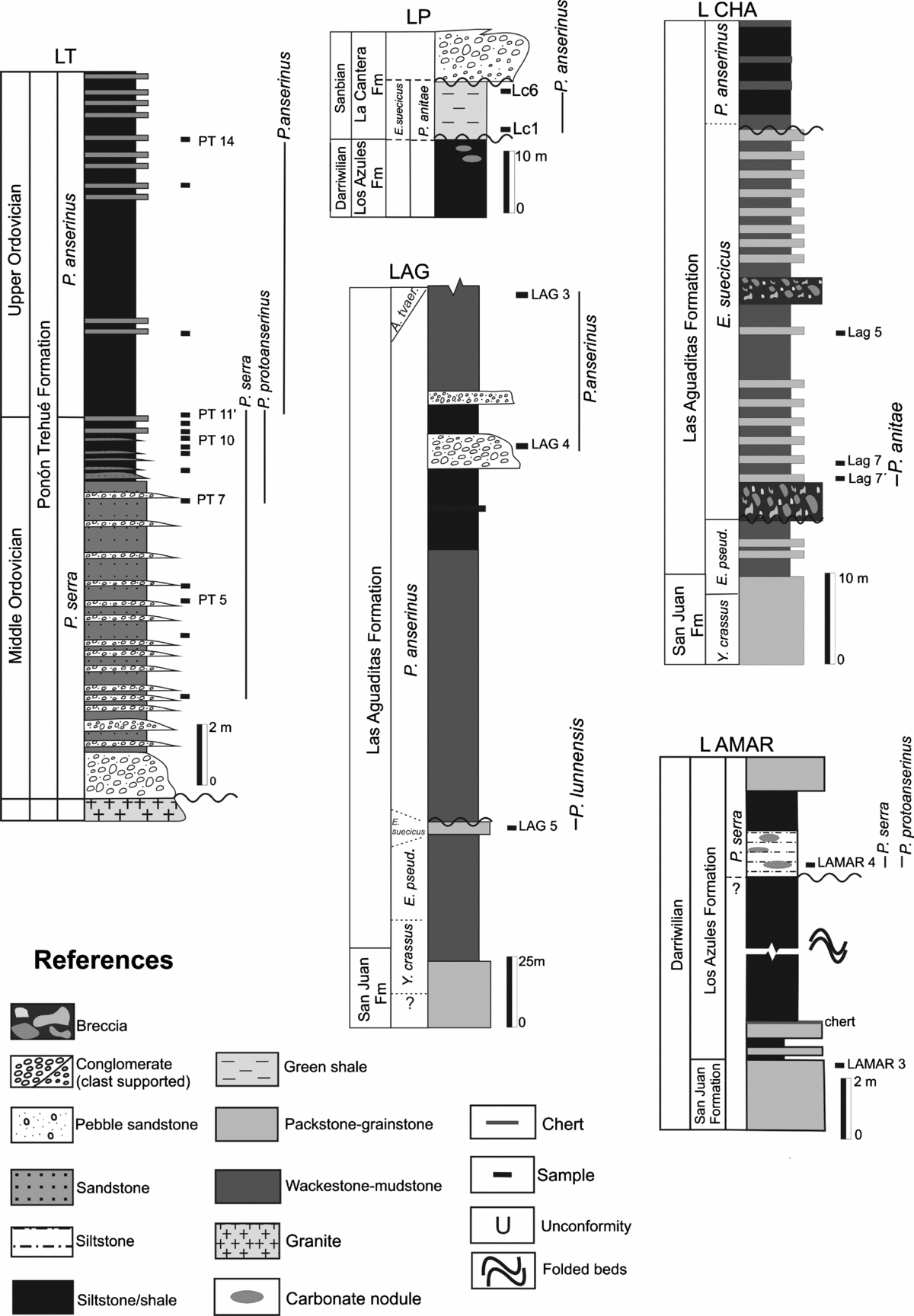
The Ordovician outcrops in the Ponón Trehué area, named the Ponón Trehué Formation, exposed in the La Tortuga (LT) section (upper Darriwilian to lower Sandbian), are composed of granite conglomerate, sandstone and thin-bedded fossiliferous limestone (Fig. 2). A distinct unconformity can be traced between the Ordovician clastic sequence and the underlying basement, exposed to the east. The dominant features of these Mesoproterozoic and Ordovician rocks are isolated, discontinuous and disperse outcrops in a green shale matrix suggesting an olisthostromic origin for these deposits (Heredia & Mestre, in press). Astini (Reference Astini2002) considered that the limestone outcrops of the Ponón Trehué Formation (sensu Bordonaro, Keller & Lehnert, Reference Bordonaro, Keller and Lehnert1996) are blocks and fragmentary carbonate bodies discontinuously exposed, floating in arkose conglomerate, in agreement with Heredia (Reference Heredia1998, Reference Heredia2001) and Beresi & Heredia (Reference Beresi and Heredia2000). In spite of these interpretations, these deposits are informative about their fossil record and history.
Stratigraphical columns of studied sections. Las Aguaditas (LAG), Las Chacritas (LCHA), Los Amarillitos (LAMAR), La Pola (LP) and La Tortuga (LT).

The Ordovician outcrops in Ponón Trehué represent a depositional cycle from shallower to deeper environments. This succession involves two different deposits: the lower comprises coarse siliciclastic deposits, and the upper consists of fine, dark carbonate – fine clastic deposits (Fig. 2). The biostratigraphy of these Ordovician outcrops has been based on conodonts, recognizing two biozones: the Pygodus serra and Pygodus anserinus zones (complete citations in Heredia, Reference Heredia and Aceñolaza2002).
2.b. Precordillera
The Lower–Middle Ordovician carbonate succession of the Precordillera, comprising La Silla and San Juan formations, is developed along a length of 400 km N–S with a width of 150 km E–W. Although these stratigraphic successions indicate the stability of the platform sedimentation, Middle and Upper Ordovician strata of largely siliciclastic facies show great vertical and lateral heterogeneity that has been taken as a record of tectonic and palaeogeographic upheaval. The siliciclastic units studied are Los Azules, Las Aguaditas and La Cantera formations that crop out in the Los Amarillitos (LAMAR), Las Aguaditas (LAG), Las Chacritas (LCHA) and La Pola (LP) sections (Fig. 1) in the central and eastern Precordillera, and represent the mentioned change of facies in the basin (Fig. 2).
The Ordovician siliciclastic rocks in the Los Azules Formation were studied by several authors mentioned in Ortega (unpub. Ph.D. thesis, Univ. Nacional de Córdoba, 1987). Ortega described the succession as composed of dark claystone and siltstone, black shale, and yellowish calcareous siltstone and marly mudstone. A rich graptolite fauna occurs in the Los Azules Formation, from the lower Darriwilian in the lower member (Ortega & Albanesi, Reference Ortega, Albanesi and Aceñolaza2002; Brussa et al. Reference Brussa, Mitchell, Ortega, Maletz and Astini2003) to the upper Darriwilian in the middle member (Brussa et al. Reference Brussa, Mitchell, Ortega, Maletz and Astini2003; Ortega & Rickards, Reference Ortega and Rickards2003) to the upper Sandbian in the upper member (Ottone et al. Reference Ottone, Albanesi, Ortega and Holfeltz1999).
The Los Amarillitos (LAMAR) section is located on the western flank of the Cauquenes Range, c. 10 km northeast of Jáchal village (Fig. 1). There, the San Juan Formation crops out in a N–S belt which consists of carbonate deposits with a thickness of 330 m (Keller, Reference Keller1999), assigned to a shallow ramp depositional setting (Cañas & Aguirre, Reference Cañas and Aguirre2005 and references therein). The upper levels of the San Juan Formation in the LAMAR section are characterized by nodular burrowed bioclastic wackestone–packstone beds, and several hardground surfaces are developed to the last 3 m of the uppermost part of the unit where numerous nautiloid fragmacones are present (Mestre, Beresi & Heredia, Reference Mestre, Beresi and Heredia2013). The Los Azules Formation overlies the San Juan Formation, and the contact between these units is transitional. The Los Azules Formation is 209 m thick in the LAMAR section, and is composed of black mudstone, chert and black shale beds alternating in the lower part (7 m), followed by folded black shale which is covered in turn by yellowish massive fine sandstone (2 m) with disperse carbonate nodules 0.08–0.10 m thick and 0.15 m in length. To the top the succession is composed of yellowish carbonate siltstone and marly mudstone (200 m) (Fig. 2).
The La Cantera Formation is a siliciclastic unit that outcrops at the eastern flank of Villicum Range, in the eastern Precordillera of San Juan (Fig. 1). This succession overlies the Los Azules Formation and is unconformably overlain by Hirnantian diamictites of the Don Braulio Formation. The La Cantera Formation is composed mainly of greenish, fining/thinning-upward siliciclastic deposits c. 142 m thick. The record of graptolite assemblages from the Pterograptus elegans Zone (Heredia et al. Reference Heredia, Kaufmann, Mestre, Soria and Ortega2014), Hustedograptus teretiusculus and Nemagraptus gracilis zones (Peralta, Reference Peralta1993) indicates a Middle–Upper Ordovician age. This unit was divided into three members (Peralta, Reference Peralta1993). The lower member is mainly composed of green shale, brown sandstone and conglomerate, which are interbedded with pebbly sandstone and siltstone. Green shale beds of 7 m thickness underlie the first conglomerate beds in the La Pola (LP) section; conodonts and graptolites were recovered from these fine deposits, indicating the Eoplacognathus suecicus Zone / Pterograptus elegans Zone.
The middle member is composed of shale and sandstone, where brachiopods, bryozoans and scarce ichnofossils belonging to the Cruziana ichnofacies (Peralta, Reference Peralta1993) are recorded. A finning/thinning-upward succession represents the upper member of the La Cantera Formation, in which intense slumping was recognized. Upwards, the upper member of the La Cantera Formation is sharply overlain by conglomerates and sandstone beds of the La Pola Formation (Fig. 2).
The Las Aguaditas Formation is composed of black silty-carbonate deposits, where the carbonate fraction varies through the Las Aguaditas (LAG) and Las Chacritas (LCHA) sections (Fig. 1).
The Ordovician succession in the LCHA section is composed of grey to dark-grey limestone, marl and mixed carbonate/siliciclastic strata deposited in a ramp setting (Mestre, unpub. Ph.D. thesis, Univ. Nacional de San Juan, 2010 and citations therein). The section begins within the Lower–Middle Ordovician San Juan Formation, composed mainly of fossiliferous limestone and marly limestone. Its base is faulted, and the exposed part is 340 m thick (Keller, Reference Keller1999). The San Juan Formation is conformably overlain by the Middle to Upper Ordovician Las Aguaditas Formation, which consists of 70 m of tabular, thin- to medium-bedded, dark carbonate mudstone, nodular fossiliferous wackestone to packstone, black shale and rare thin beds of bentonite. The contact between the San Juan and Las Aguaditas formations is transitional; the first level of black shale is used as the arbitrary boundary between these units (Fig. 2). On the other hand, the Ordovician succession in the LAG section is mainly composed of black to dark siltstone and mixed carbonate/siliciclastic strata deposited in a ramp setting. Differences between these two sections are related to the clastic versus carbonate content of strata (Fig. 2). Conodonts have been recovered from several beds in the LCHA section recording the E. suecicus Zone (P. anitae Subzone) (Heredia, Reference Heredia2012). Three conodont associations have been recorded through the LAG section, indicating the E. suecicus (P. lunnensis Subzone), the P. anserinus and the Amorphognathus tvaerensis zones (Lehnert, Reference Lehnert1995; Heredia & Mestre, Reference Heredia and Mestre2013).
3. Conodonts
Well-preserved specimens of conodonts were recovered from shale, carbonate, carbonate nodule and carbonate–sandstone samples from the diverse formations mentioned above (Fig. 2). Herein, we consider only conodont zonation information instead of graptolite/conodont zonation as proposed by Ortega & Albanesi (Reference Ortega, Albanesi and Aceñolaza2002).
The weight of each sample varied depending on lithology and purpose. Samples in the LT section weighed up to 2 kg each. Samples of 0.8–1.6 kg from the La Cantera Formation in the LP section were constrained by the scarce outcrop of fossiliferous sandstone lithology. Sampling of nodules from the Los Azules Formation was carried out by picking up two nodules of 1.630 and 1.870 kg from the outcrop. The Las Aguaditas Formation was sampled throughout the LAG and LCHA sections. Initially, 1 kg of each sample was dissolved in dilute formic acid, with additional material processed if needed (techniques described by Stone, Reference Stone and Austin1987). Draws of Pa elements of different Pygodus species were digitalized from scanning electron microscope (SEM) photographs. All photographic illustrations (Fig. 4, further below) are SEM digital photomicrographs (all figured specimens are 100 µm). Illustrations of two specimens of P. anitae were obtained from binocular microscope photographs; the bar represents 1 mm. The illustrated elements are housed in collections of the Museo de Paleontología (Universidad Nacional de Córdoba) under the code CORD-MP; INSUGEO/Instituto Miguel Lillo under the code CML-C; and the INGEO (Universidad Nacional de San Juan) under the code INGEO- MP.
4. Conodont assemblages and biostratigraphy
The conodont species recovered from the above mentioned sections have yielded typical conodont associations and allow this stratigraphical interval to be linked to the Baltic or North Atlantic scheme (Bergström, Reference Bergström, Sweet and Bergström1971, Reference Bergström1990). The different biozones and subzones and their conodont associations are listed below, following the vertical distribution.
4.a. Eoplacognathus suecicus Zone, Pygogus lunnensis Subzone
Pygodus lunnensis, Eoplacognathus suecicus Bergström, Ansella jemtlandica Löfgren, Baltoniodus medius Dzik, Dzikodus tablepointensis (Stouge), Histiodella kristinae Stouge, Paroistodus horridus (Barnes & Poplawski), Periodon macrodentatus (Graves & Ellison), Protopanderodus sp., Spinodus spinatus (Hadding) and ‘Bryantodina’ sp. aff. ‘B.’ typicalis.
4.b. Eoplacognathus suecicus Zone, Pygodus anitae Subzone
Pygodus anitae, Eoplacognathus suecicus, Histiodella bellburnensis Stouge, Paroistodus horridus, Periodon macrodentatus, Protopanderodus sp., Spinodus spinatus, ‘Bryantodina’ sp. aff. ‘B.’ typicalis and Dzikodus sp.
4.c. Pygodus serra Zone, Eoplacognathus robustus Subzone
These beds contain Pygodus serra, Pygodus protoanserinus, E. robustus Bergström, Baltoniodus prevariabilis (Fåhræus), Periodon aculeatus Hadding, Ansella sinuosa Stouge, Ansella biserrata Lehnert & Bergström, Pseudooneotodus mitratus (Moskalenko), Spinodus spinatus, Phragmodus polonicus Dzik, Strachanognathus parvus Rhodes, Drepanoistodus reclinatus (Lindström), Drepanoistodus cf. D. suberectus, Erismodus sp., Erraticodon balticus Dzik, Panderodus cf. P. sulcatus, Protopanderodus rectus (Lindström) and Costiconus ethingtoni (Fåhræus).
4.d. Pygodus serra Zone, Eoplacognathus lindstroemi Subzone
Early forms of E. lindstroemi (Hamar), Pygodus serra, P. protoanserinus, E. robustus – E. lindstroemi transition, Baltoniodus prevariabilis–variabilis (sensu Dzik, Reference Dzik, Dzik, Olempska and Pisera1994), A. sinuosa, A. biserrata, C. ethingtoni, S. parvus, P. aculeatus, Erraticodon balticus, D. reclinatus, Phragmodus? sp. and Panderodus sp.
4.e. Pygodus anserinus Zone, Lower Subzone
Pygodus anserinus, P. serra, P. protoanserinus, Baltoniodus prevariabilis–variabilis, Periodon aculeatus and Strachanognathus parvus Rhodes.
4.d. Pygodus anserinus Zone, Upper Subzone
Late forms of E. lindstroemi, P. anserinus, Cahabagnathus sweeti (Bergström) and Baltoniodus variabilis (Bergström).
Bergström (Reference Bergström, Sweet and Bergström1971) proposed two informal subzones, named as lower and upper for the P. anserinus Zone. The Lower Subzone is indicated by the appearance of P. anserinus and B. prevariabilis and the upper Subzone by P. anserinus, B. variabilis and C. sweeti. Later, Dzik (Reference Dzik1976) suggested two ‘key’ conodonts for defining these subzones, ‘Amorphognathus’ kielcensis (Dzik) and ‘A.’ inaequalis (Rhodes), the criterion followed by Bergström (Reference Bergström1983) and Bergström, Rhodes & Lindström (Reference Bergström, Rhodes, Lindström and Austin1987). However, Dzik (Reference Dzik, Dzik, Olempska and Pisera1994) re-evaluated the generic assignation of these species and interpreted them as Sagittodontina kielcencis with long vertical distribution and Rhodesognathus inaequalis which appears exclusively in the Amorphoganthus tvaerensis Zone. This recognition does not take into account these two conodont species as key conodonts for the biostratigraphic record.
5. Stratigraphical distribution of the genus Pygodus in Cuyania
The genus Pygodus in Cuyania occurs from the Eoplacognathus suecicus Zone to the Pygodus anserinus Zone (middle Darriwilian to early Sandbian).
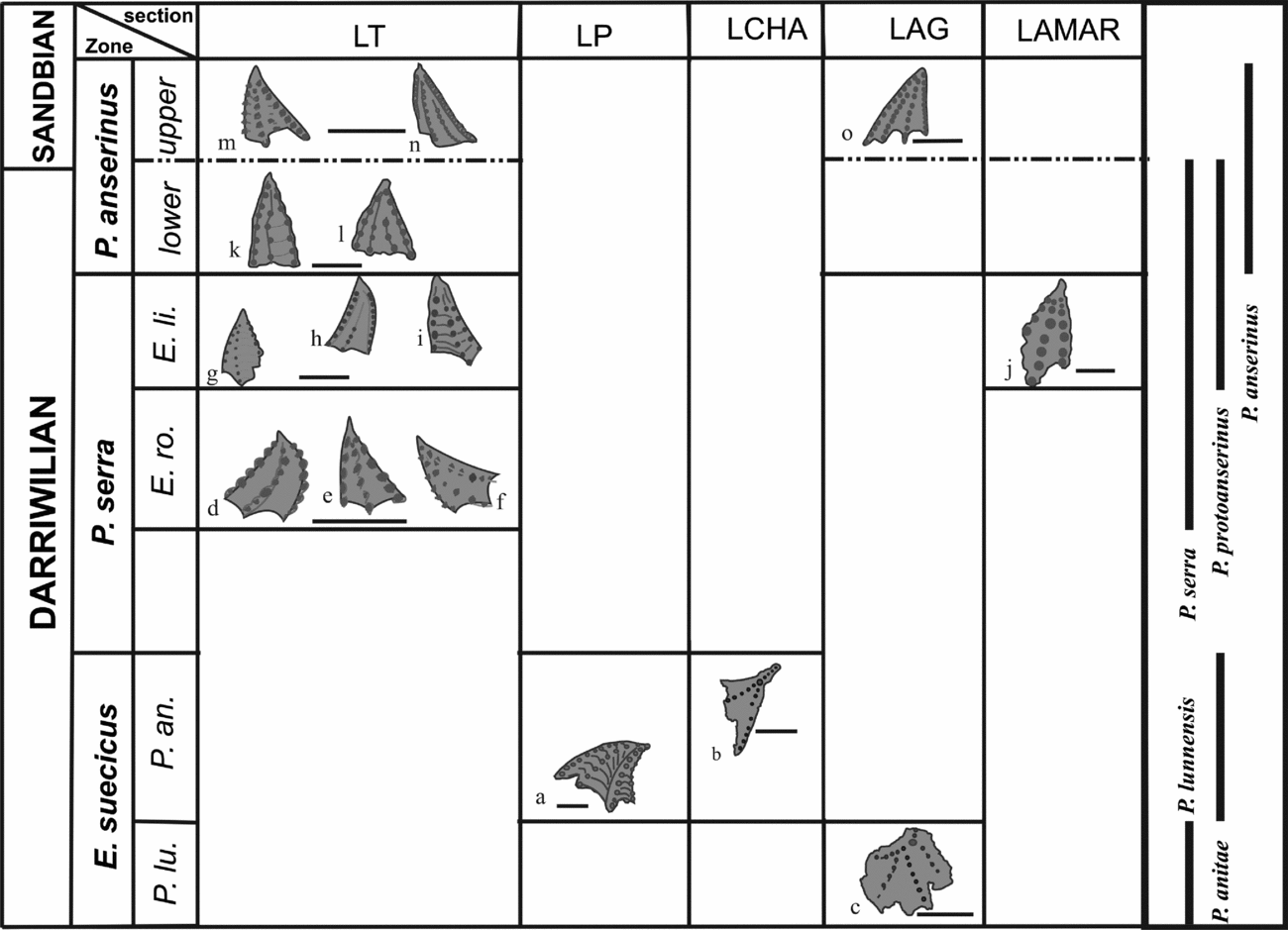
The oldest species of the Pygodus lineage is P. lunnensis, which appears to be restricted to the lower part of the Las Aguaditas Formation in the LAG section (Fig. 3), which corresponds to the lower part of the E. suecicus Zone (Heredia & Mestre, Reference Heredia and Mestre2013).
Comparative vertical distribution showing the evolution of different species of the genus Pygodus in Cuyania (based on the studied sections): (a) early Pygodus anitae, (b) late Pygodus anitae, (c) Pygodus lunnesis, (d–f, h–j) Pygodus serra, (g, k) Pygodus protoanserinus, (l–o) Pygodus anserinus.

Specimens of P. anitae were recorded from the lower part of the La Cantera Formation, in the LP section and the lower part of the Las Aguaditas Formation, and in the LCHA section (Fig. 3), indicating the upper part of the E. suecicus Zone (Heredia, Reference Heredia2012; Heredia et al. Reference Heredia, Kaufmann, Mestre, Soria and Ortega2014).
The upper part of the P. serra Zone was recorded in the Ponón Trehué Formation (LT section), the Los Azules Formation (LAMAR section) and the La Cantera Formation (Villicum Range), where the key conodont is in co-occurrence with the species Eoplacognathus robustus or/and E. lindstroemi (Heredia et al. Reference Heredia, Kaufmann, Mestre, Soria and Ortega2014, Reference Heredia, Mestre, Soria and Kaufmann2015) (Fig. 3).
The lowest level at which Pygodus protoanserinus appears is in the E. robustus Subzone. This species ranges from the upper part of the Pygodus serra Zone to the lower part of the P. anserinus Zone in the Ponón Trehué Formation (LT section). It was also recovered from the upper part of the middle member of the Los Azules Formation (LAMAR section); these beds are constrained to the base of the E. lindstroemi Subzone, P. serra Zone (Fig. 3).
The overlap of the ranges of P. serra and P. anserinus was reported by Heredia (Reference Heredia and Aceñolaza2002) for the lower part of the P. anserinus Zone in the Ponón Trehué Formation (Fig. 3). These beds represent the latest Darriwilian in Cuyania.
Heredia (Reference Heredia and Aceñolaza2002) considers the co-occurrence of P. anserinus and B. variabilis in the Ponón Trehué Formation to be evidence of Sandbian age. The same association was recovered from the middle and upper part of the Las Aguaditas Formation in the LAG section (Fig. 3).
6. Systematic palaeontology
The synonymy lists are condensed, and most contain only the original citations of species names incorporated in each multi–element taxon and records for Argentina. In the descriptions, the conventional orientation terms – anterior, posterior and lateral – have been used, noting that these do not relate to the anatomical orientation of elements (see Purnell, Donoghue & Aldridge, Reference Purnell, Donoghue and Aldridge2000).
The species P. lunnensis, P. anitae and P. protoanserinus have been selected to be described with special consideration on the Pa element. The Pb and S elements were not described because they are already widely mentioned in the literature (e.g. Bergström, Reference Bergström1983; Albanesi, Reference Albanesi1998; Zhang, Reference Zhang1998).
It is accepted that the genus Pygodus has two stelliscaphate elements (pygodiform) in the Pa positions (Zhen, Percival & Webby, Reference Zhen, Percival and Webby2004). Our observations on P. lunnensis to P. anserinus Pa elements allow us to identify dextral and sinistral Pa elements (mirror image elements) defined by the concave curvature of the inner side, and a symmetrical element was also recognized when the lateral processes were straight.
Zhang (Reference Zhang1998) proposes a new descriptive terminology for the Pa elementof the Pygodus lunnensis, recognizing the anterior and lateral processes. We apply these new morphological terms to the other species of the genus Pygodus, representing the inner process by the concave ledge of platform, the outer process by the convex ledge of platform, and the anterior process by the central row on the platform.
Genus Pygodus Lamont & Lindström, Reference Lamont and Lindström1957
Type species: Pygodus anserinus Lamont & Lindström, Reference Lamont and Lindström1957
Pygodus anitae Bergström, Reference Bergström1983
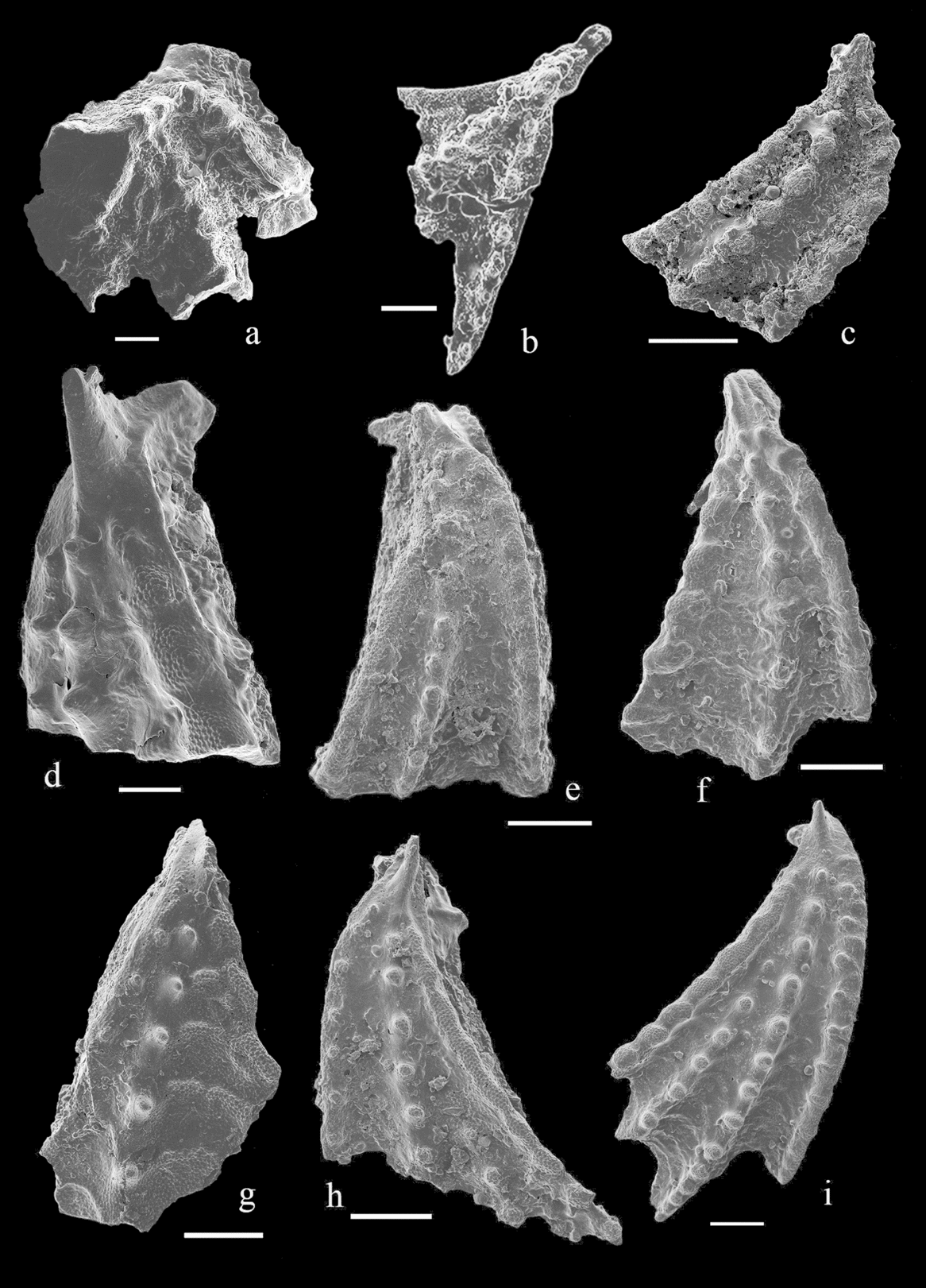
Fig. 4b; Fig. 5a, b
Reference Bergström1983. Pygodus anitae n. sp. Bergström: p. 55, fig. 6V-Z (cum syn.)
1990. Pygodus anitae Bergström, An & Zheng: pp. 170–1, pl. XIII, figs. 4–6, pl. XIV, fig. 18 (cum syn.)
1995. Pygodus anitae Bergström, Ortega, Albanesi & Hünicken: pl. 6, figs. 19–20.
1998. Pygodus anitae Bergström, Albanesi: pl. 15, figs. 7–10
Reference Bergström2007. Pygodus anitae Bergström, Ortega, Albanesi & Frigerio: fig. 5, R
2013. Pygodus anitae Bergström, Heredia & Mestre: pl. 1, Fig. 4
Plate of SEM microphotographs. The bar indicates 0.1 mm. All specimens in oral views. (a) Pygodus lunnensis Zhang, sinistral Pa element, INGEO MP 4002 (1), Las Aguaditas section, sample LAG 31. (b) Pygodus anitae Bergström, dextral Pa element, INGEO MP 3406 (1), Las Chacritas section, sample LCHA 7. (c–e) Pygodus serra (Hadding): (c) dextralPa elements, INGEO MP 2003 (1), (d) symmetrical Pa element, INGEO MP 2003 (2), Los Amarillitos section, sample LAMAR 4, (e) dextral Pa element, CORD MP 2236 (62), La Tortuga section, samples PT9’. (f, g) Pygodus protoanserinus Zhang: (f) dextral Pa elements, CORD MP 2237 (73), La Tortuga section, sample PT10’, (g) sinistral Pa element, CORD MP 2360 (5), La Tortuga section, sample PT11. (h, i) Pygodus anserinus Lamont & Lindström: (h) sinistral Pa elements, CORD MP 2238 (1), La Tortuga section, sample PT11”. (i) dextral Pa elements, CORD MP 2238 (2), La Tortuga section, sample PT11”.

Material: Six elements and casts from LP section (La Cantera Formation), one element from LCHA section (Las Aguaditas Formation). INGEO MP 3800 (1–6); CML-C 3406(1).
Description: Only stelliscaphate Pa elements were recovered from LCHA and LP sections.
One dextral Pa element from the LCHA section has been recovered from LAG 7. This specimen has a short posterior process with four denticles. The anterior process is close to the inner process. The basal cavity is wide, with a thick basal body. This specimen has been interpreted as a late form of P. anitae, which is similar to Pa of P. serra, but differs from it by the presence of a long and narrow denticulate posterior process.
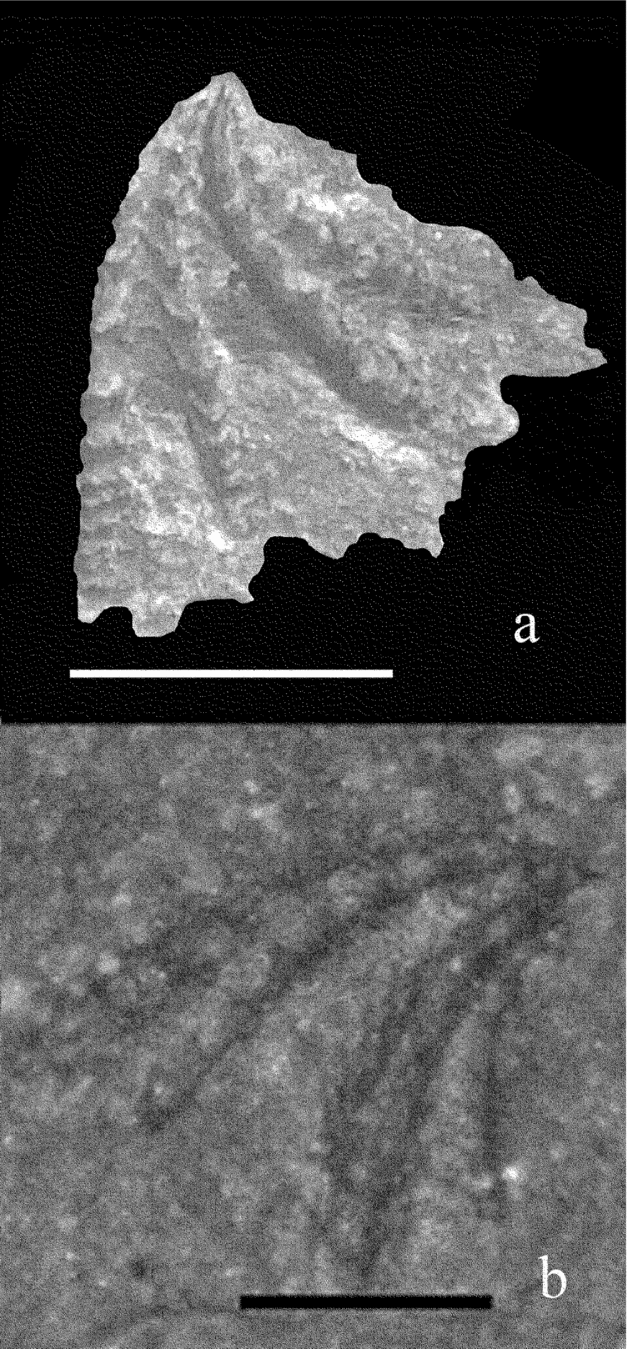
On the other hand, the Pa elements from the LP section (Fig. 5) represent early forms, which exhibit the morphological features already described by Bergström (Reference Bergström1983) and Albanesi (Reference Albanesi1998). The stelliscaphate Pa element has a subtriangular shape with a well-developed anterior platform and small cusp; the posterior process is wide and short, but is difficult to see in several specimens preserved on bedding planes. The anterior platform has three processes: anterior, inner and outer which has a lobe with a denticulate row, shaping a platform with four denticulate rows.
Plate of SEM microphotographs. The bar indicates 1 cm. Oral views of the two specimens (a, b).Pygodus anitae Bergström, sinistal Pa elements, INGEO MP 3800 (1–2), La Pola section, sample LP6.

Occurrence: Las Aguaditas Formation, in LCHA (LAG 7 sample) and La Cantera Formation in LP section (LP 3 sample), E. suecicus Zone, P. anitae Subzone. This species also occurred in Sweden (Zhang, Reference Zhang1998) and North China (An & Zheng, Reference An and Zheng1990).
Pygodus lunnensis Zhang, Reference Zhang1998
Fig. 4a
Reference Löfgren1978. Pygodus? sp. B, Löfgren: p. 97, pl. 16: 2, 3.
Reference Bergström1983. Pygodus? n. sp., Bergström: p. 45, fig. 3.
?1987. Polonodus tablepointensis Stouge, Hünicken & Ortega: p. 140, pl. 7.1:2 (non 1).
Reference Zhang1998. Pygodus lunnensis sp.n., Zhang: p. 95, pl. 1: 12–16; figs. 2A, 4A.
Reference Heredia and Mestre2013. Pygodus lunnensis Zhang, Heredia & Mestre: pl. 1: 2
Material: Three Pa elements, one mature and two juvenile elements from LAG section. INGEO MP 4002 (1–3).
Description: Zhang (Reference Zhang1998) originally described the apparatus of P. lunnensis considering pygodontiform, haddingodiform and ramiform elements, but only Pa elements were recovered from LAG 31 bed. The illustrated sinistral stelliscaphate Pa element has anterior, posterior and two lateral processes (inner and outer process). The inner process is wider and longer than other processes and is overgrown by a lobe. The platform ledges of the anterior and inner processes are confluent. The posterior process is short and wide. Each row has short denticles. The basal cavity is wide and extended downward of every process. A thick basal body is present in the mature Pa element.
Occurrence: Las Aguaditas Formation in Las Aguaditas section (LAG 31) (Figs. 2, 3). This species also occurred in Sweden (Löfgren, Reference Löfgren1978; Zhang, Reference Zhang1998).
Discussion: Albanesi (Reference Albanesi1998) proposed a new species named Polonodus magnum, which was also mentioned and illustrated in Ottone et al. (Reference Ottone, Albanesi, Ortega and Holfeltz1999) as Polonodus nov. sp. A. Ortega, Albanesi & Frigerio (Reference Ortega, Albanesi and Frigerio2007) proposed it as a junior synonym of Pygodus lunnensis. A review of these illustrated Pa specimens permits interpretation of the presence of a posterior process, typical of the primitive morphology of Pygodus, and several specimens show an extension of the platform in the inner side that is also present in the Pa elements of Pygodus anitae, implying a connection between these two species. It is probably a new species of Pygodus that co-occurred with early forms of P. anitae; this relationship was already recorded by Albanesi (Reference Albanesi1998) and Ortega, Albanesi & Frigerio (Reference Ortega, Albanesi and Frigerio2007).
Serra et al. (Reference Serra, Albanesi, Ortega and Bergström2015) recorded Polonodus magnum in the upper part of the ‘Las Chacritas’ Formation (Las Chacritas section). They proposed that this species indicates the base of the E. suecicus Zone, interpreting P. magnum as the senior synonym of Pygodus lunnensis from the same beds where Heredia (Reference Heredia2012) recorded advanced forms of E. suecicus, representing the late E. suecicus Zone.
Feltes, Albanesi & Bergström (Reference Feltes, Albanesi and Bergström2016) recorded Polonodus magnum in co-occurrence with E. pseudoplanus (Viira) in the Las Aguaditas section, proposing this co-occurrence as the record of the upper part of the E. pseudoplanus Zone. A review of the illustrated element allows it to be interpreted as a Pa element of Dzikodus sp. The E. suecicus Zone and the P. lunnensis Subzone were introduced by Heredia & Mestre (Reference Heredia and Mestre2013) for the same beds studied by Feltes, Albanesi & Bergström (Reference Feltes, Albanesi and Bergström2016), who recorded the E. pseudoplanus Zone instead.
Finally, the proposal of Feltes, Albanesi & Bergström (Reference Feltes, Albanesi and Bergström2016) that consider P. magnum as indicative of the late E. pseudoplanus Zone is conflictive.
Pygodus protoanserinus Zhang, Reference Zhang1998
Fig. 4f–g
Reference Zhang1998 Pygodus protoanserinus n. sp., Zhang: pl. 3: 9–18; fig. 2D (cum syn.)
2004 Pygodus protoanserinus Zhang, Zhen, Percival & Webby: p. 158, fig. 9, B–J.
Reference Dubinina and Ryazantsev2008 Pygodus protoanserinus Zhang, Dubinina & Ryazantsev: pl. 3; figs. 7–9, 11, 15
Material: Fourteen Pa elements from LT section: CORD MP 2236 (60–63), CORD MP 2237 (73–75), CORD MP 2360 (5–11). Ten Pa elements from LAMAR section: INGEO MP 2002 (1–10).
Description: The Pa element has three denticulate rows on the platform, corresponding to the anterior, inner and outer processes. The anterior process is situated next to the outer process, and the distance between the inner and the anterior process is large. The ridges on the inside of the platform between anterior and inner process are straight or bent, and could have one or more small nodes on the ridges. We had recovered dextral, sinistral and symmetrical Pa elements.
Occurrence: P. protoanserinus specimens were recovered from the Ponón Trehué Formation, from the upper P. serra and lower P. anserinus zone (LT section) samples. Also, a few specimens of P. protoanserinus were identified from the Los Azules Formation (LAMAR section).This species was recorded in Baltoscandia (Zhang, Reference Zhang1998), Scotland (Bergström & Orchard, Reference Bergström, Orchard, Higgins and Austin1985), North America (Fåhræus, Reference Fåhræus1982) and China (An & Zheng, Reference An and Zheng1990).
Remarks: The species Pygodus protoanserinus was introduced by Zhang (Reference Zhang1998), considering this species as an intermediate form between P. serra and P. anserinus, although it is must be noted that Fåhræus (Reference Fåhræus1982) proposed the presence of transitional forms in the pygodiform elements between P. serra and P. anserinus. Bergström (Reference Bergström2007) interpreted the Pa elements of P. protoanserinus as the junior synonym of P. serra, after the review of Hadding's collection. Bergström (Reference Bergström2007) also proposed the need for biometric studies to confirm the distinctiveness of this new species, which is verified in this contribution.
In our collections the S and Pb elements are undifferentiated from those correlatives of P. serra.
The records of this species in Europe and North America are mentioned in Zhang (Reference Zhang1998) (with all citations therein); Dubinina & Ryazantsev (Reference Dubinina and Ryazantsev2008) recorded the co-occurrence of P. serra, P. protoanserinus and P. anserinus in the Polyakovka Formation in the South Urals.
7. Final evolutionary considerations of the genus Pygodus
The evolutionary trend of the genus Pygodus began in the middle Darriwilian with the P. lunnensis (Zhang, Reference Zhang1998) which shows strong similarity to its ancestor Dzikodus (Stouge & Bagnoli, Reference Stouge, Bagnoli and Serpagli1999). The stelliscaphate Pa of P. lunnensis has four processes – posterior, anterior, inner lateral and outer lateral – and a lobe between the outer lateral and anterior process developing a platform. The posterior process is wide and short.
The early form of P. anitae is the possible descendant of P. lunnensis (Zhang, Reference Zhang1998) by the reduction of the posterior process and the merged platforms of the anterior and inner lateral processes, developing a platform with four denticulate rows, represented by the anterior process, inner process and outer process with a denticulate lobe. The late form of P. anitae shows the evolutionary changes involving the loss of lobe between the outer process and anterior process, developing a platform with three denticulate rows, typical of the P. serra, but with a long and narrow posterior process.
The lower subzones of the P. serra Zone, the E. foliaceus and E. reclinatus subzones, were not recorded in Cuyania, so it is not possible to study the morphological variations of the genus Pygodus during this time interval in Cuyania.
The Pa elements of P. serra, recorded in the E. robustus and E. lindstromi subzones, exhibit three processes, anterior, inner and outer. The posterior process is very short, restricted to the posterior flank of the cusp (Fig. 4d). The Pa element of the P. serra in the Cuyania exhibits the anterior process in the middle or inner side of the platform, and dextral, sinistral and symmetrical elements are recognized.
The evolutionary trend continues with P. protoanserinus, involving the migration of the anterior process from the middle to the outer side of the platform; the distance between the anterior and outer process decreases, developing an expansion on the platform with ridges between the denticles of the anterior and inner processes.
The P. anserinus is the direct descendant of P. protoanserinus as proposed by Zhang (Reference Zhang1998). The Pa element of the P. anserinus has four denticulate rows on the platform which correspond to the anterior, outer and inner processes with a denticulate lobe between the anterior and inner processes.
We pointed out that there is a marked change in the evolution of the genus Pygodus, taking into account the connection of the denticulate lobe in the Pa elements; this is linked to the outer process in P. anitae; it is missing in P. serra and P. protoanserinus, and connected to the inner process in P. anserinus.
We also observed in our material and the literature that the basal body (basal plate of Sweet, Reference Sweet1988) is present in the Pa elements of early species of the genus Pygodus but absent in specimens from P. serra to P. anserinus. Fåhræus & Hunter (Reference Fåhræus and Hunter1981) recorded the preference for shallower environment of P. serra, and calm ocean waters for P. anserinus. On the other hand, the records of P. lunnensis and P. anitae in Cuyania are related to deep fine clastic environments. This loss of the basal body is probably related to the change in environmental preferences of the genus Pygodus through time.
Acknowledgements
The authors are grateful for the PIP 139 grant (Research National Council of Argentina). Technician Mercedes González is acknowledged for her work at conodont lab. The MEByM from the CCT-Mendoza is thanked for the SEM microphotographs.