Introduction
Motion sickness is an uncomfortable but common occurrence in the general population. The most common symptoms experienced are feeling hot or sweaty, headache, and drowsiness, which often are accompanied by nausea and vomiting.Reference Turner and Griffin1 The mechanism behind motion sickness is believed to be a mismatch in the expectation of movement and the actual perception of movement. Being in control of motion, as when driving a car, and therefore, being able to predict motion stimuli, reduces the incidence of motion sickness. Females seem to be more susceptible to motion sickness than are males and passengers with no forward view during traveling experience greater symptoms.Reference Turner and Griffin1
Studies report that up to 28% of individuals experience motion sickness during public coach transportation.Reference Turner and Griffin1 Rapid travel on winding roads or up and down travel on a series of hills causes more symptoms than travel on smooth, straight roads. Motion sickness can be even more debilitating and anxiety provoking for an already sick patient being transported in the back of an ambulance. The symptoms are uncomfortable, can lead to an increased risk of aspiration due to vomiting, and may interfere in maintaining cervical spine immobilization in the setting of trauma. Given that patients in the back of an ambulance are rear facing, it would be expected that the incidence of motion sickness would be even greater than the incidence in the general population. A 2003 study using healthy volunteers showed an incidence of motion sickness of 43% of those transported in the back of an ambulance on a mountainous route.Reference Weichenthal and Soliz2 It would be expected that the incidence of motion sickness in the prehospital setting may be even higher in already sick patients.
In the California paramedic scope of practice, no specific therapy for the treatment of motion sickness currently exists. Studies that have examined the treatment of motion sickness in the prehospital setting have shown that the use of supplemental oxygenReference Kober, Fleischakl, Scheck, Lieba, Strasser, Friedmann and Sessler3,Reference Fleischhackl, Dörner, Scheck, Fleischhackl, Hafez, Kober, Bertalanffy and Hoerauf4 and hand acupressureReference Bertalnanffy, Hoerauf and Strasser5 decreases the incidence. Droperidol also has been shown to reduce symptoms of motion sickness in healthy volunteers.Reference Weichenthal and Soliz2 The use of droperidol has since been limited due to the FDA “black box” warning concerning prolonged QT and torsade de pointes. There has been no study examining the effect of metoclopramide (MTCP) or diphenhydramine (DPH) in reducing motion sickness.
The goal of this study was to determine if MTCP or DPH when compared to placebo help relieve the symptoms associated with motion sickness during ambulance transport.
Methods
This was a prospective, randomized, double-blinded, placebo-controlled study involving patients being transported in the Sierra Nevada mountain Range of Fresno County between January 2005 and June 2008. Paramedics staffing two ambulance posts in this mountainous region were trained in the study protocol. The first post was located in Auberry, California at 2,018 feet (615 meter) of elevation. The closest receiving hospital to this post is a 40-minute drive. The second post was at Shaver Lake, California at 5,640 feet (1,719 meter) elevation and requires a transport of >60 minutes to the nearest hospital.
The study consisted of a convenience sampling of patients who presented for transport at times when paramedics trained in the study protocols were on duty. All patients consented prior to the start of ambulance transport. Inclusion criteria included: (1) 18 to 65 years of age; (2) transported by ambulance in the mountainous areas of Fresno County; and (3) clinically stable, alert, oriented, and competent to give informed consent prior to transport. Patients were not eligible if they met any of the following exclusion criteria: (1) <18 or >65 years of age; (2) considered to be too sick or hemodynamically unstable; (3) pregnant; (4) known renal insufficiency or renal failure; (5) already taking MTCP, DPH, or another antiemetic; (6) not oriented or competent to consent; or (7) if prehospital care might be compromised by inclusion in the study. Exclusion criteria two and seven were left to the judgment of the paramedic on scene.
Patients who met the inclusion criteria were approached for consent prior to transport by a paramedic trained in the research protocol and human subjects research. Patients had the option of withdrawing from the study at any point. Once consented, an intravenous (IV) was placed and the patient was transported in the back of an ambulance. All patients received care following normal emergency medical services (EMS) policies and procedures. Patients were asked by the paramedic every five minutes to rate any feelings of motion sickness on a 100 mm visual analog scale (VAS). Patients who developed symptoms were randomized to receive MTCP 20mg IV, DPH 50mg IV, or an equivalent volume amount of placebo (normal saline).
Metoclopramide was chosen as a study drug because it has some centrally acting antiemetic effects, similar to droperidol that had been examined in the pilot study. Dosing for MTCP is quite variable, from 10–140 mg, depending on its indication. A 20 mg dose was chosen for this study based on previous studies looking at the use of MTCP as an antiemetic in the emergency department setting.Reference Wright, Anderson, Lesko, Woolf, Linakis and Lewander6,Reference Braude, Soliz, Cradall, Hendey, Andrews and Weichenthal7 Diphenhydramine was chosen because it is known to have mild anti-emetic properties and already is included in the California paramedic scope of practice. Dosing for DPH is far more standardized and a common adult dose of 50 mg was selected.
Both the paramedic and the patient were blinded to the medication given. The study investigators developed randomized numbers using www.random.org, which were assigned to the three different drug categories: Placebo, MTCP, and DHP. The paramedic coming off the night shift would draw up the medications and label each syringe with an appropriate randomly assigned number from one of the three drugs groups. Depending on the anticipated number of calls, the night paramedic would draw up three to nine doses of the various drugs. The syringes then were passed on to the oncoming morning paramedic. Once a randomized number was assigned to a drug syringe, there was no record at the two posts of which numbers corresponded to which drugs. Only the principal investigator maintained the master list of randomized numbers, and the medications administered were not unblinded until after the study period was completed. All unused medications once drawn up into syringes were discarded after 24 hours if not used.
Following the administration of medication, patients again were asked to rate their sickness on the VAS scale every five minutes. If symptoms persisted for >15 minutes after the original medication administration, patients were offered the option of receiving a rescue dose of MTCP. The decision to receive a rescue dose was entirely left to the patient and their perceived level of persistent symptoms. If the patient verbalized the desire for a rescue dose, 20 mg of MTCP was administered intravenously. Metoclopramide was chosen as a rescue medication because it is a centrally acting antiemetic and it has a large therapeutic window. Paramedics also were asked to note any adverse reactions to the medications given. If patients developed a dystonic allergic reaction, DPH was offered to the patient as per the EMS protocol.
This study was approved by the hospital institutional review board (IRB) and by the California Emergency Medical Services Authority.
Statistical Processing
All data were entered into an Excel spreadsheet (2007, Microsoft, Inc., Redmond, WA) and then imported into NCSS/PASS 2000 (©2000 Jerry Hintze) which was used for all statistical calculations. Multi-level Analysis of Variance and the Bonferroni Test were used for multiple comparisons. The multi-factor ANOVA was used to compare two independent variables (drug and time) compared to the dependant variable (VAS). Within group comparisons were made to determine that all groups improved with time alone. A One-Way Analysis of Variance was used to compare means not involving the control group (placebo) and for comparisons of the baseline characteristics of the treatment groups (DPH and MTCP). The two treatment groups (MTCP and DPH) were compared to placebo. Parametric and nonparametric analyses were also performed. A chi-square analysis was used to determine independence between groups when comparing rescue medication use. All calculations were performed using an alpha of 0.05.
Results
A total of 26 patients were enrolled and completed the study, and 22 patients (84.6%) developed signs and symptoms of motion sickness. Of the 22 patients who developed motion sickness, seven were in the placebo group, seven were in the DPH group, and eight were included in the MTCP group.
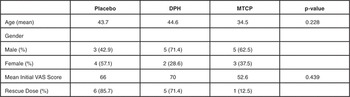
There were no statistically significant differences between the three groups with regard to age, gender, or initial VAS score (Table 1).
Patient baseline characteristics

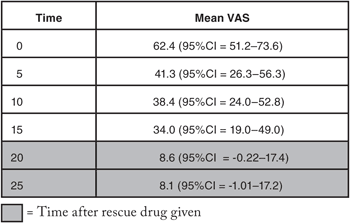
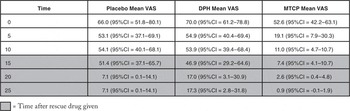
Together, all three drug groups showed a significant reduction in the VAS score over time (p = 0.002; Table 2). Patients in the MTCP group had a significant reduction in their mean VAS score at 10, 15, 20, and 25 minutes compared to their initial VAS score (Table 3). There was no significant reduction in the mean VAS score for the DPH or the placebo groups until 20 minutes after the drugs were administered, and a rescue dose of MTCP was given if requested (Table 3).
Combined VAS score for all three drug groups over time
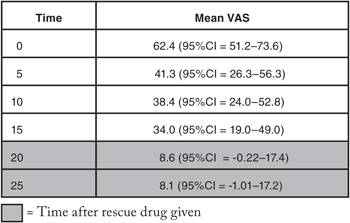
Comparison of mean VAS score between drug groups over time

At 15 minutes, there was a significant difference in the mean VAS score between the three drug groups (p = 0.02), but there was no difference in the reduction of the VAS score between the DPH group and the placebo group (p = 0.864).
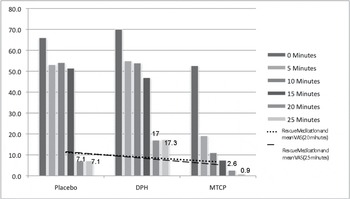
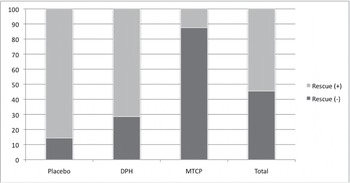
Twelve out of the 22 patients (54.5%) who developed motion sickness requested a rescue dose of MTCP at 15 minutes; six out of seven patients (85.7%) in the placebo group; 5 out of 7 patients (71.4%) in the DPH group; and 1 out of 8 subjects (12.5%) in the MTCP group (Figures 1 and 2). There was a statistically significant difference in the VAS score at 15 minutes for those patients who chose to receive a rescue dose of MTCP compared to those who did not (49.8 versus 14.9, p = 0.019). There was a decrease in the VAS score in both the placebo and DPH group after the MTCP rescue dose was given (Table 3). At 25 minutes, there was no statistical difference in the mean VAS score among all three drug groups (p = 0.361). The administration of the rescue dose of MTCP was not independent of the three drug groups (p = 0.0099).
Treatment of motion sickness, mean VAS

Percent of patients who requested a rescue dose of MTCP in each study group

None of the patients in the DPH or MTCP group reported any side effects. One patient in the placebo group reported dry mouth. It was not specified if this side effect was experienced before or after the rescue dose of MTCP was given. No dystonic reactions were reported.
Discussion
Motion sickness in an ill patient being transported in the back of an ambulance can lead to an uncomfortable transport, and can put the patient at risk for emesis and aspiration. Patients in the back of an ambulance are predisposed to experiencing motion sickness because they have no forward facing view of the road ahead.
Across all three drug groups in this study, participants equally experienced symptoms of motion sickness when they entered the study. Close to 85% of the patients transported by ambulance experienced signs and symptoms of motion sickness. This number is much higher than the incidence of motion sickness in a pilot study done by Weichenthal et al in 2003.Reference Weichenthal and Soliz2 Their study found a motion sickness incidence of 43% in healthy volunteers. Other studies report that up to 28% of automobile passengers experience motion sickness.Reference Turner and Griffin1 The higher incidence of motion sickness in this study may be because the patients being transported were already ill, and therefore, predisposed to developing motion sickness or may have already been symptomatic before transport secondary to their illness. It also is possible that patients who knew that they suffered from motion sickness preferentially chose to be involved in the study.
The signs and symptoms of motion sickness improved over time in all three of the study groups, and there was no difference in symptoms between the three groups at the end of the study. However, subjects who received MTCP intravenously felt better much sooner. These patients had improvement in their symptoms as soon as 10 minutes after the administration of MTCP. In comparison, patients in the DPH and the placebo group had to wait 20 minutes until they felt better, and that was not until after most of them had received a rescue dose of MTCP.
At 15 minutes after drug administration, there was a significant difference in the mean VAS score between the three drug groups. At that time, the DPH group and the placebo group experienced significantly more motion sickness symptoms when compared to the MTCP group, but there was no difference in their symptoms when compared to one another. Also, more patients in the DPH group and the placebo group chose to get a rescue dose of MTCP at 15 minutes. This was presumably because they did not feel as good as the patients in the MTCP group. It is interesting to note that there was a significant improvement in the VAS score five minutes after the administration of the rescue dose in both the DPH group and the placebo group when compared to their initial VAS score. Also, all of the patients felt the same at the end of the study. This points to the possibility that the rescue dose of MTCP worked in further decreasing the signs and symptoms of motion sickness. However, the data cannot prove this since there was no control group for the rescue medication.
Although this study is small, it suggests that MTCP improves the signs and symptoms of motion sickness experienced by patients being transported via ambulance in a mountainous setting. However, DPH is not superior to placebo in the treatment of motion sickness in this environment.
Limitations
There are several limitations of this study including the small sample size, the necessity of convenience sampling, and the potential that the method of blinding the paramedics to the nature of the study drugs was not foolproof. The initial intent was to enter more individuals into the study; however, the exclusion criteria prevented many of the patients transported at the two mountain posts from being enrolled in the study. One of the posts was located near a skilled nursing facility, and transported many patients who were not competent to give consent. The other post transported a majority of underage patients from a local ski resort, who were excluded from enrollment secondary to their age. Although the study used a convenience sample, during the majority of the study period the paramedies trained in the study protocol were staffing the two posts and were able to enroll patients. All paramedics who regularly worked these two posts were trained in the study protocol. Only when a replacement paramedic from the metro area was staffing one of the posts were patients unable to be enrolled. Finally, although the blinding method was not perfect, it was the best that could be devised in this remote prehospital setting. Paramedics would have to deliberately circumvent the blinding process for it to be ineffective, and, even if they did so, their bias would only have a limited impact as the patients engaged in a self evaluation of symptoms.
Conclusions
Metoclopramide is a common anti-emetic used for in-hospital treatment of nausea and vomiting. This study shows that MTCP also is effective in treating the signs and symptoms of motion sickness experienced by patients during prehospital transport in a mountainous setting. Further, larger studies of MTCP in this setting are needed to more clearly delineate its efficacy and safely.
Acknowledgements
The authors wish to acknowledge American Ambulance for their assistance in data collection, and Brandy Snowden, MPH, CCRP for her assistance throughout the study.
Abbreviations:
DPH = diphenhydramine
MTCP = metoclopramide
The abstract was presented at the American College of Emergency Physicians, 05 October 2009, in Boston, Massachusetts.