Non-technical Summary
The horned dinosaurs underwent great changes throughout their evolution, including a shift in the locomotor mode (from bipedal to quadrupedal posture), enlargement of horns and frills, and increase in body size. Endocast reconstruction also suggests a decrease of olfactory acuity, hearing frequency, and the reptile encephalization quotient in derived horned dinosaurs. However, it is still unclear how these endocranial structures changed in early ceratopsian taxa due to a lack of information from the earliest horned dinosaurs. Here, we use virtual analytical methods to reconstruct the endocast of extinct dinosaurs and examine the evolution of the endocasts of horned dinosaurs that display some unique structures associated with auditory sense and smell. Based on the dataset and analytical detail on endocranial structures, we found that early-diverging horned dinosaurs (e.g., Yinlong and Psittacosaurus) had a high olfactory acuity and were adapted to hearing high frequencies, whereas the late-diverging horned dinosaurs (e.g., Triceratops) possessed lower olfactory acuity and hearing frequency. The early horned dinosaurs bear relatively large brain volumes, even higher than most extant reptiles. Head posture in ceratopsians displays a transition from forward facing to a downward tilt, indicating their different feeding preferences. These results are valuable for understanding the evolution of horned dinosaurs as well as extant tetrapods.
Introduction
The endocranial morphology in Ceratopsia has been studied for more than a century based on the observations of cranial cavities exposed in specimens or physical casts of the endocranial surface from specimens (Brown Reference Brown1914; Brown and Schlaikjer Reference Brown and Schlaikjer1940; Hopson Reference Hopson1979; Forster Reference Forster1996). Computed tomography (CT) scanning has allowed new insights into the endocranial structure of extinct taxa. Recently, details of the endocranial anatomy of some ceratopsians have been described based on CT scanning, including Psittacosaurus (Zhou et al. Reference Zhou, Gao, Fox and Du2007; Bullar et al. Reference Bullar, Zhao, Benton and Ryan2019; Napoli et al. Reference Napoli, Hunt, Erickson and Norell2019; Sakagami et al. Reference Sakagami, Kawabe, Hattori, Wenjie and Xinsheng2023), Liaoceratops (Yang et al. Reference Yang, Gong, Zhao, Wu, Godefroit and Hu2023), Auroraceratops (Zhang et al. Reference Zhang, King, Li, Hou and You2020), Pachyrhinosaurus (Witmer and Ridgely Reference Witmer, Ridgely, Currie and Tanke2008; Tykoski and Fiorillo Reference Tykoski and Fiorillo2012), and Triceratops (Sakagami and Kawabe Reference Sakagami and Kawabe2020). These studies concentrate on endocast anatomy, sensorineural attributes, and endocranial capabilities using quantitative comparisons. Differing from other ceratopsians, the endocast of Psittacosaurus reveals a large olfactory bulb and tall vertical semicircular canals, which suggests that they were agile animals (Zhou et al. Reference Zhou, Gao, Fox and Du2007). The endocast of Liaoceratops more closely that of resembles Psittacosaurus than it does those of more late-diverging ceratopsians, possessing large olfactory bulbs, a discernible flocculus, and relatively long semicircular canals (Yang et al. Reference Yang, Gong, Zhao, Wu, Godefroit and Hu2023). In Auroraceratops, slender semicircular canals, a large olfactory bulb, and a swollen cerebrum appear transitional to ceratopsids (Zhang et al. Reference Zhang, King, Li, Hou and You2020). Smaller olfactory bulbs, relatively shorter cochlear ducts, and smaller semicircular canals characterize late-diverging ceratopsians (Witmer and Ridgely Reference Witmer, Ridgely, Currie and Tanke2008; Sakagami and Kawabe Reference Sakagami and Kawabe2020). In general, the endocranial structures of ceratopsians can be seen to have undergone a series of transitions. However, the origin and early evolution of endocranial structures in ceratopsians have remained unclear due to a lack of information from the earliest-diverging bipedal ceratopsians.
Yinlong is one of the earliest ceratopsians from the Upper Jurassic Shishugou Formation of the Juggar Basin, Xinjiang, China (Xu et al. Reference Xu, Forster, Clark and Mo2006). It is also the most complete and well-preserved Jurassic ceratopsian and is known from more than 30 individuals. Previous studies focused on morphology, phylogeny, and tooth replacement (Han et al. Reference Han, Forster, Clark and Xu2016, Reference Han, Forster, Xu and Clark2018; Hu et al. Reference Hu, Forster, Xu, Zhao, He and Han2022). Here, for the first time, we present a detailed description of the endocast of an adult specimen of Yinlong created by micro-CT imaging, and provide a discussion about endocranial evolution among ceratopsians. In addition, we also provide the endocasts of the holotype of Liaoceratops and a new specimen of Psittacosaurus lujiatunensis for comparison. This study provides important new evidence in our understanding of the initial evolution and associated behavioral change of early-diverging ceratopsians.
Institutional Abbreviations
CUGW, China University of Geosciences (Wuhan), Wuhan, China; FPDM, Fukui Prefectural Dinosaur Museum, Fukui, Japan; IVPP, Institute for Vertebrate Paleontology and Paleoanthropology, Chinese Academy of Sciences, Beijing, China; PMoL, Palaeontological Museum of Liaoning, Liaoning, China; ZMNH, Zhejiang Museum of Natural History, Zhejiang, China.
Results
Endocranial Morphology of Yinlong downsi
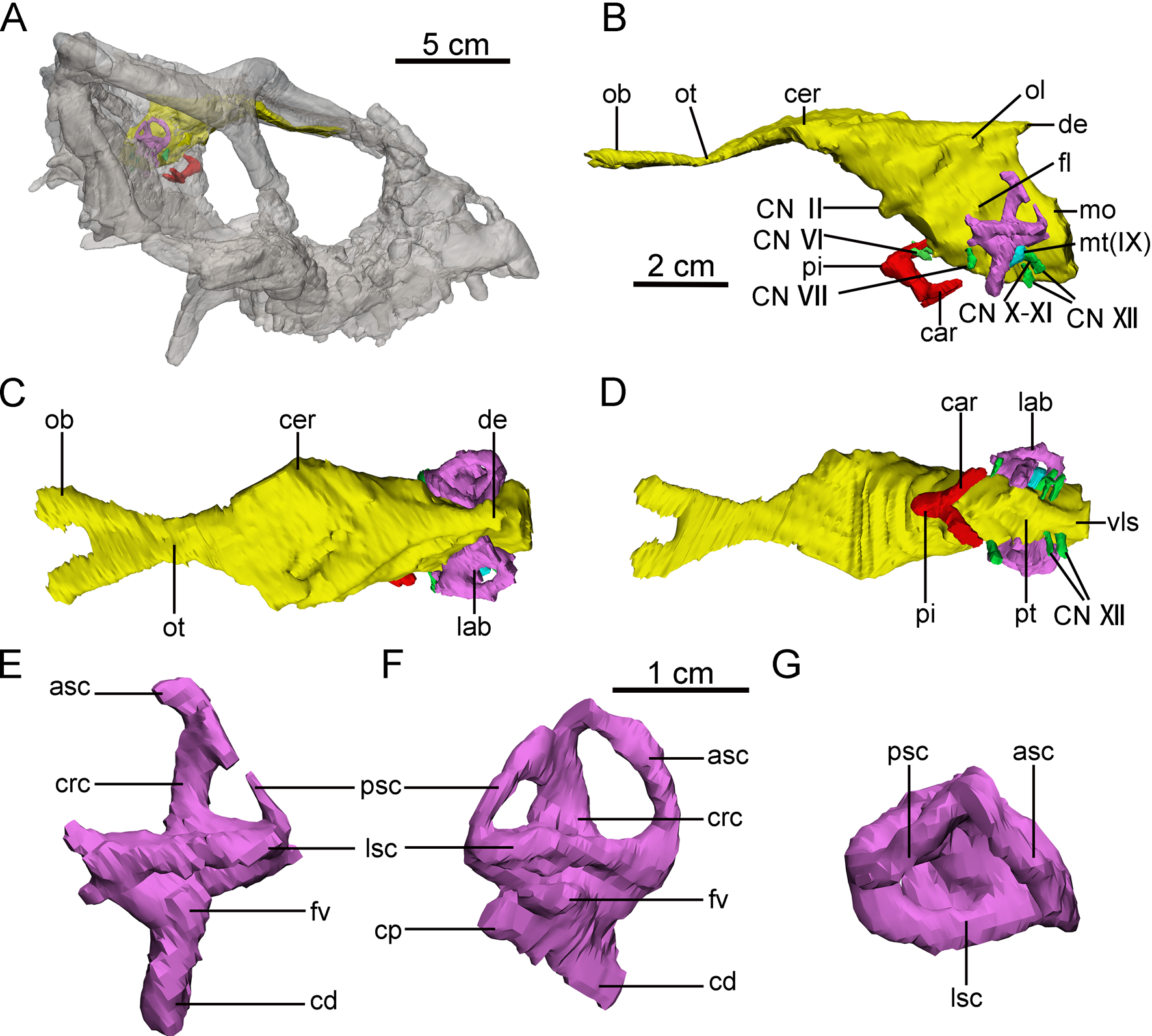
The skull of IVPP V18637 is slightly compressed dorsolaterally and the braincase is well preserved. For the sake of simplicity, we refer to the digital casts of bone-bounded spaces that housed soft tissue as if they were the structures themselves. The digital reconstructions include the braincase (Supplementary Fig. A1), the cranial endocast, the endosseous labyrinth, the endocranial vasculature, and the cranial nerves (Fig. 1).
The 3D reconstructions of the skull, cranial endocast, and endosseous labyrinth of Yinlong downsi (IVPP V18637). Skull in lateral view (A). Cranial endocast in left lateral (B), dorsal (C), and ventral (D) views. Left endosseous labyrinth (E) and right endosseous labyrinth (F) in lateral view. Right endosseous labyrinth in dorsal view (G). Brain endocast is represented by yellow; cranial nerves by green; cerebral carotid artery and pituitary by red; metotic fissure by cyan; endosseous labyrinth by purple. Abbreviations: asc, anterior semicircular canal; cd, cochlear duct (cochlearis); car, cerebral carotid artery canal; cer, cerebrum; cp, complex of metotic fissure and CN IX-XI; crc, crus commune; de, dural peak; fl, flocculus; fv, fenestra ovalis (foramen vestibuli); lab, endosseous labyrinth; lsc, lateral semicircular canal; mo, medulla oblongata; mt(IX), the canal for CN IX (glossopharyngeal nerve) and the metotic fissure; ob, olfactory bulb; ol, optic lobe; ot, olfactory tract; pi, pituitary fossa; pt, prismatic protuberance; psc, posterior semicircular canal; vls, ventral longitudinal sinus. CN II, optic nerve canal; CN VI, abducens nerve canal; CN VII, facial nerve canal; CN X-XI, vagus and accessory nerves; CN XII, hypoglossal nerve canal.

Cranial Endocast
In IVPP V18637, the olfactory bulbs, the olfactory tract, the cerebrum, the optic lobe, the cerebellum, the pituitary, and the medulla oblongata are well reconstructed (Fig. 1A–D). Because it is not enclosed by bone, the ventral part of the olfactory region cannot be reconstructed (Fig. 1D). In dorsal view, the rostralmost part of the endocast is the oval olfactory bulbs (ob) which appear asymmetric due to compression (Fig. 1C). The olfactory bulbs are impressed into the ventral surface of the frontal bone. Caudally, the olfactory tract (Fig. 1C, ot) narrows from the olfactory bulbs and gradually widens, contacting the cerebrum after reaching its narrowest point. Caudal to the olfactory tract is the cerebrum (Fig. 1C, cer), visible as a rounded lateral swelling in the forebrain (Fig. 1B). The dorsal surface of the cerebrum is flat, as in Psittacosaurus (Zhou et al. Reference Zhou, Gao, Fox and Du2007: fig. 2; Napoli et al. Reference Napoli, Hunt, Erickson and Norell2019: fig. 13),
Medial to the semicircular canals exists a pyramidal process projecting into the ring formed by the anterior semicircular canal (asc) and the crus commune, but not extending past it (Fig. 1B,C). The process is identified as the flocculus (fl) wrapped by the prootic (Fig. 1B). A relatively large flocculus is also known in Psittacosaurus and Liaoceratops (Sakagami et al. Reference Sakagami, Kawabe, Hattori, Wenjie and Xinsheng2023: fig. 3; Yang et al. Reference Yang, Gong, Zhao, Wu, Godefroit and Hu2023: fig. 2). The flocculus plays a role in gaze stabilization and coordinating eye movements during movements of the head, the neck, and the body (Walsh et al. Reference Walsh, Iwaniuk, Knoll, Bourdon, Barrett, Milner, Nudds, Abel and Sterpaio2013). It is relatively small in most dinosaurs compared with that of flying reptiles and avians (Witmer et al. Reference Witmer, Chatterjee, Franzosa and Rowe2003: fig. 2; Walsh et al. Reference Walsh, Iwaniuk, Knoll, Bourdon, Barrett, Milner, Nudds, Abel and Sterpaio2013).
The midbrain is caudal to the cerebrum (Fig. 1B). The position of the optic lobes has been debated, and some researchers suggest that the optic lobes in ceratopsids are not visible (Hopson Reference Hopson1979: figs. 22, 23; Witmer and Ridgely Reference Witmer, Ridgely, Currie and Tanke2008: fig. 2). However, in Yinlong, low swellings rostral to the dural peak and caudal to the cerebrum are identified as the optic lobes, similar to that in Psittacosaurus (Zhou et al. Reference Zhou, Gao, Fox and Du2007: fig. 2; Fig. 1B). Caudal to the optic lobes is a caudally directed protuberance that is nearly parallel to the medulla oblongata and represents the dural peak (de), as seen in other dinosaurs (Yang et al. Reference Yang, Gong, Zhao, Wu, Godefroit and Hu2023: fig. 2; Fig. 1B). It was identified as the “cartilage area of the supraoccipital” by Zhou et al. (Reference Zhou, Gao, Fox and Du2007). In lateral view, and below the dural peak, the posterior edge of the cerebellum descends steeply to the medulla oblongata at an angle of 70°. This angle is larger than that in Psittacosaurus (Zhou et al. Reference Zhou, Gao, Fox and Du2007: fig. 2; Fig. 1B). In ceratopsids, a smoother transition lacking this steep angle is seen between the cerebellum and medulla oblongata (Brown Reference Brown1914: plate XXXIV; Witmer and Ridgely Reference Witmer, Ridgely, Currie and Tanke2008: fig. 2; Sakagami and Kawabe Reference Sakagami and Kawabe2020: fig. 2).
The ventral surface of the medulla oblongata (mo) is nearly parallel to the dorsal surface of the endocast rostral to the dural peak, which is the primitive archosaur pattern (Giffin Reference Giffin1989). The medulla oblongata narrows rostrodorsally and is constricted at the level of the otic capsule as in other dinosaurs (Hopson Reference Hopson1979). The endocast in Yinlong shows a longitudinal ridge ventral to the medulla oblongata that extends forward from the foramen magnum and widens immediately caudal to the constriction forming the prismatic protuberance (pt), as reported in Psittacosaurus (Zhou et al. Reference Zhou, Gao, Fox and Du2007: fig. 3; Fig. 1D). The ventral longitudinal ridge has been identified as the sinus for the basilar artery in Psittacosaurus, Pachyrhinosaurus, and Triceratops (Forster Reference Forster1996: fig. 8; Zhou et al. Reference Zhou, Gao, Fox and Du2007: fig. 2; Witmer and Ridgely Reference Witmer, Ridgely, Currie and Tanke2008: fig. 2), and the ventral longitudinal sinus (vls) is a common feature of archosaur endocasts (Witmer and Ridgely Reference Witmer, Ridgely, Currie and Tanke2008: fig. 2). In ventral view, the center of the prismatic protuberance bears a slight pit caused by the tuber of the basioccipital (Fig. 1D).
The cast of the pituitary fossa (pi) is identified by the cavity of the basisphenoid and accompanied by the paired cerebral (internal) carotid arteries ventrally (Fig. 1B). The pituitary is ovoid-shaped with a tuber projecting caudally and constricting at contact with the cerebral carotid arteries (Fig. 1B, car). Differing from Auroraceratops, Protoceratops, Anchiceratops, and Triceratops (Brown Reference Brown1914; Brown and Schlaikjer Reference Brown and Schlaikjer1940; Forster Reference Forster1996; Zhang et al. Reference Zhang, King, Li, Hou and You2020), in Yinlong, the pituitary fossa ends above the level of the ventral margin of the medulla oblongata as in Psittacosaurus (Zhou et al. Reference Zhou, Gao, Fox and Du2007; Napoli et al. Reference Napoli, Hunt, Erickson and Norell2019).
Inner Ear
Caudolateral to the cerebellum is the endosseous labyrinth (lab) of the inner ear, represented on both sides, and three semicircular canals on the right side. The right cochlear duct (cd) is only partially complete in our CT data due to the poorly preserved right exoccipital (Fig. 1F). Fortunately, the left cochlear duct is well preserved, although it may be compressed and stretched somewhat due to distortion (Fig. 1C). Hence, the complete morphology of the endosseous labyrinth in Yinlong can be reconstructed.
The upper part of the endosseous labyrinth is composed of the semicircular canals and the vestibule. The anterior semicircular canal (asc) is the largest and is similar to those of Psittacosaurus and Liaoceratops (Zhou et al. Reference Zhou, Gao, Fox and Du2007: fig. 2; Fig. 1F). The semicircular canals in Yinlong are relatively stocky, and the crus commune (crc) is almost twice as wide as the vertical semicircular canals as in Psittacosaurus, Liaoceratops, and Protoceratops (Brown and Schlaikjer Reference Brown and Schlaikjer1940: plate XII; Bullar et al. Reference Bullar, Zhao, Benton and Ryan2019: fig. 13; Yang et al. Reference Yang, Gong, Zhao, Wu, Godefroit and Hu2023: fig. 3). In ceratopsids, the semicircular canals are nearly as wide as the crus commune (Brown Reference Brown1914: plate XXXIV; Brown and Schlaikjer Reference Brown and Schlaikjer1940: plate XII; Witmer and Ridgely Reference Witmer, Ridgely, Currie and Tanke2008: fig. 3; Sakagami and Kawabe Reference Sakagami and Kawabe2020: fig. 3). The anterior semicircular canal and posterior semicircular canal (psc) both ascend from the dorsal side of the crus commune and then diverge at nearly a right angle (Fig. 1G), which also occurs in Psittacosaurus and Liaoceratops (Bullar et al. Reference Bullar, Zhao, Benton and Ryan2019: fig. 13; Yang et al. Reference Yang, Gong, Zhao, Wu, Godefroit and Hu2023: fig. 3). This angle is usually obtuse in Protoceratops and ceratopsids (Brown Reference Brown1914; Brown and Schlaikjer Reference Brown and Schlaikjer1940; Witmer and Ridgely Reference Witmer, Ridgely, Currie and Tanke2008; Sakagami and Kawabe Reference Sakagami and Kawabe2020). In addition, the anterior semicircular canal ascends significantly higher than the posterior semicircular canal, similar to the situation in other early-diverging ceratopsians. The lateral semicircular canal (lsc) is relatively stocky and widens at both ends (Fig. 1G).
The lower part of the endosseous labyrinth comprises the cochlear duct (cd) and the fenestra ovalis (fv) (Fig. 1E). In lateral view, the relatively long cochlear duct projects well below the fenestra ovalis (Fig. 1E). In Yinlong, the cochlear duct lies next to the metotic fissure (mt), as in Psittacosaurus and Liaoceratops (Figs. 1B, 2B and 3A). The basilar papilla housed within the cochlear duct is closely correlated with hearing frequency sensitivity (Manley Reference Manley1972).
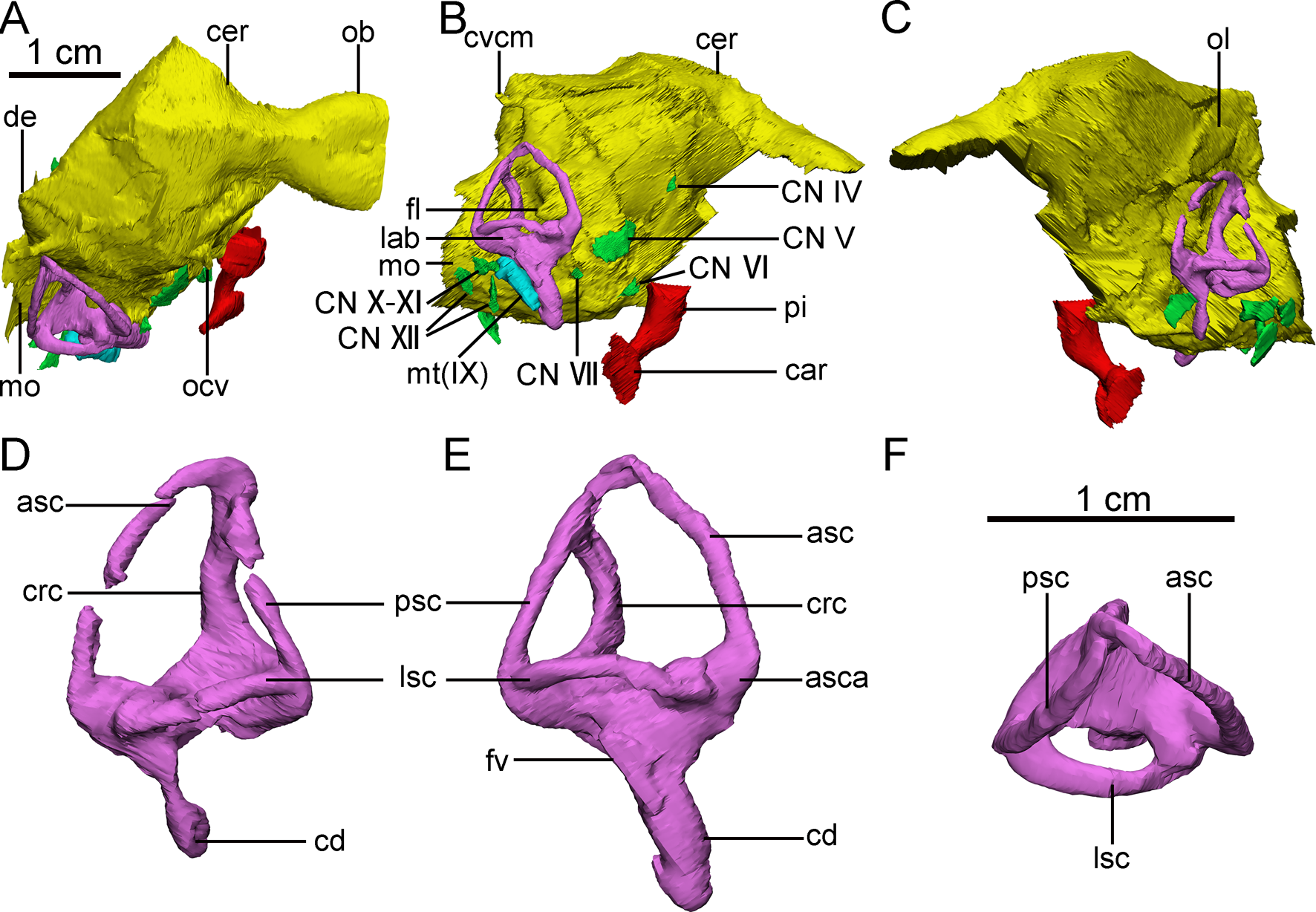
The 3D reconstructions of cranial endocast and endosseous labyrinth of Liaoceratops (IVPP V12738). Cranial endocast in dorsal (A), right lateral (B), and left lateral (C) views. Left endosseous labyrinth (D) and right endosseous labyrinth (E) in lateral view. Right endosseous labyrinth in dorsal view (F). Abbreviations: asca, ampulla of the anterior semicircular canal; cvcm, caudal middle cerebral vein; ocv, orbitocerebral vein canal; CN IV, trochlear nerve canal; CN V, trigeminal nerve canal. See Fig. 1 caption for other abbreviations.

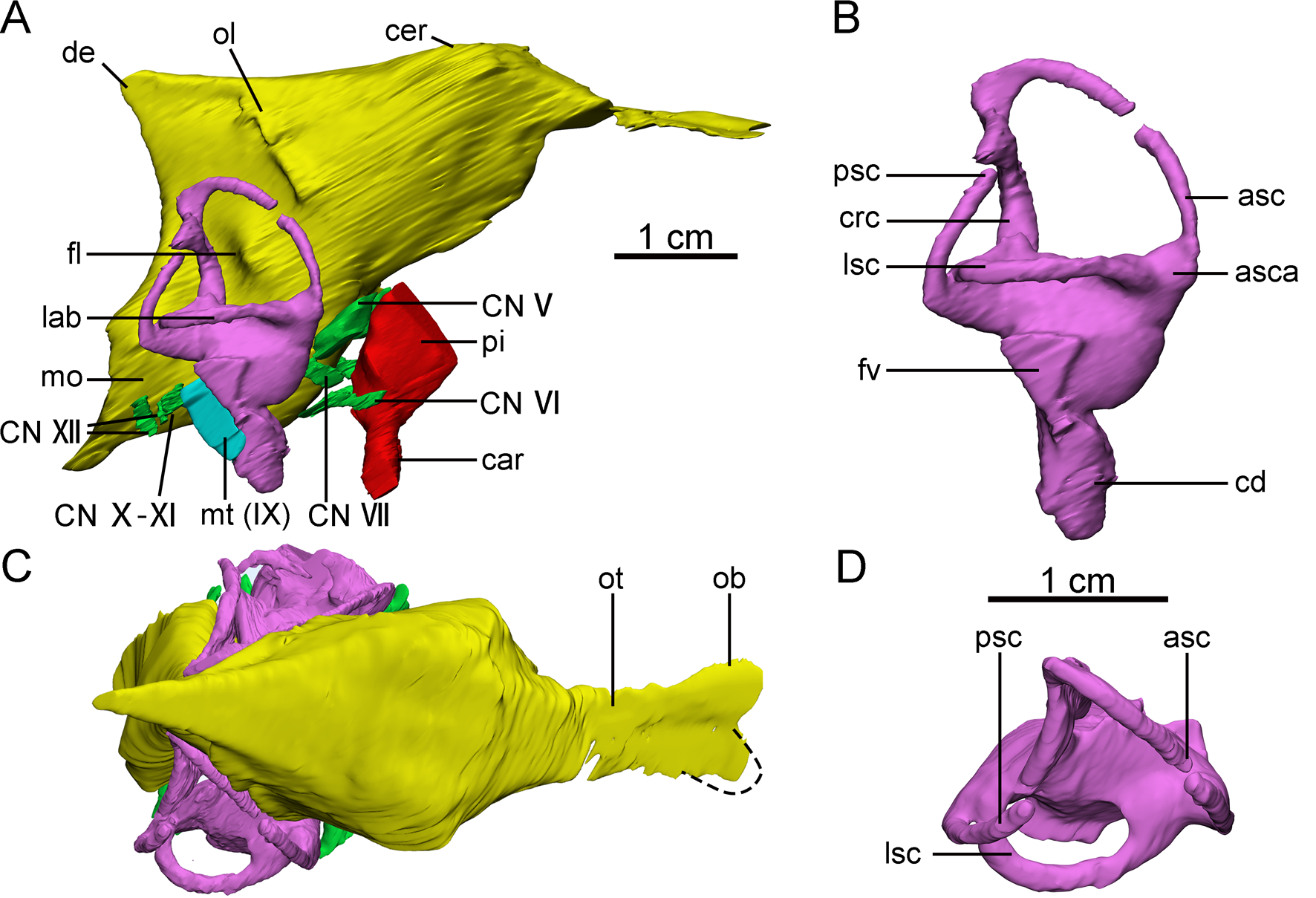
3D reconstructions of cranial endocast and endosseous labyrinth of Psittacosaurus (CUGW VH104). Cranial endocast in right lateral (A) and dorsal (C) views. Right endosseous labyrinth in lateral (B) and dorsal (D) views. The dotted line represents the possible morphology of the damaged right olfactory bulb. See Fig. 1 and Fig. 2 captions for abbreviations.

Cranial Nerves
The optic nerve (CN II) canal exits the braincase through the optic foramen immediately rostrodorsal to the pituitary fossa and passes rostroventrally through the laterosphenoid (Fig. 1B). The abducens nerve (CN VI) canal is narrow and surrounded by the basisphenoid. CN VI extends from the brain cavity toward the pituitary and is oriented rostrodorsally (Fig. 1B). In Pachyrhinosaurus, Triceratops, and Anchiceratops, CN VI passes rostroventrally from the rostroventral end of the medulla through both sides of the pituitary (Brown Reference Brown1914: plate XXXIV; Witmer and Ridgely Reference Witmer, Ridgely, Currie and Tanke2008: fig. 2; Sakagami and Kawabe Reference Sakagami and Kawabe2020: fig. 2). The facial nerve (CN VII) canal is observed on both sides of IVPP V18637 and situated rostral to the endosseous labyrinth as in Psittacosaurus and Pachyrhinosaurus (Witmer and Ridgely Reference Witmer, Ridgely, Currie and Tanke2008; Napoli et al. Reference Napoli, Hunt, Erickson and Norell2019). The glossopharyngeal nerve (CN IX) canal exits the braincase from the metotic fissure on the left side. The vagus and accessory nerve (CN X–XI) canals are posterior to CN IX and exit the braincase from a common canal on the left side. The hypoglossal nerve (CN XII) canal bears two branches of CN XII on both sides (Fig. 1D), whereas only one branch is preserved in Protoceratops and ceratopsids (Brown Reference Brown1914; Brown and Schlaikjer Reference Brown and Schlaikjer1940; Witmer and Ridgely Reference Witmer, Ridgely, Currie and Tanke2008; Sakagami and Kawabe Reference Sakagami and Kawabe2020). The rostral branch on the right side may be reconstructed in the otic capsule because of a broken bony boundary.
Endocranial Vasculature
As for the intraneurocranial vasculature of Yinlong, only the cerebral carotid arteries could be reconstructed entirely (Fig. 1D). The rostral part of cerebral carotid arteries is wrapped by the basisphenoid and the caudal part by the exoccipital. The left and right cerebral carotid arteries join as they enter the pituitary fossa. They curve caudolaterally at 120° from each other immediately below the pituitary fossa, as in other ceratopsians.
Additional Endocranial Features of Liaoceratops yanzigouensis
Recently, the endocranial morphology of Liaoceratops has been studied by Yang et al. (Reference Yang, Gong, Zhao, Wu, Godefroit and Hu2023). The endocast of the holotype of Liaoceratops (IVPP V12738) reconstructed here provides some new information, with most structures preserved (Fig. 2). Here, we describe some previously undescribed neuroanatomical characteristics.
In dorsal view, the olfactory bulbs are well preserved and symmetric, appearing oval in shape. The olfactory bulbs are separate and diverge from the midline at an acute angle (Fig. 2A). The olfactory tract of Liaoceratops is short and wide with a longitudinal ridge, as in PMoL-AD00097 (reported by Yang et al. Reference Yang, Gong, Zhao, Wu, Godefroit and Hu2023) on the dorsal surface, but differing from the olfactory tracts of Yinlong, Psittacosaurus, and Auroraceratops (Zhang et al. Reference Zhang, King, Li, Hou and You2020: fig. 3; Fig. 2A). Due to compression, the right part of the olfactory tract appears fused with the cerebrum (Fig. 2B). Likewise, the ventral part of the olfactory region cannot be reconstructed, as it is not enclosed by bone.
Additional features of IVPP V12738 were previously unknown or unlike the condition in PMoL-AD00097 (Yang et al. Reference Yang, Gong, Zhao, Wu, Godefroit and Hu2023). Caudal to the olfactory tract, the cerebrum occurs as a slightly pointed swelling (Fig. 2B). In dorsal view, the right surface of the cerebrum shows the orbitocerebral vein (Fig. 2A, ocv) projecting laterodorsally. The left orbitocerebral vein is not preserved, possibly due to the deformation of the braincase. In left lateral view, the optic lobe is located caudoventral to the cerebrum and visible as a large swelling immediately above the labyrinth (Fig. 2C). The right flocculus is a wedge-shaped tuber projecting caudally and extends laterally past the ring formed by the anterior semicircular canal and the crus commune (Fig. 2B). It is relatively larger than the flocculus in PMoL-AD00097 (Yang et al. Reference Yang, Gong, Zhao, Wu, Godefroit and Hu2023: fig. 2). The right caudal middle cerebral vein (cvcm) is located immediately below the dural peak and projects caudally (Fig. 2B).
The endosseous labyrinth of the inner ear on both sides is situated lateral to the cerebellum and rostral to the medulla oblongata (Fig. 2D,F). The anterior semicircular canal and posterior semicircular canal are siphonate and form a slightly acute angle to one another in dorsal view (Fig. 2F). In dorsal view, the lateral semicircular canal widens to the junction with the posterior semicircular canal (Fig. 2F). The crus commune is almost twice as wide as the vertical semicircular canals. The lower part of the inner ear, the cochlear duct, is elongated and relatively long.
The facial nerve (CN VII) is present in IVPP V12738. CN VII is situated below the anterior semicircular canal and extends laterally from the brain cavity (Fig. 2B).
Additional Endocranial Features of Psittacosaurus lujiatunensis
The endocast of Psittacosaurus has been well studied in previous works (Zhou et al. Reference Zhou, Gao, Fox and Du2007; Bullar et al. Reference Bullar, Zhao, Benton and Ryan2019; Napoli et al. Reference Napoli, Hunt, Erickson and Norell2019; Sakagami et al. Reference Sakagami, Kawabe, Hattori, Wenjie and Xinsheng2023). However, the endocast of Psittacosaurus (CUGW VH104) reconstructed here provides additional new information about neuroanatomical characteristics (Fig. 3), including the relatively complete cochlear duct for the first time.
In CUGW VH104, the olfactory bulbs are separate and oval (Fig. 3C). In lateral view, medial to the endosseous labyrinth, lies the flocculus (Fig. 3A). The flocculus is relatively wide and does not exceed the plane composed of the anterior semicircular canal and the crus commune and is smaller than those in ZMNH M12414 and ZMNH M12423 (Sakagami et al. Reference Sakagami, Kawabe, Hattori, Wenjie and Xinsheng2023: fig. 5). The size of the flocculus is larger than that of Yinlong and smaller than that of Liaoceratops. In the upper part of the inner ear, the semicircular canals are elongated, as in previous studies (Fig. 3B,C). The fenestra ovalis is situated rostral to the metotic fissure and these two are separated by a thin ridge. The cochlear duct of Psittacosaurus is relatively longer than those of late-diverging ceratopsids.
Sense of Smell
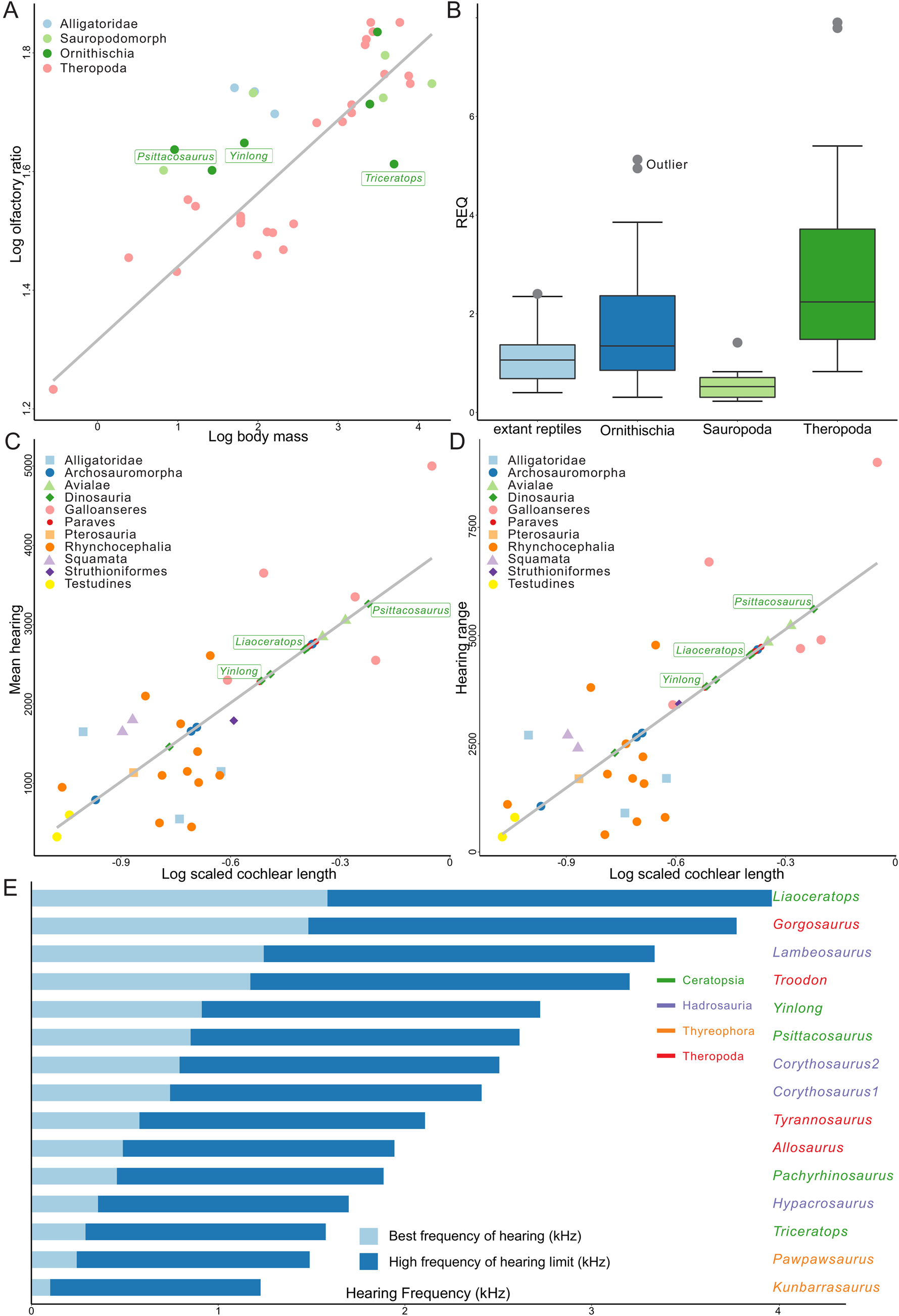
Olfactory acuity was explored by Sakagami and Kawabe (Reference Sakagami and Kawabe2020) in a scatter plot showing the relationship between body mass and olfactory ratio. The ceratopsid Triceratops plotted well below the regression line, indicating that its olfactory acuity was lower than that in both ornithopods and theropods with similar body mass. When the early-diverging ceratopsians Yinlong and Psittacosaurus are added to this dataset, they plot above the regression line, indicating higher olfactory acuity than theropods with similar body size (Fig. 4A). In addition, the olfactory acuity of Liaoceratops (53.24%) is higher than that of both Psittacosaurus (43.35%) and Yinlong (44.6%).
Comparison of sensorineural attributes and endocranial capabilities based on the quantitative evaluations of the endocasts in amniotes. (A) Relationship between olfactory ratio and body mass for dinosaurs and crocodilians (data from Zelenitsky et al. Reference Zelenitsky, Therrien and Kobayashi2009; Sakagami and Kawabe Reference Sakagami and Kawabe2020); (B) reptile encephalization quotient (REQ) of three dinosaur clades and extant reptiles; (C) the estimated mean hearing sensitivities and (D) the estimated hearing range inferred from the cochlear length based on interpolation of three ceratopsians into the plots of Walsh et al. (Reference Walsh, Barrett, Milner, Manley and Witmer2009) and Hanson et al. (Reference Hanson, Hoffman, Norell and Bhullar2021); (E) best frequencies of hearing and high frequency of hearing limit for selected dinosaurs (modified from Sakagami and Kawabe Reference Sakagami and Kawabe2020). The figure 4 is produced from Supplementary data S1–S4.

Reptile Encephalization Quotient (REQ)
The volume of the brain endocast only includes the forebrain, the midbrain, and the hindbrain. Based on the smallest femoral circumference (about 100 mm in IVPP V18637), the body mass is about 66.834 kg. Therefore, REQ using 73% of brain volume is 1.49 (Table 1). As mentioned earlier, the braincase of IVPP V18637 shows some gentle degree of compression. As a result, the REQ for Yinlong might have been slightly higher. In the same way, we calculated the REQ of Psittacosaurus to be about 2.43 (Table 1). Theropods are characterized by relatively high REQ values (0.83–7.91) (Fig. 4B).
Endocranial volume, body mass, brain-to-endocast (BEC) index, and reptile encephalization quotient (REQ) of known ceratopsians. Abbreviations: EV, endocranial volume (expressed as the mass in Protoceratops); M bd, body mass; V br, brain volume; V bd, body volume. The data for Protoceratops and Triceratops (A and B) come from Hurlburt (Reference Hurlburt1996).

Hearing Ability
Following Gleich et al. (Reference Gleich, Dooling and Manley2005), the optimal hearing frequency for Yinlong is estimated at 913 Hz. The highest hearing frequency limit of Yinlong is 2726 Hz. Psittacosaurus has a similar range of hearing frequency as Yinlong, and Liaoceratops is estimated to have the highest hearing frequency and the widest range of hearing frequencies (Fig. 4E). Compared with ceratopsids, early-diverging ceratopsians have relatively higher hearing frequencies and wider optimal hearing frequencies (Fig. 4E). Similar to Lambeosaurus and theropods, early-diverging ceratopsians appear to have been adapted to hear higher-frequency sounds (Fig. 4E).
The cochlear duct (cd) length of IVPP V18637 is 11.06 mm, and its basicranial length is 36.29 mm. Following the equation of Walsh et al. (Reference Walsh, Barrett, Milner, Manley and Witmer2009), the estimated mean hearing sensitivity and the estimated hearing range are about 2292.46 Hz and 3825.91 Hz in Yinlong, 3262.19 Hz and 5613 Hz in Psittacosaurus, and 2683.18 Hz and 4546.19 Hz in Liaoceratops, respectively (Fig. 4C,D).
Discussion
Head Posture
When animals are alert and in a habitual stance, they tend to hold their heads in an orientation that places the lateral semicircular canal roughly in the horizontal plane (Witmer et al. Reference Witmer, Chatterjee, Franzosa and Rowe2003, Reference Witmer, Ridgely, Dufeau, Semones, Endo and Frey2008; Coutier et al. Reference Coutier, Hautier, Cornette, Amson and Billet2017). Therefore, the typical head posture of extinct animals can be evaluated by orienting the lateral semicircular canal horizontally. However, Taylor et al. (Reference Taylor, Wedel and Naish2009) pointed out that in living tetrapods the lateral semicircular canal is not always held horizontally. Despite these flaws, the orientation of the lateral semicircular canal is often used as a proxy for the head posture, especially in paleontological studies (Witmer et al. Reference Witmer, Chatterjee, Franzosa and Rowe2003; Coutier et al. Reference Coutier, Hautier, Cornette, Amson and Billet2017).
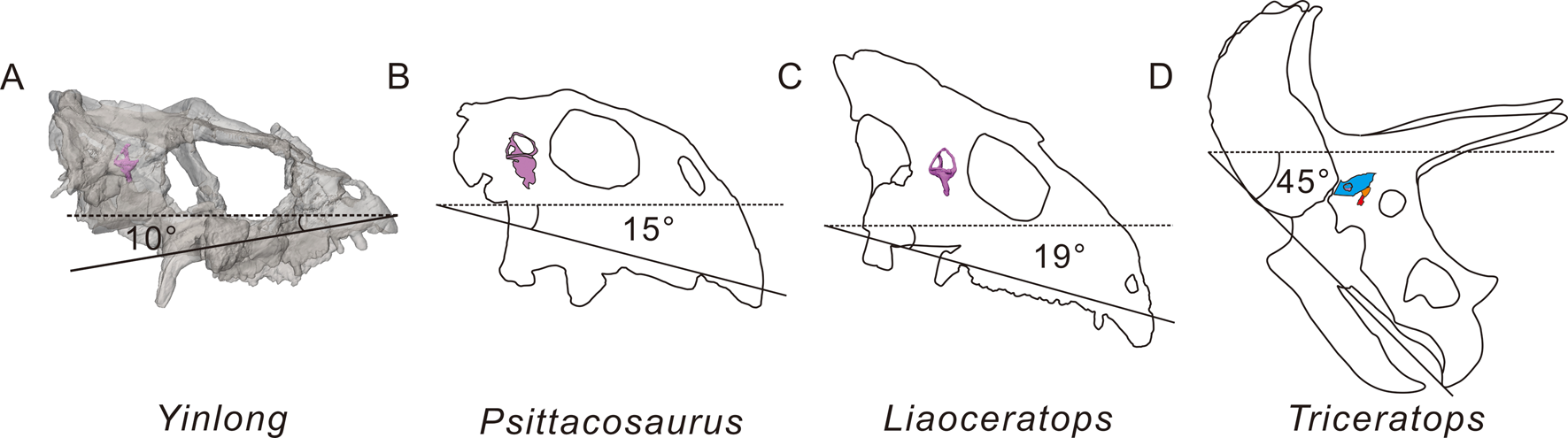
Previous researchers have demonstrated that the head postures of dinosaurs and other archosaurs were rather variable, even within a clade (Witmer et al. Reference Witmer, Chatterjee, Franzosa and Rowe2003, Reference Witmer, Ridgely, Dufeau, Semones, Endo and Frey2008). We adjusted our 3D models to place the lateral semicircular canal horizontally (dotted line) and parallel to the ground (Fig. 5). Uniquely, Yinlong has a head posture in which the palatal plane is inclined approximately 10° above the horizontal plane (Fig. 5A). In Psittacosaurus, the palatal plane is usually below the horizontal plane, and the angles between the lateral semicircular canal and the palatal plane are variable in the ontogenetic series of Psittacosaurus but show a clear trend of convergence (Bullar et al. Reference Bullar, Zhao, Benton and Ryan2019). The angle changes from 38° in the hatchling stage, to 25° in the juvenile, and to 15° in the adult (Fig. 5B), which is consistent with the suggested posture shift from quadrupedal to bipedal during growth (Zhao et al. Reference Zhao, Benton, Sullivan, Martin Sander and Xu2013a; Bullar et al. Reference Bullar, Zhao, Benton and Ryan2019). Liaoceratops has a head posture similar to Psittacosaurus with an angle of about 19° (Fig. 5C). In Triceratops, orienting the lateral semicircular canal horizontally results in a head posture such that the palatal plane was inclined approximately 45° below the horizontal plane (Sakagami and Kawabe Reference Sakagami and Kawabe2020; Fig. 5D).
Comparison of the alert head posture in Ceratopsia when the lateral semicircular canal is horizontal and parallel to the ground. (A) IVPP V18637; (B) IVPP V12617; (C) IVPP V12738; (D) FPDM-V-9775. The 3D model of Yinlong is flipped horizontally, because the right side of the skull is deformed. Psittacosaurus is modified from Bullar et al. (Reference Bullar, Zhao, Benton and Ryan2019) and flipped horizontally. Triceratops is modified from Sakagami and Kawabe (Reference Sakagami and Kawabe2020) and flipped horizontally.

In general, skulls in ceratopsians displays a transition from the upward palatal posture in Yinlong, to a slight downward posture in Psittacosaurus and Liaoceratops, to 45° below the horizontal plane in Triceratops. Browsers (upward or horizontal) are expected to hold their heads higher than grazers (downward foragers) and mixed feeding species (closer to horizontal than a downward inclination) (Schellhorn Reference Schellhorn2018). Therefore, Yinlong is possibly a browser, whereas Psittacosaurus, Liaoceratops, and Triceratops, which bear a downward head posture, are possibly mixed feeders or grazers.
In late-diverging ceratopsians, frills and horns are large and exaggerated. Knapp et al. (Reference Knapp, Knell and Hone2021) suggested that the frill functioned as a sociosexual signal in ceratopsian dinosaurs. It is advantageous for ceratopsids and other late-diverging ceratopsians with exaggerated ornamentation to hold their heads at an efficient angle for displaying frills and horns, such as at 45° below the horizontal plane, as in Triceratops (Fig. 5D). This suggests that feeding style is not the only factor that affect head posture.
The Evolution of Endocast Morphology in Cerapoda
The endocasts of Yinlong, Psittacosaurus, and Liaoceratops described here offer an excellent opportunity for comparing the endocasts of different ceratopsians in order to understand the early evolution of the endocast in Ceratopsia. In addition, the endocasts of ceratopsians can be compared with those of known ornithopods to investigate the evolution of ornithischian neuroanatomy.
Cranial Endocast Comparative Anatomy
In Yinlong, Psittacosaurus, Liaoceratops, and Auroraceratops (Zhang et al. Reference Zhang, King, Li, Hou and You2020), the olfactory bulbs are oval and separate from one another along the midline, which differs from ceratopsids, in which the olfactory bulbs contact each other (Witmer and Ridgely Reference Witmer, Ridgely, Currie and Tanke2008; Sakagami and Kawabe Reference Sakagami and Kawabe2020). Among Ceratopsia, Liaoceratops has the relatively largest olfactory bulbs (olfactory ratio: 53.24%) followed by Yinlong and Psittacosaurus (44.60% and 43.35%, respectively). Ceratopsids (Pachyrhinosaurus and Triceratops) have the smallest olfactory bulbs (34.34% and 40.98%, respectively). Additionally, the olfactory tracts of Yinlong and Psittacosaurus develop longitudinal compression on the dorsal surface (Figs. 1C, 3C), while Liaoceratops and ceratopsids develop a longitudinal ridge.
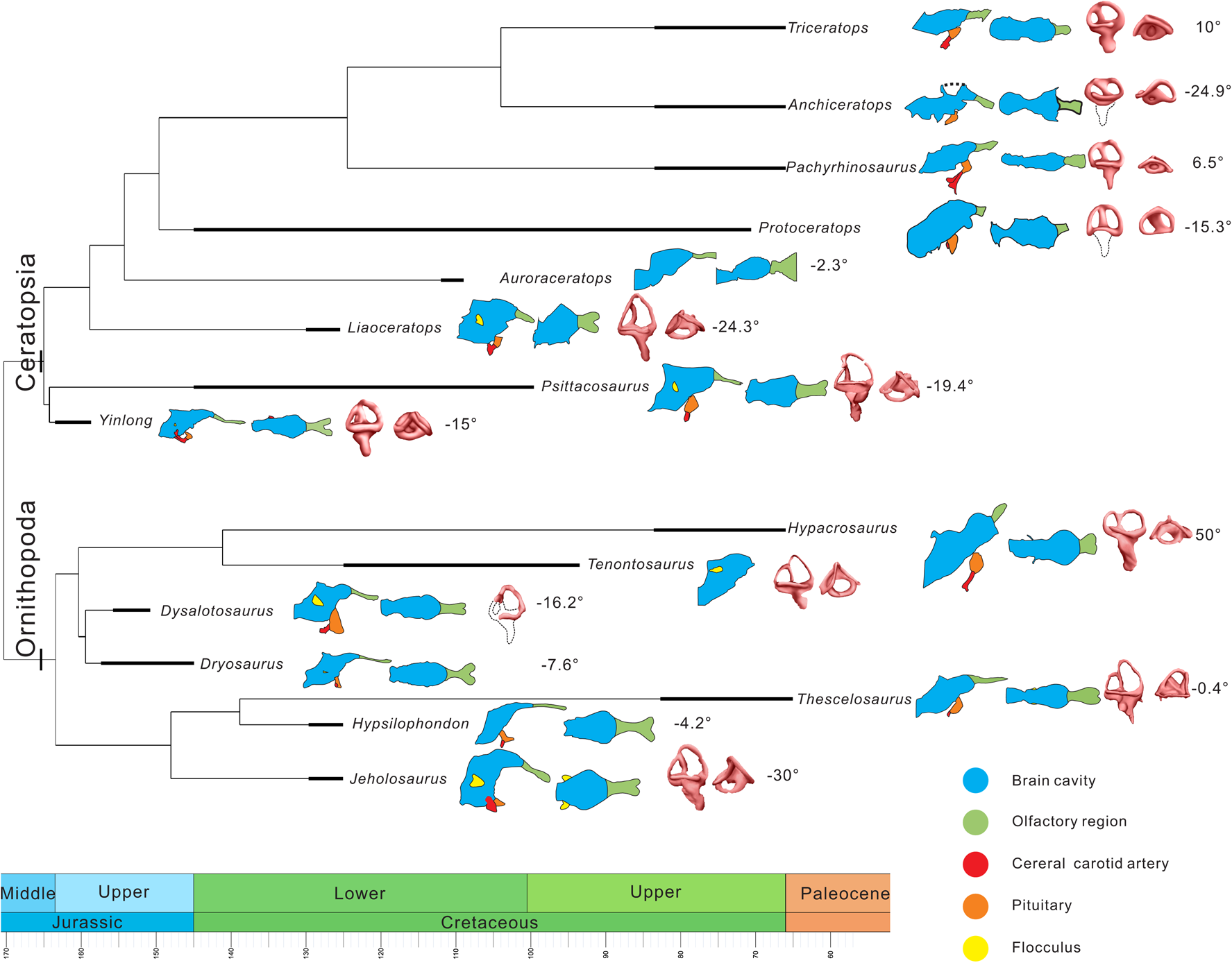
In Cerapoda, most groups have olfactory bulbs that diverge from the midline at an acute angle, with the exception of late-diverging ceratopsids and hadrosaurids (Fig. 6). We adjusted the endocast of these taxa to place the lateral semicircular canal horizontally and found that the orientation of the olfactory region also changes in ceratopsians and ornithopods. In Ceratopsia, the angle between the olfactory region and horizontal plane changes from 15° downward (Yinlong) to 10° upward (Triceratops) (Fig. 6). In Ornithopoda, the angle changes from 30° downward (Jeholosaurus) to 50° upward (Hypacrosaurus) (Fig. 6). In general, the olfactory region in Ceratopsia and Ornithopoda underwent similar transformations, including the fusing of the olfactory bulbs, the raising of the olfactory region, and the shortening of the olfactory tracts. Ceratopsians are different from Ornithopoda in that their olfactory bulbs narrow during their evolution. Large olfactory bulbs typically also occur in some predatory theropods such as Allosaurus (Rogers Reference Rogers1999) and Tyrannosaurus (Brochu Reference Brochu2000), which may indicate an adaptation for seeking out prey. Large olfactory bulbs in early-diverging ceratopsians no doubt play a very different role. In Pachyrhinosaurus and Triceratops, the olfactory bulbs became narrower than the midbrain. Similarly, the acuity of the sense of smell also was lower than in theropods (Fig. 4A).
Comparison of cranial endocasts and endosseous labyrinth in Ornithischia, displayed on a cladogram. Hypsilophodon, Thescelosaurus, and Dryosaurus from Galton (Reference Galton1989) and Button and Zanno (Reference Button and Zanno2023). Dysalotosaurus from Lautenschlager and Hübner (Reference Lautenschlager and Hübner2013). Tenontosaurus from Thomas (Reference Thomas2015). Hypacrosaurus from Evans et al. (Reference Evans, Ridgely and Witmer2009). Auroraceratops from Zhang et al. (Reference Zhang, King, Li, Hou and You2020). Protoceratops from Brown and Schlaikjer (Reference Brown and Schlaikjer1940). Pachyrhinosaurus from Witmer and Ridgely (Reference Witmer, Ridgely, Currie and Tanke2008). Anchiceratops from Brown (Reference Brown1914). Triceratops from Sakagami and Kawabe (Reference Sakagami and Kawabe2020). Parts of endocasts and inner ears have been rotated or flipped to maintain the same right lateral orientation. The inner ear of Yinlong consisted of the left lagena and the right semicircular canals. The black outlines represent the possible morphologies of the endosseous ducts. The angles signify the angle formed between the olfactory region and the horizontal line. Positive values indicate an upward direction, while negative values indicate a downward direction.

In Yinlong, Liaoceratops, and Psittacosaurus, the cerebrum extends laterally and forms two angular processes resulting in a nearly triangular dorsal surface of the brain cavity (Figs. 1C, 2A, 3C). In Auroraceratops and ceratopsids, the cerebrum also extends laterally but forms a nearly circular lateral surface, resulting in an elliptic dorsal surface (Witmer and Ridgely Reference Witmer, Ridgely, Currie and Tanke2008; Sakagami and Kawabe Reference Sakagami and Kawabe2020; Zhang et al. Reference Zhang, King, Li, Hou and You2020). In lateral view, the cerebrum in Yinlong is flat dorsally, whereas that in Psittacosaurus is slightly convex (Fig. 3A). In Liaoceratops, the cerebrum bears obvious swelling dorsally similar to late-diverging ceratopsians (Brown Reference Brown1914; Brown and Schlaikjer Reference Brown and Schlaikjer1940; Witmer and Ridgely Reference Witmer, Ridgely, Currie and Tanke2008; Sakagami and Kawabe Reference Sakagami and Kawabe2020; Zhang et al. Reference Zhang, King, Li, Hou and You2020). The cerebrum thus appears to transform from a flat dorsal surface to a rounded swelling during the evolution of Ceratopsia (Fig. 6). In Jeholosaurus and Hypsilophondon, the dorsal surface of the cerebrum is similar to that of early-diverging ceratopsians (Fig. 6). Therefore, the dorsal flat cerebrum may be the primitive character of Cerapoda.
Zhou et al. (Reference Zhou, Gao, Fox and Du2007) proposed that the orientation of the pituitary fossa housed in the basisphenoid exhibits two patterns in Ceratopsia. The pituitary fossa is caudoventrally directed in Psittacosaurus and Ceratopsidae (Witmer and Ridgely Reference Witmer, Ridgely, Currie and Tanke2008; Sakagami and Kawabe Reference Sakagami and Kawabe2020), but is vertically oriented in Protoceratops (Brown and Schlaikjer Reference Brown and Schlaikjer1940). In Liaoceratops, the pituitary fossa is also directed vertically (Fig. 6). In Ornithopoda, the pituitary fossa is directed caudoventrally (Fig. 6). Differing from Protoceratops and Anchiceratops, in which the cerebral carotid artery canals enter the lateral sides of the pituitary fossa (Brown and Schlaikjer Reference Brown and Schlaikjer1940), in other ornithischians, the cerebral carotid artery canals all enter the posteroventral side of the pituitary fossa.
Before this study, the flocculus had only been reported in Liaoceratops and Psittacosaurus among Ceratopsia (Sakagami et al. Reference Sakagami, Kawabe, Hattori, Wenjie and Xinsheng2023; Yang et al. Reference Yang, Gong, Zhao, Wu, Godefroit and Hu2023). Here, three additional specimens also preserve the flocculus. In Yinlong, the flocculus is a small pyramidal process. In Psittacosaurus, the flocculus is an elliptic process and does not extend beyond the ring formed by the anterior semicircular canal and the crus commune (Fig. 3A). Liaoceratops has the largest flocculus among Ceratopsia; it is a wedge-like process and extends beyond the anterior semicircular canal–crus commune ring. No flocculus is present in ceratopsids (Fig. 6). The disappearance of the flocculus in ceratopsians may indicate reduced head movement capability or a great reduction in size. Among Ornithopoda, early-diverging ornithopods Jeholosaurus and iguanodontids have a relatively larger flocculus (Fig. 6). During the evolution of Ornithopoda, the flocculus existed for a long period but disappeared in late-diverging hadrosaurids. Overall, the flocculus went through a similar pattern of change in Ceratopsia and Ornithopoda, which may correspond to the similar transformation in the locomotion mode and increased body size.
Inner Ear
The functional morphology and evolution of the endosseous labyrinth are important for understanding the sensory evolution and success of Ceratopsia and Ornithopoda. As in Psittacosaurus, Auroraceratops, Liaoceratops, and Protoceratops (Brown and Schlaikjer Reference Brown and Schlaikjer1940; Zhou et al. Reference Zhou, Gao, Fox and Du2007; Zhang et al. Reference Zhang, King, Li, Hou and You2020), the posterior semicircular canal in Yinlong is positioned near the foramen magnum, which differs from the posterior semicircular canal in Anchiceratops, Pachyrhinosaurus, and Triceratops, in which a relatively longer medulla oblongata results in the canals being located far rostral to the foramen magnum (Brown Reference Brown1914; Sakagami and Kawabe Reference Sakagami and Kawabe2020). As in more late-diverging ceratopsians (Brown Reference Brown1914; Brown and Schlaikjer Reference Brown and Schlaikjer1940; Sakagami and Kawabe Reference Sakagami and Kawabe2020), the semicircular canals in Yinlong are relatively short and thick, differing from those of Psittacosaurus and Liaoceratops, which have elongate and thin semicircular canals (Fig. 6). The anterior semicircular canal in early-diverging ceratopsians (Yinlong, Psittacosaurus, and Liaoceratops) ascends significantly higher than the posterior semicircular canal, while the anterior semicircular canal reaches a similar height in ceratopsids (Fig. 6). In addition, the angle between the anterior semicircular canal and posterior semicircular canal increased through the evolution of Ceratopsia.
In Ornithopoda, the endosseous labyrinth followed similar evolutionary patterns, in that early-diverging taxa have a higher and longer anterior semicircular canal and the angle between the anterior semicircular canal and posterior semicircular canal in late-diverging hadrosaurs becomes obtuse (Fig. 6). The semicircular canals of early-diverging ornithopods (e.g., Jeholosaurus) are flattened in contrast to the cylindrical condition in ceratopsians. The morphological difference of the vertical semicircular canals indicates that the sensory input for the reflexive stabilization of gaze and posture in later-diverging ceratopsians and hadrosaurids was lower than in early-diverging taxa. It has been suggested that bipedal dinosaurs exhibit a dorsoventrally tall anterior semicircular canal, while quadrupedal dinosaurs exhibit a horizontally broad anterior semicircular canal and the posterior semicircular canal (Hanson et al. Reference Hanson, Hoffman, Norell and Bhullar2021). However, iguanodontians (e.g., Tenontosaurus), which may be partially quadrupedal, also bear a tall anterior semicircular canal and orthogonal vertical semicircular canals (asc and posterior semicircular canal). Therefore, we conclude that the morphology of the semicircular canals may be influenced by indicators such as phylogeny.
The cochlear ducts of late-diverging ceratopsians relative to their heads are comparatively shorter than in early-diverging ceratopsians (Fig. 6). In Ornithopoda, early-diverging taxa also presented relatively elongated cochlear duct. Therefore, it can be postulated that the relatively elongated cochlear duct is a plesiomorphic trait that gradually shortens in late-diverging ceratopsians. However, late-diverging hadrosaurs also relatively retained long cochlear ducts and ornithopodans showed a different evolutionary pattern. As a ventrally extended cochlear duct has been linked to increased auditory acuity, perhaps the retention of this trait marked a significant increase in auditory ability, vocality, sociality, and cognition, all of which are thought to be integrally linked (Brown et al. Reference Brown, Butler, Ezcurra, Bhullar and Lautenschlager2020). Subsequently, the relatively elongated cochlear duct in early-diverging ceratopsians and ornithopods may contribute to complex social behaviors related to vocalization, as discussed earlier.
Behavior
The endocasts of three early-diverging ceratopsians provide associated structures as a basis for a realistic interpretation of paleobiology and behavior. Parental care or social behavior has been reported in some hadrosaurs (Horner and Makela Reference Horner and Makela1979; Horner Reference Horner2000). In lambeosaurines, the nasal crests have been hypothesized to function in vocalization (Weishampel Reference Weishampel1997) and visual display (Hopson Reference Hopson1975). In Psittacosaurus, juvenile-only clusters suggest that these juveniles may have associated as a close-knit, mixed-age herd either for protection, to enhance their foraging, or as putative helpers at the parental nest (Zhao et al. Reference Zhao, Michael, Xing and Sander2013b). These complex behaviors are related, to some extent, to their high degree of encephalization. In addition, some complex behaviors have been well documented in theropods, such as avian-type nesting behavior (Norell et al. Reference Norell, Clark, Chiappe and Dashzeveg1995, Reference Norell, Balanoff, Barta and Erickson2018). These fossil taxa with complex behaviors all have selected for larger brain sizes and higher REQs, as mentioned earlier. Furthermore, a consistent association between total brain size and sociality has been found in ungulates (Pérez-Barbería and Gordon Reference Pérez-Barbería and Gordon2005; Shultz and Dunbar Reference Shultz and Dunbar2006). To a certain extent, it is possible to associate complex behaviors with higher REQ.
Previous studies have shown that the REQs of Triceratops and Protoceratops are 0.832 and 2.115, respectively (Jerison Reference Jerison1973; Hurlburt Reference Hurlburt1996). The recalculated REQ value of Psittacosaurus is 2.43. The assessment of REQ for Yinlong and Psittacosaurus suggests that these species were more encephalized than most extant reptiles (0.4016–2.4035) (Hurlburt Reference Hurlburt1996) and known sauropods (0.23–1.42) (Fig. 4B). In general, the early-diverging ceratopsians have relatively higher REQs than ceratopsids, indicating a high degree of encephalization. As noted earlier, we suggest that early-diverging ceratopsians had relatively higher hearing ranges and greater sensitivities than most theropods along the lineage leading to birds. Relatively higher hearing frequency is also observed in ecological analogous modern ungulates than in their predators (Heffner and Heffner Reference Heffner and Heffner1983, Reference Heffner and Heffner1992). Psittacosaurus has the highest mean hearing sensitivity and hearing range among known non-avian dinosaurs (Fig. 4C,D). It is possible that a high degree of encephalization and high hearing frequency existed in Psittacosaurus to support its complex social behaviors (Zhao et al. Reference Zhao, Michael, Xing and Sander2013b). Therefore, it is likely that some complex social behaviors also exist in Yinlong with its relatively high hearing frequency and REQ. In Protoceratops, the well-developed frill may have played a sociosexual signaling role (Knapp et al. Reference Knapp, Knell and Hone2021), and the presence of intraspecific communication may account for the high degree of encephalization to some extent. Why the high degree of encephalization is reduced in Triceratops, which also has a well-developed frill, is worthy of further investigation and suggests a decoupling between sociosexual signaling and hearing and encephalization.
Conclusion
The examination of three early-diverging ceratopsians not only filled an important morphological gap but also provided the data for ecological interpretations of the endocast morphology. Early-diverging ceratopsians exhibit some unique characteristics, including large and diverging olfactory bulbs, the triangular dorsal surface of the endocast, the relatively large flocculus, thin and elongated semicircular canals, long and high anterior semicircular canals, and a long cochlear duct.
Based on our interpretations of the endocranial anatomy, we suggest that the sense of smell in early-diverging ceratopsians is more sensitive than in Protoceratops and late-diverging ceratopsids. Early-diverging ceratopsians had higher hearing frequencies than ceratopsids and non-avian theropods. Early-diverging ceratopsians are more encephalized. Yinlong has a unique head posture, in which the palatal line is above the horizontal plane, while Psittacosaurus and Liaoceratops hold their palatal lines at a relatively low angle below the horizontal plane.
Comparisons with other ornithischians suggest a number of evolutionary patterns in the endocasts in Ceratopsia and Ornithopoda. In the evolution of these clades, the olfactory bulbs gradually narrowed and merged, and the flocculus disappeared. Several morphological adaptations also occurred during the evolution of the inner ear, including the reduction of the anterior semicircular canal, the increasing angle between the anterior semicircular canal and the posterior semicircular canal, and the shortening of the cochlear duct. These changes are significant for understanding the evolution of locomotion and behavior in dinosaurs and extant tetrapods.
Materials and Methods
Materials
Among all specimens of Yinlong, only IVPP V18637 preserved the relatively complete braincase. IVPP V18637 is a nearly complete skull lacking a mandible with an incomplete postcranial skeleton. It is the largest preserved specimen, with a skull length (rostral to quadrate condyle) of approximately 23 cm.
The skull and mandible of Liaoceratops were collected from the Yixian Formation of Liaoning, China. IVPP V12738 has a nearly complete skull and a detached mandible with dorsolateral compression. The skull length is approximately 11.29 cm.
A new specimen of Psittacosaurus (CUGW VH104) housed at the China University of Geosciences (Wuhan) is examined for comparison. This specimen includes a complete skull, mandible, and postcranial skeleton. The skull length is about 13.98 cm.
CT Scanning
Nondestructive high-resolution X-ray micro-CT was used to visualize the internal space and anatomical features of the braincase. IVPP V18637 was scanned using a 450 kV micro-CT instrument (450 ICT, Institute of High Energy Physics, Chinese Academy of Sciences) at the Key Laboratory of Vertebrate Evolution and Human Origins, Beijing, China. Scanning parameters are listed in Supplementary Table A1. IVPP V12738 was scanned using a 225 kV micro-CT instrument at the Key Laboratory of Vertebrate Evolution and Human Origins. CUGW VH104 was scanned using a 300 kV micro-CT instrument (Phoenix Vtomex M) and the detector (Dynamic41-100) at Yinghua Testing (Shanghai). CT datasets were input in Mimics (v. 15.0 and 16.0, Materialise Corporation, Leuven, Belgium) to render 3D models of the braincase and the brain cavity. CT scans of the three specimens (all cropped to the braincase regions) have been uploaded in Dryad in .BMP file format (http://doi.org/10.5061/dryad.h70rxwdr8).
Cognitive Capabilities
The digital endocast is a 3D cast of any internal space (Balanoff et al. Reference Balanoff, Bever, Colbert, Clarke, Field, Gignac and Ksepka2016). However, the soft tissue forming the interface with the surrounding skeleton is not the brain but the superficial surface of the dural meninges and vasculature enveloping the brain (Balanoff et al. Reference Balanoff, Bever, Colbert, Clarke, Field, Gignac and Ksepka2016). Therefore, there is a variance between the endocast and the brain in size and shape. It can vary widely between lineages (Balanoff et al. Reference Balanoff, Bever, Colbert, Clarke, Field, Gignac and Ksepka2016) and over ontogeny (Watanabe et al. Reference Watanabe, Gignac, Balanoff, Green, Kley and Norell2019). We followed the study about the brain-to-endocast index (BEC) of two extant archosaur taxa, Alligator mississippiensis and Gallus gallus, with divergent ontogenetic trends (Watanabe et al. Reference Watanabe, Gignac, Balanoff, Green, Kley and Norell2019). The value midway between the mean BEC in the oldest individuals of Alligator and Gallus is about 73% (Watanabe et al. Reference Watanabe, Gignac, Balanoff, Green, Kley and Norell2019; Knoll et al. Reference Knoll, Lautenschlager, Kawabe, Martínez, Espílez, Mampel and Alcalá2021). It is rational to estimate that the proportion of the endocast occupied by the brain tissues was about 73% for IVPP V18637, the largest specimen.
Although it remains controversial to link “brain” and “cognition,” both represent a set of particularly complex variables (Willemet Reference Willemet2013), the encephalization quotient is one of the very few approaches available to obtain insight, as rudimentary as it may be into the complexity of extinct taxa (Knoll et al. Reference Knoll, Lautenschlager, Kawabe, Martínez, Espílez, Mampel and Alcalá2021). The REQ is always a dimensionless constant, especially in estimates for extant reptiles. However, recent studies generally calculate REQ by the ratio of the volume of the brain to the estimated mass of the body in extinct species (Paulina-Carabajal and Currie Reference Paulina-Carabajal and Currie2017; Müller et al. Reference Müller, Ferreira, Pretto, Bronzati and Kerber2021). In this case, the REQ of an extinct species is difficult to compare with those of extant species. Therefore, we followed the expected brain volume equation modified from the equation calculating REQ by the body and brain mass from Hurlburt (Reference Hurlburt1996):

where V br and V bd correspond to brain and body volume, respectively.
This equation reflects brain–body relationships in extant non-avian reptiles. We calculated the volume of the body in extinct species following the body density of an adult individual Tarentola mauritanica that Knoll et al. (Reference Knoll, Lautenschlager, Kawabe, Martínez, Espílez, Mampel and Alcalá2021) measured by water displacement, and ρ is 1.035 g/cm3. Finally, we collected previous datasets about REQ in extinct species to compare with extant reptiles (Supplementary Data S1).
Body-Mass Estimations
The body mass was estimated using an estimation method based on the relation between body mass and femoral circumference (Campione and Evans Reference Campione and Evans2012; Campione et al. Reference Campione, Evans, Brown and Carrano2014). Yinlong was usually identified as a bipedal animal (Xu et al. Reference Xu, Forster, Clark and Mo2006). Therefore, we adopted the equation of Campione et al. (Reference Campione, Evans, Brown and Carrano2014):

where BMbip is the body mass of the biped, and C femur is the femoral circumference.
Hearing Ability
In extant reptiles and birds, the length and other dimensions of the basilar papilla (the hearing organ of the inner ear) are closely correlated with hearing sensitivity (Manley Reference Manley1972). To estimate the hearing range, we followed the method described by Walsh et al. (Reference Walsh, Barrett, Milner, Manley and Witmer2009). We measured the cochlear duct length and basicranial length (measured from the midventral border of the foramen magnum to the basisphenoid–presphenoid suture). The cochlear duct length is scaled to basicranial length to reduce size effects (Supplementary Data S2). Values were log transformed to meet the assumptions of multiple regression. The best hearing range is calculated by the equation:

where x is the scaled and log-transformed cochlear duct length, and y is the best hearing range (in Hz) (Walsh et al. Reference Walsh, Barrett, Milner, Manley and Witmer2009).
The mean best hearing frequency is calculated by the equation:

where y is the mean best hearing frequency (in Hz) (Walsh et al. Reference Walsh, Barrett, Milner, Manley and Witmer2009).
To compare hearing ability within Ceratopsia, we adopted the dataset of Sakagami and Kawabe (Reference Sakagami and Kawabe2020), which includes Triceratops and Pachyrhinosaurus. This study followed the method presented by Gleich et al. (Reference Gleich, Dooling and Manley2005), who calculated the best hearing frequency based on the basilar papilla length defined by two-thirds of the cochlear duct length (Supplementary Data S3). The best hearing frequency is calculated by the equation:

where x is the basilar papilla length, and y is the best hearing frequency (in kHz).
The high-frequency hearing limit is calculated by the equation:

where x is the best hearing frequency, and y is the high-frequency hearing limit.
The method Gleich et al. (Reference Gleich, Dooling and Manley2005) presented is calculated based on the correlation analysis between the basilar papilla length and the hearing frequency in extant archosaurs (mainly composed of birds). However, it cannot reduce size effects. Therefore, we chose another method, the one Walsh et al. (Reference Walsh, Barrett, Milner, Manley and Witmer2009) presented, which standardizes the cochlear duct length using basicranial length; this method is based on more reptile groups, including Testudines, Crocodylia, and Squamata. In addition, the results calculated by these two methods are different. The results based on Gleich et al. (Reference Gleich, Dooling and Manley2005) are about the highest hearing frequency and best frequency of hearing, while the results based on Walsh et al. (Reference Walsh, Barrett, Milner, Manley and Witmer2009) are about the mean hearing and hearing range. We dedicate more discussion to the results based on the method of Gleich et al. (Reference Gleich, Dooling and Manley2005) and presented in the text, because there are more data on hearing frequencies of ceratopsids and hadrosaurids. We prefer to retain two methods to provide the comparison with extant groups and an example for future analysis about the hearing ability of ceratopsians.
Olfactory Acuity
Olfactory bulb size has been used as an indicator of the ability to discriminate different odors and sensitivity to odors in extant archosaurs and mammals (Zelenitsky et al. Reference Zelenitsky, Therrien and Kobayashi2009). Zelenitsky et al. (Reference Zelenitsky, Therrien and Kobayashi2009) presented the first quantitative evaluation of olfactory acuity in extinct theropod dinosaurs and a phylogenetically corrected least-squares regression of olfactory ratio to body mass in theropods:

where x is the log-transformed body mass (kg), and y is the log-transformed olfactory ratio (%).
The olfactory ratio is calculated as the ratio of the greatest diameter of the olfactory bulb to the greatest diameter of the cerebral hemisphere. The olfactory ratios of Yinlong, Liaoceratops, and Psittacosaurus are calculated. In addition, we collected the datasets of Triceratops and the other three ornithischians provided by Sakagami and Kawabe (Reference Sakagami and Kawabe2020) and interpolated these data into the datasets of Zelenitsky et al. (Reference Zelenitsky, Therrien and Kobayashi2009) to compare the olfactory acuity with other theropods (Supplementary Data S4).
Acknowledgments
We thank the members of the Sino-American expedition team for collecting the fossils described herein, and L. S. Xiang, T. Yu, and X. Q. Ding for preparing the fossils. Y. Feng and Y. M. Luo for helping CT scan. T. Qiu for helping reconstruct CT models. S. Y. Shi for helping sketch. We thank the editors, N. Fröbisch and J. Kastigar. S. Kawabe and another reviewer for valuable comments.
Competing Interest
The authors declare that no competing interests exist.
Funding Statement
This project was supported by the National Natural Science Foundation of China (41972021, 42288201, 42372036, 42072008, and 42272020).
Data Availability Statement
All CT scans of the three specimens (cropped to the braincase regions), appendix file 1 including figure A1 and table A1, supplementary S1–S4 have been uploaded in Dryad in .BMP file format (http://doi.org/10.5061/dryad.h70rxwdr8).