


In the Critique of Pure Reason, the basic forms of judgement are given in this 4 (titles)×3 (moments) diagram:
Such is the table of judgements, which serves as the basis for constructing the table of categories.Footnote 1 If the derivation of the latter table directly appeals to transcendental logic, all the moments in the former table are allegedly identifiable in general logic alone. As Kant puts it in the Prolegomena, to build this table he has ‘the [already finished] work of the logicians’ lying before him (Prol. 4: 323). There is a noticeable departure on Kant’s part, however, from the logicians in treating the forms of judgement as to quantity and quality. For them there are only four such forms: universal affirmative (A), universal negative (E), particular affirmative (I), particular negative (O). When they do mention singular and infinite judgements, they treat the former as universal and the latter as affirmative. Thus Kant readily admits that his including ‘singular’ and ‘infinite’ has deviated from ‘the customary technique of the logicians’, and finds it necessary to issue certain ‘caveats (Verwahrungen) against a worrisome misunderstanding’ (A70–1/B96).
Whatever misunderstanding Kant is trying to forestall, the reasons he gives for including ‘singular’ and ‘infinite’ have caused more concerns than they might resolve. The most pressing concern has to do with the standpoint from which such reasons are given. When explaining why the singular and the infinite constitute two ‘special member[s] of the classification’ under quantity and quality, respectively, Kant appeals to transcendental logic—explicitly so with infinite judgements, though only implicitly so with the singular ones (A71–2/B97). Such an appeal, as Brandt puts it, raises a spectre of circularity. Brandt proposes to remove the spectre by distinguishing two aspects of transcendental logic, a ‘transcendental-philosophical’ and a ‘purely formal’ one: if Kant must invoke transcendental logic to include ‘singular’ and ‘infinite’ in the table of judgements, he needs only to consider its ‘purely formal, not yet transcendental-philosophical aspect’ (Brandt Reference Brandt1995: 73–5). If, in making this proposal, Brandt assumes that general logic does not contain suitable resources for distinguishing the singular from the universal or the infinite from the affirmative, other commentators have suggested otherwise. Allison, for instance, argues that the appeal to transcendental logic does not show that the relevant distinctions cannot be made in Kantian general logic in the first place (Allison Reference Allison2004: 141–2). To this we may add Krüger’s remark that transcendental-logical considerations serve only to make the putative general-logical distinctions ‘relevant’ (Krüger Reference Krüger1968: 333–56). But neither Allison nor Krüger has identified any general-logical resources for making the said distinctions.Footnote 2
I share Brandt’s concern to remove the spectre of circularity he sees in Kant’s justification for including ‘singular’ and ‘infinite’ in the table of judgements. But I am not convinced that this invites a distinction between purely formal and transcendental-philosophical aspects of transcendental logic. If the question of circularity comes down to whether Kant has adequate general-logical resources for drawing the singular-universal and infinite-affirmative distinctions, Allison and Krüger have suggested a simpler way to resolve it: Kant can draw the distinctions within general logic, even though afterwards he may invoke transcendental logic to make them relevant to his project in the Critique. To flesh out this suggestion we must answer these questions first. What are the relevant general-logical resources? And how may Kant consistently assert the distinctions in question while maintaining that the logicians are right to treat singular judgements as universal and the infinite ones as affirmative?
In this paper I address these questions as they pertain to Kant’s account of singular judgements at A71/B96–7. In section 1, I spell out the circularity threat specific to this account, as is suggested by Kant’s claim that the singular judgement has a special place in the table of judgements because it represents unity (Einheit), which naturally brings to mind the category of unity. In section 2, I clarify Kant’s view of singular judgement by comparing it with that of his predecessors: though they distinguish universal, particular, and singular judgements in a similar way, Kant adopts a different perspective in the Critique to evaluate the distinction, so that the singular does emerge as a special form of judgement. I explain that, when Kant relates ‘singular’ with ‘unity’ at A71/B96, he need not conceive the latter as the category of unity and hence need not presuppose any substantive connection between the logical moments of quantity (universal, particular, singular) and the categorial ones (unity, plurality, totality). By thus weakening the link between two occurrences of Einheit – one at A71/B96 and one in the table of categories – we can hope to resolve the circularity threat presented in section 1. This move has a further implication, I argue in section 3, for the controversy about how the logical moments of quantity should correlate with the categorial ones. I conclude (section 4) by outlining a general issue about how general logic relates to Kant’s project of metaphysical deduction, with respect to which the further implication of my reading may be appreciated.
1
Kant gives a two-fold account of singular judgements at A71/B96–7, to show why its inclusion in the table of judgements is justified despite how it has been treated by ‘the logicians’. The logicians are right, he grants, to treat singular judgements like universal ones: ‘just because they have no extension at all, their predicate … holds of that concept [of the subject] without exception, just as if the latter were a general concept with an extension, with the predicate applying to the whole of what is signified’. Nevertheless, he then argues, a singular judgement differs from ‘a general one’ and counts as a special moment of judgement: considered ‘merely as cognition’, the former relates to the latter ‘as unity relates to infinity’ (A71/B96). Kant thus recognizes the apparent tension between treating singular and universal judgements alike and regarding the former as unique, and tries to resolve the tension by affixing two different but presumably compatible perspectives to these treatments. Suppose the first treatment conforms to the logicians’ perspective, the second to a distinctively Kantian one. What are these perspectives?
It might seem natural to think that Kant is contrasting general-logical and transcendental-logical perspectives. After all, even though he does not explicitly mention transcendental logic in explaining why ‘singular’ must be included in the table of judgements, one may read an implicit transcendental-logical appeal into his explanation; for he begins the next paragraph, where he justifies the inclusion of ‘infinite’, with the following claim: ‘Likewise, in a transcendental logic infinite judgements must also be distinguished from affirmative ones, even though in general logic they are rightly included with the latter.’Footnote 3 Thus Longuenesse takes Kant’s two-fold account of singular judgements to suggest that ‘from a strictly [general-]logical standpoint, the singular is not distinguished from the universal judgement because in both alike the predicate is attributed to the totality of what is thought under the subject’ and that, to render the singular a special form of judgement, Kant must instead assume a transcendental-logical viewpoint and treat it in respect of the ‘relation to sensibility’ (Longuenesse Reference Longuenesse1998: 139). But why, from this viewpoint, should Kant think that a singular judgement stands to a general one as unity (Einheit) to infinity (Unendlichkeit)?
Some commentators have questioned the very intelligibility of the Einheit-Unendlichkeit contrast. Allison, for example, is baffled by Kant’s reference to Unendlichkeit: ‘why not totality?’ (Allison Reference Allison2004: 141). And Kemp Smith frowns upon Kant’s connecting Einheit with the singular as opposed to universal judgement: ‘the universal is itself a form of unity, as Kant virtually admits in deriving, as he does, the category of unity from the universal judgement’ (Kemp Smith Reference Kemp Smith1923: 192). In expressing these misgivings, Allison and Kemp Smith share two related assumptions – that Kant means the Einheit-Unendlichkeit contrast to capture the difference between a singular and a universal (allgemein) judgement, and that the Einheit mentioned at A71/B96 is the same as the unity to be introduced later with the table of categories. Hence for Allison, who supposes that the universal judgement correlates with the category of totality, it is puzzling that Kant should refer to Unendlichkeit. For Kemp Smith, who takes the universal judgement to correlate with the category of unity, it seems incoherent for Kant to ascribe Einheit to the singular judgement instead.
However one may understand the correlation between the logical moments of quantity (singular, etc.) and the categorial ones (unity, etc.), the assumption that the Einheit at A71/B96 is precisely the category of unity poses a serious exegetical challenge. To put the challenge crudely, this assumption feeds into the suspicion that Kant’s construction of the table of judgements is ‘artificial’ and likely driven by the need to coordinate it with a preconceived table of categories.Footnote 4 Tonelli notes that the two tables in their final shapes occurred around the same time and, on that basis, speculates that the table of judgements – as it appears in the Critique – may very well be built on the already finalized table of categories (Tonelli Reference Tonelli1966: 134, 150). It would be a non-sequitur, of course, to infer from the fact that the two tables matured around the same time to the claim that, in the Critique, Kant bases the table of judgements on the table of categories. Nonetheless Tonelli’s observation, together with the aforesaid assumption that the reference to Einheit at A71/B96 is but a reference to the category of unity, points to a circularity threat in Kant’s argument for including ‘singular’ in the table of judgements. The threat is roughly this: provided that Kant intends to derive the categorial moments of quantity from the logical ones, there would be a vicious circle if he first had to distinguish the singular from the universal by invoking any category of quantity. To interpret Kant’s account of singular judgements at A71/B96–7 charitably, then, we have to show that he has other viable grounds for making the needed distinction.
Most commentators who have attempted such a charitable interpretation have sought the alternative grounds within transcendental logic. Brandt’s aforementioned distinction between the ‘purely formal’ and ‘transcendental-philosophical’ aspects of transcendental logic can be seen as one such attempt: if categories pertain to the transcendental-philosophical aspect of transcendental logic, Kant’s justification for treating the singular as a special form of judgement may involve only the purely formal aspect of the same logic. By contrast, Longuenesse straightforwardly appeals to Kant’s transcendental-logical distinction between sensible intuition and discursive thought, and suggests that a singular judgement differs from a universal one in virtue of having a special relation to sensibility: the former alone ‘refer[s] concepts to what is beyond the discursive capacity [i.e. to singular intuition]’ (Longuenesse Reference Longuenesse1998: 139). Both readings assume that, for Kant, general logic contains no resources for distinguishing the singular from the universal judgement and that the distinction can be made only within transcendental logic. This is a questionable assumption, though. Kant’s concession to the logicians at A71/B96–7 is not that the singular cannot be distinguished from the universal judgement in general logic at all. His point is rather that, if both he and the logicians recognize some general-logical distinction between the two forms of judgement, the logicians deny that the distinction qualifies the singular as a basic form of judgement in addition to the universal one; and this is because the logicians assess the distinction – as to whether it makes the singular judgement ‘special’ vis-à-vis the universal one – from a syllogism-centred viewpoint, a viewpoint that Kant deems irrelevant to his project in the Critique (but does not reject otherwise).
I shall flesh out this point in section 2, by analysing Kant’s account of singular judgements at A71/B96–7 in light of some materials from early modern logics as well as from his own logic corpus. In brief, I take it that his reason for including ‘singular’ in the table of judgements comes down to the following triad of theses.
(I) One can distinguish singular from universal judgements within general logic. Kant and the logicians can agree on this point.
(II) This distinction may then be assessed from different perspectives. From the logicians’ perspective, to the extent that in syllogisms singular judgements play no unique inferential role in comparison with the universal ones, the distinction does not make the former a basic judgement-form beside the latter. Kant sees this syllogistic standpoint as irrelevant to his task of constructing the table of judgements, though. For his purpose, a judgement is seen merely as ‘cognition in general’ regardless of how it may function in syllogisms, from which perspective the aforesaid distinction does provide the basis for treating the singular as a special form of judgement.
(III) A further but higher-order account may be needed for why considering a judgement as ‘cognition in general’ is the appropriate perspective for Kant to adopt in the Critique. This is where certain transcendental-logical considerations may be involved (if at all).
I shall focus on explicating (I) and (II).
2
Two statements at A71/B96 capture Kant’s reason for including ‘singular’ in the table of judgements without discrediting ‘the customary technique of the logicians’: (i) ‘The logicians rightly say that in the use of judgements in syllogisms singular judgements can be treated like universal ones (gleich den allgemeinen).’ (ii) ‘If, on the contrary, we compare a singular judgement with a general one (mit einem gemeingültigen), merely as cognition, with respect to quantity, then the former stands to the latter as unity to infinity.’Footnote 5 The expression ‘on the contrary’ suggests a contrast between two ways of viewing a singular judgement, which Kant restates as that between construing it ‘with respect to its inner validity’ and ‘as cognition in general, with respect to the quantity it has in comparison with other cognitions’. The contrast thus involves these two perspectives: (i′) perspective-s: consider a singular judgement as to its ‘inner validity (Gültigkeit)’, as to how the predicate relates or applies (gilt) to the subject, insofar as this predicate-to-subject relation determines the syllogistic use of the judgement;Footnote 6 (ii′) perspective-c: consider a singular judgement in terms of its quantity qua cognition in general.
In Kant’s view, a certain ‘logical distinction’ among singular, particular and universal judgements must be made ‘at the beginning’ before one can say ‘afterward’ that the singular can be treated as universal in use.Footnote 7 If, as I shall explain next, perspective-c turns out to be that from which the said distinction is made, then it is logically prior to perspective-s. Accordingly, Kant’s stated reason at A71/B96–7 for including ‘singular’ in the table of judgements may be rephrased as follows. First, a singular judgement, as ‘cognition in general’, can be logically distinguished from a general one. Second, having made such a distinction, one may – as the logicians usually do – proceed to treat singular judgements like universal ones from perspective-s. But Kant need not take the latter step in the Critique. Rather he treats a judgement ‘merely’ as cognition in general, i.e. solely from perspective-c, without regard to its syllogistic use. Hence he could say: whatever logical distinction has been drawn between singular and general judgements from perspective-c remains as is; and this distinction can in turn serve as the basis for including the former in the table of judgements.
Now we ask: what logical distinction between singular and general judgements, considered as ‘cognition in general’, is Kant in a position to draw? And in what sense can this purported distinction be cast in terms of Einheit versus Unendlichkeit? To answer these questions, I shall begin with a two-tiered distinction held by some philosophers with whose logic writings Kant is acquainted: first, singular versus general judgements; second, within general ones, universal versus particular judgements. This two-tiered distinction is clearly present in Kant’s logic corpus. I shall then introduce a geometrical symbolism – which can also be traced out in Kant’s logic corpus – to demonstrate, within the bounds of Kantian general logic, both that a singular judgement stands to a general one, respecting quantity, as Einheit to Unendlichkeit and that the former can subsequently be used like a universal one in syllogisms.
2.1
Many philosophers before Kant shared two theses about singular judgements. First, there is a two-tiered distinction among judgements respecting quantity.
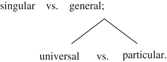
Second, a singular judgement can be treated as universal in logical inferences to the extent that, like the latter, its predicate applies to what falls under the subject-concept without exception. Both theses can be found in the Port-Royal Logic, which – with the notion of extension it introduced into the early modern logic discourse (Frisch Reference Frisch1969: 5) – initiated the basic framework within which later philosophers would present their own versions.
In the Port-Royal Logic there is first a distinction between a singular idea and a general or ‘common’ one: the former ‘represent[s] only a single thing’ or ‘individual’, while the latter ‘represent[s] several things’, which constitute its extension.Footnote 8 In these terms is cast the distinction among universal, particular and singular judgements which ‘arises from the subject’: a singular judgement is one ‘whose subject is singular’, on account of which it differs from a general one, whose subject is a ‘common term’; the latter judgement is in turn universal or particular, depending on whether its subject is ‘taken in its entire extension’ or ‘taken only through an indeterminate part of its extension’. But singular judgements ‘take the place of universals in arguments’ for the reason that they ‘have a singular subject that is necessarily taken through its entire extension’, which is precisely what characterizes all universal propositions: ‘For it makes no difference to the universality of a proposition whether the subject’s extension is large or small, provided that whatever it is, it is taken completely throughout.’Footnote 9
The reason why this observation about how the predicate relates to the extension of the subject-concept justifies treating singular and universal judgements alike in arguments has to do with how arguments are generally understood in the Port-Royal Logic. A basic ‘argument’ is a relation of three terms, two of which (the major and minor terms) are compared by means of a third (the middle term). All arguments are either explicitly syllogistic or can be ‘reduced to syllogisms if they are valid’.Footnote 10 The validity of an argument is determined by how the predicate of each involved judgement relates to the subject in respect of extension – to wit, by whether the former is affirmed/denied of the latter through the entirety or only an indeterminate part of its extension. Thus, having distinguished singular from both universal and particular judgements (as well as affirmative from negative ones), the Port-Royal logicians proceed to ‘reduce’ all judgements to four kinds: A, E, I, O.Footnote 11
Many of Kant’s immediate predecessors distinguish singular from both universal and particular judgements as the Port-Royal logicians have done. The versions in Baumgarten (Reference Baumgarten1761), Knutzen (Reference Knutzen1747) and Crusius (Reference Crusius1747), in particular, contain verbal hints as to why Kant thinks that, apropos quantity, singular judgements stand to the general ones as Einheit to Unendlichkeit.Footnote 12 According to Baumgarten, the quantity (quantitas) of a judgement concerns the ‘number’ of things falling under the subject-concept: it is singular or general (communis, gemein), the latter in turn being universal (universalis, allgemein) or particular (Baumgarten 1983: §§142–3, 135–41) As Wolff – whose logic Baumgarten is summarizing – puts it, the subject of a singular judgement signifies (significat) a single thing, whereas that of a general one represents a multitude of individuals (Wolff Reference Wolff1740: §§113–14, 240–1). Similarly, Knutzen takes a judgement to be either singular, if its subject is a singular concept representing an individual, or universal or particular, if the subject is a general concept containing a multitude of individuals under itself (Knutzen Reference Knutzen1747: §141). This multitude, as Crusius sees it, is a ‘logical whole (totum logicum)’ that is ‘of infinite extent (unendlicher Weite)’; and whether a general judgement is universal or particular depends on whether the predicate is affirmed/negated of this logical whole ‘without restriction of its extent’ or with regard to an indeterminate part thereof (Crusius Reference Crusius1747: §§230–1).
In these terms, the aforesaid two-tiered distinction may be reworded as follows. First, singular and general judgements differ with respect to the quantity of what is signified by the subject-concept. Insofar as the subject-concept of a singular judgement signifies exactly one individual, while that of a general one signifies a totum logicum, and insofar as the totum logicum of a general concept is of infinite extent, the contrast of quantity amounts to that between one and an infinite multitude. Second, general judgements are divided into particular and universal ones, depending on whether the totum logicum is restricted or not.
2.2
Would Kant recognize this two-tiered distinction among singular, particular and universal judgements as a logical one by his own standard? My answer will be yes. But, in anticipation of certain reasons one might have to doubt such an answer, let me first clarify three relevant points about Kantian general logic.
First, in Kant’s view, general logic ‘exhaustively presents and strictly proves nothing but the formal rules of all thinking’.Footnote 13 Now to think is to relate given representations in some manner. Accordingly every thought – be it concept, judgement or inference – has both matter (the given representations) and form (the manner in which they are related). General logic concerns only the latter.Footnote 14 In particular, it treats (categorical) judgements solely in terms of the various ways in which given concepts may be related and conjoined in one thought. This treatment proceeds from a general conception of (categorical) judgement with respect to its basic structure: different forms of (categorical) judgement can be traced to what may be called the ‘x-a-b schema’ of judgement. This resonates with Kant’s view that every (categorical) judgement has the form of the cognition of an object – ‘something x’ – through two predicates: the first predicate (a, ‘logical subject’) is the given conceptual representation of the object, and the second (b, ‘logical predicate’) is compared with the first.Footnote 15 A judgement thus has two relations: that of a to x and that of b to a. To borrow Kant’s terms, we may regard the first as a signifying relation: a signifies (bedeutet) an object=x, and the object is the signification (Bedeutung) of a in the judgement. To say that b is predicated of a is then to say that b applies (gilt) to the Bedeutung of a. Footnote 16
One might wonder, though: is there even any room for ‘object’ in Kantian general logic? Kant occasionally says that general logic treats thinking in abstraction ‘from any relation (Beziehung) of it to the object’.Footnote 17 Does this entail that it must treat thinking as if it had no object at all and that any reference to objects would take us beyond general logic? Answering this question requires a thorough textual analysis of Kant’s discussions of general logic apropos its nature and boundary. Here is my answer in a nutshell, which is based precisely on such an analysis (Lu-Adler Reference Lu-Adler2012: ch. 1). When Kant claims that general logic treats thinking in abstraction from all relation to the object, he is primarily concerned with distinguishing this logic from transcendental logic: the latter deals with the a priori conditions under which a cognition may be related to objects of experience, a relation that determines its objective validity; general logic, by contrast, only considers how given cognitions are related with one another, no matter whether they may in turn relate to the objects (of experience).Footnote 18 Considered in this light, general logic need not treat thinking as if it had no object at all. Rather, one may use a thin notion of object=x: in (categorical) judgements, this x simply stands for whatever is signified by the logical subject, regardless of whether any object (of experience) may be given, to which the concept must be related in order to be objectively valid.Footnote 19
Finally, for the philosophers mentioned above, the distinction between singular and general judgements boils down to that between singular and general concepts (or ideas). This distinction might not seem available to Kant, given that he denies there to be singular concepts in the first place. It is worth clarifying, however, what is exactly meant by such a denial. Kant actually describes singular concepts in two ways, accepting them under one description while rejecting them under the other. On the one hand, there is no singular concept qua ‘thoroughly determinate’ cognition of an object; for there can be no determinate cognition of an object by concepts alone, due to their essential generality and discursivity.Footnote 20 On the other hand, one may speak freely of a singular concept as that ‘which does not grasp a multitude under itself, but is only a single thing’.Footnote 21 To the extent that this captures the singularity of the Bedeutung of a concept in abstraction from how the individual signified thereby may be determined, calling the concept ‘singular’ merely marks its logical feature – that it purports to signify exactly one object (=x) – without contradicting the previous point that no object can be thoroughly determined thereby. As Kant puts it, although a concept by nature can only represent what is common among several things, its ‘use’ (in judgements) may be general or singular. For instance, the concept ‘house’ may be used in its capacity qua general representation, e.g. in the judgements ‘all houses must have a roof’ and ‘some houses must have a gate’; but it may also be used ‘only for an individual thing: e.g. this house is plastered this way or that’.Footnote 22 Accordingly, I shall use ‘this A is B’ to express the form of a singular judgement.Footnote 23
2.3
With these clarifications we can now return to Kant’s claim at A71/B96 that a singular judgement, as ‘cognition in general’, stands to a general one as Einheit to Unendlichkeit. This reference to judgement as cognition in general can be read in light of Kant’s two remarks about judgement in a previous section (On the Logical Use of the Understanding in General): first, judgement is ‘the mediate cognition of an object, hence the representation of a representation of it’; second, to judge is to judge by means of concepts, and all concepts, ‘as predicates of possible judgements, are related to some representation of a still undetermined object’ (A68–9/B93–4). These remarks reflect the aforementioned x-a-b schema of (categorical) judgement: to consider a judgement as cognition in general is to see it as a mediate cognition of an object=x by means of two concepts – a logical subject that signifies the object, and a logical predicate that applies to the object so signified. In these terms Kant may adapt his predecessors’ two-tiered distinction among judgements of quantity, roughly as follows: first, a judgement is singular or general, depending on whether its logical subject is used to signify exactly one object (=x) or a multitude of objects (=x); second, a general judgement is particular or universal, depending on whether the said multitude – to which the logical predicate applies – is restricted or not.
This two-tiered distinction may be illustrated with reference to Kant’s account of the logical extension of a concept. If the subject-concept of a general judgement is used as a general representation, such generality lies in the capacity of the concept to represent a multitude of things and hence in it having an extension.Footnote 24 One may, Kant suggests, use a circle to represent this extension: ‘The multitude of things (Dinge) that are contained under the concept is called the logical sphere [a.k.a. extension] of the concept. … One understands by that … the circle of application, a line that … comprehends a great space’ (V-Lo/Dohna, 24: 755). Otherwise, a ‘point’ can represent a concept in its singular use.Footnote 25 This circle-cum-point symbolism gives Kant a way of referring to the objects (=x) signified in judgements without regard to how our concepts may, if at all, relate (beziehen) to any objects of experience or what those objects may be. Now take any concepts A and B. With A as the logical subject and B the logical predicate, three judgements can be composed which differ in quantity: (i) ‘all A is B’; (ii) ‘some A is B’; (iii) ‘this A is B’. Kant sometimes uses circles to represent (i) and (ii) as in
Figure 1(R3215, 16: 715; R3036, 16: 627; R3063, 16: 637).
Figure 1

With the circle-cum-point symbolism, Kant can also represent (iii) as shown in
Figure 2.
Figure 2
Clearly, (iii) differs from both (i) and (ii) with respect to the quantity of what is signified by A. In (i) and (ii), A is used in its capacity qua general representation, to signify a multitude of objects=x. In (iii), by contrast, it is used to signify exactly one object=x; the singularity of such signification is the necessary function of ‘this’, which renders irrelevant the fact that A, qua concept, is capable of representing multiple individuals. This distinction between (iii) and (i)/(ii) holds for any concepts that may take the places of A and B, regardless of whether they relate (beziehen) to any objects of experience. So construed, the distinction indeed belongs to Kantian general logic – in the sense clarified in section 2.2.
These figures also help illustrate why Kant casts the distinction between singular and general judgements in terms of Einheit versus Unendlichkeit: it is the difference between representing exactly one object and representing an infinite multitude of objects. A concept, qua general representation, is applicable to infinitely many objects, when objects are understood in the mere sense of objects=x, in abstraction from whether they may be given to us in experience or what particular features they may have. Accordingly, the multitude of objects signified by A in the general judgements (i) and (ii) is infinite. To that extent (iii), where A is used to signify exactly one object, stands to both (i) and (ii) as Einheit to Unendlichkeit with respect to quantity. The different ways in which A is represented in Figures 1 and 2 – as a circle versus as a point – reflects such a contrast: the circle that represents the Bedeutung of A in Figure 1 contains infinitely many points.
2.4
Figure 2 represents an affirmative singular judgement as having this logical form: the object signified by the subject-concept falls inside the extension of the predicate. Now, as I mentioned in 2.1, the subject–predicate relation in a judgement determines its use in syllogisms (insofar as logical validity is concerned). So, when Kant agrees with the logicians that a singular judgement can be treated like a universal one in syllogisms, we expect him to justify such a treatment precisely in terms of the account of singular judgements I have attributed to him. But it is not immediately clear that he meets such an expectation in the Critique.
At A71/B96 Kant states the relevant justification thus: ‘just because [singular judgements] have no extension at all, their predicate is not merely related to some of what is contained under the concept of the subject while being excluded from another part of it. Thus it applies to that concept without exception.’ It would strike modern readers as puzzling that a singular judgement or, more precisely, its subject-concept should ‘have no extension’. Thus Codato declares that Kant’s notion of a concept without extension is ‘oxymoron’ and ‘border[s] on nonsense’ (Codato Reference Codato2008: 144). Anderson, by contrast, thinks that such a notion is indeed meaningful, but only if ‘extension’ refers to the concepts subordinate to the given concept, not the objects falling under it (Anderson Reference Anderson2004: 512 n. 28). His reasoning seems to be this: the extension of a concept equals the sum of its subordinate concepts, and a concept has extension only if it has at least one subordinate concept; the logical subject of a singular judgement is a concept with no subordinate concept; therefore, it has no extension. If, Anderson might add, Kant had instead taken extension to comprise the objects falling under a concept, he would have said that the subject-concept of a singular judgement, on account of signifying exactly one object, has a one-member extension rather than no extension at all.
There are two problems with this line of argument. First, it is at odds both with what Kant usually says about a concept that (purportedly) has no subordinate concepts and with his characterization of a concept in singular use. A concept with no subordinate concepts would be a species infima, which would be a general as opposed to singular representation.Footnote 26 Meanwhile, as I mentioned in section 2.2, Kant describes a concept in singular use as that which is used to signify exactly one individual, not as one without subordinate concepts.Footnote 27 Second, the aforesaid reason against ascribing to Kant the objectual notion of extension – i.e. the notion that the extension of a concept comprises the objects it signifies – applies more precisely to our modern conception of extension, according to which a concept with exactly one object falling under it has a one-member extension. I agree that Kant cannot mean the latter when he takes the subject-concept of a singular judgement to have no extension. But it does not follow that he must therefore take extension to be a conceptual one in Anderson’s sense. In fact, his claim makes perfect sense on an objectual notion of extension, albeit a characteristically early modern one.
The said objectual notion of extension is intended for general concepts to begin with, generality being their capacity to represent a multitude of objects.Footnote 28 This implies that a concept has extension only if it applies to more than one object. Thus, the subject-concept of a singular judgement – insofar as it is used to signify only one object – is treated as having no extension. It is in these terms that Kant often explains why a singular judgement, having no extension, is used like a universal one in syllogisms. Take ‘Caesar is mortal’ for instance,
no exception can occur here, because the concept Caesar … does not comprehend a multitude under itself, but is only an individual thing …, that is to say, it does not have a sphere [i.e. extension] at all from which something could be excluded. … consequently a singular judgement is like the universal one in use.Footnote 29
An individual, because it is not a multitude, is not an extension. It cannot be restricted in the way an extension can: it must be taken in its entirety when related to something else. Hence the logical predicate of a singular judgement always applies to the logical subject – to its Bedeutung – ‘without exception (Ausnahme)’ (A71/B96).
To illustrate, in the fashion of Figure 2, use a point to represent the subject-concept (A) and a circle to represent the predicate (B) of a singular judgement. The point must be placed either inside or outside the circle. These two possibilities correspond to the two basic forms of singular judgement: ‘this A is B’ (Figure 3a) and ‘this A is not B’ (Figure 3b).
Figure 3
The subject–predicate relations exhibited in these figures – to wit, what is signified by A falls completely inside or completely outside the logical extension of B – are the same as those in the universal affirmative (Figure 4a) and universal negative judgements (Figure 4b).
Figure 4
These figures help clarify the sense in which a singular judgement has the same ‘inner validity (innere Gültigkeit)’ as a relevant universal one does, i.e. the same way in which B applies (gilt) to A in respect of its signification. This is presumably Kant’s basis for granting that the former judgement is not ‘special’ vis-à-vis the latter ‘in that [syllogistic] logic which is limited only to the use of judgements with respect to each other’ (A71/B96–7). Roughly put, a singular judgement does not count as a separate basic form of judgement in a logical system where considerations about syllogistic validity determine the status of a form of judgement. In such a system, whether a form of judgement is irreducibly basic in comparison with other forms hinges on whether it plays a distinct inferential role in syllogisms, which has in turn to do with whether it represents a unique subject–predicate relation. Since in this regard a singular judgement is no different from a universal one, it can be treated just like the latter in syllogisms and, eo ipso, does not count as a basic form of judgement on a par with the latter.Footnote 30
Kant grants that one can take this syllogistic perspective to assess the status of singular judgements. But he is also clear that, with respect to his project in the Critique, he is not constrained by such a perspective. Rather, for the purpose of deciding which forms of judgements should be included in the table of judgements, he suggests that we consider a judgement merely as cognition in general – namely, as a mediate cognition of objects by two concepts (x-a-b) – no matter how it may then be used in syllogisms. In this respect, the distinction drawn in 2.3 between singular and general judgements qua cognition in general qualifies the former as a distinct form of judgement respecting quantity. In sum,
[if] we compare a singular judgement with a general one, merely as cognition, with respect to quantity, then the former stands to the latter as unity to infinity, and is thus in itself essentially different from the latter. Therefore, … [the singular] deserves a special place in a complete table of the moments of thinking in general (though obviously not in that logic that is limited only to the use of judgements with respect to each other). (A71/B96–7, my italicization)
Here Kant remains true to his claim that, in sorting out all the moments of judgement, he can utilize the work of the logicians. As we learned in section 2.1, the basics of the logical distinctions that Kant draws among universal, particular and singular judgements have already been laid out by his predecessors. The difference between his account and theirs is not that they have overlooked any of these forms. It is rather that, as long as they take perspective-s and investigate the logical forms of judgement only with regard to what affects the validity of syllogisms, they have no cause to grant singular judgements the status of a basic form alongside the universal ones. Kant in the Critique, by contrast, begins and remains with perspective-c, whereby singular judgements are first distinguished from the general (and hence from the universal) ones.
On this interpretation, Kant’s account of singular judgements at A71/B96–7 presupposes nothing about the category of unity, despite its reference to Einheit. We can thus dispel the spectre of vicious circularity envisioned in section 1 that, in order to distinguish singular from general judgements, Kant relies on a preconception about how the logical moments of quantity relate to the categorial ones (which are themselves to be derived from those logical moments) – especially about the relation between singular judgements and the category of unity. On my reading, in sum, the notion of Einheit at A71/B96 is meant only to capture the distinctive logical feature of a singular judgement qua cognition in general (x-a-b), namely that its subject-concept signifies exactly one object (=x). Even if Kant may eventually connect this feature of singularity with the category of unity, he need not presume any such connection in order first to distinguish singular from both universal and particular judgements.
3
By thus weakening the link between the occurrence of Einheit at A71/B96 and the category of unity, my reading has another immediate exegetical implication: it helps to resolve a controversy about how the logical moments of quantity should be ordered in the table of judgements and correlated with the categorial ones. Different sides of this controversy, as we shall see, proceed from similar assumptions – about the role of Einheit at A71/B96 and about Kant’s basis for including ‘singular’ in the table of judgements – as the ones that caused the aforesaid circularity threat.
The controversy begins with the observation that Kant presents the logical moments of quantity in two different orders in various texts: <universal, particular, singular> (Order I) and <singular, particular, universal> (Order II). The former can be found in the Critique and the Prolegomena among others,Footnote 31 the latter mainly in Kant’s lectures on metaphysics.Footnote 32 Meanwhile, the categories of quantity are always ordered as <unity, plurality, totality>. This has prompted discussions surrounding two questions. First, which of Order I and Order II is the right one? Second, how should the logical and the categorial moments of quantity correlate? Especially, should the correlation be universal-unity and singular-totality, or singular-unity and universal-totality?Footnote 33 My reading of Kant’s account of singular judgements at A71/B96–7 undermines two strategies that some commentators have used to address these questions.
First, it is no longer legitimate to use the explicit connection that Kant makes between singular judgements and Einheit at A71/B96 to pit one correlation against the other. Swing argues that Kant’s comparison of singular judgements to Einheit at A71/B96 is ‘evidence’ that he has in mind this more ‘natural’ correlation: singular-unity, particular-plurality, universal-totality (Swing Reference Swing1969: 20). This assumes that, by comparing singular judgements to Einheit at A71/B96, Kant is already explicitly relating them to the category of unity. My interpretation of the Einheit-Unendlichkeit contrast has queried such an assumption. On my account, at A71/B96 Einheit simply captures the special logical feature of singular judgements – that the subject-concept is used to signify exactly one object (=x). However this notion of Einheit may later be connected (if at all) to the category of unity, Kant need not use any such connection to justify his ascribing Einheit to singular judgements at A71/B96. In other words, just because Einheit figures in his argument for including ‘singular’ in the table of judgements, it does not follow that the argument presupposes any correlation between ‘singular’ and the category of unity.
Second, my reading also undermines any effort to determine how the logical moments of quantity should be ordered in the table of judgements based on how the categorial ones are ordered.Footnote 34 It is not unusual for commentators to think that the order of the three logical moments in the table of judgements must reflect how they are to correlate with the three categories of quantity. Bennett, for instance, argues that in the Critique Kant should have arranged the logical moments of quantity as <singular, particular, universal> and that it is a ‘slip’ on his part to have reversed the order – precisely because ‘the associated trio of concepts is given as “unity, plurality and totality”’ (Bennett Reference Bennett1996: 77). Longuenesse gives a more detailed argument to the same effect, drawing on a footnote in the Prolegomena where Kant says: ‘if I start from unity (in singular judgement) and proceed to totality, … I think only a plurality without totality’, a progression that is ‘necessary, if the logical moments are to be placed under’ the categories. (Prol. 4: 302) Taking these remarks to mean that ‘to understand the categories of quantity one must consider their genesis as parallel to the progression from singular to particular, then to universal judgement’, Longuenesse thinks that the footnote has ‘answered conclusively’ the question of whether ‘one of the tables [should] be reversed (and then, which one?), the correspondence then being singular judgement/unity, universal judgement/totality’. The alleged conclusive answer is that (i) the logical and categorial moments of quantity should correlate as singular-unity, particular-plurality, universal-totality and that, provided it is necessary to go from unity to totality, (ii) the logical moments of quantity in the table of judgements should be arranged in Order II as opposed to Order I, even though the latter is how they are given in both the Critique and the Prolegomena (Longuenesse Reference Longuenesse1998: 249).
Given what we saw in section 2, the move from (i) to (ii) is unwarranted. For the sake of argument we may grant that, to understand how the categorial moments of quantity may be specifically derived from the logical ones, the latter moments must be taken in the progression from singular to particular and then to universal. But it does not follow that this is how these logical moments should initially be ordered in the table of judgements. For, although they may be viewed as the moments of judgement from which specific categories are to be generated (in the order of unity, plurality and totality), they may also be viewed merely as three basic judgement-forms with respect to quantity, regardless of how particular categories may be derived from them. Kant indicates the contrast between these two views in the very footnote that Longuenesse cited, where he explains the sense in which judicia plurativa is a more suitable term than judicia particularia for particular judgements.
For the latter already contains the thought that they are not universal. If, however, I start from unity (in singular judgements) and proceed to totality, … I think only a plurality without totality, not the exception of the latter. This is necessary, if the logical moments are to be placed under the pure concepts of the understanding; in logical usage things can remain as they were. (Prol. 4: 302)
This claim contains a notable caveat: we must follow the singular-particular-universal sequel if these logical moments ‘are to be placed under the pure concepts of the understanding’ – to wit, if they are conceived as the moments of judgement through which given intuition is subsumed under the pure concepts of quantity (Prol. 4: 300–2). But this goes beyond what Kant needs to assume while introducing the singular as a distinct form of judgement. So he adds that ‘in logical usage things can remain as they were’, and proceeds to present a table of judgements in which the three logical moments of quantity appear in Order I: universal, particular, singular (Prol. 4: 302).
At bottom, the central problem with Longuenesse’s argument for favouring Order II over Order I is its mixing two questions. It is one thing to ask (a): how should the logical and categorial moments of quantity correlate, and hence in what order should we consider the logical moments so that they may serve as the basis for generating the specific categorial ones in the right way? But it is another to ask (b): how should the logical moments be arranged as they are first introduced in the table of judgements? My reading of Kant’s account of singular judgements at A71/B96–7 helps to disentangle these questions. On the one hand, an answer to (b) is adequate if it reflects the logical grounds on which certain forms of judgements are included in the table. If I was right to argue that Kant’s two-tiered distinction among universal, particular and singular judgements from perspective-c is his primary basis for including all three of them in the table, then it is of little importance whether these forms of judgements are introduced in Order I or Order II. On the other hand, to address question (a) effectively, one should not dwell on a particular order in which the logical moments of quantity initially appear in the table of judgements. For handling (a) takes a different viewpoint from what has been assumed to introduce those logical moments into the table. Especially, it presupposes a view about how the specific categories of quantity must be derived from the logical moments of quantity. But Kant need not assume any such view while constructing the table of judgements. Accordingly, we should not expect an exact correlation between the initial order of the logical moments in this table and the subsequent order of the categorial moments.
4
To summarize, I explicated Kant’s claim at A71/B96–7 that, even though singular judgements are rightly used like universal ones in syllogisms, as cognition in general they stand to general ones as Einheit to Unendlichkeit, to which extent they constitute a special logical moment of quantity. I argued that Einheit is meant here just to capture the distinctive logical feature of singular judgements as cognition in general (x-a-b) – i.e. that the subject-concept signifies exactly one object (=x) – and that, even if Kant may eventually connect it with the category of unity, he need not presuppose any such connection in order to distinguish singular from general judgements in the first place. This reading had two immediate exegetical consequences. First, it dispelled the threat of vicious circularity that Kant has to distinguish the three logical moments of quantity by appealing to the categorial ones, which are in turn to be derived from the former. Second, it helped to resolve the controversy about how the logical moments of quantity should be ordered in the table of judgements and correlated with the categorial ones.
This interpretation hinges on two claims about Kantian general logic, as I suggested in section 2.2: in this logic, (1) every (categorical) judgement can be regarded as having an x-a-b schema, in terms of which I explained what Kant means by ‘cognition in general’ at A71/B96, and (2) a concept may be taken to signify objects in the most abstract sense (=x), irrespective of whether the objects so represented can be given in our sensible intuition. Now one may ask: granting that my reading has addressed the aforesaid issues that are specific to Kant’s account of singular judgements at A71/B96–7, and granting that (1) and (2) are compatible with his remark that general logic abstracts from any relation (Beziehung) of cognitions to objects, are there any general, philosophically significant reasons for attributing (1) and (2) to Kant? I have addressed this question with respect to (2) at great length elsewhere.Footnote 35 I now conclude with a sketch of the larger context in which I take Kant to hold (1).
Note, to begin with, that Kant’s account of singular judgements at A71/B96–7 is part of a metaphysical deduction, which supposedly establishes ‘the a priori origin of the categories in general … through their complete coincidence with the universal logical functions of thinking’ (B159). If Kant is serious about this claim, he needs first to explain how ‘the universal logical functions of thinking’ – as they are listed in the table of judgements – may have been derived independently of the categories.Footnote 36 This task belongs to pure general logic, which, as Jäsche puts it in the Preface to the Logik, is ‘regarded [by Kant] as a separate science, existing for itself and grounded in itself’ (Log. 9: 6): it is ‘a self-cognition of the understanding and of reason … merely as to form’, and ‘will thus have no other grounds or sources than the nature of human understanding’.Footnote 37 More specifically, given that the essential act of the understanding and of reason is thinking and that every act necessarily accords with certain rules, logic boils down to the cognition on the part of the understanding and reason with regard to the universal rules of their own act, which constitute the necessary formal condition of the very possibility of thinking.Footnote 38 As a ‘demonstrated science’ or ‘doctrine’, moreover, logic must derive these rules from certain principia a priori.Footnote 39
In light of these remarks about the nature and subject matter of pure general logic, we can say the following about the x-a-b schema in reference to which singular judgements were distinguished from the general ones: if the logical forms of thinking in general must somehow be grounded in the nature of human understanding, the x-a-b schema can be taken to represent a notion of thinking – namely, the characteristic act of the understanding – from which certain forms of thinking may be derived (as rules for relating given concepts in one thought). In particular, if I was right about the pressure for Kant to establish the table of judgements in advance and independently of the categories, this notion enjoys the benefit of having a rich enough structure for deriving at least all three forms of judgement respecting quantity.Footnote 40 This is admittedly far from showing how Kant may derive – systematically and independently of his account of categories – all the forms of judgement contained in the said table. It did, however, foreground the relevant materials in his logic corpus from which such a derivation may be reconstructed.Footnote 41



