INTRODUCTION
The foraminifera test is one of the principal sources ofCaCO3 in the tropical and subtropical seas and oceans (Kennett, Reference Kennett1982; Hallock et al., Reference Hallock, Cottey, Forward and Halas1986). In few locations around the Hawaiian Islands 23% of the sand is composed of Amphistegina tests (Hallock Muller, Reference Hallock Muller1976). This percentage may reach as high as 90% in certain locations in the Pacific (Mckee et al., Reference Mckee, Chronic and Leopold1959; Hallock et al., Reference Hallock, Talge, Cockey and Müller1995; Langer et al., Reference Langer, Silk and Lipps1997). Reproduction in Amphistegina is achieved both through asexual multiple fission and sexual gamete production. The latter is generally observed among individuals over one millimetre in diameter (Hallock, Reference Hallock1985). Several hundred offspring are generally produced by asexual multiple fission. The lifespan of an Amphistegina individual is four to twelve months, depending upon the environment (Hallock et al., Reference Hallock, Talge, Cockey and Müller1995). Whatever the circumstances, the genus contributes a great deal to the continuous formation of sediment in the localities where it lives.
The species of Amphistegina exhibit a wide distribution range (Langer & Hottinger, Reference Langer and Hottinger2000). The principal habitats of Amphistegina bicirculata Larsen, A. lessonii d'Orbigny, A. lobifera Larsen, A. papillosa Said and A. radiata Fichtel & Moll include the Red Sea, the Indo-Pacific islands, such as Herm Island (Australia), Ohau (Hawaii), Timor and Tanimbar (Indonesia), the Philippines, Ishigaki and Iriomete Islands (Japan) (Reiss and Hottinger, Reference Reiss and Hottinger1984; Hallock, Reference Hallock1984; Glenn, Reference Glenn1986; Van Marle, Reference Van Marle1988; Hatta & Ujiie, Reference Hatta and Ujiie1992; Hallock et al., Reference Hallock, Talge, Smith and Cockey1993; Hottinger et al., Reference Hottinger, Halicz and Reiss1993; Loeblich & Tappan, Reference Loeblich and Tappan1994). Some of the Amphistegina species have also been reported from the Gulf of Florida and the Caribbean (Hallock et al., Reference Hallock, Talge, Cockey and Müller1995; Harney et al., Reference Harney, Hallock and Talge1998).
Many Indo-Pacific originated marine species have been introduced to the Mediterranean Sea via the Suez Canal. Some of the aliens have also been reported from Turkey (in Öztürk & Başusta, Reference Öztürk and Başusta2002). Although quite rare in the Aegean Sea, the lessepsian Amphistegina lobifera Larsen is common in the eastern Mediterranean and it coexists with other benthic foraminifera (Alavi, Reference Alavi1988; Avşar, Reference Avşar1997; Hollaus & Hottinger, Reference Hollaus and Hottinger1997; Avşar et al., Reference Avşar, Meriç and Ergin2001; Meriç et al., Reference Meriç, Avşar and Bergin2004; Koukousioura et al., Reference Koukousioura, Triantaphyllou, Tsourou, Dimiza and Dermitzakis2006; Hyams-Kaphzan et al., Reference Hyams-Kaphzan, Almogi-Labin, Sivan and Benjamini2008). But this species has not yet been observed in the western Mediterranean (Cimerman & Langer, Reference Cimerman and Langer1991; Sgarella & Moncharmont-Zei, Reference Sgarrella and Moncharmont-Zei1993, Yokeş et al., Reference Yokeş, Meriç and Avşar2007). The other lessepsian Amphistegina species is the Amphistegina lessonii d'Orbigny, in the Mediterranean, which has only been reported from north-east of Crete (Hollaus & Hottinger, Reference Hollaus and Hottinger1997; Langer, Reference Langer and Por2008).
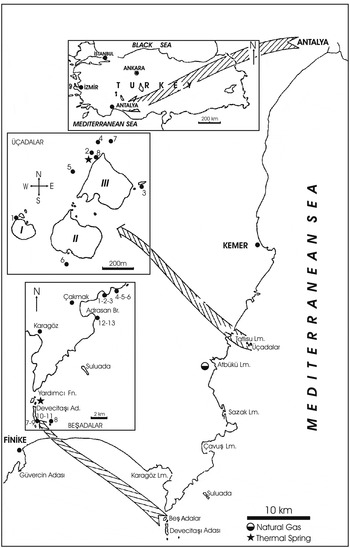
Amphistegina lobifera has been considered as rare on the Turkish Mediterranean and Aegean coastline (Meriç et al., Reference Meriç, Avşar and Bergin2004). But recent observations show that this species is very common around Antalya (south-western Turkey). In certain locations, such as Kaş and Beş Adalar A. lobifera populations have been expanded to such an extent that the building up of tests has formed a 30–60 cm thick layer of deposits on the sea bottom. The aim of this study is to find out the causes of high abundance of A. lobifera on the western coast of the Gulf of Antalya (Figure 1).
The locations of the stations and the thermal springs.

MATERIALS AND METHODS
Gulf of Antalya
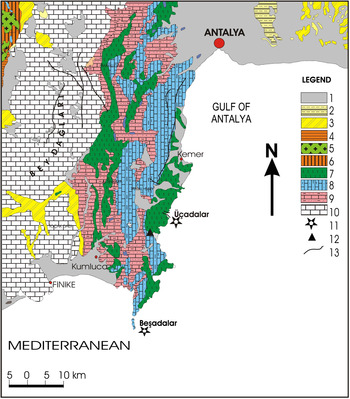
The Gulf of Antalya is located on the south-west coast of Turkey and is encircled by mountains on the west, the east and the north, that can reach to 1500 m of altitude. The geological structure of the surrounding landscape is formed by Palaeozoic (Cambrian, Ordovician, Silurian, Devonian, Carboniferous and Permian), Mesozoic (Triassic, Jurassic and Cretaceous) and Cenozoic (Palaeocene, Eocene, Miocene, Pliocene and Quaternary) units (Figure 2). Tectonic activities are commonly observed. Numerous streams are found along the coastline but they are too small to form deltas and their flow rates vary depending on the seasonal rainfalls.
Simplified geological map of the research area: (1) Beydağları Autochthon (Mesozoic carbonates); (2) Çataltepe and Alakırçay nappes (various sediments of Permian to Maastrichtian); (3) Tahtalıdağ nappe (mainly dominated by carbonates of Cambrian to Maastrichtian); (4) Tekirova ophiolite nappe (Cretaceous); (5) Yeşilbarak nappe (mainly Eocene to Miocene clastic sediments); (6) Lycian nappe (Mesozoic carbonates); (7) Eocene (mainly clastic sediments); (8) Miocene; (9) Pliocene; (10) Quaternary; (11) studied locations; (12) natural gas exits; (13) faults (from Şenel, Reference Şenel1997).

The structure of the sea bottom is in good accordance with the surrounding land topography. Continental shelf, continental slope and abyssal plains are observed in the region. The depth can reach 1000 m in the gulf, whereas it exceeds 2500 m out of the gulf. A complex sediment structure is observed in the gulf. The dominant types of deposits are mud, silt, muddy-silt, sand and sandy units. Other sediment types such as pebble, sandy-pebble, pebbly-sand, sand, silty-sand, sandy-mud, muddy-silt and clay, also occur. In addition, rocky structures exist in some locations on the continental slope and on its foot.
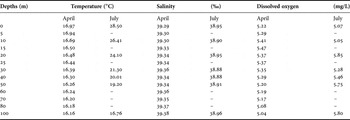
The seasonal water temperature and the salinity observed in the Gulf of Antalya and the vicinity of Üç Adalar are given in Table 1 and Table 2, respectively.
Seasonal water temperature and the salinity observed in the Gulf of Antalya.

Temp., temperature.
Depth, temperature, salinity and dissolved oxygen values near Üç Adalar (west of Antalya).

Sampling methods
Sediment samples have been manually collected from 12 stations in Üç Adalar using SCUBA diving. Thirteen additional samples have been collected from the southernmost point of the Gulf of Antalya, from an island complex known as Beş Adalar (Figure 1). The samples were dried. Five grams of each sediment sample were weighed, treated with 17% H2O2 for 24 hours and sieved through a pore size of 0.0063 mm. The dried samples were successively sieved through pore sizes of 2, 1, 0.5, 0.25 and 0.125 mm, and then the Amphistegina lobifera individuals were separated. The specimens were not distinguished as to whether they were alive or dead.
Three litres of water were collected from the submarine spring in Station 8, at a depth of 4 m. Chemical analyses of the water samples were performed by graphite furnace atomic absorption spectrometry using Perkin Elmer SIMAA 6000.
Amphistegina lobifera tests were subjected to heavy metal analysis. The samples were dried for 24 hours at 1100C. 0.35 g of test were weighed from each sediment sample and subjected to hydrochloric acid, phosphoric acid and fluoric acid in Teflon® containers, then dissolved by applying microwave in Milestone Ethos 1600 microwave digestion apparatus. Chemical analyses were performed in a Perkin Elmer SIMAA 6000 simultaneous atomic absorption spectrophotometer (AAS) by graphite oven techniques.
RESULTS
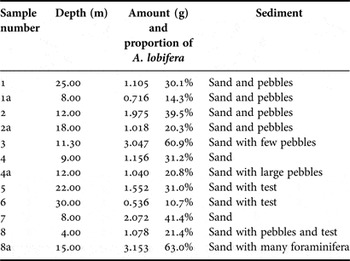
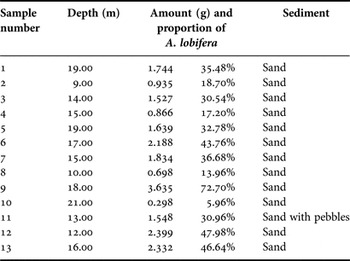
A high proportion of A. lobifera test was observed in all of the samples. The percentages of A. lobifera individuals in five grams of the sediment were found to be 10.7–63.0% in Üç Adalar and 5.92–72.7% in Beş Adalar. The richest sediments were found to be Sample 8a from Üç Adalar and 9 from Beş Adalar (Table 3 and Table 4). The tests varied in dimension, but in all of the samples analysed, approximately 21–22% were between 2.0 and 1.0 mm, 77–78% between 1.00 and 0.50 mm, and >1% between 0.500 and 0.250 mm.
The frequency of Amphistegina lobifera observed in the sediment samples from Üç Adalar.

The frequency of Amphistegina lobifera observed in the sediment samples from Beş Adalar.

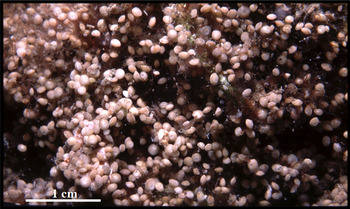
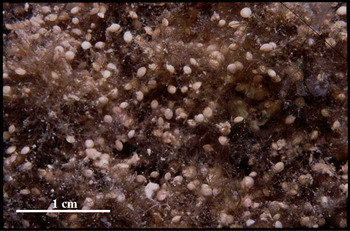
Macrophotographs of the sea bottom revealed the presence of an extremely dense population of A. lobifera inhabiting the south-western coasts of Turkey. Alive individuals stick to any kind of hard substrate via their pseudopods. The dead individuals can easily be separated by smoothly brushing the surface. Vertical walls where dense populations of A. lobifera were observed in Sation 8a were brushed and macrophotographs were taken. In one of the photographs 490 alive individuals of A. lobifera were counted on a surface area of 15.75 cm2. 194 alive individuals were counted on another photograph covering an 8.4 cm2 area from Station 2 in Üç Adalar (Figures 3 and 4). These data suggest the presence of population with a density of 230.000–310.000 individuals per square metre.
490 alive Amphistegina lobifera individuals have been counted on 15.75 cm2 of sea bottom.

194 alive Amphistegina lobifera individuals have been counted on 8.4 cm2 of sea bottom.

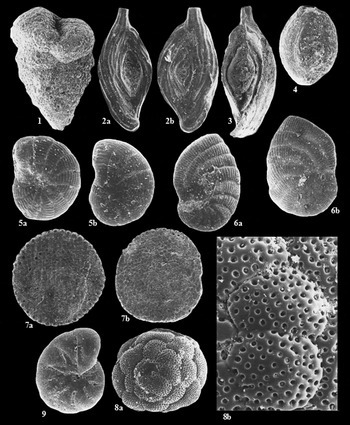
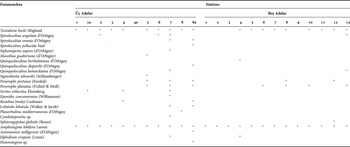
Other benthic foraminifers were poorly represented in the samples. The observed species include: Textularia bocki Höglund; Spiroloculina angulata Terquem; Quinqueloculina bertelotiana d'Orbigny; Q. lamarckiana d'Orbigny; Peneroplis pertusus (Forskål); P. planatus (Fichtel & Moll); Sphaerogypsina globula (Reuss); and Elphidium crispum (Linné). Textularia bocki Höglund was the best represented among these rarer species in all samples (Table 5; Figures 5 and 6).
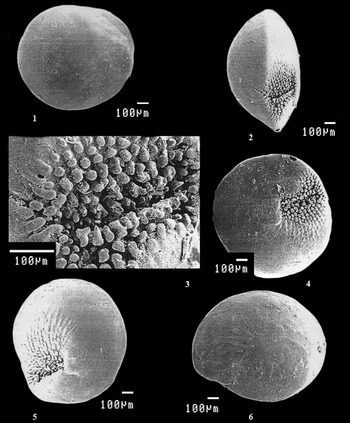
(1–6) Amphistegina lobifera Larsen: external views, Station 2a, Üçadalar-Antalya, Turkey.

(1) Textularia bocki Höglund: external view, ×50, Station 1, Üçadalar-Antalya, Turkey; (2) Spiroloculina angulata d'Orbigny: (a, b) external views, ×85, Station 7, Üçadalar-Antalya, Turkey; (3) Spiroloculina ornata d'Orbigny: external view, × 75, Station 7, Üçadalar-Antalya, Turkey; (4) Sigmoilinita edwardsi (Schlumberger): external view, ×120, Station 5, Üçadalar-Antalya, Turkey; (5) Peneroplis pertusus (Forskål): (a, b) external views, ×120 (a) Station 5 (b) Station 7, Üçadalar-Antalya, Turkey; (6) Peneroplis planatus (Fichtel & Moll): (a, b) external views, ×85, Station, 7, Üçadalar-Antalya, Turkey; (7) Sorites orbiculus Ehrenberg: (a, b) external views, ×50 (a) Station 1a (b) Station 7, Üçadalar-Antalya, Turkey; (8) Cymbaloporetta sp.: (a) external view, ×170 (b) detail view of the test surface, ×700, Station 7, Üçadalar-Antalya, Turkey; (9) Astrononion stelligerum (d'Orbigny): external view, × 120, Station 8a, Üçadalar-Antalya, Turkey.

Benthic foraminifera species observed in Üç Adalar and Beş Adalar.

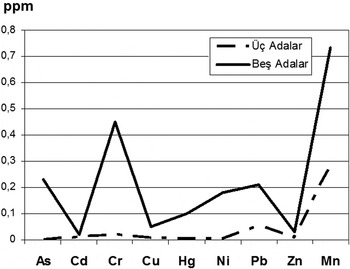
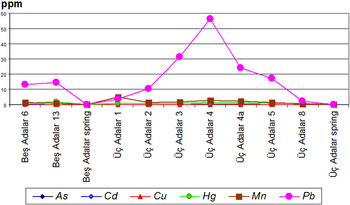
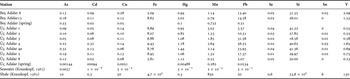
Two submarine wells were found in the research area. Chemical analysis of the water samples obtained from the these springs and the A. lobifera tests collected from the stations nearby are given in Table 6, and their comparison together with normal seawater concentrations (Krauskopf, Reference Krauskopf1985) are shown in Figures 7 and 8. High concentrations of Pb were observed in A. lobifera tests from Üç Adalar. High temperature (23°C) and low salinity (31.770/00) are features of a fresh water source which may be coming from the submarine spring in Station 8 (Üç Adalar) during early May.
Chemical analysis of the spring waters from Üç Adalar and Beş Adalar.

Comparison of the heavy metal analysis of calcophylic elements in Amphistegina lobifera tests and spring waters. High concentrations of Pb observed in tests suggests an influence of the geochemical environment rather than from the seawater composition, since the area is free of anthropogenic heavy metal pollution.

Chemical analysis of Amphistegina lobifera tests and spring waters from Üç Adalar and Beş Adalar (ppm).

DISCUSSION
A large population of Amphistegina lobifera Larsen is found between 4.00 and 30.00 m of depths all over the research area. Amphistegina lobifera tests form thick deposits of which the thickness reaches to 60 cm in certain localities. Only in rocky areas where the seabed suddenly plunges downward does the quantity suddenly decrease. Amphistegina lobifera Larsen populations show abnormal dominance in the samples collected from the research area. But individuals of this species are only rarely observed along the remainder of the Turkish Mediterranean and Aegean coastline (Meriç & Avşar, Reference Meriç and Avşar2001; Meriç et al., Reference Meriç, Avşar and Bergin2004; Koukousioura et al., Reference Koukousioura, Triantaphyllou, Tsourou, Dimiza and Dermitzakis2006). Amphistegina species are widely distributed over the entire Indo-Pacific, but they form up to 90% of the sediment in certain localities, as it is observed on the western coast of Antalya, which suggests that similar environmental factors may lie behind this situation.
Being the most crowded touristic centre, the coastline between Kemer and Alanya is exposed to a relatively high level of pollution from tourism, whereas Tekirova, Üç Adalar and Beş Adalar remain relatively undisturbed. Heavy metal pollution is at least, out of the question in the research area.
The region enclosed by the Islands II and III in Üç Adalar is shallow (about 4 m of depth), and it gets deeper towards the south-east. The seabed plunges to a depth of 35 m between Islands I and II, suggesting a fault line which might be responsible for the source of the warmer water observed in the spring located near to Station 8. Even though there is no evidence of volcanic activity in this area or anywhere eastward in the Mediterranean, the geophysical map of Anatolia displays tectonic activity on the west coast of the Gulf of Antalya. On the Beydağları Range, the pressure of the landmass with faults running generally north–south is dominant over the fault lines running approximately east–west (Figure 2). An extension of the east–west fault running westward from the Tatlısu Cove (south of Kemer) to that of Atbükü may be responsible for the landscape of Üç Adalar (Şenel, Reference Şenel1997). Another well-known phenomenon is the so-called ‘eternal flame’ that burns continuously because of the methane gas escape at Mount Olympus, south-west of Kemer. The presence of mud volcanoes on the Anaximander Mountains area, which is considered as a prolongation of the Beydağları Range and Antalya Nappe Complex, suggests the possibility of such activities in the vicinity of the research area (Woodside et al., Reference Woodside, İvanov and Limonov1997; Aloisi et al., Reference Aloisi, Pierre, Rouchy, Foucher and Woodside2000). The quantity, as well as the quality of the trace elements coming from the submarine springs which are located on the active faults are not thought to be responsible for high accumulation of A. lobifera tests; however, the presence of limestones with karstic characteristics in the Taurus Mountains combined with submarine springs cause salinity and temperature variations, as well as an increase in CaCO3 in the seawater.
ACKNOWLEDGEMENTS
The authors thank Adnan Büyük from Seagull's Diving Center; Uğur Ergen from Derin Diving Center; Dr Muhittin Görmüş and Erkan Gökaşan for their kindly collaboration and technical support; and Burak Karacık and Rıza Dervişoğlu for their contribution in sample collection.