INTRODUCTION
The Indus Valley Civilization (IVC), one of the world’s oldest urban civilizations, thrived between ~3300–1500 BCE, in the northwestern region of the Indian subcontinent (mainly present-day northwestern India and Pakistan) (Kenoyer Reference Kenoyer1991a; Possehl Reference Possehl2002; Weber et al. Reference Weber, Tim and Lehman2010). The civilization spread across the Indus River basin, with a complex material culture (Marshall Reference Marshall1931; Bhan et al. Reference Bhan, Vidale, Kenoyer, Settar and Korisettar2002; Possehl Reference Possehl2002; Shinde Reference Shinde, Schug and Walimbe2016). A large number of sites stretching from the Himalayan foothills in the east, Kashmir in the north, to Maharashtra in the south and Baluchistan in the west (Possehl Reference Possehl1999) have been discovered. They cover a wide range of environmental conditions, including several modern eco-zones, riverine system and two distinct rainfall systems, namely the winter westerlies and the Indian summer monsoon. The Indus Valley Civilization was dependent on agricultural activities, but later on developed as an urban culture sustained by surplus agricultural production and trade with Mesopotamia and other contemporary civilizations (Levey and Burkey Reference Levey and Burke1959). A number of Indus/Harappan sites viz., Harappa, Miri-Qalat, Kunal, Rohira, Sanghol, Balu, Banawali, Masudpur, Rojdi, Rangpur, Babar-Kot, OriyoTimbo, Shikarpur, Surkotada, Khirsara and Kanmer have been excavated. These sites yielded food grains to understand the questions related to agricultural strategies and the use of plants as food by the Indus farmers in different ecological conditions (Wheeler Reference Wheeler1947; Vats Reference Vats1974; Saraswat Reference Saraswat1986, Reference Saraswat1992, Reference Saraswat1995; Costantini Reference Costantini and Taddei1990; Weber Reference Weber1991, Reference Weber1999; Chanchala Reference Chanchala1994; Reddy Reference Reddy1994; Tengberg Reference Tengberg1999; Saraswat and Pokharia Reference Saraswat and Pokharia2002, Reference Saraswat and Pokharia2003; Fuller Reference Fuller2006; Pokharia et al. Reference Pokharia, Kharakwal, Rawat, Osada, Nautiyal and Srivastava2011, Reference Pokharia, Kharakwal and Srivastava2014, Reference Pokharia, Agnihotri, Sharma, Bajpai, Nath, Kumaran and Negi2017; García-Granero et al. Reference García-Granero, Lancelotti and Madella2015; Bates and Petrie Reference Bates and Patrie2016; Petrie et al. Reference Petrie, Bates, Higham and Singh2016). Moreover, the archaeobotanical data have been used to explore aspects related to fuel (Lancelotti Reference Lancelotti2010; Lancelotti et al. Reference Lancelotti, Ruiz-Pérez and García-Granero2017), material culture (Kenoyer Reference Kenoyer1994; Lancelotti Reference Lancelotti2010, Lancelotti et al. Reference Lancelotti, Ruiz-Pérez and García-Granero2017), nature of social organization (Weber et al. Reference Weber, Tim and Lehman2010; Petrie et al. Reference Petrie, Singh, Bates, Dixit, Rench, Dodell, Jones, Lancelotti, Lyman, Neogi, Pandek, Parikh, Pawar, Redhouse and Singh2017) and culture-climate-subsistence relationship (Madella and Fuller Reference Madella and Fuller2006; Weber et al. Reference Weber, Tim and Lehman2010; Farooqui et al. Reference Farooqui, Gaur and Prasad2013; Pokharia et al. Reference Pokharia, Kharakwal, Rawat, Osada, Nautiyal and Srivastava2011, Reference Pokharia, Kharakwal and Srivastava2014, Reference Pokharia, Agnihotri, Sharma, Bajpai, Nath, Kumaran and Negi2017). Harappa, with a remarkable evidence of urbanization, has also demonstrated the role of craft technologies that formed the bases for later technology used in south Asia, providing evidence for ways in which the Indus Valley Civilization contributed to the development of technologies and urban strategies significant for global history (Kenoyer Reference Kenoyer, Morley and Renfrew2010).
Here, we present the results of macro-botanical remains quantitatively from the Early phase to the Mature phase. To glean the information about agricultural strategies in different ecological conditions the comparative analysis of crop economy between present and other studied Indus sites has also been taken into consideration. The archaeobotanical results from the site will provide additional information to understand the role of climate and ecology for the agricultural production of the Indus settlements with respect to peripheral and core zones.
GEOLOGY AND ARCHAEOLOGICAL BACKGROUND
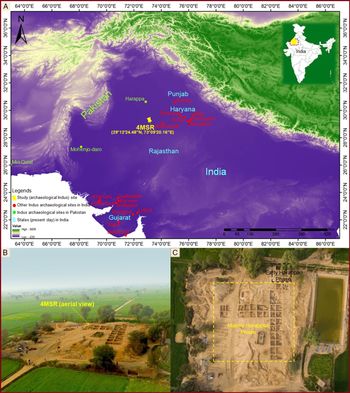
The archaeological site 4MSR (29º12′24.48"N, 73º09′20.16"E), is situated on dry alluvial bed of paleo Ghaggar-Hakra River channel in western Rajasthan (Figure 1). This relict channel is thought to have catered several pre-historic phases of human civilizations in northwestern India. Modern satellite imagery also indicates the existence of a continuous river channel system in northwestern region, along which several records of human settlements of the Indus culture have been unearthed. A large number of furnaces and hearths with ash have been unearthed at the site during course of excavations. Artifacts of gold and copper, shells and terracotta were also recovered from the site. Beads of different shapes and designs made of semiprecious stones with assemblage of ceramic ware have also been recorded. Weights of varying sizes made up of chert and shell, along with the artifacts representing cultural advancement viz., seals, fragments of gold beads, miniature beakers (probably used for measuring liquids) indicate that the site was used for an industrial purpose. The findings at 4MSR place it as an important “habitation or industrial settlement” which shows a major industrial activity along with domestic hearths recovered from the cultural layers in Harappan context.
(A) Map showing the location of the archaeological study site 4MSR (in yellow), Rajasthan along with other Indus site in the region of north-western India (in red) and Pakistan (in green). Map created via software ArcGIS (version# 10.3). (B) Aerial view of the site 4MSR surrounded by wheat fields. (C) Excavated “key trenches” on the mound showing locations of the Early and Mature Harappan Phase. (Please see electronic version for color figures.)

MATERIAL AND METHODS
Macro-Botanical Remains: Collection, Sorting and Analysis
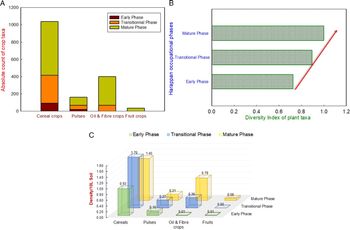
Macro-botanical remains consist of plant traces that are large enough to be recognized (Fritz Reference Fritz, Maschner and Chippindale2005) with the naked eye or low-powered microscope (Ford Reference Ford and Schiffer1979; Pearsall Reference Pearsall2000). The macro-botanical samples were collected by the water floatation technique (using the principle of density difference between inorganic and organic material) during course of excavation. All buoyant carbonized botanical material was sieved through a 30 mesh (0.5 mm) geological sieve. In all 199 macrobotanical samples were collected by floating 7122 L (990l from Early phase, 1825l from Transitional phase and 4307l from Mature phase levels) of soil systematically from cultural contexts (floor, hearths, pits; Figures S1, S2, S3). However, only 156 samples yielded the macro-remains (Table S1). The carbonized macro-remains were segregated from the mixture containing other modern biological material and charcoal pieces under a stereo binocular microscope (Leica EZ4). Segregated samples were sorted, identified and photo-documented by Leica Z6APO (Figures 2A and 2B). The plant taxa were identified on the basis of morphological details preserved in the carbonized grains/seeds up to species level by comparing them with the corresponding parts of the extant plants of the same taxa and other identification reference material (Martin and Barkley Reference Martin and Barkley1961; Pokharia et al. Reference Pokharia, Kharakwal, Rawat, Osada, Nautiyal and Srivastava2011; Fuller Reference Fuller2018). Absolute counts of plant taxa, ubiquity (Popper Reference Popper, Hastorf and Popper1988) and Diversity Index (DI) or Shannon-Weaver Index (Pearsall Reference Pearsall2000) were used to statistically analyze the data (Figure 3A, B and Table S2). The relative abundance of economic crops was also standardized as densities (Weber Reference Weber1999) across all phases by dividing the total number of samples by the volume of sediment floated (Figure 3C, Table S3).
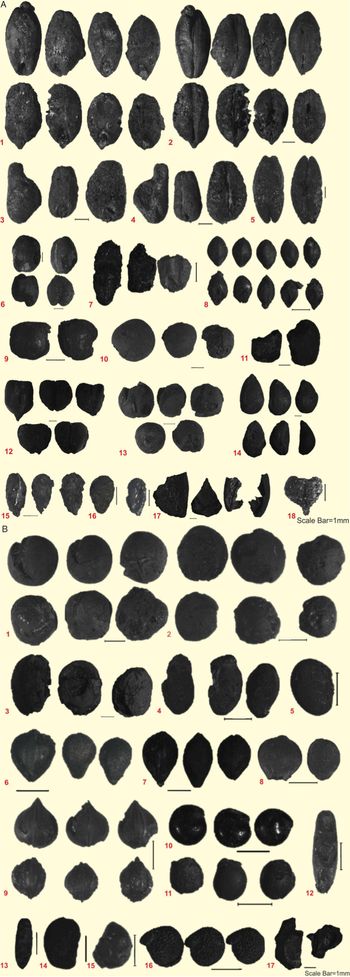
(A) Charred crop remains recovered from the cultural layers of archaeological site 4MSR (Binjor), Rajasthan: (1) Hordeum vulgare (dorsal); (2) Hordeum vulgare (ventral); (3) Triticum aestivum/durum (dorsal); (4) Triticum aestivum/durum (ventral); (5) Triticum dicoccum (dorsal & ventral); (6) Triticum sphaerococcum (dorsal and ventral); (7) Oryza cf. sativa; (8) Setaria sp.; (9) Lathyrus sativus; (10) Lens culinaris; (11) Vigna mungo/radiata; (12) Cicer arietinum; (13) Pisumarvense; (14) Gossypium sp.; (15) Linum usitatissimum; (16) Sesamum indicum; (17) Juglans regia; (18) Vitis sp. (B) Charred weeds and wild taxa remains recovered from the cultural layers of archaeological site 4MSR. (1) Vicia sativa; (2) Vicia hirsuta; (3) Acacia sp.; (4) Medicago sativa; (5) Lespedeza sp.; (6) Scirpus sp.; (7) Polygonum sp.; (8) Cyperaceae; (9) Rumex dentatus; (10) Chenopodium album; (11) Scleria sp.; (12) Aegilops sp.; (13) Andropogon sp.; (14) Desmodium sp.; (15) Phyllanthus sp.; (16) Trianthema sp.; (17) Ziziphus nummularia.

(A) Histogram showing comparative account of absolute count of recovered crop taxa. (B) Bar chart showing the increasing trend of the diversity index of crops and weeds taxa from different phases at 4MSR, Rajasthan. (C) Density of crop taxa per 10 L of soil sediment.

Radiocarbon Dating
In order to understand the chronology of the archaeological site, 14C dating of different habitational layers (charcoal and sediment) and carbonized grains was carried out by conventional beta counting liquid scintillation counter (LSC) and accelerator mass spectrometry (AMS) radiometric dating methods (Table 1). The LSC radiometric dating of the charcoal samples was carried out at the 14C laboratory of the Birbal Sahni Institute of Palaeosciences (Lab code BS-), Lucknow, India, while sediment and carbonized grain samples were dated at the Institute of Physics, Gliwice Radiocarbon Laboratory (Lab code GdA-), Poland. Radiocarbon ages were determined from the 14C/12C ratios after normalizing carbon isotopic fractionation measured by δ13C = −25.0‰ (Stuiver and Polach Reference Stuiver and Polach1977) and then calibrated with the probability method of Calib 7.04 (Stuiver and Reimer Reference Stuiver and Reimer1993) using the IntCal13 data set (Reimer et al. Reference Reimer, Bard, Bayliss, Beck, Blackwell, Bronk Ramsey, Buck, Cheng, Edwards and Friedrich2013). The radiocarbon dates confirm the age of the cultural sequence, along with the ceramic and artifact assemblage recovered at the site.
AMS and LSC 14C dates of charcoal, carbonized grains and sediment samples from the archaeological site 4MSR, dated at the Birbal Sahni Institute of Palaeosciences (lab code BS-) in Lucknow, India, and the Institute of Physics, Gliwice Radiocarbon Laboratory (lab code GdA-) in Poland (68.2% probability).

RESULTS
Chronology of the site 4MSR
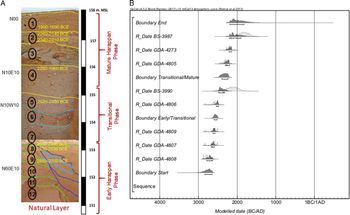
14C ages of cultural layers, including charcoal, soil-sediment and carbonized grains (barley, wheat and rice) indicate the site was occupied from the Early Harappan phase until the termination of Mature phase (Figure 4B and Table 1). A Bayesian model of the obtained dates has been created using the Sequence and Boundary functions of OxCal v4.3.2 (Bronk Ramsey Reference Bronk Ramsey2017) using the IntCal13 calibration curve (Reimer et al. Reference Reimer, Bard, Bayliss, Beck, Blackwell, Bronk Ramsey, Buck, Cheng, Edwards and Friedrich2013). Figure 4A shows the complete stratigraphy and chronological details, based on the radiometric dates acquired from different trenches across the site, as each of these trenches represents a discrete archaeological phase where stratigraphic continuity of the samples could be maintained, these phases could be placed broadly relative to one another in the chronological model. Due to their out of sequence distributions and long tails, there was poor agreement for the LSC charcoal samples BS-3990 and BS-3987. Modeled boundaries for the beginning of the Early phase at the site ranged 2880−2700BCE (GdA-4808; 1σ), the beginning of the Transitional phase 2620−2490 BCE (GdA-4806; 1σ) and the start of the Mature phase at 2340−2210 BCE (GdA-4805; 1σ) and termination of occupation is 1950−1690 BCE (BS-3987; 1σ). The 1σ (one sigma) ranges were favored due to the overlap of the long tails on some of the modeled distributions. Based on 14C dating and artifacts recovered from the site, we present overall chronology of the site in a three broad phases: Early phase ca. 2900−2600 BCE (period 2, Kot Diji phase); Transitional phase 2600−2500 BCE (period 3A, initial) and Mature phase 2500−1800 BCE (period 3B and 3C, final) based on Indus tradition chronology at Harappa (Kenoyer Reference Kenoyer and Meadow1991b).The termination of the occupation 1800 BCE is not based on the actual dated material, hence the end of the occupation favored is given as the modeled end date. However, the main occupational phases Early, Transitional, and Mature are based on the dated carbonized grains for e.g. barley from the Early phase dated back to ~2830−2500 BCE (GdA-4807), and from the Transitional phase dated back to ~2620−2490 BCE (GdA-4806) (Table 1). Remarkably, the single date of rice from 4MSR dates to ~2340−2210 BCE (GdA-4805; Table 1) which is analogous to ~2430−2140 BCE dated from another Indus site Masudpur I (Haryana) (Petrie et al. Reference Petrie, Bates, Higham and Singh2016).
(A) Stratigraphy at the site 4MSR showing chronology from the Early Harappan phase to the Mature phase. (B) Bayesian model created by using OxCal v4.3.2 atmospheric curve between calibrated radiocarbon ages and mean above sea level (masl).

Quantifying Agricultural Production and Intensification
The macro-botanical assemblage revealed (Table S1) the occurrence of cultivated plants characterized by cereals and leguminous crops viz., Hordeum vulgare, Triticum aestivum/durum, Triticum sphaerococcum, Triticum dicoccum, Oryza sativa, Pisum arvense, Lens culinaris, Cicer arietinum, Lathyrus sp. and Vigna sp. Besides, oleiferous and fibrous crops such as Sesamum indicum, Linum usitatissimum and Gossypium sp. have also been recorded. Horticultural crops like Vitis sp. and Juglans regia were also found (Figure 2A). The presence of ruderal weeds and wild taxa has also been noticed in association with agricultural crop assemblage (Figure 2B. During the Early phase (~2900−2600 BCE) the winter crops (98%) (Figure 5) are represented by the Hordeum vulgare (77%) and Triticum sp. (5%), along with winter season pulses like Pisum arvense (6%), Lens culinaris (6%), Lathyrus sp. (4%) and insignificant summer crops (2%) viz., Vigna sp. and Gossypium sp.
Pie charts showing the relative proportion of summer and winter crops at 4MSR, Rajasthan.

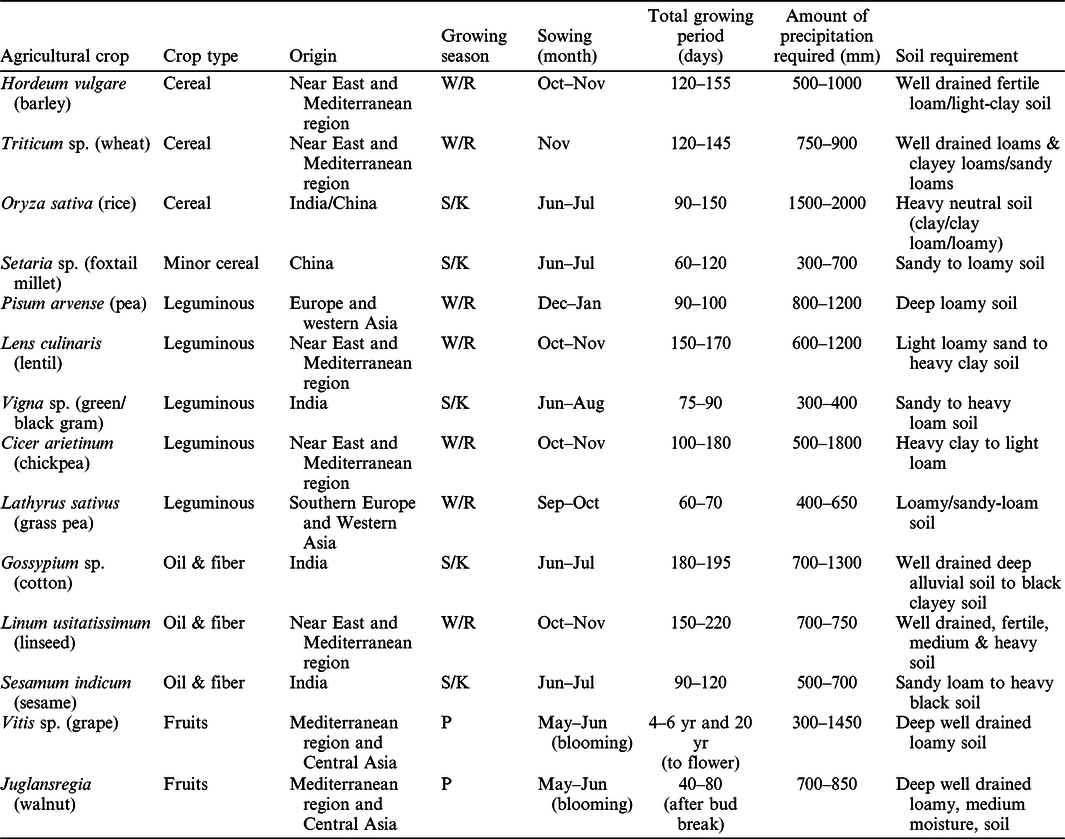
The crop economy during the Transitional phase (~2600−2500 BCE) is witnessed by winter (83%) and summer (17%) season crops (Figure 5). A uni-seasonal (winter) cropping strategy was gradually modified into the double-cropping system based on winter (Hordeum vulgare, 60%; Triticum sp., 12%; Pisum arvense, 5%; Lens culinaris, 1% and Lathyrus sp., 2%; Linum usitatissimum, 3%) and summer (Oryza sativa, <1%; Setaria sp., 1%; Vigna sp., 3%; Gossypium sp., 11% and Sesamum indicum, 2%) crops. The abundance of cotton seeds during this phase are noted. The presence of summer crops (17%) during the Transitional phase suggests the inception of strong Indian Summer Monsoon (ISM). However, the intensification and diversification of the agricultural production has been observed during the Mature phase (~2500−1800 BCE) and can be attributed to favorable mainly winter and summer precipitation. The agricultural strategy seems fully developed and might have provided the production of surplus food for the settlers throughout the year. The summer crops accounted for 43% and winter crops 57%. The occurrence of Juglans regia (3%), native of temperate region, indicates trade contacts with far distant culture during this time period. The estimated diversity index (DI) or Shannon-Weaver index (Pearsall Reference Pearsall2000) of the plants during the Early, Transitional and Mature phases also corroborates the macro-botanical assemblage found at 4MSR represented by 0.7<0.9<1.0 respectively (Figure 3B; Table S2). The density has also been calculated for the cereals, pulses, oil and fiber crops and fruits per 10 L of soil floated (Figure 3C), thus surmising maximum diversity during the Mature Phase. The agricultural crop requirements (modern scenario) of Indus crop assemblage grown at 4MSR can be understood from the adapted Table 2.
Agricultural crop requirements of Indus crop assemblage recorded at 4MSR. Adapted from different sources viz. Handbook of Agriculture, Indian Council of Agricultural Research, New Delhi (Anonymous 2006); Irrigation Water Management: Irrigation Water Needs, F.A.O., United Nations, Italy (Brouwer and Heibloem, Reference Brouwer and Heibloem1986); USDA (2020) plants database; and Petrie and Bates (Reference Petrie and Bates2017). (Abbreviations: W/R=Winter/Rabi; S/K=Summer/Kharif; P=Perennial.)

DISCUSSION
Archaeological Context: Architecture and Ceramic Data
Early Harappan Phase (~2900−2600 BCE)
The excavations at lower levels of trenches (N60E10, S30W50, N30W10, N30W20, S30W50, S20W10, N10E00, S10E10, S30W40; Supplementary Table 1) revealed the Early phase of Indus civilization which was not characterized by any citadel complex or town planning. The ceramic assemblage found from this phase was mainly dominated by Hakra, Sothi and Kot Dijian elements indicating cultural contacts during the Early phase of Indus. The ceramics were beautifully painted with figures of a peacock and other birds, and a lion (or an animal of family Felidae), as well as bichrome floral designs with black horizontal bands and wavy lines on pots. Seals or pendants with engravings of animals on both sides were also recovered from this phase. The discovery of an octagonal fire altar made of burnt brick, with a yasti (a shaft) indicates ritual practices performed by the Harappans. The dominance of winter season crops indicates the winter precipitation might have supported the agriculture during the Early phase.
Transitional Phase (~2600−2500 BCE)
The transitional phase is characterized by the combination of potteries belonging to Early and Mature Harappan phases. Before the onset of the Mature phase, the hearths were found within residential complex, although industrial activity got started in the Transitional phase. A seal lacking script found during the Transitional phase has a geometric pattern on one side and a little knob on the other side plausibly used as a stamp for trade practices. The settlers during this phase were practicing both winter and summer cropping system indicating amelioration in Indian summer monsoon.
Mature Harappan Phase (~2500−1800 BCE)
During the Mature phase, technological and industrial activity in the form of bead and metallurgical processing testify to trade practices at the site. The ceramic and artifacts are dominated by black-on-red ware, plain red ware, perforated jars, pots and plates, globular pots, dish-on-stand, beakers, pots with pencil seals, sealing and cubicular weight etc. Other important artifacts like beads made of carnelian, lapis lazuli, steatite, agate and terracotta, shell and terracotta bangles, copper rings and fish hooks, terracotta spindle and whorls, toy-cart frames, figurines of humped bulls, and arrowheads etc. were recorded from this phase. Inscribed seals found from this phase had the engraving of a unicorn on them. The lower levels of this phase also revealed the evidence of streets. Potsherds with the impression of fabric remains of cotton indicate sophisticated-craft specialization. Ornaments made of gold were also found indicating high economic status of the settlers. Excavated trenches revealed small rooms and walls made of mud-bricks in the ratio of 1:2:4 (Mature Harappan feature) with post holes. A massive (8 m wide) wall built of mud bricks suggests that wall enclosures might have been built to prevent flooding as evidenced from Indus sites as Kalibangan, Kanmer and Khirsara (Kharakwal et al. Reference Kharakwal, Rawat and Osada2012; Pokharia et al. Reference Pokharia, Agnihotri, Sharma, Bajpai, Nath, Kumaran and Negi2017). Bones of tortoises, freshwater fish and cattle suggest that they have played an important role in the subsistence economy. Series of furnaces at different levels indicate that multiple artisans had worked simultaneously. Silos lined with mud plaster indicate the residential nature of the site. All this evidence demonstrates gradual transformation from agriculture to technological advancement during the Mature phase.
State of Agriculture: Development, Diversification and Intensification
Identifying the exact origin of agriculture is challenging because the transition from hunter-gatherer societies to the sedentary life began thousands of years before the invention of writing. Nonetheless, archaeobotanists have traced the selection and cultivation of specific food plant characteristics, e.g. semi-tough rachis and larger seeds, to just after the Younger Dryas (~9500 BCE) in the early Holocene in the Levant region of the Fertile Crescent. There is considerable earlier evidence which indicates the use of wild cereal grains from sites across Southwest Asia and North Africa. It has been shown that the cultivation developed long after, hunter-gatherers began utilizing wild cereals like wild emmer wheat and barley at Ohalo II in Israel since ~22,000 BCE (Kislev et al. Reference Kislev, Nadel and Carmi1992; Piperno et al. Reference Piperno, Wiess, Holst and Nadel2004; Weiss et al. Reference Weiss, Wetterstrom, Nadel and Bar-Yosef2004). Cultivation of wild forms of cereals was also evident from the Late Natufian sites of the northern Levant (Middle Euphrates River Valley, Syria) after ca. 11,000 BCE and certainly prior to ca. 9000 BCE (Willcox Reference Willcox, Gosden and Hather1999, Reference Willcox2002, Reference Willcox2004, Reference Willcox2005; Garrard Reference Garrard2000; Moore et al. Reference Moore, Hillman and Legge2000; Hillman et al. Reference Hillman, Hedges, Moore, Colledge and Pettitt2001).
The transition to agriculture in South Asia has taken multiple pathways, based on local domestication and adoption of crops from adjacent areas by hunter gatherer populations (Fuller and Murphy Reference Fuller and Murphy2014). In these diverse strategies, relationships between sedentism, cultivation and herding emerged, though evidence suggests that sedentism preceded agriculture in the subcontinent (Fuller Reference Fuller2011a). The transition from hunter-gatherer societies to settled agriculture communities is demonstrated from sites located in the Ghaggar-Hakra valley of Indian sub-continent (Guha Reference Guha1994). The early food producing communities were evidenced from the highlands of Baluchistan in Pakistan during 7th to 4th millennium BCE. The recent studies at Datrana IV in North Gujarat uncovered a Mesolithic hunter-gatherer occupation with superimposed Chalcolithic deposits showing semi-nomadic pastoralism and plant cultivation, which resulted in the domestication of several millets, pulses, and sesame (Garcia-Granero et al. Reference García-Granero, Lancelotti, Madella and Ajithprasad2016). South Asia acquired a unique Neolithic transition towards agricultural domestication (Murphy and Fuller Reference Murphy, Fuller and Shugart2017). Only a few Neolithic sites added archaeobotanical evidence from South Asia (Fuller et al. Reference Fuller, Korisettar, Venkatasubbaiah and Jones2004). It is evidenced from northwestern region of South Asia, the dominant crops were derived from the Southwest Asian Neolithic Founder crops (Zohary Reference Zohary and Harris1996; Zohary and Hopf Reference Zohary and Hopf2000). These founder crops of the agriculture mainly include Triticum sp., Hordeum vulgare, Pisum arvense, Lens culinaris, Cicer arietinum, Lathyrus sativus and Linum usitatissimum. The first possible domesticated forms of these cereals date from the Pre-Pottery Neolithic A (ca. 9500 BCE) in adjacent regions of Southwest Asia, although their domestication status or dated time period is still questionable (Colledge Reference Colledge2001, Reference Colledge, Peltenberg and Wasse2004; Willcox Reference Willcox2005).
Later, these pastoral communities settled during the Early Harappan phase (regionalization era ~3300−2600 BCE) of IVC (Kenoyer Reference Kenoyer and Meadow1991b). The expansion of human population and cultural exchange might lead to the development of agricultural practices (Harlan Reference Harlan, Cowan, Wesley and Watson1992; Madella and Fuller Reference Madella and Fuller2006) in spatial and temporal domain and became an advanced oldest civilization of South Asia. The plant-based subsistence economy of Early Harappans mainly relied on winter crops (uni-seasonal) like barley and wheat, but later diversification and intensification of variety of tropical pulses, oil and fiber crops along with horticultural plants modified their agricultural skills by harvesting two crops a year i.e. winter and summer season crops (Pokharia et al. Reference Pokharia, Kharakwal, Rawat, Osada, Nautiyal and Srivastava2011, Reference Pokharia, Kharakwal and Srivastava2014; Petrie and Bates Reference Petrie and Bates2017). The Early Harappans’ subsistence is also evident from native (Indian) pulse Vigna radiata, which might have originated in western Himalaya and the southern Peninsula; Macrotyloma uniflorum, domesticate of Rajasthan, Gujarat or the southern Peninsula and small grained millet Panicum sumatrense at Harappa indicate pre-sedentary period in the region (Fuller Reference Fuller2006; Murphy and Fuller Reference Murphy, Fuller and Shugart2017). The archaeobotanical evidence from the archaeological sites of south India indicates the predominance of Vigna radiata, along with Macrotyloma uniflorum and millets Brachiaria ramosa and Setaria verticillata (Fuller et al. Reference Fuller, Korisettar and Venkatasubbaiah2001, Reference Fuller, Korisettar, Venkatasubbaiah and Jones2004). Further archaeological investigations are needed to document the emergence of pre-Harappan agricultural villages and their direct or indirect cultural contacts across India. Over the course of the Chalcolithic and Harappan era, the range of summer crops diversified across India, including more pulses, millets, and rice.
Harappans apparently evolved a more developed irrigation technology than their predecessors, that allowed to exploit the spacious and fertile Indus River basin (Kenoyer Reference Kenoyer1991a). The network of dams, canals and reservoirs at Indus/Harappans site Dholavira indicates elaborated water management system during the Indus time (Bisht Reference Bisht1998–1999). Being a region with fertile alluvium soils and perennial rivers, the Ghaggar basin might have been a potential area for settlement and surplus production of food grains.
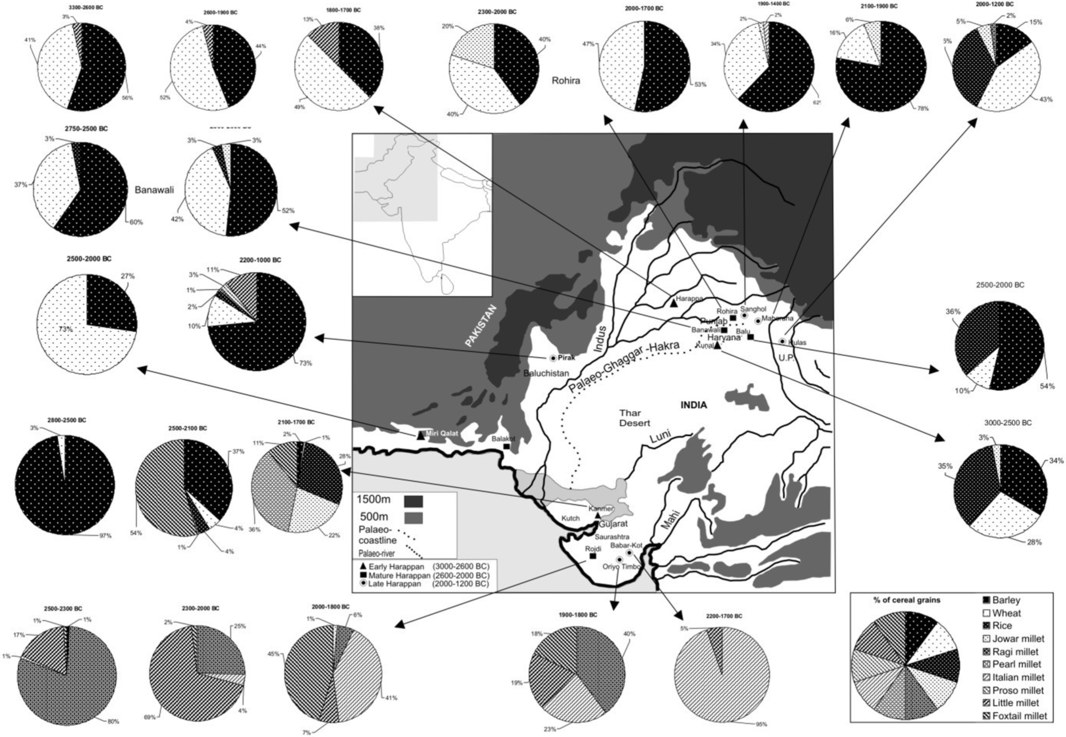
The archaeobotanical evidence at 4MSR provides ample information to infer cropping system and subsistence strategies adopted by Harappans in the semi-arid region of western Rajasthan. Macro-remains data revealed that the Early phase (~2900−2600 BCE) at 4MSR was dominated by the winter crops like barley and wheat (Figure 5), when the climate was relatively conducive for agricultural practices and mainly governed by the winter precipitation as also noticed from other Harappan sites viz.,Miri-Qalat, Pirak, Harappa, Rohira, Sanghol, Kunal, Balu, Banawali, Shikarpur, Rojdi, Oriyo-Timbo, Babar-kot, and Kanmer (Costantini Reference Costantini and Taddei1990; Saraswat, Reference Saraswat1992; Reddy, Reference Reddy1994; Tengberg Reference Tengberg1999; Saraswat and Pokharia Reference Saraswat and Pokharia2002, Reference Saraswat and Pokharia2003; Weber Reference Weber, Weber and Belcher2003; Pokharia et al. Reference Pokharia, Kharakwal, Rawat, Osada, Nautiyal and Srivastava2011) (Figure 6).
Relative proportion of cereal grains in the Indus/Harappan civilization.

Several palynological and geochemical studies from the lakes of Rajasthan (such as Lunkaransar, Didwana, Sambhar) and Gujarat (such as Nal Sarovar and Malvan lake) suggest a change in climate and precipitation during different time intervals of the Holocene epoch and numerous significant monsoon variations (wet and dry episodes) over short and long term time scale (Vishnu-Mittre Reference Vishnu-Mittre1973, Reference Vishnu-Mittre1979; Singh et al. Reference Singh, Joshi, Chopra and Singh1974, Reference Singh, Wasson and Agrawal1990; Vishnu-Mittre Reference Vishnu-Mittre1979; Bryson and Swain Reference Bryson and Swain1981; Swain et al. Reference Swain, Kutzbach and Hastenrath1983; Wasson et al. Reference Wasson, Smith and Agrawal1984; Prasad et al. Reference Prasad, Kusumgar and Gupta1997; Enzel et al. Reference Enzel, Ely, Mishra, Ramesh, Amit, Lazar, Rajaguru, Baker and Sandler1999). After ~5000 BCE, the wet phase began again in the early Holocene (wetter conditions) after an arid interval after Last Glacial Maxima (LGM) indicated by high and continuous lake levels (Singh et al. Reference Singh, Joshi, Chopra and Singh1974, Reference Singh, Wasson and Agrawal1990; Wasson et al. Reference Wasson, Smith and Agrawal1984; Enzel et al. Reference Enzel, Ely, Mishra, Ramesh, Amit, Lazar, Rajaguru, Baker and Sandler1999). Similar brief episodic fluctuations of wet and dry phases were also recorded by the marine isotopic records (Staubwasser et al. Reference Staubwasser, Sirocko, Grootes and Erlenkeuser2002, Reference Staubwasser, Sirocko, Grootes and Segl2003). Overall, the climatic conditions during the mid Holocene (~5000 BCE) showed consistently high rainfall with maximal winter monsoon (Singh et al. Reference Singh, Joshi, Chopra and Singh1974; Bryson and Swain Reference Bryson and Swain1981; Enzel et al. Reference Enzel, Ely, Mishra, Ramesh, Amit, Lazar, Rajaguru, Baker and Sandler1999). The palynological data from the region of central India (Madhya Pradesh) also suggests higher winter precipitation during the beginning of third millennium BCE (Chauhan Reference Chauhan1996, Reference Chauhan2000, Reference Chauhan2002). However, during the mid-third millennium BCE (~2600/2500 BCE) the transition of Holocene marks the onset of modern monsoonal conditions evidenced from central India (Chauhan et al. Reference Chauhan, Sharma, Phartiyal and Kumar2013). This phase corresponds with the Transitional Harappan phase (~2600−2500 BCE). Crop assemblage during the Mature Harappan phase indicates that the region experienced wetter and warmer climatic conditions (Figures 3 and 5). Agriculture strategy shifted from wetter conditions to drier (drought resistant crops) conditions, which suggests the human adaptation during the late Mature Phase (drought conditions). Attempts have been made to relate the evolution of the Harappan civilization to the changing monsoonal condition since the mid-Holocene. Moreover, the growth and migration/collapse of Harappan civilization has also been linked to the intensification of ISM during the mid-Holocene climate optimum and its subsequent weakening after mid-second millennium BCE respectively. The collapse of the contemporaneous civilizations such as the Akkadian (Mesopotamia), Yangtze (China), Minoan (Crete), has been attributed to either weakening of monsoon or Asian aridification during ~4.1 kyr (Singh et al. Reference Singh, Joshi, Chopra and Singh1974; Enzel et al. Reference Enzel, Ely, Mishra, Ramesh, Amit, Lazar, Rajaguru, Baker and Sandler1999; Gupta et al. Reference Gupta, Anderson and Overpeck2003; Staubwasser et al. Reference Staubwasser, Sirocko, Grootes and Segl2003; Prasad and Enzel Reference Prasad and Enzel2006; Dixit et al. Reference Dixit, Hodell and Petrie2014).
The history of origin, antiquity and spread of rice cultivation has long been a subject of debate. The origin of Oryza sativa, a domesticated Asian rice has been a contentious topic (Choi et al. Reference Choi, Platts, Fuller, Hsing, Wing and Purugganan2017). For instance, there has been a long debate on the possibility of more than one geographically distinct origin of rice e.g. India and China. Changes in land use pattern by early farmers, selection for the traits for rice domestication, modernization of agricultural techniques, crop economy based on rice are major study areas to answer the questions related to history of rice domestication. Domestication of rice in India and China was followed by two pathways for the early cultivation of rice, one with selection for domestication traits in early Yangtze japonica and another a non-domestication feedback system inferred for “proto-indica” (Fuller Reference Fuller2011b). Recent genetic studies suggest that the course of continuous selection of desirable traits, Oryza sativa sp. japonica arose separately from wild progenitor O. rufipogon and/or O. nivara into domesticated species (Choi et al. Reference Choi, Platts, Fuller, Hsing, Wing and Purugganan2017). Genetic research shows that there are two distinct taxonomically recognized subspecies indica and japonica (Garris et al. Reference Garris, Tai, Coburn, Kresovich and McCouch2005; Londo et al. Reference Londo, Chiang, Hung, Chiang and Schaal2006; Fuller et al. Reference Fuller, Ling, Yunfei, Zhijun, Xugao, Aoi and Guo-Ping2009) and also identifies a group of indica-like rice lineages, referred to as aus rice (McNally et al. Reference McNally, Childs, Bohnert, Davidson, Zhao, Ulat, Zeller, Clark, Hoen and Bureau2009; Zhao et al. Reference Zhao, Tung, Eizenga, Wright, Ali, Price, Norton, Islam, Reynolds, Mezey, McClung, Bustamante and McCouch2011; Schatz et al. Reference Schatz, Maron, Stein, Wences, Gurtowski, Biggers, Lee, Kramer, Antoniou and Ghiban2014; Civan et al. Reference Civan, Craig, Cox, Brown, Fuller, Molina, Huang, Gross, Zhao and Goff2015; Travis et al. Reference Travis, Norton, Datta, Samar, Dasgupta, Savio, Macaulay, Hedley, McNally, Sumon, Islam and Price2015; Choi et al. Reference Choi, Platts, Fuller, Hsing, Wing and Purugganan2017). It has been suggested that the first domesticated rice population arose from O. rufipogon at ~13.1–24.1 ka and later on the expansion of O. rufipogon occurred after the Last Glacial Maximum at ~18 ka (Choi et al. Reference Choi, Platts, Fuller, Hsing, Wing and Purugganan2017). They further states that there is significant gene flow from japonica to both indica and aus, which led to the transfer of domestication alleles from early domesticated japonica to proto-indica and proto-aus populations.
Recent versions of rice domestication highlight the necessity of hybridization between a fully domesticated japonica and semi-domesticated proto-indica, whereby japonica became the donor of many domestication syndrome genes in indica (Sang and Ge Reference Sang and Ge2007; Sweeney and McCouch Reference Sweeney and McCouch2007; Fuller et al. Reference Fuller, Weisskopf and Castillo2016). The evidence of rice from Indus sites such as Kunal, Balu and Banawali in northwestern India (Saraswat et al. Reference Saraswat, Srivastava and Pokharia2000; Saraswat Reference Saraswat2002; Saraswat and Pokharia Reference Saraswat and Pokharia2002, Reference Saraswat and Pokharia2003) suggests its cultivation in the Indus plain, however their actual context is not very clear due to lack of direct dates. The recent direct dates of rice from Masudpur I, Haryana (~2430−2140 BCE; Petrie et al. Reference Petrie, Singh, Bates, Dixit, Rench, Dodell, Jones, Lancelotti, Lyman, Neogi, Pandek, Parikh, Pawar, Redhouse and Singh2017) and 4MSR (~2340−2210 BCE) surmise the rice cultivation during the late Mature phase in the Indus region. Bates et al. (Reference Bates, Singh and Petrie2017) reported the wild and domesticated type spikelets and found the progressive increase in the proportion of domesticated type spikelets bases during the late Mature phase. The accompanying weeds, however, showed no increased proportions of wetland species (Bates et al. Reference Bates, Singh and Petrie2017). It was, therefore, suggested that the development of an independent rice tradition might have been intertwined with the practice of settled populations living in the eastern most reaches of the IVC. A few rice grains from 4MSR without spikelet bases showing resemblance with the rice grains have been identified as proto-indica due to predominant wild morphological appearance (i.e. immature grains). Occurrence of proto-indica rice from 4MSR suggests pre-domestication cultivation during the late Mature phase of Indus/Harappan period. The evidence of rice outside its natural habitats of wild rices and Indus crop package (wheat and barley) into the Ganges Valley between 2850−2460 (Pokharia et al. Reference Pokharia, Sharma, Tripathi, Misra, Pal and Ram Vinay2016; Liu et al. Reference Liu, Lister, Zhao, Petrie, Zeng, Jones, Staff, Pokharia, Bates, Singh, Weber, Matuzeviciute, Dong, Li, Lu, Jiang, Wang, Ma, Tian, Jin, Zhou, Wu and Jones2017) suggest that the dispersal of crops from Ganga Valley and vice-versa may be due to direct or indirect contacts.
Cotton is known as a crop of great importance for agriculture, industry and trade, especially for tropical and subtropical regions. The exploitation of cotton fabric has been shown from several sites viz., Mohenjo-daro in Sind (Pakistan) (Marshall Reference Marshall1931) and Nevasa (Clutton-Brock et al. Reference Clutton-Brock, Mittre and Gulati1961) during ~3000 BCE. However, the seeds observed from the sites such as Harappa (Weber Reference Weber, Weber and Belcher2003), Hulas (Saraswat Reference Saraswat1993), Chandoli (Kajale Reference Kajale and Renfrew1991) and Loenbar 3 (Costantini Reference Costantini and Stacul1987), Balakot (Fuller Reference Fuller, Settar and Korisettar2001), Kunal (Saraswat and Pokharia Reference Saraswat and Pokharia2003), Banawali (Saraswat et al. Reference Saraswat, Srivastava and Pokharia2000), Kanmer (Pokharia et al. Reference Pokharia, Kharakwal, Rawat, Osada, Nautiyal and Srivastava2011), Khirsara (Pokharia et al. Reference Pokharia, Agnihotri, Sharma, Bajpai, Nath, Kumaran and Negi2017) suggest that the cultivation of cotton has been practiced since the Mature Harappan times (~2600−2200 BCE). Our finding from 4MSR also observed plenty of cotton seeds from the Transitional phase-11% to the Mature phase-28% (~2600−1900 BCE). The abundance of cotton seeds during the Mature phase suggests their prolonged cultivation as a fibrous crop owing to favourable climatic conditions. Potsherd with the impression of a fabric corroborates the macro-botanical finds recovered from the site and also indicates intensive usage/trade.
CONCLUSION
The subsistence pattern at 4MSR indicates continuity and change in temporal domain likely owing to changing climatic/environmental conditions, resources and knowledge gained by exchange/trades of cultures over a time period of ~2900−1800 BCE. The crop-change appears to be intentional as the human population in the past is known to have managed crops in a range of ways (Pokharia et al. Reference Pokharia, Agnihotri, Sharma, Bajpai, Nath, Kumaran and Negi2017). The evidence provided by the combination of macro-botanical remains in specific context and phases of occupation reveal much about bi-seasonal cropping which enables consideration of issues related to adoption, intensification, adaptation and resilience in the face of changing social, economic and environmental conditions.
ACKNOWLEDGMENTS
We are thankful to the Director General of the Archaeological Survey of India, New Delhi, and the Director of BSIP, Lucknow, U.P., for permission and encouragement to collaborate for multidisciplinary studies. We are grateful to the Department of Science and Technology, New Delhi, for providing financial support under SERB-DST Project No. EMR/2015/000881. We are also grateful to anonymous reviewers and A.J.T. Jull and Yaroslav Kuzmin for their constructive comments, which greatly helped to improve the earlier version of the manuscript.
SUPPLEMENTARY MATERIAL
To view supplementary material for this article, please visit https://doi.org/10.1017/RDC.2020.37