Introduction
This paper discusses significant changes that have occurred in the senior music curriculum over the last two decades in New Zealand. The paper begins by considering the historical development of knowledge differentiation and verticality in senior school music and outlines how recent restructuring has led to a diversification of curriculum knowledge structures, content, and specification. Bernstein's (2000) theories of knowledge differentiation (vertical and horizontal discourse) are utilised as explanatory concepts in the critique of these changes. A challenge for the realisation of senior music is the variety of curriculum knowledge structures now contained in the subject's varied components (performance, composition, analysis etc.). The concept of regionalisation (Bernstein, Reference BERNSTEIN2000), a process whereby singulars (strongly classified subjects) are recontextualised into larger fields, is also utilised as a means to consider knowledge displacement, curriculum ‘over-crowding’, and the changing classification of the subject; senior music has become populated with new knowledge areas, despite the fact that curriculum documents have been emptied of much of the knowledge content. Finally, in light of social realist critiques of curriculum development it is argued that the retention of some foundational conceptual content is advisable to ensure students have access to knowledge generally considered ‘powerful’ within the discipline (Young, Reference YOUNG2008, Reference YOUNG2010a, Reference YOUNG2010b).
Knowledge differentiation
The emphasis in current official education policy on curriculum relevance has brought the question of knowledge within education into increasing focus (Muller, Reference MULLER, Young and Gamble2006; Young & Gamble, Reference YOUNG and GAMBLE2006; Young, Reference YOUNG2008, Reference YOUNG, Daniels, Lauder and Porter2009, Reference YOUNG2010a, Reference YOUNG2010b; Maton & Moore, Reference MATON and MOORE2010; Moore, Reference MOORE, Maton and Moore2010; Wheelahan, Reference WHEELAHAN2010). Bernstein (Reference BERNSTEIN2000) was concerned to clarify how knowledge as a form of cultural consciousness is produced, structured and acquired. He differentiates the knowledge required for academic learning from everyday learning and terms them vertical and horizontal discourses respectively. The discourses of academic fields have traditionally been concerned with the development and transmission of conceptual, context-independent knowledge. Students are introduced to the systemised theoretical concepts and content they need to progress to higher-order thinking within various subject boundaries. Bernstein's vertical discourse can take one of two forms – either ‘a coherent, explicit and systematically principled structure, hierarchically organised as in the sciences, or it takes the form of a series of specialised languages . . . as in the social sciences and humanities’ (2000, p. 157). Within vertical discourse the ‘systematically principled structures’ of the sciences contain a higher level of verticality reliant on hierarchical levels of abstraction whereas the social sciences and arts consist more usually of a series of segmented languages with what Bernstein (Reference BERNSTEIN2000) terms varying ‘grammars’ from strong to weak. What is interesting about music is that while it is structured segmentally each segment contains differing degrees of verticality.
An example of a knowledge structure with a strong grammar (a more hierarchical structure) within music is music theory, where traditional rules beginning with pitch and duration nomenclature can lead sequentially to facility in advanced concepts such as counterpoint and fugue. This demonstrates a conceptual integrity in which the knowledge progression and integration are pivotal for acquisition. In contrast, within the field of composition for example, there exists a weaker grammar comprising a series of segmented stylistic languages (e.g. minimalism, 12-bar blues) that are not necessarily reliant on a sequential development of knowledge but more on conceptual awareness of stylistic conventions associated with the chosen ‘voice’. School subjects, like their parent knowledge structures, can be usefully conceptualised as varying along a continuum of verticality (or knowledge progression) from hierarchical to segmented (Muller, Reference MULLER, Young and Gamble2006; Maton, Reference MATON2009). Awareness of knowledge structures has significant implications for curriculum conception and specification and for pedagogy. A lack of awareness of the underlying knowledge structures may lead to under-specification of knowledge content and progression and consequently impede student learning (Muller, Reference MULLER, Young and Gamble2006).
The vertical discourse of intellectual fields can be differentiated from the horizontal discourse of everyday knowledge which is ‘likely to be oral, local, context dependent and specific, tacit, multi-layered . . .’ (Bernstein, Reference BERNSTEIN2000, p. 157). This knowledge is situated, segmented, and acquired through ad hoc experience rather than through ‘systematically related sets of concepts’ (Young, Reference YOUNG2010b, p. 25). Vertical and horizontal forms of knowledge are often conceptualised as an abstract/concrete, oral/written, informal/formal dichotomy, and are generally heard as oppositional rather than complementary. They are often ideologically positioned, the ratiocination of knowledge having led to dominant discourses that have ‘silenced’ or excluded others within education. Until recent times western classical art music has been positioned as a form of sacred knowledge (in Bernstein's terms a vertical discourse), and popular music as an expression of the profane (a horizontal discourse).
University music, elective school music, and to a large extent one-to-one instrumental tuition (both within and outside institutions), exhibit the characteristics of vertical discourse, with strong distributive rules regulating access, transmission and evaluation (Bernstein, Reference BERNSTEIN2000). On the other hand the world of everyday, self-taught music making and listening, for example a garage band, can be heard as a form of horizontal discourse where the knowledge is ‘contextually specific and context dependent, embedded in on-going practices, usually with strong affective loading, and directed towards specific, immediate goals, highly relevant to the acquirer in the context of his/her life’ (Bernstein, Reference BERNSTEIN2000, p. 159, italics in original). Popular music's ubiquitous presence and its importance to young people, create a potential tension between the traditional vertical discourse of school music, the processes of informal music learning (horizontal discourse), and the musical values and interests of students and teachers (Sloboda, Reference SLOBODA2001; Green, Reference GREEN2006, Reference GREEN2008; Walker, Reference WALKER2007).
The development of verticality in senior school music
The historical development of music education saw the evolution of distinct classes of musical knowledge. This was manifested as a divide between the theoretical and practical dimensions of the subject. Historically this division can be seen in the emergence of the European conservatoires after the French revolution, and in the differences in the musical training carried out within these conservatoires compared with the universities. In Oxford in 1870, for example, an examination for the award of a degree in music comprised harmony and counterpoint, fugue, canon, analysis, musical history and the submission of an original composition (Rainbow, Reference RAINBOW2006). In New Zealand from 1884 through to at least the early 1950s the same components made up the curriculum of the bachelor of music degree.
By contrast the emphasis in the European conservatoires was on the applied practice of music performance through instrumental studies, with supplementary theoretical, compositional and historical knowledge (Rainbow, Reference RAINBOW2006). While the teaching of instrumental skills has developed its own verticality of knowledge towards increasing levels of technical and musical skill, it tends to be localised into segmented schools of performance and technical styles. The academic knowledge of the university, in contrast, consists of induction into structured and sequentially more complex knowledge concepts that are the result of ‘historically evolved rules of collective evaluation’ (Moore, Reference MOORE, Maton and Moore2010, p. 152).
As the senior school curriculum developed in the UK and New Zealand in the 20th century it mirrored the parent structure of the more highly valued knowledge of the university in that practical elements were rendered secondary to the explicitly cognitive dimensions of analysis, history, harmony and counterpoint. In this way the subject was able to comply with the hegemonic principles of ratiocination, or verticality of knowledge, which lie at the heart of western scientific method (Muller, Reference MULLER, Christie and Martin2008; Drummond, Reference DRUMMOND, Grierson and Mansfield2003). This recontextualisation of music increased its status and enabled its affiliation with academic school subjects. The preference afforded to classical over popular music, the emphasis given to developing skills in musical literacy over oral or practical fluency, and the ordering of musical knowledge into ‘sequential learning, prescriptive goals and materials, tests and national examinations . . .’ (Drummond, Reference DRUMMOND, Grierson and Mansfield2003, p. 54) are symptoms of this process of ratiocination. In New Zealand secondary schools, performing and composing were not accorded a place within formal assessment for qualifications until 1993.
Historically in elective school music, an official vertical discourse evolved modelled on the high-status musical knowledge structures of the university rather than on the horizontal and local music practices of everyday music making or even on the more vertically developed one-on-one training in instrumental studies. The resulting curricular content and pedagogic practices emphasised a logic of transmission rather than acquisition; an emphasis on ‘states of knowledge rather than ways of knowing’ (Bernstein, 2003, p. 98, italics in original). Although within education rational abstract thinking remains more highly prized than practical skills (Ivinson, Reference IVINSON, Singh, Sadovnik and Semel2010), such narrow conceptions of musical knowledge have begun to be challenged by the increasing recognition of ‘local’ and ‘real-world’ procedural and situated knowledges or other ‘ways of knowing’ (Elliott, Reference ELLIOTT1995; Westbury, Reference WESTBURY, Colwell and Richardson2002; Drummond, Reference DRUMMOND, Grierson and Mansfield2003). Of interest is the way in which the pedagogic identities of the teacher and students interact with the changing classification of the subject. Previously strong commitments or callings to a subject, based on the premise of the value of its intrinsic knowledge, are now quickly diversifying as teachers and curriculum writers have responded to calls for inclusivity and relevance, and as graduates of new tertiary courses in popular music and jazz have begun to move into secondary school teaching. Wignell (Reference WIGNELL, Christie and Martin2008) suggests that as boundaries weaken around a discipline and ‘the more it listens to other voices’ then the more likely it is that it will evolve as either a segmented knowledge structure or as a blend of hierarchical and segmented (Wignell, Reference WIGNELL, Christie and Martin2008, p. 203).
With the inclusion of performance, composition, popular and other musics into the school curriculum, and the influence of new technologies, a number of possible discourses now vie for curricular space, as well as new and varied music identities. The subject has particular challenges as its strength of classification weakens, in that it seeks to look in many directions: towards vertical theorised knowledge, towards the horizontal practices of music-making (where music intersects so significantly with the interests of students), and increasingly towards new technologies and the popular music market. These components contain not only varying degrees of verticality (of knowledge progression) within a segmented curriculum structure, but also vying for space are elements of the discourse of informal music learning. This creates a mix of both principled and procedural knowledge (Gamble, Reference GAMBLE, Young and Gamble2006) and therefore particular challenges for music teachers in the recontextualisation of knowledge such as whether the framing of senior music courses should be largely determined by conceptual or procedural knowledge.
Recent senior curriculum development
In New Zealand assessment standards form the basis of curriculum content in the senior school. At each of three qualifications levels the standards provide the evaluative component of a vertical discourse reflecting the subject knowledge structures. These curriculum structures contain varied grammars or degrees of verticality segmented into discrete learning areas. In some standards the knowledge content is relatively tacit, and the mode of transmission is likely to be achieved through modelling or developing an appropriate ‘voice’ or ‘gaze’, as in composition. In other segments there is a more explicit knowledge progression such as in instrumentation or analysis where vertical integration of theoretical knowledge is required.
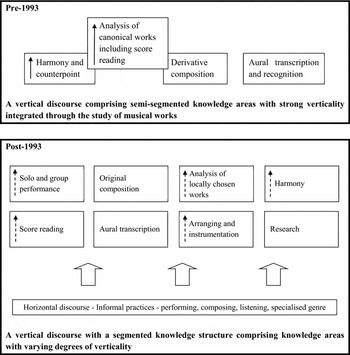
Figure 1 outlines the pre-1993 and post-1993 senior music assessment structure utilising Bernstein's constructs of a vertical discourse with a segmented knowledge structure. As indicated some knowledge structures contain a higher degree of verticality than others (represented by an arrow). The horizontal discourse of informal learning is represented in the underlying extended rectangle. This aspect is most usually brought into the school by teacher acknowledgement and accommodation of student interest or their own interests. In the post-1993 structure teachers can construct senior elective courses, through which students are eligible for national qualifications by choosing from a variety of achievement standards.
Senior music curriculum structures pre-and-post 1993

The curriculum post-1993 contains both principled and procedural knowledge in a complex relationship; both general theoretical knowledge and knowledge of particular practices (Gamble, Reference GAMBLE, Young and Gamble2006). The content is also influenced by the continuing production of new knowledge, as music intersects with the technological developments of the market place, for example sequencing software such as GarageBand. Furthermore, music presents particular challenges for teachers as it contains a diverse mix of knowledge structures in a domain which is at breaking point in terms of its potential content. Unlike the fine arts, which were divided into a series of discrete subjects in the New Zealand curriculum (design, painting, printmaking, photography, sculpture), music still encompasses such varied dimensions as solo and group performance, composition, aural transcription, score reading, theory, arranging, analysis and research. Where discussions regarding the verticality of school knowledge structures generally consider a subject as comprising one predominant type of knowledge structure (Muller, Reference MULLER, Young and Gamble2006; Wignell, Reference WIGNELL, Christie and Martin2008; Ivinson, Reference IVINSON, Singh, Sadovnik and Semel2010) in music this is not the case. This variety in knowledge structures and degrees of verticality within the segmented knowledge areas creates particular challenges for the realisation of appropriate curriculum specification and pedagogy. Bernstein suggests that if ‘discourses are differently specialised, then they must have a space in which to develop their unique identity, an identity with its own internal rules and special voice’ (Bernstein, Reference BERNSTEIN2000, p. 6). Multiple knowledge structures and identities create a problem that may be unique to music within the secondary curriculum (see discussion of music works and composition below).
Moves towards regionalisation
Music in NZ first entered the canon of academic subjects in 1945 with its inclusion in the syllabus for School Certificate, the third year secondary qualification. At this time music, like most other school subjects, was a strongly classified singular (Bernstein, Reference BERNSTEIN2000) marked out from other subjects and everyday knowledge with a specialised discrete discourse. The academic prescription, almost entirely western classical in its conception, remained in place until 1993 when a radically new system was introduced. This revision included the internal assessment of student instrumental performance and composition and saw the removal of the study of centrally-prescribed set works. Politically, these changes opened the door for alternative views of music that might be heard within an education and qualifications context. These changes facilitated the inclusion of popular music within elective courses, although jazz had already been included in the nationally prescribed set works since the mid-1970s. In 2002, further substantial changes were instigated in the national assessment system with the arrival of the National Certificate of Educational Achievement (NCEA) (Ministry of Education, 1999) in which ‘packages’ of skills are assessed in achievement and unit standards. This format offers a wide range of assessment possibilities to support courses that teachers can devise locally to meet the needs and interests of their students. While ideally the assessment standards can be used to underpin a more broadly conceived course of study, the standards more commonly drive the curriculum (Hipkins, Reference HIPKINS2010). Despite ideological concerns (see O'Neil et al., Reference O'NEIL, CLARK and OPENSHAW2004 for example) these changes appear to have brought about a measure of positive change in regards to increased variety in curriculum content, flexibility of study choices and increased enrolments in senior music courses.
Running alongside these assessment changes were developments in national curriculum statements. In 2000 the first national curriculum for the Arts was introduced, The Arts in the New Zealand Curriculum (Ministry of Education, 2000), the last of seven documents covering the essential learning areas of the national curriculum (English, Maths, Languages, the Arts etc.). This arts document subsumed the formerly separate subject domains of music and the fine arts into a region along with the newly introduced subjects of drama and dance. Many schools moved to reflect this structural change by creating performing arts departments and reallocating subject hours and staffing. In terms of music content the document provided achievement objectives along with detailed learning examples structured into four conceptual learning strands – understanding music in context, developing practical knowledge, developing ideas, and communicating and interpreting.
In 2007 the national curriculum was further reformed with the seven previously separate learning areas, each with a separate document, being combined into one leaner document. Music was re-branded as Music–Sound Arts and the four strands remained but learning examples were reduced to brief generic descriptions of possible activities. The 2007 changes were even more significant, as the essential learning areas (English, Maths, the Arts etc.) were downgraded simply to ‘learning areas’, and formerly generic essential skills became reframed as key competencies and placed at the front end of the document. This signalled an increase in the importance of the key competencies in relation to the learning areas, denoting a significant shift towards what Bernstein (Reference BERNSTEIN2000) describes as genericism, a particular view of education related to short-term trainability and ‘continuous pedagogic re-formations’. Generic modes are attractive to governments which hope to create citizens with a ‘flexible transferable potential’ (Bernstein, Reference BERNSTEIN2000, p. 59).
The move to genericism goes hand in hand with what Bernstein (Reference BERNSTEIN2000) terms regionalisation, the process whereby singulars (strongly insulated and introspective subjects) are recontextualised into larger fields. Where inward-looking singulars comprise ‘a specialised discrete discourse . . . protected by strong boundaries and hierarchies’ (Bernstein, Reference BERNSTEIN2000, p. 52), regionalisation produces new approaches and identities that ‘are more likely to face outwards to fields of practice and thus their contents are likely to be dependent on the requirements of these fields’ (Bernstein, Reference BERNSTEIN2000, p. 55). The concept of regionalisation can be applied to the restructuring of music within the New Zealand curriculum; on one level new knowledge structures have ‘regionalised’ the traditional singular subject base, and on another level there has been regionalisation as music has been subsumed into a region of arts disciplines. In both instances the classification of the subject and its associated identity constructions are weakened (Bernstein, Reference BERNSTEIN2000). Bernstein states that regionalisation has been prominent in higher education but that school knowledge structures remain firmly based in singulars (2000, p. 52).Footnote 1 At the macro level the recontextualisation of curriculum structures in New Zealand in 2000 and 2007 has been a move towards regionalisation.
The concept of regionalisation can also be applied as an explanatory concept to theorise the process of knowledge development and weakening classification within the subject of music specifically. School music is in transition away from its strongly classified origins as a singular so its classification has become weakened. Music has been ‘regionalised’ by technologies and diversifying musical knowledges, segmenting into new knowledge areas as it has turned to face outward towards fields of practice traditionally excluded from the curriculum. Where previously the university was the primary field of knowledge production for music, the field has since widened to include the world of informal and commercial music making and technological innovation. Moreover in New Zealand groups of teachers have had direct and significant input into the recent changes in the intellectual field as they have been contracted to create curriculum and assessment documents by the state's official creator of educational discourse, the Ministry of Education. Universities have had no choice but to respond to curriculum changes as students with a lack of traditional knowledge but new and varied skills undertake tertiary study (Gould, Reference GOULD2010). New knowledge areas and technologies have therefore impacted greatly on the subject's classification and sense of identity at all levels of the sector.
Knowledge displacement and varied knowledge structures in the senior music curriculum
Bernstein (Reference BERNSTEIN2000, p. 52) suggests that regionalisation is more likely to occur where singulars move from course-based structures to modular formats, as has been the case in the senior curriculum for all subjects in New Zealand. What constitutes musical knowledge (classification) is weakening and the modes of delivery (framing) are diversifying as music moves from a strongly framed singular to a more weakly framed region. This creates considerable challenges for teachers in terms of knowledge content, knowledge structures and pedagogy. Changes in knowledge content with resultant varied structures have been brought about by a shift in emphasis from traditional bodies of knowledge to assessment and qualifications. This has largely occurred through the modularisation of knowledge into assessment packages, or achievement standards as they are termed in the New Zealand Qualifications Framework (NZQF).
Within a context of a technical-instrumentalist educational paradigm (Young, Reference YOUNG2008) the balance between knowledge and knower has shifted, and there is now little consistency in what might define a music programme in one school compared with that in another. The New Zealand Curriculum appears to support a conception that favours knowers over knowledge when it suggests ‘[l]earning is relevant to students’ lives now . . . (as opposed to learning relevant only to a limited range of possibilities from the past)’ (Ministry of Education, 2009). Many teachers aim to provide a balance across the various knowledge areas covered by the assessment standards, but the ideology of choice, now firmly embedded in the curriculum framework, also allows teachers to avoid assessing, and presumably teaching, areas that their students may find less relevant or more difficult. Recent social realist critiques warn that the emptying out of the curriculum of significant aspects of knowledge content in acquiescence to the ideology of relevance and choice can have unintended consequences (Muller, Reference MULLER, Young and Gamble2006).
One example of an ‘emptying out’ of explicit learning content in the New Zealand curriculum can be found in the development of the knowledge associated with analysis of musical works. While introducing students to musical works considered important in the history of various musical sub-fields, the study of analysis also allows students to develop sequentially more sophisticated conceptual skills and is therefore relatively vertical in its structure. Gamble (Reference GAMBLE, Young and Gamble2006) suggests the argument for including principled knowledge such as this in the curriculum is in its progression and portability: ‘the abstract nature of this form of knowledge develops a capacity for problem solving in a wide range of contexts (in other words, this is what makes knowledge ‘portable’)’ (Gamble, Reference GAMBLE, Young and Gamble2006, p. 98). Current curriculum documents (Ministry of Education, 2007) provide broad and open guidelines as to what works might be studied. It is to the assessment prescriptions (NZQA, 2002, 2004) that teachers must look for more concrete detail in determining exactly what knowledge content might be included. The achievement standard documents provide some specific information in relation to skill and concept development, but give little specific signposting of appropriate knowledge progression that might be developed from one level to the next. This leaves the relationship between content and appropriate skill development to the discretion of the teacher. In my role as national moderator for NCEA music I have viewed copious locally devised tasks and student work based on these standards and I can attest that there is too great a variance in the knowledge content and the skill levels demanded from school to school for these standards. This raises issues of validity for the qualification and validates Muller's concern that unacceptable levels of variance can occur where teachers may not possess the requisite knowledge to choose appropriate content (Muller, Reference MULLER, Young and Gamble2006, p. 78).
One area of music knowledge that is relatively new to the curriculum and that has a more segmented rather than vertical knowledge structure is that of original composition (as compared with the derivative composition required in past curricula). While this addition is an appropriate expansion of knowledge content, the level of support in curriculum specification, resources and training has been almost non-existent. Few music teachers undertake composition as part of their own tertiary training and the skills required in composition and its teaching vary greatly from one genre to another. The curriculum documents provide little assistance: ‘Create, structure, refine, and represent compositions and musical arrangements, using secure technical and musical skills and technologies to express imaginative thinking and personal understandings’ (Ministry of Education, 2007, Music–Sound Arts, Level 8). As with the music works analysis example discussed above the assessment standards provide some fleshing out of content by defining technical skills, creative skills and notation expectations, but stylistically and technically the possibilities are wide open. Neither document answers the question of whether basic musical tonal logic and grammar along with notation skills are expected building blocks towards greater compositional sophistication or whether students should or could be given free rein in terms of compositional style and experimentation. These are significant issues on which teachers in New Zealand lack basic guidance, leaving such decisions to be worked out at the local level dependent on teacher skill and competence.
While not promoting a return to overly narrow and euro-centric prescriptions, I consider that more detail and guidance in terms of knowledge structure and sequence would be beneficial for teachers and students. The rendering of such progressions as tacit in curriculum documents can leave both teachers and students unsure as to appropriate content, sequence, pacing and evaluation particularly in the case of music where there is such a wide range of knowledge structures within the subject. Cognisance of varied knowledge structures is likely to assist teachers in providing students with access to the important building blocks of conceptual and procedural knowledge. This has direct implications for curriculum structure, content and pedagogy: ‘the appropriate lesson to be drawn here is that different knowledge structures have different curricular specificatory requirements . . . curriculum policy will distinguish and differentiate between the structural needs of the different curricular knowledge structures’ (Muller, Reference MULLER, Young and Gamble2006, p. 72, italics in original). This is particularly so for subjects or subject segments with a strong verticality such as music theory and analysis. In these components content sequence and coverage are of paramount importance. This coverage is not only important within each segment but may also provide connective knowledge across music's segmented curriculum. Where knowledge differentiation and progression is tacit and largely left to the teacher to construct, there can be significant implications for student learning and access to important knowledge (Allais, Reference ALLAIS, Young and Gamble2006; Muller, Reference MULLER, Young and Gamble2006). The recontextualisation of music knowledge at the school level has become a dynamic process of regionalisation but one in which teachers’ knowledge, values and actions are pivotal.
Conclusion
Music's transition from a strongly classified singular towards a region is well under way, and this creates particular challenges for curriculum realisation in senior school music in New Zealand. This regionalisation has resulted in changes to both the degree of insulation from new discourses (a weakening classification with segmented curriculum content) and the variety of knowledge structures present within the subject (varying degrees of knowledge progression or verticality). Combined with the admission of aspects of the horizontal discourse of popular music produces challenges unique to music as a subject.
Bernstein's concepts of discourses (vertical and horizontal) and knowledge structures (hierarchical and segmented) were utilised to differentiate knowledge areas and structures, however the recontextualisation of school knowledge may be more usefully theorised using a continuum of verticality to horizontality (Muller, Reference MULLER, Young and Gamble2006; Maton, Reference MATON2009). Moreover in a field where assessment exerts a powerful influence over curriculum realisation, horizontal elements will always need to comply to some degree with the notion of verticality which is inherent in the structure of pedagogic discourse. The discussion of the curriculum specifications for analysis and composition provided two specific examples of knowledge segmentation and varying degrees of verticality across music's segments. These examples were used to illustrate the complexity and variation of music knowledge structures within the subject and the way in which this variety creates challenges for curriculum planning and pedagogy particularly where curriculum documents remain generic.
Knowledge displacement, brought about by the move to generic curriculum documents, increasingly places the responsibility on teachers to manage and balance the epistemic and social demands of curriculum realisation. In the case of senior school music in New Zealand, the reshaping of the subject over the last two decades has been far-reaching. A curriculum of cultural transmission centred on classical traditions has largely given way to alternative relativist conceptions centred on popular music and student rights of ownership. The resulting aesthetic relativism presents tremendous challenges and responsibilities for teachers as they act as recontextualising agents in the pedagogic recontextualising field (Bernstein, Reference BERNSTEIN2000). Who now says what music knowledge and knowing is? Who has the authority to be the author of the content? Jorgensen (Reference JORGENSEN2003) has articulated that many music teachers ‘are afraid they do not know all they should know. Others fear that what they know and value is no longer relevant in a world that is changing dramatically’ (Jorgensen, Reference JORGENSEN2003, p. x). Given the unlikely possibility for one music teacher or even one music department to provide expertise in every possible music sub-field, a more realistic aim for music education may be for teachers to model musical expertise and musicianship in a particular style while taking on the responsibility for providing the ‘connective’ and foundational ‘academic’ knowledge to enable students to participate with confidence in their chosen area of interest. As Sloboda (Reference SLOBODA2001) suggests, one of the key functions of music departments of the future may be to act as sorting houses, directing students to where the particular expertise exists within the wider community, while Small (Reference SMALL and Wright2010) suggests the teaching of music should be taken out of school altogether. For the present the question of knowledge content remains paramount.
Recent social realist critiques of knowledge (Young & Gamble, Reference YOUNG and GAMBLE2006; Young, Reference YOUNG2008; Maton & Moore, Reference MATON and MOORE2010; Wheelahan, Reference WHEELAHAN2010; Young, Reference YOUNG2010a, Reference YOUNG2010b) argue that within education the dichotomised orthodoxies of neo-conservatism (where knowledge is a given) and social constructivism (where knowledge is relative to the knower) fail to confront fundamental epistemological issues in relation to educational knowledge and create an either/or dichotomy. Although the question of what ‘counts’ as knowledge within the curriculum will always be contested, oppositional socio-political conceptions are likely to result in continual contests as one ideological perspective seeks to replace another. Social realism on the other hand acknowledges the social construction of knowledge yet suggests that ‘some knowledge claims can be considered more epistemologically powerful than others in terms of their explanatory power’ (Maton & Moore, Reference MATON and MOORE2010, p. 3). This is because conceptual knowledge, developed over time, is critiqued and continually modified within specialist communities. Young (Reference YOUNG2008) argues that it is exactly the social and collective nature of such communities that gives knowledge a level of objectivity. This view of the importance of the epistemic over the socio-political suggests that abstract theoretical knowledge firmly grounded in subject disciplines needs to be at the centre of an empowering curriculum (Young, Reference YOUNG2010b). In New Zealand the current drive to ensure relevance in the curriculum may ironically result in continued imbalances of access to powerful and empowering knowledge.
While just what this empowering knowledge is will remain contestable, the teachers and students interviewed in some current research (McPhail, in progress) value theoretical knowledge, including music reading and an awareness of musical structures and the historical development of musical style, as well as practical music knowledge. Rather than being given transcendental status, however, more traditional forms of knowledge remain epistemologically significant in terms of empowering students to participate fully in the many varied conversations of their chosen music discipline (Wheelahan, Reference WHEELAHAN2010). There appears to be a generally accepted body of theoretical knowledge in western music which underpins the many varied conversations that are possible.
The case studies in the empirical part of this current research (McPhail, in progress) are being undertaken to illuminate the ways in which a number of teachers are responding to the challenges associated with curriculum construction in their daily work. In one case study the teacher's approach is consistent with the recognition of both the epistemic and social dimensions of knowledge; finding a balance for students between recognising their own voice and emphasising the generative conceptual knowledge that underpins the discipline. One student who was new to her school commented on the differences in the approach to knowledge compared with her previous school:
Y13 student: I came from a small country school and all we did was performance, we never learnt theory or anything. I only came here last year. In music class all we did was jam on the instruments, that's literally all we did. . . . just more time to have fun.
At the student's previous school there was apparently little distinction between the horizontal discourse of informal learning and the experience at school; school was simply a bigger place in which to play. In such instances where the content appears highly relevant to students’ lives now, the result may in fact be restricted access to powerful knowledge. Matters of epistemology are pivotal in the arguments and developments concerning the accessibility of knowledge and its form and place in educational institutions worldwide. Popular music can certainly cross the vertical–horizontal divide and become part of a principled discourse while conversely the development of mindless executant skills via classical music can be context bound and devoid of educational intent. The significant point is that the teacher has a central role to play, acting as a conduit for how knowledge and meanings from various sources will be selected, interpreted, structured and constructed with students. As boundaries in the classification of knowledge shift, teachers must ask in whose interest are the newly emerging forms of consciousness. What may have been lost and what has been gained? Music teachers grapple with the continuing discursive shift from knowledge to knower, working as they do at the boundaries between discourses in what Bernstein describes as a place of tension ‘between the past and possible futures’ (2000, p. xiii).