


Population studies have shown clear correlations between mental health and physical activity level in both younger and older adults (Reference Paffenbarger, Lee and LeungPaffenbarger et al, 1994; Reference Ruuskanen and RuoppilaRuuskanen & Ruoppila, 1995). It is widely held that exercise is ‘useful in depression’, but studies to date have had methodological problems and only three have studied patients aged 60 years or over. McNeil et al (Reference McNeil, LeBlanc and Joyner1991) studied 30 patients but used neither randomisation nor follow-up. Blumenthal et al (Reference Blumenthal, Babyak and Moore1999) targeted patients (mean age 57 years) with major depressive disorder, comparing the effects of aerobic exercise with the effects of antidepressants. Singh et al (Reference Singh, Clements and Fiatarone1997) examined the use of progressive resistance training instead of antidepressant therapy in older people, but the control intervention failed to match the exercise training intervention for attention. The paucity of robust studies on the potential effects of exercise as an adjunct to antidepressant therapy in later life is a significant omission. We designed a controlled trial to address this gap in the literature.
METHOD
Study design and selection criteria
All participants were out-patients recruited by the research nurse (A. S. M.) over a period of 15 months from primary care, psychiatric services and by direct advertisement in the local newspaper and on local radio. Potential participants from primary care were identified from computer-generated lists of patients in the appropriate age group receiving antidepressant therapy. Potential participants initially were screened by a mental health nurse. To be included in the study, they were required to have symptoms of depression and an absence of cognitive impairment (Mini-Mental State Examination (MMSE; Reference Folstein, Folstein and McHughFolstein et al, 1975) > 26). Patients were considered for study participation if they were aged 53 years and over with a diagnosis of mood (affective) disorder. Diagnosis was made at clinical interview by an experienced psychiatrist according to ICD-10 (World Health Organization, 1992). A score of at least ten was required on the Geriatric Depression Scale (GDS; Reference YesavageYesavage, 1988) and patients had to have been in receipt of a therapeutic dose of antidepressant therapy for at least 6 weeks without evidence of a sustained response prior to study entry. Participants who took tobacco, alcohol or caffeinated beverages on a regular basis were asked to continue this unaltered for the duration of the study. Patients were excluded if there was: current alcohol or substance misuse; ongoing structured psychotherapy; participation in regular exercise more than twice weekly; or a specific medical contraindication to exercise, for example, an unstable cardiac condition, major stroke or limb amputation.
The study was a randomised controlled trial approved by the Tayside Committee on Medical Research Ethics. All patients (n=86) gave written informed consent prior to inclusion and subsequently were allocated randomly to one of two groups: a treatment group (exercise) or a non-exercise social control (health education talks). Allocation to treatment was made by the research nurse (A. S. M.), separate from the assessors, by opening sealed envelopes supplied in sequence by an individual not directly involved in the study (M. E. T. M.) and prepared from a computer-generated random number table. All patients continued to take antidepressant therapy throughout the trial.
Interventions
Exercise
The exercise class used is open to the public and run by the University of Dundee for people aged 60 years and over. This particular class was chosen because it has been shown already to be both acceptable to older people and effective (Reference McMurdo, Mole and PatersonMcMurdo et al, 1997). Each of the exercise classes lasted for 45 min and comprised predominantly weight-bearing exercise performed to music, led by an instructress from a podium in the centre of the hall. There was a warm-up period of 5-10 min at the start and a cool-down period at the end of each session. The format of the class contained elements of endurance, muscle strengthening and stretching. The class was followed by optional refreshments. Participants were asked to attend classes twice per week for 10 weeks and the attendance at the class was recorded.
Health education (non-exercise control)
Those randomised to the control group of the study were asked to attend twice-weekly health education talks for a period of 10 weeks at Ninewells Hospital and Medical School, Dundee. Talks lasted for 30-40 min and were delivered by medical and nursing staff and staff from the professions allied to medicine. Topics were depression, anxiety, relaxation, memory problems, safe alcohol use, healthy ageing, exercise, healthy hearts, diet, bone and dental health, sleep, accidents at home, structuring time and homoeopathic medicine. Talks were followed by a 15-min question-and-answer session and optional refreshments were available. The attendance was recorded. The series of talks also was open to the general public, in order to produce a mixed population similar to the exercise class.
Assessment and outcome measures
Patients were assessed on three occasions: baseline, 10 weeks and 34 weeks. The interventions began 1 week after baseline measurements had been recorded. The assessments were made at clinical interview by one of two psychiatrists who were blind to treatment allocation and remained blind for the duration of the study. The primary outcome was seen with the 17-item Hamilton Rating Scale for Depression (HRSD; Reference HamiltonHamilton, 1960). This instrument was chosen because it has been shown to be useful in the assessment of community-dwelling older people (Reference Onega and AbrahamOnega & Abraham, 1997; Reference Mottram, Wilson and CopelandMottram et al, 2000), although it was not originally designed for use with this group. Its use also permits comparison of our findings with those from the international depression literature. Secondary outcomes were seen with the GDS, Clinical Global Impression (CGI; Reference GuyGuy, 1976) and Patient Global Impression (PGI; Reference GuyGuy, 1976). A second depression score (GDS) was included both as a screening instrument (for which it was developed) for study eligibility and as a secondary outcome measure, because it is the only such instrument devised specifically for use with an older population. However, use of such a self-report measure as the primary outcome of this study would have rendered the results highly susceptible to patient expectation bias.
Statistical analysis
The primary outcome variable was change in the HRSD from baseline. For the purposes of this study, ‘response’ was defined as a 30% or greater decrease from the baseline score. To address the possibility of dependencies between the measured variables and serial correlation within subjects on consecutive occasions, changes from baseline in all four variables were assessed using the appropriate analysis for repeated measures (Reference Crowder and HandCrowder & Hand, 1990). Fisher's exact test and exact contingency tests were used for comparison of numbers of patients who responded to treatment. All analysis was by intention-to-treat.
It was estimated that in order to detect a 30% difference between the percentage of responders in the control group compared with that in the exercise group at the P=0.05 level of significance, a sample size of 40 subjects per group would be required to give a power of 90%. Data on poorly responsive depression are scant but the proportion of responders in the control group was reasonably anticipated to be 10%, compared with an anticipated 40% in the exercise group.
RESULTS
Recruitment
A total of 1885 patients were either referred or screened over a 15-month period with a view to recruitment; 86 patients were finally randomised (Fig. 1). Forty-three patients were allocated to each group; exercise group (36 female, 7 male); control group (23 female, 20 male). The median age of the patients recruited to the exercise group was 63 years (range 53-78) and the median age of the patients in the control group was 65 years (range 56-91). There was no discernible association between age and response in either the exercise group (P=0.21, 95% CI −0.02 to 0.01) or the control group (P=0.12, 95% CI −0.02 to 0.01). There were no drop-outs and all participants completed all the assessments. Initial scrutiny of the data revealed that one patient in the exercise group had not met the eligibility criteria for the study, so this individual's results were removed from the analysis. Results are therefore presented for the remaining 85 patients. There were no adverse events associated with either intervention. The only significant difference in baseline characteristics (Table 1) between the groups was the higher proportion of females in the exercise group (OR=0.23, P=0.01, 95% CI 0.08-0.67). There was no significant difference between the response of men and women in the exercise group (Mann-Whitney U=156, P=0.93, 95% CI difference in medians −0.25 to 0.30) or in the control group (U=478,P=0.35, 95% CI difference in medians −0.10 to 0.25). There was no discernible difference between mean depression rating scale scores at baseline between the exercise and control group. Mean (interquartile range) attendances at the health education sessions and the exercise sessions were 85% (56-100%) and 67% (39-100%) respectively.
Recruitment of study participants.

Baseline characteristics
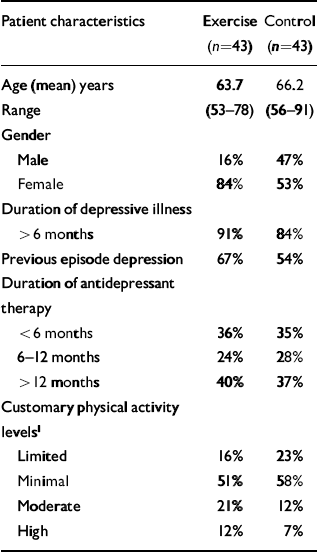
| Patient characteristics | Exercise (n=43) | Control (n=43) |
|---|---|---|
| Age (mean) years | 63.7 | 66.2 |
| Range | (53-78) | (56-91) |
| Gender | ||
| Male | 16% | 47% |
| Female | 84% | 53% |
| Duration of depressive illness | ||
| > 6 months | 91% | 84% |
| Previous episode depression | 67% | 54% |
| Duration of antidepressant therapy | ||
| < 6 months | 36% | 35% |
| 6-12 months | 24% | 28% |
| > 12 months | 40% | 37% |
| Customary physical activity levels1 | ||
| Limited | 16% | 23% |
| Minimal | 51% | 58% |
| Moderate | 21% | 12% |
| High | 12% | 7% |
Response to intervention
Primary outcome measure (HRSD)
The primary outcome of interest was the proportion of participants achieving a ‘response’, defined as a ≥30% reduction in HRSD score from baseline. At 10 weeks 23/42 (55%) of the exercise group achieved a response, whereas in the control group only 14/43 (33%) had achieved the ≥ 30% reduction (OR=2.51, P=0.05, 95% CI 1.00-6.38). Further analysis using the Mann-Whitney test revealed no discernible difference between the two groups in overall effect on the HRSD score (U=1683,P=0.28, 95% CI difference in medians −0.20 to 0.06).
Other outcome measures
Secondary outcome measures were seen with the GDS, CGI and PGI. At the end of the 10-week intervention period both the exercise and the control group had scores that were statistically significantly different from baseline, with no difference between the two groups (Table 2). This observation persisted at 34 weeks in both the exercise and the control groups.
Outcome measure scores at baseline, 10 weeks and 34 weeks, with differences (Diff) and 95% confidence intervals for the differences: exercise (n=42); control (n=43)

| Assessment | Hamilton Rating Scale for Depression | Geriatric Depression Scale | Clinical Global Impression | Patient Global Impression | ||||||||
|---|---|---|---|---|---|---|---|---|---|---|---|---|
| Exercise | Control | Diff (Cl) | Exercise | Control | Diff (Cl) | Exercise | Control | Diff (Cl) | Exercise | Control | Diff (Cl) | |
| Baseline | 16.7 | 17.4 | 0.7 (-2.1 to 3.4) | 18.2 | 19.1 | 0.9 (-1.8 to 3.6) | 3.8 | 3.8 | 0.0 (-0.5 to 0.4) | 4.7 | 4.7 | 0.0 (-0.9 to 0.9) |
| 10 weeks | 12.6 | 13.7 | 1.1 (-1.6 to 3.9) | 15.4 | 16.7 | 1.3 (-1.8 to 4.4) | 3.1 | 3.2 | 0.1 (-0.5 to 0.6) | 6.0 | 6.1 | 0.1 (-0.7 to 1.0) |
| 34 weeks | 11.5 | 13.7 | 2.2 (-0.6 to 4.9) | 15.0 | 17.5 | 2.5 (-0.7 to 5.6) | 2.9 | 3.2 | 0.3 (-0.3 to 0.8) | 6.0 | 5.5 | -0.5 (-1.4 to 0.5) |
DISCUSSION
Main findings
Our randomised controlled trial found that 10 weeks of twice-weekly exercise was associated with a modest reduction in depression symptoms in a group of older people with depression. The observation that significantly more patients in the exercise group than in the control group achieved a predefined response at 10 weeks (≥ 30% reduction in HRSD score) suggests that for older adults who are willing to contemplate increasing their physical activity levels, a short period of group exercise may offer a useful supplement to antidepressant therapy. The convention in trials of antidepressant therapy is to use a ≥ 50% reduction in HRSD score as the definition of a response. However, our study focused on a group who had failed to respond to initial treatment, and because of the poorly responsive nature of their illness we believe that a ≥ 30% reduction in HRSD score associated with participation in exercise is of clinical interest.
Both groups showed statistically significant differences from baseline in all outcome measures at both 10 and 34 weeks, with no between-group difference. This is likely to have been the result of regression to the mean, participation in the trial or due to other external factors.
Comparisons with previous studies
The existing literature on exercise and depression focuses mainly on younger adults and is almost uniformly positive, suggesting that a large proportion of patients with depression can be encouraged to exercise (Martinsen et al, Reference Martinsen, Medhus and Sandvik1985, Reference Martinsen, Hoffart and Solberg1989). Attendance at the exercise group in our study was significantly less than the 90% reported in all three previous studies in this age group (Reference McNeil, LeBlanc and JoynerMcNeil et al, 1991; Reference Singh, Clements and FiataroneSingh et al, 1997; Reference Blumenthal, Babyak and MooreBlumenthal et al, 1999). A 59% mean attendance rate was achieved in our study over a 10-week period in the exercise group. A trial by the authors with older subjects without depression using the same exercise class intervention achieved a mean attendance of 83% over a 32-week period (Reference McMurdo, Mole and PatersonMcMurdo et al, 1997).
The exercise intervention used for this study was already established, having catered for the exercise needs of older people for over 20 years. This is in contrast to other studies in both younger and older adults where the exercise intervention had been devised for the purposes of the study, often being carried out in a small group or on an individual basis. If exercise is to become a possible treatment option for older patients with depression, it must be both acceptable and accessible to old people. Our study suggests that this may be more difficult to achieve than previously reported. Contrary to all other research in both younger and older adults, our experience shows that depressive symptoms can act as a barrier to participation in an exercise class.
Methodological considerations
The biggest challenge of this study was recruitment. A total of 1885 patients were considered for entry to the study and yet fewer than 5% were randomised. Scrutiny of the literature reveals a dearth of research in older adults with depression, and the extreme difficulty of recruitment is described by the few researchers who have attempted clinical trials with this group (Reference Schlernitzauer, Bierhals and GearySchlernitzauer et al, 1998; Reference Stevens, Katona and ManelaStevens et al, 1999). Yastrubetskaya et al (Reference Yastrubetskaya, Chiu and O'Connell1997) reported exceptional difficulties encountered when recruiting elderly patients for a study to test a new antidepressant: mirroring our own experience, fewer than 5% of patients screened for study entry were eventually recruited. Schlernitzauer et al reported their 5-year experience of recruiting patients for a study of depression associated with bereavement. During this period only 65 patients were recruited, which is an average of one patient per month. The authors reported that by far their most successful method of recruitment was from response to a media campaign, which generated 54% of the total study group. The inclusion of patients who responded to an advertisement in our own study may limit the generalisability of our results but research in late-life depression trials suggests that the response in such solicited patients does not differ from those recruited by consultation referral (Reference Miller, Hooper and BakishMiller et al, 1997). Our efforts confirm, however, that although recruitment was laborious and difficult, it was achievable in this patient group.
The inclusion of a structured social control group in our study is of particular methodological importance. This is crucial in attempting to disentangle the diversional and psychosocial effects of coming together as a group from the effects of exercise itself. The therapeutic effects of a structured social intervention should not be underestimated in a group for which loneliness and isolation may be common. It is therefore important that future studies of depression in older people include an appropriate control.
It is possible that the preponderance of women in the exercise group may have introduced a bias to our results. The prevalence rate of depression among older women appears to decline with advancing years (Reference Henderson, Jorm and KortenHenderson et al, 1998) but female gender continues to be cited as a significant risk factor for developing late-life depression (Reference Green, Copeland and DeweyGreen et al, 1992). We are, however, aware of no literature to suggest that gender influences response to treatment in late-life depression. Analysis of our results showed no difference between the responses of men and women in either group.
A follow-up assessment period of 24 weeks was chosen for this study, to redress the short follow-up periods used in other studies. Although the 24-week follow-up is substantially lengthier than used in previous studies, a recent meta-analysis of all studies examining the effects of exercise on depression suggests that this follow-up period should be longer still (Reference Lawlor and HopkerLawlor et al, 2001). A 1-year follow-up for our study is planned.
The implications of our findings for the health service are that time-limited, brief, structured group exercise sessions can be associated with a modest improvement in depressive symptoms in a group of patients for whom response to pharmacological treatment may be limited. The many physical health benefits associated with exercise in old age are well known. Our findings suggest that older people with poorly responsive depressive disorder should be encouraged to attend group exercise activities.
Clinical Implications and Limitations
CLINICAL IMPLICATIONS
-
• Exercise was superior to social intervention in the extent of response in symptoms at 10 weeks.
-
• Future studies of depression in older people should include a structured social control group.
-
• Older people with poorly responsive depressive disorder should be encouraged to attend group exercise activities.
LIMITATIONS
-
• Only 5% of the total group eligible for recruitment were finally entered in the study.
-
• Physical comorbidities were not considered.
-
• Given the study findings, the addition of a non-intervention control group would have been of interest.
Acknowledgements
Funding was provided by the Biomedical and Therapeutics Committee of the Chief Scientist's Office, Department of Health (K/MRS/50/C2692).
The authors are grateful to Miss Dorothy Dobson of the University of Dundee's over-60s' exercise class, Miss Ruth Miller from the Department of Epidemiology and Public Health for assistance with data entry, Dr Fergus Daly from the Department of Medicine for help with statistical analysis, Miss Adele Makarewicz for practical and secretarial support, colleagues who gave the health education talks and, of course, all the patients who participated in the trial.




eLetters
No eLetters have been published for this article.