Systemic lupus erythematosus is a complex chronic autoimmune disease involving multi-system, a wide spectrum of manifestations, and overabundance of immunological and laboratory abnormalities.Reference Pons-Estel, Ugarte-Gil and Alarcón1 Among all the complications, pulmonary arterial hypertension is a major contributor of systemic lupus erythematosus related death.Reference Huang, Li and Liu2,Reference Chow, Chandran, Fazelzad and Johnson3 Pulmonary arterial hypertension is characterized by vascular proliferation and remodeling,Reference Gaine and Rubin4,Reference Rubin5 which results in progressively increase pulmonary vascular resistance and right ventricular failure and death.Reference Humbert, Sitbon and Simonneau6 The prevalence of pulmonary arterial hypertension in systemic lupus erythematosus is estimated to be 0.5–17.5%.Reference Dhala7 The prevalence of systemic lupus erythematosus-related pulmonary arterial hypertension in Chinese population is around 3.8%, which is the third leading cause of death in patients with systemic lupus erythematosus after mental lupus and lupus nephritis.Reference Li, Wang and Zhao8
Most of the early symptoms of pulmonary arterial hypertension, such as dyspnea and fatigue, can be mild and non-specific. Symptoms of pulmonary arterial hypertension in lupus can also be caused by other conditions such as interstitial lung disease, all make early diagnosis challenging. Recent novel therapies, especially therapies that targets abnormalities in prostacyclin, endothelin, and nitric oxides pathways have been shown to improve patients’ functional status, pulmonary hemodynamics, and a potential to slow disease progression.Reference O’callaghan, Savale and Montani9 However, prevention pulmonary arterial hypertension progression is extremely challenged and rarely achieved, especially for patients with connective tissue disease-related pulmonary arterial hypertension.Reference Fisher, Mathai and Champion10 For systemic lupus erythematosus-associated pulmonary arterial hypertension, immunosuppressive treatment may benefit patients with relatively mild disease at baseline, but limited benefit for patients with severe pulmonary arterial hypertension.Reference Jais, Launay and Yaici11–Reference Sanchez, Sitbon, Jaïs, Simonneau and Humbert13 Early diagnosis and intervention are essential to improve patient outcomes.
Some clinical manifestations and immunologic test have been shown to predict pulmonary arterial hypertension in systemic lupus erythematosus patients.Reference Tselios, Gladman and Urowitz14,Reference Chen, Que, Zheng, Zou, Pin and Xuwei15 However, pulmonary arterial hypertension is a complex condition, risk factors may have different association for certain disease characteristics. In the current study, we aimed to identify early clinical and laboratory predictor for systemic lupus erythematosus associated pulmonary arterial hypertension and other systemic lupus erythematosus characteristics to help early diagnosis and identify higher risk population and allow for more intensive monitoring and intervention if necessary.
Methods
Participants
Patients diagnosed with systemic lupus erythematosus in the Department of Rheumatology and Immunology of Guangdong General Hospital and Guangdong Academy of Medical Sciences from January 2010 to December 2018 were eligible for the study. A total of 84 patients who were diagnosed with systemic lupus erythematosus and pulmonary arterial hypertension were included as the case group, and 160 patients who were diagnosed with systemic lupus erythematosus but did not have pulmonary arterial hypertension were included as the control group. The study was approved by the Guangdong General Hospital and Guangdong Academy of Medical Sciences. Informed consent was obtained.
Diagnosis
Diagnosis of systemic lupus erythematosus was made in accordance with the systemic lupus erythematosus classification established by the American College of Rheumatology in 1997.Reference Hochberg16 Pulmonary arterial hypertension was diagnosed by pulmonary artery systolic pressure ≥ 30 mmHg using the color Doppler echocardiography.Reference Simonneau, Galie and Rubin17 Patients with pulmonary arterial hypertension caused by lung diseases, cardiomyopathy, structural heart disease, myocardial infarction, or other diseases were excluded. Pulmonary arterial hypertension severity was classified as mild: pulmonary artery systolic pressure 30–40 mmHg; moderate: pulmonary artery systolic pressure 41–70 mmHg; and severe: pulmonary artery systolic pressure > 71 mmHg. Mild and moderate pulmonary arterial hypertension were grouped into mild to moderate pulmonary arterial hypertension group. Disease activity was classified according to the systemic lupus erythematosus disease activity index,Reference Bombardier, Gladman, Urowitz, Caron and Chang18 with systemic lupus erythematosus disease activity index ≥ 8 defined as disease being active.
Variables of interest
Clinical manifestations and laboratory test results at enrollment were collected and analysed. Clinical manifestations, including lupus nephritis, skin and mucosa manifestations, Raynaud’s phenomenon, pericardial effusion, serositis, digital vasculitis, arthritis, mental symptoms, and pulmonary interstitial lesions were included. Laboratory test including erythrocyte sedimentation rate, platelet count, C-reactive protein level, complement 3, serum creatinine, urine protein, anti-double stranded DNA antibodies, antinuclear antibody, anticardiolipin antibodies immunoglobulin G, anticardiolipin antibodies immunoglobulin M, anti-u1 ribonucleoprotein antibodies, anti-Sjögren’s-syndrome-related antigen A antibodies, and anti-Sjögren’s-syndrome-related antigen B antibodies. Indicators were compared between the case group and the control group using bivariate logistic regression. Indicators that were statistically significant were labeled as candidate systemic lupus erythematosus-pulmonary arterial hypertension risk factors. Among the 84 cases with systemic lupus erythematosus-pulmonary arterial hypertension, patients were grouped according to pulmonary arterial hypertension severity (mild to moderate versus severe), systemic lupus erythematosus disease activity (systemic lupus erythematosus disease activity index < 8 points versus systemic lupus erythematosus disease activity index ≥ 8 points), treatment status (remission, stable, and deterioration), and duration of pulmonary arterial hypertension ((<1 year and ≥ 1 year). Remission was defined as remaining in low risk status in accordance to the 2015 European pulmonary hypertension guidelines.Reference Galiè, Humbert and Vachiery19 Stable was defined as the same risk status for 6 months (excluding high risk status). Deterioration was defined as moving from lower risk status to higher risk status (low risk status to intermediate/high risk status, intermediate risk status to high risk status, or high risk status with worsening indicators).
Statistical analysis
Data were analysed using SPSS version 19.0 statistical software (SPSS Inc, Chicago, Illinois). Continuous variables were expressed as mean (standard deviation) if following normal distribution, and median (interquartile range) if not. Categorical variables were expressed as count (percentage). Between groups comparison was performed using student t-test for continuous variables and chi-square test for categorical variables. Logistic regression was used for risk factor analysis. Associations between candidate systemic lupus erythematosus-pulmonary arterial hypertension risk factors and different classification group were compared using logistic regression to identify risk factors for different pulmonary arterial hypertension prognostic outcomes. p < 0.05 indicated that the difference is statistically significant.
Results
A total of 84 patients with systemic lupus erythematosus and pulmonary arterial hypertension and 160 patients with systemic lupus erythematosus but without pulmonary arterial hypertension were included. On average, cases were 36.2 (10.7) years old (range, 22–53) and 89.3% were female. In the control group, the mean age was 34.8 (11.5) years old (range, 24–55) and 88.1% were female. No statistically significant difference in age and sex were observed in the two groups (p > 0.05 for both).
Comparison of clinical manifestations between case group and control group
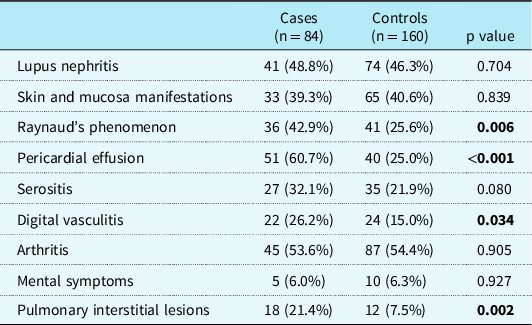
Compared to systemic lupus erythematosus patients without pulmonary arterial hypertension, higher proportion of patients with pulmonary arterial hypertension were presented with Raynaud’s phenomenon (42.9 versus 25.6%, Table 1), pericardial effusion (60.7 versus 25.0%), digital vasculitis (26.2 versus 15.0%), and pulmonary interstitial lesions (21.4 versus 7.5%). No statistically significant differences were observed in lupus nephritis, skin and mucosa manifestations, serositis, arthritis, or mental symptoms (p > 0.05 for all).
Clinical manifestations in the case group and the control group

Comparison of laboratory results between case group and control group
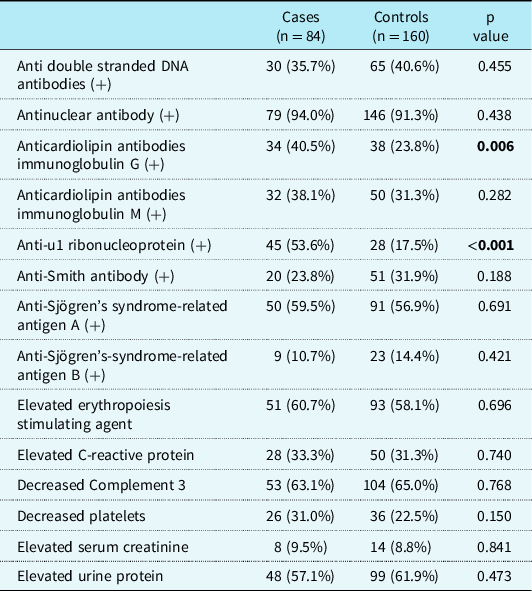
Compared to systemic lupus erythematosus patients without pulmonary arterial hypertension, higher proportion of patients with pulmonary arterial hypertension had anticardiolipin antibodies immunoglobulin G (40.5 versus 23.8%, Table 2) and anti-u1 ribonucleoprotein antibodies (53.6 versus 17.5%). No statistically significant differences were observed in anti-double stranded DNA antibodies, anti-anticardiolipin antibodies, anticardiolipin antibodies immunoglobulin M, Anti-Sm, anti-Sjögren’s-syndrome-related antigen A, or anti-Sjögren’s-syndrome-related antigen B (p > 0.05 for all). No significant in other laboratory results demonstrated in Table 2 were observed between the two groups.
Laboratory results in the case group and the control group

Associations between candidate risk factors and pulmonary arterial hypertension in systemic lupus erythematosus patients
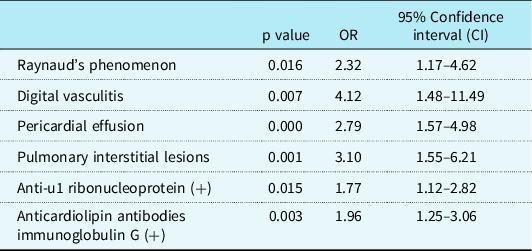
Among collected patient characteristics, Raynaud’s phenomenon, digital vasculitis, pericardial effusion, pulmonary interstitial lesions, positive anti-u1 ribonucleoprotein antibodies, and positive anticardiolipin antibodies immunoglobulin G were associated with significantly higher risk of pulmonary arterial hypertension in systemic lupus erythematosus patients (Table 3). Among them, digital vasculitis had the stronger association with pulmonary arterial hypertension in systemic lupus erythematosus patients (OR 4.12, 95% CI: 1.48–11.49), followed by pulmonary interstitial lesions (OR 3.10, 95% CI: 1.55–6.21).
Association between candidate risk factors and pulmonary arterial hypertension in systemic lupus erythematosus patients

Associations between candidate risk factors and pulmonary arterial hypertension severity
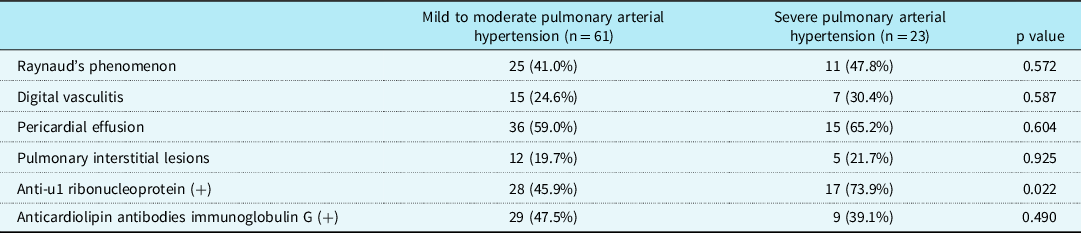
Putting all candidate risk factors in the model, anti-u1 ribonucleoprotein antibodies was associated with significantly higher risk of severe pulmonary arterial hypertension (45.9% in mild to moderate pulmonary arterial hypertension versus 73.9% in severe pulmonary arterial hypertension group, Table 4). No significant differences in other candidate risk factors were observed between mild to moderate group and severe group (p > 0.05 for all).
Association between candidate risk factors and systemic lupus erythematosus-pulmonary arterial hypertension severity

Associations between candidate risk factors and systemic lupus erythematosus activity
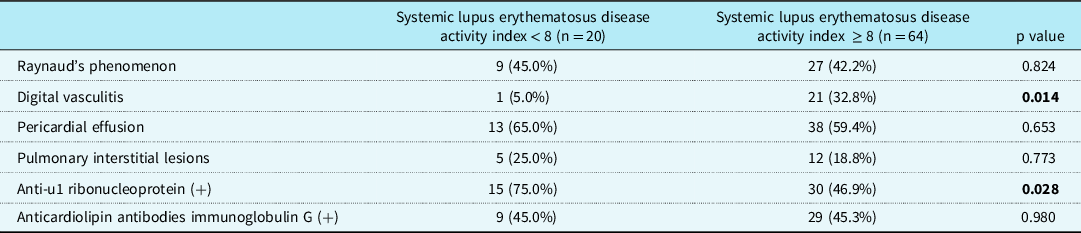
Comparing patients with systemic lupus erythematosus disease activity index < 8 versus those with systemic lupus erythematosus disease activity index ≥ 8, patients with higher systemic lupus erythematosus activity were more likely to have digital vasculitis (5.0 versus 32.8%, Table 5). Interestingly, patients with higher systemic lupus erythematosus activity were less likely to have anti-u1 ribonucleoprotein antibodies (75.0 versus 46.9%). No significant differences were observed in other candidate risk factors.
Association between candidate risk factors and systemic lupus erythematosus activity

Associations between candidate risk factors and treatment status
Among the 84 cases enrolled, 33 (39.3%) were at remission, 40 (47.6%) were at stable, and 11 (13.1%) were at deterioration. Checking the distribution of candidate risk factors across groups, digital vasculitis was most prevalent in remission group (42.4%), followed by stable group (17.5%) and deterioration group (9.1%, p = 0.021, Table 6). On contrary, pericardial effusion was most commonly observed in deterioration group (90.9%), while least common in the remission group (39.4%, p = 0.003). No significant differences were observed in other characteristics.
Association between candidate risk factors and systemic lupus erythematosus treatment status

Associations between candidate risk factors and pulmonary arterial hypertension duration
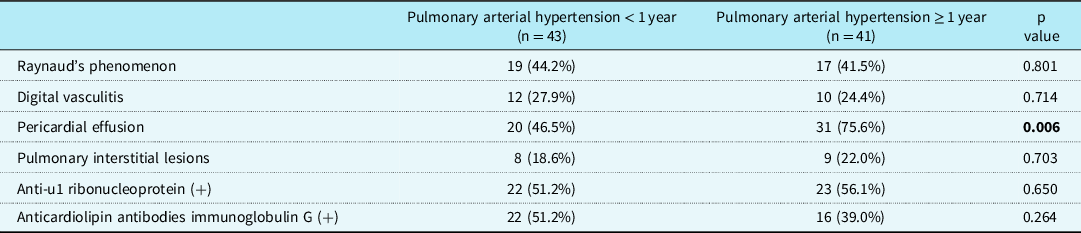
Forty-one (48.8%) patients had pulmonary arterial hypertension duration longer than 1 year. Compared to patients with pulmonary arterial hypertension less than 1 year, these patients were more likely to have pericardial effusion (75.6 versus 46.5%, Table 7). No significant differences were observed in other characteristics.
Association between candidate risk factors and pulmonary arterial hypertension duration

Discussion
We found that clinical manifestations including Raynaud’s phenomenon, digital vasculitis, pericardial effusion, and pulmonary interstitial lesions, and immunologic abnormalities including anti-u1 ribonucleoprotein positive and anticardiolipin antibodies immunoglobulin G positive were predictors for systemic lupus erythematosus associated pulmonary arterial hypertension. Among the risk factors, positive anti-u1 ribonucleoprotein was independently associated with severe pulmonary arterial hypertension and more active disease. Digital vasculitis was independently associated with systemic lupus erythematosus alleviation, while pericardial effusion was associated with deterioration. Pericardial effusion was associated with longer pulmonary arterial hypertension duration.
Our findings were consistent with previous studies. In a study involving 41 systemic lupus erythematosus patients with pulmonary arterial hypertension and 106 systemic lupus erythematosus patients without pulmonary arterial hypertension, serositis, Raynaud’s phenomenon, anticardiolipin antibodies, and anti-u1 ribonucleoprotein were associated with higher risk of systemic lupus erythematosus-pulmonary arterial hypertension.Reference Chen, Que, Zheng, Zou, Pin and Xuwei15 In another cross-sectional study, Raynaud’s phenomenon was associated with elevated pulmonary artery systolic pressure.Reference Kasparian, Floros and Gialafos20 Luo et al.Reference Luo, Robbins, Karatas, Brixey, Rice and Light21 found that pleural effusions frequently accumulate in patients with pulmonary arterial hypertension associated with connective tissue disorders. Wang et al.Reference Li, Wang and Zhao8 observed in a large systemic lupus erythematosus-pulmonary arterial hypertension cohort that pericarditis, pleuritis, and anti-ribonucleoprotein positivity are associated with higher systemic lupus erythematosus activity and vasculopathy, suggesting that higher disease activity and vasculopathy may contribute to pulmonary arterial hypertension development in systemic lupus erythematosus. Study from the same cohort confirmed that long systemic lupus erythematosus duration and interstitial lung disease et al.Reference Huang, Li and Liu2 were associated with higher risk of pulmonary arterial hypertension in systemic lupus erythematosus patients. In addition, anti-u1 ribonucleoprotein and antiphospholipid antibodies were associated with higher risk of pulmonary arterial hypertension.Reference Huang, Li and Liu2 Consistent with our results, anti-u1 ribonucleoprotein is associated higher risk of pulmonary arterial hypertension.Reference Huang, Li and Liu2,Reference Li, Wang and Zhao8,Reference Prete, Fatone, Vacca, Racanelli and Perosa22 Antiphospholipid antibodies, including anticardiolipin antibodies in our work, also is a strong predictor of pulmonary arterial hypertension in systemic lupus erythematosus patients.Reference Huang, Li and Liu2,Reference Prabu, Patel and Yee23,Reference Xia, Tu and Hu24
Consistently observed in various population and studies, anti-u1 ribonucleoprotein antibody was associated with higher disease activity and more severe pulmonary arterial hypertension. Anti-u1 ribonucleoprotein antibody is a specific antibody for mixed connective tissue disease but also present in systemic lupus erythematosus patients.Reference Sharp, Irvin, Tan, Gould and Holman25 Anti-u1 ribonucleoprotein antibody can up-regulate the expression of adhesion molecules and major histocompatibility complex II molecules on pulmonary artery endothelial cells, which play important roles in the development of pulmonary arterial hypertension.Reference Okawa-Takatsuji, Aotsuka, Fujinami, Uwatoko, Kinoshita and Sumiya26 In our work, positive anti-u1 ribonucleoprotein antibody was associated with more severe pulmonary arterial hypertension, suggesting that vascular lesion involving anti-u1 ribonucleoprotein antibody may be involved in pulmonary arterial hypertension development and positive u1 ribonucleoprotein antibody indicates worse prognosis among pulmonary arterial hypertension patients. Together with previous studies, our results suggest that among patients with systemic lupus erythematosus and patients with mild to moderate systemic lupus erythematosus-pulmonary arterial hypertension, those with anti-u1 ribonucleoprotein antibody are at higher risk of developing pulmonary arterial hypertension, especially severe pulmonary arterial hypertension. These patients should be more closely monitored. At the same time, positive anti-u1 ribonucleoprotein antibody also is associated with higher disease activity in our study. Annual pulmonary arterial hypertension screening is recommended by some researchers, especially for systemic lupus erythematosus patients with other risk factors.Reference Li, Wang and Zhao8
Thrombosis has been suggested as one mechanism of pulmonary arterial hypertension in patients with connective tissue disease.Reference Dhala7 Studies have found that anti-phospholipid antibodies are associated with pulmonary arterial hypertension in systemic lupus erythematosus and suggested that thrombosis involves in pulmonary arterial hypertension pathogenesis.Reference Li, Wang and Zhao8,Reference Tselios, Gladman and Urowitz14,Reference Prabu, Patel and Yee23 Though it is worth noted that some studies found negative results between antiphospholipid antibodies and pulmonary arterial hypertension.Reference Farzaneh-Far, Roman and Lockshin27 In our work, positive anticardiolipin antibodies immunoglobulin G was associated with pulmonary arterial hypertension, but not associated severity of pulmonary arterial hypertension. Thromboembolic disease, pulmonary vasculitis, and hypoxia and fibrosis from interstitial lung disease all have been suggested to involve in pulmonary arterial hypertension in systemic lupus erythematosus patients.Reference Pope28 It is possible that antiphospholipid antibodies is only involved in a certain pathways and that explains the heterogeneous associations observed.
Our study has several strengths. First, we have relatively large sample size. Second, we assessed the association between risk factors and different systemic lupus erythematosus, and systemic lupus erythematosus-pulmonary arterial hypertension characteristics. As observed, different factors may predict different characteristics, which may be a result of various underlying mechanisms involved. Our study also has several limitations. First of all, our study is a cross-sectional study. It is difficult to interpret some of the observed associations with cross-sectional data. For example, pericardial effusion was more commonly observed in patients with pulmonary arterial hypertension longer than 1 year. However, it is not clear whether patients with pericardial effusion shared certain risk factors with earlier onset of pulmonary arterial hypertension, or the observed association is solely a result of longer systemic lupus erythematosus duration. Longitudinal data that is able to differentiate the temporal relationship between risk factors and pulmonary arterial hypertension development and progression are needed to elucidate the associations. Second, our results are based on single centre data. As a tertiary hospital, it is possible we are seeing patients with more severe systemic lupus erythematosus and more advanced pulmonary arterial hypertension. Multicentre data involving patients at different stage are needed to test the generalisability of these results.
In summary, we confirmed several risk factors that are associated with pulmonary arterial hypertension in systemic lupus erythematosus patients, and identified different risk factors for pulmonary arterial hypertension and systemic lupus erythematosus characteristics. Specifically, Raynaud’s phenomenon, digital vasculitis, pericardial effusion, and pulmonary interstitial lesions, and immunologic abnormalities including anti-u1 ribonucleoprotein positive and anticardiolipin antibodies immunoglobulin G positive were predictors for systemic lupus erythematosus associated pulmonary arterial hypertension. Positive anti-u1 ribonucleoprotein was independently associated with severe pulmonary arterial hypertension and more active disease. Our study suggested that for patients with above risk factors, more intensive monitoring and interventions if necessary should be given to improve these patients’ prognosis.
Acknowledgements
None.
Author contributions
YXL is resposible for the guarantor of integrity of the entire study, study concepts, definition of intellectual content, literature research, clinical studies, data analysis, statistical analysis, manuscript review; XZ is resposible for the study design; YF is resposible for the data acquisition & analysis, statistical analysis, manuscript preparation & editing & review; JYW is resposible for the experimental studies, data analysis, statistical analysis, manuscript preparation & editing & review; RQL is resposible for the literature research, clinical studies.
All authors read and approved the final manuscript.
Financial support
This research received no specific grant from any funding agency, commercial or not-for-profit sectors.
Conflicts of interest
None.
Ethical standards
The study was approved by the Guangdong General Hospital and Guangdong Academy of Medical Sciences. Informed consent was obtained.
Consent for publication
Not applicable.
Availability of data and material
Not applicable.