Introduction
It is now well-established that Mexico is undergoing epidemiological and demographic transitions, in which several dominant forces are occurring. First, under the epidemiological transition, chronic conditions have gained importance as main causes of mortality and illness, while infectious and parasitic diseases are losing relative ground but remain present in some parts of the country. Second, under the demographic transition, lower mortality and fertility patterns were reached rapidly over the last 50 and 30 years of the 20th century, respectively (Brea Reference Brea2003; Pérez-Brignoli Reference Pérez-Brignoli2010). In addition, Mexico experienced a rural to urban population shift in the last 60 years. In 1960, around 49 per cent of the population lived in rural areas but this percentage decreased steadily to 23 per cent by 2010 (Instituto Nacional de Estadística y Geografía 2011). This combination of transitions gave rise to a high speed of population ageing. However, the social and political context within which this ageing process is occurring is still under-developed. Institutional support systems are lacking or scarce and financial markets are not available for the majority of people (Wong and Palloni Reference Wong, Palloni and Uhlenberg2009).
Without a doubt, one of the most salient transitions that Mexico experienced was a decline in the fertility rate (Zavala de Cosío Reference Zavala de Cosío1992). Family planning and contraceptive use began in Mexico in 1959. In the early 1960s, Mexico increased the promotion of family planning and the control of fertility rates. Further, between 1972 and 1976 Mexico liberalised laws banning the promotion and commercialisation of contraceptives and the Family Planning Commission was established. By 1976, the total fertility rate (TFR) lingered around 6 (Secretaría de Programación y Presupuesto and Instituto de Investigadores Sociales de la U.N.A.M. 1976). One year later, Mexico promoted the first National Family Planning Programme with five-year goals to encourage couples to have fewer children with the slogan ‘La familia pequeña vive mejor’ (‘Small families live better’) (Tuirán et al. Reference Tuirán, Partida, Mojarro and Zúñiga2002). The impact on the TFR happened in three separate stages (Romo-Viramontes and Sánchez-Castillo Reference Romo-Viramontes and Sánchez-Castillo2009), with the first showing an accelerated reduction between 1977 and 1980 when the TFR decreased to approximately 4.4 (Consejo Nacional de Población 1983). The second stage consisted of a moderate reduction between 1981 and 1998 when the TFR fluctuated around 2.8 (Consejo Nacional de Población 2011). Finally, the third stage occurred between 1999 and 2010 and was marked by a spike followed by a reduction that stabilised the TFR around 2.3 (Consejo Nacional de Población 2011).
One of the main objectives of family planning programmes was the diffusion and promotion of contraceptive options that could help women in the process of delaying childbearing or preventing unwanted pregnancies. However, contraceptives were primarily available for educated females living in large cities. Uneducated women and women living in rural areas had virtually no knowledge of the existence of these options and often relied on ‘traditional’ methods motivated by religious beliefs (Licea de Arenas, Arenas and Valles Reference Licea de Arenas, Arenas and Valles2002). This created two separate demographic transitions because a large fraction of the female population, primarily those living in rural areas, experienced these changes after the planning programmes had been in place for over 15 years (Cabrera Reference Cabrera, Finkle and McIntosh1994; Juárez et al. Reference Juárez, Singh, García and Díaz-Olavarrieta2009).
Socio-economic differences were present in the initial stages of the programme. In the late 1960s, nearly 95 per cent of women aged 15–49 living in urban areas were aware of at least one contraceptive method while only 44 per cent of women living in rural areas knew any of the available options. By 1976, the percentages increased to 98 per cent and 80 per cent in urban and rural areas, respectively. Further, the contraceptive pill was and still is the most widely known method. In 1976, around 82 per cent knew about this option and by 1997 it increased to 94 per cent (Zúñiga, Zubieta and Ayala Reference Zúñiga, Zubieta and Ayala2000).
In terms of use, in the early 1970s, women who used contraceptive methods preferred the pill (36%) versus ‘traditional’ methods such as rhythm or withdrawal (23%) and the intrauterine device (19%). In the early 2000s, female permanent sterilisation (45%) and the intrauterine device (22%) were the two preferred contraceptive methods among female users while the demand for short-term contraceptive options has declined considerably over the past 20 years (Instituto Nacional de Estadística y Geografía 2007; Miranda Reference Miranda2006). A cohort effect emerged among Mexican females as a result of this process as females born in different years experienced different effects of the fertility decline (Zavala Reference Zavala and Rabell-Romero2014).
The concept of a cohort has been widely used in the social sciences and refers to a group of individuals who share a common trait or a common event (Glenn Reference Glenn2005). Age cohorts are often used as a tool to conduct social studies (Ryder Reference Ryder1965) and in our study we seek to understand the effect that a change in a demographic component (fertility) had on old-age wellbeing among two groups that had different fertility patterns. As a result, different fertility (captured by the number of children ever born) will be associated with the wellbeing of elderly individuals by impacting health and socio-economic variables including the number of depressive symptoms, accumulated assets and others. Dividing the sample into separate age groups will allow us to assess the old-age consequences of lower fertility for each cohort.
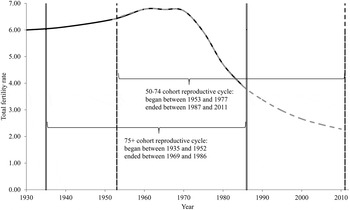
Based on previous research demonstrating that fertility began decreasing among cohorts born after 1937 (Zavala Reference Zavala and Rabell-Romero2014), we split our sample into two cohorts (one aged 50–74 years old and one aged 75 years or older in 2012) to examine differences across cohorts with different levels of fertility. The older cohort (aged 75 or older in 2012) was born in 1937 or earlier. Their reproductive cycle began (at age 15) approximately between 1935 and 1952 and ended (at age 49) between 1969 and 1986. This cohort experienced the introduction of family planning policies after 1975. Thus, women enjoyed the benefits of these policies when their reproductive cycle was almost over. In contrast, the younger cohort (aged 50–74 in 2012) was born between 1938 and 1962. Their reproductive cycle began (at age 15) between 1953 and 1977 and ended (at age 49) between 1987 and 2011. Compared to the older women, this cohort enjoyed the benefits of family planning for more years of their reproductive cycle and also had more years of schooling that were reflected in a higher use of contraceptive methods, delayed marriage and delayed childbearing.
The TFRFootnote 1 is a synthetic measure that represents the average number of children a woman would have during her reproductive years (ages 15–49), assuming she survived all those years and subject to the current fertility rate at each age (United Nations 2015). Figure 1 presents the TFR for Mexico between 1930 and 2010. These years include the reproductive period of the two age cohorts and illustrate the effect of the family planning policies for each cohort. Therefore, as expected, women in the older cohort exhibit little change in the TFR (see solid black line in the figure). In contrast, the younger cohort exhibits a much sharper decline in TFR (see dashed grey line in the figure).
Total fertility rates for Mexico, 1930–2010, with cohort reproductive cycles.

The impact of the fertility transition brought changes to the family dynamics and, as a result, social support for older people also changed. Normally, older people and their wellbeing depend on the extended family (defined vertically or horizontally). Family members tend to make different investments in human and social capital (e.g. health, education and support) for the wellbeing of the members regardless of age (Becker Reference Becker1993; Lee and Mason Reference Lee and Mason2011). Intra-family support can flow from adult children to older parents or from older parents to children and grandchildren, making the flow of support dynamic and multi-directional. Over time, support may flow in any direction and may respond to temporary needs such as health shocks or high rates of unemployment in a region (Biddlecom, Chayovan and Ofstedal Reference Biddlecom, Chayovan, Ofstedal and Hermalin2002).
Social support from children to their elderly parents has been previously studied in developed countries (see e.g. Felton and Berry Reference Felton and Berry1992; Lee, Netzer and Coward Reference Lee, Netzer and Coward1995; Umberson Reference Umberson1992). However, family interactions are expected to vary over the fertility transition experienced in developing nations. In Latin America, older people are still regarded with respect and admiration because they fulfil a role in the family by providing advice, experience and knowledge. In addition, the concept of family can sometimes take precedence over individualism and personal independence (Beyene, Becker and Mayen Reference Beyene, Becker and Mayen2002). Therefore, adult children are normally viewed as the ‘traditional’ care-givers and primary source of support for older people.
In Mexico, Wong and Higgins (Reference Wong, Higgins, Angel and Whitfield2007) reported that older individuals are more likely to start receiving economic help and to stop giving it in response to the financial conditions of those involved. However, this is not the same finding for non-economic help (e.g. providing assistance with chores or transportation), which seems to respond more to health shocks. In this case, older individuals who were not receiving help and became sick were more likely to start receiving non-economic support. In addition, older adults who had more living children were also more likely to receive both economic and non-economic help.
In developing countries like Mexico, around 55 per cent of adults aged 60 or older live with adult children because co-residence is mutually beneficial (Bongaarts and Zimmer Reference Bongaarts and Zimmer2002). The former receive health and financial support while the latter receive help in household-related activities (De Vos Reference De Vos1990; Ruggles and Heggeness Reference Ruggles and Heggeness2008). However, a transformation is expected to occur in many countries that are ageing rapidly. Changes in living arrangements motivated by the rapid decline of fertility rates will affect the traditional order in which elderly wellbeing rests solely on the younger generations (Solé-Auró and Crimmins Reference Solé-Auró and Crimmins2014). This order is also being affected by socio-economic changes that threaten the traditional filial support as younger generations face limited economic resources to sustain their nuclear family and hence their extended families (Chen and Silverstein Reference Chen and Silverstein2000; González-Vázquez et al. Reference González-Vázquez, Bonilla-Fernández, Jaúregui-Ortiz, Yamanis and Salgado de Snyder2007).
As mentioned before, research on fertility levels and old-age wellbeing has focused on developed countries. Given low institutional support for older people and the traditional environment of prevailing support from children to older parents in Mexico, fertility declines may present major concerns for current and future generations of older adults. A key question regarding this transition is whether the fertility decline has resulted in a significant and noticeable change in the wellbeing of older adults.
This paper contributes to this research gap by analysing how two different cohorts have been affected by changes in fertility rates in a developing country such as Mexico. The association between number of children and parental wellbeing vary by population sub-groups and by stage of the lifecycle (Margolis and Myrskylä Reference Margolis and Myrskylä2011). The fertility behaviour of an individual will be modified by past, present and even expectations on the future (such as social norms, culture and government institutions) and internal factors (such as personal resources and biological characteristics) (Huinink and Kohli Reference Huinink and Kohli2014). People at childbearing age with more children will experience more stress than those without children (Koropeckyj-Cox, Pienta and Brown Reference Koropeckyj-Cox, Pienta and Brown2007), but this relationship is not evident at old age (McLanahan and Adams Reference McLanahan and Adams1987).
Since there can be positive and negative consequences of low parity, the fertility transition could have produced various consequences for parents in old age. First, negative, as fewer adult children represent fewer opportunities for assistance to older parents in financial and non-financial terms. Second, there might be positive effects of low fertility by reducing the economic and psychological stress associated with raising a large family (Nomaguchi and Milkie Reference Nomaguchi and Milkie2003). In terms of health, having fewer children may positively influence wellbeing by improving the health consequences in old age of women who had a high number of pregnancies and births. High parity has been linked to higher risk of dying from cancer or chronic heart disease (Dior et al. Reference Dior, Hochner, Friedlander, Calderon-Margalit, Jaffe, Burger, Avgil, Manor and Elchalal2013), higher risk of mortality (Doblhammer Reference Doblhammer2000), long-term illness (Grundy and Tomassini Reference Grundy and Tomassini2005), and overall worse health than women with fewer or no children (Aiken, Angel and Miles Reference Aiken, Angel and Miles2012; Grundy and Holt Reference Grundy and Holt2000; Kington, Lillard and Rogowski Reference Kington, Lillard and Rogowski1997).
Thus, we postulate two hypotheses: (a) that having fewer children will affect elderly wellbeing in positive and negative terms; and (b) that low fertility will influence individuals born on or before 1937 differently than individuals born after 1937 in Mexico. We empirically test our hypotheses by evaluating the influence of the number of children on health-, economic- or psychosocial-related outcomes in old age.
Data and methods
Sample
Data are from the Mexican Health and Ageing Study (MHAS), a prospective panel investigation of health and ageing in Mexicans born in 1951 or earlier. Participants were first interviewed in 2001 (92 per cent response rate) with follow-ups in 2003 (93 per cent follow-up rate) and in 2012 (88 per cent follow-up rate) in a stratified sample (N = 15,186) representative of the national population. The database includes information on the participants' economic situation, education, living arrangements, marital status and social network, as well as self-reports of functional capacity and chronic conditions (Mexican Health and Ageing Study 2001). Additionally, in 2012 the sample was refreshed with 6,259 new eligible individuals between ages 50 and 60 to keep the survey nationally representative of the population aged 50 or older in 2012 (Mexican Health and Ageing Study 2012) (for more information regarding the construction of the database, see Wong, Michaels-Obregón and Palloni Reference Wong, Michaels-Obregón and Palloni2015).
Our analysis begins with a sample of 14,872 respondents aged 50 or older in 2012. We exclude 1,770 respondents who have incomplete information. Thus the sample for our analyses includes 13,102 respondents with 10,945 cases for the younger cohort (50-74 years old) and 2,157 respondents for the older cohort (aged 75 and older).Footnote 2
Covariates
Covariates come from the 2012 survey and include age, sex, education and marital status. Education is reported in the survey as completed years of education and categorised as no education (zero years), incomplete elementary education (one to five years), complete elementary education (six years) and greater than elementary education (seven or more years). Marital status is categorised as married or in a consensual union, widowed and other (divorced, separated or never married). Fertility is captured with total number of children ever bornFootnote 3 and is categorised into tertiles as zero to two children, three or four children, and five or more children. While respondents reporting no children may have unique characteristics, this percentage in the older cohort is small (approximately 4%; 95 cases). Because our focus is not necessarily on childlessness, we group together those reporting no children with those reporting one or two to maximise the number of respondents in each category. In analyses not shown, we also separated the childless respondents and created a categorical variable: (a) childless, (b) one or two children, (c) three or four children, and (d) five or more children. Across our regression models, the childless category behaved in similar ways to the category for one or two children. Hence, we chose to leave the groups to avoid reporting results based on few respondents. The number of children ever born includes all the children born during a women's reproductive cycle. Using this variable instead of the number of children currently alive allows us to present a more accurate reflection of how an individual's fertility behaviour might affect their socio-economic situation and wellbeing (Adhikari Reference Adhikari2010). Further, we use the total number of children ever born as our measure of fertility because a respondent's children may have died throughout the respondent's lifecourse but may have supported the respondent before dying.
Dependent variables
We group our outcome variables into different dimensions of wellbeing following Lindenberg (Reference Lindenberg2001) and Nauck (Reference Nauck2001). Both authors divide wellbeing into a physical–material dimension that includes health and economic outcomes, a psychological dimension that includes emotional outcomes, and a social dimension that comprises social approval and behaviour inside social networks. We adapt this approach with the available data from the MHAS.
Our outcome measures are grouped into three dimensions of wellbeing (health, economic and psycho-social) and come from the 2012 survey. Health wellbeing is measured as a count of chronic conditions ranging from zero to six (the list includes: self-reported hypertension, diabetes, stroke, heart attack, cancer and pulmonary conditions). Psycho-social wellbeing is operationalised through a nine-item Center for Epidemiologic Studies for Depression scale (CES-D; Radloff Reference Radloff1977), ranging from 0 to 9. Economic wellbeing is captured through the number of consumer durable items available in the household of residence ranging from 0 to 8 (the list includes: radio, television, refrigerator, washer, telephone, water heater, internet and computer), and having any form of health insurance.
The use of a variable that clearly captures socio-economic status across studies is not consistent and often researchers switch between proxies like consumption, household or personal income, or expenditures, among others (Bollen, Glanville and Stecklov Reference Bollen, Glanville and Stecklov2002). Income for elderly respondents is very low as most only receive a small pension from the Social Security system in Mexico but many have savings or other forms of wealth so their income might not be a true reflection of their wellbeing. Therefore, many studies in developing countries use the number of consumer durables in the dwelling as a proxy measure to capture socio-economic status (Bollen, Glanville and Stecklov Reference Bollen, Glanville and Stecklov2001).
The two main public insurance providers in Mexico are the Instituto Mexicano del Seguro Social (IMSS) and the Instituto de Seguridad y Servicios Sociales de los Trabajadores del Estado (ISSSTE). Both of these institutions were created for formal labour market employees and their families so many older adults benefited by having insurance via their children. In recent years, IMSS and ISSSTE have had economic difficulties that resulted in inconsistent service across states. Further, both systems are on the verge of bankruptcy (Aguilar-García Reference Aguilar-García2006).
Many individuals consider buying private insurance as a complement to their public insurance. While in some cases medical attention and coverage with private insurance companies may be superior to those from public institutions, individuals are faced with different types of coverage with varying prices and quality of service. As a result, many are unable to afford private insurance (Giedion, Villar and Ávila Reference Giedion, Villar and Ávila2010).
As the majority of health insurance coverage in Mexico comes from IMSS and ISSSTE, we capture insurance coverage with a dummy variable based on those with any form of coverage versus those without coverage. Results from our analytical sample show around 88 per cent of respondents with some type of insurance versus 12 per cent without any type of coverage. Within the 88 per cent who had insurance in 2012, around 48.5 per cent was covered by IMSS; 18.2 per cent had access to ISSSTE; 27.2 per cent had access to Seguro Popular (a programme introduced by the federal government in 2003 to offer health insurance to the segment of the population that was not covered by any public or private institution); 4.0 per cent were covered by other public institutions (oil company workers, military and others); and only 2.0 per cent had private insurance.
Statistical analysis
Statistical methods differ based on the type of outcome variable (count/binary). We model health insurance status using logistic regression. The number of depressive symptoms and the number of consumer durables in the household are modelled using standard Poisson regression, while the count of chronic conditions is modelled through a zero-inflated Poisson regression as the number of respondents reporting zero chronic conditions is large (44%). Vuong tests are used to determine if the zero-inflated Poisson regression models fit data significantly better than standard Poisson regressions (Vuong Reference Vuong1989). Standard Poisson regressions use robust standard errors (Cameron and Trivedi Reference Cameron and Trivedi2010). All data analysis uses Stata/SE 13.1 (StataCorp. 2013). To examine differences by the two birth cohorts with differing levels of fertility, all models are stratified by birth cohort.
Results
Descriptives
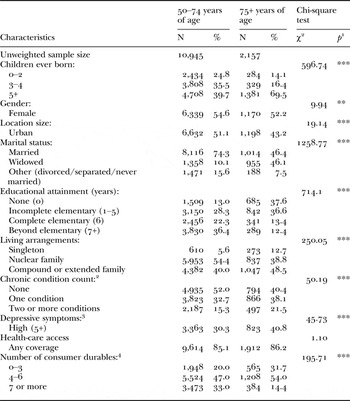
Table 1 shows that important differences are observed between the two birth cohorts. First, regarding fertility, respondents in the older birth cohort had more children. The average number of total children ever born in the younger birth cohort was 4.7 and 6.9 in the older cohort. Additionally, those in the older cohort were more likely to live in rural areas and be widowed. For the health dimension of wellbeing, the older birth cohort had higher counts of chronic conditions. Differences between the two cohorts could be an effect of age rather than cohort, thus the multivariate regressions control for age. For the economic dimension of wellbeing, the older cohort reported poorer economic conditions with fewer consumer durables but similar levels of health-care access. Birth cohorts seemed to differ in the psycho-social dimension of wellbeing, with respondents in the older cohort reporting higher levels of depressive symptoms.
Distribution of characteristics of older Mexican adults by age group, age 50+ from the Mexican Health and Ageing Study Wave 3 (2012)

Notes: N = 13,102. Weighted results and unweighted sample size. 1. Probability of type 1 error. 2. Chronic condition count is self-reported hypertension, diabetes, strokes, heart attacks, cancer and pulmonary conditions. 3. Depressive symptoms: nine-item Center for Epidemiologic Studies Depression scale. 4. Consumer durables are self-reported ownership of: radio, television, refrigerator, washer, telephone, water heater, internet and computer.
Source: Authors' calculations with information from the Mexican Health and Ageing Study (2012).
Significance levels: ** p < 0.01, *** p < 0.001.
Psycho-social wellbeing
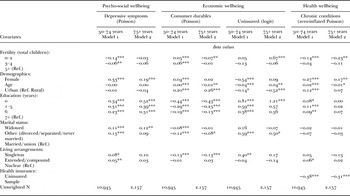
Regression results for measures of psycho-social wellbeing are provided in the first part of Table 2. We use Poisson regression to model the count of reported depressive symptoms. Analyses are stratified by birth cohort in Models 1 and 2 with the younger cohort in Model 1 and the older cohort in Model 2. In the younger birth cohort, lower fertility (zero to two, or three or four, compared to five or more children) is associated with reporting fewer depressive symptoms. However, this association was not observed in the older cohort. Other covariates show significant association with depressive symptoms for both cohorts. For instance, being female and having low educational achievement (zero to six years of schooling, compared to having seven or more) is associated with a higher number of depressive symptoms. Similarly, non-married respondents (divorced, separated, widowed and never married) and those living alone or in extended households exhibit more depressive symptoms compared to married couples and those living in nuclear households, respectively.
Principal results for three dimensions of wellbeing of older Mexican adults by age group, age 50+ from the Mexican Health and Ageing Study Wave 3 (2012)

Notes: N = 13,102. Ref.: reference category.
Source: Authors' calculations with information from the Mexican Health and Ageing Study (2012).
Significance levels: * p < 0.05, ** p < 0.01, *** p < 0.001.
Economic wellbeing
Regression results for measures of economic wellbeing are shown in the second part of Table 2. We use Poisson regression to model the count of consumer durables in the household. We find important differences between the two age cohorts. In the younger cohort (Model 1), lower fertility (zero to two, or three or four, compared to five or more children) is associated with better economic wellbeing, while in the older cohort (Model 2), lower fertility (zero to two, compared to five or more children) is associated with worse economic wellbeing. As a second measure of economic wellbeing we consider the respondent's health insurance status. We use logistic regression to predict the odds of being uninsured. The stratification shows that while fertility is not associated with the odds of being uninsured in the younger cohort (Model 1), lower fertility is associated with higher odds of being uninsured in the older cohort (Model 2).
Other covariates show significant association with both economic outcomes. For the younger cohort, being female and living in an urban area increases the number of consumer durables and reduces the odds of being uninsured. Fewer years of education, living in a single household and not being married increases the odds of being uninsured and also reduces the number of consumer durables. However, for the older cohort, gender, having between one and six years of schooling (only for the uninsured), being a widow, and living in an extended or compounded household show no association with the economic wellbeing of older Mexicans.
Health wellbeing
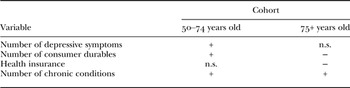
Regression results for count of chronic conditions are shown in the last portion of Table 2. A Vuong test in Model 1 indicates that the zero-inflated Poisson regression model fits the data significantly better than a standard Poisson regression. Similar results are seen across models which were stratified by birth cohort (Models 1 and 2). In both cohorts, lower fertility (zero to two children compared to five or more children) was associated with fewer chronic conditions. Other covariates show significant association with the number of chronic conditions. For example, women have a higher number of chronic conditions for both cohorts while living in an urban area seems to impact positively only those in the younger cohort. The rest of the covariates (marital status, living arrangements and years of education) show weak associations for a few of the categories (e.g. one to five years of schooling and extended or compound household) in the younger cohort and no association at all with the health wellbeing of the older cohort. A summary of the effects by cohort are shown on Table 3.
Effects of low fertility (zero to two children) versus five or more children for older Mexican adults by age cohort from the Mexican Health and Ageing Study Wave 3 (2012)

Notes: N = 13,102. The sign refers to the effects of low fertility on the wellbeing of older Mexican adults.
Source: Authors' calculations with information from the Mexican Health and Ageing Study (2012).
Significance level: n.s.: not statistically significant at the 95 per cent confidence level.
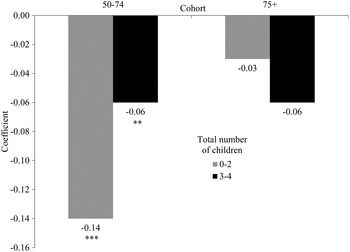
We then illustrate the impact of lower fertility (having zero to two, or three or four, compared to five or more children) on each of the selected outcomes. Figure 2 shows the coefficients of having low fertility (compared to high fertility) in the psychosocial dimension for each age cohort. Both cohorts benefit from having fewer children as the number of depressive symptoms is lower with fewer children but results for the older cohort are not statistically significant.
Effects of low fertility on the number of depressive symptoms for older Mexican adults by age cohort from the Mexican Health and Ageing Study Wave 3 (2012).

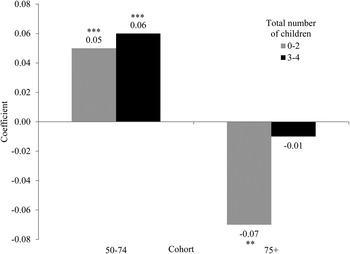
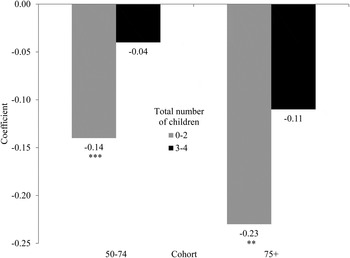
Figure 3 shows the coefficients of low fertility (versus high fertility) in the economic dimension for each age cohort. This is the only case where we find a cohort difference. Having fewer children is associated with a higher number of consumer durables in the younger cohort and with a lower number of consumer durables in the older cohort. Finally, Figure 4 shows the coefficients of low fertility (versus high fertility) in the health dimension for each age cohort. Having low fertility (zero to two children) shows the strongest association with lower number of chronic conditions and this is true for both the younger and the older respondents.
Effects of low fertility on the number of consumer durables for older Mexican adults by age cohort from the Mexican Health and Ageing Study Wave 3 (2012).

Effects of low fertility on the number of chronic conditions for older Mexican adults by age cohort from the Mexican Health and Ageing Study Wave 3 (2012).

Discussion and conclusions
The demographic transition in Mexico brought an accelerated decline in fertility rates. The introduction of family planning programmes and the promotion and distribution of contraceptives reduced Mexico's TFR from over 6 to just above replacement level in around four decades. A cohort effect among Mexican females was created as fertility rates in Mexico started to decrease. Individuals born after 1937 and those born in 1937 or earlier experienced different effects of the fertility decline caused by the family planning programmes in Mexico. Because of the combined drops in fertility and mortality, Mexico also faced a rapid ageing of the population.
Previous research has shown that familial ties are associated with wellbeing at old age (Attias-Donfut Reference Attias-Donfut2001; Grundy and Henretta Reference Grundy and Henretta2006; Reinhardt, Boerner and Horowitz Reference Reinhardt, Boerner and Horowitz2006) and receiving emotional support from adult children benefits older people (Zunzunegui, Béland and Otero Reference Zunzunegui, Béland and Otero2001). The impact of the fertility transition changed family dynamics and caused a change in the potential amount of social support given to older people. On one hand, in the Mexican socio-economic context, fewer adult children may represent fewer opportunities for economic and emotional support to elderly parents. On the other, low fertility may reduce financial and psychological strain caused by raising a large family with limited resources.
However, research on fertility levels and old-age wellbeing has focused on developed countries like the United States of America. Thus, our study closes the gap by analysing the effects of the fertility transition on economic, psycho-social and health aspects of old-age wellbeing in a developing and family-centric country like Mexico. We used Poisson and logistic regressions to measure four different outcomes (number of chronic conditions, number of consumer durables, insurance coverage and number of depressive symptoms) in three separate dimensions of wellbeing (health, economic and psycho-social).
Overall, we find evidence that having fewer children is associated with various wellbeing outcomes in old age and the association varies across the two age cohorts depending on the outcome (for a summary of results, see Table 3). In the economic dimension, for consumer durables in the household, younger cohorts seem to have a better economic status associated with low fertility whereas the opposite is observed in the older cohort. On the other hand, lower fertility was associated with higher odds of being uninsured in the older cohort only. This may be because the younger cohorts benefited from the emergence of the social security institutions starting in the 1950s and could gain health insurance coverage on their own, while the older cohort tended to gain health insurance coverage through their children (Aguilar-García Reference Aguilar-García2006). Thus, for the older cohort, having fewer children may have implied fewer opportunities to gain access to health insurance.
Mixed results are observed for psycho-social wellbeing. Lower fertility was associated with fewer depressive symptoms, but only in the younger cohort. Finally, for the health dimension of wellbeing, lower fertility was associated with reporting fewer chronic conditions, an association that was similar for both age cohorts.
Not surprisingly in the Mexican context, urban and rural differences were significant, particularly in the economic dimension models. Living in an urban area was associated with the number of consumer durables owned by both cohorts while it seems to benefit the younger cohort in terms of insurance coverage. Socio-economic conditions influence the financial stability and wellbeing of individuals (Wong and DeGraff Reference Wong and DeGraff2009), and urban households with more consumer durables have the ability to react better to income fluctuations than rural households (Dhawan-Biswal Reference Dhawan-Biswal2002).
Our study comes with some limitations. First, we are basing our hypotheses in the traditional familial support structure of adult children providing assistance and becoming primary care-givers for their elderly parents. Younger generations are becoming less likely to follow traditional pathways as issues like co-habitation, divorce, fewer children, among others, gain more weight in modern societies (Ryan and Willits Reference Ryan and Willits2007). Second, while our analysis includes the total number of children ever born, key characteristics of the children are not included. For example, the analysis may be strengthened by considering the sex and living arrangements of the children. The child may or may not live in the same household or even the same city or state as the respondent. In addition, the socio-economic characteristics of the children were not considered.
Third, mortality bias might be present as respondents in the older cohort are more likely to experience higher mortality than those in the younger cohort. Fourth, prevalence of undiagnosed conditions, like diabetes or hypertension, among cohorts with different types of access to health-care services might modify the findings in the health dimension. Fifth, the MHAS has no available data on preferences, access or the time of purchase of the consumer durables. We assume that having access to a given consumer durable provides wellbeing to the older adults, regardless of its net worth or time of purchase. The purpose of including consumer durables in our models is not to capture the net worth of the item itself or how long ago it was purchased, but to measure the potential wellbeing that the item brings to older respondents by having access to these items at home.
Further research is needed to confirm these results and to continue exploring the effects of the fertility transition as data on younger cohorts become available. The inclusion of other health-related variables, such as smoking and drinking behaviours, and economic-related variables, such as consumption and savings, among others, might be useful to determine if the number of children has other impacts on the wellbeing of elderly Mexicans. In addition, a comparison between Mexico and another rapidly ageing developing country like Costa Rica may be useful as these countries have experienced fertility declines at different times.
Acknowledgements
This work is funded by the National Institute on Aging (NIA) at the National Institutes of Health (NIH) (grant R01 AG018016 and Health of Older Minorities Award T32 AG000270), by the National Institute on Disability and Rehabilitation Research (NIDRR) (postdoctoral training grant H133P110012), and by infrastructure and resources of the Sealy Center on Aging at the University of Texas Medical Branch. This study was approved by the Institutional Review Boards or Ethics Committees of the University of Texas Medical Branch in the United States of America, the Instituto Nacional de Estadística y Geografía (INEGI) and the Instituto Nacional de Salud Pública (INSP) in Mexico.