Introduction
Intestinal parasites constitute some of the most common infections in humans and animals worldwide (Dado et al., Reference Dado, Izquierdo and Vera2012; Pullan et al., Reference Pullan, Smith, Jasrasaria and Brooker2014). Dogs are reservoirs of several zoonotic parasites of public health significance worldwide (Deplazes et al., Reference Deplazes, van Knapen, Schweiger and Overgaauw2011) and are also linked with mechanical transmission of intestinal parasites such Ascaris lumbricoides (Shalaby et al., Reference Shalaby, Abdel-Shafy and Derbala2010), Toxoplasma gondii (Lindsay et al., Reference Lindsay, Dubey and Blagburn1997) and Hymenolepis (Meloni et al., Reference Meloni, Thompson, Hopkins, Reynoldson and Gracey1993). In addition to being reservoirs of infectious agents to humans, animals and wildlife, intestinal parasitic infections in dogs are either asymptomatic or lead to severe clinical symptoms including anaemia, diarrhoea, vomiting, anorexia, dermatitis or even death, especially in puppies (Bowman, Reference Bowman2014).
Domestic dogs are potential reservoirs of infectious agents which are transmissible to wildlife, resulting in severe disease outbreaks such as that of canine distemper virus in the Serengeti–Mara ecosystems (Alexander & Appel, Reference Alexander and Appel1994; Roelke-Parker et al., Reference Roelke-Parker, Munson and Packer1996; Cleaveland et al., Reference Cleaveland, Appel, Chalmers, Chillingworth, Kaare and Dye2000) and Chile (Acosta-Jamett et al., Reference Acosta-Jamett, Chalmers, Cunningham, Cleaveland, Handel and Bronsvoort2011). The survival of wildlife is also threatened by emerging diseases in humans and domestic animals such as toxoplasmosis and cryptosporidiosis (Bowser & Anderson, Reference Bowser and Anderson2018). Wild carnivores may also act as reservoirs of human and domestic animal infectious agents as a result of spill-over events (Otranto & Deplazes, Reference Otranto and Deplazes2019). In the domestic–wildlife interface areas, pastoralists keep dogs to help them in herding and guarding their livestock from wild carnivores. This practice leads to leaving these shepherd dogs without food, shelter and veterinary care and, therefore, encourages free roaming and scavenging in wildlife habitats, thus posing a health risk to humans, domestic animals and wildlife (Sparkes et al., Reference Sparkes, Fleming, Ballard, Scott-Orr, Durr and Ward2015). Mass vaccination of dogs against rabies and canine distemper coupled with anti-parasitic treatment against helminths can help reduce the risk of dogs transmitting these infectious diseases (Cleaveland et al., Reference Cleaveland, Thumbi, Sambo, Lugelo, Lushasi, Hampson and Lankester2018; Dantas-Torres et al., Reference Dantas-Torres, Ketzis and Mihalca2020). In Kenya, the human–domestic animal–wildlife interactions are common because of encroachment into national parks/game reserves by pastoral communities during grazing of livestock (Løvschal et al., Reference Løvschal, Håkonsson and Amoke2019).
Considering the frequent interactions between humans, domestic and wild animals, and the possibility of disease transmission, this is an ideal environment for the application of the One Health approach in disease control. The One Health approach has been defined by the American Veterinary Medical Association (AVMA) as 'the collaborative effort of multiple disciplines working locally, nationally and globally to attain the optimal health for people, animals and our environment’. The use of One Health has been encouraged by the Ministries of Health and Agriculture, Livestock and Fisheries in Kenya, and especially by the Zoonotic Disease Unit (ZDU) (Munyua et al., Reference Munyua, Njenga and Osoro2019); thus, this study presented yet another opportunity for its application.
The introduction of wildlife conservancy areas within human habitats in Kenya has increased recently. In these areas, land utilization to maximize the well-being of wildlife and livestock keeping is encouraged (Løvschal et al., Reference Løvschal, Håkonsson and Amoke2019). However, this co-existence of wildlife, domestic animals and people poses the danger of transmission of infectious diseases (Nthiwa et al., Reference Nthiwa, Alonso, Odongo, Kenya and Bett2019). In Kenya, information on the epidemiology of intestinal parasites of dogs and their role as potential reservoirs of zoonoses is limited. Further, little is known of domestic dogs living in a human–animal–environmental interface and their potential as reservoirs and sentinels for infectious diseases in Kenya. This information is important for the development of public health and veterinary strategies for treatment, control and prevention of these zoonoses and other diseases in a One Health approach. This study involved the collaboration of physicians, veterinarians and scientists, both locally and globally, to estimate the prevalence human and animal diseases of importance in the community. Hence, it used the One Health approach to collect and analyse human, domestic animals and wildlife faecal and blood samples, and aims to report the data and design appropriate control measures tailored to the study area. This study, therefore, reports the helminths detected in dogs, in a human–animal–environmental interface, Oloisukut Conservancy, Narok County, Kenya. The results from human, livestock and wildlife samples are reported elsewhere.
Materials and methods
Study area
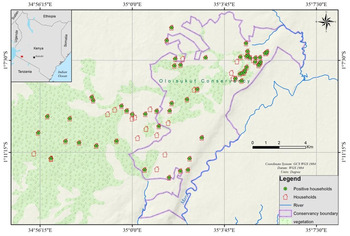
The study was conducted in the Oloisukut Conservancy in Narok County, Kenya (fig. 1). The Oloisukut Conservancy is a community initiative that was established in 2006 and started its operations in 2010. The conservancy is part of the greater Mara–Serengeti ecosystem and has an annual temperature ranging from 14.8°C to 28°C and rainfall range of 700–2300 mm, with an average of 1500 mm. The Trans Mara sub-county lies at an altitude of 1500–2500 m above sea level. The conservancy covers an area of 23,000 acres, comprising 51 individually registered parcels of land. At the time of sampling, the conservancy had a membership of 109 heads of households, with a human population of approximately 12,500; however, some of the members reside outside the conservancy (fig. 1). The livestock population was 21,200 cattle, 35,850 sheep and goats, 250 donkeys and 881 dogs at the time of the study (Mpario, pers. comm.).
Map of Kenya showing the Oloisukut Conservancy, sampled households and households with dogs infected with intestinal helminths.

Dog faecal sampling
Dog faecal samples were collected per rectum in households that were randomly selected in April 2019 during a rabies and canine distemper vaccination and deworming campaign. Approximately 10 g of faecal samples were collected from the rectum. The faecal samples were examined macroscopically for the presence of worms or proglottids before being preserved immediately in 80% ethanol.
Detection of intestinal helminths in dog faecal samples by zinc chloride flotation-sieving and formal-ether concentration techniques
The presence of helminth eggs was determined by the zinc chloride flotation technique (Mathis et al., Reference Mathis, Deplazes and Eckert1996). Approximately 2–3 g of faecal samples were transferred into 15 ml falcon tubes and excess ethanol drained off. Then, 8 ml of distilled water were added into the faecal samples (1:4) to wash off excess ethanol. The pellet was washed again with 8 ml of 1 × phosphate-buffered saline containing 0.03% Tween-20 (1:4); helminth eggs were harvested by adding 8 ml (1:4) of zinc chloride (specific gravity 1.45) and then sieved through two sequential sieves of 50 and 22 microns. Helminth eggs trapped by the 22-micron sieves were washed off through a funnel into a 15 ml falcon tube. The eggs were transferred into 2 ml microcentrifuge tubes after centrifugation at 400 rpm and stored in 70% ethanol.
For the formal-ether concentration method, excess ethanol was drained off from samples. Approximately 3 g of faecal samples were rinsed by adding distilled water and thoroughly mixing by vortexing and centrifugation. To the pellet, saline (0.85%) was added up to the 7 ml marker and topped up to the 10 ml marker by adding diethyl ether. The faecal samples were thoroughly mixed by vortexing and centrifuged at 2500 rpm for 15 min (Cheesbrough, Reference Cheesbrough2009). Helminth eggs were examined at X10 and identified according to Soulsby (Reference Soulsby1968) and Thienpont et al. (Reference Thienpont, Rochette and Vanparijs1986).
Extraction of genomic DNA from helminth eggs or proglottids
Individual taeniid eggs were picked under the microscope (X4) using a pipette and transferred into 0.2 ml thin-walled polymerase chain reaction (PCR) tubes containing 10 μl of 0.02 M sodium hydroxide (NaOH) and lysed at 99°C for 10 min. For faecal samples containing proglottids, a small proglottid tissue was cut and lysed in 50 μl of 0.02 M NaOH at 99°C for 30 min. The QIAamp® Stool Mini Kit (Qiagen, Hilden, Germany) was used to extract genomic DNA of Dipylidium caninum, Spirometra spp. and hookworm. The eggs were lysed by adding 1.4 ml of ASL buffer and subjected to three cycles of freeze (−80°C for 30 min) and thaw (80°C for 15 min). The DNA was extracted according to the manufacturer's instructions and eluted in 50 μl of elution buffer.
Genotyping of helminths (Taenia spp., hookworm, D. caninum and Spirometra spp.)
The taeniid lysates were used as a template in a nested PCR targeting part of NADH dehydrogenase subunit 1 as described by Mulinge et al. (Reference Mulinge, Magambo and Odongo2018). Briefly, the PCR was carried out in 25 μl reaction containing 1 × DreamTaq™ Green Buffer (Thermo Fisher Scientific, Massachusetts, USA), 0.2 mm deoxyribonucleotide triphosphates (dNTPs), 0.25 μM of each primer, 2 mm magnesium chloride (MgCl2), 0.625 units of DreamTaq™ Green DNA Polymerase (Thermo Fisher Scientific, Massachusetts, USA) and 2 μl of taeniid lysate as DNA template. The cycling conditions for both PCRs were: 5 min of initial denaturation at 94°C, 40 cycles of 94°C for 30 s, 55°C for 30 s and 72°C for 1 min, with a final extension at 72°C for 5 min. The PCR amplicons were subjected to a restriction digest using HphI endonuclease in 20 μl reaction containing 1 × CutSmart® Buffer, 0.5 μl of HphI enzyme (New England Biolabs, Massachusetts, USA), 10 μl of PCR product and 7.5 μl of nuclease-free water. The restriction digests were incubated overnight at 37°C and resolved on 3% agarose gel containing ethidium bromide. Known positive controls for Echinococcus granulosus sensu stricto, Echinococcus ortleppi, Echinococcus canadensis (G6/7) and Echinococcus felidis were cut with HphI and run alongside test samples. Genotyping of D. caninum and Spirometra spp. was done through the same nested PCR used for taeniids, but targeted DNA extracted from eggs or lysates of proglottids.
A single PCR targeting the internal transcribed spacer (ITS)-1, 5.8S and ITS 2 regions of Ancylostoma spp. and Uncinaria stenocephala (Traub et al., Reference Traub, Robertson, Irwin, Mencke and Thompson2004) was performed. The 50 μl PCR contained 5 μl genomic DNA, 2 mm MgCl2, 0.2 mm dNTPs, 0.5 μM of each primer, 1 × DreamTaq™ Green Buffer (Thermo Fisher Scientific, Massachusetts, USA) and 1.25 units of DreamTaq™ Green DNA Polymerase (Thermo Fisher Scientific, Massachusetts, USA). The cycling conditions were identical to those used for taeniids except the number of cycles (50). A new nested PCR method targeting part of the cytochrome oxidase 1 gene (cox1) was developed and applied to genotype canine hookworm. The primary PCR was amplified using primers 5′-TGGTTCCTTTAATGTTGGGTGC-3′ and 5′-TGCTGCAGTAAAATAAGCCCG-3′, resulting in 667 bp amplicons. The nested PCR yielded a product of 606 bp and used primers 5′-GTTGGGTGCACCAGATATAAGT-3′ and 5′-GCTCAAACCACACAACCAATCA-3′. Identical PCR and cycling conditions stated for taeniids were used for the new cox1 hookworm PCR. For all the helminths, 10 μl of PCR amplicons were resolved on 2% agarose gel and visualized under ultraviolet following ethidium bromide staining.
Purification and sequencing of PCR amplicons
PCR products were purified using the QIAquick PCR Purification Kit (Qiagen, Hilden, Germany) according to the manufacturer's instructions. PCR products were sequenced using nested PCR reverse primer depending on the helminth at the International Livestock Research Institute (ILRI), Nairobi, Kenya.
Statistical data analysis
The data were entered in Microsoft Excel 2013 (Microsoft Corporation) and transferred into STATA version 12.0 (STATA Corporation, College Station, Texas, USA) for analysis. The chi-square (χ2) test was used to determine the potential correlation between age and sex of the dogs with helminth infections. The difference was considered significant when the P-value was ≤0.05. DNA sequences were viewed and edited using GENtle v. 1.9.4 (http://gentle.magnusmanske.de, Manske M. 2003, University of Cologne, Germany). The sequences were identified by comparing with those available in the National Centre for Biotechnology Information database (NCBI) using the basic local alignment search tool (BLAST) (http://www.ncbi.nlm.nih.gov/BLAST/; Altschul et al., Reference Altschul, Madden, Schaffer, Zhang, Zhang, Miller and Lipman1997).
Results
Demographic data
Faecal samples were collected from 100 dogs, 43 females and 57 males. The age of the dogs ranged between three months and 15 years. Faecal samples were collected from 76 out of 109 households (table 1 and fig. 1). Single faecal samples were collected from 57 households, two faecal samples from 15 households, three faecal samples from three households and four faecal samples from a single household (table 1).
Households and faecal samples collection in a human–animal–environmental interface, Oloisukut Conservancy, Kenya.

a 1–4 represent the number of faecal samples collected per household.
Macroscopy examination and coproscopy analysis
Proglottids or whole cestodes were detected in 13 (13%) of the faecal samples. Nine genera were detected in dogs (table 2). Of the 100 faecal samples, 65 (65%) harboured at least one helminth infection and originated from 54/76 (71.05%) households (fig. 1). Hookworm infection was the most common (n = 39, 39%), followed by Spirometra spp. (n = 17, 17%). The other helminths detected included taeniid eggs (n = 13, 13%), Toxocara and Trichuris spp. (n = 10, 10%) each, Spirocerca lupi (n = 5, 5%), Physaloptera spp. (n = 2, 2%), D. caninum and Strongyloides spp. (n = 1, 1%) each (table 2).
Macroscopic and microscopic examination of dog faecal samples in a human–animal–environmental interface, Oloisukut Conservancy, Kenya.

P%, prevalence of helminths
a Spirometra spp. eggs were detected microscopically in 17 faecal samples, from one additional sample the eggs were detected by PCR and sequencing.
b Macroscopic examination (cestode proglottids such as Taenia, Spirometra and Mesocestoides spp.).
c Three additional samples contained Dipylidium caninum DNA/eggs by PCR and sequencing but had no eggs on microscopy.
Association of age, sex and intestinal helminth infections in dogs
The age groups ≤12, 25–48 and 49–72 months had the highest infections, and this correlated with the number of faecal samples examined (table 3). There was no significant association for helminth infections in general and the age of the dogs (χ2 = 11.60, P = 0.07). In general, helminth infections were more common in the male dogs (42%) compared to the females (24%); however, the difference was not significant (χ2 = 3.49, P = 0.06). Only the infections with hookworms, in which 47% and 28% male and female dogs, respectively, were infected, was significant (χ2 = 3.90, P = 0.05) (table 3).
Association of helminth infections with age and sex in domestic dogs in a human–animal–environmental Interface, Oloisukut Conservancy, Kenya.

a P-value was significant.
Genotyping of helminths by PCR, Restriction Fragment Length Polymorphism (RFLP) and sequencing
Taeniids eggs were picked for PCR from nine of the 13-taeniid egg-positive faecal samples. Thirty-one (31) of 168 taeniid eggs tested by nested PCR yielded products and originated from five faecal samples. PCR products from 18 taeniid eggs were sequenced and identified as Taenia serialis (17) and Taenia madoquae (1). The T. serialis eggs originated from four faecal samples and the single egg of T. madoquae from one sample. All the T. serialis isolates were 100% identical to sequence accession number MH287113 (Mulinge et al., Reference Mulinge, Odongo and Magambo2020), a representative sequence was deposited in the GenBank under accession number MZ032032. The T. madoquae isolate was 99% identical to sequence AB731726 (Nakao et al., Reference Nakao, Lavikainen, Iwaki, Haukisalmi, Konyaev, Oku, Okamoto and Ito2013) and was deposited in the GenBank under accession number MZ032033. Spirometra theileri was detected by nested PCR from three faecal samples out of 17 microscopically positive samples; the other S. theileri isolate was from a proglottid since that faecal sample had no eggs on microscopy. The sequences of the S. theileri isolates in this study were 100% identical to the sequence accession number MN244299 (Eom et al., Reference Eom, Park and Lee2019), an isolate from a leopard (Panthera pardus) in Tanzania. A representative sequence of the S. theileri isolates from this study was deposited in the GenBank under accession number MZ032034. One of the faecal samples with proglottids contained Mesocestoides sp. that was not identified to the species level. The short sequence (218 bp) was 98% identical to a Mesocestoides isolate (accession number MH998127) from a dog in Germany (Hirzmann et al., unpublished data). Three faecal samples contained eggs/DNA for D. caninum by PCR and failed to show eggs on microscopy; two representative sequences were deposited in the GenBank with accession numbers MZ209412 and MZ209413. Of the 39 faecal samples containing hookworm eggs, PCR products were obtained from 18 samples: eight by ITS PCR and 15 by cox1 nested PCR. The ITS PCR–RFLP method identified the eight isolates as A. caninum. These results were confirmed by the partial sequencing of the 15 cox1 gene PCR products. Three sequences (accession numbers MZ021521–MZ021523) out of the four representative sequences were 99% identical to A. caninum isolate AP017673 (Kikuchi et al., unpublished data), while the other isolate (accession number MZ021524) was 100% identical to this reference sequence (Kikuchi et al., unpublished data).
Discussion
This study reports nine genera of intestinal helminths detected in dog faecal samples in the Oloisukut Conservancy, a human–animal–environmental interface in Kenya. In a previous study in Turkana, Narok (Maasai Mara), Isiolo and Meru counties, 11 parasite genera/families were detected in dog faecal samples collected from the environment (Mulinge, Reference Mulinge2020). The helminths reported in this study are either zoonotic, cause illness in dogs or/and are acquired from wildlife (T. serialis, T. madoquae, Mesocestoides sp., S. theileri, Toxocara spp., Physaloptera spp. and S. lupi). The helminths with zoonotic potential which pose a public health problem to humans including T. canis, A. caninum, T. serialis, Strongyloides spp., Mesocestoides sp. and Spirometra spp. On the other hand, A. caninum, S. lupi, Mesocestoides sp. and Physaloptera spp. cause illness in dogs and are, therefore, important to animal health. The control of these helminth infections in dogs, humans and wildlife calls for collaborative effort from the human, animal and environment health professionals in the context of the One Health approach.
Ancylostoma caninum was the only species from the genus identified in this study and these findings are similar to previous ones in Maasai Mara (Mulinge et al., Reference Mulinge, Njenga and Odongo2019). However, in that study, Ancylostoma braziliense and Ancylostoma duodenale were reported from other counties in Kenya. Ancylostoma caninum cause haemorrhagic enteritis in young puppies and chronic iron-deficiency anaemia in older dogs (Georgi et al., Reference Georgi, LeJambre and Ractliffe1969), while in humans it causes cutaneous larva migrans and eosinophilic enteritis (Bowman et al., Reference Bowman, Montgomery, Zajac, Eberhard and Kazacos2010). A few studies have reported the presence of A. caninum eggs/DNA in human faeces; however, it remains uncertain if these were natural infections or inadvertent passage, as non-patent worms of this species were detected in human intestines previously (George et al., Reference George, Levecke, Kattula, Velusamy, Roy, Geldhof, Sarkar and Kang2016; Ngcamphalala et al., Reference Ngcamphalala, Lamb and Mukaratirwa2019; Furtado et al., Reference Furtado, Dias, Rodrigues, Silva, Oliveira and Rabelo2020).
The dogs could have acquired infection with Toxocara spp. by ingesting the embryonated eggs or paratenic hosts (rodents, lagomorphs, birds) infected with third-stage larvae or by transmammary or transplacental transmission (Macpherson, Reference Macpherson2013). Toxocara spp. cause a range of conditions in humans such as ocular and visceral larva migrans, covert or common toxocariasis and neurotoxocariasis. Toxocara spp. eggs survive in the environment for a long time, increasing the risk of zoonotic transmission to humans. This is especially true for children, due to their habit of ingesting/playing with soil or being in close contact with domestic dogs (Ma et al., Reference Ma, Holland, Wang, Hofmann, Fan, Maizels, Hotez and Gasser2018). The actual burden of human toxocariasis worldwide is likely to be underestimated due to the lack of diagnosis, resulting in underreporting (Holland, Reference Holland2017). Similarly in Kenya, human infections with Toxocara spp. are not documented and, therefore, the relative contribution of domestic dogs and cats to human toxocariasis is unknown. The only available literature has shown that 7.5% of nomads from Turkana tested positive for antibodies against T. canis excretory–secretory antigens (Kenny et al., Reference Kenny, MacCabe, Smith and Holland1995).
This study reports for the first time the detection of Physaloptera spp. in dogs in Kenya. The only previous account of Physaloptera spp. in Kenya was in baboons (Hahn et al., Reference Hahn, Proulx, Muruthi, Alberts and Altmann2003). The dogs could have acquired the infection with Physaloptera spp. after ingesting arthropod intermediate hosts (cockroach, crickets or beetles) or feeding on infected paratenic hosts such as rodents. Although Physaloptera spp. has no zoonotic potential, it causes gastritis, enteritis and excessive mucous secretion in dogs after the adult worm invades the stomach and duodenal walls (Anderson et al., Reference Anderson, Chabaud and Willmott2009).
Spirocerca lupi has serious effects in dogs, causing nodules in the oesophagus, aortic lesions and weight loss. Spirocerca lupi also infects wild canids such as foxes, wolves and raccoons (Anderson et al., Reference Anderson, Chabaud and Willmott2009) and infections in dogs were previously detected in Kenya (Murray, Reference Murray1968; Wandera, Reference Wandera1976; Brodey et al., Reference Brodey, Thomson, Sayer and Eugster1977). Spirocercosis was also reported as the second common cause of death in dogs in Kenya among parasitic diseases after ancylostomiasis (Kagira & Kanyari, Reference Kagira and Kanyari2000).
Spirometra spp. are found frequently in dogs and wild carnivores in the Maasai Mara ecosystem (Engh et al., Reference Engh, Nelson, Peebles, Hernandez, Hubbard and Holekamp2003; Mulinge, Reference Mulinge2020). This observation supports the earlier suggestion that a sylvatic cycle involving wild carnivores and herbivores as the second intermediate hosts could be responsible for the transmission of Spirometra spp. in Maasai Mara (Nelson et al., Reference Nelson, Pester and Rickman1965). The dog infections in this area could be due to the consumption of second intermediate hosts such as frogs. In Kenya, few human sparganosis case reports have been reported in Maasai and Pokot communities (Schmid & Watschinger, Reference Schmid and Watschinger1972). A recent case report was also identified in Maasai Mara during the Guinea worm eradication campaigns (MOH, 2016). These human infections could be due to consumption of water containing infected copepods originating from dog or wild carnivore faeces.
The two Taenia species (T. serialis and T. madoquae) reported in this study are transmitted mainly in sylvatic cycles. This observation is not surprising considering dogs live in a conservancy where they are free to hunt wild intermediate hosts such as hares and small antelopes. Taenia serialis uses the domestic dog as a definitive host and lagomorphs as intermediate hosts and is rarely found in squirrels, other rodents, cats and humans. The detection of T. serialis as the most common species in this study is contrary to previous findings that reported Taenia hydatigena and Taenia multiceps as the most common species in dogs in Maasai Mara (Mulinge et al., Reference Mulinge, Odongo and Magambo2020). Although T. multiceps was not reported in this study, a case of coenurosis in a goat was detected after necroscopy from one of the households in the conservancy. In addition, several clinical cases of coenurosis were encountered in small ruminants during this study and farmers reported that it is a common disease in the community. Taenia serialis was reported to be frequent in dogs from Meru and Isiolo counties (Mulinge et al., Reference Mulinge, Odongo and Magambo2020). So far there are no recorded human infections with T. serialis in Kenya and only 30 human coenurosis cases (African type coenurosis) are reported in Africa (Deplazes et al., Reference Deplazes, Eichenberger and Grimm2019). The dog infection with T. madoquae could have been acquired through feeding of the skeletal muscles of small antelopes such as dik-dik (Madoqua spp.). This species has been reported in dogs in Turkana, Isiolo and Maasai Mara (Mulinge et al., Reference Mulinge, Odongo and Magambo2020) and from silver-backed jackal (Jones et al., Reference Jones, Allsopp, Macpherson and Allsopp1988; Zhang et al., Reference Zhang, Hu, Jones, Allsopp, Beveridge, Schindler and Gasser2007).
Dipylidium caninum rarely causes dipylidiasis in humans and only a few cases are reported globally (Sarvi et al., Reference Sarvi, Daryani, Sharif, Rahimi, Kohansal, Mirshafiee, Siyadatpanah, Hosseini and Gholami2018). Dipylidium caninum has been detected in dogs in Kenya during post-mortem examination of intestinal contents of dogs in Nairobi and Turkana (Wachira et al., Reference Wachira, Sattran, Zeyhle and Njenga1993; Buishi et al., Reference Buishi, Njoroge, Zeyhle, Rogan and Craig2006) and also after faecal examination of domestic cats in Thika (Nyambura Njuguna et al., Reference Nyambura Njuguna, Kagira, Muturi Karanja, Ngotho, Mutharia and Wangari Maina2017). Proglottids of D. caninum are not regularly voided in faeces and, therefore, coprodiagnosis techniques are likely to miss up to 95% of infections (Lillis, Reference Lillis1967) and this explains why D. caninum DNA was detected in faecal samples in the absence of eggs by microscopy.
Mesocestoides sp. is reported for the first time in dogs in Kenya, as jackals and red foxes are known to be the main definitive hosts (Karamon et al., Reference Karamon, Dabrowska, Kochanowski, Samorek-Pierog, Sroka, Rozycki, Bilska-Zajac, Zdybel and Cencek2018). The dogs could have acquired infection with Mesocestoides by feeding on the tetrathyridium larva in the second intermediate hosts, which are rodents, amphibians, reptiles or birds (Loos-Frank, Reference Loos-Frank1991). Mesocestoides spp. are potentially zoonotic, causing human infections after consumption of raw or undercooked snake, chicken and wild game viscera (Szell et al., Reference Szell, Tolnai and Sreter2015). Mesocestoides spp. also causes a life-threatening illness in dogs. The tetrathyridium larvae can multiply asexually by longitudinal fission, penetrate the intestinal wall and invade the peritoneal cavity leading to peritonitis and pleuritis (Boyce et al., Reference Boyce, Shender and Schultz2011).
This study had a few limitations. First, the detection of taeniid eggs in dog faecal samples by microscopy is likely to underestimate the prevalence because eggs are not shed regularly and, therefore, would be missed during prepatent phase of infection. However, the gold standard method necroscopy and purgation are no longer applied due to ethical issues, side effects to dogs and environmental contamination (Craig et al., Reference Craig, Mastin, van Kesteren and Boufana2015). Second, this study characterized individual taeniid eggs instead of extracting genomic DNA from taeniid-positive eggs. This approach is preferred because it has the ability to detect mixed infections of either Echinococcus or Taenia species or both. Extraction of genomic DNA from pooled eggs could increase the PCR sensitivity at the expense of missing the detection of mixed infections, especially if species-specific primers are not used (Stefanić et al., Reference Stefanić, Shaikenov, Deplazes, Dinkel, Torgerson and Mathis2004; Boufana et al., Reference Boufana, Campos-Ponce and Naidich2008) or multiplex PCR is not applied (Trachsel et al., Reference Trachsel, Deplazes and Mathis2007; Boubaker et al., Reference Boubaker, Macchiaroli and Prada2013; Liu et al., Reference Liu, Lou and Li2015). Going forward, more sensitive methods such as real-time PCR are recommended for the characterization of taeniid eggs and DNA extraction from faecal samples whose taeniid eggs fail to yield amplicons.
In conclusion, domestic dogs living in a human–domestic–environmental interface are frequently infected with helminths of both public and animal health importance. This study reports for the first time in domestic dogs the molecular detection of S. theileri, D. caninum and Mesocestoides sp. The presence of some helminths confirms the interaction of domestic dogs and wildlife. This study provides baseline data and paves the way for further studies on humans, livestock and wildlife to better understand the epidemiology of infectious diseases at the human–animal–environmental interface. Addressing potential zoonotic disease threats requires the application of the One Health approach in the collection of data and the design and implementation of control and prevention strategies. Our observations indicate that the existing local intersectoral collaboration will support and promote such an approach.
Acknowledgements
We sincerely thank the people of Oloisukut Conservancy for giving consent to collect faecal samples from their dogs. We appreciate the veterinary students from Western University of Health Sciences (Christina Trabanco, Christina Paterson, Amanda Liggett and Marianne Dominguez), the field assistant Inderjit Dhillon and Conservancy staff members Leonard Kinata and Charles Ntaiyia who participated in the faecal sampling. We also thank Christina Trabanco and Deanna Overton for their evaluation of the manuscript. This research article is published with permission from the Director General, Kenya Medical Research Institute.
Financial support
This work was supported by the Intramural Program of Western University of Health Sciences (M.K., grant number 12365V 1398 IMR WU).
Conflicts of interest
None.
Ethical standards
This study was carried out according to the requirements of the Animal Care and Use Committee of Kenya Medical Research Institute, Kenya, the Institutional Animal Care and Use Committee (IACUC, R19IACUC004) and the Institutional Review Board (IRB, 14116363) of Western University of Health Sciences, Pomona, California, USA.