1. Introduction
Research on bilingual aphasia has shown that brain injury may affect the languages differently and/or that the languages do not always improve equally during the recovery process (Paradis, Reference Paradis2004). Studies in this field address a recurrent topic in bilingualism, namely, whether there exist cross-language effects (CLEs) in the linguistic representation and performance of bilinguals. Several studies on bilingual aphasia have provided evidence for the existence of CLEs. To start with, treatment in one language has been shown to lead to stable improvement in the untreated language, which can be considered an instantiation of a general cross-language transfer of therapy benefits (Ansaldo, Marcotte, Scherer & Raboyeau, Reference Ansaldo, Marcotte, Scherer and Raboyeau2008; Faroqi-Shah, Frymark, Mullen & Wang, Reference Faroqi-Shah, Frymark, Mullen and Wang2010). Moreover, task-related and punctual cross-language influence has also been attested in priming studies, where it has been shown that hearing a sentence in one language can facilitate the production of a sentence with the same structure in another language (Verreyt, Bogaerts, Cop, Bernolet, De Letter, Hemelsoet, Santens & Duyck, Reference Verreyt, Bogaerts, Cop, Bernolet, De Letter, Hemelsoet, Santens and Duyck2013a). Similarly, cognate facilitation and interference effects observed in lexical decision tasks indicate that the language which is not used is also active and has an effect on the lexical processing of the other (Verreyt, De Letter, Hemelsoet, Santens & Duyck, Reference Verreyt, De Letter, Hemelsoet, Santens and Duyck2013b). The production of mixed utterances has been taken as a piece of evidence for interlinguistic influence at the lexico-semantic domain (Diéguez-Vide, Gich-Fullà, Puig-Alcántara; Sánchez-Benavides & Peña-Casanova, Reference Diéguez-Vide, Gich-Fullà, Puig-Alcántara, Sánchez-Benavides and Peña-Casanova2012; Goral, Levy, Obler & Cohen, Reference Goral, Levy, Obler and Cohen2006). In general, CLEs are interpreted as a consequence of the activation of both languages in the bilingual mind, suggesting the existence of shared neural networks (Gollan & Kroll, Reference Gollan, Kroll and Rapp2001; Kroll & Tokowicz, Reference Kroll, Tokowicz, Kroll and de Groot2005).
In the morpho-syntactic domain, questions (1) and relative clauses (2) have been reported to be difficult in (impaired and unimpaired) processing and language acquisition (Avrutin, Reference Avrutin, Grodzinsky, Shapiro and Swinney2000; Friedmann, Belletti & Rizzi, Reference Friedmann, Belletti and Rizzi2009; Grodzinsky, Reference Grodzinsky2000).
-
(1)

-
(2)


According to the generative approach (Rizzi, Reference Rizzi1990), the examples in (1) and (2) are all derived by movement of a determiner phrase (DP) from its canonical position to the left periphery, leaving a gapFootnote 1 in its place of origin. But, interestingly, not all movement-derived structures are equally difficult. Some studies have shown that non-referential subject questionsFootnote 2 (SQs) (1a) are acquired earlier than object questions (OQs) (1b) (De Vicenzi, Ardurino, Ciccarelli & Job, Reference De Vicenzi, Ardurino, Ciccarelli, Job and Bagnara1999; Tyack & Ingram, Reference Tyack and Ingram1977, but cf. Jakubowicz & Gutierrez-Mangado, Reference Jakubowicz and Gutierrez-Mangado2007; Stromswold, Reference Stromswold1995), and are also better preserved in agrammatism (Garraffa & Grillo, Reference Garraffa and Grillo2008; Neuhaus & Penke, Reference Neuhaus and Penke2008, but cf. Hickok & Avrutin, Reference Hickok and Avrutin1996). Similarly, acquisition and processing studies on relative clauses (RCs) have shown that subject relatives (SRs) (2a) are more easily acquired/processed and better preserved than object relatives (ORs) (2b) in many SVO languages like English (Caramazza & Zurif, Reference Caramazza and Zurif1976; Gibson, Reference Gibson1998; Wolfe-Quintero, Reference Wolfe-Quintero1992).
Research on bilingual agrammatism is scarce (Abuom & Bastiaanse, Reference Abuom and Bastiaanse2012; Wulfeck, Juarez, Bates & Kilborn, Reference Wulfeck, Juarez, Bates, Kilborn and Vaid1986) and to our knowledge no studies have investigated such movement-derived structures in bilingual aphasia. This paper aims to fill this gap in the field by examining the comprehension of root wh-questions and RCs in two typologically distant languages, Spanish and Basque, in a bilingual diagnosed with Broca's aphasia, and addresses the following research questions: a) are questions and relatives similarly impaired in the two languages? b) does the impairment pattern observed reveal any cross-linguistic influence? c) which theoretical approach can best account for the data?
The paper is organized as follows: Section 2 deals with movement-derived structures in agrammatism and reviews different approaches that account for the difficulties reported. The literature on bilingual aphasia is reviewed in section 3. Section 4 describes the morpho-syntactic properties of questions and relatives in Spanish and Basque (4.1), predictions (4.2), participants (4.3), materials (4.4) and procedure (4.5). Section 5 reports on the results and sections 6 and 7 contain the discussion and the conclusions, respectively.
2. Questions and relative clauses in agrammatism
One of the characteristics of agrammatism is the difficulty of processing movement-derived structures such as wh-questions and relatives, when compared to structures involving no movement operations (Grodzinsky, Reference Grodzinsky2000). Research with monolingual patients has shown that the impairment can be selective in that not all types of structures are equally affected. Subject-object asymmetries have been reported in the comprehension of both referential (Hickok & Avrutin, Reference Hickok and Avrutin1996; Neuhaus & Penke, Reference Neuhaus and Penke2008) and non-referential wh-questions (Garraffa & Grillo, Reference Garraffa and Grillo2008; Martínez-Ferreiro, Reference Martínez-Ferreiro2010; Neuhaus & Penke, Reference Neuhaus and Penke2008), showing that agrammatics comprehend SQs better than OQs.
Similarly, investigations of RCs have reported that the impairment affects comprehension of ORs to a significantly greater extent than SRs in English (Caramazza & Zurif, Reference Caramazza and Zurif1976) and in other languages with postnominal relatives such as Hebrew (Friedmann & Shapiro, Reference Friedmann and Shapiro2003), Italian (Garraffa & Grillo, Reference Garraffa and Grillo2008) and Russian (Friedmann, Reznick, Dolinski-Nuger & Soboleva, Reference Friedmann, Reznick, Dolinski-Nuger and Soboleva2010). Interestingly, in languages with prenominal relatives like Cantonese (Law & Leung, Reference Law and Leung2000) and Mandarin (Su, Lee & Chung, Reference Su, Lee and Chung2007) SRs are more affected than ORs.
In Spanish, eye-tracking studies on unimpaired adults have shown that SRs are comprehended faster and more easily than ORs (Betancort, Carreiras & Sturt, Reference Betancort, Carreiras and Sturt2009). The opposite pattern is attested in Basque by Carreiras, Duñabeitia, Vergara, de la Cruz-Pavía and Laka (Reference Carreiras, Duñabeitia, Vergara, de la Cruz-Pavía and Laka2010) and Laka, Erdocia, Duñabeitia, Molinaro and Carreiras (Reference Laka, Erdocia, Duñabeitia, Molinaro and Carreiras2011) who found that SRs take longer to read and show a larger electrophysiological response related to syntactic complexity (P600 amplitude) than ORs in native and non-native unimpaired adults, respectively. In the same vein, Gutierrez-Mangado (Reference Gutierrez-Mangado2011) and Gutierrez-Mangado and Ezeizabarrena (Reference Gutierrez-Mangado, Ezeizabarrena, Biller, Chung and Kimball2012) found higher error rates in the comprehension of SRs than in ORs in typically developing L1 Basque children.
Language- and structure-specific cues such as word order, morphology and semantics seem to modulate difficulties in comprehending movement-derived structures (Bates, Friederici & Wulfeck, Reference Bates, Friederici and Wulfeck1987; MacWhinney, Osmán-Sági & Slobin, Reference MacWhinney, Osmán-Sági and Slobin1991). Several studies have shown that agrammatic speakers are unable to use morpho-syntactic cues (subject-verb agreement or case morphology) for the interpretation of movement-derived structures, while their ability to use word order and/or semantic information is preserved at (near) normal levels (Bates et al., Reference Bates, Friederici and Wulfeck1987 for English and German; Burchert, De Bleser & Sonntag, Reference Burchert, Bleser and Sonntag2003 for German; Friedmann et al., Reference Friedmann, Reznick, Dolinski-Nuger and Soboleva2010 for Russian; Friedmann & Shapiro, Reference Friedmann and Shapiro2003 for Hebrew and Hagiwara & Caplan, Reference Hagiwara and Caplan1990 for Japanese). In contrast, in some languages where morphology is a reliable cue, agrammatic patients preserve certain sensitivity to morphological information. Nevertheless, case cues appear to be less robust for agrammatics than for controls for whom morphological information is almost entirely deterministic. See Bates et al., Reference Bates, Friederici and Wulfeck1987 for Italian; MacWhinney et al., Reference MacWhinney, Osmán-Sági and Slobin1991 for Turkish and Hungarian; Ostrosky-Solís, Marcos-Ortega, Ardila, Rosselli & Palacios, Reference Ostrosky-Solís, Marcos-Ortega, Ardila, Rosselli and Palacios1999 for Spanish and Smith & Mimica, Reference Smith and Mimica1984 for Serbo-Croatian.
In this paper we will entertain different accounts for the comprehension difficulties observed in agrammatism, most of which are grounded within the Generative framework. On the one hand, representational accounts claim that the grammar of agrammatic patients is mostly preserved, except for some syntactic representations, which are lost and affect particular structures that involve movement. More specifically, according to the Trace Deletion Hypothesis (TDH) (Grodzinsky, Reference Grodzinsky2000), traces are deleted from the syntactic representation of agrammatic patients, and consequently the theta-role of DPs is assigned by default, following a linear strategy which assigns agent and theme roles to the first and second arguments respectively in the sequence of potential arguments without a role. The Double Dependency Hypothesis (DDH) (Mauner, Fromkin & Cornell, Reference Mauner, Fromkin and Cornell1993) claims that the deficit in agrammatism affects the processing of syntactic R(eferential)-dependencies because the parser cannot process coindexation. Consequently, structures with two thematic R-dependencies (passives, ORs) have ambiguous representations and are more likely to be impaired than structures with a single R-dependency (actives, SRs).
On the other hand, processing-based accounts claim that agrammatics’ syntactic representations are intact, although the computational resources to process them are limited or intermittently reduced (Caplan, Waters, DeDe, Michaud & Reddy, Reference Caplan, Waters, DeDe, Michaud and Reddy2007). They state that structures whose syntactic and thematic roles are not aligned in a theme-agent order increase agrammatics’ processing difficulties. Both the Weak Syntax approach (Avrutin, Reference Avrutin, Grodzinsky and Amunts2006) and the Slow Syntax account (Burkhardt, Avrutin, Piñango & Ruigendijk, Reference Burkhardt, Avrutin, Piñango and Ruigendijk2008) posit that agrammatics use discursive or semantic strategies (agent-first linear strategy) to compensate for the lack of the resources necessary to create syntactic structures. Moreover, the Generalized Minimality (GM) (Garraffa & Grillo, Reference Garraffa and Grillo2008; Grillo, Reference Grillo2009) approach, based on Rizzi (Reference Rizzi1990), predicts a higher difficulty in the interpretation of structures where a movement dependency crosses over an interveningFootnote 3 DP. Grillo argues that a slowed-down syntactic system might cause the impoverishment of scope-discourse morpho-syntactic features and, consequently, selective minimality effects may arise whenever there is an intervening element which blocks movement. Finally, The Competition Model (Bates et al., Reference Bates, Friederici and Wulfeck1987; MacWhinney et al., Reference MacWhinney, Osmán-Sági and Slobin1991) focuses on the different (non)-linguistic cues used by speakers to process sentences. According to this approach, cue validity becomes crucial. This concept refers to the information value of a given semantic (animacy), syntactic (word order) and/or morphological (subject-verb agreement or case markers) cue to sentence meaning, the strength of which varies across languages. The weaker the strength of a cue in a given language, the more sensitive it is in language impairment. Moreover, the higher the number of cues pointing to the same interpretation (convergence), the closer the aphasics are to ceiling performance. Research has also shown that language-specific patterns regarding cue hierarchy are preserved in agrammatism, although the relative strength of the cues may be degraded (Bates et al., Reference Bates, Friederici and Wulfeck1987; MacWhinney et al., Reference MacWhinney, Osmán-Sági and Slobin1991).
3. Cross-language effects in bilingual aphasia
Studies on bilingual aphasia have shown that treatment in one language can benefit the untreated language. This finding, which has been interpreted as evidence for CLEs is reflected in improved accuracy, shorter latencies and fewer code-switched structures, among others (Ansaldo et al., Reference Ansaldo, Marcotte, Scherer and Raboyeau2008; Faroqi-Shah et al., Reference Faroqi-Shah, Frymark, Mullen and Wang2010). For instance, Goral, Rosas, Conner, Maul and Obler (Reference Goral, Rosas, Conner, Maul and Obler2012) report on a patient (L1-Spanish-Catalan, L2-French, L3-German, L4-English) who improved in French after treatment in Spanish, and in German after treatment in English, though no improvement was attested in Spanish and French after treatment in English. Similarly, Gil and Goral (Reference Gil and Goral2004) found that gains of treatment in L1-Russian generalized to L2-Hebrew in auditory comprehension, elicited speech and reading, but not in naming and writing skills. The significant improvement in Russian when compared to Hebrew was thought to result from the structural differences between the lexical and orthographic systems of the two languages. In the domain of morphosyntax, Goral, Levy and Kastl (Reference Goral, Levy and Kastl2010) observed a differential effect of treatment depending on the similarity of the structures of the languages of a trilingual chronic aphasic (L1-Hebrew, L2-English, L3-French). Interestingly, the benefits of the treatment, focused on English morphosyntax, only extended to those structures in French which were similar to English. However, no generalization of treatment was attested either in L1-Hebrew or French-specific morpho-syntactic components.
Priming studies have shown that structures sharing the same word order are especially susceptible to CLEs, regardless of the typological differences between the languages (Hartsuiker & Pickering, Reference Hartsuiker and Pickering2008; Verreyt et al., Reference Verreyt, Bogaerts, Cop, Bernolet, De Letter, Hemelsoet, Santens and Duyck2013a). CLEs have also been observed in comprehension by Ardila, Rosselli, Ostrosky-Solís, Marcos, Granda and Soto (Reference Ardila, Rosselli, Ostrosky-Solís, Marcos, Granda and Soto2000), who showed that Spanish–English unimpaired bilinguals were more accurate in the comprehension of structures which were syntactically close.
Factors such as language status (first or not), premorbid language proficiency, language use, type of treatment, and language distance may modulate cross-language influence in bilingual aphasia (Faroqi-Shah et al., Reference Faroqi-Shah, Frymark, Mullen and Wang2010; Goral et al., Reference Goral, Levy, Obler and Cohen2006; Reference Goral, Rosas, Conner, Maul and Obler2012) and consequently may affect recovery patterns and postmorbid performance (Ansaldo et al., Reference Ansaldo, Marcotte, Scherer and Raboyeau2008; Paradis, Reference Paradis2004). Although the most common pattern reported in bilingual aphasia is that of parallel impairment and parallel recovery, brain lesions do not always affect both languages to the same extent and languages do not always improve similarly during the recovery process (Paradis, Reference Paradis2004).
Some researchers attribute non-parallel impairment and recovery to the unavailability of transfer due to the structural differences between the languages (Chinese vs. Spanish/Catalan in Diéguez-Vide et al., Reference Diéguez-Vide, Gich-Fullà, Puig-Alcántara, Sánchez-Benavides and Peña-Casanova2012; Greek vs. English in Kambanaros & Grohmann, Reference Kambanaros and Grohmann2012). Similarly, Venkatesh, Edwards and Saddy (Reference Venkatesh, Edwards and Saddy2012) reported on two highly proficient multilingual L1-Gujarati late learners of English and Hindi with a differential syntactic impairment favouring Hindi. They argue that case morphology in Hindi might facilitate theta-role assignment in comprehension.
The investigation of CLEs in bilingual aphasia may provide insights into the representation of languages in the bilingual brain. The CLEs observed both in unimpaired (Gollan & Kroll, Reference Gollan, Kroll and Rapp2001; Hartsuiker & Pickering, Reference Hartsuiker and Pickering2008; Kroll & Tokowicz, Reference Kroll, Tokowicz, Kroll and de Groot2005) and impaired bilinguals (Faroqi-Shah et al., Reference Faroqi-Shah, Frymark, Mullen and Wang2010; Goral et al., Reference Goral, Levy and Kastl2010; Verreyt et al., Reference Verreyt, Bogaerts, Cop, Bernolet, De Letter, Hemelsoet, Santens and Duyck2013a) have been interpreted as evidence for shared representations in the bilingual brain. These results contrast with the differential and alternating recovery patterns attested in studies on bilingual aphasia supporting the view that languages are neurofunctionally isolable and are represented as distinct and modular microanatomical subsystems (Paradis, Reference Paradis2004), which may be susceptible to selective pathological inhibition (Green, Reference Green1986).
4. The study
In this study, we explore the comprehension of wh-questions and relative clauses by a Spanish–Basque bilingual patient, in her two languages. The aim is twofold: first, to see whether the morpho-syntactic impairment affects the two languages similarly, and second to test which of the hypotheses mentioned in section 2 fit better with the impairment pattern observed. The results may shed light on a) the language-specific symptoms in the two languages (Paradis, Reference Paradis2004), and b) the availability of (similar or dissimilar) strategies regarding cues for the interpretation of sentences in the languages of the bilingual (Wulfeck et al., Reference Wulfeck, Juarez, Bates, Kilborn and Vaid1986).
4.1. Questions and relative clauses in Spanish and Basque
Spanish and Basque are typologically distant languages. Spanish is an SVO head-initial nominative language with flexible word order where finite verbs agree with the subject (Bosque & Demonte, Reference Bosque and Demonte1999). Basque is a richly inflected, SOV head-final ergative language which displays highly flexible word order (Hualde & Ortiz de Urbina, Reference Hualde and Ortiz de Urbina2003). Finite verbs agree with the subject, the direct and the indirect object, and all three arguments of the verb can be omitted. Subjects of transitive verbs bear the ergative suffix –k, direct objects bear a zero absolutive marker (-Ø) and indirect objects the dative suffix –ri (3a). Agentive subjects bear ergative case (3a) and direct objects and subjects of unaccusatives absolutive case (3a, 3b):
-
(3)

According to generative analyses of both Spanish (Torrego, Reference Torrego1984; Zubizarreta, Reference Zubizarreta1998) and Basque (Ortiz de Urbina, Reference Ortiz de Urbina1989), wh-questions are formed via movement of the wh-word to the left periphery. This movement triggers the displacement of the finite verb to a position adjacent to the moved wh-word, as illustrated for Spanish SQs (4a) and OQs (4b)Footnote 5 .
-
(4)

In Spanish OQs (4b) the animate wh-phrase is preceded by the preposition a “to”. In Basque transitive sentences, the subject wh-word bears the ergative suffix –k (5a), while the object wh-word bears the null absolutive case (5b).
-
(5)

In Spanish, RCs follow the head and are introduced by different complementizers such as quien “who”, donde “where” or que “that” (6) (Brucart, Reference Brucart, Bosque and Demonte1999). Note that the preposition a preceding animate objects in Spanish distinguishes subjects from objects, and consequently al pingüino “(to) the penguin” and el pingüino “the penguin” identify (6a) and (6b) as a SR and an OR respectively. Also, the subject of the OR may appear postverbally, a position which sounds more natural than the alternative Este es el niño que el pingüino está limpiando “This is the child that the penguin is washing” (Torrego, Reference Torrego1984).
-
(6)

In Basque, RCs are prenominal and there is no wh-phrase introducing them. Instead, a subordinating suffix –en attached to the auxiliary signals the presence of an RC (Artiagoitia, Reference Artiagoitia1992; de Rijk, Reference de Rijk1972; Ortiz de Urbina, Reference Ortiz de Urbina1989). Recall that the ergative case marking –k in (7b) distinguishes SRs from ORs so that the zero-marked object pinguinoa “the penguin-absolutive” indicates that (7a) is a SR whereas the –k marked subject pinguinoak “the penguin-ERG” indicates that (7b) is an OR.
-
(7)

4.2. Predictions for Spanish & Basque agrammatism
The accounts reviewed above make different predictions for agrammatism in Spanish and Basque. The two representational accounts predict difficulties in assigning theta-roles due to agrammatics’ limitations (i) in accessing traces (TDH) or (ii) in assigning theta-roles to R-dependencies (DDH). As for Spanish, according to the TDH, agrammatics would resort to the strategy of assigning the agent role to the first referential-expression (quién “who” in (4a) and el niño “the child” in (6a)), which would yield the correct interpretation in SQs (4a) and SRs (6a) as they both involve agent-theme linear orders. No difficulty would be expected in these sentences under the DDH approach as there would be a single R-dependency (the subject). In contrast, worse performance is expected in OQs (4b) and ORs (6b), as the object (the first argument, a quién “whom” in (4b) and el niño “the child” in (6b)) would receive the agent role by the linear strategy (TDHFootnote 6 ) and there would be two R-dependencies (DDH), leading to an ambiguous representation.
Regarding Basque, the TDH and the DDH predict better performance in SQs (5a) than in OQs (5b) for the same reasons as in Spanish. However, the two theories make different predictions for relatives in Basque. On the one hand, the TDH predicts worse performance for SRs (7a) and better performance for ORs (7b), since only the latter displays agent-theme word order. In SRs (7a), the sentence-final agent umea “the child” would receive the theme role via the linear strategy and thus the structure would have two themes (the one assigned by the verb to the non-moved pinguinoa “the penguin”, and the linearly assigned one to umea “the child”), leading to chance performance. In contrast, ORs (7b) would be less problematic since the linear strategy matches the agent-theme sequence. The DDH, on the other hand, predicts the opposite pattern, namely better performance in SRs (only one R-dependency, the subject) than in ORs (two R-dependencies, the subject and the object).
As for the processing accounts, the weak/slow syntactic approaches make the same predictions as the representational accounts for Spanish: better performance in SQs (4a) and SRs (6a) than in OQs (4b) and ORs (6b), because the linear word order of the arguments does not match the agent-theme sequence in OQs and ORs. In cases of a mismatch, a weakened or slowed down syntactic system would lead agrammatics to resort to a pragmatic strategy such as linear order, creating a competition between syntax and pragmatics. Similarly, according to GM, OQs (4b) and ORs (6b) would be harder to parse than SQs (4a) and SRs (6a) since the subject intervenes between the moved object and its trace, blocking coreference between them. No such intervention effect would arise in SQs (4a) and SRs (6a), since the object does not intervene between the moved subject and its trace.
The Competition Model predicts a similar pattern of performance in Spanish SQs and SRs as the cues for word order and morphological marking converge in these two structures: the position of the second argument and its accusative marking (preposition a), both point towards a theme interpretation. In contrast, in OQs the word order and morphological cues compete (the first argument is marked as accusative), and consequently, the result of the competition will depend on the relative weight of these cues in the processing system. If word order had the highest cue validity (due to a selective vulnerability of morphology), performance in OQs would be close to SQs (in both cases the first argument would be interpreted as the agent and the second as the theme), predicting below–chance performance. If morphology were the most reliable cue, OQs would be comprehended at above–chance level (the accusative first argument would be interpreted as theme more often than as agent). Finally, in the case of ORs, there is no morphological cue and thus preserved syntax is required for its target-like comprehension, which makes this an ideal structure to exhibit syntactic deficits. In this case, below–chance performance would be expected if word order were used as a reliable cue, but chance performance if word order biases were random (cf. Bates et al., Reference Bates, Friederici and Wulfeck1987 for Italian). Regarding OQs, we predict that they will be better comprehended than ORs since the preposition a in OQs marks the theme argument, and its use as a “morpho-syntactic cue” is preserved in Spanish agrammatism (Ostrosky-Solís et al., Reference Ostrosky-Solís, Marcos-Ortega, Ardila, Rosselli and Palacios1999). In contrast, the absence of such cue in ORs hinders agent-role assignment and, consequently, the syntactic impairment typical in agrammatism will arise.
For Basque, processing-based accounts make the same predictions as for Spanish with respect to SQs (5a) and OQs (5b), namely better performance in the former than in the latter. With respect to relatives, however, the predictions differ. The weak/slow syntax processing accounts and the Competition Model predict worse performance in SRs (7a) than in ORs (7b), as in the latter the agent-theme linear word order and case-marking cues converge, while in SRs no morphological cue is available and the word order cue points to the reverse theta-role assignment. Thus, SRs make syntactic impairment more likely to surface due to the absence of morphological cues to assist comprehension. Given that morphology is also the determining cue for unimpaired Basque speakers (Erdocia, Laka, Mestres-Missé & Rodriguez-Fornells, Reference Erdocia, Laka, Mestres-Missé and Rodriguez-Fornells2009) the Competition Model would make the same predictions for Basque OQs and SRs as for Spanish OQs and ORs (see above). In contrast, GM predicts the same pattern of impairment as in Spanish for both questions and relatives, i.e., SQs and SRs should be better comprehended than OQs and ORs.
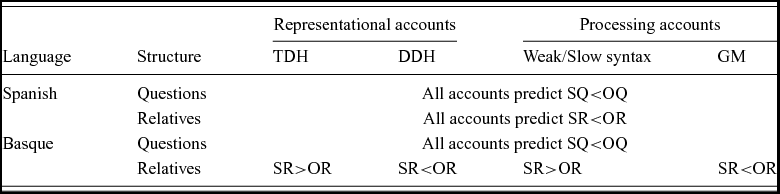
To sum up, all approaches converge in predicting better comprehension of SQs than OQs in both Spanish and Basque and in expecting SRs to be better preserved than ORs in Spanish. However, the accounts differ with respect to Basque RCs: the representational TDH account and the processing weak/slow syntax accounts as well as the Competition Model predict better comprehension of ORs than SRs, whereas the representational DDH and the processing GM accounts predict SRs to be better comprehended than ORs. Although the data under investigation cannot provide conclusive evidence in favour of a representational vs. a processing account, the results may reveal additional evidence which may favour one account over the other. See Table 1 for a summary of the predictions.
Impairment predicted in Spanish and Basque by structure, account and language.

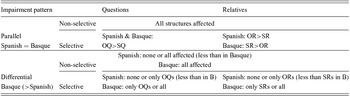
In addition to the language-specific predictions, the impairment patterns included in Table 1 may vary depending on whether the impairment affects only one or both languages of the bilingual as well as on the degree of the impairment affecting each of them. In case the impairment should affect both languages similarly (parallel impairment), two different outcomes could be predicted: a) a non-selective impairment affecting subject and object extracted structures similarly in both languages or b) a selective impairment affecting mostly OQs in both languages, and mostly ORs in Spanish and SRs in Basque. On the other hand, the impairment could affect the two languages differently (differential impairment). For the sake of simplicity, we will restrict the possible scenarios to the option where Basque is more affected than Spanish. In this case, the impairment affecting questions and relatives could be non-selective in that all types of structures would be impaired in Basque but none (or impaired to a slighter degree) in Spanish, or alternatively it could selectively affect only OQs in Basque (or all OQs and SQs) and none in Spanish or only OQs in Spanish (but to a lesser degree than in Basque). In the case of relatives, the selective impairment would affect only SRs in Basque (or all SRs and ORs) but no structure in Spanish or only ORs (but to a lesser extent than SRs in Basque). Table 2 summarizes the potential patterns in Spanish–Basque agrammatism considering the impairment/recovery pattern and the structures affectedFootnote 7 .
Predictions of the structures and language(s) affected in Spanish–Basque agrammatism.

Taking into account that cue validity and the interpretation of cues differ cross-linguistically the question arises as to whether the same cue hierarchy is applied in Spanish and Basque bilingual agrammatism. Wulfeck et al. (Reference Wulfeck, Juarez, Bates, Kilborn and Vaid1986) showed that the Spanish–English unimpaired and impaired bilinguals they studied applied the same strategy to process their languages either by showing a combination of cues to form a strategy “amalgam” or by adopting the strongest cue of one of their languages failing to show sensitivity to the strongest cue of the other language. Considering that Spanish and Basque share the same cue hierarchy (morphology>word order), that language-specific patterns are preserved in agrammatism and that bilinguals may use the same strategy for their languages, we expect our bilingual patient to make use of morphology as the most reliable cue in both Spanish and Basque. However, given that the strength of morphological cues might be degraded, we could predict the degree of the advantage of morphology over word order to be smaller than in the case of unimpaired speakers in both languages.
Finally, with respect to CLEs, since wh-questions have the same surface word order in Spanish and Basque (examples 4 and 5) and cue validity points to the same direction in both languages (convergence of word order and morphology in SQs, and competition in OQs) wh-questions provide the most likely environment for CLEs to surface. Consequently, the potential existence of CLEs leads us to predict a scenario where performance is more similar between the two languages in questions than in relatives.
4.3. Participants
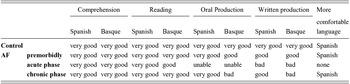
This study is based on the performance of one brain-damaged female (AF). A second unimpaired participant, matched in gender, age, education (university studies) and language background (Spanish–Basque), acted as a control. The proficiency and use of the language as self-rated by means of a questionnaireFootnote 8 developed by the first author revealed a proficient and daily use of both languages by the control and AF at the premorbid stage, although both of them self-rated as Spanish dominant (Appendix 1).
AF is a right-handed early bilingual female aged 49 at testing time who was highly proficient in Spanish and Basque premorbidly. Her mother was a native speaker of Basque and her father of Spanish and she used to communicate with them in their respective native language. AF lived in an area where both Spanish and Basque were usedFootnote 9 . However, in childhood and adolescence Spanish was the main language used by AF socially as well as throughout her formal education from school to university. Thus, Basque was only used at home during her early childhood. After graduating, she was enrolled in Basque courses and obtained the official Basque language EGA certificate (equivalent to the C1 of the Common European Framework of Reference for Languages). She taught classical languages through Basque until age 39, when she suffered a stroke in the left hemisphere that caused a right hemiplegia and speech difficulties and she was diagnosed with Broca's aphasia. According to her self-report, in the acute phase just after the brain lesion she was not able to speak in either of her languages, yet she retained comprehension in both (Appendix 1). A neurological examination one year after the stroke revealed an area with hyperintensity that affected the posterior region of the left frontal operculum, with a slight extension into the insula, internal capsule and corona radiata which suggested an antecedent of infarct with late subacute or chronic evolution. She chose to receive speech therapy in Spanish, although the last few minutes in each session were dedicated to Basque. After the injury she communicated almost exclusively in Spanish and, regarding her language competence at the beginning of the present study, she self-rated her oral and written production higher in Spanish than in Basque (Appendix 1). Note that she rated her written production before the lesion in both languages as good (rather than very good), which might indicate that she was very strict when evaluating her own skills. However, her professional qualification confirms her premorbid high proficiency in Spanish and Basque.
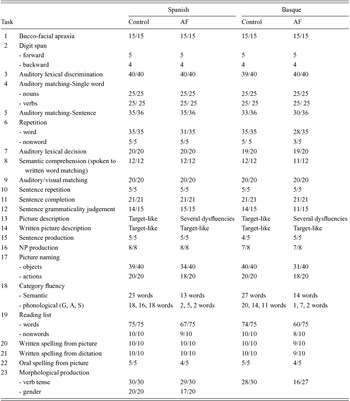
The data analyzed in this study are part of a longer longitudinal sample which started 6 years after the stroke, when AF was already in the chronic phase. Extensive information about AF's performance was collected longitudinally in 20 sessions over a period of five years in both languages using a Spanish and Basque version of the unpublished CNL Language Screening Battery developed by the Harvard Cognitive Neuropsychology LaboratoryFootnote 10 , several comprehension and production tasks and an analysis of spontaneous speech. The data have shown that AF's lexico-semantic comprehension, phonological perception and phonological working memory are preserved in both languages. However, target-deviant production is characterized by difficulties in retrieving both lexical and post-lexical phonological information, which results in a lower accuracy than the control, mostly in Basque (Appendix 2). The asymmetry in the phonological difficulties between Spanish and Basque was confirmed by AF's performance in spontaneous speech (Munarriz & Ezeizabarrena, Reference Munarriz, Ezeizabarrena and Bretones Callejas2009b) and in an extended picture naming task (Munarriz & Ezeizabarrena, Reference Munarriz, Ezeizabarrena, Marrero and Pineda2009a).
Slight problems were observed in the comprehension of certain morpho-syntactic structures, as indicated by the auditory matching task on sentences of the general screening (Appendix 2, task 5). AF showed accurate performance in Spanish, but in Basque difficulties were observed in the comprehension of non-canonical structures which depicted semantically reversible events as well as in a sentence-to-picture matching task designed to analyze the comprehension of RCs in Spanish and Basque. As for production, AF was able to produce accurate canonical and movement-derived structures in both languages, although their low frequency in spontaneous speech together with the production of incomplete and simplified wh-questions in more structured elicitation tasks points to some morpho-syntactic difficulty in both languages.
To summarize, preliminary results from the general screening and spontaneous and experimental tasks suggest that AF has some difficulty in movement-derived structures, at least in Basque.
4.4. Materials
The comprehension of RCs and root wh-questions was tested using two sentence-picture matching tasks in both languages. The task for questions was initially developed by Celia Jakubowicz, and adapted for Basque and Spanish by Gutierrez-Mangado. The materials for the wh-questions included pictures with three characters in a row. The first character on the right was performing an action on the second character, who in turn did the same to the third character. For instance, in one of the trials the subjects were shown a picture of a queen who was combing the hair of the character in front of her, in this case a fairy, who in turn was combing a third character placed in front of her, Santa Claus. In each trial the question was always about the middle character (the fairy in examples 8, 9), who was being combed by the queen and at the same time she herself was combing Santa Claus. The materials included 12 SQs (8) and 12 OQs (9). The materials also included a set of 12 complex SQs and 12 complex OQs, the results of which are not reported here. The sentences were presented pseudo-randomly, so that no more than two items of the same type appeared consecutively. Each picture was used twice for each question type and half of the times the response corresponded to the picture on the left and half of the times to the picture on the right. The correct picture was not presented in the same position more than two consecutive times.
-
(8)
-
(9)


The task for the comprehension of relatives was developed by Naama Friedmann and adapted for Basque and Spanish by Gutierrez-Mangado and Munarriz, respectively. In this task, two pictures were presented to the participants for each test item. One of the pictures depicted the description presented by the experimenter while in the other the same two characters were performing the same action but with the agent/theme roles reversed. All the pictures represented reversible actions performed by animate (human and animal) characters. This task included 20Footnote 11 SRs (10), 20 ORs (11), and 40 declarative sentences with canonical word order (SVO in Spanish (12a) and SOV in Basque (12b)) that were used as control sentences. All the linguistic items involved transitive sentences (Appendix 3).
The sentences were presented in pseudo-randomized order, so that no more than two sentences of the same type were heard consecutively. Each picture was used four times: half of the times the response corresponded to the picture on the top and the rest of the times to the picture on the bottom. The correct picture was in the same position no more than three consecutive times.
-
(10)
-
(11)
-
(12)


Both tasks were run on a laptop by means of audiovisual presentations. The sentences, previously recorded by a Spanish–Basque early bilingual, were presented auditorily in both languages, so that both participants heard exactly the same stimuli.
4.5. Procedure
In both tasks the pictures were displayed on the screen, and for each item the visual stimulus was presented a few seconds before the auditory stimulus. In the wh-question comprehension task, the participants were asked to answer the question by pointing to and naming the correct character. In the relative comprehension task, the participants were asked to point to the (upper/lower) picture that matched the sentence. No feedback was provided during the experiment. There was no time limit and the stimulus was repeated if the participants requested this. Consequently, two kinds of responses were distinguished: the first response and the final response (the one given regardless of whether it was given in the first or in subsequent trials).
For each task, the test batteries were distributed in two sessions which took place in two different days. An equal number of items was administered for the two languages in each session. The sessions were organized as follows: for relatives, in session 1 the first part was done in Spanish and the second part in Basque. The order was reversed in session 2. For questions, in session 3 the first part was carried out in Spanish and the second in Basque while in session 4 the reverse order was followed. The comprehension of questions was tested five months after the task on relatives. Each task was preceded by a training session in order to ensure that the participants understood the task.
5. Results
In this section we will present the data obtained from the control and the aphasic participants’ comprehension tasks.
5.1. Wh-questions
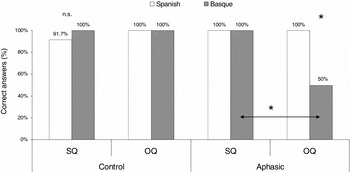
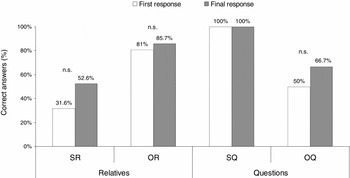
AF's performance was 100% accurate in both SQs and OQs in Spanish and in SQs in Basque, never requiring any repetition of the oral stimulus. However, she showed difficulties in OQs in Basque: chance performance (50%) in the first response (Figure 1) and above–chance (66.7%) in the final response. Target-deviant responses involved answering the OQ by selecting the agent instead of the theme (the queen instead of Santa Claus in (9b)). Interestingly, in 3 out of 4 incorrect responses, AF produced the answer corresponding to the incorrect character with the incorrect case marker. For example, in response to the question (9b) Zein orrazten du maitagarriak? “whom is the fairy combing?” the answer given was erreginak “the queen-erg” instead of the target Bizar Zuri “Santa Claus-abs”. In no case did AF respond by choosing the third character (the fairy), namely the only character explicitly mentioned in the question. AF's performance was equally accurate for Spanish SQs and OQs; whereas in Basque, AF was significantly more accurate in SQs than OQs (χ2 = 5.56, p = .01843), though the statistical difference disappeared when considering the final response (χ2 = 2.7, p = .1003).
Accuracy percentages in questions for both participants (first response).

The comparison between AF's Spanish and Basque questions showed that she comprehended SQs in both languages equally well but that the comprehension of OQs was significantly poorer in Basque in her first response (χ2 = 5.56, p = .01843), even if the difference did not reach statistical significance when considering the final response (χ2 = 2.7, p = .1003).
The control participant performed with an accuracy of 91.7% in SQs in Spanish, and 100% in SQs in Basque and OQs in both languages. No statistically significant differences were found between SQs and OQs in either of the two languages nor between languages. When compared to the control, AF's performance only differed in OQs in Basque in the first response (χ2 = 5.56, p = .01843) as shown in Figure 1.
5.2. Relatives
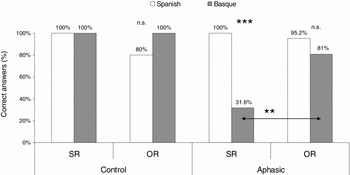
AF's performance was equally accurate in SRs (100%) and ORs (95.2%) in Spanish, where no repetitions were requested (Figure 2). As for Basque, AF was significantly more accurate in ORs (81%) than in SRs (31.6%) (χ2 = 8.03, p = .0046) in the first response, though this difference was only marginally significant in the final response (ORs 85.7%; SRs 52.6%; χ2 = 3.74, p = .0531). In target-deviant SRs, AF pointed to the image depicting the transitive action but with the agent/theme roles of the characters reversed. For example in (10b) (“the child that washes the penguin”) she chose the picture that depicted a penguin washing a child instead of the one where the child washed the penguin. The comparison between comprehension in Spanish and Basque revealed no statistically significant differences regarding ORs (first response χ2 = .91, p = .3401; final response χ2 = .28, p = .5967), contrasting with the significant differences in SRs in both first (χ2 = 16.84, p<.0001) and final responses (χ2 = 9.32, p = .0023).
Accuracy percentages in relatives for both participants (first response).

The control participant's accuracy was 80% for ORs in Spanish and 100% for SRs in Spanish as well as SRs and ORs in Basque. No statistically significant differences were found between SRs and ORs in the control's performance in either of the two languages. When compared to the control, AF's performance revealed statistically significant differences only in the comprehension of SRs in Basque both in the first (χ2 = 17.56, p < .0001) and in the final response (χ2 = 9.79, p = .0018).
Regarding root sentences displaying canonical word order, no comprehension difficulty was attested either in Spanish (97.5% first response, 100% final response) or in Basque (100%). The control participant performed 100% correctly in both languages in the first response.
AF's first and final responses (Figure 3) can be interpreted differently depending on the impairment criterion applied. On the one hand, although AF's performance improved in accuracy, this slight increase did not reach statistical significance in either of the structures, showing a consistent difficulty in both responses. On the other hand, the progress from chance to above–chance in OQs and from below–chance to chance in SRs evidences a categorical improvement.
AF's accuracy percentages in questions and relatives (first and final response).

Table 3 shows the number of sentences that the participants requested to be repeated.
Amount of repetitions requested by the participants in the experimental tasks.

The control participant asked for repetition only once (Spanish ORs). In contrast, AF asked for the repetition of eight sentences, all of them in Basque, five of which were SRs (namely, 26.3% of all SRs) (Table 3). AF made more requests than the control for Basque SRs (χ2 = 3.91, p = .048). Notably, AF also asked for two repetitions of OQs (16.7% of all OQs), the other structure that showed comprehension difficulties, though the amount of requested repetitions did not differ statistically from that of the control's (χ2 = .55, p = .4583). Overall, these data reinforce the consistency of AF's difficulty in comprehending both OQs and especially SRs in Basque. Furthermore, the same pattern of errors was observed in both structures and in the two sessions, irrespective of the language used first.
The results may be summarized as follows: 1) AF's accurate comprehension of movement-derived structures in Spanish, 2) a selective difficulty in the comprehension of Basque OQs and SRs, and 3) consistency of errors across types of responses and sessions.
6. Discussion
This section discusses the results obtained with a view to addressing the aims outlined in the introduction. Section 6.1 tackles the following questions: (i) whether the structures studied are similarly impaired in the two languages of the Spanish–Basque aphasic participant and (ii) which of the hypotheses presented can better account for the impairment pattern revealed. Section 6.2 discusses whether the pattern observed can be explained in terms of CLEs.
6.1. Differential and selective impairment
AF shows accurate comprehension of canonical sentences, wh-questions and relatives in Spanish. However, the selective difficulties observed in the comprehension of certain relatives and questions in Basque reinforce the differential impairment (affecting Basque more than Spanish) previously observed in AF's experimental and spontaneous production of lexical and post-lexical phonology (Munarriz & Ezeizabarrena, Reference Munarriz, Ezeizabarrena, Marrero and Pineda2009a, b). The combination of factors such as the language of therapy, use, motivation and appropriateness (Ansaldo et al., Reference Ansaldo, Marcotte, Scherer and Raboyeau2008; Paradis, Reference Paradis2004) may have worked in favour of the better preservation of Spanish than Basque.
Regarding the selective impairment in Basque, on the one hand, AF's better comprehension of SQs (100%) when compared to OQs (50%) in her first response (though not in the final) converges with the results found cross-linguistically in monolingual aphasia (Garraffa & Grillo, Reference Garraffa and Grillo2008; Martínez-Ferreiro, Reference Martínez-Ferreiro2010; Neuhaus & Penke, Reference Neuhaus and Penke2008). On the other hand, with respect to relatives, AF's more accurate comprehension of ORs (81%) than of SRs (31.6%) coincides with results from other languages with prenominal relatives (Law & Leung, Reference Law and Leung2000; Su et al., Reference Su, Lee and Chung2007), contrasting with the pattern reported on languages with postnominal relatives, where SRs are easier than ORs. Moreover, AF's results converge with studies on unimpaired adult processing (Carreiras et al., Reference Carreiras, Duñabeitia, Vergara, de la Cruz-Pavía and Laka2010; Laka et al., Reference Laka, Erdocia, Duñabeitia, Molinaro and Carreiras2011) and child language acquisition (Gutierrez-Mangado, Reference Gutierrez-Mangado2011; Gutierrez-Mangado & Ezeizabarrena, Reference Gutierrez-Mangado, Ezeizabarrena, Biller, Chung and Kimball2012), which have shown that ORs are comprehended more easily than SRs in Basque. AF's difficulty with both SRs and OQs is also confirmed by her requests to the researcher to repeat some of the test items, mostly SRs and OQs.
One more piece of data to consider in AF's agrammatism stems from the lower accuracy rate observed in SRs (31.6% first response; 52.6% final response) vs. OQs (50% first response; 66.7% final response) in Basque. Despite the fact that this difference in performance did not reach statistical significance either in the first (χ2 = .42, p = .5169) or in the final response (χ2 = .16, p = .6892), AF's accuracy could be characterized as below–chance and chance performance regarding SRs and as chance and above–chance performance regarding OQs in first and final responses, respectively.
The performance observed in OQs and SRs being worse than in (accurate) SQs and ORs is in line with all the theories that predict non-canonical theme-agent word orders (9b, 10b) to be harder to comprehend than agent-theme linear ones (8b, 11b). In this respect, AF's selective impairment in Basque supports the TDH (Grodzinsky, Reference Grodzinsky2000) representational account as well as the Weak/Slow syntax (Avrutin, Reference Avrutin, Grodzinsky and Amunts2006; Burkhardt et al., Reference Burkhardt, Avrutin, Piñango and Ruigendijk2008) and the Competition Model (Bates et al., Reference Bates, Friederici and Wulfeck1987; MacWhinney et al., Reference MacWhinney, Osmán-Sági and Slobin1991) processing-based accounts.
Nevertheless, the categorical improvement observed between the first and final responses might call into question approaches like the TDH that account for agrammatism in terms of a syntactic representational deficit, since no improvement would be expected across repetitions under the assumption that the syntactic representation is absent. Rather, the observed enhancement as well as AF's unimpaired production of questions and relatives both in spontaneous and elicited speech in the two languages (section 4.3.) are compatible with accounts which explain agrammatism in terms of (intermittent) failures to process syntactic representations (Caplan et al., Reference Caplan, Waters, DeDe, Michaud and Reddy2007) as a consequence of weak/slow processing (Avrutin, Reference Avrutin, Grodzinsky and Amunts2006; Burkhardt et al., Reference Burkhardt, Avrutin, Piñango and Ruigendijk2008). AF's requests for repetition could be interpreted as attempts to give herself another chance to analyse the structures which she is unable to reanalyse on-line when she first hears them. This interpretation would be in line with eye-tracking studies concluding that “the agrammatic parser [. . .] fails to compute reanalysis even when one is detected” (Hanne, Sekerina, Vasishth, Burchert & De Bleser, Reference Hanne, Sekerina, Vasishth, Burchert and De Bleser2011, p. 239). Note that AF's difficulties do not appear to be due to short-term memory limitations since AF showed normal performance in a digit-span task (Appendix 2, task 2). Further research using on-line methods would shed more light on this issue.
If our interpretation is on the right track, neither representational nor processing-based accounts can fully account for the finding that Basque OQs are less impaired than SRs, which might indicate that AF resorts to a morphological cue in addition to word order, as we predicted for Spanish and Basque following the Competition Model. In a morphologically ergative and free-word-order language like Basque, agentive subjects in transitive sentences are overtly marked with the –k ergative suffix. Ergative case has been described as a very salient and strong morphological cue in on-line processing: once the argument is identified as agent, it may allow the parser to predict that the structure to come is transitive (cf. Polinsky, Gómez Gallo & Graff, Reference Polinsky, Gómez Gallo and Graff2012). Although there is not a one-to-one correspondence between the meaning and the morphological marking, since the –k is neither an unambiguous nor a consistent marker of agentive subjects (Ezeizabarrena, Reference Ezeizabarrena2012), agentivity and –k marking are strongly related in Basque, especially in reversible two-argument structures like the ones used in this study. Indeed, processing studies with unimpaired adults have shown that –k marked DPs, which can be plural objects as well as singular ergative subjects (plural and ergative –k are homophonous in Basque), are interpreted by default to be ergative singular subjects at the beginning of the sentence (Erdocia et al., Reference Erdocia, Laka, Mestres-Missé and Rodriguez-Fornells2009; Yetano, Duñabeitia & Laka, Reference Yetano, Duñabeitia and Laka2011).
In the particular experimental tasks run in this study, the –k ergative marking, which invariably corresponds to the agent, becomes crucial for the identification of the overt agent argument in SQs, OQs, ORs and SOV root sentences and, consequently, for their accurate comprehension. The more accurate comprehension of structures containing the overt ergative –k as opposed to the poorer performance in SRs, in which both DPs (the agentive head and the theme) are zero-marked (10b) indicate that AF is sensitive to the morphological ergative cueFootnote 12 . The partial preservation of morphological cues attested in agrammatism in other languages with flexible word order (Bates et al., Reference Bates, Friederici and Wulfeck1987; MacWhinney et al., Reference MacWhinney, Osmán-Sági and Slobin1991; Ostrosky-Solís et al., Reference Ostrosky-Solís, Marcos-Ortega, Ardila, Rosselli and Palacios1999), and especially in the case of individuals with explicit grammatical knowledge (Paradis, Reference Paradis and Paradis1995), lends support to such interpretation of AF's data. Consequently, we cannot reject the possibility that some syntactic impairment underlies the (apparently) preserved comprehension of SQs and ORs in Basque (and all the four structures in Spanish) in line with Burchert et al.'s (2003) suggestion in relation to mild agrammatic patients.
Nevertheless, we cannot straightforwardly account for AF's chance performance in the first response in OQs (9b) by the use of the morphological cue, since its consistent use (–k marked argument=agent=subject) should result in above–chance performance. Recall that according to the Competition Model, these sentences are expected to be problematic even for aphasics who are able to use morphology as a cue, due to the competition between word order and morphological cues (see section 4.2 above). If morphology were the cue with the highest validity, as it is for Basque unimpaired processing (Erdocia et al., Reference Erdocia, Laka, Mestres-Missé and Rodriguez-Fornells2009), target-like performance would be expected. Our results indicate that despite being stronger than word order, the cue validity of morphology is not strong enough for AF, since her sensitivity to the morphological cue might be modulated by the position of the marked DP in the sentence. Under the assumption that sentence-final positions are suitable for fast decay (Kolk, Reference Kolk1995), especially in cases of a weak/slow parser, target-deviant comprehension of OQs may be interpreted as an effect of the sentence-final placement of the ergative marked DP. In these cases (9b), AF may have interpreted the initial zero-marked wh-word (zein “who-abs”) as agent, disregarding the –k marked agent (maitagarriak “the fairy-erg”), only two words later, in sentence final position.
We suggest that both word order and morphological cues are available to AF for sentence processing in Basque and that the language-specific pattern regarding weights of cues is retained (cf. Bates et al., Reference Bates, Friederici and Wulfeck1987; MacWhinney et al., Reference MacWhinney, Osmán-Sági and Slobin1991). Nevertheless, the results indicate that, contrary to the control, the morphological cue is not strong enough to prevail over word order, which leads AF to the inaccurate interpretation of structures where morphology and word order compete. Several pieces of data seem to point in this direction. First, no comprehension difficulty is observed in Basque sentences where both cues converge (SOV, SQs and ORs), as predicted. Second, the response pattern observed in OQs, chance (in the first) or above–chance (in the final response), was also predicted for structures in which there is a competition between similarly strong cues, or in which morphology turns out to be a stronger cue than word order, respectively. Third, the difficulties observed in the comprehension of SRs are compatible with a scenario where there are no cues available and the participant resorts to the agent-first strategy (below–chance in the first response) or just guessing (chance in the final response). Consequently, by pitting cues against one another, the Competition Model is able to account for the scalar performance pattern observed in Basque: canonical sentences, SQs and ORs are better preserved than OQs, which at the same time are better preserved than SRs (SVO & SQs & ORs > OQs > SRs).
Turning now to Spanish, the accurate interpretation of all sentences suggests that AF's (morpho-) syntactic representation is preserved in this language. Consequently, the predictions regarding agrammatism in Spanish (section 4.2.) could not be tested. If AF had difficulties with movement-derived structures in Spanish, we would expect to find them in sentences where linear order or morphological strategies do not provide a cue to compensate for her syntactic impairment (Ostrosky-Solís et al., Reference Ostrosky-Solís, Marcos-Ortega, Ardila, Rosselli and Palacios1999), namely in ORs (11a), since a) both agent and theme arguments are equally zero-marked in the absence of the preposition a and b) the first argument is the theme. Thus, the accurate interpretation of movement-derived structures in Spanish indicates that AF relies on syntax regardless of the morpho-syntactic cue that marks theme arguments (preposition a). In addition, the accurate comprehension of OQs indicates that despite competition between word order and morpho-syntactic cues, morpho-syntax preserves its status. These results may cast doubt on whether AF can be considered an agrammatic patient in Spanish. However, the morpho-syntactic difficulties attested in production (see section 4.3 above), may suggest that the materials used in the current study are not sensitive enough to detect mild agrammatism (cf. Burchert et al., Reference Burchert, Bleser and Sonntag2003).
To sum up, AF's performance in Spanish is virtually unimpaired, whilst her results for Basque have shown a selective impairment which affects some structures more than others (OQs>SQs and SRs>ORs). This pattern remains consistent regardless of the response type (first/final) and the language order used in each of the sessions (Spanish before/after Basque). In structures in which the patient cannot carry out a successful syntactic analysis the morphological ergative case still appears as a reliable (though weakened) cue for this agrammatic participant to assign thematic roles in Basque. The partial availability of this cue may have allowed her to interpret most SQs and ORs in an (apparently) accurate way, thus hiding the surface manifestation of the syntactic deficit.
6.2. Cross-language effects in bilingual agrammatism
As reviewed above, CLEs have been observed to affect bilingual aphasia in the form of transfer of a) therapy benefits from the treated to the untreated language (Ansaldo et al., Reference Ansaldo, Marcotte, Scherer and Raboyeau2008; Faroqi-Shah et al., Reference Faroqi-Shah, Frymark, Mullen and Wang2010), b) processing strategies (Wulfeck et al., Reference Wulfeck, Juarez, Bates, Kilborn and Vaid1986) and c) linguistic structures (Verreyt et al., Reference Verreyt, Bogaerts, Cop, Bernolet, De Letter, Hemelsoet, Santens and Duyck2013a). However, CLEs are sensitive to the typological differences between the languages of the bilingual so that the bigger the differences between the languages and the structures involved the less likely it is for CLEs to arise (cf. Faroqi-Shah et al., Reference Faroqi-Shah, Frymark, Mullen and Wang2010; Goral et al., Reference Goral, Levy and Kastl2010; Reference Goral, Rosas, Conner, Maul and Obler2012; Hartsuiker & Pickering, Reference Hartsuiker and Pickering2008).
In this regard, the asymmetric impairment affecting mostly Basque suggests that in the case of AF there have not been (strong enough) transfer gains of therapy or recovery from the more intensively treated and reinforced language (Spanish) to the untreated one (Basque). Such an interpretation converges with explanations proposed for other cases of non-parallel recovery based on the absence of CLEs (Diéguez-Vide et al., Reference Diéguez-Vide, Gich-Fullà, Puig-Alcántara, Sánchez-Benavides and Peña-Casanova2012; Gil & Goral, Reference Gil and Goral2004; Goral et al., Reference Goral, Levy and Kastl2010; Kambanaros & Grohmann, Reference Kambanaros and Grohmann2012).
Since CLEs are observable in structures which are similar in both languages in terms of linear word order, grammatical function and/or complexity, wh-questions are good candidates for CLEs to surface in Spanish and Basque contact situations (section 4.2.). Our data showed that wh-questions are preserved in Spanish but selectively impaired in Basque, and, notably, this pattern was consistent across sessions, regardless of the type of response (first, final), and of the order of languages tested in each session. Thus, no evidence for CLEs was observed in the condition where it was expected. AF's results differ from the ones obtained in other language combinations which point to CLEs between similar syntactic structures either in production (Hartsuiker & Pickering, Reference Hartsuiker and Pickering2008; Verreyt et al., Reference Verreyt, Bogaerts, Cop, Bernolet, De Letter, Hemelsoet, Santens and Duyck2013a) or in comprehension (Ardila et al., Reference Ardila, Rosselli, Ostrosky-Solís, Marcos, Granda and Soto2000). Despite the fact that in the performance of this particular task, the presence of overt morphology (preposition a in Spanish and –k suffix in Basque) overrides word order and becomes the determining cue for the interpretation of questions and relatives in these DP-V-DP structures, our results suggest that the availability of the same morphological cue is not equally strong in the two languages (cf. Wulfeck et al. Reference Wulfeck, Juarez, Bates, Kilborn and Vaid1986), since AF resorts to the case cue for sentence comprehension only partially in Basque.
We propose that the language-specific morpho-syntactic features together with the specificity of the task are the cause of the differences observed. First, the overtly marked DPs signal different arguments in Spanish and Basque transitive sentences: while preposition a marks animate objects in Spanish (theme), the ergative –k suffix marks Basque subjects (agent). Second, both Spanish and Basque are free-word-order languages, but despite sharing surface linear order in questions (SQs: agent-theme and OQs: theme-agent) they show the reverse order in relatives (agent-theme in Spanish SRs and Basque ORs vs. theme-agent in Spanish ORs and Basque SRs). Consequently, the position of the overtly marked argument varies from Spanish to Basque in the structures analyzed. In questions, the overtly marked theme in Spanish appears earlier in linear order (first constituent) than the overtly marked agent in Basque OQs (third and final constituent). As for relatives, the overtly marked agent in Basque ORs appears linearly earlier (first constituent) than the overtly marked theme (final constituent) in Spanish SRs. Thus, the absence of CLEs in this study is compatible with an explanation based on the morpho-syntactic distance between the languages. This distance, instantiated in the specific structures tested, may have hindered both the general benefits of transfer of treatment/recovery and also the punctual influence of the language-order in which the tests were administered in each session.
The differential impairment reported, which has been interpreted as a consequence of the absence of CLEs, questions the representational accounts of agrammatism. Under the DDH and the TDH approaches the differential impairment would point to a language-specific coindexation condition or trace-mechanism (preserved in Spanish but disrupted in Basque), which seems difficult to sustain. In fact, AF's ability to process coindexation and traces in the unimpaired language (Spanish) is not easily compatible with her inability to process them in the impaired language (Basque), unless we assume language-specific parsers.
The results discussed in sections 6.1 and 6.2 may also have implications for neuropsycholinguistic models in bilinguals. CLEs are considered as evidence for overlapping representation and processing across languages (Faroqi-Shah et al., Reference Faroqi-Shah, Frymark, Mullen and Wang2010; Gollan & Kroll, Reference Gollan, Kroll and Rapp2001; Goral et al., Reference Goral, Levy and Kastl2010; Kroll & Tokowicz, Reference Kroll, Tokowicz, Kroll and de Groot2005). Thus, the differential impairment attested at the morpho-syntactic domain, as well as the absence of CLEs found, is in line with approaches that argue that languages are neurofunctionally isolable subsystems in the bilingual brain and thus can be selectively inhibited (Paradis, Reference Paradis2004). Moreover, AF's data are not compatible with neuropsycholinguistic models which argue that structures with the same surface word order have shared representations in bilinguals (Hartsuiker & Pickering, Reference Hartsuiker and Pickering2008; Verreyt et al., Reference Verreyt, Bogaerts, Cop, Bernolet, De Letter, Hemelsoet, Santens and Duyck2013a). In the same vein, the asymmetry observed in the simultaneous bilingual studied casts doubts on the claim that (morpho)syntactic representations are processed by the same procedural system in early bilinguals (Ullman, Reference Ullman2001).
To summarize, despite the limitations of the sample size of a single case study and of the methodologies used, the differential (mostly Basque) and selective (OQs and SRs) pattern of morpho-syntactic impairment/recovery found in the performance of the Spanish–Basque bilingual aphasic studied reveals no evidence for CLEs. The typological distance between languages and structures seems to play a crucial role in the results observed.
7. Conclusion
This study has reported on the differential and selective morpho-syntactic impairment observed in an early Spanish-Basque bilingual adult with chronic aphasia. The accurate comprehension of RCs and wh-questions in Spanish contrasts with the target-deviant comprehension in Basque, which reveals a very selective impairment affecting only OQs and SRs.
The asymmetry found at the morpho-syntactic level suggests that the morpho-syntactic cues are not equally available for AF in Spanish and Basque, which confirms previous studies suggesting that CLEs are less likely to emerge in contact situations of typologically distant language pairs.
Both participants’ self-reported proficiency as revealed by the language questionnaire.

Results of AF and the control in the CNL screening.

Appendix 3: list of materials
Spanish materials
• SQ
PRETEST:
¿Quién está filmando al carnero? – Who is filming the goat?
TEST SENTENCES:
-
1. ¿Quién está mordiendo al cerdo? – Who is biting the pig?
-
2. ¿Quién está chupando a la cebra? – Who is licking the zebra?
-
3. ¿Quién está llevando a la bailarina? – Who is pulling the dancer?
-
4. ¿Quién está mojando al bombero? – Who is wetting the fireman?
-
5. ¿Quién está empujando al abuelo? – Who is pushing the grandfather?
-
6. ¿Quién está secando a la niña? – Who is drying the girl?
-
7. ¿Quién está filmando al rey? – Who is filming the king?
-
8. ¿Quién está limpiando a la rana? – Who is washing the frog?
-
9. ¿Quién está pintando a la niña? – Who is painting the girl?
-
10. ¿Quién está peinando al león? – Who is combing the lion?
-
11. ¿Quién está empujando al gato? – Who is pushing the cat?
-
12. ¿Quién está llevando al mono? – Who is pulling the monkey?
• OQ
PRETEST:
¿A quién está peinando el hada? – Whom is the fairy combing?
TEST SENTENCES:
-
1. ¿A quién está secando el niño? – Whom is the boy drying?
-
2. ¿A quién está mordiendo la vaca? – Whom is the cow biting?
-
3. ¿A quién está empujando el niño? – Whom is the child pushing?
-
4. ¿A quién está llevando el policía? – Whom is the policeman pulling?
-
5. ¿A quién está mojando el niño? – Whom is the boy wetting?
-
6. ¿A quién está chupando la vaca? – Whom is the cow licking?
-
7. ¿A quién está peinando el caballo? – Whom is the horse combing?
-
8. ¿A quién está llevando el tigre? – Whom is the tiger pulling?
-
9. ¿A quién está empujando el gato? – Whom is the cat pushing?
-
10. ¿A quién está filmando el rey? – Whom is the king filming?
-
11. ¿A quién está pintando el niño? – Whom is the boy painting?
-
12. ¿A quién está limpiando el pulpo? – Whom is the octopus washing?
• SOV
PRETEST:
El niño está abrazando al mono – The boy is hugging the monkey.
La señora está besando a la niña – The lady is kissing the girl.
TEST SENTENCES:
-
1. La niña está pintando a la mujer – The girl is painting the woman.
-
2. El niño está peinando al caballo – The boy is combing the horse.
-
3. La niña está empujando a la señora – The girl is pushing the lady.
-
4. El médico está pellizcando al rey – The doctor is pinching the king.
-
5. El niño está llevando al señor – The boy is pulling the grandfather.
-
6. La niña está limpiando a la jirafa – The girl is washing the giraffe.
-
7. La reina está acariciando a la niña – The queen is caressing the girl.
-
8. La niña está filmando a la enfermera – The girl is filming the nurse.
-
9. La mujer está secando a la niña – The woman is drying the girl.
-
10. El niño está empujando al perro – The boy is pushing the dog.
-
11. La niña está dibujando a la mujer – The girl is drawing the woman.
-
12. La gallina está peinando a la niña – The hen is combing the girl.
-
13. El niño está pintando al elefante – The boy is painting the elephant.
-
14. La jirafa está chupando a la vaca – The giraffe is licking the cow.
-
15. El rey está peinando al niño – The king is combing the boy.
-
16. El hipopótamo está secando al niño – The hippopotamus is drying the boy.
-
17. El elefante está mojando al león – The elephant is wetting the lion.
-
18. El pingüino está limpiando al niño – The penguin is washing the boy.
-
19. El gato está mordiendo al perro – The cat is biting the dog.
-
20. El hombre está mojando al niño – The father is wetting the boy.
-
21. El caballo está peinando al niño – The horse is combing the boy.
-
22. La mujer está dibujando a la niña – The woman is drawing the girl.
-
23. El león está mojando al elefante – The lion is wetting the elephant.
-
24. El niño está limpiando al pingüino – The boy is washing the penguin.
-
25. La vaca está chupando a la jirafa – The cow is licking the giraffe.
-
26. El señor está llevando al niño – The grandfather is pulling the boy.
-
27. La jirafa está limpiando a la niña – The giraffe is washing the girl.
-
28. La niña está acariciando a la reina – The girl is caressing the queen.
-
29. La enfermera está filmando a la niña – The nurse is filming the girl.
-
30. La niña está secando a la mujer – The girl is drying the woman.
-
31. El perro está empujando al niño – The dog is pushing the boy.
-
32. La niña está peinando a la gallina – The girl is combing the hen.
-
33. La mujer está pintando a la niña – The woman is painting the girl.
-
34. El niño está mojando al hombre – The boy is wetting the father.
-
35. El elefante está pintando al niño – The elephant is painting the boy.
-
36. El perro está mordiendo al gato – The dog is biting the cat.
-
37. El niño está secando al hipopótamo – The boy is drying the hippopotamus.
-
38. El rey está pellizcando al médico – The king is pinching the doctor.
-
39. La señora está empujando a la niña – The lady is pushing the girl.
-
40. El niño está peinando al rey – The boy is combing the king.
• SR
PRETEST:
El soldado que está dibujando al médico – The soldier that is drawing the doctor.
El erizo que está tocando al gato – The hedgehog that is touching the cat.
TEST SENTENCES:
-
1. El gato que está mordiendo al perro – The cat that is biting the dog.
-
2. El elefante que está mojando al león – The elephant that is wetting the lion.
-
3. El niño que está secando al hipopótamo – The boy that is drying the hippopotamus.
-
4. El niño que está mojando al hombre – The boy that is wetting the father.
-
5. El elefante que está pintando al niño – The elephant that is painting the boy.
-
6. El perro que está empujando al niño – The dog that is pushing the boy.
-
7. La niña que está secando a la mujer – The girl that is drying the woman.
-
8. La señora que está empujando a la niña – The lady that is pushing the girl.
-
9. La niña que está limpiando a la jirafa – The girl that is washing the giraffe.
-
10. El niño que está peinando al caballo – The boy that is combing the horse.
-
11. La niña que está pintando a la mujer – The girl that is painting the woman.
-
12. El médico que está pellizcando al rey – The doctor that is pinching the king.
-
13. El rey que está peinando al niño – The king that is combing the boy.
-
14. La gallina que está peinando a la niña – The hen that is combing the girl.
-
15. El señor que está llevando al niño – The grandfather that is pulling the boy.
-
16. La niña que está dibujando a la mujer – The girl that is drawing the woman.
-
17. El pingüino que está limpiando al niño – The penguin that is washing the boy.
-
18. La niña que está filmando a la enfermera – The girl that is filming the nurse.
-
19. La niña que está acariciando a la reina – The girl that is caressing the queen.
-
20. La vaca que está chupando a la jirafa – The cow that is licking the giraffe.
• OR
PRETEST:
El gnomo que está filmando el príncipe – The dwarf that the prince is filming.
El pingüino que está empujando el conejo – The penguin that the rabbit is pushing.
TEST SENTENCES:
-
1. La niña que está pintando la mujer – The girl that the woman is painting.
-
2. El pingüino que está limpiando el niño – The penguin that the boy is washing.
-
3. La vaca que está chupando la jirafa – The cow that the giraffe is licking.
-
4. El rey que está peinando el niño – The king that the boy is combing.
-
5. La gallina que está peinando la niña – The hen that the girl is combing.
-
6. El médico que está pellizcando el rey – The doctor that the king is pinching.
-
7. La niña que está pintando la mujer – The girl that the woman is painting.
-
8. El señor que está llevando el niño – The grandfather that the boy is pulling.
-
9. La niña que está acariciando la reina – The girl that the queen is caressing.
-
10. La niña que está filmando la enfermera – The girl that the nurse is filming.
-
11. El gato que está mordiendo el perro – The cat that the dog is biting.
-
12. La señora que está empujando la niña – The lady that the girl is pushing.
-
13. El niño que está secando el hipopótamo – The boy that the hippopotamus is drying.
-
14. El hombre que está mojando el niño – The father that the boy is wetting.
-
15. El elefante que está pintando el niño – The elephant that the boy is painting.
-
16. El perro que está empujando el niño – The dog that the boy is pushing.
-
17. La niña que está limpiando la jirafa – The girl that the giraffe is washing.
-
18. El niño que está peinando el caballo – The boy that the horse is combing.
-
19. La niña que está secando la mujer – The girl that the woman is drying.
-
20. El elefante que está mojando el león – The elephant that the lion is wetting.
Basque materials
• SQ
PRETEST:
Zeinek filmatzen du akerra? – Who is filming the goat?
TEST SENTENCES:
-
1. Zeinek egiten dio haginka txerriari? – Who is biting the pig?
-
2. Zeinek miazkatzen du zebra? – Who is licking the zebra?
-
3. Zeinek eramaten du dantzaria? – Who is pulling the dancer?
-
4. Zeinek bustitzen du suhiltzailea? – Who is wetting the fireman?
-
5. Zeinek bultzatzen du aitona? – Who is pushing the grandfather?
-
6. Zeinek lehortzen du neska? – Who is drying the girl?
-
7. Zeinek filmatzen du erregea? – Who is filming the king?
-
8. Zeinek garbitzen du igela? – Who is washing the frog?
-
9. Zeinek margotzen du neska? – Who is drawing the girl?
-
10. Zeinek orrazten du lehoia? – Who is combing the lion?
-
11. Zeinek bultzatzen du katua? – Who is pushing the cat?
-
12. Zeinek eramaten du tximinoa? – Who is pulling the monkey?
• OQ
PRETEST:
Zein orrazten du maitagarriak? – Whom is the fairy combing?
TEST SENTENCES:
-
1. Zein lehortzen du mutikoak? – Whom is the boy drying?
-
2. Zeini egiten dio haginka behiak? – Whom is the cow biting?
-
3. Zein bultzatzen du umeak? – Whom is the child pushing?
-
4. Zein eramaten du poliziak? – Whom is the policeman pulling?
-
5. Zein bustitzen du mutikoak? – Whom is the boy wetting?
-
6. Zein miazkatzen du behiak? – Whom is the cow licking?
-
7. Zein orrazten du zaldiak? – Whom is the horse combing?
-
8. Zein eramaten du tigreak? – Whom is the tiger pulling?
-
9. Zein bultzatzen du katuak? – Whom is the cat pushing?
-
10. Zein filmatzen du erregeak? – Whom is the king filming?
-
11. Zein margotzen du mutikoak? – Whom is the boy drawing?
-
12. Zein garbitzen du olagarroak? – Whom is the octopus washing?
• SOV
PRETEST:
Mutikoak tximinoa besarkatzen du – The boy is hugging the monkey.
Amonak neskatxa muxukatzen du – The grandmother is kissing the girl.
TEST SENTENCES:
-
1. Neskak amatxo pintatzen du – The girl is painting the mother.
-
2. Mutikoak zaldia orrazten du – The boy is combing the horse.
-
3. Neskak amona bultzatzen du – The girl is pushing the grandmother.
-
4. Medikuak erregea atximurkatzen du – The doctor is pinching the king.
-
5. Mutikoak aitona eramaten du – The boy is pulling the grandfather.
-
6. Neskak jirafa garbitzen du – The girl is washing the giraffe.
-
7. Erreginak neska laztantzen du – The queen is caressing the girl.
-
8. Neskak erizaina filmatzen du – The girl is filming the nurse.
-
9. Amatxok neska lehortzen du – The mother is drying the girl.
-
10. Mutikoak txakurra bultzatzen du – The boy is pushing the dog.
-
11. Neskak amatxo marrazten du – The girl is drawing the mother.
-
12. Oiloak neska orrazten du – The hen is combing the girl.
-
13. Mutikoak elefantea margotzen du – The boy is drawing the elephant.
-
14. Jirafak behia miazkatzen du – The giraffe is licking the cow.
-
15. Erregeak mutikoa orrazten du – The king is combing the boy.
-
16. Hipopotamoak mutikoa lehortzen du – The hippopotamus is drying the boy.
-
17. Elefanteak lehoia bustitzen du – The elephant is wetting the lion.
-
18. Pinguinoak mutikoa garbitzen du – The penguin is washing the boy.
-
19. Katuak txakurrari haginka egiten dio – The cat is biting the dog.
-
20. Aitak mutikoa bustitzen du – The father is wetting the boy.
-
21. Zaldiak mutikoa orrazten du – The horse is combing the boy.
-
22. Amatxok neska marrazten du – The mother is drawing the girl.
-
23. Lehoiak elefantea bustitzen du – The lion is wetting the elephant.
-
24. Mutikoak pinguinoa garbitzen du – The boy is washing the penguin.
-
25. Behiak jirafa miazkatzen du – The cow is licking the giraffe.
-
26. Aitonak mutikoa eramaten du – The grandfather is pulling the boy.
-
27. Jirafak neska garbitzen du – The giraffe is washing the girl.
-
28. Neskak erregina laztantzen du – The girl is caressing the queen.
-
29. Erizainak neska filmatzen du – The nurse is filming the girl.
-
30. Neskak amatxo lehortzen du – The girl is drying the mother.
-
31. Txakurrak mutikoa bultzatzen du – The dog is pushing the boy.
-
32. Neskak oiloa orrazten du – The girl is combing the hen.
-
33. Amatxok neska pintatzen du – The mother is painting the girl.
-
34. Mutikoak aita bustitzen du – The boy is wetting the father.
-
35. Elefanteak mutikoa margotzen du – The elephant is drawing the boy.
-
36. Txakurrak katuari haginka egiten dio – The dog is biting the cat.
-
37. Mutikoak hipopotamoa lehortzen du – The boy is drying the hippopotamus.
-
38. Erregeak medikua atximurkatzen du – The king is pinching the doctor.
-
39. Amonak neska bultzatzen du – The grandmother is pushing the girl.
-
40. Mutikoak erregea orrazten du – The boy is combing the king.
• SR
PRETEST:
Medikua marrazten duen soldadua – The soldier that is drawing the doctor.
Katua ukitzen duen trikua – The hedgehog that is touching the cat.
TEST SENTENCES:
-
1. Txakurrari haginka egiten dion katua – The cat that is biting the dog.
-
2. Lehoia bustitzen duen elefantea – The elephant that is wetting the lion.
-
3. Hipopotamoa lehortzen duen mutikoa – The boy that is drying the hippopotamus.
-
4. Aita bustitzen duen mutikoa – The boy that is wetting the father.
-
5. Mutikoa margotzen duen elefantea – The elephant that is drawing the boy.
-
6. Mutikoa bultzatzen duen txakurra – The dog that is pushing the boy.
-
7. Amatxo lehortzen duen neska – The girl that is drying the mother.
-
8. Neska bultzatzen duen amona – The grandmother that is pushing the girl.
-
9. Jirafa garbitzen duen neska – The girl that is washing the giraffe.
-
10. Zaldia orrazten duen mutikoa – The boy that is combing the horse.
-
11. Amatxo pintatzen duen neska – The girl that is painting the mother.
-
12. Erregea atximurkatzen duen medikua – The doctor that is pinching the king.
-
13. Mutikoa orrazten duen erregea – The king that is combing the boy.
-
14. Neska orrazten duen oiloa – The hen that is combing the girl.
-
15. Mutikoa eramaten duen aitona – The grandfather that is pulling the boy.
-
16. Amatxo marrazten duen neska – The girl that is drawing the mother.
-
17. Mutikoa garbitzen duen pinguinoa – The penguin that is washing the boy.
-
18. Erizaina filmatzen duen neska – The girl that is filming the nurse.
-
19. Erregina laztantzen duen neska – The girl that is caressing the queen.
-
20. Jirafa miazkatzen duen behia – The cow that is licking the giraffe.
• OR
PRETEST:
Printzeak filmatzen duen ipotxa – The dwarf that the prince is filming.
Untxiak bultzatzen duen pinguinoa – The penguin that the rabbit is pushing.
TEST SENTENCES:
-
1. Amatxok marrazten duen neska – The girl that the mother is drawing.
-
2. Mutikoak garbitzen duen pinguinoa – The penguin that the boy is washing.
-
3. Jirafak miazkatzen duen behia – The cow that the giraffe is licking.
-
4. Mutikoak orrazten duen erregea – The king that the boy is combing.
-
5. Neskak orrazten duen oiloa – The hen that the girl is combing.
-
6. Erregeak atximurkatzen duen medikua – The doctor that the king is pinching.
-
7. Amatxok pintatzen duen neska – The girl that the mother is painting.
-
8. Mutikoak eramaten duen aitona – The grandfather that the boy is pulling.
-
9. Erreginak laztantzen duen neska – The girl that the queen is caressing.
-
10. Erizainak filmatzen duen neska – The girl that the nurse is filming.
-
11. Txakurrak haginka egiten dion katua – The cat that the dog is biting.
-
12. Neskak bultzatzen duen amona – The grandmother that the girl is pushing.
-
13. Hipopotamoak lehortzen duen mutikoa – The boy that the hippopotamus is drying.
-
14. Mutikoak bustitzen duen aita – The father that the boy is wetting.
-
15. Mutikoak margotzen duen elefantea – The elephant that the boy is painting.
-
16. Mutikoak bultzatzen duen txakurra – The dog that the boy is pushing.
-
17. Jirafak garbitzen duen neska – The girl that the giraffe is washing.
-
18. Zaldiak orrazten duen mutikoa – The boy that the horse is combing.
-
19. Amatxok lehortzen duen neska – The girl that the mother is drying.
-
20. Lehoiak bustitzen duen elefantea – The elephant that the lion is wetting.