Introduction
The prevalence of depression in older people living in nursing homes (NHs) is three to four times higher than among community-dwelling older people (Teresi et al., Reference Teresi, Abrams, Holmes, Ramirez and Eimicke2001). Reasons for the high prevalence of depression in NHs include dementia, social isolation, medical/physical illness, adjustment to long-term placement, loss of independence and the impoverished NH environment (Leo et al., Reference Leo, Sherry, DiMartino and Karuza2002).
Australia is a diverse society in which 18% of persons aged over 65 years are from culturally and linguistically diverse (CALD) backgrounds (Australian Bureau of Statistics, 2002) and approximately one in four Australian NH residents are born overseas (Australian Institute of Health and Welfare, 2002). Studies suggest there are differences in the prevalence of mental health problems in CALD in comparison with non-CALD older persons in the community (LoGiudice et al., Reference LoGiudice, Hassett, Cook, Flicker and Ames2001). Higher rates of depression among elderly minority groups in countries such as Canada and the U.S.A. have also been reported (Lai, Reference Lai2004; Ostbye et al., Reference Ostbye, Kristjansson, Hill, Newman, Brouwer and McDowell2005). Contributing factors to higher depression rates in ethnic communities could include communication problems leading to social isolation and decreased access to care (LoGiudice et al., Reference LoGiudice, Hassett, Cook, Flicker and Ames2001), culturally different interpretations of depression (Huang et al., Reference Huang2003), and lack of culturally appropriate assessment tools and services (LoGiudice et al., Reference LoGiudice, Hassett, Cook, Flicker and Ames2001).
The interaction of the effects of NH residence and migrant status has been less studied. In the U.S.A., depressive symptoms in African American and white Caucasian NH residents with dementia were similar although whites were more likely to receive a diagnosis of depression (Cohen et al., Reference Cohen, Hyland and Magai1997) and were more likely to be prescribed psychotropic medications than Chinese and black residents (Huang et al., Reference Huang2003). There have been no Australian studies reporting on the prevalence of depression in persons from CALD backgrounds living in NHs.
The environment and culture may be important pathogenic factors in causing depression in migrant NH residents. Mainstream residential facilities tend to have a majority of English-speaking residents with only a few from minority backgrounds. The ability of mainstream residential facilities to provide appropriate quality care for CALD residents has been debated (Petrov and Arnold, Reference Petrov and Arnold2000). It has been suggested that the inability of mainstream facilities to provide culturally appropriate care and the lack of staff speaking the same language results in poor care, aggression, withdrawal, social deprivation (Australian-Polish Community Services, 2008) and verbally disruptive behaviors (Cohen-Mansfield and Werner, Reference Cohen-Mansfield and Werner1997). Additionally, higher levels of daytime benzodiazepine use were found in mainstream NHs compared to Italian-specific NHs (Runci et al., Reference Runci, Redman and O'Connor2005).
Ethno-specific residential care pays more attention to culture, religion, language and food, which may aid in providing a more stimulating environment and additional social interaction, and is especially important as CALD residents lose their English language skills as their dementia progresses (Runci et al., Reference Runci, Redman and O'Connor2005). Runci et al. (Reference Runci, Doyle and Redman1999), in a within-person intervention study, showed that a music therapy intervention delivered in residents’ native language was more effective in reducing verbally disruptive behavior than music therapy delivered in English by the same therapist.
This study's primary aim is to explore the relationship between ethno-specific care and depression among Chinese residents in NHs. The hypothesis is that rates and levels of depression in Chinese residents in mainstream NHs are higher than among Chinese residents in Chinese-specific NHs. No previous study has examined the levels of depression in CALD residents living in ethno-specific compared to mainstream care. Secondary aims are to explore differences between facility types on factors that may influence levels of depression, such as antidepressant use and social support.
Methods
Research design and participants
This was a cross-sectional study. A convenience sample of 40 mainstream NHs with older Chinese residents and all three Chinese-specific NHs in Sydney were approached to participate. Mainstream nursing homes with “clusters” of Chinese residents were excluded as this may have confounded the study result. Clustering in residential facilities is a model of providing cross-cultural care which involves grouping three or more residents from similar backgrounds in one unit to facilitate the provision of culturally appropriate care, Three hundred residents and their family carers were invited to participate; all Chinese residents (n = 120) from 13 participating mainstream NHs (i.e. 32.5% of invited mainstream NHs) were invited. These represented 13.8% of all the residents in those mainstream NHs. Eighty percent of residents from the three Chinese-specific NHs (n = 120) were invited to participate. The remaining 20% of residents were not invited, as one of the three Chinese-specific NHs had half of their residents involved in other research projects and were reluctant for them to be involved in another. For the residents to be included in the study they had to be of Chinese ancestry, aged 65 years or older, and consent had to have been given by their family carers. In addition, wherever possible, consent was obtained from the residents themselves (n = 24). Thirty-four (58.6%) of the residents could not provide consent as they were too ill (n = 5), too dysphasic or demented (n = 10), blind or deaf (n = 2), or spoke another language other than Mandarin or Cantonese (n = 4). The participation rate was low with 25.8% and 15.0% in the Chinese-specific and mainstream NHs participating respectively. Anecdotally, staff members from both types of NHs reported that many family carers were reluctant to participate as they were involved in other ongoing research studies, had language barriers, busy schedules or were fearful of upsetting the resident. A total of 58 older persons identified as being of Chinese ancestry (two born in Australia, the rest born in China, Hong Kong, Malaysia or Singapore) were recruited from three Chinese-specific NHs (n = 31) and 13 mainstream NHs (n = 27).
Measures
Data were collected from residents’ charts and by interviewing the residents, their family carers and nursing staff. Interviews were conducted in Mandarin, Cantonese (using an interpreter) or English according to the preference of the interviewee.
Collection of chart data
Data collected from residents’ charts comprised gender, age, education level, previous occupation, marital status, religion, date of NH admission, principal reason for admission into the NH, chart diagnoses of psychiatric and other medical conditions, and current medications.
Mini-mental State Examination (MMSE)
A validated Chinese version of the MMSE (Folstein et al., Reference Folstein, Folstein and McHugh1975; Peng et al., Reference Peng, Xu, Liu, Jiao and Zhang2005) was administered to assess level of cognitive impairment. The examination consists of 11 questions that test five areas of cognitive function: orientation, registration, attention, calculation, recall and language. The maximum score is 30; a score of 23 or lower is indicative of cognitive impairment (Folstein et al., Reference Folstein, Folstein and McHugh1975).
Global Deterioration Scale (GDS)
The GDS was rated after interviews with the resident, staff and family. The GDS (Reisberg et al., Reference Reisberg, Ferris, deLeon and Crook1982) was used to assess the stage of primary degenerative dementia. The first three stages represent pre-dementia; stages 4–7 connote different severities of dementia; and stage 5 or above indicates inability to live independently.
The Cornell Scale for Depression in Dementia (CSDD)
A comprehensive approach to rate the 19-item CSDD was used, deriving information from the participant, the family carer and nursing staff (Alexopoulos et al., Reference Alexopoulos, Abrams, Young and Shamoian1988). The interview focused on depressive signs and symptoms in the week preceding the interview. Each item was rated for severity between 0 and 2 (0 = absent, 1 = mild or intermittent, 2 = severe). The ratings of the CSDD items represent the rater's clinical impression after gathering best available information. Item scores are added together, with total scores above 18 indicating definite major depression, above 10 indicating probable major depression, between 6 and 10 indicating significant depressive symptoms, and below 6 indicating absence of significant depressive symptoms.
Questionnaires for staff and family carer
Other information collected comprised family carer demographics, whether the carer had to care for other people in the family, number of visits to the resident per week from the carer, the total number of visits that participants received per week, the resident's preferred language, migrant history (native country and length of stay in Australia), previous psychiatric history, and carer-rated English language proficiency of the resident (very good = fluent and able to hold social conversations; good = able to hold a simple social conversation, but not completely fluent; poor = enough to be able to buy groceries and get around; not at all = unable to speak). Family carers and staff members were also asked to rate the level of participation (yes/no), reason for non-participation, and their enjoyment of NH activities (yes/no).
Efficacy of antidepressant therapy
For those receiving antidepressant therapy, the treatment was considered to be effective in residents who had CSDD scores below 11 and ineffective in those had CSDD scores of 11 and above.
Social support
Perceived social support was measured by the average number of visits to the resident each week, and the nurses’ rating of the residents’ reactions to family visits and lack of visits.
Sociocultural influences
Sociocultural influences were considered based on the number of staff and ratio of co-residents in the same unit, of the same background as the resident.
Statistical analysis
The sample size of 58 provided more than 86% power of detecting large effect differences and 47% power of detecting medium effect differences on depression between the mainstream and ethno-specific groups, with alpha set at 0.05. Differences between NH facility types were tested with independent t-tests or χ2 analyses for continuous or categorical variables respectively. To identify potential covariates, differences between facility types and the correlation with CSDD scores was examined by independent t-tests and Pearson correlation tests. Those variables that were correlated with CSDD scores were included in the analysis of covariance (ANCOVA). The ANCOVA was used to control for covariates while examining differences between NH types. Multilevel linear models in SPSS 15.0 were used to compare CSDD scores across the 16 NHs and to examine whether disparities in CSDD scores were due to differences in numbers of co-residents in the same room and staff of the same background between NHs. Multilevel models take into account clustering of the residents within residential facilities and allow for examination of resident-level covariates (e.g. age, gender) and NH-level (e.g. number of staff and residents) covariates.
The University of New South Wales Standing Committee on Ethics in Research involving Humans approved this study.
Results
Demographics
Participants
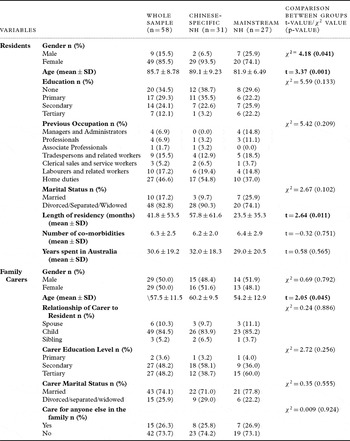
Descriptive data of the 58 participants are shown in Table 1. They were elderly (mean age 85.8 years), mostly female (84.5%) and had been in residential care for an average of 41.8 months (S.D = 53.5) with 10.3% having been admitted within the last three months and 20.7% more than five years ago.
Selected characteristics of the participants (n = 58)

Family carers
The 58 family carers interviewed were most commonly the residents’ children (84.5%). They were equally male or female, usually middle aged (but included a carer of 27 years and one of 87 years) and were more educated than the participants. Fifteen (25.9%) cared for other people in addition to the resident (see Table 1).
Comparing demographics between groups (Table 1)
Residents from Chinese-specific facilities were more likely to be female, to be older, and to have been in residence for a longer time. Additionally, family carers from Chinese-specific NHs were significantly older than those from mainstream NHs (t(55) = 2.05, p < 0.05). None of these resident or family caregiver variables was significantly associated with CSDD scores on independent t-test or Pearson's correlation analysis.
Dementia and cognitive impairment
Thirty-four participants (58.6%) completed the MMSE. As noted earlier, five participants were too ill to speak, ten were too dysphasic or demented, two were deaf and/or blind, four spoke another dialect other than Mandarin or Cantonese, and three were unwilling to be interviewed. There were no significant differences in CSDD scores between those who completed the MMSE ( = 11.5, S.D = 5.9) and those who did not ( = 8.1, S.D = 5.8).
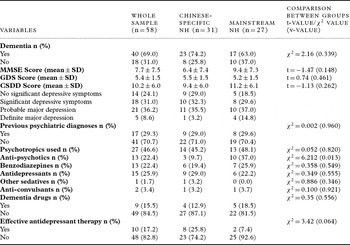
The low MMSE scores ( = 7.7, S.D = 7.5) and high GDS scores ( = 5.4, S.D = 1.5) indicate that majority of the participants had at least moderately severe cognitive impairment; only five participants rated better than GDS 4. Approximately 84.5% of the participants scored below 23 for the MMSE, which is the traditional cut-off for dementia (Folstein et al., Reference Folstein, Folstein and McHugh1975) (Table 2). This was consistent with the finding that 40 (69%) of the participants had a chart diagnosis of dementia, indicating a diagnosis of Alzheimer's disease in 13, vascular dementia in three and dementia of unspecified type in the remainder. Both MMSE and GDS scores did not significantly differ between facility types when independent t-test analyses were employed.
Cognitive impairment, depression and psychotropic prescription (n = 58)

MMSE = Mini-mental State Examination; GDS = Global Deterioration Score; CSDD = Cornell Scale for Depression in Dementia.
Depression
There was a high rate of depression, with 76% of the participants having significant depressive symptoms or higher (CSDD score > 6) (Table 2). In an independent t-test, mean CSDD scores did not differ significantly between the two types of NHs. When antidepressant therapy was controlled for using ANCOVA, there was no significant difference in CSDD scores between NH types.
There were significantly higher CSDD scores in participants who had higher MMSE scores and higher levels of benzodiazepine use (r = 0.278, p < 0.05 and r = 0.378, p < 0.05, respectively). Additionally, participants with vascular dementia ( = 18.0, S.D = 1.7) had higher CSDD scores compared to participants with Alzheimer's disease ( = 11.8, S.D = 6.5; t(13) = −3.01, p < 0.05). There was no significant correlation between the number of medical comorbidities and CSDD scores in both types of NHs. These relationships were also significant when correlations within Chinese-specific and mainstream NHs were calculated separately. When an ANCOVA was run with gender, age, MMSE scores, number of benzodiazepines and vascular dementia as covariates, NH type was not significantly associated with CSDD scores.
Previous psychiatric conditions
Seventeen participants (29.3%) had previous psychiatric conditions of whom nine were from Chinese-specific NHs and eight from mainstream NHs (Table 2). Altogether, 12 residents had a previous diagnosis of depression, both facility types had an equal number of residents previously diagnosed with depression. Previous diagnosis of depression was associated with higher CSDD scores(t(56) = 2.12, p < 0.05), and higher numbers of prescribed psychotropics (t(56) = 2.84, p < 0.05).
Medications
Twenty-seven (46.6%) participants were prescribed psychotropics. Of the 49 psychotropic medications prescribed, 14 were antipsychotics, 16 were benzodiazepines, 16 were antidepressants, one was another sedative and one was an anticonvulsant. Only nine participants were using drugs for dementia, all acetylcholinesterase inhibitors (Table 2). The number of prescribed antipsychotic drugs was higher in mainstream NHs (t(56) = 2.53, p < 0.05).
Efficacy of antidepressant therapy between facility types
Eight participants in the Chinese-specific NHs were receiving effective antidepressant therapy compared to two in mainstream NHs. This difference was not statistically significant but the numbers were small. An ANCOVA was run among residents receiving antidepressant therapy (n = 15), with number of psychotropics and previous psychiatric diagnoses as covariates and effective antidepressant therapy (CSDD score < 11) as the dependent variable. It indicated that only the number of psychotropics was a significant covariate (F(1, 15) = 14.84, p < 0.05), and the difference in effective antidepressant therapy between Chinese-specific and mainstream NHs was significant when the number of psychotropics was controlled for (F(1, 15) = 6.75, p < 0.05).
Sociocultural influences on depression
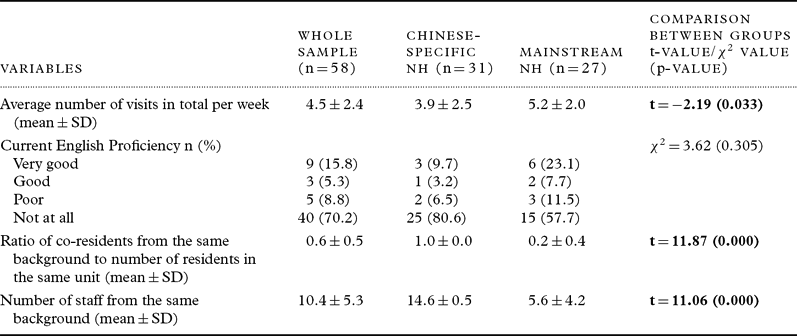
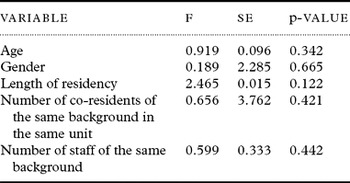
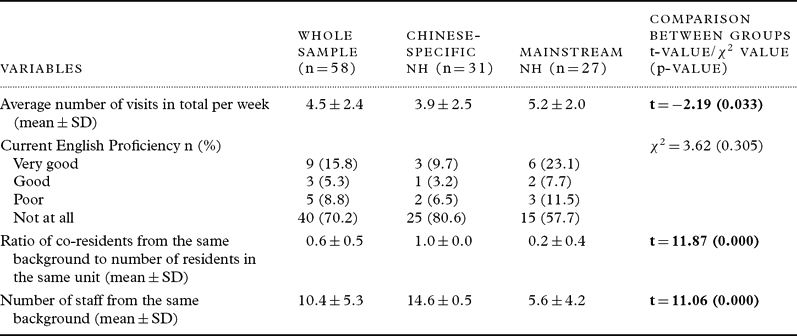
As expected, the ratio of Chinese co-residents in the same unit and number of staff of the same background was higher in Chinese-specific compared to mainstream NHs (Table 3). However, even after controlling for these differences using the ANCOVA, CSDD scores did not differ significantly between Chinese-specific and mainstream NHs. Results of the multilevel linear models with CSDD as the outcome variable adjusting for gender, age, length of residency and number of co-residents and staff of the same background in the NH are presented in Table 4.
Social support and sociocultural influences (n = 58)
Linear mixed models results with CSDD scores as the outcome variable (n = 58)

Social support
Participants in mainstream NHs received significantly more visits per week compared to Chinese-specific NHs ( = 5.2 vs 3.9), (t(55) = −2.19, p <.05) (Table 3). However, the number of visits did not correlate to CSDD scores and did not influence CSDD scores to differ between facility types.
Discussion
A major finding was the high proportion of residents (76%) who had significant depressive symptoms (CSDD scores ≥6) compared to the 40.5% reported in Australian residential aged care facilities using the CSDD (Snowdon and Fleming, Reference Snowdon and Fleming2007). However, the rates of definite major depression in our study (8.6%) were similar to the rates found in Australian NHs (6–25%) (Ames, Reference Ames2005; Snowdon and Fleming, Reference Snowdon and Fleming2007). Our sample was representative of the 2006–7 Australian residential aged care facility population with regard to sociodemographic characteristics (gender, age and marital status) (Australian Institute of Health and Welfare, 2008), but the low participation rate reduces the generalizability of these findings.
Our hypothesis that residing in ethno-specific NHs would be associated with lower levels of depression was not confirmed. These results found no significant differences in CSDD scores or rates of probable or definite depression between Chinese-specific and mainstream NHs. One possible explanation is that mainstream NHs are able to cater for the mental health needs of Chinese people as well as Chinese-specific NHs. However, there are a number of alternative explanations. First, the low participation rate of Chinese residents in mainstream NHs may have introduced recruitment bias. Directors of Nursing and family carers of mainstream NHs who agreed to take part may have been more supportive and involved in the welfare of the resident, thus reducing the rates of depression in mainstream NHs. Secondly, many staff members in mainstream NHs were unaware of the residents’ emotional state leading to under-estimation of depressive symptoms in these facilities. This was in contrast to the situation in the Chinese-specific NHs where staff members reported that residents confided in them frequently and many friendships were formed. The high rates of moderate to severe cognitive impairment in residents restricted our ability to obtain information on mood directly from some residents, and may have restricted the residents’ ability to express their feelings, which may be reflected in the higher levels of depression in residents with higher MMSE scores. Thirdly, participants’ mood was only measured on one occasion which may not be representative of their usual mood. Finally, family informant accounts may be unreliable: some family carers are protective and under-report symptoms of depression because of stoicism and the stigma associated with depression in Chinese culture or because their visits do not provide them with much information about the resident's mood.
An interesting finding was the higher prescription rate of antipsychotic drugs in mainstream NHs compared to Chinese-specific NHs. This was similar to the finding by Runci et al. (Reference Runci, Redman and O'Connor2005) in which daytime benzodiazepine prescription levels were higher in mainstream NHs than in ethno-specific Italian NHs. Staff nurses may resort to antipsychotics more readily when communication difficulties in mainstream NHs result in frustration in the residents (Cohen Mansfield et al., Reference Cohen-Mansfield and Werner1997) or when non-pharmacological strategies to reduce difficult behaviors cannot be successfully implemented because of cultural and language differences (Runci et al., Reference Runci, Doyle and Redman1999).
More participants in Chinese-specific NHs received effective antidepressant therapy compared to the mainstream NHs. It is possible that the longer length of stay in Chinese-specific NH residents has allowed more time for the detection and treatment of depression and this is further facilitated by language compatibility between staff and residents allowing complex emotional concepts to be discussed (Lai, Reference Lai2004).
Participants from mainstream NHs received a higher number of visits per week compared to Chinese-specific NHs, although this did not influence CSDD scores. Perhaps residents in mainstream NHs have less engagement with staff, but this is offset by more family visits, which may protect against depression, especially in Chinese older people who place a high value on the principle of filial piety (Lin et al., Reference Lin, Wang and Huang2007).
An unexpected finding was that the higher number of co-residents from the same background was not associated with lower CSDD scores across all NHs. This may be related to the different dialects spoken which may hinder close friendships from being formed. Alternatively, the high rates of moderate to severe cognitive impairment among residents may have diminished their ability to socialize. The higher number of Chinese staff members in Chinese-specific NHs was also not associated with lower CSDD scores. This is in contrast to studies which found higher satisfaction among Italian residents where there were increased ethno-congruent interactions between Italian staff and residents (Runci et al., Reference Runci, Redman and O'Connor2005). Perhaps staff in mainstream NHs were making an effort to communicate and attend to Chinese residents despite language barriers.
Further research is necessary to investigate whether ethno-specific NH care results in different outcomes from mainstream care. This could include longitudinal studies, sample other ethnic groups, and mainstream NHs where there are clusters of ethnic residents.
Conclusion
Our findings suggest that Chinese ethno-specific care does not influence levels or rates of depression, but is associated with lower levels of antipsychotic use and higher numbers of residents receiving effective antidepressant therapy in comparison to mainstream care.
Conflict of interest
None.
Description of authors' roles
I. Goh contributed to the design of the study, collected the data, carried out the statistical analyses and drafted the paper. L. Low and H. Brodaty conceptualized the study, had primary responsibility for the design of the study, supervised the data collection and contributed to the interpretation, drafting and editing of the paper.
Acknowledgments
Appreciation is extended to Ada Cheng and the staff of the Australian Nursing Home Foundation, and the Directors of Nursing and staff members of all the mainstream nursing homes for their support and participation in this study. We would also like to thank residents and families for their support and their willingness to be interviewed. Dr. Low is funded by NHMRC grant no. 455377. The Australian government-funded Dementia Collaborative Research Centre: Assessment and Better Care Outcomes at the University of New South Wales hosted the study and provided infrastructure support.