This article is about the “serious game” of dining. Serious games, following Ortner (Reference Ortner1996, Reference Ortner2006), are patterned, intentional cultural activities with well-defined structures—the rules of the game. These rules, far from dictating behavior, invite strategy and improvisation within certain constraints. Players must decide how to play the game, can adjust their tactics as the game unfolds, and may even break the rules or refuse to play. In this way, playing serious games is different from following a script: players conduct themselves with “skill, intention, wit, knowledge, intelligence” (Ortner Reference Ortner1996:12). Yet, although players cultivate their abilities and hone them with practice, serious games are not necessarily meritocracies. Players enter with different levels of knowledge, skill, and resources. Rules benefit some players and disadvantage others. Players leave as winners and losers: “Games thrive on difference; there is no game without difference” (Ortner Reference Ortner1999:180).
During the Victorian era, dining was a “secular domestic ritual” (Wall Reference Wall1994:111) through which households enacted moral values and jockeyed for social standing. Ceramic tablewares were the primary equipment needed for this game. Consequently, buying the “right” tablewares and using them in the “right” way was critical: “In some eyes, an improperly set table was a symbolic indication that the consuming household failed to measure up to dominant moralities and was not worthy of the social privileges and citizen rights implicit in an appropriate material assemblage” (Mullins Reference Mullins2011:76).
This study examines the tablewares used within a US Chinese diaspora community during the late Victorian era (1860s–1890s). Historians and archaeologists have generally assumed that Chinese diaspora communities operated largely outside Victorian-era cultural norms. Yet many Chinese diaspora sites contain substantial quantities of British-produced ceramic tableware vessels that were associated with the domestic rituals of Victorian-era dining. How were these vessels used? Did Chinese immigrants enter the game of Victorian gentility through dining? Or did they acquire and use these tableware vessels for heterodox purposes?
To investigate these questions, I expand Ortner's framework of serious games to examine the relationship between pragmatism and play in Chinese immigrants' selection and use of ceramic tableware vessels. I argue that play and pragmatism reflect a continuum of intention. Through pragmatism, an action is defined by the degree to which it solves a problem or resolves a situation (Bacon Reference Bacon2012): “Pragmatism is thus practical to its very core! It considers the differences that particular ideas or actions make in the world” (Cipolla Reference Cipolla2013:19). Play, in contrast, is an attitude or disposition toward an action rather than the action itself or the action's outcome (Karpatschof Reference Karpatschof, Schousboe and Winther-Lindqvist2013; Malaby Reference Malaby2009). It is common for anthropologies of play to focus on uncovering the significant cultural and political stakes hidden beneath playful activities, such as Ortner's theory of serious games and Geertz's (Reference Geertz1977:412–453) deep play. Here, the concept of play is specifically used to draw attention to an often-overlooked range of affective dispositions: humor, bemusement, curiosity, and experimentation. By attending to the interplay between play and pragmatism, this analysis reveals complicated dynamics within Chinese diaspora communities and their diverse engagements with the social norms of Victorian-era dining.
Victorian Dining as a Serious Game
The “Victorian age” refers not only to Queen Victoria's reign (1837–1901) but also to a global cultural movement that elevated “gentility” as a suite of values, behaviors, and aesthetics. Gentility, during the Victorian era, linked individual moral correctness to nineteenth-century progress narratives of civilization. It referred to the cultivation of a refined and civilized manner—acting as a gentleman or gentlewoman. Because gentility could be cultivated, it was a quality accessible to all, not just those born into noble status. Evaluation of personal conduct thus provided justification for enforcing social hierarchies. Gentility also linked moral values to geopolitical and economic structures, separating the civilized colonizer from the barbaric colonized, and distinguishing the coarse masculine world of industrial work from the refined feminine world of domesticity.
The cult of domesticity (also known as the ideology of separate spheres) emphasized the home as a refuge from the vulgarity of the world. The belief that the right aesthetics contributed to the formation of proper character elevated homemaking from a practical necessity to a moral art. Dining was a special focal point: midday and evening meals reunited male breadwinners and others working outside the home with women, children, and others who remained in the home. Etiquette books, magazine articles, and other media established proscriptive norms about the new rules of genteel dining. These discourses emphasized not only the food that was eaten but also the material culture used to serve it, “incorporating new material into a new domestic tradition” (Wall Reference Wall1994:111).
Victorian genteel dining elaborated on changes in meal practices that had begun in the late eighteenth century, when the industrialization of the Staffordshire pottery industry introduced mass quantities of attractive, white-bodied, and low-cost British refined earthenwares to everyday consumers. This facilitated a “slow, steady shift to individualized utensils,” which has been interpreted as emblematic of the emergence of a new “Georgian worldview” shaped by order, control, balance, and individuality (Deetz Reference Deetz1977:62–63; see also Leone Reference Leone2005; Shackel Reference Shackel1993).
In the Victorian era, the dominant meanings of tableware ceramics expanded beyond Georgian individualism to acquire moral significance related to gentility. Matched sets of white tablewares with molded gothic revival and naturalistic floral designs expressed social values of piety and purity. The unity of style afforded by matched sets of ceramics emphasized “the community of a group, rather than the differences among its individual members” (Wall Reference Wall1994:144). Tableware ceramics, in this historical context, became “elements of a social discourse” (Beaudry et al. Reference Beaudry, Cook, Mrozowski, McGuire and Paynter1991:174) about gentility, respectability, and citizenship, used not only in displays for visitors but also in quotidian dining rituals through which household members affirmed shared cultural values, identities, and ambitions. The global distribution of inexpensive, industrially produced ceramics enabled working- and middle-class communities to participate (or not) in Victorian genteel dining alongside trendsetting upper-class households (Mullins Reference Mullins2011; Wall Reference Wall1994).
Archaeologies of Difference in Victorian Dining
Victorian gentility was developed through hierarchies that stigmatized difference, such as race, ethnicity, nationality, sexuality, and religion. In this context, mass-produced, low-cost ceramic tablewares were “new commodities for creating, expressing and demonstrating the respectable family” (Karskens Reference Karskens, Mayne and Murray2001:74). Archaeologists have found that many households in poor and working-class neighborhoods purchased fashionable matched sets of British refined earthenwares at costs above what their income levels would recommend (Karskens Reference Karskens, Mayne and Murray2001; Mazrim Reference Mazrim2013; McCarthy Reference McCarthy, Mayne and Murray2001; Praetzellis and Praetzellis Reference Praetzellis, Praetzellis, Yentsch and Beaudry1992). Irish Americans living in New York's Five Points neighborhood used tablewares to undermine ethnic stereotypes (Brighton Reference Brighton2001). Nipmuc (Native American) residents of the Sarah Boston Farmstead site in Massachusetts invested in mid-priced, hand-painted ceramics that demonstrated consumer savoir (know-how and expertise), using these dishes in entertaining “as a means of bridging differences and establishing relationships outside of the Nipmuc community” (Pezzarossi Reference Pezzarossi2014:162). Transfer-printed wares in classical and orange-blossom patterns established “gestures to the English home” in the roadside tent hotels of the South African diamond mines (Weiss Reference Weiss, Voss and Casella2012:51–54). Ceramic assemblages from Victorian-era brothels often include a mixture of high-cost fashionable ceramics and inexpensive plain dishes, indicating a split between the tablewares used for entertaining middle- and upper-class clients and those used for brothel workers’ daily meals (Foster et al. Reference Foster, Lindly and Ryden2005; Meyer et al. Reference Meyer, Gibson and Costello2005; Seifert et al. Reference Seifert, O'Brien, Balicki, Schmidt and Voss2000). These and other examples suggest that many marginalized households engaged with the serious game of Victorian genteel dining to achieve key social objectives.
Other households used British refined earthenwares to create heterodox styles that articulated distinct values, positions, and identities. Boardinghouse residents in Lowell, Massachusetts, ate from plain, sturdy, undecorated tablewares with large communal serving dishes (Beaudry Reference Beaudry1989; Mrozowski et al. Reference Mrozowski, Ziesing and Beaudry1996). Working-class women in Victorian-era New York used a wider variety of tableware ceramics than their middle-class contemporaries, creating an aesthetic distinct from hegemonic Victorian gentility (Wall Reference Wall1999). Convict residents in the Rocks neighborhood in Sydney, Australia, created unorthodox dining sets by combining mixed colors of matching transfer prints and creating “‘crazy’ tea sets, made up of pretty unmatched china” (Karskens Reference Karskens, Mayne and Murray2001:77). Métis bison hunters in Canada carried sets of fragile transfer-printed teaware for use in gatherings that facilitated information exchange and ethnic solidarity (Burley Reference Burley1989). Intergenerational use of British refined earthenwares among Eastern Pequot households in New England was a strategy for indigenous cultural persistence within the constraints of consumer choice in the regional marketplace (Silliman and Witt Reference Silliman and Witt2010). Enslaved African Bahamians selected hand-painted and slip-decorated wares with colors and decorations that echoed pan-African spiritual symbolism (Wilkie and Farnsworth Reference Wilkie and Farnsworth1999). These examples show that while some households “played by the rules” of Victorian genteel dining, others established “house rules” that coexisted alongside dominant norms.
British Refined Earthenware in the Chinese Diaspora
Less attention has been given to the ways in which Chinese diaspora communities engaged with the norms of Victorian genteel dining. British refined earthenwares are commonly found on nineteenth-century Chinese diaspora sites in North America, Australia, and New Zealand. Archaeologists often interpret these ceramics either as evidence of market constraints (local unavailability of Chinese porcelain) or as an index of acculturation (for discussion, see Voss Reference Voss2005:426–429).
Lydon's (Reference Lydon1999) study of Chinese residents of the Rocks neighborhood in Sydney, Australia, was among the first to reject acculturation models, instead arguing that Chinese households’ use of British refined earthenwares was evidence of intercultural entanglement and exchange. Praetzellis and Praetzellis (Reference Praetzellis, Praetzellis, Yentsch and Beaudry1992) similarly focus on intercultural relations in their interpretation of British refined earthenwares in a Chinese American mercantile household in Sacramento, California. Newspaper accounts indicate that Chinese American business leaders used elaborate sets of British refined earthenware during banquets hosted for European American friends and associates. British refined earthenwares were thus “props in the game of … impression management” (Praetzellis and Praetzellis Reference Praetzellis and Praetzellis2001:648), “to show, perhaps, that Chinese are not so different from Americans” (Praetzellis and Praetzellis Reference Praetzellis and Praetzellis1998:89).
In a study of ceramic tablewares associated with Chinese cannery workers in British Columbia, Ross found that British refined earthenwares consisted primarily of large and extra-large plates, measuring 18 to 25 cm. Ross (Reference Ross2011:88) concludes, “This small number of (mostly large) plates in relation to [Asian porcelain] bowls suggests plates were not used by individual diners, but rather as serving vessels for communal dishes.” Ross (Reference Ross and Smith2013:5681) later concludes that “Chinese migrants also combined inherited and adopted objects and practices. … Sometimes this involved significant changes to traditional cultural practices but also reuse and recontextualization of non-Chinese objects and behaviours in unique ways.” By focusing on the practical functions served by British refined earthenwares, Ross's interpretation marks a significant departure from earlier studies that interpreted British refined earthenwares as evidence of intercultural exchange.
Play and Pragmatism in the Market Street Chinatown: Insights from Community-Based Research
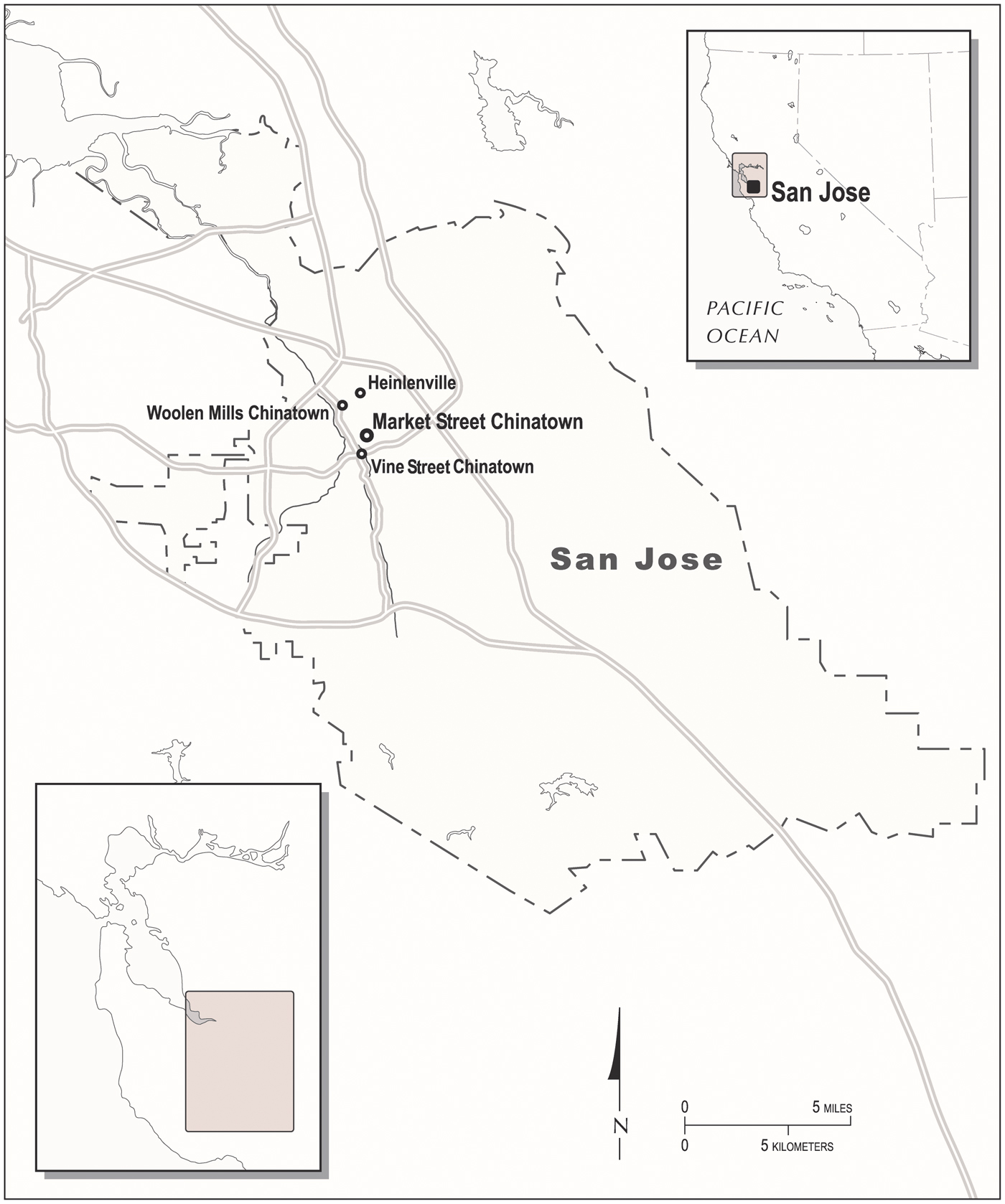
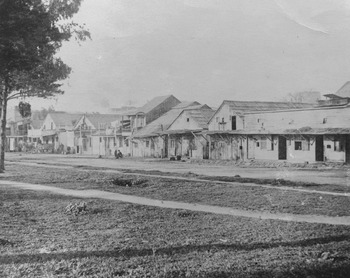
The Market Street Chinatown (1866–1887) was located on the western two-thirds of a city block in downtown San Jose, California (Figures 1 and 2). At its peak, the Market Street Chinatown housed more than 1,000 men, women, and children, with its businesses, temples, and theaters serving as a regional center for an additional 2,000 Chinese diaspora residents living in surrounding communities. In May 1887, during the height of San Jose's anti-Chinese movement, the Market Street Chinatown was destroyed by an arson fire. Prohibited from rebuilding in San Jose's downtown, the residents and businesses of the Market Street Chinatown relocated to two sites, Woolen Mills and Heinlenville, both located away from the city center (Laffey Reference Laffey1993; Yu Reference Yu2001).
Locations of historic Chinatowns in San Jose, California. Cartography by Connie Young Yu and 360Geographics.

The Market Street Chinatown, circa 1887. Photographer unknown. Courtesy of History San José.

The site of the Market Street Chinatown was excavated from 1985 to 1988 during redevelopment of San Jose's downtown district. During construction, archaeologists identified and hastily excavated 63 features, mostly pits filled with domestic refuse. Today the collection is being studied through the Market Street Chinatown Archaeology Project, a community-based participatory research partnership between Stanford University, History San José, the Chinese Historical and Cultural Project, and Environmental Research Associates (Voss Reference Voss2012; Voss et al. Reference Voss, Kwock, Yu, Gong-Guy, Bray and Kane2013). Careful analysis of the original excavators’ notes, photographs, and reports was undertaken to reconstruct the context of each feature and assess its research potential (Kane Reference Kane2011; Voss Reference Voss2008, Reference Voss2012).
At our first collaboration meeting, some members of the Chinese Historical and Cultural Project asked, Why do archaeologists spend so much time describing ceramics? They suggested instead that our research focus on social issues, especially internal differences within the Market Street Chinatown, interactions between Chinatown residents and their non-Chinese neighbors, and the effect of the anti-Chinese movement on Chinatown residents (Voss Reference Voss2005:434–435).
Over time we came to see that ceramic analysis could contribute to a richer understanding of these concerns. There is ample evidence that most Chinatown residents were aware of the proscribed rules of Victorian-era dining. Many Chinatown residents worked as cooks, waiters, and servants in European-American restaurants, clubs, and private homes. Preparing and serving “American-style” meals was often a core responsibility of these positions, including laying table settings, serving at table, and clearing and washing used dishes (Yu Reference Yu2001).
Additionally, Chinatown residents were scrutinized by their non-Chinese neighbors for evidence of compliance or noncompliance with Victorian-era dining norms. The anti-Chinese movement mocked Chinese foodways as part of their smear campaign against Chinese immigrants. European American journalists published sensationalized reports describing food served at Chinese banquets and festivals. Missionaries visited Chinatown homes to coach Chinese women in “civilized” housekeeping, including use of European-produced ceramics (Voss Reference Voss, Ryan Kennedy and Rose2019). What Chinatown residents ate, and how they ate it, was a realm of social practice through which racial categories and cultural citizenship were defined and contested.
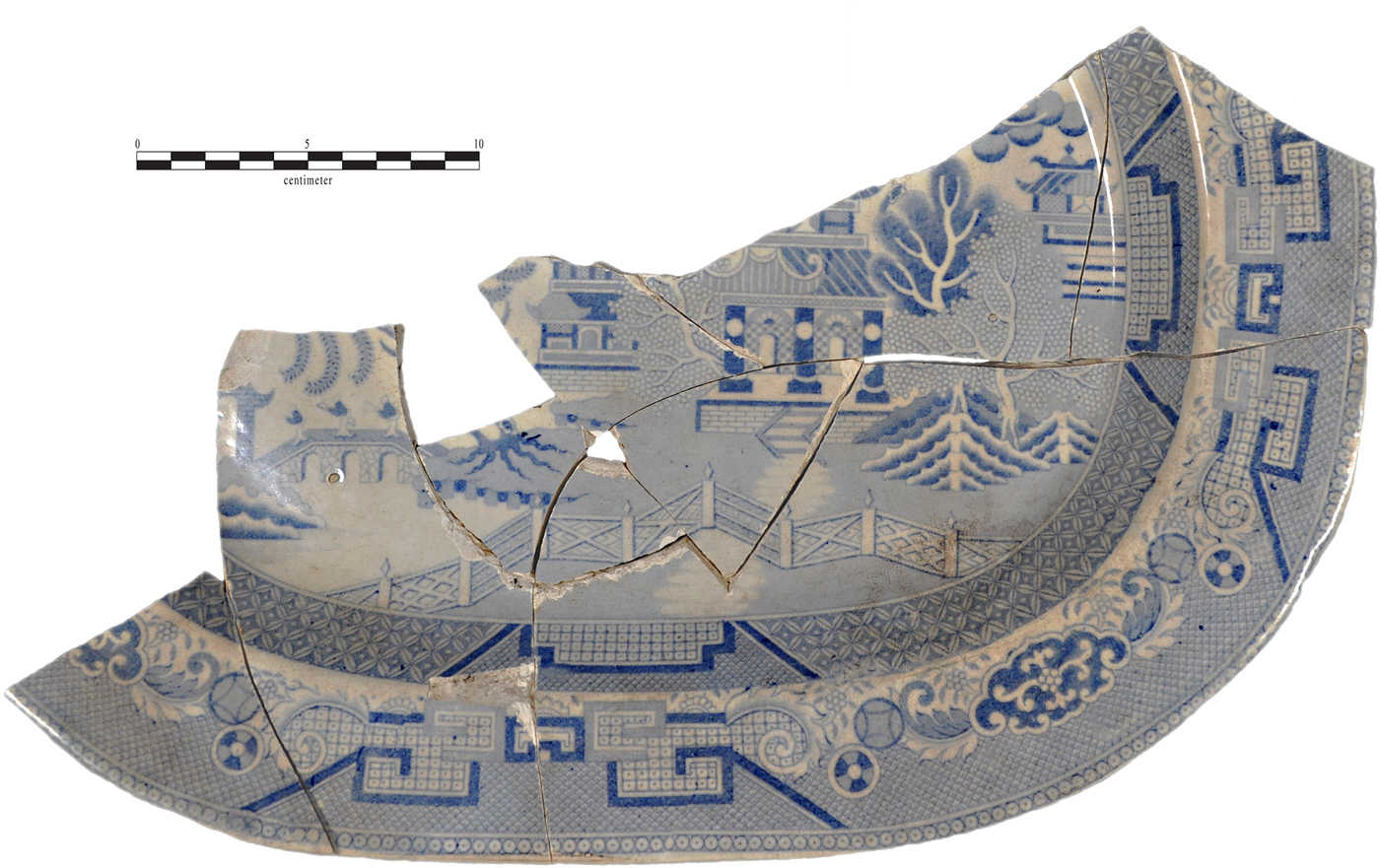
The use of “play” and “pragmatism” as organizing concepts for ceramic analysis also emerged from ongoing dialogues with members of the Chinese Historical and Cultural Project. For example, several of the British refined earthenwares in the collection are printed with chinoiserie landscape motifs (Figure 3). Chinoiserie is an aesthetic style in which objects and motifs are made to “look” Asiatic to non-Asian consumers. But British-produced chinoiserie ceramics look nothing like Chinese-produced porcelain vessels. When viewing chinoiserie ceramic specimens in the Market Street Chinatown collection, members of the Chinese Historical and Cultural Project often reacted with puzzlement. Why, they asked, would Chinatown residents have purchased such absurd patterns? Perhaps, they speculated, Chinatown residents thought these dishes were “funny”—humorous curiosities, packed with comic value and irony. Or maybe the buyer was looking for a vessel of a particular size or shape and did not notice the decoration. Or perhaps this dish was on sale—a good bargain. If it was useful, who cares what the decoration looked like?
Chinoiserie transfer-printed platter, Willow pattern. Photo courtesy of Market Street Chinatown Archaeology Project.

These conversations opened up a new research topic: how seriously did Chinatown residents take the “serious game” of Victorian-era dining? Was it funny to them—both “funny–peculiar” and “funny–ha ha”? Did they purchase some ceramic tablewares as a joke? Did they experiment and improvise? Or were they primarily concerned with thrift and function?
Themes of thrift and humor commonly surface in community consultations for the Market Street Chinatown Archaeology Project. Immigration to the United States was heavily motivated by economic need, and many Chinatown residents were undoubtedly careful spenders who prioritized sending remittances back to their Pearl River Delta villages rather than seeking personal gratification through consumer purchases (Voss Reference Voss2005). Yet the Market Street Chinatown was also known for its recreational facilities, including opera houses, tea houses, gambling halls, lotteries, and other entertainments. Oral histories recount practical jokes and pranks that Chinatown residents played on each other. Cantonese and related dialects are famous for wordplay and punning. The archaeological analyses detailed below were developed in order to explore whether this interplay between function and fun, and thrift and humor, extended into tableware ceramic selection and use.
Analysis Methods
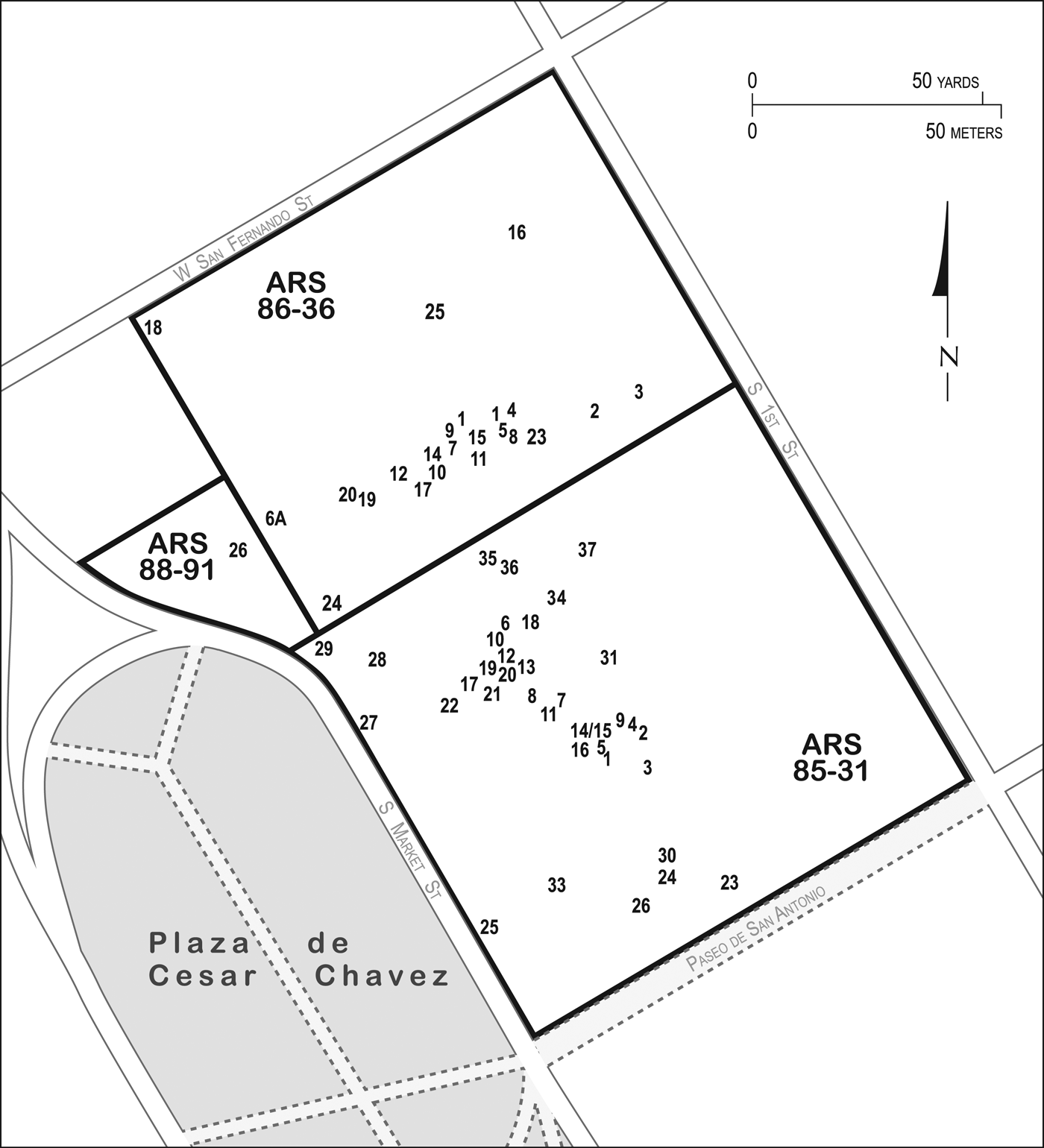
Ceramic tablewares were recovered from 53 of the 63 features excavated at the site of the Market Street Chinatown, totaling 8,809 specimens (115,563.8 g; Figure 4). All ceramic tableware specimens were cataloged using standard procedures (Market Street Chinatown Archaeology Project 2016). The resulting dataset affords a characterization of the entire ceramic tableware assemblage by waretypes, decorations, vessel forms, and vessel sizes. Because artifact density calculations are not possible (the original archaeologists did not record the volumes of excavated soil), ratios and frequencies are used for comparisons between features. Weight rather than specimen count is used for site-wide quantitative analyses to avoid distortions related to differential breakage.
Archaeological features excavated at the Market Street Chinatown site. Adapted from Parsons (Reference Parsons1993). Cartography by 360Geographics and Katie Johnson.

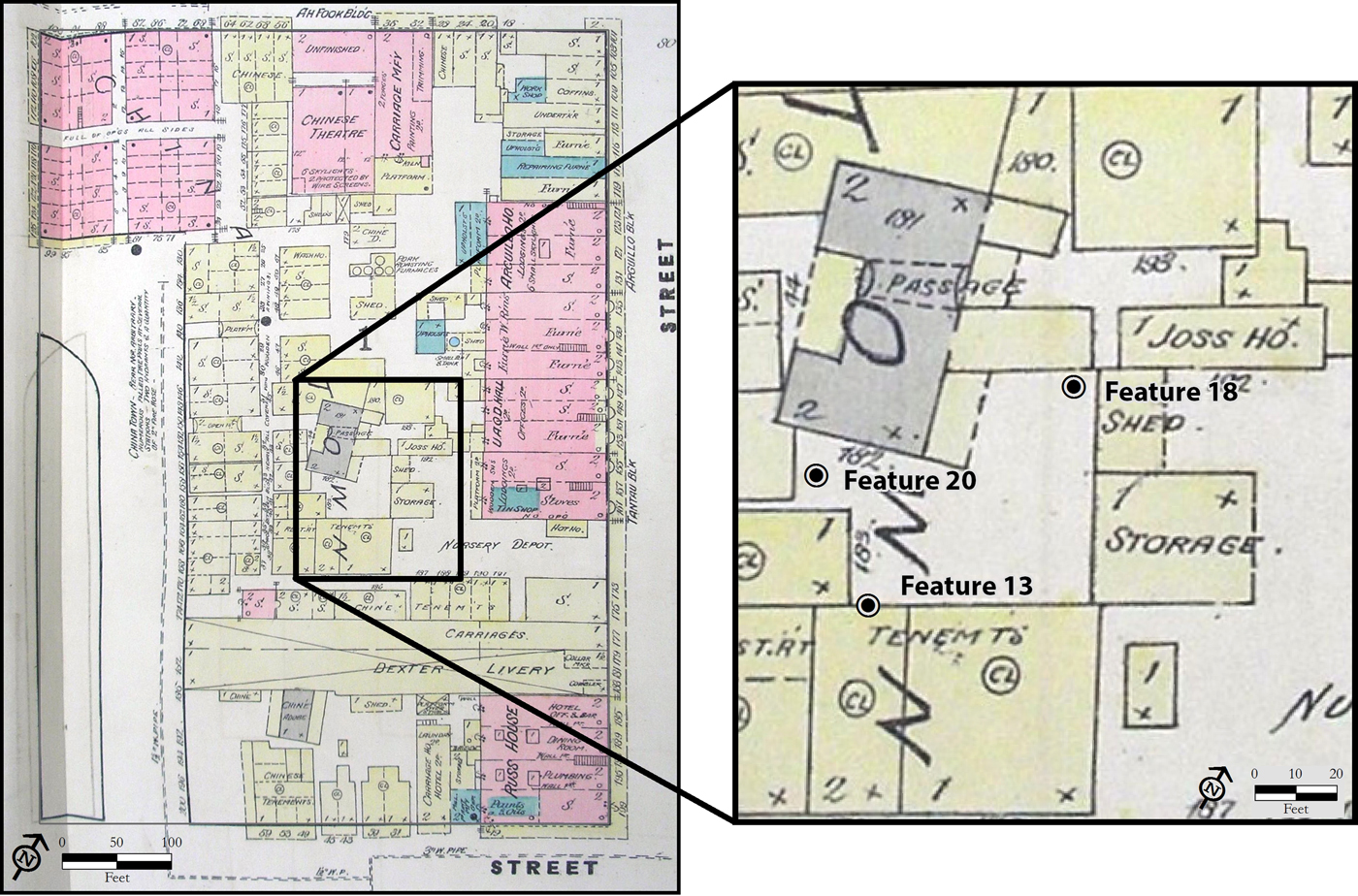
In addition, three features—Feature 85-31/13, Feature 85-31/18, and Feature 85-31/20—were selected for minimum number of vessel (MNV) analysis using standard quantitative and qualitative procedures (Voss and Allen Reference Voss and Allen2010). These three features all met four key criteria: (1) they were detected and fully excavated without substantial construction impact, (2) they contain little or no heat-affected material, (3) they have an abundance of tableware ceramics, and (4) they are located in the physical and cultural center of the Market Street Chinatown—an intermural space bordered by one of the Chinatown's largest stores, the temple, and a group of tenement buildings (Figure 5). A full inventory of tableware represented in each feature is provided in the Supplemental Materials.
Sanborn Fire Insurance Map from 1884, San Jose, Block 1, with close-up showing locations of Features 85-13, 85-18, and 85-20. Courtesy History San José.

Of the tableware ceramics, 56.46% (65,249.6g), by weight, are Chinese porcelains. Chinese porcelain patterns were identified using established typologies (e.g., Choy Reference Choy2014; Felton et al. Reference Felton, Lortie and Schulz1984; Greenwood Reference Greenwood1996; Sando and Felton Reference Sando, Felton and Wegars1993).
British refined earthenwares count for 42.27%, by weight (48,848.5 g), of the tableware ceramics. The use of these ceramics by Chinatown residents is confirmed both by the association of these ceramics with artifacts that are typically unique to Chinese diaspora settlements (e.g., traditional Chinese medicine bottles, jade ornaments, gaming pieces) and by the presence of pecked-mark Chinese characters on some British refined earthenware vessels (Michaels Reference Michaels2005). They were sorted into waretypes according to paste color, glaze color, and body vitrification. Creamware (1760s–1810s), pearlware (1770s–1820s), and whiteware (1805–present) are all nonvitreous, white-bodied wares distinguished by the color of the paste and glaze. The presence of creamwares and pearlwares indicates that some tablewares used by Market Street Chinatown residents were likely acquired secondhand; this is confirmed by makers’ marks and decorations indicating pre-1860 manufacture. Improved whiteware (also known as ironstone, white granite, and stone china) is a semivitreous ware introduced in the 1840s, along with a blue-tinted variant introduced in the 1850s. Porcelaneous whitewares, also sometimes classified as “semiporcelain,” are visually identifiable by the dense, glossy body and were commonly produced from the 1870s onward (Brown Reference Brown1982; Majewski and O'Brien Reference Majewski and O'Brien1987; Miller Reference Miller1991; Miller et al. Reference Miller, Samford, Shlasko and Madsen2000).
The remaining 1.27% (1,465.7 g) of ceramic tablewares are grouped as “other ceramics” and include Wedgwood, Jackfield, yellowware, Rockingham, and some glazed gray- and brown-bodied stonewares (Claney Reference Claney2004; Hume Reference Hume2001; Leibowitz Reference Leibowitz2002). Extremely small fragments of Mexican-produced majolica and galera were also present in the collection. These likely represent background debris from the Spanish colonial/Mexican Pueblo de San José (1777–1846).
An attribute-based system was developed to facilitate cross-waretype analysis of vessel form and decoration across Chinese porcelains, British refined earthenwares, and other ceramics. Vessel form analysis followed a nested sequence from basic form (e.g., hollowware, flatware), general form (e.g., bowl, plate, cup, serving dish), specialized form (e.g., sugar bowl, teacup, mug), and vessel size (rim diameter, base diameter, and height). Vessel decorations were analyzed using a modified version of the taxonomic approach advocated by Majewski and O'Brien (Reference Majewski and O'Brien1987), including description of vessel shape, shape surface, relief decoration, glaze treatment, applied pigment (overglaze and underglaze), pigment application techniques, pigment colors, primary and secondary motifs, and (when identifiable) decorative pattern name.
“There Is No Game without Difference”: Variation in Tableware Ceramics among Chinatown Residents
The high frequency of British refined earthenwares in the Market Street Chinatown collection indicates a strong community-level engagement with the material culture associated with Victorian genteel dining. However, when the frequencies of Chinese porcelains, British refined earthenwares, and other ceramics are examined feature by feature, a more complex picture emerges (Figure 6). One feature (85-31/14) contains only Chinese porcelains, and four features (85-31/25, 85-31/29, 85-31/30, and 86-36/16) contain only British refined earthenwares. The relative waretype frequencies vary significantly across the remaining 53 features.
Frequency of Chinese porcelain, British refined earthenware (BRE), and other ceramics, by feature.

Could features with high frequencies of British refined earthenwares represent trash deposited by European Americans living along the edges of the Market Street Chinatown? Of the 10 features with more than 90% British refined earthenwares, eight are located on the edges of the Market Street Chinatown, but two (86-36/10 and 86-36/15) are located in the heart of Chinatown itself. Nine of these 10 features contain artifacts typically associated with Chinese diaspora material culture, including Chinese brown-glazed stoneware containers, glass zhu gaming pieces, opium pipe bowls, and traditional Chinese medicine bottles. Additionally, other nearby features contain a preponderance of Chinese porcelain tablewares, such as Feature 86-36/6A (95.92%), Feature 86-36/8 (93.69%), and Feature 85-31/24 (84.18%). Were some trash pits used by both Chinatown residents and European American residents of the block, resulting in intermingled trash? Were some European American residents of the block acquiring, using, and disposing of Chinese-produced material culture, including Chinese porcelain tablewares? These indeterminacies are typical of the methodological challenges endemic to archaeological research on dense urban communities.
However, most of the archaeological features are located squarely within the Market Street Chinatown and can be securely affiliated with Chinatown residents. Setting aside the 7 features with more than 90% Chinese porcelain and 10 features with more than 90% British refined earthenware, the remaining 36 of the 53 features indicate that many Chinatown residents were using a mixture of Chinese porcelain, British refined earthenware, and other ceramics in their dining practices. Furthermore, these data indicate high variability in the use of British refined earthenwares, with some Market Street Chinatown residents using very few British refined earthenwares, and others relying on this waretype for the majority of their tablewares.
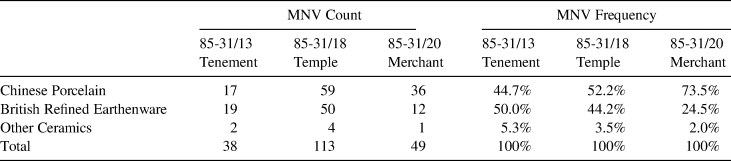
This conclusion is further supported by MNV analysis of Features 85-31/13, 85-31/18, and 85-31/20 (Table 1). Curiously, the merchant-associated feature has the lowest frequency of British refined earthenwares (24.5%, by MNV), and the tenement-associated feature has the highest (50.0%, by MNV). Archaeological research at other historic Chinese diaspora settlements has suggested that Chinatown merchants were key nodes of communication and economic trade between Chinese and white populations (e.g., Praetzellis and Praetzellis Reference Praetzellis and Praetzellis1998, Reference Praetzellis and Praetzellis2001; Praetzellis et al. Reference Praetzellis, Praetzellis, Brown and Staski1987). Yet the merchant household represented by Feature 83-31/20 relied most heavily on Chinese porcelains for their table settings. Even the feature associated with the Chinese temple contained 44.2%, by MNV, of British refined earthenwares.
Waretypes, by Minimum Number of Vessels, for Features 85-31/13, 85-31/18, and 85-31/20.

Intrasite analysis thus reveals that there was considerable variability in Chinese diaspora households’ use of non-Asian ceramics. Some used Chinese porcelain tablewares almost exclusively, others used diverse mixtures of Chinese porcelains and British refined earthenwares, and still others relied primarily on British refined earthenwares. Unexpectedly, the use of British refined earthenwares extended into tenements that housed working-class families and bachelors—those who were least expected to engage with the norms and practices of Victorian genteel dining.
All the Rice Bowls Green and Flowered: Chinese-Style Dining
While comparative frequencies of waretypes demonstrate variability, this alone does not indicate that Chinatown residents were acquiring and using British refined earthenwares in accordance with the norms of Victorian genteel dining. Functional analysis of Chinese porcelains (this section) and British refined earthenware and other ceramics (next section) is necessary to reconstruct the likely uses of these vessels.
In his book In Small Things Forgotten, Deetz (Reference Deetz1977) contrasts the sparse attention given to domestic ceramics in colonial New England probate inventories (one of which described a household's entire ceramic assemblage simply as “all the earthenware plain and flowered”) with the detailed analyses that archaeologists conduct. Similarly, as members of the Chinese Historical and Cultural Project have asked, did Market Street Chinatown residents really pay much attention to the ceramics they used? After all, isn't it pretty much certain that Chinatown residents ate their meals from rice bowls?
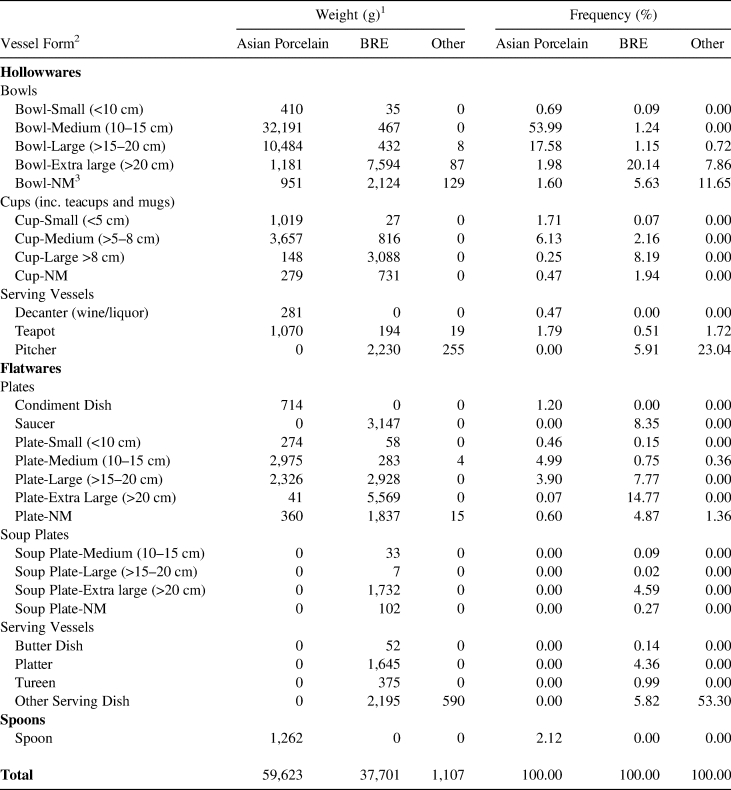
Indeed, 53.99%, by weight, of the Asian porcelains in the Market Street Chinatown collection are medium-sized (10–15 cm) “rice” bowls (Table 2). This finding is consistent with Ross's (Reference Ross2011:80) intersite rank-order analysis of tableware vessel forms at Chinese diaspora sites in North America: medium bowls are almost always the most common vessel recovered (see also Evans Reference Evans and Schuyler1980; Felton et al. Reference Felton, Lortie and Schulz1984; Rains Reference Rains2003; Staski Reference Staski and Wegars1993).
Vessel Form, by Weight and Frequency, for Market Street Chinatown Ceramic Tableware Assemblage.

1 Specimen weight is used to control for differences in sherd size across deposits.
2 Only specimens that could be identified to specific vessel forms are included in this analysis. This includes 95.08 of all Asian porcelains, 77.3 of British refined earthenware, and 75.6 of other tableware ceramics.
3 NM = not measurable
The prevalence of medium bowls fits expectations for the material culture requirements of dining in nineteenth-century southern China. Typically, meals were organized according to a basic division between cooked starchy grains (fan—typically rice but also sorghum, barley, buckwheat, millet, and wheat) and seasoned dishes (sung [Cantonese]; cai [Mandarin]) made with chopped meats and vegetables. Along with balancing fan and sung, meals were organized to maintain yin-yang (dark-bright) balance by pairing “cool” energy foods (mild, steamed or boiled, and earthy) with “hot” energy foods (fatty, fried or baked, and spicy). A complete meal thus required multiple sung dishes, which were served together at the center of the table. For a simple family meal, this included a soup, plain steamed fan, and a few sung dishes (in lean times, perhaps only a little salted fish and some preserved vegetables). Holiday meals, meals with guests, and banquets were marked by multiple courses of sung dishes and the use of rare and pricy ingredients, not through use of specialized vessel forms.
Whether at simple family meals or at a banquet, diners were provided with the same implements: a medium bowl, chopsticks, a ceramic spoon, a teacup, and occasionally a small plate. Sung dishes were served in large plates and bowls, with condiments in smaller sauce dishes, and beverages served in teapots and liquor decanters. If the meal included soup or porridge, this was typically served first into diners’ individual bowls. After soup was eaten, some rice or other fan was served into the same bowl, with small bites of vegetables and meats from sung dishes added to the diners’ bowls throughout the meal (Anderson Reference Anderson1988; Chang Reference Chang1977; Cummings et al. Reference Cummings, Voss, Yu, Kováčik, Puseman, Yost, Kennedy and Kane2014; Kennedy Reference Kennedy2016; Simoons Reference Simoons1991).
In the Market Street Chinatown collection, Chinese porcelain sherds represent not only medium bowls but also other vessel types used in the above-described historic dining pattern. This suggests that most Chinatown households generally organized their meals along principles associated with Chinese-style dining. With few exceptions, British-produced tablewares are found among these Chinese-produced tablewares. Clearly, the presence of British-produced tablewares in these contexts does not indicate a wholesale adoption of Victorian genteel dining practices among Chinatown residents.
Supersized Ceramics: British Refined Earthenwares
If Chinatown residents were not adopting Victorian genteel dining practices, why were they acquiring and using so many British refined earthenwares? Archaeologists have commonly interpreted the presence of British refined earthenwares on Chinese diaspora sites as evidence of assimilation/acculturation, market forces, or interethnic hospitality. Regarding the first, most Chinatown residents were using the full complement of Chinese porcelain dining vessels; British refined earthenwares supplemented, rather than replaced, Chinese porcelains. To the extent that the use of British refined earthenware indicates cultural change, these results indicate an additive approach (similar perhaps to bricolage), rather than acculturation, hybridity, or syncretism.
Regarding market forces, availability was not a factor: the Market Street Chinatown was a commercial hub with dozens of stores selling Chinese-produced goods. Without exact pricing data, cost sensitivity (e.g., bargain hunting) cannot be ruled out, but the best available information suggests that there was little difference in price between Chinese porcelains and roughly equivalent British refined earthenwares (Miller Reference Miller1991; Sando and Felton Reference Sando, Felton and Wegars1993). Thus, it seems unlikely that economic constraints or thrift pulled consumers toward one or the other waretype.
There is some historical support for the use of British refined earthenwares in interethnic hospitality. The San Jose Presbyterian Woman's Board of Missions, which evangelized the Market Street Chinatown, recorded that some Chinatown households kept some American-style plates and cutlery in their homes for this purpose (Voss Reference Voss, Ryan Kennedy and Rose2019). However, this does not account for the full assemblage of British refined earthenware from the Market Street Chinatown. If Chinatown residents were maintaining parallel sets of European American–style table service, the British refined earthenwares should include significant numbers of small and large plates, small and medium bowls, and soup plates, along with teaware and serving vessels, ideally in matched sets consistent with the norms of Victorian genteel dining. Neither of these expectations match the evidence. In Features 85-31/13, 85-31/18, and 85-31/20 combined, there is not a single pair of matching British refined earthenware dishes. In sum, although culture change, market forces, and interethnic hospitality were likely contributing factors, none of these common interpretations fully explain the quantities, attributes, and distributions of British refined earthenwares in the Market Street Chinatown.
When comparing the vessel forms of Chinese porcelains and British refined earthenwares, one key difference jumps out: size. Of the British refined earthenwares specimens, 56.63% represent large (>15–20 cm) or extra-large (>20 cm) vessels, whereas only 23.78% of Chinese porcelains do. When this is narrowed to consider only extra-large vessels, the difference becomes even clearer: 39.51% of British refined earthenwares are bowls, plates, and soup plates more than 20 cm in diameter, in comparison to only 2.05% of Chinese porcelains. Additionally, the assemblage contains sherds from several platters and oval-shaped serving dishes, most of which measure from 20 to 36 cm maximum diameter.
These differences in vessel size indicate that, although Chinatown residents primarily used Chinese porcelain vessels for individual place settings, their serving vessels included both large Chinese porcelain bowls and plates and large and extra-large British refined earthenware plates, soup plates, bowls, platters, and oval dishes.
Why? Perhaps these “supersized” British refined earthenwares and other ceramics allowed cooks to serve larger quantities of food. Were Chinatown residents simply eating more food than they had in their home villages in southern China? Economic deprivation and hunger were among the motivations to leave China for work abroad. Bioarchaeological studies, although limited, show that some Chinese migrants experienced nutritional stress as children and adolescents, presumably before migrating, but were not nutritionally stressed as adults (Harrod and Crandall Reference Harrod and Crandall2015). Additionally, zooarchaeological and archaeobotanical research on the Market Street Chinatown collection shows that residents had access to a rich variety of both meat and plant foods (Cummings et al. Reference Cummings, Voss, Yu, Kováčik, Puseman, Yost, Kennedy and Kane2014; Kennedy Reference Kennedy2016; Popper Reference Popper2014).
Chinatown cooks also may have prepared foods that simply did not physically fit within available Chinese porcelain large plates and bowls. Zooarchaeological evidence indicates that alongside cleaver-chopped pork and poultry, cooks in the Market Street Chinatown were acquiring saw-cut beef steaks, chops, and roasts and whole pork limbs from European American butchers. Fish were also prepared whole (Kennedy Reference Kennedy2016). Extra-large British refined earthenware vessels would have been ideal for serving whole fish, steaks, roasts, hams, and other large cuts of meat.
Finally, Chinatown residents may have been eating in larger groups than was common in nineteenth-century southern China. In migrants’ home villages, food preparation was customarily done within the home. Extended families typically lived in a shared “double house,” with the elder parents and their dependent children living on one side, a married son and his wife and children living on the other side, and a shared general-use room separating the two groups. Each side had its own kitchen, so the two generations did not typically eat together.
This “double house” form was rarely found in Chinese diaspora settlements in North America. Housing stock in the Market Street Chinatown was dominated by crowded tenements, typically with one nuclear family or several men sharing each single room. Tenement residents prepared meals in a shared kitchen or on small braziers in their rooms. Merchants and other entrepreneurs typically lived in the back of their businesses, often housing and feeding employees along with family members. Stores sold ready-made food to Chinatown residents and visitors.
The temple, which housed a caretaker and sometimes a resident monk, served as a hostel for visitors without family or friends and included a kitchen for serving large group meals (Voss Reference Voss2008). Additionally, district associations and village associations provided meals for farmworkers and other laborers who visited the Market Street Chinatown on their days off to shop, worship, and socialize (Yu Reference Yu2001).
In all of these situations, meals likely included diners beyond the nuclear or extended family. Although the individual place setting—rice bowl, small plate, spoon, cup, and chopsticks—would not have changed, larger serving vessels may have helped cooks serve larger dishes to feed more people.
The shift from family dining to communal eating is well documented in other Chinese diaspora contexts, especially work camps and factory towns (e.g., Costello and Maniery Reference Costello and Maniery1988; Ross Reference Ross2011; Spier Reference Spier1958; Van Bueren Reference Van Bueren2008). Ceramic tablewares from the Chinese bunkhouse on Lion Island in British Columbia, Canada, followed a similar pattern as that described above: Chinese porcelains were limited to medium bowls, tea and liquor cups, spoons, and teapots and decanters. British refined earthenwares were predominantly large and extra-large plates, most likely used as serving vessels for communal dishes (Ross Reference Ross2011:88).
British refined earthenware and Rockingham pitchers in the Market Street Chinatown assemblage could also have been used to serve beverages to larger groups. However, the presence of many large-sized British- and American-produced drinking vessels (cups, teacups, and mugs) cannot be similarly explained, as they would have been used by individuals. What changes in beverage consumption does the adoption of British refined earthenware drinking vessels reflect? Were people drinking more of the same beverages? Or does the adoption of these large drinking vessels signal the consumption of European American beverages, such as coffee, beer, and wine?
Taken together, this analysis indicates that although Chinatown residents were acquiring large quantities of British refined earthenwares, they were generally not adopting the conventions of Victorian genteel dining. Instead, Chinatown residents primarily used these vessels to augment, rather than replace, Chinese porcelain serving dishes. British refined earthenware platters, tureens, pitchers, oval dishes, and large and extra-large plates and bowls were most likely used to deliver greater quantities of food than Chinese porcelain serving vessels would allow. Whether this was done in order to accommodate larger groups of diners, to serve American-style steaks and chops, or to simply allow people to eat more food, the acquisition and use of these vessels reflects a pragmatic approach to changing foodways by adopting new material culture.
Playing with Ceramics: Aesthetic Eclecticism
To this point, analysis has focused on vessel function. But this does not account for the aesthetic qualities and symbolic associations of tableware ceramics. My attention was first drawn to this through conversations in my lab with members of the Chinese Historical and Cultural Project and with scholars from southern China. When viewing the Market Street Chinatown collection, these visitors commented that the British refined earthenwares just do not “belong.” The sizes and shapes are off, the decorations are bizarre, and overall it is just strange to think of these vessels being used in households that were at most one to two decades removed from daily life in the rural villages in southern China.
Nearly all the Chinese porcelains in the Market Street Chinatown collection are typical of min yao—folk ware—produced in southern China for everyday use. These everyday porcelains have been manufactured in organized craft workshops since the Tang dynasty (AD 618–907) and continue to be produced and used today. Beginning in the eighteenth century, min yao porcelains were also exported throughout the world, primarily although not exclusively to Chinese migrants living abroad (Choy Reference Choy2014; Greenwood Reference Greenwood1996; Sando and Felton Reference Sando, Felton and Wegars1993).
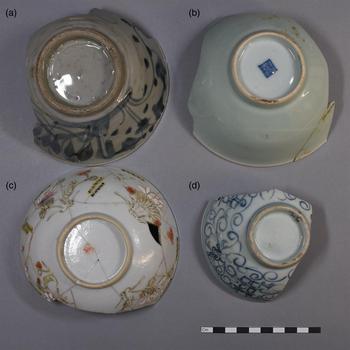
In Chinese diaspora settlements in North America, including the Market Street Chinatown, min yao vessels were dominated by four patterns: Winter Green, Double Happiness, Bamboo, and Four Season Flowers (Figure 7). These four patterns account for 98.7% of the Chinese porcelains in the Market Street Chinatown collection (Voss et al. Reference Voss, Ryan Kennedy, Tan and Ng2018:Table 2). Their decorations consist of highly stylized naturalistic symbolic motifs—plants, fruits, flowers, and rocks—that gain added meaning through repetition and specific combinations. For example, the most ubiquitous vessels—medium-sized Bamboo bowls—are decorated in qing hua (青花, blue/green flower) style. In broad brush strokes, the Bamboo pattern evokes a landscape vignette: plum tree with blossoms, rock, and bamboo grove. On the other side of the bowl, a stylized figure, possibly a Ganoderma fungus, floats in midair next to three circles, which are interpreted as representing the “three friends” of the winter season: plum, bamboo, and pine or evergreen. Together, these motifs convey resilience, strong health, and long life. Similarly, Double Happiness bowls feature the auspiciously paired 喜喜 (shuangxi, double joy) characters interspersed among flowering vines. The Four Season Flowers pattern includes peony (spring), lotus (summer), chrysanthemum (fall), and plum (winter), surrounding a ripe peach symbolizing health and longevity. Winter Green ceramics feature a green-tinted glaze that references the greenery of nature, the color of heaven, and jade (Choy Reference Choy2014).
(a) Bamboo, (b) Winter Green, (c) Four Season Flowers, and (d) Double Happiness decorations. Photo courtesy of Market Street Chinatown Archaeology Project.

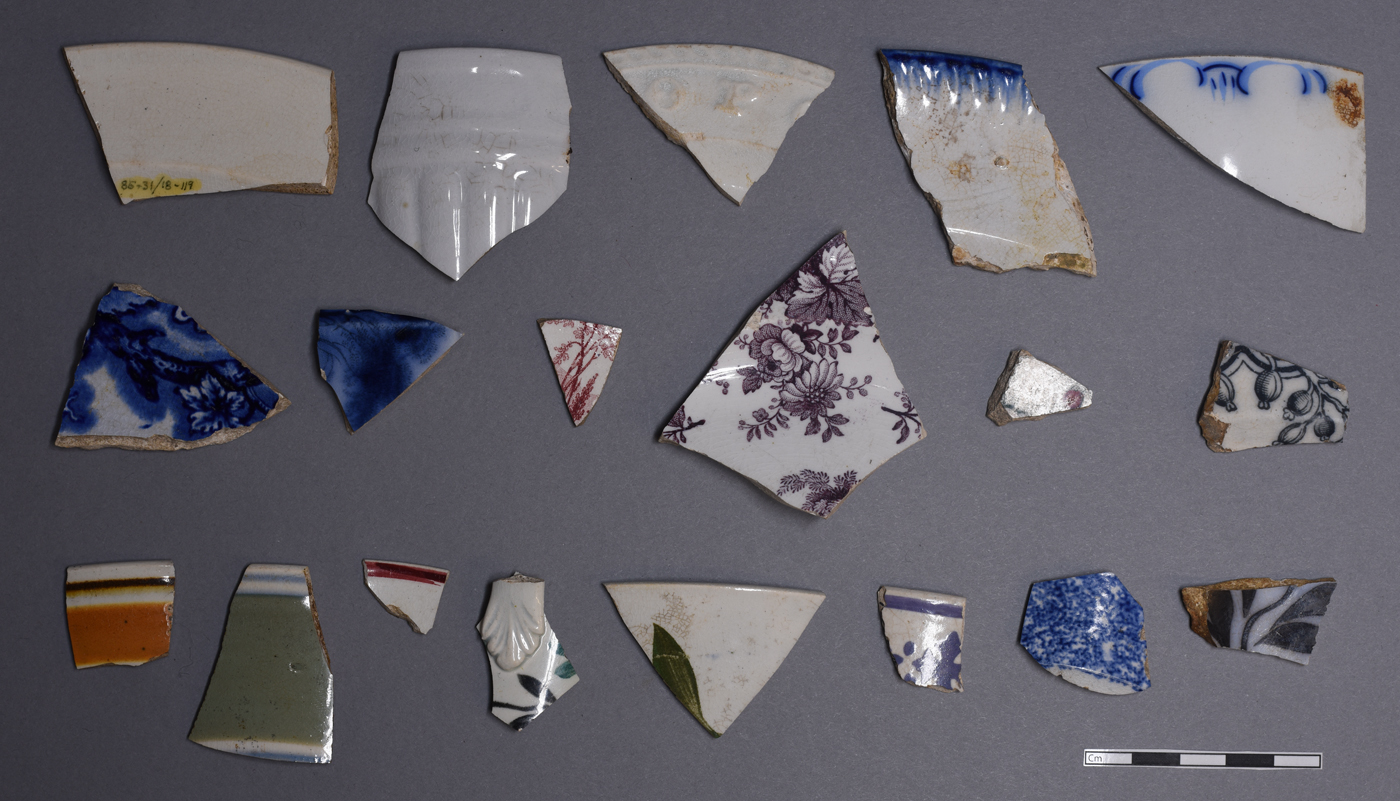
The British refined earthenwares present a very different aesthetic profile. There are no matched sets, so nearly every specimen has unique characteristics (Figure 8). Plain vessels are the most common; some have molded decorations, including impressed rim bands, paneled brims, a quarter-rose patterned rim, a portico and columns motif, and an alphabet plate. The prominence of plain and plain-molded vessels matches ceramic production trends at the time; these wares were popular during the 1850s to 1880s (Brown Reference Brown1982:6; Majewski and O'Brien Reference Majewski and O'Brien1987:153–155).
Examples of British refined earthenware sherds from Features 85-31/13, 85-31/18, and 85-31/20, showing variation in waretype, form, and decoration. Photo courtesy of Market Street Chinatown Archaeology Project.

Edge-decorated, hand-painted vessels included plain rim bands, impressed “shell-edge” (ca. 1800–1835), and nonimpressed feather-edge (ca. 1865–1895; Miller et al. Reference Miller, Samford, Shlasko and Madsen2000:12–13). Sponge-decorated vessels are all blue, as is the stenciled vessel; these designs were typically introduced in the 1840s (Majewski and O'Brien Reference Majewski and O'Brien1987:161–163). Other hand-painted vessels exhibit more intricate thick-line floral motifs (Majewski and O'Brien Reference Majewski and O'Brien1987:156–159). Slip-decorated vessels include simple bands and stripes, along with more complex mocha-swirled cats’ eyes and rouletted chevron motifs.
Transfer-printed vessels are primarily decorated in floral and landscape motifs and include blue, flow blue, black, green, purple, and red designs, with blue being the most common. Only three can be precisely dated: Cyrene pattern, a romantic Mediterranean landscape (1829–1861); a plate with a Wood & Challinor mark, featuring stylized feathers with hand-painted red and yellow accents (1828–1843); and a flow blue transfer-printed saucer bearing a Thomas Hughes mark, indicating a production date of 1860 to 1894 (Chan Reference Chan2013; Godden Reference Godden1964). Finally, two porcelaneous whiteware vessels, one from Feature 85-31/18 and one from Feature 85-31/20, are fancy teawares, distinguished from the rest of the assemblage by metallic gilding and iridescent luster finishes.
Features 85-31/13, 85-31/18, and 85-31/20 also contained fragments of yellowware serving bowls, a yellowware rectangular serving dish, and a Rockingham teapot. Feature 85-31/18 also included two small sherds of majolica and one sherd of galera, both Spanish colonial-era ceramics that were likely present as a result of mixing from earlier Pueblo-related deposits.
In summary, Chinese porcelains are decorated in a small number of familiar patterns and were likely acquired in sets or in smaller batches from Chinatown merchants who kept quantities of these patterns regularly stocked. In contrast, British refined earthenwares display extreme variety. Chinatown residents could have purchased matched sets of British refined earthenwares, but instead they acquired vessels piece by piece, both new and secondhand, selecting a mixture of decorative types and motifs. The end result can best be described as aesthetic eclecticism, in which a mixture of elements from previous styles are combined to create a new effect.
Whether intentional or not, British refined earthenwares produced an effect of visual difference—objects that may have been humorous, interesting, curious, or out of place. There is no equivalent in Chinese min yao porcelain to the bold and vibrant earth tones of slip-decorated wares, the sharply rendered geometric and landscape transfer-printed patterns, and abstract stamped and stenciled geometric patterns. The use of these ceramics in everyday dining suggests that some Chinatown residents were engaging in a playful aesthetic exploration of the intersections and disjunctures between Chinese-produced and British- and American-produced material culture.
Discussion and Conclusion
In analyzing nineteenth-century ceramics, historical archaeologists have emphasized compliance with or resistance to the formal rules of Victorian-era genteel dining. Calling attention to evidence for pragmatic choices and aesthetic play expands the scope of archaeological analyses to include goal-oriented functional analysis alongside process-oriented aspects of material practice such as curiosity, pleasure, and humor. Without question, affective states are culturally constructed and have political consequences (Cough Reference Cough2007), and affective outcomes, such as enjoyment, can be goals in themselves. Pragmatism and play are not separate; they are intertwined throughout a continuum of intention and disposition.
Were Chinatown residents participating in the “serious game” of Victorian-era genteel dining? The evidence presented here suggests that they were not, and that instead they developed new sets of house rules for dining. In summary:
1. Many Chinatown residents were familiar with the norms and practices of Victorian-era genteel dining through employment in European-American establishments and homes and exposure to missionary programs aimed at “civilizing” Chinatown households.
2. Chinatown residents varied considerably in their uses of dining-related material culture. In this sense, the use or nonuse of British refined earthenwares and other ceramics was a means through which Chinatown residents constructed relations of difference among themselves.
3. Most Chinatown residents used British refined earthenwares and other ceramics only as a supplement to Chinese porcelains.
4. British refined earthenwares and other ceramics were acquired piece by piece or in mixed batches, instead of in the matched sets proscribed by Victorian-era genteel dining.
5. Many of the British refined earthenwares and other ceramics were significantly larger than Chinese porcelains and were likely used as serving vessels.
6. British refined earthenwares contributed decorative variety to Chinatown table settings, in a manner congruent with eclectic aestheticism.
The presence of British refined earthenwares on Chinatown tables was not evidence of acculturation, emulation, or impression management. Instead, it seems that many Chinatown residents acquired large and extra-large British refined earthenwares to serve larger quantities of food than could be accommodated in Chinese porcelain serving vessels. They were, perhaps, “supersizing” their meals, enjoying a wide variety of ingredients, and—as archaeobotanical and zooarchaeological studies indicate—experimenting with novel preparations and combinations of foods. Additionally, the use of larger serving vessels would support dining in larger groups, shifting food consumption outside the nuclear family (as was typically the case in southern China) and expanding commensality to include nonkin, such as coworkers, fellow boardinghouse residents, and store patrons.
As anthropologists have long documented, who shares food with whom and in what circumstances is an important cultural barometer. Eating in larger groups may have started as a pragmatic response to the disruption of family relations caused by immigration and crowded living conditions that were common in the Market Street Chinatown. Yet this likely had unexpected social outcomes, generating new nonkin relationships and obligations that differentiated Chinese diaspora communities from village society in southern China. Historians studying Chinese diaspora communities have long noted the importance of nonkin organizations (district associations, business associations, and occupational guilds) in fulfilling the social functions that were typically handled by clan and family kinship groups in southern China (Hsu Reference Hsu2000). This study contributes a practice-based perspective, suggesting that both formal organizations and everyday patterns of domestic life were involved in the rising importance of nonkin-based social collectives.
British refined earthenwares and other ceramics contributed decorative variety to Chinatown table settings, in a manner congruent with eclectic aestheticism. The pattern of acquisition evidenced by the archaeological record—the use of both new and secondhand ceramics and the preference for unique vessels rather than matched sets—suggests improvisation, exploration, and perhaps even humor in selecting vessels to add to the visual repertoire of food-related material culture.
For archaeological analyses, Ortner's model of “serious games” provides a framework for (1) reconstructing dominant social norms—the “official rules”—within a given context, while also (2) recognizing that social actors always face multiple choices in how (or whether) to engage with such norms and (3) foregrounding the production of difference as one of the core operations of such norms. Second, archaeologists often interpret evidence through either functional/economic or cultural/symbolic frameworks. The continuum of intention represented by pragmatism and play affords an integrated methodology that encourages archaeologists to examine multiple possible motivations for and outcomes of particular actions. By attending to users’ intentions, the approach taken here highlights the lived experiences of the people being studied. A platter held by a cook when carrying a dish from the stove to a table full of hungry diners; a diner resting a bowl in one hand, with chopsticks in the other; a tablemate pouring tea from a teapot into another diner's cup: these everyday moments are processes through which both the living body and the social subject are simultaneously produced and sustained.
Acknowledgments
This study was undertaken as part of the Market Street Chinatown Archaeology Project (http://marketstreet.stanford.edu), a community-based research and education collaboration among Stanford University's Historical Archaeology Lab, the Chinese Historical and Cultural Project, History San José, and Environmental Science Associates. Conversations with Philip P. Choy and Connie Young Yu provided important cultural and historical background. Ben Baker, Willa Brock, Nicholas Brown, Sasa Caval, Stephanie Chan, Kimberley Garcia, Scott Haddow, Katie Johnson, Megan Kane, Siliang Kang, Pearle Lun, Laura Marsh, Nicole Martensen, Sara Ouenes, Annie Parker, Kate Rose, Peri Unver, and David Wintermeyer all contributed to cataloging, analyzing, and photographing the ceramic artifacts discussed here. Laura Daly provided editorial assistance. I am grateful to Debbie Gong-Guy, J. Ryan Kennedy, Mary Maniery, Ken Middleton, Virginia Popper, Connie Young Yu, American Antiquity editor Lynn Gamble, and three anonymous reviewers for their helpful commentaries on earlier versions of this manuscript. Funding for this research was generously provided by the Wenner-Gren Foundation for Anthropological Research Inc., Debbie Gong-Guy Gift Fund, Stanford Institute for Research in the Social Sciences, Stanford Archaeology Center, UPS Endowment, and Vice Provost for Undergraduate Education at Stanford University.
Data Availability Statement
The Market Street Chinatown collection and associated catalogs and datasets are curated by History San José (San Jose, California). The ceramics analyzed for this study are currently on loan to the Historical Archaeology Laboratory at the Stanford Archaeology Center, Stanford University.
Supplemental Materials
For supplementary material accompanying this paper, visit https://doi.org/10.1017/aaq.2018.72.
Supplemental Table 1. List of Minimum Number of Vessels for Feature 85-31/13.
Supplemental Table 2. List of Minimum Number of Vessels for Feature 85-31/18.
Supplemental Table 3. List of Minimum Number of Vessels for Feature 85-31/20.