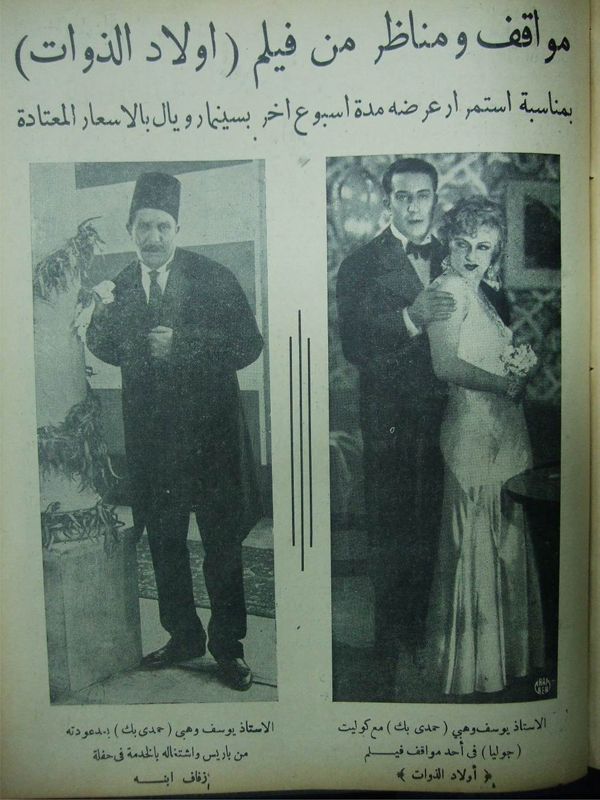
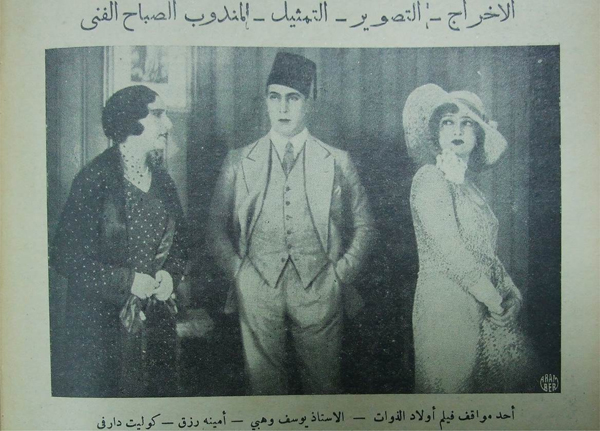
On 14 March 1932, Egypt's first talkie, Awlad al-Dhawat (Sons of the Aristocrats), opened at the Royal Cinema in Cairo. The film was the second collaboration between the trailblazer theater performer and producer Yusuf Wahbi and the film director Muhammad Karim, who first collaborated on the acclaimed film Zaynab released two years earlier. It was Wahbi's first role on the silver screen, and he recruited the celebrity theater actors Amina Rizq and Siraj Munir, and the French actress Colette Darfeuil, to star alongside him.
Marking Egypt's entry into sound film production, Awlad al-Dhawat created a flurry of enthusiasm in the press. Writers heralded it as a watershed project, a symbol of national prestige, and a sign of Egypt's ability to keep up with global cinematic trends.Footnote 1 At a time when the strengthening and diversification of national industry were high priorities, commentators lauded Awlad al-Dhawat as both a symbol of Egyptian cinematic and industrial strength, and a commodity that could propel Egypt into the global film market.Footnote 2 On the heels of this whirl of nationalist excitement, Awlad al-Dhawat became the most successful film from Egypt since the beginnings of film production there in the early 1920s. Screening simultaneously in cinema houses in Cairo, Alexandria, and Port Said,Footnote 3 the film broke the record for the most watched film during its first week, attracting over 35,000 viewers.Footnote 4 So confident was Wahbi that the film would meet global success, he made ten copies for export around the world.Footnote 5
Notwithstanding its success, Awlad al-Dhawat provoked outrage among certain audiences. Telling the story of an Egyptian man's calamitous affair with a European woman, it brought to the surface the politics of desire, gender, and race at a time when the parameters of Egyptian nationhood were being drawn in bolder lines. The debates it engendered and the anxieties it stirred brought to the surface the political, economic, and cultural tensions that characterized Egypt in the early 1930s. So controversial was the film that when the Egyptian Interior Ministry banned it in a cinema in Alexandria, protests erupted, the pressure of the crowd shattering the cinema's glass windows.Footnote 6
A combination of historical factors explains why Awlad al-Dhawat touched a raw nerve, and raised the sound, so to speak, on questions of love and desire in a colonial context. The film's novelty as a sound film heralded new sonic experiences that zigzagged their way across networks of industry, nationalism, anticolonialism, and gender. Specifically, and as I will show in this article, the technologies of recorded voice generated a new set of ideas—around the ideal woman and man, and around the place of Egyptian films globally—that were specific to both the conditions and the cinematic form of the early 1930s. Through an analysis of Awlad al-Dhawat, this article examines the way anticolonial nationalism shaped cinematic representations, especially in their gendered and racialized forms, and how they rubbed up against commercial factors and global trends.
The Coming of Sound Films
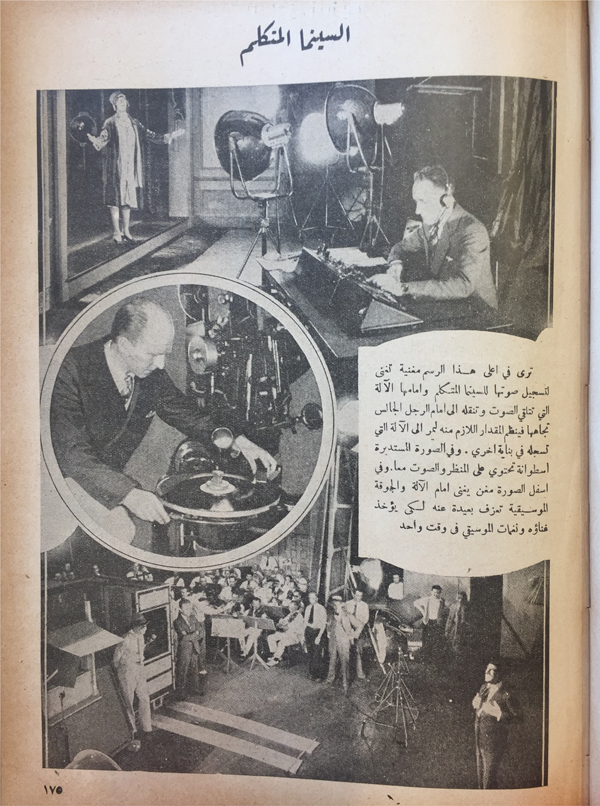
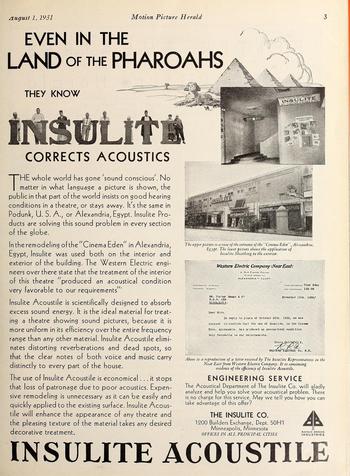
The first foreign sound films were exhibited in Egypt in 1928, less than a year after the release of the first ever talkie, the American film The Jazz Singer.Footnote 7 Egypt's cinema proprietors quickly noted the “talking” nature of films in their promotional material to attract audiences, emblazoning the words fīlm nāṭiq or fīlm mutakallim (talking film) on their magazine advertisements.Footnote 8 As in most other countries, the introduction of talkies attracted wide attention, and signalled the end of the silent film. The wiring of cinemas occurred rapidly, as cinema owners across Egypt purchased sound installation to remain competitive in the burgeoning sound film market.Footnote 9 By 1935, the market for silent films had been virtually wiped out. During that year alone 99 percent of film imports in Egypt were talkies. In 1931, 97 percent of film imports from the United States, the biggest film exporter to Egypt, were silent. By 1934, silent film imports stood at only 2 percent.Footnote 10 By 1938, all registered movie theaters, 101 in total, were wired for sound (Figures 1 and 2).Footnote 11
“Talking Cinema,” Misr al-Haditha al-Musawwara, 8 December 1928, 175.

Advertisement for Insulite Acoustile. Motion Picture Hearld, 1 August 1931, 3.

In a few short years, therefore, the entire sensorial experience of movie going in Egypt had changed. Globally, the move to sound, as Sara Byrant writes, “produced one of the most salient modernist technologies of voice,” with Hollywood promising audiences “a reintegrated sensorium and the novelty of embodied sound.”Footnote 12 Although silent film experiences were certainly not silent, the appearance of talkies propelled the importance of “listening” to dialogue, and engaged the aural perceptions of audiences in new ways.Footnote 13
Local film producers very quickly recognized the need to keep abreast with new sound technologies and slowly abandoned silent productions. Yusuf Wahbi was one of the first to sense an opportunity in the new sound film industry. Whilst cinemas were wired for sound, Egypt did not have a studio for recording sound scenes. For this reason, Wahbi traveled to Europe. After exploring options in Germany and France, he opted to begin filming the sound scenes of Awlad al-Dhawat (about 40% of the film)Footnote 14 at the Tobis Sound Studio in Paris. At the time, recording talking pictures was expensive. Wahbi reportedly spent 200 Egyptian pounds per day (a significant amount in those days, when one Egyptian pound amounted to five dollars)Footnote 15 on studio rent for five days.Footnote 16
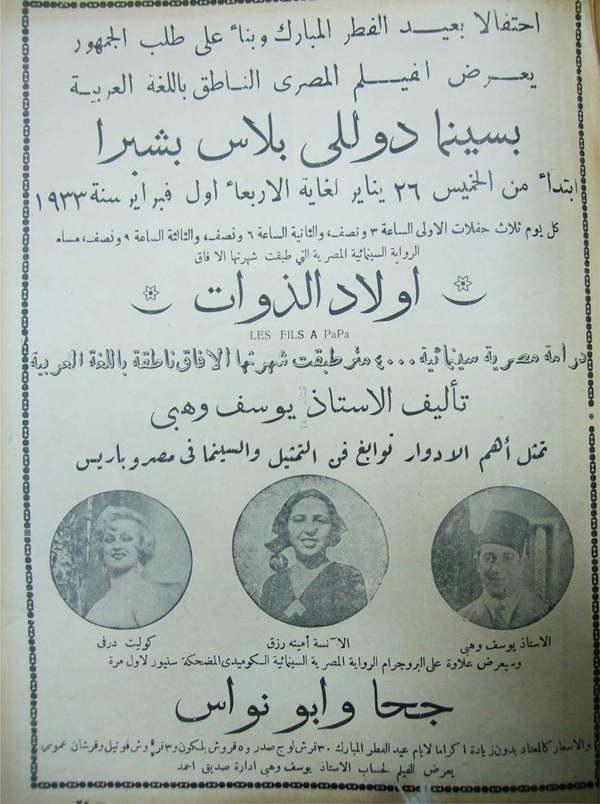
Sound technology developed in conditions of increased nationalist sentiment, merging with widespread demands for Arabic to be prioritized at the cinema. Wahbi recognized the importance of the Arabic language to many cinemagoers and emphasized it in Awlad al-Dhawat's promotional material (Figure 3). Expectations ran high. Karim, afflicted with high fever on the day of his arrival in Paris, refused to delay the shooting of the sound scenes. “It's impossible,” he exclaimed, “this is the first sound film I will direct … what would people say about me?” Calling Egyptian newspapers and Egyptian audiences “merciless,” Karim feared that people would see him as a failure who made up an illness to hide his inadequacies in filmmaking.Footnote 17 He worked through the fever, writing in his memoir: “woe to the director who because of illness stops work on the first day he directs a sound film for Egypt.”Footnote 18 Karim's description of Awlad al-Dhawat as being directed “for Egypt” drew the audience into his nationalist imagining of the film. It seems that the audience interpreted the film similarly. When the first Arabic words cracked out of the stereos during the premier of Awlad al-Dhawat, the audience burst into applause.Footnote 19
Advertisement for Awlad al-Dhawat in Dolly Palace, Shubra, Cairo. Al-Sabah, 20 January 1933, 25.

Despite its popularity and the circulation of ten copies of the film abroad, no version of Awlad al-Dhawat exists today.Footnote 20 To reconstruct the film and glimpse the politics within which it was embedded, this article pieces together information collated from memoirs, promotional photographs, press articles, advertisements, and a synopsis published in al-Kawakib (The Planets) magazine.
The Film and the Politics of National Insult
Awlad al-Dhawat follows the story of an Egyptian aristocrat named Hamdi who falls madly in love with a Frenchwoman named Julia, for whom he unapologetically leaves his Egyptian wife and son and moves to Paris.Footnote 21 Things turn sour in Paris, however, when he discovers that Julia is having an affair with another man. In a fit of rage, Hamdi kills Julia's new lover and is sentenced to fifteen years of hard labor. Twelve years pass before Hamdi escapes and returns to Egypt where he discovers his family preparing for his son's wedding. Intent on seeing his son get married, Hamdi attends the reception posed as a waiter. He suffers the ultimate humiliation by serving drinks to the guests and even earning himself a one-pound tip from the unsuspecting groom. Penitently overcome with tears, Hamdi expresses regret to his former wife Zaynab and then dies by suicide by laying himself on a tram track.
Feelings of national insult and humiliation, associated mostly with the depiction of Egyptian men, shaped Wahbi's writing of Awlad al-Dhawat. According to Wahbi, the 1923 murder of the millionaire playboy ʿAli Kamil Fahmi by his French wife Marie-Marguerite Laurent Alibert in a London hotel, and the ensuing trial, provided direct inspiration for the film.Footnote 22 The trial, which also took place in London, became a site of racialized and orientalist fantasies,Footnote 23 and provided the material against which Wahbi formulated his plot. To exonerate Alibert from the charge of murder, her lawyer, the famous British barrister Sir Edward Marshall Hall, drew his argument from a reservoir of Orientalist stereotypes, claiming that Alibert, the victim of an abusive marriage with a hypersexualized Egyptian male, acted in self-defense.Footnote 24 Hall deployed racist images of “Oriental” masculinity and white female purity to construct an idea of justice in which the Frenchwoman is owed sympathy.Footnote 25 One contemporary argued that Hall's tactics created “an atmosphere of intense sympathy for the prisoner, this fragile creature who had been in the power of this decadent Oriental millionaire.”Footnote 26
For many Egyptian critics, the racial politics that informed Hall's defense represented yet another example of how Europeans misrepresented Eastern cultures.Footnote 27 Taking place at the height of anticolonial nationalist fervor, four years after the 1919 revolution and one year after Egyptian “independence,” the case created a sensation. Al-Ahram followed the day-to-day proceedings of the trial, lamenting the smearing of Egypt's reputation and dignity (karāmat al-misriyīn).Footnote 28 Shaun Timothy Lopez argues that Egyptian responses to the Fahmi case were informed by an anticolonialism intent on defending Egyptians against colonial vilifications.Footnote 29
Egyptians who followed the events interpreted the trial and verdict as an insult to the Egyptian nation. The president of the Egyptian bar furiously sent a cable to the British attorney general condemning Hall's racist arguments as “unjust and deplorable.”Footnote 30 The attorney general brushed off the protest, claiming that the Egyptian bar “may have been misled by a newspaper summary.”Footnote 31 Hall was notified of the bar's complaint, and sent a letter to the attorney general to defend himself. He wrote:
Any attack I made was, on express instructions received through Egyptian sources, on the man ʿAli Fahmy [sic] and not on the Egyptians as a nation… . If, by any chance, in the heat of advocacy I was betrayed into saying anything that can be construed as an attack on the Egyptians as a nation, I shall be the first to disclaim any such intention, and express regret if I was so represented.Footnote 32
Despite Hall's attempts to explain away his court statements, the damage had been done.
The presiding judge, perhaps having noticed Hall's deployment of racialized sympathy, requested of the jury that it “not let fear or loathing prevent you from using your mental faculties.” Yet, despite the incriminating evidence against her, the jury heeded Hall's call to “let this woman go back into the light of God's great Western sun,” and exonerated Alibert.Footnote 33 The audience in the English courtroom erupted in triumphant cheers. A white woman had been saved from the horrors of an Oriental man.Footnote 34
Yet, there is a twist in the story that fuses the personal and the political, and adds another layer to Wahbi's motivations. ʿAli Kamal Fahmi was Wahbi's brother-in-law. Wahbi married Fahmi's sister ʿAʾisha in 1929 shortly before he wrote the play Awlad al-Dhawat, and he recalled ʿAʾisha speaking endlessly about the murder and trial.Footnote 35 Incensed at Hall's conduct during the trial, he interpreted the British public's support for Alibert as part of a wider colonial strategy of representation that disempowered the colonized: “There is nothing easier than to drown the Easterner in accusations and lies. Imperialism's main objective is to position the colonized nations [in a frame of otherness and primitiveness].”Footnote 36 What happened next provided the impetus for Awlad al-Dhawat and draws further to the surface the role that insult played in Wahbi's actions.
Shortly after their marriage, Wahbi and ʿAʾisha moved into ʿAli Kamil Fahmi's extravagant riverside palace in the Cairene island neighbourhood of Zamalek where he had lived with Alibert. Snooping around Alibert's room, Wahbi made a discovery that made the “blood in [his] veins boil.”Footnote 37 He found a bundle of letters “wrapped in a silk red bow.” Written in French, they were love letters from Alibert's French lover. Alibert was not only a murderer, but also a cheating wife. What Wahbi wrote in his memoir is revealing about the centrality of feelings of insult and humiliation at the heart of his creative impulse:
I could not find a means to resist our humiliation as Arabs except by writing a play that examines selfish foreigners … and to unmask the greed of foreign tramps [al-affaqāt al-ajnabiyyāt] who scheme their way into the beds of our young men … They hide their negative traits and attach like vipers in the beds of our nation's sons, and their aim is one: plundering, murder, and disloyalty.Footnote 38
The result was the play Awlad al-Dhawat. In his memoirs, Wahbi writes that he wrote the play in eight nights, his energy fueled by his fury at the injustice of the Fahmi case, which for him illuminated the humiliating denigrations that governed Europe's relationship with Egypt. When it was first performed in Cairo in 1929, the play caused a major stir, ran for three months, and sold out at every performance. According to Wahbi, the didactic messages of the play, which included a warning against romantic involvement with foreign women, delighted men of religion, who from mosque pulpits advised young men to attend the performance and learn its lessons.Footnote 39
The representation of the foreign woman in Wahbi's play, a classic femme fatale character, incensed members of Egypt's foreign communities. When the play was performed for the first time, foreign newspapers attacked Wahbi, and foreign embassies issued formal complaints to the Egyptian government.Footnote 40 Angry letters penned by foreigners condemning the play flowed into Wahbi's mailbox. Yet Wahbi remained unapologetic. On the closing night of the play, he gathered the letters and burnt them, and with his troupe “kept warm from the fire of bitterness and spite, [and took] revenge on the racist lawyer Sir Marshall Hall.”Footnote 41
“Julia, O Everyone's Woman, O Trash”: Foreign Women and the Demise of Egypt's Men
Julia provided the oppositional figure against which Egyptian women's respectability was constructed, Egyptian men were defended, and national dignity was upheld. With her air of nonchalance and mischief, Awlad al-Dhawat’s Julia is a one-dimensional caricature. Frivolous and bored, she chooses and loses her sexual partners without remorse. She is “everyone's woman,” “trash,” as Hamdi describes her when he discovers her affair with a Frenchman named Raymond whom she duped Hamdi into thinking was her brother (Julia, yā marʾat al-kull, yā mazbala).Footnote 42
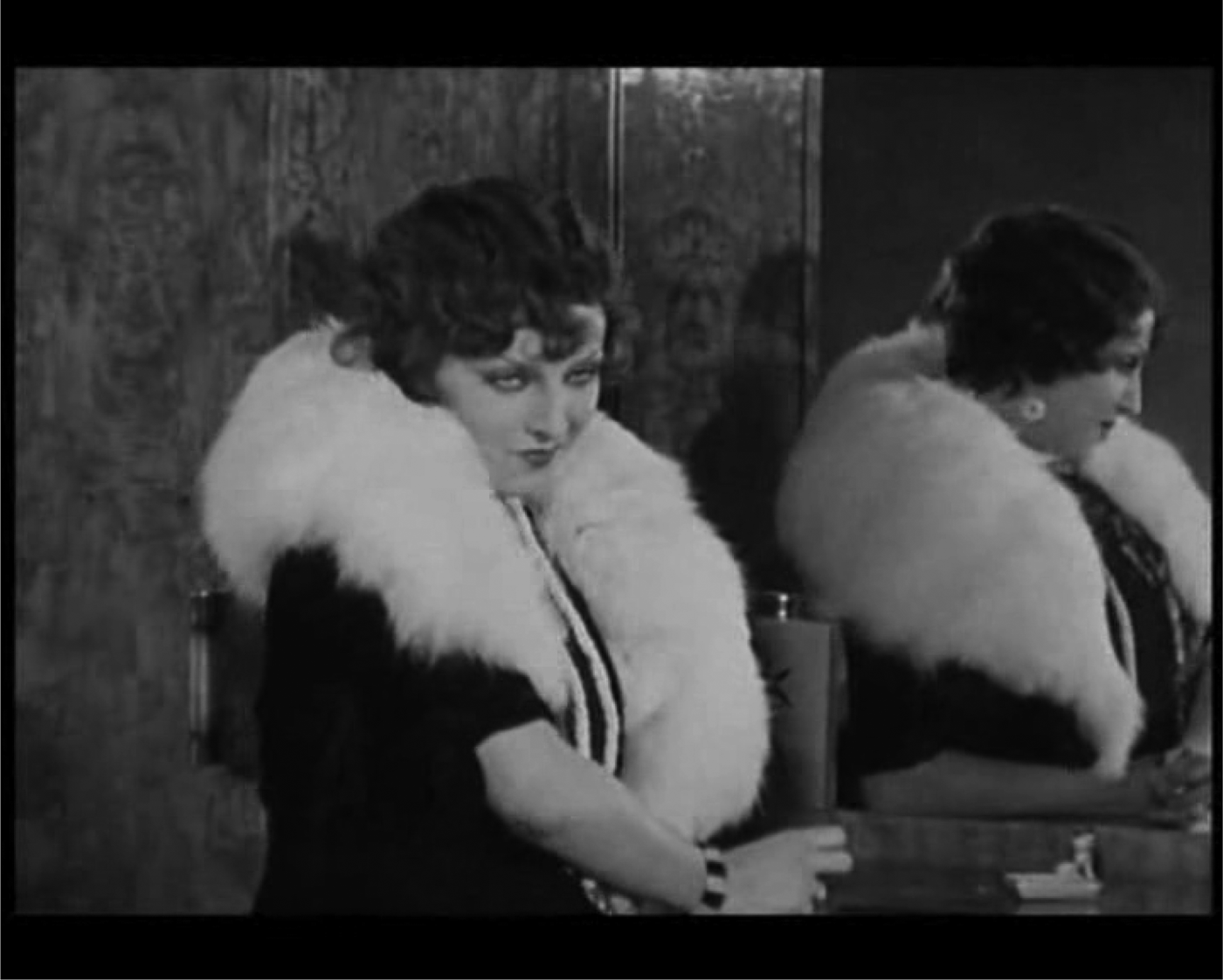
Needless to say, Awlad al-Dhawat did not create the femme fatale character, but as I will discuss in detail later, it subscribed to broader global film trends. Colette Darfeuil was also no stranger to the femme fatale role. A year before her work with Wahbi, she played a similar role in Jean Godard's 1931 Pour un soir (Figure 4), and her mannerisms in that film are similar to those in Awlad al-Dhawat (Figure 5). Published in various Egyptian magazines, photographs of Darfeuil, in her white slinky dress, her dark lipstick juxtaposed with her pale skin and short platinum blond hair, show Julia as a woman up to no good. Melodramatic in composure, she often does not look straight into the camera, but glances mischievously to her side—a clear spillover effect from silent film gestures.Footnote 43 In one shot, she is standing defiantly with a pipe in her hand, in front of a statue of a black panther, bespeaking her predatory nature (Figure 6). In another, she simply looks indifferent (Figure 7). In yet another, published in al-Kawakib magazine, she lays playfully on Yusuf Wahbi's lap.Footnote 44 Although Colette Darfeuil mastered the femme fatale character, Karim had to ensure that she did not cross any censorship lines. In one of the film's scenes, Darfeuil, without instruction to do so, kept slipping down the top of her nightgown to reveal what Karim thought was too large a section of her décolletage.Footnote 45 “The people would like it,” Darfeuil exclaimed. But Karim protested that the Egyptian censors would not allow such a scene, and the shot had to be redone twice before Darfeuil complied with Karim's instructions.
Colette Darfeuil in Pour un soir (For One Night), directed by Jean Godard, 1931.

An advertisement for Awlad al-Dhawat. Al-Sabah, 25 March 1932, 15.

Colette Darfeuil as a Femme Fatale. Karim, Mudhakkirat, 166.

Hamdi between his Egyptian Wife and Foreign Mistress. Al-Sabah, 18 March 1932, 24.

Wahbi also portrayed Julia as a poor or working-class Parisian.Footnote 46 In the film, Julia meets her Egyptian husband Amin in a dance hall in France.Footnote 47 Without a copy of the film we cannot know for certain to what extent Julia's class background proved significant to the story, but Wahbi hints in his memoirs that it played an important role. He wrote,
I wish to turn the reader's attention to the fact that I did not mean through the play to generalize and disgrace all foreign women or wives for lack of loyalty… . I only meant it to be a warning, when it comes to choices, against picking up wives from streets and nightclubs, and from falling into the claws of reckless tramps.Footnote 48
In representing Julia, Wahbi therefore drew upon interwoven stereotypes of race, gender, and class that shaped Egyptian descriptions of foreign woman. Media sources during this period indicate a widespread fascination with and angst about Egyptian men's relationships with foreign women. Hanan Kholoussy has examined this angst and argues that the debates generated ideal visions of female and male gender roles.Footnote 49 Indeed, the matter even reached legislators’ ears, and in 1933 a law was passed prohibiting Egyptian diplomats from marrying foreign women to prevent them from causing shame to the nation.Footnote 50
In 1927, the wife of a certain ʿAli Shukri Khamis Bey wrote an article subtitled “Khatar Yuhaddid al-Qawmiyya al-Misriyya” (A Danger Threatening Egyptian Nationalism) in the woman's magazine al-Marʾa al-Misriyya (The Egyptian Woman). Her article warned men against marrying Western women and highlighted the importance of protecting the nation's well-being and the purity of “Egyptian blood.” She expressed sadness that young Egyptian men took their nationalism so lightly, while other nations safeguarded their nationalism by frowning upon mixed relationships.Footnote 51
An article in al-Sabah (The Morning) magazine, published in January 1933, stated that: “The foreign wife does not prefer marriage to an Egyptian man, except for one reason, to take his wealth, which she will use to adorn herself and to spend. And when he becomes bankrupt, she will be the first to wash her hands of him.”Footnote 52 When foreign women were not directly accused of social deviance, they were seen as initiators of relationships, desperate to marry their Egyptian male lovers.Footnote 53 Kholoussy argues that although Egyptian writers may have sometimes praised European women for being good wives, there was greater consensus that marrying a foreign woman was bad for the nation.Footnote 54 As the ultimate apotheosis, Egyptian men should avoid marrying European women because, as one Azhari shaykh put it, children from such a union would imitate the European mother's “love of colonization.”Footnote 55
Just as it had during its stage run, the film adaptation of Awlad al-Dhawat angered Egypt's foreign communities, many of which sent complaints to the Egyptian Interior Ministry.Footnote 56 Foreign embassies lodged official complaints to the Egyptian government. Criticisms of the film and its depiction of foreign women also spilled onto the pages of Egypt's non-Arabic press, which received a flood of letters from disgruntled readers about the film's representations of Europeans. The English-language Egyptian Post went so far as to label Wahbi “an extremist, from amongst the archenemies of the West.”Footnote 57 In an article entitled “Extremism in the Cinema,” one foreign newspaper scoffed at the film for its “old and laughable” techniques, and described it as propaganda in the variety of Russian Communist films. It continued that “the purpose of the film was to incite hatred for the foreign woman, especially the French woman, by representing her as a home wrecker, leading man—her victim—to destruction, crime, and death.”Footnote 58
The dismantling of white female purity struck a blow to colonial imaginings of gender norms. Although antimiscegenation laws did not exist, there was sensitivity to representations of European women, centred especially on the Egyptian male's gaze. As early as 1917, British residents voiced concerns about the representation of women in foreign films screened in Egyptian cinemas. In a letter to the Egyptian Mail, one writer condemned European films that were being screened in Egyptian cinemas out of fear for how they might affect Egyptian perceptions of European women:
As it is, a splendid picture is exhibited to the native population of what the European woman is not, but unfortunately with most persuasive force to make him take it for a genuine likeness. European civilization must appear a queer fish to your Egyptian, when a man of the world is supposed to have no other place of amusement, or even for his meals, if he dines away from home, but gilded palaces of infamy where women sprawl in stranger's arms and dance lewd can-cans on tables or among seated guests.Footnote 59
The anonymous author of the letter specifically worried about the supposed denigration of European women among the “natives,”Footnote 60 and was especially dismayed by film posters that featured “society women in attitudes that should make every European blush.”Footnote 61 The author also worried that these images of European women might undermine “the much vaunted superiority of our social system.”Footnote 62
In the late 1920s, coinciding with the rise of cinema venues and international film distribution, the British Board of Film Censors issued stringent rules governing the portrayal of the empire in British films. Scenes that would bring the British army or the “white race” into disrepute were deemed unacceptable, as were scenes considered to have potential to inflame tensions in the colonies.Footnote 63 Films that included scenes of “equivocal situations between white girls and men of other races” were also stringently controlled.Footnote 64 As Poonam Arora has shown in the Indian context, the British were particularly sensitive to any films that contained negative images of European women because they believed that such images were an attack on the “prestige of the empire.”Footnote 65
Notwithstanding the strategic selection of producers, Awlad al-Dhawat ruptured European fantasies of white female purity. It reversed colonial imaginings of Egyptian masculinity and colonial visions of miscegenation that represented Arab men as oversexualized and a threat to the purity of white women. When Wahbi described foreign women as “vipers in the beds of our nation's sons,” he upended the normative imperial narrative by positioning the Egyptian male as the sexual victim of the European woman.Footnote 66 Awlad al-Dhawat, therefore, reordered the gendered dynamics of colonial desire, providing in turn anticolonial ideas of marriage, relationships, and love.Footnote 67
Awlad al-Dhawat straightjackets desire, sex, and marriage, constraining representations of Egyptian women. Loyalty and passionlessness are key characteristics of female respectability that defined the normative behavior of the “good” woman.
Zaynab: “The Destroyed Wife” and the Domestication of Women
Awlad al-Dhawat is predicated on the binary of loyal mother/wife and frivolous whore. Zaynab's characterization formed part of a broader anticolonial gendering of morality in which native or indigenous women were positioned as symbols of the nation's purity. Awlad al-Dhawat constructs Zaynab as the embodiment of the ideal Egyptian women: the good mother and wife, who, with patience, overcomes and forgives her husband's mistakes. The film first introduces Zaynab on her return home in Cairo after spending time away taking care of her sick mother in Alexandria. From the start, then, Zaynab personifies the ideal feminine trinity of good wife, mother, and daughter. Even the choice of name, Zaynab, anticipates a particular characterization linked to tradition and authenticity. The name Zaynab had already been linked to such characterizations through Karim and Wahbi's first film Zaynab, an adaptation of Muhammad Hasan Haykal's novel from 1914. Zaynab celebrated the ideals of “proper” modern femininity and garnered a whirl of attention.Footnote 68 It starred Bahija Hafiz, an ambitious, French-speaking musical composer whom Karim first noticed at a party.Footnote 69
In its detailed description of the film's storyline, al-Kawakib magazine reproduced the binary for its readers, and politicized affection and passion, delineating their exchange value. Whereas the magazine described Zaynab as “the destroyed Egyptian wife, mourning her stolen love,” it described the “foreign woman” as she who is “glaring in her disregard … and who sells her affections/passions [hawāhā] to whoever pays.”Footnote 70 Zaynab's love is perceived to be pure, given in exchange for nothing. Julia's “affections/passions” are a commodity to be bought.
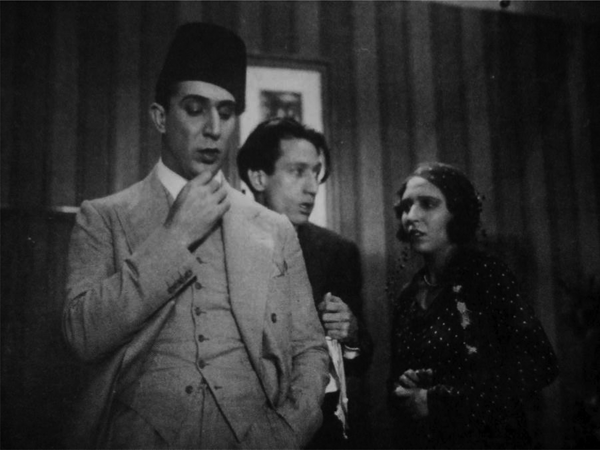
Zaynab represented nationalist visions of the ideal modern Egyptian woman and female citizen. Educated, maternal, and loyal, she embodied wider visions of women's rights and empowerment.Footnote 71 Awlad al-Dhawat criticizes male behavior and absolves Egyptian women of any responsibility for undermining the family unit. In promotional material, Zaynab is shown in dark, modest clothing, and appears innocent (Figures 7, 8, and 9). In upholding this notion of womanhood, the film polices female behavior, hemming it into frames of innocence and respectability.
Zaynab Sitting on Hamdi's Lap during a Scene in Awlad al-Dhawat. Karim, Mudhakkirat, 186.

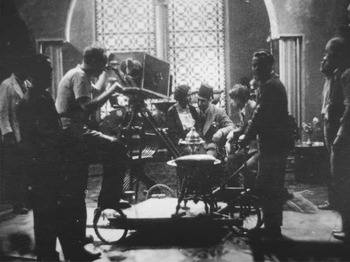
Karim Giving Wahbi and Rizq Instructions during the Filming. Karim, Mudhakkirat, 183.

By contrast, writing in al-Malahi al-Musawwara (Attractions Illustrated), a certain Muhammad Tawfiq Gharib felt that the character of Zaynab left much to be desired. She was “weak and ignorant,” sitting idly by as her husband left her. For Gharib, such passivity, far from an ideal position, undermined the modern image of the Egyptian woman. He argued that Zaynab, rather than allowing herself to be victimized by her husband, “should have had more self-worth [ʿizzat al-nafs] … to safeguard it and defend her interests and honor.”Footnote 72 Drawing on notions of national reputation, Gharib also contended that the image of Zaynab was detrimental to the reputation of the “enlightened” Egyptian woman (al-misriyya al-nāhiḍa) and counterproductive to the film's representations of Egypt's “modern life that is founded upon freedom and equality.”Footnote 73 Gharib's perspective reveals the cracks in understandings of what constituted a modern Egyptian woman. For him, a modern Egyptian woman was not a victim of men, and any such suggestion would be an insult to Egypt's perceived modernity. However, Gharib's disapproval proved inconsequential. Tethered to the exaltation of women's domestic role, the image of the victim mother and wife flourished in Egyptian cinematic representations, and resonated with audiences. In fact, Rizq became typecast in that role for the rest of her career.
The implications of these representations were a desexualization of Egyptian women in matters of romance and passion. The cinematic construction of Egyptian women as pure, innocent mothers placed them low in the hierarchies of sexual desire and in sexual capital, but perched high on the maternal and familial mantle. It is no surprise, then, that Egyptian film directors never represented “good” Egyptian women as sexually or romantically available to foreign men; the thought was inconceivable to them.
The need to juxtapose Julia to a quintessentially Egyptian woman—grounded in Egyptian values—may explain why Karim winced at the initial selection of actress Bahija Hafiz for the lead role of Zaynab.Footnote 74 During the shooting of the film, Karim grumbled that Hafiz was not acting in the manner he wanted, and worse still, she was pronouncing her Arabic words incorrectly. The introduction of sound film in Egypt at a time of rising nationalist sentiment meant that the locally made films not only had to look genuinely Egyptian (this look, as we have seen, was not easily defined) but also had to sound Egyptian. By the time of the film's release, there was a surge of discussion taking place about the importance of the Arabic language. Indeed, in December 1932, eight months after the release of Awlad al-Dhawat, Egypt's Arabic Academy was established in an effort to facilitate scholarship on the Arabic language.Footnote 75 Because of her French education and upper-class upbringing, Hafiz spoke Arabic with a heavy accent, making her the butt of jokes in the Arabic press.Footnote 76 With such importance placed on the Arabic language at the time of the film's making and release, it may have been unwise to have the quintessential Egyptian female character personified by an actress who spoke Arabic in a way deemed incorrect.
The Voice and Ideal Femininity
But it was not only Hafiz's pronunciation that ailed Karim. He did not think she acted well. But more importantly, as he wrote in his memoirs, her “incapacities of voice” were one of the reasons he did not want her for the lead role. In a very public spat, Wahbi called Hafiz a failure on set, stuttering and mispronouncing lines—of which he claimed to have recorded evidence. Such was the intensity of the criticism that Hafiz felt she needed to defend herself from rumors about her voice.Footnote 77 What Karim meant by “incapacities of voice” is unclear; but the reference indicates the existence of an already developed idea of what constituted the ideal voice. As Amy Lawrence, Michel Chion, and others have convincingly argued, recorded voices are loaded with ideological and contextual constraints.Footnote 78 “Just like the body,” writes Jessica Taylor, “which is increasingly viewed as something which must be historicized and contextualised, ‘the voice’ is not a natural object, but a discursive category (with physical manifestations) which is produced in particular moments in time and space.”Footnote 79
Karim's comment must be positioned within a wider context of the politics of the female voice. Talking films were part of a network of sound technologies: gramophones and the telephone service, for example, both of which engendered deep anxieties about the voice of women.Footnote 80 As On Barak has demonstrated, female telephone operators were often criticized for disrupting time, and taqāṭīq, short, often wry songs by women about the follies of men that were enjoyed by a large market of the middle class, provoked anger and resentment.Footnote 81 The recorded voice of women was therefore not new, and in fact gramophone companies prioritized their female singers more than male singers (Figure 10).Footnote 82 The specific time in which talkies emerged in Egypt determined the ideological slant of the voice. Although gramophones gave women the ability to tease and upend conservative mores, the sound film appeared at a time when morality, nationhood, and what it meant to be a good Egyptian were defined in bolder ways. It is perhaps not a stretch, therefore, to read the very specific intonations and voices of women in early Egyptian cinema as having marked a deliberate break from these rude and blush-worthy songs of the taqāṭīq era.
Misr al-Haditha al-Musawwara, 22 April 1929, backpage.

Regardless of what Karim thought of Hafiz's capacities of voice, he was surely relieved when, in a stormy outburst, or in a malicious attempt to force her out, Hafiz quit the film and returned to Egypt, where she filed a suit against Wahbi for contractual violations.Footnote 83 Wahbi did not take the matter lightly. As part of their public row, he countersued Hafiz for monetary loss, and even threatened to play the recorded sounds of her stuttering in court and in theaters as evidence of her inadequacy to play the part of Zaynab.Footnote 84 In the meantime, Wahbi invited the actress Amina Rizq to Paris to replace her. Throughout her career, Amina Rizq's lingering sighs and wails, for which she became famous, personified and gave sonic expression to the downtrodden good woman, the silent sufferer and martyr of men's menaces.Footnote 85 By the late 1930s, after a series of disappointing attempts to break into the film market, Bahija Hafiz moved away from the filmmaking world. She worked on a film in 1947, and then appeared in one last film in the 1960s.
Egyptian Female Spectatorship and Awlad al-Dhawat as a Defense of Women
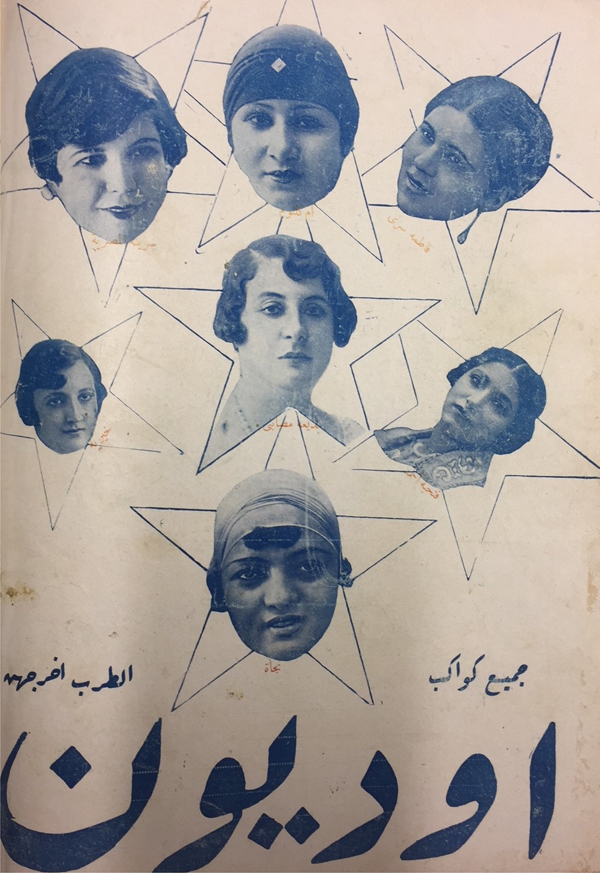
Egyptian women attended screenings of Awlad al-Dhawat in unprecedented numbers—a “strange” occurrence according to the proprietor of the Royal Cinema.Footnote 86 Several factors may explain why Egyptian women embraced the film so enthusiastically. For one, the increasing consumption of cinematic culture by women during this period was bound to women's increased foray into education as well as public and commercial spaces, and their access to a press culture that specifically targeted their purchasing power. From 1896 theater owners capitalized on the consumption potential of the female market by offering women-only sessions.Footnote 87 At the time of Awlad al-Dhawat’s release, women-only sessions were a common feature at cinemas. Increasingly women also accessed film news through women's magazines such as al-ʿArusa (The Bride) or general magazines such as al-Sabah and al-Kawakib.
More importantly, recognizing their lucrative purchasing power, Wahbi targeted women in his marketing campaign for the film. In December 1931, when Wahbi appeared in a film advertisement to announce the release of Awlad al-Dhawat, he described the film as a defense of the Egyptian woman “in the face of Egyptian men who encroach upon her rights and prefer the foreign woman instead of her.”Footnote 88 In his memoirs, Wahbi also noted that the initial play was “a passionate defence of our dignity and of the Egyptian woman's loyalty and the greatness of her sacrifice, and her loyalty to the partner of her life.”Footnote 89
Egyptian women's spectatorship of Awlad al-Dhawat may have also been linked to anxiety over Egyptian men's relationships with foreign women. Hanan Kholoussy has demonstrated that debates about mixed marriages in the Egyptian press from the early 20th century were “primarily constructed by indigenous women.”Footnote 90 She argues that the debates provided an entry point through which women expressed certain attitudes about gender and modernity. But the character of Zaynab also opened avenues for women to criticize wider social constructions of female desirability, finding in nationalist rhetoric not a limitation but a sense of ennoblement.
Commentators used the issue of mixed marriages to critique the role and place of women in Egyptian society, and to call for female empowerment and education so that they might better compete with European women. Awlad al-Dhawat engaged with these debates, not by blaming Egyptian women for driving men into the arms of foreign women, but by criticizing and punishing men for being weak in the face of foreign seduction. Yet, in celebrating Egyptian women, the film did not radically criticize patriarchy. Instead, it reinforced the value of traditional gender ideals.
Awlad al-Dhawat may have been made for women, but it was also implicated in the process of sidelining women in the creative and commercial process. Bahija Hafiz's fate in the film is a case in point. A rabble-rouser who was on the margins of acceptability, Hafiz possessed a voice and a form of spoken Arabic that had no place in the sounds of the nation as represented in film. She found no acceptance in the aural repertoire of nationalism. The embodied female voice had to be controlled and funnelled into a normative sound. Whereas she rose to stardom in the early part of her career producing, directing, starring in, and composing music for films, she found no place in the industry as the arena of filmmaking expanded.
Wahbi's fallout with Hafiz points to the beginnings of not just an ideological narrowing of perceived gender roles, but also institutional changes in the film industry that marginalized women.Footnote 91 In the late 1920s and early 1930s, women in Egypt marked their presence in film production in hierarchically dominant positions as producers and directors. Within a decade, many of these women, including Hafiz, either disappeared from high positions or became disproportionately outnumbered by men. The reasons for this are multilayered, accounting for both personal and institutional factors. But Wahbi and Karim's attempts to rein in Hafiz's behaviour, the comments about her inappropriate accent, and Wahbi's threat to publicly shame her for her stuttering may have signalled the changing attitudes within the industry that enabled male domination. In addition to Wahbi'ssly comments about Hafiz's rich-girl antics and needs—her fainting on set, her first-class cabin tickets to Paris, and her desire for a fitting room on set—his obsession with the costs of the film signalled new financial models of filmmaking. The costs of making Awlad al-Dhawat were unprecedented in Egypt—and signalled new high-stake private investments in the filmmaking industry that would shape it for years to come. Although beyond the parameters of this study, one may raise questions about whether the coming of sound technology, and with it a solidification of women's ideal social roles, as well as cinema's entanglement in newer forms of capital and the strengthening of a clique culture—especially the seeming rise of a boy-club culture—pushed women out or discouraged them from taking higher positions in the filmmaking process.
Regardless, Awlad al-Dhawat as both a text and a commodity underlines the tensions of female disempowerment within a context of increased female purchasing powers. Cinema going confined women within a cinematic nationalist trope of national honor and purity, and closed spaces for their creative output. But it also opened space for women within a consumer economy. Awlad al-Dhawat valorized women's domestic roles, yet its very nature as a film required women to leave their homes, travel using Egypt's transport system, spend capital, and partake in a communal activity within a public space. The enthusiasm of women for Awlad al-Dhawat thus sheds light on their precarious position in Egypt at the beginning of the 1930s, as cinemagoers, as consumers, and as the maternal symbols of a nation that placed restrictions on their bodies and movements, but not on their wallets.
Hamdi and Egypt's Lost Masculinity
Although Wahbi promoted Awlad al-Dhawat as a defense of the Egyptian woman, the film was deeply invested in constructions of ideal Egyptian masculinity. Experiences of masculinity in Awlad al-Dhawat revolve around the humiliation of Egyptian men by foreign women. Julia humiliates Hamdi, as well as her first Egyptian husband Amin, who complains at the beginning of the film that she has “dishonored his dignity.”Footnote 92 The foreign woman—with both her colonial and her feminine powers—had the potential to sap and destroy weak Egyptian men. The film links the dignity of the Egyptian nation to the loyalty of Egyptian women to their men. Foreign women undermined the dignity of Egyptian men. In this regard, Julia is a product of Egyptian masculine colonial anxiety, and embodies a double threat to Egyptian virility. She epitomizes the threat of powerful women in a context of increased women's rights, and the castrating threat of colonialism. Her emasculation of Hamdi becomes a symbol of the emasculation produced by colonialism. As a gendered attack on colonialism, the film, therefore, raises the stakes concerning the threats posed to the nation's masculinity, and in doing so engages in a construction of the ideal man in modern Egypt.Footnote 93 Whereas Amin's manhood is resurrected when he marries Zaynab, Hamdi's manhood does not fare so well. Awlad al-Dhawat’s representation of ideal Egyptian masculinity is, therefore, predicated on the disapproval of what Hamdi stands for: a weak man who is easily duped.
In Egypt, the crisis of masculinity, deeply tied to the colonial context, expressed itself as a crisis of representation. Years after its production, Wahbi claimed that Awlad al-Dhawat was made to purposely dispel Sir Marshall Hall's descriptions of Eastern men as “barbaric, savage, and insignificant,” and prove the “opposite” to be true. It would show that the gold-digging foreign woman has “no dignity, honor , credulity, or loyalty.”Footnote 94 By depicting the male Egyptian protagonists in the film as the victims of sinister foreign women, Awlad al-Dhawat embodied a proverbial attack on colonial imaginings of Egyptian men that often posited them as licentious, profligate, and violent misogynists who abuse their wives.
It is interesting that Wahbi chose to represent the violence of Egyptian men by making Hamdi murder Julia's lover in a fit of jealous rage. The sudden realization of the humiliating relationship in which he is entwined acts as the impetus for Hamdi's violence. The murder of the French male lover does not point to the inherent violence of the Egyptian male; rather, it represents the violent outcome of Hamdi's, and by extension the nation's, injured sense of dignity.Footnote 95 Yet, through his emotional grip and by committing a murder, Hamdi has abandoned the ideal image of a modern Egyptian man.
Far more than an elucidation of Hamdi's descent into unmodern crime, his violence towards both the foreigner and himself (through suicide) is a complex commentary on revolutionary violence. If the film is a gendered critique of Egypt's relationship with European colonialism, then Hamdi's violence is a gloomy forecast of the violent processes of liberation. In the struggle to regain his dignity, Hamdi engages the destruction of both the foreigner (who humiliates) and himself (the humiliated). He kills the foreigner, Julia's French lover, and in the process removes himself from modernity by operating outside of the law. Functioning outside modern institutional frameworks, he becomes an outlaw. More significantly, Hamdi carries out the ultimate act of harm on the self by taking his own life. His death is a sacrifice for the rejuvenation and rebirth of a new generation of modern Egyptian men. Nowhere is this message clearer than in the film's final scenes, as the shot of Hamdi's suicide synchronizes with his son's first wedding kiss.Footnote 96 It is at the precise moment of his father's violent death that the son begins his life as the devoted husband to an Egyptian woman.
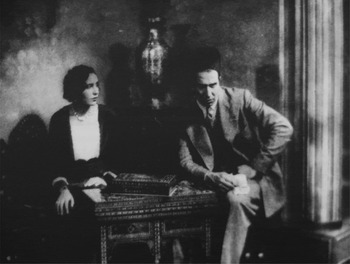
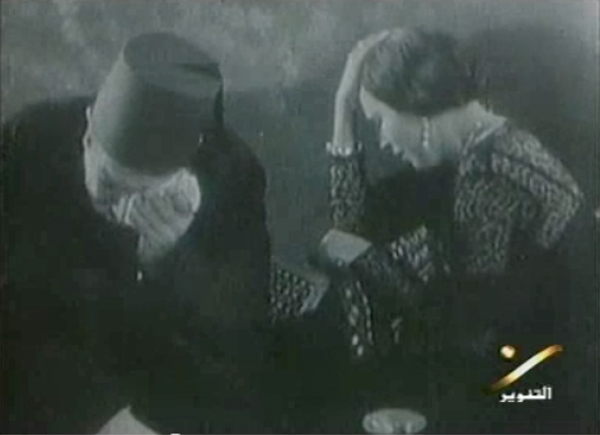
Responding to Western denigrations of “brutal” Egyptian men, therefore, Wahbi demasculinized his male protagonist and punished him for that demasculinization. Hamdi is no longer the ideal Egyptian male. The act of demasculinization also has class ramifications, as Hamdi is demoted to a servant at his son's wedding. Hamdi's demotion is captured well in one film advertisement published in al-Sabah (Figure 5). The advertisement features two photographs, each representing a different stage of Hamdi's life. The first depicts a young, naive looking Hamdi, posing with a blank expression on his face next to a treacherous-looking Julia. He is clean shaven and wearing a dinner jacket. In the second, Hamdi poses as a servant. He stands with a slight slouch and a regretful expression on his face. Wahbi's descent into humiliation is also captured well vis-à-vis his relationship with Zaynab. His characterizations in the film blatantly illustrate his social descent. Whereas in the beginning of the film, Hamdi is represented as an ungrateful and stubborn husband (Figure 11), by the end he is a broken man, weeping in front of his former wife (Figure 12).
Karim, Mudhakkirat (2006), 177.

“Muqabala Qadima Maʿ Yusuf Wahbi,” YouTube video, accessed 18 October 2018, http://www.youtube.com/watch?vXii3bGgKmtI.

With his dignity tarnished, his social position lost, and his merits as a law-abiding citizen in ruin, Hamdi has no place in Wahbi's modern Egypt. He eventually acknowledges the bad choices he made—e.g., leaving his Egyptian wife for a foreign woman—but the film does not forgive him, and he is sentenced to his final tragic and violent fate. The Belgian-owned trams in front of which he throws himself, which crisscrossed the city with frightening speed and connected diverse peoples, become the ultimate symbol of the potential destructiveness and monstrosity of the colonial modernity in which Hamdi's predicament is embedded.Footnote 97 Although the film does not pardon Hamdi for abandoning his family and his nation, it nonetheless sets him up as a victim. In one of the film's final scenes, Hamdi expresses his regret to the wife he abandoned, and inspires sympathy in the audience for the path that he followed.Footnote 98
In Awlad al-Dhawat the dignity of the nation is thus significantly bound to the behavior of Egyptian men.Footnote 99 For Wahbi and his audience, Hamdi's desire for Julia is a humiliation and an insult to the pride of Egyptian national identity because it perpetuates feelings of unworthiness amid an anticolonial struggle. These cross-cultural encounters on the screen allow us to reassess our understanding of the representation of men in anticolonial rhetoric, not so much as the upholders of national dignity, but as subjects who can easily tarnish it. The film, then, calls for the regulation of Egyptian male desire, and contends that it is the national interest that dictates to whom the Egyptian male should and should not have sexual access.Footnote 100
Alongside his victimization by Europeans, the film deploys Hamdi as a stinging critique of the aristocracy. Its title makes this obvious, even more so when we learn that it was initially translated into French as Fils a papa (Rich Daddy's Boy). The film condemns the excesses, foolishness, and misplaced desires of aristocrat men, and can be read as part of a broader dialogue with interwar constructions of ideal manhood and claims to ostensibly correct modes of modernity.Footnote 101 Neither Wahbi nor Karim were ever divorced from these social constructs, positions, and, perhaps more importantly, “effendi” performances. Karim's work on Zaynab brought to the surface his own effendi sensibilities, the apotheosis of which was realized in his cinematic collaboration with the crooner Muhammad ʿAbd al-Wahhab during the 1930s and 1940s. The films they produced centralized ideal effendi masculinities.Footnote 102
Aside from local constructions of manhood, Hamdi's character significantly points to an engagement with the global anxiety of masculinity. A product of international and local influences, Awlad al-Dhawat, like many European fallen-man films, typified and engaged with a broader discourse about the crisis of masculinity in the interwar years.
The Commercial Context
As considerations of female spectatorship indicate, motivators for cinematic representations cannot be simply collapsed into ideological imperatives. Although a sense of injured pride provided the immediate impetus for Awlad al-Dhawat’s representational logic, Wahbi's construction of his characters in the film and the nature of the promotion were also embedded in commercial conditions and international film trends. The timing of the film's release can provide some clues as to the nature of this intersection. Here we must recall the murder of ʿAli Fahmy that initially influenced Awlad al-Dhawat’s plot. In his memoirs, Wahbi claimed to have moved in with ʿAʾisha Fahmi, ʿAli Fahmi's sister, around the 1929–30 theater season.Footnote 103 This means that he moved in with her, and found the bundle of French love letters, more than six years after the case in London took place. It could also mean a slight memory inconsistency on the part of Wahbi. Whatever the case may be, although Wahbi credits the 1923 Fahmi case as his source of inspiration, it took him another six years to write the play and bring it to the stage.Footnote 104 This insight forces us to shift our historicization of the play, and raise questions about why Wahbi chose to draw upon the ʿAli Kamil Fahmi story for inspiration six years after the trial. Why did the Fahmi case spark a creative cord for Wahbi years after the event? In terms of the production of the film itself, it raises another important question. If Wahbi, a prolific playwright since 1923, had a corpus of plays from which to choose for adaption into Egypt's first sound film, why did he select Awlad al-Dhawat? Wahbi's choice depended upon historical factors specific to the early 1930s, including economics and international cinematic trends, as well as a wide repertoire of available symbols in 1930s Egyptian mass culture. In short, commercial opportunities and cultural attitudes governed Wahbi's decision to bring Awlad al-Dhawat to the silver screen.
Commercial and economic interests tied to the expanding international and local film market in 1931–32 informed the choices made in shaping and promoting Awlad al-Dhawat. By the time Awlad al-Dhawat was released, Egypt's film market had experienced dramatic growth.Footnote 105 In 1932, seven locally made feature films had been produced, the highest annual output by that time.Footnote 106 Yet, foreign films still dominated the film market, and certain genres and themes were particularly fashionable. When Wahbi chose to make Awlad al-Dhawat, he was tapping into an already popular international film genre that centred on the downfall or humiliation of good men at the hands of women; Janet Staiger has termed the genre the “fallen-man film.”Footnote 107 Reflecting tense anxieties about the “new woman” and a crisis of masculinity, German cinema of the 1920s especially popularized the trend.Footnote 108 Karl Grune's 1923 The Street, Joe May's 1929 Asphalt, and Josef Von Sternberg's 1930 The Blue Angel represented men lured to their demise by tempting vamps. Some of these films were screened in Egypt.Footnote 109 The success and prevalence of this theme in German cinema is important to consider because Karim studied filmmaking in Germany during the 1920s. He had worked on the set of Fritz Lang's Metropolis, which also involved the story of a femme fatale character causing the demise of an entire city.Footnote 110 Whether these German films directly influenced Karim is unknown, but their international popularity at the time of Awlad al-Dhawat’s release is important because by using a formulaic narrative that had proven internationally and locally successful, Awlad al-Dhawat’s filmmakers attempted to capture a growing film market in Egypt and Europe. In addition, some filmmakers hoped that their use of European characters and cast members would ensure their work's success in Europe.Footnote 111 By turning the femme fatale into a foreign woman, Awlad al-Dhawat sublimated the fallen-man genre to an Egyptian colonial setting. In particular, by “othering” the foreign woman, the film created an oppositional vision against which to delineate the contours of the modern Egyptian woman. Yet the marking of the femme fatale as foreign cannot be simply collapsed into nationalist imperatives. The choice may have had to do with attempts to break into European markets. Wahbi was eager to involve Colette Darfuiel because she had an international reputation that could be a major factor in audience attendance.
Awlad al-Dhawat was not the first or last Egyptian fallen-man film. Between the end of 1931 and April 1932, the only two other Egyptian films released—Wakhz al-Damir (Pangs of Remorse) and Unshudat al-Fuʾad (Song of the Heart)—also focused on the downfall of Egyptian men after their affairs with European women. A foreign woman appeared as a main protagonist in at least six major films produced between 1928 and 1934. Out of the six films, four (one of which was Awlad al-Dhawat) represented the European woman as the source of an Egyptian man's downfall. So popular was this theme that confusion arose among some film critics for what they perceived to be an unwarranted fascination with foreign women. One writer, bewildered at the number of films revolving around foreign women, wrote a piece in al-Kawakib that called on filmmakers to abandon the mixed-race relationship plot: “Does there not exist in Egypt a social problem, or a family problem, or any issue concerning morals, or any fault from the faults of humanity … except the marriage of Egyptian men to foreign women!!!”Footnote 112 This writer was astonished that the theme was given so much attention by filmmakers even though a very small percentage of Egyptian men actually married foreign women, and most of these couples, he argued, lived happy lives together. The writer was quick to clarify: “We, of course, do not approve of marriage to foreign women … even though this has its opponents and supporters, its advantages and disadvantages … and yet we do not approve that filmmakers isolate their efforts on one issue of so little importance to Egyptian life, and fail to consider other themes, and to write about other issues.”Footnote 113 Yet to ensure commercial success locally, Awlad al-Dhawat tapped into prevalent concerns about Egyptian men's relationships with foreign women. The film was a product of the filmmakers’ commercial considerations as well as their sensitivities to broader social anxieties.
National Industry and Foreign Competition
The Egyptian press and many local filmmakers followed the foreign press’ reactions to Awlad al-Dhawat with embittered agitation. Some magazines translated the foreign reviews and offered critical evaluations for their readers.Footnote 114 They interpreted the foreign response to the film as a form of European sabotage of Egyptian industrial initiative. The film, as previously mentioned, was tied to discourses concerning the building of national industry, as well as local economic and global economic imperatives.Footnote 115 Local reactions were part of wider, and deeply rooted, feelings of anger at the perceived power of foreigners in the country. From the early 1930s until the 1950s, the economic and legal privileges that foreign communities enjoyed were a source of simmering discontent among nationalists who behind the slogan “Egypt for Egyptians.”Footnote 116
For the director of the film, the European press’ condemnation of Awlad al-Dhawat could only be explained by foreign attempts to safeguard the film market from Egyptian competition. In fact, he directly blamed bitter representatives of foreign film distributors for inciting the foreign press in Egypt to attack Awlad al-Dhawat.Footnote 117 Another article about the film in al-Sabah magazine described the “bitterness and annoyance” that foreigners in Egypt felt towards Egyptian films generally.Footnote 118 In reaction to a French article condemning Awlad al-Dhawat, al-Kawakib declared sarcastically: “This is just some of the welcome and encouragement that our emerging Egyptian work is greeted with by foreign newspapers in Egypt.”Footnote 119 Al-Kawakib pushed its argument further by tapping into a wider struggle over Egypt's image. It claimed that foreign newspapers were often annoyed at Egyptian misrepresentations of Europeans, but were silent if Europeans vilify Egyptians or Islam. This was hardly an insignificant accusation. Cinemas were a fierce commercial battleground upon which business interests competed. Often cinema proprietors mobilized nationalist rhetoric—promising an “Egyptian-owned,” nondiscriminatory experience—to gain ground on foreign cinemas.
Yusuf Wahbi channelled his affective response to national indignity over the representation of Egyptian men into the making of Awlad al-Dhawat. Yet it is erroneous to think of the film as simply a nationalist project, divorced from the economic and international context from which it emerged. Awlad al-Dhawat was a product of variegated factors: national injury, global film trends, and a commercial context. These interrelated factors laid the ground for the film's construction of gender norms, marriage, masculinity, and femininity.
Conclusion
Gendered, racialized, and deeply embedded within an anticolonial genre of counter-representations, Awlad al-Dhawat reveals both a stratagem of resistance at the cinema and how feelings of insult helped formulate normative national ideals of romance, passion, and sexuality on the screen. Focused on an inter-racial relationship, Awlad al-Dhawat typified and elaborated a profoundly racialized notion of desire and domesticity that defined the parameters of ideal Egyptian womanhood, manhood, and intimacy—one that became a mainstay of film productions for decades. At the heart of the film was a flipping of colonial, gendered and sexual stereotypes in European and Hollywood films: turning pure white women from victims of black and brown men into vamps who preyed on helpless colonized men, hypersexualized (or invisible) Egyptian women into tamed mothers, and decadent despotic men into victims of white women. The impact of such representational flipping played into notions of desire and love that were profoundly colonial in nature.
Awlad al-Dhawat operated as an “anti-Orientalist” film by challenging colonial stereotypes of Egyptian male barbarity and sexual degeneracy. In making the film, Wahbi channelled his affective response to national indignity, while tapping into the wider commercial popularity of fallen-man films that warned against the perils of the femme fatale. The interplay between Awlad al-Dhawat as a commodity entering an increasingly competitive film market, and as a political text interlinked to issues of colonial representation of Egyptian men, draws into sharp focus the welding of various economic and nationalist factors that informed cinematic work in the early 1930s. The implications ran deep. This complex layering of commercial, political, and personal factors shaped constructions of ideal Egyptian men and women, hemming them into air-brushed models of social and intimate respectability.
The marking of the femme fatale as European lasted only until the mid-1930s. The obsession with foreign women in the Egyptian media dimmed as nationalist rhetoric shifted, but also as the position of Egyptian films in the global network of cinema crystallized. The realization that Arabic-language films would not break into the international market dominated by Hollywood studios proved a catalyst for the fall of the foreign woman as femme fatale. As the European and American gaze became less of an issue, the urgency of correcting misrepresentation was placed on the back burner. In other words, except in a few cases, foreign women disappeared from the Egyptian silver screen because their functionality in creating a figure against which to defend Egyptian men on the global stage became otiose.
In 1943, more than a decade later, Yusuf Wahbi released al-Tariq al-Mustaqim (The Straight Path), a remake of Awlad al-Dhawat. The basic storyline remained the same. An upper-class man, the head of the National Bank (played by Wahbi), is seduced by a singer and leaves his good wife (again played by Amina Rizq). Julia is replaced by Soraya (played by Fatma Rushdi), a conniving, gold-digging, Egyptian singer. Marketed to Egyptian and Arab audiences, the film was less about defending Egyptian dignity than about drawing into sharper focus the boundaries of feminine and masculine respectability. By this stage, the timbres and voices of ideal femininity seemed to be set. The femme fatale's high-pitched laughs provided a strong aural contrast against the wails and slow intonations of the good wife. Awlad al-Dhawat articulated early 1930s anxieties of national indignity, especially concerning the representation of Egyptian men, and provides a compelling case study for exploring Egypt's claim to a global film market at a time of profound technological, economic, and political changes.