

Introduction
Free radicals are normally produced during the oxidative process of cell metabolism and are essential to meeting energy requirements. However, uncontrolled production of free radicals is detrimental and the reactive oxygen species (ROS) are responsible for lipid peroxidation, protein denaturation, cell death and also platelet dysfunctions (Anderson, Reference Anderson1996). In normal conditions, enzymes as natural antioxidants help to counteract the cellular effects of ROS. However, external consumption of drugs and intense exercise lead to the production of a large quantity of ROS, interfering with the scavenging effect of natural antioxidants (Medved et al., Reference Medved, Brown, Bjorksten, Murphy, Petersen, Sostaric, Gong and McKenna2004). To reduce the harmful effects of ROS, the exogenous intake of antioxidants is necessary, either as food or therapeutics. Currently, major efforts are concentrated in the search for new sources of natural antioxidants. Organic extracts of a variety of natural resources have been traditionally used as nutraceuticals. Generally, plant extracts are the source of antioxidants (Raghavan et al., Reference Raghavan, Kristinsson and Leeuwenburgh2008). Bioactive principles, particularly antimicrobial and antioxidant products, play an important role in host defence especially the innate immunity in most living organisms (plants, insects, amphibians and mammals) (Yen and Wu, Reference Yen and Wu1999). Among the fauna, arthropods are a focal point for different biomolecules possessing potent antioxidant properties. Arthropods have successfully evolved with a complex antioxidant mechanism to overcome the toxic impacts of ROS, which are evident in enzyme activities such as glutathione peroxidase, catalase, superoxide dismutase and ascorbate peroxidase (Liu et al., Reference Liu, Sun, Yu, Zhang, Bi, Zhu, Qu and Yang2012).
For decades, organic extracts have been used in traditional medicine as well as in the food industry as they are generally regarded as safe (GRAS) (Sagisaka et al., Reference Sagisaka, Miyanoshita, Ishibashi and Yamakawa2001). Nowadays antioxidants of natural or biological origin are in high demand because their effects on human beings are less deleterious. Natural bioactive products of different origins as secondary metabolites, especially crude extracts, are widely employed in the food and pharmaceutical industries, as they are GRAS. Such extracts usually contain a mixture of compounds with several biological functions (e.g. antimicrobial and antioxidant). Hence, the crude extracts have beneficial health effects, as they are reservoirs of several ingredients (Suh et al., Reference Suh, Kim, Hwang, Kim and Kim2011a , Reference Suh, Lee, Kim, Shin, Park and Park b ). Among different natural resources, insects are considered novel as their bioactive principles fight against oxidative stress in humans (Suh et al., Reference Suh, Kim, Lee, Park and Kang2010). Insects are in common use to treat many infectious diseases in rural areas of India. People in the foothills of the Western Ghats traditionally employ an extract from pill-millipedes to treat skin infections and diseases. Thus, the present study envisaged evaluating the antioxidant potential of endemic pill-millipedes of the Western Ghats of India belonging to the genus Arthrosphaera as a future source of pharmacological applications.
Materials and methods
Pill-millipedes and extraction
Pill-millipedes Arthrosphaera fumosa Pocock were collected from Karike (12°45′N, 75°38′E) and Arthrosphaera magna Attems from Adyanadka (12°41′N, 75°6′E) of the Western Ghats of Karnataka (both Sphaerotheriida: Arthrosphaeridae). They were rinsed with distilled water followed by 70% ethanol, killed and dissected to eliminate the intestinal portion. Eviscerated individuals were lyophilized and pulverized; an extract with methanol was prepared based on the method described by Virdi et al. (Reference Virdi, Sivakami, Shahani, Suthar, Banavalikar and Biyani2003). A sample of 5 g of dried powder was mixed with 20 ml of methanol; the mixture was shaken for 24 h on a shaker for extraction (125 rpm/min). The extract was air-dried and the weight was determined gravimetrically. A defined quantity of dried extract was dissolved in a small aliquot of methanol (1 or 2 mg/ml) for further assessment.
Total phenolics
Total phenolics in millipede extracts were determined according to the method developed by Rosset et al. (Reference Rosset, Bärlocher and Oertli1982). A dried sample of 100 mg was re-extracted in 5 ml of 50% methanol in a water bath (95 ± 1°C) for 10 min and centrifuged (1500 rpm). The supernatant was collected and subjected to re-extraction with 50% methanol; the pooled supernatant was made up to 10 ml with 50% methanol. The combined extract (0.5 ml) was mixed with an equal volume of distilled water and treated with 5 ml of Na2CO3 (0.1 N NaOH) for 10 min. Folin–Ciocalteu's reagent (0.5 ml, diluted, 1:2 v/v) was then added to the mixture and mixed; the absorbance was measured at a wavelength of 725 nm. Tannic acid served as standard and the results are expressed as mg of tannic acid equivalents per gram of the sample (mg TAEs/g).
Antioxidant assays
Methanolic extracts of millipedes were subjected to the following in vitro antioxidant assays: total antioxidant activity (TAA), 2,2-diphenyl-1-picrylhydrazyl (DPPH) radical scavenging, ferrous ion chelating, reducing power and hydrogen peroxide scavenging.
Total antioxidant activity
This was determined based on the methodology proposed by Prieto et al. (Reference Prieto, Pineda and Aguilar1999). The extract (0.1 ml) was mixed with the reagent mixture (1 ml): sulphuric acid (0.6 m), sodium phosphate (28 mm) and ammonium molybdate (4 mm). The samples were incubated (95°C for 90 min) and cooled to room temperature. Absorbance was measured at a wavelength of 695 nm. Methanol served as the blank and TAA is expressed as μm equivalent of ascorbic acid per gram of the extract (μm AAEs/g).
2,2-Diphenyl-1-picrylhydrazyl radical scavenging assay
The assay of the DPPH radical scavenging activity of the methanolic extract was performed following the methodology developed by Miliauskas et al. (Reference Miliauskas, Venskutonis and Van Beek2004) with slight modification. DPPH in methanol (0.004%) was prepared, 2 ml of which was added to 1.0 ml of the extract at different concentrations (1–2 mg/ml). After 30 min of incubation at room temperature, the absorbance was measured at a wavelength of 517 nm. A separate control was maintained and various concentrations of ascorbic acid served as standard. Lower absorbance of the reaction mixture indicates high free radical scavenging activity. The scavenging capacity of the DPPH radical reaction mixture was calculated. The EC50 was calculated from the graph for the standard as well as the millipede extracts.
 $$DPPH\,\,scavenging\,\,ability\,(\%) = (\Delta A _{0} - \Delta A _{1}/\Delta A _{0})\times 100 $$
(where A 0 is the absorbance of the control reaction and A 1 the absorbance of the extracts).
Ferrous ion chelating assay
This was based on the methodology developed by Viollier et al. (Reference Viollier, Inglett, Hunter, Roychoudhury and Van Cappellen2000), in which ferric ions are converted to ferrous ions and these react with ferrozine to form a violet-coloured complex that can be measured spectrophotometrically at an absorbance of 560 nm. The absorbance is proportional to the iron concentration in the sample. Ferrozine (5 mm) and ferrous chloride (2 mm) were prepared and 0.2 ml of ferric chloride was added to 0.4 ml of the methanolic extract in different concentrations (0.2–1 mg/ml). After 30 sec, 0.1 ml of ferrozine was added. Absorbance was measured at a wavelength of 560 nm. The EDTA-2Na is used as a positive control at different concentrations (1 mg/ml). Lower absorbance of the reaction mixture indicates high ferrous chelating activity; the EC50 were calculated from the graph.
 $$Ferrous\,chelating\,activity\,(\%) = ( A _{0} - A _{1}/ A _{0})\times 100 $$
(where A 0 is the absorbance of the control reaction and A 1 the absorbance of the samples).
Reducing power assay
This was performed according to the protocol explained by Oyaizu (Reference Oyaizu1986). Different concentrations of the methanolic extracts in 2.5 ml were mixed with an equal volume of sodium phosphate buffer (200 mm/l; pH 6.6) and potassium ferricyanide (1%). The mixture was incubated for 20 min at 50°C; then, centrifuged (650 rpm, 10 min) after the addition of 2.5 ml of 10% trichloroacetic acid. Following this, 5 ml of the upper layer were mixed with an equal volume of distilled water and 1 ml (0.1%) ferric chloride. The absorbance was read at a wavelength of 700 nm; ascorbic acid served as the standard.
Hydrogen peroxide scavenging assay
This was performed according to the methodology proposed by Ruch et al. (Reference Ruch, Cheng and Klaunig1989). Scavenging activity was determined by adding and mixing 1.0 ml of H2O2 (0.1 mm) and an equal volume of various concentrations of the extract. Two drops of ammonium molybdate (3%), 10 ml of sulphuric acid (2 m) and 7.0 ml of potassium iodide (1.8 m) were added. The reaction mixture was titrated against NaS2O3 (5.09 mm); the appearance of yellow colour indicates the endpoint of the reaction. The reaction mixture without the sample served as the control.
 $$Hydrogen\,peroxide\,scavenging\,(\%) = ( V _{0} - V _{1}/ V _{0})\times 100 $$
(where V 0 is the volume of NaS2O3 solution used to titrate the control and V 1 the volume of NaS2O3 solution used to titrate the test sample).
Statistical analysis
Each data point constitutes an average of measurements in triplicate and each individual measurement was performed twice. Total phenolics and antioxidant activities between millipedes, the sexes and species were evaluated by two-way ANOVA followed by Tukey's test for significant difference (SigmaPlot 11, 2008).
Results
Total phenolics
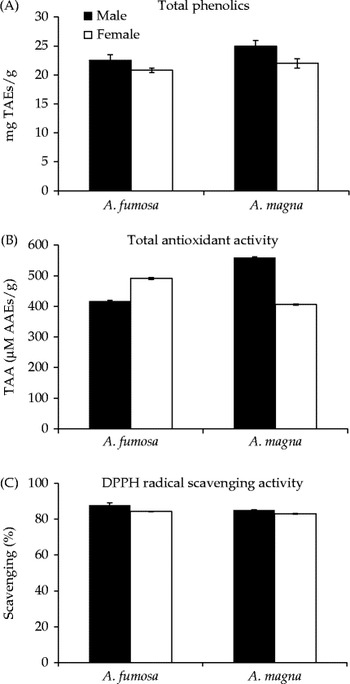
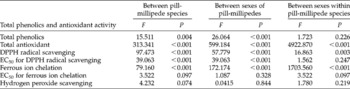
Total phenolics ranged between 20.8 and 24.93 mg TAEs/g in A. fumosa and A. magna (Fig. 1A). It was higher in males than in females and significantly differed between species (P= 0.004) as well as between the sexes (P< 0.001) (Table 1).
(A) Total phenolics (between the species and the sexes: P< 0.001), (B) total antioxidant activity (between the species, the sexes and the sexes within species: P< 0.001) and (C) DPPH radical scavenging activity (between species: P< 0.001; the sexes: P< 0.01; the sexes within species: P< 0.001) (n= 3; mean ± SD).

Result of two-way ANOVA for total phenolics and antioxidant potential between millipedes, sexes and sexes within millipede species (Tukey's test, P<0.05)

Total antioxidant activity
Increased TAA activities were observed with increasing concentrations and the maximum activity was reached at 1 mg/ml (Fig. 1B). In A. magna, males had higher activities than females; the opposite was found for A. fumosa. The TAA differed significantly (P< 0.001) between species, the sexes and the sexes within species (P< 0.001) (Table 1).
2,2-Diphenyl-1-picrylhydrazyl radical scavenging activity
The extracts were tested for DPPH radical scavenging activity at different concentrations ranging from 0.4 to 2 mg/ml. Decreased absorbance was taken as a measure of radical scavenging potential (Fig. 1C). The scavenging effect of the extract was evaluated considering ascorbic acid as a standard. The extracts showed maximum decolourization at the highest concentration (87.7% at 2 mg/ml). The highest activity (87.7%) was recorded for males of A. fumosa; it was lowest in females of A. magna (83%). The DPPH radical scavenging activity differed significantly between species (P< 0.001), the sexes (P< 0.01) and also the sexes within the two species (P= 0.003).
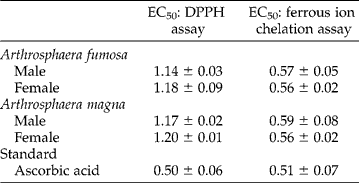
The EC50 value for DPPH scavenging potential of ascorbic acid was 0.5 mg/ml (Table 2). For millipede extracts, it ranged between 1.14 and 1.20 mg/ml. It differed significantly between species as well as between the sexes (P< 0.001) (Table 1).
The EC50 values for methanolic extracts (1 mg/ml) of Arthrosphaera spp. compared with ascorbic acid standard (n=3; mean±SD)

Ferrous ion chelating activity
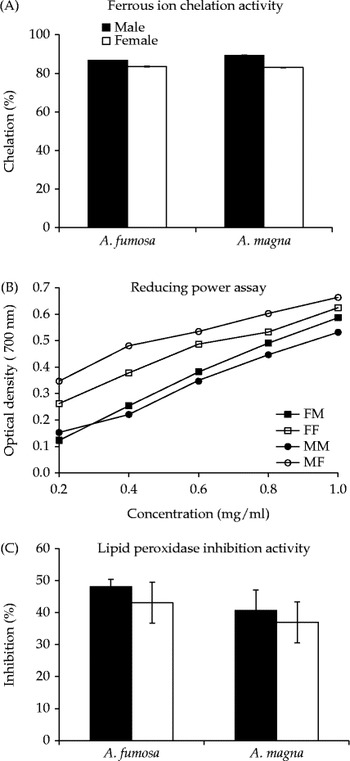
The maximum percentage of chelation by the extract was achieved at a concentration of 1 mg/ml (Fig. 2A). The chelating capacity at a concentration of 1 mg/ml ranged between 83 and 89.4%. Compared with the positive control (EDTA-2Na), chelation by millipedes is relatively low (98% vs. 83–89.3%). The ferrous ion chelating activity between millipedes, the sexes and the sexes within species differed significantly (P< 0.001) (Table 1).
(A) Ferrous ion chelating activity (between millipedes, the sexes and the sexes within species: P< 0.001), (B) reducing power (between millipedes, the sexes and the sexes within species: P< 0.01) and (C) lipid peroxidase inhibition activity (n= 3; mean ± SD) (Reducing power: MM, A. magna male, MF, A. magna female; FM, A. fumosa male; FF, A. fumosa female).

The EC50 for EDTA-2Na was 0.51 mg/ml for ascorbic acid; for millipedes, it ranged between 0.56 and 0.59 mg/ml (Table 2). The EC50 for ferrous ion chelation activity between the species, the sexes and the sexes within species was not significantly different (Table 1).
Reducing power
The reducing potential was dose dependent for millipede extracts (Fig. 2B). The reducing power between species, the sexes and the sexes within species was significantly different (P< 0.01). The extent of reducing power in decreasing order was female A. magna>female A. fumosa>male A. fumosa> male A. magna.
Hydrogen peroxide scavenging activity
Maximum activity was reached at a concentration 1 mg/ml (Fig. 2C). The extracts showed inhibition of lipid peroxidation at concentrations ranging from 0.2 to 1.0 mg/ml with the highest level of inhibition up to 48.1%. The extent of inhibition in decreasing order was male A. fumosa>female A. fumosa>male A. magna>female A. magna. The maximum activity shown by the extracts (48.1 vs. 42.7%) was higher than that of the ascorbic acid standard (at 1 mg/ml). Hydrogen peroxide scavenging activity was not significantly different between species, the sexes and the sexes within species (P>0.05) (Table 1).
Discussion
Total phenolics
Total phenolics serve as a key bioactive principle responsible for scavenging free radicals (Komali et al., Reference Komali, Zheng and Shetty1999). Being non-essential dietary components, they have a high potential in the prevention of cancer and atherosclerosis (Williams and Iatropoulos, Reference Williams, Iatropoulos, Baskin and Salem1997). In addition, a diet with high levels of phenolics has been related to a low incidence of atherosclerosis, cancer and heart disease (Randhir et al., Reference Randhir, Lin and Shetty2004; Alothman et al., Reference Alothman, Bhat and Karim2009). Phenolics are known to chelate metal ions, and inhibit the formation of free radicals and the termination of lipoxygenase (Decker, Reference Decker1997). The highest quantity of total phenolics was observed in males of A. magna (24.93 mg TAEs/g). When the present result is compared with the results of earlier studies, phenolics have an important role in stabilizing lipid oxidation and thus show potential antioxidant activity (Komali et al., Reference Komali, Zheng and Shetty1999; Oktay et al., Reference Oktay, Gülçin and Küfrevioglu2003). Several studies have mentioned that plant phenolics are responsible for antioxidant activities due to their redox potential, which allows them to act as singlet oxygen quenchers as well as hydrogen donors (reducing agents) (Chang et al., Reference Chang, Wu, Wang, Kang, Yang and Shyur2001). Duh et al. (Reference Duh, Tu and Yen1999) have also elucidated the direct role of the antioxidant activity of phenolics. It was also reported that phenolics play an important role in the stabilization of lipid peroxidation (Yen and Wu, Reference Yen and Wu1999). Several studies demonstrated that food components with a high level of phenolics could reduce the risks of atherosclerosis especially because of the antioxidant activities (e.g. Kaur and Kapoor, Reference Kaur and Kapoor2002; Halliwell and Gutteridge, Reference Halliwell and Gutteridge2007). Inhibitory effects on mutagenesis and carcinogenesis were correlated with the presence of phenolics in fruits and vegetables (Tanaka et al., Reference Tanaka, Kuei, Nagashima and Taguchi1988).
Antioxidant potential
Arthrosphaera spp. contain good quantities of phenolics and the crude extract exhibited considerable in vitro antioxidant potential.
The activity of major antioxidants has been attributed to various mechanisms such as chain initiation prevention, transition metal ion catalyst binding, decomposition of peroxides, hydrogen abstraction prevention, reducing capacity and radical scavenging properties. The assay of the TAA denotes the promising potential of the methanolic extracts as natural antioxidants and confirms the results of methanolic extracts of the insect Allomyrina dichotoma (Suh et al., Reference Suh, Kim, Lee, Park and Kang2010) and also the TAA in beetles (Liu et al., Reference Liu, Sun, Yu, Zhang, Bi, Zhu, Qu and Yang2012).
The DPPH radical scavenging assay has been widely accepted and employed to evaluate antioxidant potential quickly, as it is a stable free radical with the characteristic absorption at 570 nm. The extent of absorption decreases as an antioxidant donates protons to DPPH. As a stable free radical, DPPH produces a violet colour with methanol. Its decolourization denotes the antioxidant activity and is often used in the evaluation of the radical scavenging activity of natural as well as synthetic antioxidants (Brand-Williams et al., Reference Brand-Williams, Cuvelier and Berset1995). The scavenging effects of the extracts of A. fumosa and A. magna were tested on the DPPH radical; the results showed considerable scavenging potential. Earlier studies on the lucanid beetle (Serrognathus platymelus castanicolor) also confirm the DPPH free radical scavenging potential in arthropods (Suh et al., Reference Suh, Kim, Hwang, Kim and Kim2011a , Reference Suh, Lee, Kim, Shin, Park and Park b ).
The assessment of metal ion chelating ability is useful due to the catalytic activity leading to lipid peroxidation in foods, which in turn causes arthritis and cancer (Gordon, Reference Gordon and Hudson1990; Halliwell et al., Reference Halliwell, Murcia, Chirico and Aruoma1995). This activity of an antioxidant could prevent the generation of free radicals and the consequent oxidative damage. Chelating agents form σ-bonds with metal ions, reduce redox potential and stabilize the oxidized form of metal ions (Srivastava et al., Reference Srivastava, Harish and Shivanandappa2006). As shown in Fig. 2A, extracts of A. fumosa and A. magna showed comparable results on ferrous ion chelation equivalent to the positive control (EDTA-2Na). This finding may imply that certain effective chelating agents may be present in the extracts. Different authors have shown the ferrous ion chelation capacity of bioactive components derived from various arthropods (e.g. beetles) (Suh et al., Reference Suh, Kim, Hwang, Kim and Kim2011a , Reference Suh, Lee, Kim, Shin, Park and Park b ; Liu et al., Reference Liu, Sun, Yu, Zhang, Bi, Zhu, Qu and Yang2012).
Reducing power is an effective indicator of the antioxidant activity of a compound (Young and Woodside, Reference Young and Woodside2001) and its ability to reduce Fe3+ to Fe2+ (active) denotes its capacity to act as a pro-oxidant in the biological system. The reductive potential of the extracts was dose dependent in the current study. Earlier reports on beetles state that the reducing power of methanolic extracts might be due to their hydrogen donating ability (Suh et al., Reference Suh, Kim, Hwang, Kim and Kim2011a , Reference Suh, Lee, Kim, Shin, Park and Park b ). A higher content of reductones in the extracts studied may react with free radicals and successfully block the chain initiation.
Lipid peroxidation is an oxidative degradation of lipids that leads to cell damage resulting in the production of reactive aldehydes that lead to mutagenesis and carcinogenesis. High levels of inhibition of lipid peroxidation limit free radical formation, which has an active role in the development of diseases. Various studies on mushrooms and other plant extracts also demonstrated that methanolic extracts possess high lipid peroxidation inhibition capacity (Dinis et al., Reference Dinis, Madeira and Almeida1994; Young and Woodside, Reference Young and Woodside2001; Mau et al., Reference Mau, Lin and Chen2002). In the present study, the level of inhibition of lipid peroxidation by millipede extracts was higher than that of ascorbic acid, denoting that the extracts scavenge free radicals as a primary antioxidant. The extracts may react with free radicals (as a major initiator of the autoxidation of fatty acid) and terminate the chain reaction (Fang et al., Reference Fang, Yang and Wu2002).
EC50 of extracts
The antioxidant properties of DPPH radical scavenging and ferrous ion chelating ability were normalized and are usually expressed as EC50 values (mg/ml). These serve as an effective concentration of each pill-millipede extract and standard required to exhibit 50% antioxidant activity. The antioxidant properties of extracts are inversely proportional to their EC50 values (Liu et al., Reference Liu, Sun, Yu, Zhang, Bi, Zhu, Qu and Yang2012). The extracts showed significant differences in DPPH scavenging between species as well as the sexes, but did not significantly differ between the sexes within species. Female pill-millipedes showed lower efficiency of scavenging radicals than males. The EC50 of DPPH scavenging of ascorbic acid was 0.5 mg/ml, a concentration less than half of that of millipede extracts (1.1–1.2 mg/ml). The EC50 values of the chelating abilities of extracts on ferrous ions varied between 0.56 and 0.59 mg/ml in the millipedes studied. However, the EC50 for EDTA was 0.51 mg/ml and values lower than 10 mg/ml are considered to be an indication of effective antioxidant activities in various natural sources (Lee et al., Reference Lee, Yen and Mau2007).
In the recent past, major attention has been given to health promotion and disease prevention by the use of natural antioxidants (plant and animal origin) rather than synthetic antioxidants (butylated hydroxytoluene and butylated hydroxyanisole). The present study showed that the antioxidant potential of methanolic extracts of Arthrosphaera spp. is comparable to that of ascorbic acid, the standard antioxidant. Extracts of Arthrosphaera may play an important role in ROS scavenging against oxidative stress and provide protection from damaging effects. Millipede extracts have a high level of activity and could serve to develop functional health-promoting pharmaceutical products in future. Further optimization of extraction procedures is necessary along with assessment of the antioxidant potential in vivo.
Acknowledgements
The authors are grateful to Mangalore University for granting permission to carry out studies on pill-millipedes in the Department of Biosciences. CNA acknowledges the award of INSPIRE Fellowship, Department of Science and Technology, New Delhi, Government of India (DST/INSPIRE Fellowship/2011/294: award no. IF110540). KRS acknowledges the award of UGC-BSR Faculty Fellowship by the University Grants Commission, New Delhi. The authors appreciate the relevant suggestions of referees to modify the earlier version of the manuscript.