


The purpose of this review is to re-examine the epidemiology of personality disorder and to develop a set of concepts for addressing the problem using the public health problem-solving paradigm. The paradigm is described by Guyer (Reference Guyer, Armenian and Shapiro1998) as including the following steps:
-
(a) defining the problem;
-
(b) measuring the magnitude of the problem;
-
(c) developing a conceptual framework for the key determinants of the problem, including biological, epidemiological, socio-cultural, economic and political determinants;
-
(d) identifying and developing intervention and prevention strategies;
-
(e) setting priorities among strategies and recommending policies;
-
(f) implementing programmes and evaluating them.
METHOD
Computerised Medline, PsycINFO and International Bibliography of the Social Sciences searches were performed from January 1990 to December 2001 using the terms PERSONALITY DISORDER, AXIS II DISORDER, PUBLIC HEALTH, EPIDEMIOLOGY. In addition, a series of official reports and book chapter reviews of the area were cross-referenced. The aim was to review the major findings of the epidemiological studies of personality disorder together with their public health implications. This was not an inclusive review, and the choice of articles reflects the author's qualitative assessment of current themes of importance in this area of research.
RESULTS
Epidemiology
There have been several previous reviews of the epidemiology of personality disorder, but these have not considered a public health approach. Epidemiology is often considered to be the basic science of public health (Reference Brownson, Brownson and PetittiBrownson, 1998). The most widely accepted definition is ‘the study of the distribution and determinants of health-related states or events in specified populations, and the application of this study to control of health problems’ (Reference LastLast, 1995). However, a definition relevant to public health practice describes epidemiology as the study of the health of human populations. The functions of epidemiology are:
-
(a) to discover the agent, host and environmental factors which affect health in order to provide a scientific basis for the prevention of disease and injury and the promotion of health;
-
(b) to determine the relative importance of causes of illness, disability and death, in order to establish priorities for research and action;
-
(c) to identify those sections of the population which are at greatest risk from specific causes of ill health, in order that the indicated action may be directed appropriately;
-
(d) to evaluate the effectiveness of health programmes and services in improving the health of the population (Reference TerrisTerris, 1992).
Each of these four functions aims to improve the overall health of the population. They can be reformulated as questions for the future epidemiological study of personality disorder (Appendix).
Future studies
If more were known about aetiological risk factors for personality disorders and associated factors leading to disability and mortality, then key priorities could be established for future research and action. For example, clinicians may incorrectly believe that the conditions they encounter most frequently result in the heaviest burden of care. Borderline personality disorder is the most frequently encountered personality disorder in in-patient settings and receives considerable research interest. But persons with borderline personality disorder are characterised by strong tendencies to seek psychiatric help. In contrast, individuals with antisocial personality disorder may place greater burdens on society and the criminal justice system. Systematic studies of burden of care and costs to society posed by different categories of personality disorder are urgently required, especially when these are displaced onto a range of organisations outside the health care system.
New services
Little is known about the geographical distribution of the disorders of personality or which sections of the population are at greatest risk. Although several targeted or ‘high-risk’ (Reference RoseRose, 1992) health care interventions exist, or are currently under development in the UK, it must be questioned whether these are based on evaluation of need, whether they are appropriately located and whether expediency could have determined their development. It is generally assumed that new services will automatically undergo future evaluation. However, certain services for individuals with personality disorder have remained unchanged for years, without systematic evaluation of either effectiveness or value for money (Reference Dolan and CoidDolan & Coid, 1993).
Public health methods
Clinicians who treat patients with personality disorder might argue that it is premature to take a public health view of the problem while epidemiological information remains limited. However, public health has the advantage of linking the biological basis of health and disease with social and political processes of society. Solving problems in public health is fundamentally different from medical diagnosis and the treatment of personality disorder and it requires a broader conceptual framework. For example, a child psychiatrist may be unimpressed that a boy with conduct disorder has been treated successfully for fire-setting behaviour, if the original goal was to bring about a generalised improvement of a range of disordered behaviours, and where associated truanting, fighting, stealing, running away from home and substance misuse continue. But a criminologist or epidemiologist interested in fire-setting at the population level might take a different view. A significant proportion of malicious fire-setting remains uncleared by the police in the UK and is believed to be perpetrated by youths, often while truanting. In certain inner-city areas, extensive damage and accompanying deterioration of the urban environment have resulted. If an intervention were applied which resulted in even a small percentage drop in fire-setting behaviour in a population of young persons, this would be considered a major public health achievement, as well as successful crime prevention.
Rose (Reference Rose1992) divided preventive interventions into ‘high-risk’ strategies, which are targeted at individuals identified as at high risk, and ‘population’ strategies, aimed at bringing about overall population change. Current interventions for personality disorder do not extend beyond the first category. A public health perspective requires a broader view which takes into account the determinants of these conditions, organisation of available health services, and political issues.
Problem definition (beyond ICD-10 and DSM—IV)
Defining the problem may be the single most important step in public health problem-solving (Reference Guyer, Armenian and ShapiroGuyer, 1998). For personality disorder, it remains the biggest problem. Despite attempts to bring ICD-10 (World Health Organization, 1992) and DSM—IV (American Psychiatric Association, 1994) personality disorder categories closer, this has not been achieved (most researchers use DSM—IV). There is little consensus regarding research diagnostic instruments, whether interviews or self-report methods produce superior data (Reference LorangerLoranger, 1992), when patients should be evaluated, or whether subject or informant data are more accurate (Reference ZimmermanZimmerman, 1994). Although self-report instruments are criticised for producing false-positive diagnoses, there is no gold standard for comparing instruments. Even structured clinical interviews show divergent results when compared, and where one instrument cannot simply be substituted for another (Reference Clark, Livesley and MoreyClark et al, 1997). Major problems remain in test—retest reliability.
Despite the definition of personality disorder as an enduring pattern of inner experience and behaviour which is inflexible, pervasive, stable and of long duration, research increasingly reveals that these conditions show major fluctuations. For example, early findings from a US multisite study of patients with borderline, avoidant, schizotypal and obsessive—compulsive personality disorder found that 40%, 30%, 32% and 31%, respectively, no longer met criteria at 6-month follow-up (Reference Shea, Stout and DolanShea et al, 1999). In contrast, measures of personality using the 5-factor model Neuroticism, Extraversion and Other — Personality Inventory — Revised (NEO—PI—R) remained stable (Reference Morey, Gunderson and StoutMorey et al, 1999). Personality may show stability over time but personality disorder does not, thereby challenging its own definition.
Debates continue over whether to include categorical or dimensional classifications, the latter appealing to those whose theoretical approach is influenced by psychological trait theory, the former to those with a medical training. The debate emphasises important public health considerations of who sets the definitions of personality disorder and how they are set. Categories in ICD-10 and DSM—IV were finally arrived at following complex committee negotiations between experts. The origins of individual categories, including psychoanalysis (narcissistic, borderline personality disorder), empirical longitudinal research (antisocial personality disorder), clinical observations by influential early 20th century German clinicians (dependent, obsessive—compulsive, paranoid disorders) can be obscured by subsequent changes of clinical opinion, new research and negotiations which precede new editions of the glossaries.
Psychiatrists are prisoners of the diagnostic glossaries of their time. But despite shortcomings in case definition, it has been argued that current categories are good enough and should be tested in epidemiologically representative samples (Reference Dolan and CoidDolan & Coid, 1993). Public health surveillance strategies find broad case definitions acceptable in the early stages and in the absence of laboratory data. When a deeper understanding of the disease process emerges, a more refined definition can be substituted (Reference Thacker, Stroup, Brownson and PetittiThacker & Stroup, 1998). Meanwhile, it is important not to be constrained by the relative narrowness of current definitions, expanding case definition to include associated psychiatric morbidity, social problems and mortality, as exemplified above by conduct disorder and fire-setting. This is illustrated by the unresolved problem of measuring severity of personality disorder using current diagnostic constructs, where it is necessary to use additional external measures such as burden on health care services, financial costs to society over the lifetime, criminality and the effect of behaviour on others.
Measuring the magnitude of the problem
Initial measurement usually involves incidence and prevalence, but is intended to go beyond these to define the populations at risk and adopt indicators that correspond to the problem definition. However, this latter stage has not been reached in epidemiological personality disorder research, which is largely confined to population surveys. Jenkins (Reference Jenkins2001) has argued that large-scale surveys can address deficiencies in problem-solving. First, effective policy needs to be based on epidemiology and social and economic causes and consequences of psychiatric morbidity. Second, representative information on a defined geographical area can document the use of existing services, estimate unmet needs and identify services that are required. Third, valid information on prevalence and associated risk factors allows aetio-logical hypotheses to be generated and tested, and models developed for prevention. Fourth, by repeating community surveys it is possible to monitor trends and the health of the population.
Table 1 demonstrates the prevalence of DSM-IV Axis II categories in surveys using interviews with subjects (Reference Lyons, Tsuang, Tohen and ZahnerLyons, 1995; Reference Reich, de Girolamo, Loranger, Janca and SartoriusReich & de Girolamo, 1997; Reference MoranMoran, 1999; Royal College of Psychiatrists, 1999; Reference Singleton, Bumpstead and O'BrienSingleton et al, 2001; Reference Torgersen, Kringlen and CramerTorgersen et al, 2001). The main findings for individual categories are as follows.
Prevalence of personality disorder in community surveys
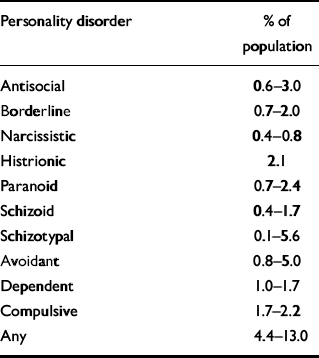
| Personality disorder | % of population |
|---|---|
| Antisocial | 0.6-3.0 |
| Borderline | 0.7-2.0 |
| Narcissistic | 0.4-0.8 |
| Histrionic | 2.1 |
| Paranoid | 0.7-2.4 |
| Schizoid | 0.4-1.7 |
| Schizotypal | 0.1-5.6 |
| Avoidant | 0.8-5.0 |
| Dependent | 1.0-1.7 |
| Compulsive | 1.7-2.2 |
| Any | 4.4-13.0 |
Paranoid
This category is more common in males and persons of lower social class, and more common among relatives of probands with schizophrenia than among relatives of controls. In forensic samples, it is frequently comorbid with antisocial personality disorder and associated with violent crime.
Schizoid
Schizoid personality disorder is uncommon in clinical settings but is more prevalent in offender populations, where it is more common in males (Reference CoidCoid, 1992; Reference Singleton, Meltzer and GatwardSingleton et al, 1998). Studies of comorbidity demonstrate association with schizotypal personality disorder. However, it has been suggested that this category might be better classified as a neurodevelopmental disorder than a personality disorder (Reference CoidCoid, 1999), possibly within the autistic spectrum (Reference Woolff and ChickWoolff & Chick, 1980; Reference WingWing, 1981).
Schizotypal
Schizotypal personality disorder is common in relatives of probands with schizophrenia (15%) (Reference Baron, Gruen and RainerBaron et al, 1985) and studies of comorbidity have demonstrated associations with schizophrenia. However, the future of this personality disorder category is uncertain as it is now included with schizophrenia in ICD-10.
Avoidant
In clinical samples, avoidant personality disorder is comorbid with dependent personality disorder and phobic disorder, specifically social phobia, which has similar clinical features (Reference Herbert, Hope and BellackHerbert et al, 1992; Reference Holt, Heimberg and HopeHolt et al, 1992; Reference Turner, Biedel and TownsleyTurner et al, 1993), and where the separation between the Axis I and Axis II disorders may be questionable.
Dependent
Dependent personality disorder is comorbid with borderline personality disorder in certain studies, but has been described as lacking a clear delineation from certain personality disorder categories such as avoidant. The aetiology is thought to be the outcome of early social processes within the family environment, although in a forensic sample it was associated with neuropsychiatric risk factors (Reference CoidCoid, 1999).
Obsessive—compulsive
Obsessive—compulsive disorder has been described as a ‘high-functioning’ category (Reference KernbergKernberg, 1984) and is more common in white, male, highly educated, married and employed individuals. It is comorbid with anxiety disorders in some studies.
Narcissistic
Surveys tend to find a low prevalence of this condition. This Axis II construct is derived from psychodynamic theory (Reference KohutKohut, 1971; Reference KernbergKernberg, 1975) but has not converted well to the DSM-IV format. It is diagnosed more frequently in males and is more common in forensic samples, where it is comorbid with antisocial personality disorder.
Histrionic
Earlier research in clinical populations suggested that histrionic personality disorder was more common in women. More recent studies indicate that the gender ratio is similar. It is more common in divorced and separated persons, associated with parasuicide, and associated in women with unexplained medical conditions and in men with substance misuse.
Borderline
Borderline personality disorder is more prevalent in younger age groups (19-34 years), females (not all surveys) and Whites (not all surveys); is associated with poor work history and single marital status; and is more common in urban areas. It is comorbid with substance misuse, phobia and anxiety disorder, and has a 9% suicide rate (Paris et al, Reference Paris, Brown and Nowlis1987, Reference Paris, Nowlis and Brown1989; Reference StoneStone, 1990). In forensic samples it is comorbid with antisocial personality disorder. Most epidemiological studies demonstrate lifetime comorbid depression, and a raised prevalence of depression has been observed in the relatives of borderline probands (Reference Riso, Klein and AndersonRiso et al, 2000). It has been argued that the association with depressive illness is weak and non-specific (Reference Gunderson and PhillipsGunderson & Phillips, 1991); it has also been argued that borderline personality disorder is an affective disorder (Reference CoidCoid, 1993). The aetiology of borderline personality disorder is thought to include a combination of neuro-psychiatric, genetic and early adverse factors in the social environment. Longitudinal studies indicate that borderline personality disorder is most severe in the mid-20s, with improvement noted in the late 30s (Reference McGlashanMcGlashan, 1986; Reference ParisParis, 1988; Reference Paris, Nowlis and BrownParis et al, 1989; Reference StoneStone, 1990). At 15-year follow-up, most subjects with borderline personality disorder no longer meet the criteria for the condition, although a subgroup has a poor long-term outcome. Patients with borderline personality disorder are typically treatment-seeking and high users of mental health services.
Antisocial
Antisocial personality disorder has a prevalence of 2-3% in most Westernised societies and is 4-5 times more common in men than in women. In the USA it has been found to be no higher in Blacks than in Whites. However, two recent European surveys indicate a lower prevalence of 0.7% for individuals aged 18-65 years in Oslo, Norway (Reference Torgersen, Kringlen and CramerTorgersen et al, 2001), and 0.6% for individuals aged 16-74 years in England, Scotland and Wales (Reference Singleton, Bumpstead and O'BrienSingleton et al, 2001). The highest prevalence is in the 25- to 44-year age band. Antisocial personality disorder is associated with school drop-out, homelessness and raised mortality in early adulthood. The prevalence is raised in inner-city populations and lower in rural areas. It is highly comorbid with substance misuse. The symptoms of antisocial personality disorder diminish in middle age, but 20% still meet the criteria at 45 years of age.
Key determinants and conceptual frameworks
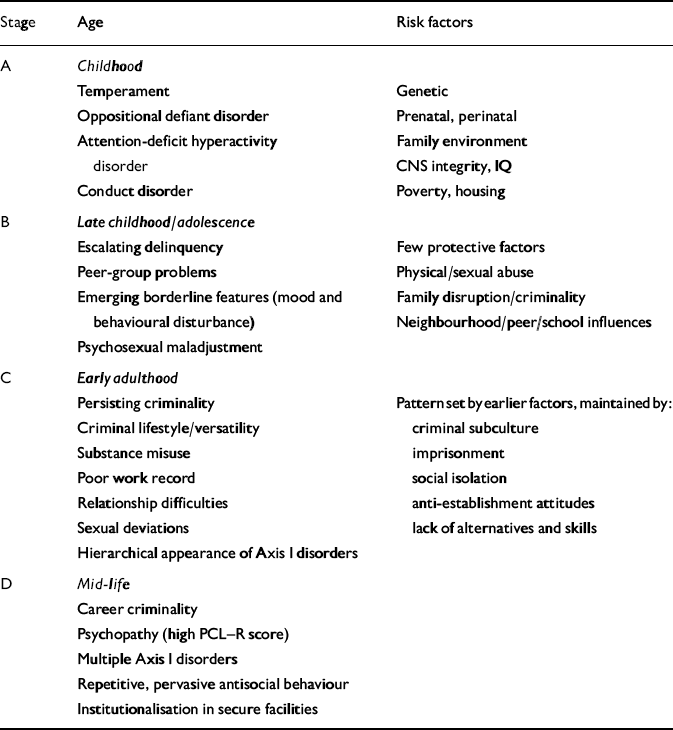
It is important to develop conceptual frameworks which can organise the disparate range of risk factors for personality disorder into a set of domains which are linked logically to outcome and which will become the organisational principle for future intervention strategies. Table 2 describes a longitudinal (or developmental) framework for high-risk offenders with personality disorder. The model indicates progression from one stage to another, assuming increasing severity of both personality disorder and associated antisocial behaviour over time. Although the table suggests a highly adverse outcome by midlife, most individuals demonstrating antisocial behaviour and experiencing these risk factors will drop out before reaching this end-point. Progression from one stage to another is dependent on a theoretical framework based on a balance between ‘risk’ and ‘protective factors’ which operate primarily during the childhood and adolescent phases of development (Warner et al, 1971; Werner & Smith, Reference Werner and Smith1977, Reference Werner and Smith1982; Reference Werner and NicolWerner, 1985).
Longitudinal (developmental) conceptual framework for high-risk offenders with personality disorder

| Stage | Age | Risk factors |
|---|---|---|
| A | Childhood | |
| Temperament | Genetic | |
| Oppositional defiant disorder | Prenatal, perinatal | |
| Attention-deficit hyperactivity | Family environment | |
| disorder | CNS integrity, IQ | |
| Conduct disorder | Poverty, housing | |
| B | Late childhood/adolescence | |
| Escalating delinquency | Few protective factors | |
| Peer-group problems | Physical/sexual abuse | |
| Emerging borderline features (mood and | Family disruption/criminality | |
| behavioural disturbance) | Neighbourhood/peer/school influences | |
| Psychosexual maladjustment | ||
| C | Early adulthood | |
| Persisting criminality | Pattern set by earlier factors, maintained by: | |
| Criminal lifestyle/versatility |
|
|
| Substance misuse | ||
| Poor work record | ||
| Relationship difficulties | ||
| Sexual deviations | ||
| Hierarchical appearance of Axis I disorders | ||
| D | Mid-life | |
| Career criminality | ||
| Psychopathy (high PCL—R score) | ||
| Multiple Axis I disorders | ||
| Repetitive, pervasive antisocial behaviour | ||
| Institutionalisation in secure facilities |
Children with difficult temperaments in infancy can progress, in certain circumstances, to conduct disorder in late childhood (Reference Reid, Patterson, Stoner, Shian and WalkerReid & Patterson, 1991; Reference ReidReid, 1993; Reference CampbellCampbell, 1995; Reference Coie, Peters and McMahonCoie, 1996; Reference Nagin and TremblayNagin & Tremblay, 2001). These childhood syndromes, which increase the risk of progress to an adverse outcome in the next phase, are more likely in the presence of risk factors such as poor family environment, pre- and perinatal difficulties and genetic loading. Developmental research suggests that the presence of more than one risk factor further increases the chances of progression to the next phase but can be balanced by protective factors, for example having a positive social orientation, receiving positive attention during the first year of life, good parent—child relationship, the presence of additional carers besides the mother and structure and rules in the household. These protective factors can overcome the negative effects of risk factors to reduce the chances of progression to the next stage. Children who become delinquent in late childhood and adolescence are thought to have experienced fewer protective factors and form a subgroup demonstrating escalation of their behavioural disorder. Their lack of protective factors may be further compounded by experiences of physical and sexual abuse, family disruption and criminal role models in the family, together with negative influences from other adolescents in their neighbourhood and at school. A small subgroup of individuals may demonstrate psychosexual maladjustment during adolescence. Features of borderline personality disorder may first emerge during this stage, with mood and identity disturbance and incidents of self-harm.
By early adulthood, most individuals drop out of this process and desist from criminal behaviour, settling into relationships and steady employment (Reference Blumstein and CohenBlumstein & Cohen, 1979). However, a subgroup persists, with the appearance of more serious offending, including violence, and associated substance misuse (Reference West and FarringtonWest & Farrington, 1977; Reference Petersilia, Greenwood and LavinPetersilia et al, 1978; Reference Gibbs and ShellyGibbs & Shelly, 1982; Reference WaltersWalters, 1990). By this phase, sexual maladjustment in adolescence can develop into paraphilias. In a further subgroup, episodes of severe mental disorder appear (Reference CoidCoid, 1992). These patterns, promoted by earlier risk factors, are now maintained by additional factors such as being part of a criminal subculture, periods of imprisonment, and lack of skills and alternatives to promote a more positive lifestyle.
By their late-20s third and early 30s, most of these individuals present with anti-social personality disorder, but within a spectrum of severity of additional psycho-pathology. The most severe cases include career criminals, individuals with psychopathy, and multiple Axis II disorders including substance misuse. Escalation and repetitive and pervasive antisocial behaviour lead to prolonged periods of institutionalisation in secure facilities, primarily prison.
Strategies for intervention and prevention
Prevention programmes need conceptual frameworks to develop interventions and choose the most effective policy. Few intervention strategies are currently available for personality disorder; most are tertiary referral services in secure institutions for individuals at stages C or D (Table 2). However, a public health approach using Table 2 would suggest early interventions based on this logical sequence of abnormal personality development, having identified the factors determining progression towards the later stages. Although it can be justifiably argued that division into four stages is artificial, this framework facilitates interventions based on theoretical countermeasures. For example, longitudinal research demonstrates that delinquency is common in adolescence but that most individuals drop out early in their 20s. Once individuals have established a criminal lifestyle in their mid- or late-20s, there is unlikely to be further attrition until their 30s or 40s (Reference Hirschi and GottfredsonHirschi & Gottfredson, 1983; Reference WaltersWalters, 1990). This suggests that intervention strategies should be targeted at earlier life phases during which these individuals are more susceptible to change. For example, conduct disorder is identified as a high-risk precursor of antisocial personality disorder. It is known to affect 4-10% of children in the UK (Reference Ruttel, Cox and TuplingRutter et al, 1975; Reference KazdinKazdin, 1987; Institute of Medicine, 1989; Reference Meltzer, Gatward and GoodmanMeltzer et al, 2000) and is associated with attention-deficit hyperactivity disorder. Of this group, 40% have serious adult psychosocial disturbances, including substance misuse, major mental disorder, higher risk of mortality, and antisocial personality disorder (Reference Robins, Hare and WingRobins, 1970; Reference FarringtonFarrington, 1995; Reference Ruttel, Giller and HagellRutter et al, 1998).
Primary prevention strategies might include:
-
(a) a targeted approach to those identified as at high risk of developing adult anti-social personality disorder;
-
(b) increasing the rate of drop out of those presenting with conduct disorder;
-
(c) prevention of inter-generational transmission within high-risk families;
-
(d) prevention of the development of conduct disorder by attempting to intervene at an even earlier stage (Reference Coid, Farrington and CoidCoid, 2003). Programmes have been developed to intervene during pregnancy, infancy and the preschool years (Reference Tremblay, Japel, Farrington and CoidTremblay & Japel, 2003) through families (specifically directed at parenting) (Reference Utting, Farrington and CoidUtting, 2003) and in schools (Reference Hawkins, Herrenkohl, Farrington and CoidHawkins & Herrenkohl, 2002).
Setting priorities and policy formulation
Rose (Reference Rose1992) argues that the public and politicians are highly ambivalent towards experts and advisors, who can confuse their technical authority with the right to decide what is best. Guyer (Reference Guyer, Armenian and Shapiro1998) argues that policy-making is a complex political process that goes well beyond professional expertise alone. It is important to recognise the realities and opportunities of policy-making which require a knowledge base, political will and social strategies. A knowledge base requires information on the size of the problem, its costs and consequences, the extent to which risk factors are causative, and how successful an intervention programme is likely to be. This will require the advice of experts. Political will refers to the willingness of policy-makers to address the problem, which may not be a factor over which experts have much influence. Social strategies are broad methods used by society to solve problems, and may include legislation and regulations to restrict certain behaviours, development of service programmes, provision of funds, etc. Rose recommends a more cautious approach when advising policy-makers. By recognising the roles and positions of the various stakeholders in making policy, experts can give policy-makers the opportunity to consider the full range of strategies that are possible and can explain the consequences to them of each strategy.
When advising policy-makers, it is important to identify the negative cost of not intervening, and to identify policies that have a direct and positive benefit for one section of the community although causing significant public health problems for another. This approach fits with Rose's ‘population’ approach to preventive intervention and can be highly relevant to interventions for personality disorder and offending behaviour. This is exemplified by the severe deterioration observed within the built environment in certain US urban centres during the 1980s. Continuing deterioration of these environments led to rapid escalation of homelessness, including people with mental illnesses; epidemics of health care problems, most significantly AIDS, tuberculosis and low birth-weight babies (which local underfunded hospitals were unable to sustain); epidemics of substance misuse; and accompanying epidemics of crime and violence affecting primarily ethnic minority populations (Reference WallaceWallace, 1988; Wallace et al, Reference Wallace, Fullilove, Wallace, Cowinson, Ruiz and Millman1992, Reference Wallace, Wallace and Andrews1995). An active process had taken place whereby initial scatterings of abandoned structures were followed by intensification and later consolidation as these areas became the focus of vandalism and arson. Fire services within these areas were unable to meet demand, having been downsized as a result of municipal policies to reduce costs and, in some cases, political policy to reduce taxation. Resulting destruction of the environment led to a major population shift to adjacent neighbourhoods, subsequent overcrowding in these new areas and perpetuation of the problem.
Within these deteriorating physical environments, an increasing range of social and health problems progressively emerged. Wallace and colleagues argue that contagious urban decay, rapid loss of housing and population shift had dramatic effects, increasing levels of substance misuse and risk of violent death. Social networks essential for socialisation and control of deviant behaviour and for health maintenance in the population had been dismantled. These problems coincided with progressive supplementation of heroin misuse within these communities by crack cocaine, together with the appearance of AIDS. The effects on children in these environments, many of which constituted the known risk factors for conduct disorder, included frequent moves of home, moves to new schools and sometimes failing schools, breakdown of social cohesion as social and family networks disintegrated, loss of parental figures and lack of adequate supervision from adults. This intensified the risk of problem behaviours, including delinquency, gang involvement and recourse to the underground criminal economy.
In such dramatic circumstances, public health professionals and epidemiologists should demonstrate the risks of not maintaining an adequate infrastructure to support population density, the need for programmes of community organisational improvement, provision of adequate housing and economic restitution. However, the need to fund these programmes requires understanding that the economic burden may ultimately fall on taxpayers elsewhere, who may have different cultural expectations and may even be primarily from different ethnic groups. However, Wallace & Wallace (Reference Wallace and Wallace1997) argue that there is a false assumption in the policies which created these conditions in the first place, and subsequent false assumptions that these problems could be largely confined to the inner-city communities and kept separate from the suburbs and areas where affluent people live and where political power currently lies.
Implementation and evaluation of interventions
Implementation is defined as the process whereby policy decisions are translated into programmatic activity. Evaluation is the process of measuring the success with which programmes reach their stated objectives (Reference Guyer, Armenian and ShapiroGuyer, 1998). The expansion of new services for individuals with personality disorder following policy decisions in England and Wales requires future evaluation. These include the decision by the Department of Health to expand therapeutic community in-patient services based on the model developed at the Henderson Hospital, and the programme to take forward the Government's proposals on managing dangerous people with severe personality disorder (DSPD).
The latter development exemplifies in part the successful operation of the administrative activities that Guyer describes as essential for programme implementation. These include effective communication concerning all aspects of the programme to all levels of personnel involved in programme delivery, development of procedures and administration to ensure effectiveness, allocation of financial resources and development of monitoring and data systems for evaluation. Despite severe criticisms of the programme on ethical grounds (Reference EastmanEastman, 1999; Reference MullenMullen, 1999; Reference GunnGunn, 2000), the Government effectively ignored these and implemented its programme by initially circulating a consultation document (Home Office & Department of Health, 1999). This was followed by a Home Affairs Committee report which supported the proposals. A Home Office project team was subsequently appointed with the initial task of establishing pilot projects across the prison service and National Health Service (NHS) secure hospital estate to develop and evaluate the assessment process, appropriate treatments and other therapeutic interventions. This has recently been supported by proposals for new mental health legislation (Department of Health & Home Office, 2000). However, a less than active involvement in the operation of the programme was shown by the Department of Health during the same period. The Government relied primarily on the use of health care resources to deliver a policy of public protection from high-risk offenders driven by the Home Office, which had a key responsibility for this policy but not for development of health care provision. Thus, the stage has not been reached where evaluation as described by Guyer can be carried out. Problems have been compounded in implementation by continuing opposition from the Royal College of Psychiatrists (Royal College of Psychiatrists, 2001).
The stated objectives of the proposals on DSPD to be evaluated in the future are:
-
(a) to ensure that dangerous people with severe personality disorder are kept in detention for as long as they pose a risk to others;
-
(b) to provide high-quality services to enable them to deal with the consequences of their disorder, reduce their risk to others and so work towards successful reintegration into the community.
These objectives, narrowly defined, are relatively simple to evaluate and lead to a series of apparently straightforward and testable measures of the effectiveness of the new services.
-
(a) How effective are the new assessment processes in identifying individuals with severe personality disorder who pose a risk to the public?
-
(b) How effective are they in identifying when those individuals no longer pose a risk?
-
(c) How effective is treatment within the new services in reducing risk and promoting reintegration into the community?
However, re-examination reveals that these questions are highly complex, with many associated implications. For example, has the problem been adequately defined for future case identification? Defining personality disorder is already problematic. Certain constructs include factors indicative of risks towards others but without an inherent measure of the severity of these risks. Furthermore, what is the true size of the problem and, consequently, the level of provision required for the programme to be successful? Before measures of prevalence of personality disorder in the population and associations with high-risk behaviour are carried out, prior agreement is required on the level and/or qualitative nature of the risks that are necessary for inclusion. This will inevitably determine future costs.
Finally, how acceptable is it to detain individuals in these new services on the basis of assessment procedures that inevitably contain some degree of error? Is the process of screening sufficiently accurate to avoid missing a substantial number of individuals who still pose a high risk to the public? The latter problem could ultimately bring the new programme (and the professionals who must deliver it) into disrepute with the public and politicians. A public health approach to the problem of personality disorder indicates that evaluation of whether new policies are successfully implemented includes not only their impact on the original stated objectives but also the refining of these objectives.
DISCUSSION
Although a significant proportion of the population has personality disorder which places considerable burden on a range of agencies, this has not been accurately quantified. The epidemiology of personality disorder is still hampered by poor case definition, largely confined to figures of prevalence, and is only beginning to reveal aetiological risk factors. Personality disorders are highly comorbid with each other and with Axis I clinical syndromes over the lifetime, thereby challenging current diagnostic constructs. Emerging knowledge of longitudinal development, and preliminary findings from studies of aetiology, question current concepts of personality disorder, and the fluctuating course of certain conditions does not correspond with the official definition. Current diagnostic classifications are therefore temporary and a broad approach should be taken to case definition.
The few specialist services for patients with personality disorder operate mainly at the tertiary referral level, often in conditions of security. Official policy in England and Wales dictates that these individuals should be treated in conventional psychiatric services. But these currently prioritise patients with severe mental illness. The public health problem-solving paradigm indicates a broader approach to the problem of personality disorder and the need for research into prevention. New policy decisions have raised the profile of personality disorder within the health services of England and Wales. However, it will be necessary to adopt a different approach when advising policy-makers, whose priorities may not coincide with those of clinicians and experts in the field. The paradigm may also be useful in providing policy-makers with the necessary advice on the likelihood of success of their policies and for evaluating the effectiveness of new services.
Clinical Implications and Limitations
CLINICAL IMPLICATIONS
-
▪ The public health problem-solving paradigm promotes alternative conceptual frameworks of abnormal personality development. From these, new treatment interventions may emerge in the future.
-
▪ Risk factors which operate at the population level are important in the aetiology of personality disorder and should be monitored by psychiatrists.
-
▪ The paradigm may help psychiatrists renegotiate their relationship with policy-makers to promote new services.
LIMITATIONS
-
▪ Poor case definition of the personality disorders limits epidemiological research.
-
▪ The public health approach to problem-solving is not typically associated with personality disorder, and few UK psychiatrists are trained in public health.
-
▪ Treatments for personality disorder in the UK are delivered on an ad hoc basis by general services, which must prioritise major mental illness, or in limited tertiary referral settings.
APPENDIX
Questions for the future epidemiological study of personality disorder
-
(a) What are the aetiological risk factors for personality disorder? Which are most important?
-
(b) What are the associated factors leading to disability and mortality?
-
(c) Which disorders of personality lead to the heaviest burden of care?
-
(d) Which sections of the population have the greatest risk for personality disorder and for experiencing causal factors?
-
(e) How effective are health programmes, services and interventions in reducing the prevalence of these conditions, their associated morbidity and burden of care?




eLetters
No eLetters have been published for this article.