Introduction
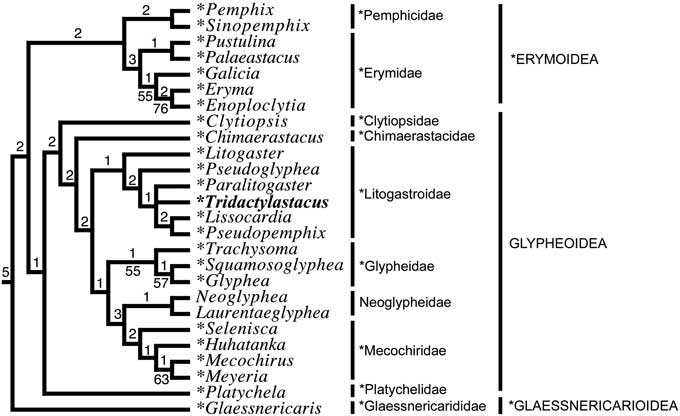
Feldmann et al. (Reference Feldmann, Schweitzer, Hu, Zhang, Zhou, Xie, Huang and Wen2012) originally placed Tridactylastacus within Glypheidae based upon its possession of diagnostic characters of the family, acknowledging that some aspects of the taxon did not fit well within the group. Karasawa et al. (Reference Karasawa, Schweitzer and Feldmann2013), after performing a phylogeny on extinct and extant lobsters, rearranged the Glypheidea and found that the characters used by Feldmann et al. (Reference Feldmann, Schweitzer, Hu, Zhang, Zhou, Xie, Huang and Wen2012) were those of the superfamily Glypheoidea. The genera to which Tridactylastacus had the most morphological similarities were placed within Litogastridae within Glypheoidea (Karasawa et al., Reference Karasawa, Schweitzer and Feldmann2013). Tridactylastacus was not included in that analysis due to its large number of missing characters, including those of the dorsal carapace.
During the summer of 2014, examination of material originally curated with shrimp revealed that it was actually a mass assemblage of small Tridactylastacus sinensis specimens. One relatively complete and some fragmentary cephalothoraxes were present. The addition of the characters of the cephalothorax permitted the scoring of Tridactylastacus within the matrix used in Karasawa et al. (Reference Karasawa, Schweitzer and Feldmann2013). Phylogenetic analysis of the original character matrix (Karasawa et al., Reference Karasawa, Schweitzer and Feldmann2013, table 2) with the addition of Tridactylastacus indicates that it nests within Litogastridae, as suggested by Karasawa et al. (Reference Karasawa, Schweitzer and Feldmann2013) based upon the observed similarity of Tridactylastacus with other members of that family. Thus, Tridactylastacus remains a member of Litogastridae.
Phylogenetic analysis
Karasawa et al. (Reference Karasawa, Schweitzer and Feldmann2013) conducted a phylogenetic analysis of all fossil and extant lobster-like groups, resulting in a well-resolved phylogeny. Charbonnier et al. (Reference Charbonnier, Audo, Barriel, Garassino, Schweigert and Simpson2015) provided an alternative view to that of Karasawa et al. (Reference Karasawa, Schweitzer and Feldmann2013) based upon taxon and character choice and focused largely on Glypheidea.
We utilized the character matrix of the Karasawa et al. (Reference Karasawa, Schweitzer and Feldmann2013) paper for several reasons. It included all lobster-like groups and utilized at least 173 specimens, including 61 holotypes, lectotypes, or paratypes, to code characters for the analysis. Specimens that were not types included those that were considered to have reliable identifications. These included extant specimens in the United States National Museum, Smithsonian Institution, which have been variously studied by lobster experts from all over the world. They included Solnhofen-type limestone specimens deposited in the Staatliches Museum für Naturkunde, Stuttgart, and the Bayerische Staatsammlung für Paläontologie und Historische Geologie in Munich. Ninety characters, many based upon previous work of others as well as our own selection, were used in the analysis (Karasawa et al., Reference Karasawa, Schweitzer and Feldmann2013, p. 81), and key synapomorphies in the clades in question herein were of the carapace and chelipeds. The issue of sexual dimorphism as a clustering character in the analysis (Charbonnier et al., Reference Charbonnier, Garassino, Schweigert and Simpson2013, p. 233) was not an issue; it does not appear for Glypheidea in Karasawa et al. (Reference Karasawa, Schweitzer and Feldmann2013, table 4) nor as a key defining character for the clades within Glypheidea.
Feldmann et al. (Reference Feldmann, Schweitzer and Karasawa2015) examined all of the new taxa and taxonomic rearrangements proposed by Charbonnier et al. (Reference Charbonnier, Garassino, Schweigert and Simpson2013) and retained nearly all of the new taxa. They did not agree with all species-level placements, based upon their own examination of material, but comparison of the classifications of Karasawa et al. (Reference Karasawa, Schweitzer and Feldmann2013), Charbonnier et al. (Reference Charbonnier, Garassino, Schweigert and Simpson2013, Reference Charbonnier, Audo, Barriel, Garassino, Schweigert and Simpson2015), and Feldmann et al. (Reference Feldmann, Schweitzer and Karasawa2015) will demonstrate that they are largely in agreement at the superfamily level. Thus, herein we use the phylogenetic characters and scheme of Karasawa et al. (Reference Karasawa, Schweitzer and Feldmann2013) to test the placement of Tridactylastacus.
Analysis
Characters and character states are those used and discussed by Karasawa et al. (Reference Karasawa, Schweitzer and Feldmann2013; tables 2, 3). We used this matrix and array of characters, although Charbonnier et al. (Reference Charbonnier, Garassino, Schweigert and Simpson2013) erected several new glypheid genera, which we recognize (Feldmann et al., Reference Feldmann, Schweitzer and Karasawa2015) because the purpose of this phylogeny was simply to test the position of Tridactylastacus, including the newly described carapace. Tridactylastacus was scored using the same characters and scoring techniques by the same authors (C.E. Schweitzer, R.M. Feldmann, H. Karasawa). The phylogenetic analysis used PAUP* 4.0b10 (Swofford, Reference Swofford1999), utilizing a data matrix originating in MacClade 4.08 for OS X (Maddison and Maddison, Reference Maddison and Maddison2005). Heuristic search analyses were performed with the following options in effect: random addition sequence, 50 replications with random input order; one tree held at each step during stepwise addition; tree-bisection-reconnection (TBR) branch stepping performed; MulTrees option activated; steepest descent option not in effect; branches having maximum length zero collapsed to yield polytomies; topological constraints not enforced; multistate taxa interpreted as polymorphism; character state optimization by accelerated transformation (ACCTRAN).
Results and discussion
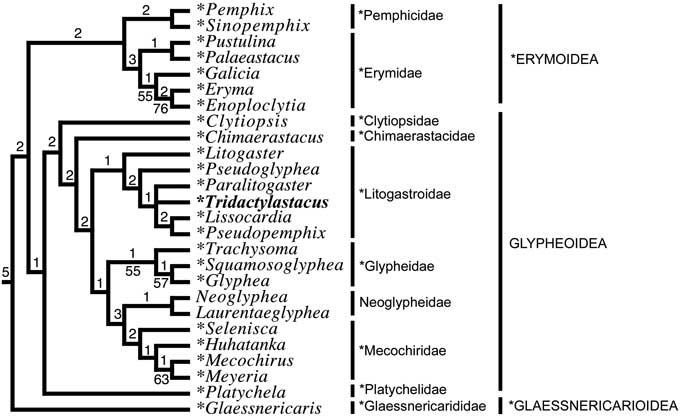
The analysis yielded 37 most-parsimonious trees, whereas the original analysis without Tridactylastacus yielded 15 most-parsimonious trees. The new tree length was 296 steps, as compared to 292 steps in the previous tree, with a consistency index (CI) of 0.4054 (new), as compared to 0.4075 (previous), a retention index (RI) of 0.8360, as compared to 0.8363, and a rescaled consistency index (RC) of 0.3389, as compared to 0.3408 (previous). A strict consensus tree for the Glypheidea is given in Fig. 1. The relationships among taxa are unchanged except for the addition of Tridactylastacus within Litogastridae, as compared with the results of Karasawa et al. (Reference Karasawa, Schweitzer and Feldmann2013). Thus, we consider the results stable and that Tridactylastacus is a confirmed member of Litogastridae. The relationships among the groups indicating Bremer support and bootstrap support exceeding 50% are given in Fig. 1.
Phylogeny of Glypheidea showing position of Tridactylastacus when added to the analysis (*indicates extinct taxa). Bremer support indicated above the clade and bootstrap support exceeding 50% indicated below the clade.
Feldmann et al. (Reference Feldmann, Schweitzer, Hu, Zhang, Zhou, Xie, Huang and Wen2012) erected Tridactylastacus sinensis based upon a holotype and thirteen paratypes. The holotype retained portions of the dorsal carapace, including outline of the rostrum and overall outline of the cephalothorax. The types, taken together, permitted description of the overall outline of the cephalothorax, cephalic appendages, pereiopods, pleon, and pleopods. The taxon was considered distinct from all previously described decapod taxa, a conclusion now further supported by the phylogenetic analysis conducted here. The publication of the genus and species names met the criteria of publication as laid out by the International Commission on Zoological Nomenclature (ICZN, 1999, p. 6–8) and the criteria of availability as per the ICZN (1999). Charbonnier et al. (Reference Charbonnier, Garassino, Schweigert and Simpson2013) considered Tridactylastacus to be a nomen dubium, defined by the ICZN as “A Latin term meaning a ‘name of unknown or doubtful application’” (ICZN, 1999, p. 111). Classification of taxa as nomina dubia is based upon subjective criteria, and thus has been the topic of some debate and dispute over correct application (Mones, Reference Mones1989). Identification of the carapace of Tridactylastacus and reanalysis of phylogeny with its carapace characters expands the description and confirms the placement of Tridactylastacus within Litogastridae. Thus, Tridactylastacus is not considered a nomen dubium and is reconfirmed as a member of Litogastridae.
Systematic paleontology
Order Decapoda Latreille, Reference Latreille1802
Infraorder Glypheidea Winkler, Reference Winkler1881
Superfamily Glypheoidea Winkler, Reference Winkler1881
Family Litogastridae Karasawa, Schweitzer, and Feldmann, Reference Karasawa, Schweitzer and Feldmann2013
Diagnosis
see Karasawa et al. (Reference Karasawa, Schweitzer and Feldmann2013, p. 107).
Genus Tridactylastacus Feldmann, Schweitzer, and Zhang in Feldmann, et al., Reference Feldmann, Schweitzer, Hu, Zhang, Zhou, Xie, Huang and Wen2012
Tridactylastacus sinensis Feldmann, Schweitzer, and Zhang, 2012 in Feldmann et al., Reference Feldmann, Schweitzer, Hu, Zhang, Zhou, Xie, Huang and Wen2012
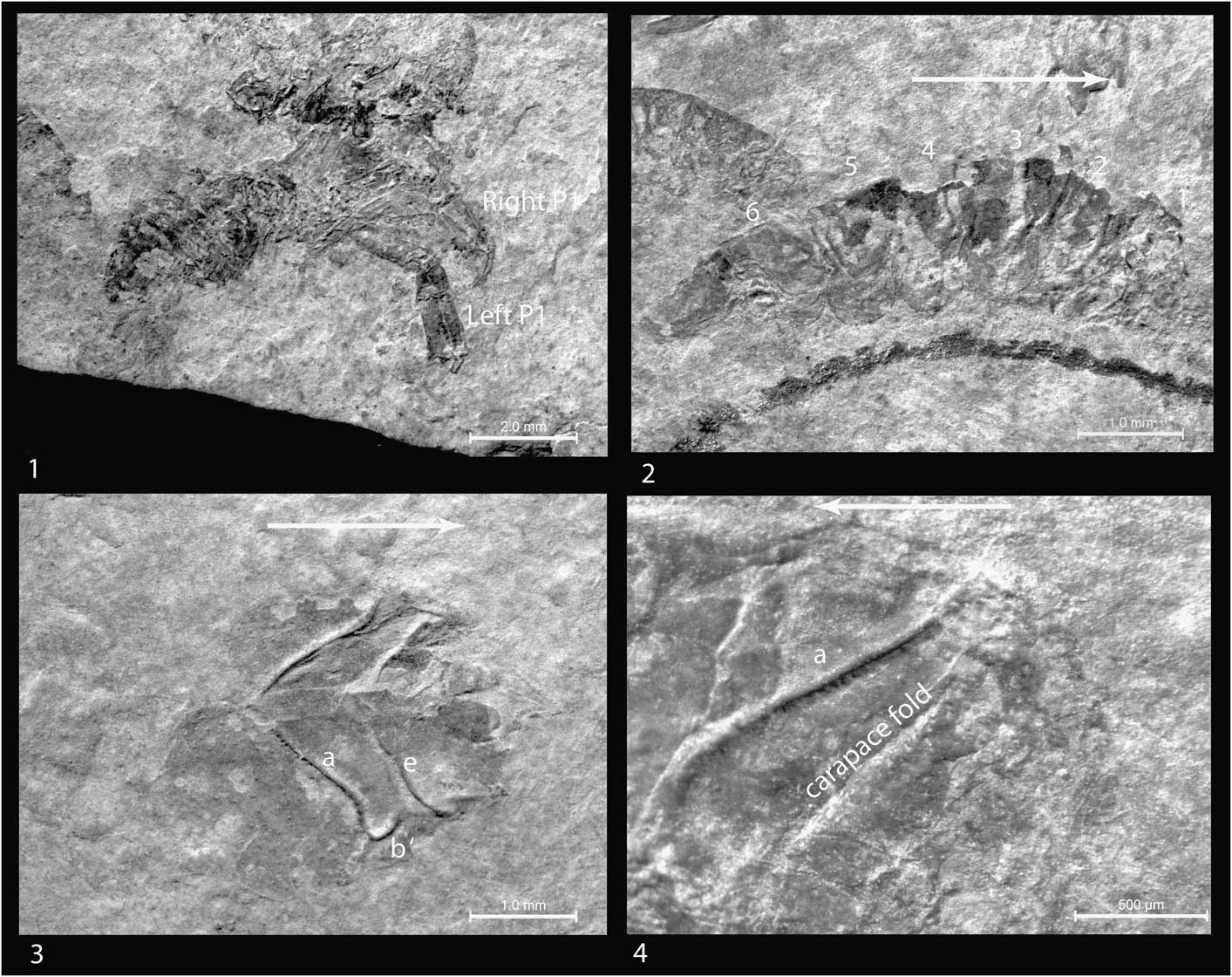
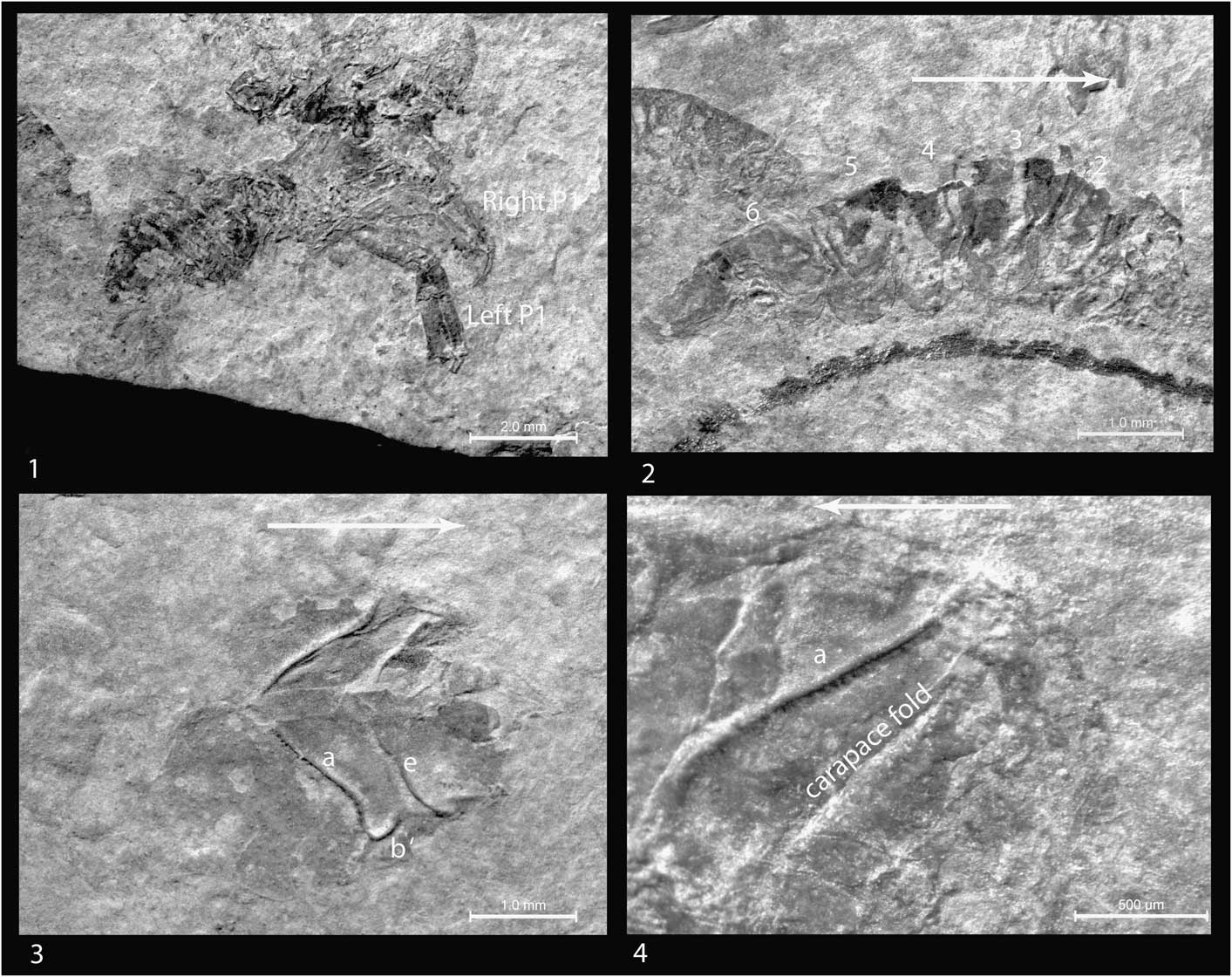
Tridactylastacus sinenensis Feldmann et al., Reference Feldmann, Schweitzer, Hu, Zhang, Zhou, Xie, Huang and Wen2012, individuals preserved on specimen LPI-32308. (1) LPI-32308B, nearly complete individual with poorly preserved carapace above pleon and first pereiopods, indicated as Right P1 and Left P1; (2) isolated pleon with somites numbered showing rounded pleura, arrow indicating anterior; (3) LPI-32308D, isolated carapace, arrow indicating anterior, e indicating cervical groove, a indicating branchiocardiac groove, and b’ indicating hepatic groove; (4) LPI-32308E, partial carapace with arrow indicating anterior showing deep branchiocardiac groove (a) with diagnostic serrations along posterior margin. Scale bars as indicated for each figure.
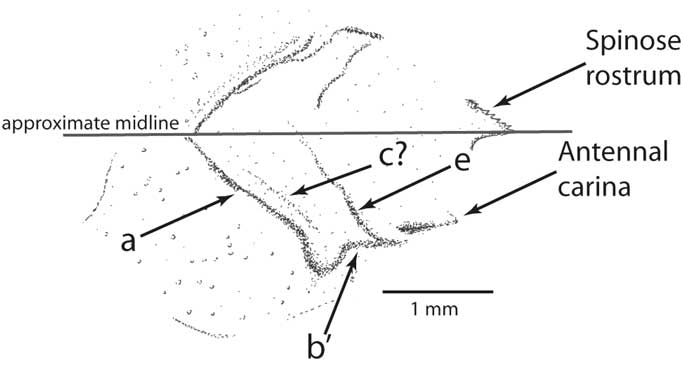
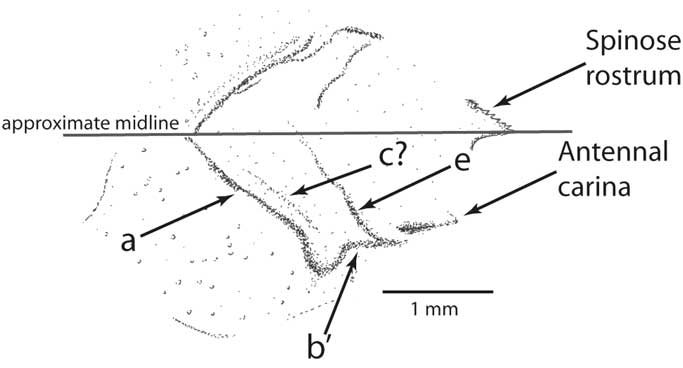
Tridactylastacus sinenensis Feldmann et al., Reference Feldmann, Schweitzer, Hu, Zhang, Zhou, Xie, Huang and Wen2012, line drawing of LPI-32308D. a=branchiocardiac groove, b’=hepatic groove, c?=possible very weak post-cervical groove, e=cervical groove. Scale bar=1 mm.
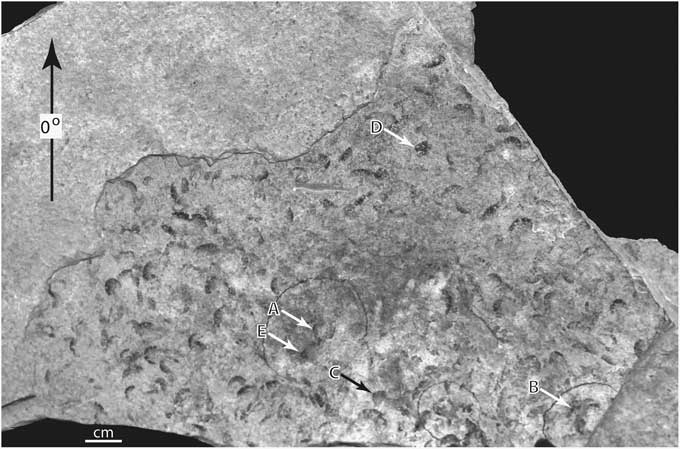
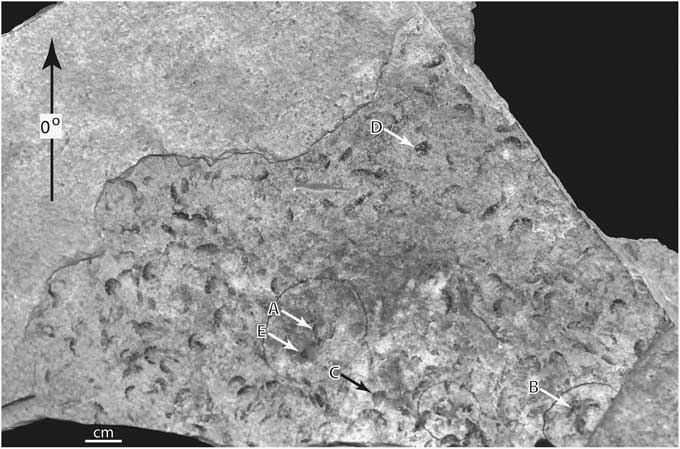
Tridactylastacus sinenensis Feldmann et al., Reference Feldmann, Schweitzer, Hu, Zhang, Zhou, Xie, Huang and Wen2012, specimen LPI-32308, with specimens A–E measured in Table 1 marked. Specimen orientations were measured from this surface with respect to the arrow arbitrarily designated at 0°. Scale bar=1 cm.
Type species
Tridactylastacus sinensis Feldmann, Schweitzer, and Zhang, 2012 in Feldmann et al., Reference Feldmann, Schweitzer, Hu, Zhang, Zhou, Xie, Huang and Wen2012, by original designation and monotypy.
Diagnosis
Rostrum short, serrate marginally; one gastric ridge and possibly second below rostrum; cephalothorax longer than high, narrowed anteriorly, cervical and branchiocardiac grooves deep, well-developed, hepatic groove arcuate, post-cervical groove absent or at best poorly defined; antennae and antennules long, flagellate; pleurae rounded or with tiny triangular tip on otherwise rounded pleuron; telson with straight termination; exopod of uropod with serrate diaeresis, exopod with spines anterior to diaeresis and serrate distal to diaeresis; first pereiopods weakly heterochelous, subchelate, merus with spines on upper and lower margins, manus with spines on upper distal margin and with stout spine above position of fixed finger on distal margin yielding the appearance of possessing three fingers, movable finger with beaded occlusal surface; second-fourth pereiopods subchelate, fifth pereiopod termination unknown, shortest of all pereiopods; pleopods apparently dimorphic, either ovate with lanceolate tip or styliform and axially keeled, extending well beyond pleurae in either case (modified after Feldmann et al., Reference Feldmann, Schweitzer, Hu, Zhang, Zhou, Xie, Huang and Wen2012, p. 431).
Description
Rostrum short, with tiny spines from tip to base. One spine projecting anteriorly, antennal spine projecting from antennal carina, possibly a supraorbital carina just below rostrum but very poorly preserved.
Cervical groove appearing to be composed of two concave forward arcs (Figs. 2.3, 3), intersecting midline at about 60° angle; branchiocardiac groove deep, straight, connecting to arcuate segment of hepatic groove which straightens anteriorly and connects to cervical groove; branchiocardiac groove bordered posteriorly with tiny serrations along upper one-third of length and groove intersecting midline at 45° angle; carapace punctate posterior to branchiocardiac groove; no strong evidence of presence of postcervical groove, left side of specimen may indicate some weak evidence of postcervical closely spaced to branchiocardiac (Fig. 3), right side of specimen shows possible weak groove parallel to upper half of branchiocardiac groove.
Specimens with sharp pleopods with tiny sharp terminations on otherwise rounded pleurae (additions to description in Feldmann et al., Reference Feldmann, Schweitzer, Hu, Zhang, Zhou, Xie, Huang and Wen2012, p. 431).
Material
LPI-32308, deposited in the Invertebrate Paleontology Collection, Chengdu Institute of Geological and Mineral Resources, Chengdu, Sichuan Province, China.
Measurements
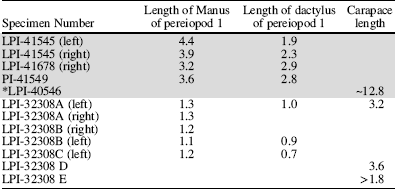
Measurements (in mm) taken on various specimens on LPI-32308 are presented in Table 1.
Measurements (in mm) taken on specimens of Tridactylastacus sinensis Feldmann et al., Reference Feldmann, Schweitzer, Hu, Zhang, Zhou, Xie, Huang and Wen2012. Shaded rows with measurements from Feldmann et al. (Reference Feldmann, Schweitzer, Hu, Zhang, Zhou, Xie, Huang and Wen2012: table 2) or *calculated from fig. 4.1 in Feldmann et al. (Reference Feldmann, Schweitzer, Hu, Zhang, Zhou, Xie, Huang and Wen2012). Right and left indicate first pereiopod from which measurements were taken. Letters following LPI-32308 are used to indicate specimen on Figure 3.

Occurrence
Member II of the Guanling Formation, Luoping Biota (see also Zhang et al., Reference Zhang, Zhou, Lu, Xie, Lou, Liu, Sun and Jiang2008, Reference Zhang, Zhou, Lu, Xie, Lou, Liu, Sun, Huang and Zhao2009; Hu et al., Reference Hu, Zhang, Chen, Zhou, Lü, Xie, Wen, Huang and Benton2010, Reference Hu, Zhang, Zhou, Lü and Wen2011; Feldmann et al., Reference Feldmann, Schweitzer, Hu, Zhang, Zhou, Xie, Huang and Wen2012; Schweitzer et al., Reference Schweitzer, Feldmann, Hu, Huang, Zhou, Zhang, Wen and Xie2014), in Quarry 2, 24°46'12.4''N, 104°18',44.5''E, near Luoping City, Yunnan Province, China.
Remarks
Placement of this taxon is rather problematic. Phylogenetic analysis places it within the Litogastridae, which seems the best placement for it for now. Tridactylastacus sinensis possesses the serrate rostrum, at least one cephalic ridge, antennal spine, cervical groove, branchiocardiac groove, possible post-cervical groove, and pereiopod formula, which are diagnostic for the family (Karasawa et al., Reference Karasawa, Schweitzer and Feldmann2013). The best-preserved carapace is flattened and crushed, so that other grooves are not discernable. The inferior groove is not apparent on the best carapace specimen, although there are some weak structures ventral to the branchiocardiac groove that could be interpreted as the inferior groove (Fig. 3). That portion of the carapace is very poorly preserved.
These features might be suggestive of erymid lobsters. However, erymid lobsters have an intercalated plate along the dorsal anterior axis, which is not seen on the new carapaces. Erymids also have well-developed chelae, not the pseudochelate appendages seen in Tridactylastacus, which are apparent in glypheoideans and a few other unrelated taxa, such as mud shrimp. Clytiopsid lobsters and glypheideans have chelate pereiopods 1–3, not subchelate pereiopods 1–4 as in Tridactylastacus. The relative antiquity (Anisian) of the animal suggests that it is either basal within the Glypheidea, sensu Karasawa et al. (Reference Karasawa, Schweitzer and Feldmann2013), or a specialized form within the same group.
Taphonomy and paleoecology
The carapace specimens described here are associated with numerous individuals of Tridactylastacus sinensis. Approximately 84 specimens, mostly preserved as the pleon only, are preserved on a single 15.45 cm x 15.4 cm x 4.63 cm bedding surface (Fig. 4). Two disarticulated carapaces are preserved, including the one described. Three specimens with pleons and appendages remain, and one has a distorted carapace associated with it (32308A). All specimens are about 3.5–4 times smaller than the holotype and original paratypes (Table 1). Of interest is the observation that in the original study, Tridactylastacus was much more common than the other two lobster taxa studied. Yunnanopalinura schrami Feldmann et al., Reference Feldmann, Schweitzer, Hu, Zhang, Zhou, Xie, Huang and Wen2012, was described based upon only two specimens, although a very much larger palinurid specimen was also reported. Koryncheiros luopingensis Feldmann et al., Reference Feldmann, Schweitzer, Hu, Zhang, Zhou, Xie, Huang and Wen2012, was based upon seven specimens. Tridactylastacus sinensis was originally described based upon a holotype and 13 additional specimens, although other associated fragmental specimens could be ascribed to the taxon because of the distinctive nature of the first cheliped. Thus, the discovery of a large accumulation of smaller specimens is perhaps not surprising.
Possible explanations for the accumulation of specimens could be that it is a juvenile assemblage, perhaps a preserved nursery; a mating assemblage of adults; an assemblage of gregarious adults (such behavior, although not on this scale, is seen in Palinuridae or spiny lobsters); or a lag deposit resulting from currents.
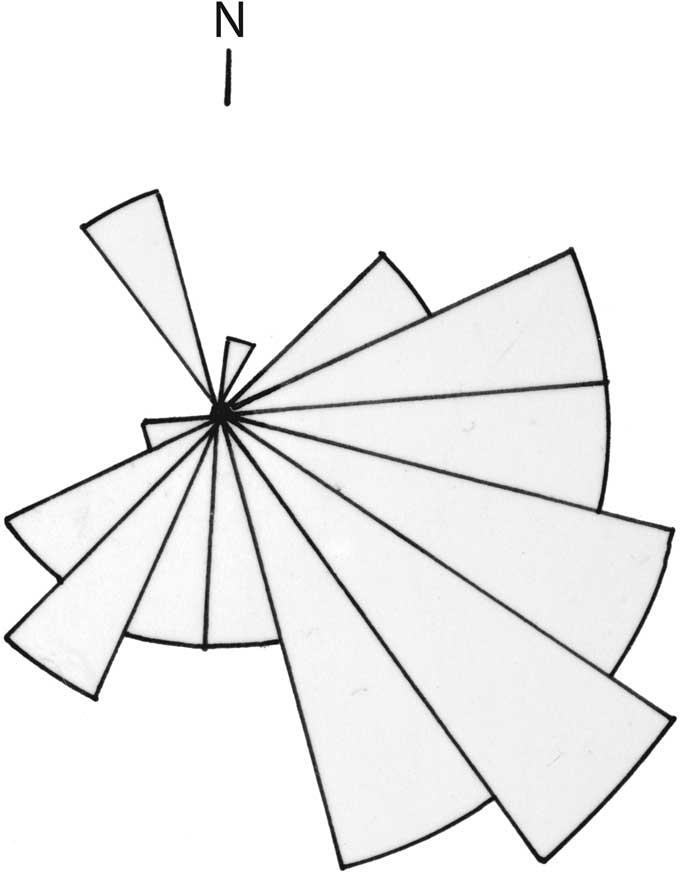
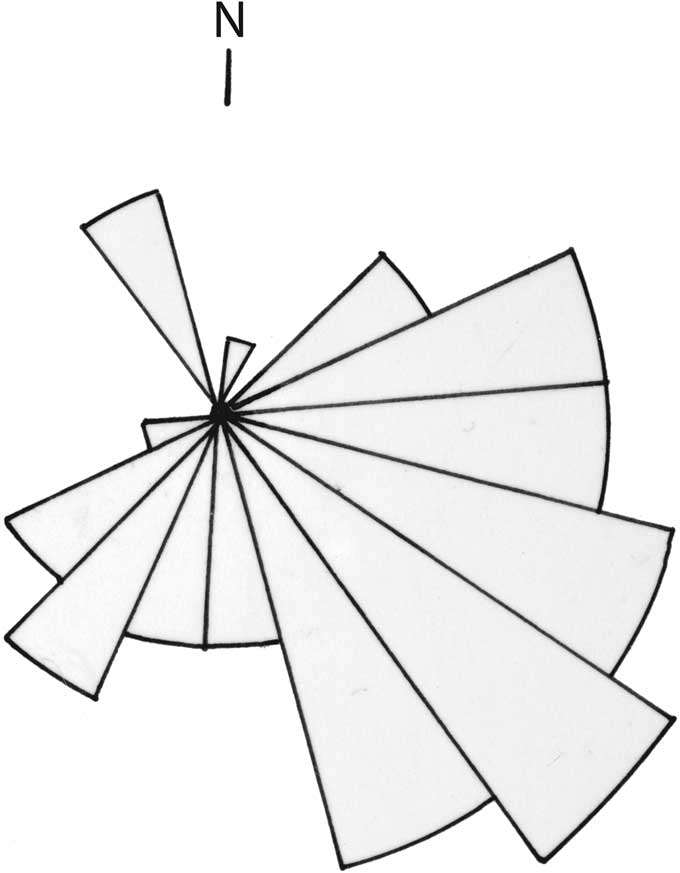
The orientation of the lobster pleons was investigated to determine whether they demonstrated a preferred orientation due to wave or current activity. Pleons were classified as straight or curved. Orientations were measured from an arbitrary reference direction (shown by the arrow in Figure 4) because the compass orientation of the rock slab was not recorded when it was collected. Bearings were recorded outward from both ends of each straight pleon, because in most cases it is not possible to determine which end is the telson. For most of the specimens (arcuate pleons; n=50), the directional angle was measured normal to a line connecting the ends of the arc, outward from the pleon’s concave side. Analysis was conducted using ASTRA.BAS (Wells, Reference Wells1999). For the curved pleons, rose diagram bins were set at 1/3 of the circular standard deviation, centered on the vector mean of 133° (i.e., displayed for maximum symmetry) (Fig. 5). This strongly suggests a current to the southeast of the arbitrarily designated 0°. The consistency ratio is 0.5. Given N=50 for curved pleons, this is strongly preferred orientation, with a probability of occurring by chance of 0.000006. Straight pleons (n=26) showed more variable orientations, with most arrayed northwest to southeast with respect to 0° in this analysis (parallel to the current) and a substantial minority oriented perpendicular to the current (Fig. 5). This probably indicates that some moved by rolling, while others swiveled parallel to the current, which is not atypical of linear objects subjected to currents. Thus, the evidence collectively suggests a current-driven assemblage of lobster pleons, perhaps assembled and winnowed by density-driven bottom currents, given the extremely fine-grained lithology of the occurrence. The likely current direction was southeast-northwest, relative to the arbitrary orientation.
Rose diagram for lobster pleon orientations. North indicated on the diagram is arbitrary because the specimen was not oriented when collected. Arcuate lobster pleons, raw data, with linear scaling and bins set at the nearest factor of 360o to 1/3 of the circular standard deviation, centered on the vector mean. Diagram generated in ASTRA.BAS (Wells, Reference Wells1999).
Even if this is a current-generated lag assemblage, it remains that it is a large number of individuals. Neoglypheidae, the only extant group to which Tridactylastacus is closely related, have large eggs, and are thought to hatch in an advanced stage of development (Forest, Reference Forest2006). Forest (Reference Forest2006) hypothesized that the newly hatched juveniles were sufficiently advanced and similar to adults in morphology that they would be able to immediately survive in their environment. Such a lifestyle, in relatively offshore environments of 200 m to 1000 m, as reported by Forest, might generate such an assemblage as seen here, wherein many tiny individuals similar in appearance to larger, apparent adults, are clustered in one place.
All other lobsters reside in different clades, because lobsters are not monophyletic (Karasawa et al., Reference Karasawa, Schweitzer and Feldmann2013). Thus, we also hypothesized about the Tridactylastacus assemblage based upon comparison with the biological and ecological characteristics of extant lobsters; “lobster” is largely a catch-all term for those reptant decapods with larger size, well-calcified cuticle, especially on the pleon, and usually, but not always, with claws (Schweitzer and Feldmann, Reference Schweitzer and Feldmann2014). We compared Tridactylastacus to lobster biological and ecological parameters due to its overall morphological similarity to those animals. Axiidea, a group to which it is also morphologically similar, exhibit a largely fossorial or cryptic habit (Dworschak et al., Reference Dworschak, Felder and Tudge2012), and there is only some evidence from the fossil record that Glypheidea was a mostly fossorial group, although some have been preserved in burrows.
It is unlikely that the specimens resulted from a nursery because the specimens are too large. According to a summary of life histories of various extant lobsters, size of the carapace of mature females ranges from 3 to 26 times the length of the size at postlarval settlement stage, averaging about 11 times the size and with a median of 9 (data from Wahle and Fogarty, Reference Wahle and Fogarty2006, table 1.1). The carapace of the sole larger specimen of Tridactylastacus is 3.5–4 times the size of the smaller carapaces in the death assemblage. Thus, because the larger specimens compared to smaller specimens barely fall into the size ratio of postlarval juveniles compared to adults, it seems most likely that they are small, young, perhaps non-reproducing adults. The hypotheses of Forest (Reference Forest2006) also support this view.
Other aspects of lobster ecology also argue against the assemblage as a nursery. In many nephropid lobsters (the group that embraces the American lobster), nurseries are shallow, gravelly areas providing shelter (Butler et al., Reference Butler, Steneck and Herrnkind2006). The lobsters then move offshore into different, deeper, offshore habitats as they grow (Butler et al., Reference Butler, Steneck and Herrnkind2006). Congregation of individuals for mating also seems unlikely. Nephropids are antagonistic and males will guard a specific nesting area during the mating season. Females seek out the male and reside in the male’s nesting area until the mating and molting is finished (Childress and Jury, Reference Childress and Jury2006); thus, mating does not occur in groups. Female lobsters within Achelata, the slipper and spiny lobsters, may receive multiple sperm packets, on the other hand, but this does not seem to be tied with a congregated mating scheme; rather it seems to be a result of multiple one-on-one mating events (Childress and Jury, Reference Childress and Jury2006).
In palinurids, nurseries for benthic juveniles are shallow regions with seagrass or other vegetation or in rocky or reefy areas in which they can shelter (Butler et al., Reference Butler, Steneck and Herrnkind2006). Unlike nephropids, they become more and more gregarious in behavior as they move from late juvenile to early adulthood and may live together in shelters, as do some scyllarid lobsters (slipper lobsters) (Lavalli and Spanier, Reference Lavalli and Spanier2010). The Tridactylastacus assemblage could suggest gregarious behavior, but the lithology of the region precludes sheltering structures such as those used by palinurid juveniles and young adults.
Another lobster clade, Polychelida, has been found to have late larval stages that settle in deeper water, below the euphotic zone (Torres et al., Reference Torres, Palero, Dos Santos, Abelló, Blanco, Boné and Guerao2014)—a habitat that seems comparable to that described for the Guanling Formation from which the Tridactylastacus specimens have been collected. As adults, these same animals occupied densities of between 1000–2000 individuals per km2 (Ramón et al., Reference Ramón, Abelló, Ordines and Massutí2014). Thus, the assemblage described here could be a lag deposit from a densely inhabited area. Litogastridae showed strong preference for low energy and carbonate environments (Schweitzer and Feldmann, Reference Schweitzer and Feldmann2014). They may have had an ecological niche similar to that of modern Polychelida, preferring quiet, soft bottoms, and perhaps deeper water.
Considering the above possibilities, it seems most reasonable to conclude that the occurrence of over 80 small individuals in a small area can be attributed to an unexceptional event, possibly an algal bloom or other short-term toxic event, in an area populated by a vast number of small individuals. Upon settlement on the substrate, gentle currents were responsible for reorientation of the remains. In this scenario, the accumulation of a large number of small individuals either as corpses or molts is not particularly remarkable. Nonetheless, the accumulation provides evidence for behavior not yet noted for Litogastridae.
Acknowledgments
This work was supported by the Chinese Geological Survey grants (no. 1212011140051 and 1212011120621). Travel to China and research there was funded by NSF OISE 1126137 to Feldmann and Schweitzer and National Geographic Society 9128-12 to Feldmann. P.K.L. Ng, National University of Singapore, commented on an earlier draft of the manuscript and advised on nomenclatural issues; J. Ortiz, Kent State University, advised on interpretation of statistical results. Helpful reviews were provided by S. Charbonnier, Muséum national d’Histoire naturelle, Paris, and an anonymous reviewer, as well as handling associate editor Joachim Haug.