One of the core questions of modern social science, as it arose in the nineteenth century, concerned the origins of the modern state (cf. Hall Reference Hall2001; Mills Reference Mills1959: 152–53; Skocpol Reference Skocpol and Skocpol1984: 1). Indeed, Max Weber's definition of the modern state as “a human community that (successfully) claims the monopoly of the legitimate use of physical force within a given territory” probably remains the most famous definition of social science. Weber's great project was to understand the historical causes that had produced this entity, a research agenda that has been coined as an attempt to answer the question “Why Europe?” (Chirot Reference Chirot1985). However, scholars invoking Weber often ignore that his understanding of the modern state contains more than the three properties explicitly included into the cited definition, that is, monopoly of violence, territoriality, and external sovereignty (Poggi Reference Poggi and Caramani2013: 64–66; see Skocpol Reference Skocpol, Evans, Rueschemeyer and Skocpol1985: 7). Most important for our purposes, the legitimacy of the monopoly on violence presupposes that state power is checked by the rule of law (Held Reference Held2006 [1987]: 131; see also Poggi Reference Poggi and Caramani2013).
By the rule of law, I mean that power is exercised not in an arbitrary way but is tempered by law. As Krygier (Reference Krygier2016) points out, power can be arbitrary both by being unlimited and by being unruly. Modern rule of law conceptions particularly address the unruliness of the exercise of power and hence emphasize criteria that make it predictable, including that laws are general, prospective, clear, certain, and consistently applied (e.g., Raz Reference Raz1979). However, in historical perspective in general and in the context of medieval and early modern Europe in particular, it is the unlimited exercise of power that is key. To rein in arbitrariness in this sense, power needs to be enmeshed in and constrained by law, based on the principle of the supremacy of law (Berman Reference Berman1983; Krygier Reference Krygier2016: 203–4; see also Møller and Skaaning Reference Møller and Skaaning2014: ch. 1). In the words of Berman (Reference Berman1983: 9), this entails that “law transcends politics.”
The point is that the modern European state, as it arose, came to combine a relatively high level of state capacity with the notion that power had to be bound by law (see also Fukuyama Reference Fukuyama2011)—what an earlier generation of scholarship termed a “liberal state” (e.g., de Ruggiero Reference Ruggiero1927). As economic historian Eric Jones (Reference Jones2008 [1981]: xiv) puts it, “Europe alone managed the politically remarkable feat of curtailing arbitrary power.” In a nutshell, what Weber was asking was why European states had taken on a rational-legalist or even constitutionalist character, which we do not find elsewhere (Chirot Reference Chirot1985).
In recent decades, scholars have returned to this question as part of an attempt to understand the origins of comparative development (Acemoglu et al. Reference Acemoglu, Johnson and Robinson2001, Reference Acemoglu, Johnson and Robinson2002, Reference Acemoglu, Johnson, Robinson and Yared2008; Fukuyama Reference Fukuyama2011, Reference Fukuyama2014). Most importantly, state capacity regulated by the rule of law has been identified as an important prerequisite for modern economic growth (Acemoglu et al. Reference Acemoglu, Johnson and Robinson2001; Jones Reference Jones2008 [1981]; North Reference North1990). So far, scholarship on the origins of the modern state has tended to favor different variations of a more general war-and-state-making perspective (Gennaioli and Voth 2015; Hintze Reference Hintze1975 [1906]; Schumpeter Reference Schumpeter, Schumpeter and Swedberg1991 [1917/1918]; Thies Reference Thies2005; Tilly Reference Tilly1975, Reference Tilly1990). The trigger of state building is here seen as generalized geopolitical competition, which creates a life or death environment that weeds out inefficient states. There is both an endogenous and an exogenous version of this claim (cf. Kurtz Reference Kurtz2013). The endogenous version holds that war directly sparks reforms of state institutions; the exogenous version claims that war creates an evolutionary selection pressure because only those units that for other reasons have developed efficient state institutions survive. However, in both scenarios the aggregate effect is the same, namely that over time inefficient state institutions disappear in the maelstrom of war-induced state building.
Generalized geopolitical competition denotes more than the warfare that has been ubiquitous in the history of human societies (Bradford Reference Bradford2001; Morris Reference Morris2014). However, it need not imply the kind of fully formed multistate system that has characterized Europe since the Peace of Westphalia in 1648 (Levy and Thompson Reference Levy and Thompson2005: 15). Generalized geopolitical competition simply means that rulers have to repeatedly mobilize their economies due to the latent threat—the generalized aspect of interstate competition—of warfare between demarcated political units that interact in the absence of a higher authority, for example, an empire.
There is much to this “geopolitical” perspective. Most scholarship agrees that war has historically been the great state builder because it has contributed to consolidating the power of the center (Downing Reference Downing1992; Ertman Reference Ertman1997; Hintze Reference Hintze1975 [1906], Reference Hintze1975 [1931]; Parker Reference Parker1996 [1988]; Schumpeter Reference Schumpeter, Schumpeter and Swedberg1991 [1917/1918]; Tilly Reference Tilly1975, Reference Tilly1990; Weber Reference Weber1981 [1927]). Most recently, a long-term historical version of this claim has been revisited and endorsed by the archaeologist Ian Morris (Reference Morris2014) in War: What Is It Good For?
But as has often been pointed out, the geopolitical perspective cannot account for the variation we find in the outcomes of state-building processes (Møller Reference Møller2014; Stasavage Reference Stasavage2016; Vu Reference Vu2010). That is, the focus on generalized geopolitical pressure does little to explain why war has historically produced very different kinds of centralized states. Returning to the subject matter of this article, it does not explain why in Europe war produced the rationalist-legalist state whereas it did not do so elsewhere. This can be illustrated by touching up on historian Geoffrey Parker's (Reference Parker1996 [1988]) seminal work in The Military Revolution. In the introduction to the book, Parker (ibid.: 2–4) sets the stage by briefly revisiting another military revolution, which took place approximately 2,000 years before that of early modern Europe, and which I will use as a foil in the theoretical discussion of the European development. This is the military revolution that occurred up until and during the era of ancient Chinese history aptly labeled the Warring States Period (475–221 BC). Parker's observation is that the intensification of geopolitical pressure in ancient China triggered the same state-building and domination dynamics as the much later European military revolution (see also Hui Reference Hui2004, Reference Hui2005; Hsu Reference Hsu, Loewe and Shaughnessy1999; Lewis Reference Lewis, Loewe and Shaughnessy1999). It thereby brought about a high level of state capacity. However, this state capacity was obviously not couched in or regulated by the rule of law (Fukuyama Reference Fukuyama2011; Hui Reference Hui2005; Møller Reference Møller2014).
More generally, generalized geopolitical pressure has been a recurrent phenomenon in human history, and ancient China and medieval and early modern Europe are simply two out of many instances where an intensification of geopolitical pressure triggered large-scale state building (Bradford Reference Bradford2001; Kaufman et al. Reference Kaufman, Little and Wohlforth2007; Mann Reference Mann1986; Morris Reference Morris2014). So the question remains: Why did this impulse create high-capacity states constrained by legalist or even constitutionalist barriers in Europe but not elsewhere?
In what follows, I argue that we need to understand what Alexis de Tocqueville termed the point de départ to explain the European development. That is, we need to understand the medieval roots of the modern state. More particularly, inspired by Tocqueville's work I claim that early modern European state building—though triggered by the onset of generalized geopolitical competition—was conditioned by a set of norms and institutions of communal representation, based on units such as parishes and towns. German historian Peter Blickle (Reference Blickle1997), who I draw on when fleshing out the argument, terms this “medieval communalism” (see also Genet Reference Genet1992; Hariss Reference Hariss1993; Reynolds Reference Reynolds1997 [1984]). Other scholars use different terms that broadly denote the same, for example, “medieval constitutionalism” (Sabetti Reference Sabetti2004) or even “the rule of law” (Fukuyama Reference Fukuyama2011). Tocqueville (Reference Tocqueville1955 [1856]) simply referred to “medieval institutions” in his classical work about the Old Regime and the French Revolution.
These ideas and institutions shaped early modern European state building in important ways. Indeed, key features of the Weberian rationalist-legal state were invented within two separate corporate locales: the Catholic Church and medieval cities. Though many medieval communal institutions were swept away following the state centralization after the military revolution between 1560 and 1660 (Downing Reference Downing1992; Parker Reference Parker1996 [1988]), others were integrated into the new state structures. Some were adopted directly by early modern state builders; some had to await the democratization of these states in the centuries after the French Revolution (Dilcher Reference Dilcher and Blickle1997: 233–35). More generally, what is so peculiar about European state building is that the resistance it constantly sparked among the communal nucleus of local society in the end helped consolidate the rational-legalist state.
The article proceeds as follows. First, the argument about the medieval roots of early modern state building is developed. Second, it is illustrated empirically by couching intra-European empirical observations in a more general comparison between European and non-European instances of state building (cf. Stasavage Reference Stasavage2016). The final section discusses the implications of the findings for present-day state-building processes.
The Argument
The general claim is simple: The effects of generalized geopolitical pressure on state building are conditional on prior state-society relations (Downing Reference Downing1992; Ertman Reference Ertman1997, Reference Ertman, Lange and Rueschemeyer2005; Møller Reference Møller2014; Tilly Reference Tilly1990). More particularly, while geopolitical pressure is generally conducive to state strengthening, it will only produce public administrations bound by the rule of law under particular circumstances. To understand why state building in Europe produced the rational-legal state whereas elsewhere it “merely” produced centralized states,Footnote 1 we need to understand the context within which European state building took place.
Several generations of historians have emphasized that the European state-building process was shaped by horizontal links based on strong communities (e.g., Blickle Reference Blickle1997; Genet Reference Genet1992, Reference Genet and Allmand1998: 7; Hariss Reference Hariss1993; Reynolds Reference Reynolds1997 [1984], Reference Reynolds2012; Van Bavel Reference Van Bavel2015: 85). To quote Genet (Reference Genet1992: 125):
The “modern” state was not built on a tabula rasa, and corporate bodies and communities of all kinds were in existence long before its appearance. Their integration into a new political structure gave birth to many conflicts . . . But the very fact of their existence was an important element in the shift from a feudal monarchy, where personal links remained the chief element of cohesiveness, to the “modern” state.
This can broadly be understood as a Tocquevillian perspective on European state building. In the Old Regime and the Revolution, Tocqueville's (Reference Tocqueville1955 [1856]) point of departure is that one and the same set of “medieval institutions” characterized all Western Europe before early modern state building began. These institutions created an extremely decentralized regime form based on local units such as parishes, townships, and free cities. Furthermore, this decentralized regime form manifested itself in a host of “intermediary institutions” with the national parliaments (in France, Les États-Généraux) as the most conspicuous but where regional parliaments and courts of law were often more important.Footnote 2
In The Old Regime, Tocqueville analyzes how war making and state making is shaped by the earlier existence of these decentralized political institutions.Footnote 3 With due reference to Tocqueville's work (see e.g., Blickle Reference Blickle1997: 329), the German historian Peter Blickle (Reference Blickle1997) has documented this in a series of works on what he terms “medieval communalism.” “Medieval communalism” can be defined as the self-government of medieval towns and rural parishes. These collective units had the right to regulate economic, religious, and social affairs, independently of the manorial rights of lords or the monarchical power of kings (see also Rothstein and Broms Reference Rothstein and Broms2013: 12). Crucially, this self-government was based on—and enmeshed in—law, that is, the autonomy of the local units was formally recognized by rulers (see also Bartlett Reference Bartlett1993: 167–76). As Reynolds (Reference Reynolds1997 [1984]: 79–82) has documented, the Western European countryside was divided into parishes around 800, by 1100 these had become effective units of self-government, and it was not until after 1800 that substantial changes were made to their boundaries.
While there is a large literature on the self-government of medieval towns (see Poggi Reference Poggi1978; Stasavage Reference Stasavage2014), Blickle's contribution has been to show that a similar form of self-government also characterized rural parishes in all medieval Western Europe (see also Reynolds Reference Reynolds1997 [1984]; Reference Reynolds2012: 100–5; Sabetti Reference Sabetti2004). Sabetti (Reference Sabetti2004: 74) sums up the medieval system of self-government as follows:
By the thirteenth century, the principle of ius proprium or iura propria—namely, the practice of (male) self-organization and self-governance, including relations based on contractual relations—extended to almost all forms of known collective activity and undertaking throughout Western Europe. Each collective undertaking was organized as a universitas, and what distinguished one universitas from another were the tasks that each set for itself, with the result that almost every town (or village, as the study of English villagers in the thirteenth century by George Homans [1941] suggested long ago) had its own multiconstitutional world, albeit organized by male family heads. Each collective undertaking had its own jurisdiction (jurisdictio), authority (gubernaculum), and the power to regulate itself (praeceptio) through a variety of means. Size was not a factor because each entity, whether small or large, possessed constitutional capacity (“right” may be too strong a word), jurisdiction, and internal regulations.
In Europe, I argue, the character of late medieval and early modern state building was conditional on the prior existence of these institutions and norms of self-government. To understand why, we need to lay bare two distinct aspects of the dynamics of state building, the first one centered on the interactions between rulers and ruled, the second on the administrative techniques available to state builders.
First Step: A Bargaining Model
A number of scholars have emphasized the weak position of the medieval monarchs at the outset of Western European state building (e.g., Blaydes and Chaney Reference Blaydes and Chaney2013; Stasavage Reference Stasavage2016). The other side of the coin is the relative strength of local communities and the elite groups that dominated them, most particularly the nobles, the clergy and—after the twelfth-century communal revolution—the townsmen (Blaydes and Chaney Reference Blaydes and Chaney2013; Møller Reference Møller2014; Reynolds Reference Reynolds1997 [1984], Reference Reynolds2012). This combination made monarch dependent on negotiating with strong local communities and strong societal groups, and thereby regularly forced them to grant political concessions while building states.
The best way of understanding this is using what Tilly (Reference Tilly, Goodin and Tilly2006: 423) terms the “extraction-resistance-settlement cycle.” This is a general description of the process of state building, as triggered by an onset of generalized geopolitical pressure (see Tilly Reference Tilly1975, Reference Tilly1990). The point is that preparations for war require hikes in fiscal extractions from society. These hikes both necessitate state building and spur societal resistance from the groups that are meant to sponsor the extractions. For two reasons, however, the prior existence of medieval communalism affects the interactions between rulers and ruled and, hence, the state building that the geopolitical pressure triggers.
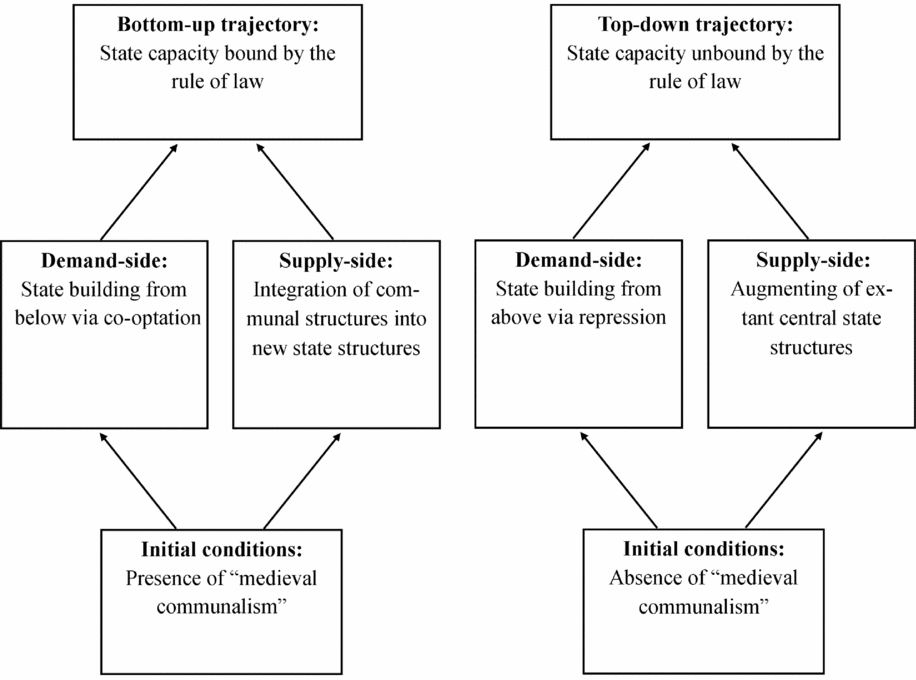
The first set of mechanisms has to do with the incentives of state builders. Nondemocratic rulers, as were all rulers in the world prior to the nineteenth century, can respond to resistance in different ways. Using terms popular in the recent literature on contemporary autocracies, they can either try to repress or to co-opt (Svolik Reference Svolik2012). However, though rulers can in theory choose from among a “menu of manipulation” (Schedler Reference Schedler2002), they do not have a free choice. Which strategy to choose depends very much on the context, including the balance of power between rulers and ruled, that is, it depends on state-society relations (Downing Reference Downing1992; Ertman Reference Ertman1997; Tilly Reference Tilly1990). More precisely, the onset of generalized geopolitical pressure can—if we conceive of it in ideal typical terms—create two very different outcomes: state building from above through repression or state building from below using co-optation and consultation. The former pattern of state building is by far the most radical one because its very aim is to strengthen the state at the expense of society, that is, to remove extant impediments against the exercise of state power.
In the top-down state-building scenario, the ruler is not apt to accept limits on his or her own power, meaning that state centralization does not rest on the rule of law or on political accountability to the ruled. This is the pattern that we see in the ancient Chinese cases to which Parker (Reference Parker1996 [1988]: 2–4) refers. A large body of recent work on ancient China thus documents how Chinese rulers in the late Spring and Autumn period (771–476 BC) and the ensuing Warring States period (475–221 BC) were able to mobilize society for sustained warfare by augmenting state capacity and by removing political constraints such as those previously represented by the nobility (Hui Reference Hui2004, Reference Hui2005; Hsu Reference Hsu, Loewe and Shaughnessy1999; Lewis Reference Lewis, Loewe and Shaughnessy1999; Li Feng Reference Feng2006; Møller Reference Møller2014; von Falkenhausen Reference von Falkenhausen2006).
In the other scenario, the strengthening of the state follows a bargaining logic. This occurs when rulers are unable to mobilize the wherewithal needed for warfare—given the external pressure—without the active assistance of elite groups. These groups can bar the ruler from mobilizing the economy directly and, at the same time, provide the infrastructure to carry out an effective mobilization of resources if they can be enlisted to aid the ruler.
This dependence on strong societal groups means that the road to state building is paved with political concessions. Moreover, state-building progresses by empowering local structures such as cities and rural parishes, which are recognized as agents or institutions of the state that can broadcast power over localities otherwise outside the sway of the ruler. Meanwhile, the apex of this system is made up of political institutions where strong groups are represented, for instance the parliaments that arose in medieval Europe (Stasavage Reference Stasavage2010, Reference Stasavage2016). These institutions not only serve to safeguard the interests of elite groups—a political purpose—but directly carry out functions of the state such as the collection of taxes and the judicial functions of courts of law. We can think of this bargaining (or its absence) as the demand side of state building.
Second Step: Institutional Reproduction and Diffusion
The key point made in the preceding paragraph is that state building from below was a condition for generalized geopolitical pressure producing state capacity bound by the rule of law. However, there is more to medieval communalism than its ability to facilitate organized opposition against state builders. The second set of mechanisms has to do with institutional reproduction and institutional diffusion. As is well known, an important historical consequence of geopolitical pressure has been the adoption of administrative and military techniques that have proved efficient in neighboring states (see Hui Reference Hui2005; Lewis Reference Lewis, Loewe and Shaughnessy1999; Morris Reference Morris2014; Tilly Reference Tilly1990). For instance, scholars have demonstrated how in the ancient Chinese state system geopolitical pressure meant that bureaucratic and military innovations quickly spread from political unit to political unit (Hui Reference Hui2005; Lewis Reference Lewis, Loewe and Shaughnessy1999). Similar observations have been made about the European multistate system (Bartlett Reference Bartlett1993; Jones Reference Jones2008 [1981]; Tilly Reference Tilly1990). In both connections, an important qualification is that the cultural and diplomatic integration of each of these systems further spurred diffusion (Hall Reference Hall1985: 135; Jones Reference Jones2008 [1981]: 45; Lewis Reference Lewis, Loewe and Shaughnessy1999: 620; Li Feng Reference Feng2006: 296; Tilly Reference Tilly1990). That is, the more tightly knit the system, the more effective the cross-unit borrowing.
A tightly knit system—as was the early modern European multistate system (Watson Reference Watson1992)—exposed to an intensification of geopolitical pressure is thus apt to experience state building inspired by the administrative “technologies” that are available elsewhere in the system. This is the second way in which the existence of medieval communalism, prior to state building, matters. The mere fact that ideas and institutions of communalism flourished in medieval Europe made a difference because state builders could turn to established administrative technologies and use established groups and institutions to channel authority. This process involved learning as state builders used administrative blueprints originally developed within the Catholic Church or in self-governing units such as towns and through a more direct integration of communal structures into the new state structures.
There is a broad consensus in the literature that a series of elements of the modern state were invented by the Catholic Church and then imported by secular rulers as they attempted to augment their own administration (Berman Reference Berman1983; Genet Reference Genet1992: 126; Tierney Reference Tierney1982; Ullmann Reference Ullmann1955). This was facilitated by the ubiquitous presence of the Church in medieval Western and Central Europe (Finer Reference Finer1997a: 857; Hall Reference Hall1985; Mann Reference Mann1986). Churchmen staffed the monarchs’ chancelleries and the bishops made up a vital part of royal administration across Western Christendom (Southern Reference Southern1970: 130–31). “[I]n this way a certain uniformity of thinking about politics and administration was established,” as German historian Otto Hintze (Reference Hintze1975 [1931]: 318) noted almost a century ago. Indeed, in the period 1050–1350 “the whole of educated Europe formed a single and undifferentiated unit” (Berman Reference Berman1983: 161–62).
It was not only that certain administrative “technologies” existed and easily diffused; it was also that already functioning institutions and personnel could be integrated into the new state apparatus. For instance, there was a professional layer to recruit administrators from in especially towns. More generally, it has been documented that the ready supply of university candidates after 1450 allowed “bureaucratic” state building in a series of Western European countries (Ertman Reference Ertman1997). These university candidates were brought about by one of the great self-governing institutions of the Middle Ages, namely the universities (the very name, from universitas, provides a reminder of this). These candidates moved freely across nascent boundaries and helped to create a “transnational terminology and method” of law and administration (Berman Reference Berman1983: 161–63).
This supply side of state building meant that a series of innovations associated with the prior communalism, in general, and the self-government of the Catholic Church and medieval towns, in particular, was imprinted into later state building. In Ancient China, however, the lack of such decentralized structures meant that the institutional borrowing mainly took the form of innovations that bolstered the central power of the state, including the creation of mass infantry armies and the use of officials to directly govern localities (Hui Reference Hui2005; Hsu Reference Hsu, Loewe and Shaughnessy1999; Lewis Reference Lewis, Loewe and Shaughnessy1999).
Empirical Illustration
In other words, both the demand and the supply side pushed European state building toward the bottom-up trajectory described in figure 1. This article proceeds by carrying out an empirical plausibility probe of this argument based on two different dimensions of empirical variation: interregional and intraregional. The point here is that, to be convincing, the explanation should be able to account for both differences between the European “case” and other multistate systems as well as differences within the European space (cf. Stasavage Reference Stasavage2016). Furthermore, within-case analysis of the instances where modern state building occurred, that is, Western European cases, should also corroborate the explanation. In what follows, I use this logic to illustrate the purchase of the arguments presented in the preceding text. A general contrasting of Western European state building with state building in other regions is followed by a more detailed description of state building in two different parts of Europe: Russia versus Western and Central Europe.
Contrasting paths of state formation sparked by generalized geopolitical pressure, depending on the prior presence (left) or prior absence (right) of medieval communalism.

Interregional Comparisons
Just as we find generalized geopolitical pressure elsewhere, we obviously also encounter numerous situations in which weak rulers faced relatively strong societies (Centeno Reference Centeno2002; Herbst Reference Herbst2000; Mann Reference Mann1986). However, at a closer look, Western and Northern Europe differ from other regions on the attributes illustrated in figure 1. Whereas we find strong societal groups and some version of self-government elsewhere, we can plausibly argue that the total edifice of medieval communalism is idiosyncratic to Europe.
The most important point here is that the European communalism was formally enshrined in law. It was a legally protected local structure of self-government, and one that politically empowered social groups and localities (Berman Reference Berman1983; Sabetti Reference Sabetti2004). We do not find such vibrant local structures outside of Europe. When discussing the importance of the right to petition for the functioning of communalism, Blickle et al. (Reference Blickle, Ellis, Österberg and Blickle1997: 151–52) accordingly point out that this right was common to all (Western and Central) European states but that we find it nowhere in Asia, including the Ottoman Empire. They furthermore stress that this difference had a huge impact on processes of state building in the two areas because the right of petition was one reason why the main push for standardizing law came from below in Western and Central Europe.
Next, though we find numerous historical cases in which power was fragmented and strong elite groups could balance rulers, only in Europe do we find a multiplicity of self-governing groups, which had their rights officially recognized by rulers. This is illustrated by Hui's (Reference Hui2001, Reference Hui2004, Reference Hui2005) comparison between state building in early modern Europe and ancient China. Hui makes a forceful case for a number of similarities in state-society relations between ancient China and medieval Europe before the intensification of geopolitical pressure in each of these settings. But she concedes that an important difference exists due to the European “existence of three—instead of one—social orders that were highly autonomous from kings and princes” (Hui Reference Hui2005: 202–3). Furthermore, she grants that this meant what she terms the logic of balancing between rulers and ruler was somewhat stronger in Europe than in ancient China. Rothstein and Broms (Reference Rothstein and Broms2013) similarly process a large body of historiography to show that European-style communalism was not present in the Islamic world.
State Building within Europe
Within Europe, we also find some stark dividing lines. The most salient one is that between “western” and “eastern” paths of state building (Knudsen and Rothstein Reference Knudsen and Rothstein1994: 205). Tilly (Reference Tilly1990) frames this as a contrast between, on the one hand, “coercion-intensive” state building in the sparsely urbanized regions of East-Central and Eastern Europe proper and, on the other hand, the “capitalized coercive” or “capital-intensive” paths in the more highly urbanized Western Europe.
State Building in Russia
The best illustration of Tilly's coercive category is surely to be found in the Russian state-building experience (see also Møller Reference Møller2015).Footnote 4 In Russia, early modern state building was sparked by the very same impulse as in Western Europe, namely the generalized geopolitical pressure characterizing the European multistate system after the sixteenth-century “military revolution” (see Parker Reference Parker1996 [1988]: 38–39). Moreover, Russian state builders keenly borrowed military and administrative technologies from the rest of Europe (Hosking Reference Hosking2001: 156–57; see also Hughes Reference Hughes1998: 76, 80).
External pressure principally sprang from the Polish and Swedish eastward expansions in the Baltics and the Ukraine, and it sparked the adoption of Western European military technology and tactics, beginning under Tsar Ivan the Terrible (Parker Reference Parker1996 [1988]: 38; Riasanovsky Reference Riasanovsky1969: 161–63). Geopolitical pressure further intensified around 1700. Indeed, most scholars identify Peter the Great's humiliating defeat against the Swedes at Narva in 1700 as the main impulse behind early modern Russian military build-up and state building (Finer Reference Finer1997b: 1413; Hosking Reference Hosking2001: 185; Riasanovsky Reference Riasanovsky1969: 245; Taylor Reference Taylor2003: 29).
The need to counter Sweden elicited the reforms Peter's reign is famous for, including a direct head tax on all peasants and townspeople and general conscription (Riasanovsky Reference Riasanovsky1969: 252–59; Taylor Reference Taylor2003: 29). Interestingly, these reforms were generally implemented and enforced through state-sponsored coercion (Taylor Reference Taylor2003: 40). Returning to the explanatory model, this is a clear instance of state building from above, based on repression (Evtuhov et al. Reference Evtuhov, Goldfrank, Hughes and Stites2004: 221).
Prior state-society relations elucidate why this trajectory was chosen. Not only did Russia have preciously little “capital” in the form of towns, it had no equivalent of medieval communalism more generally (Downing Reference Downing1992: 38–43; Finer Reference Finer1997b: 1405–23; Hosking Reference Hosking2001; Taylor Reference Taylor2003: 40). In Russia, there were no self-governing towns, the clergy was subservient to the tsars, and the nobility, the boyars, “lacked any formal, corporate, or legal means of checking him, unlike their Western counterparts” (Evtuhov et al. Reference Evtuhov, Goldfrank, Hughes and Stites2004: 105–6; Lieven Reference Lieven and Lieven2006: 239). To quote Finer (Reference Finer1997b: 1411):
[T]he boyars and the Church hierarchy posed no such restraints on Ivan IV as the landed nobility and the Catholic Church did in the West, and there were no towns, guilds, and corporations to cope with either.
Indeed, Peter was able to carry through his reform program because he faced so few political constraints on his exercise of power. Along the way, he removed the traditional constraints on the power of Muscovite grand princes and later tsars. For instance, Peter stopped consulting the Boyar nobility and made the church completely subordinated to the state (Finer Reference Finer1997b: 1414–16; Hosking Reference Hosking2001: 198–99; Riasanovsky Reference Riasanovsky1969: 254–57). More generally, Peter transformed the Russian nobility into the service nobility that, according to Perry Anderson (Reference Anderson1974), is characteristic for Eastern European absolutism. He did so using the invention of a new table of ranks that made especially military rank much less dependent upon noble status—and that simultaneously made it possible for commoners to be ennobled as a reward for faithful service (Evtuhov et al. Reference Evtuhov, Goldfrank, Hughes and Stites2004: 215–17). To once more quote Finer (Reference Finer1997b: 1415):
The landholders were now thoroughly subjected to the wishes of the Crown and such restraints as they had ever been able to impose on the tsars from Ivan IV up to Peter's time had entirely disappeared.
Indeed, Peter was “probably the least constrained of European rulers” (Taylor Reference Taylor2003: 40). Through his reforms, he created what has been termed a “fiscal-military state,” based on an “increasingly elaborate and differentiated bureaucracy” (Hosking Reference Hosking2001: 155). This included a total reorganization of central government along lines inspired by Sweden in particular. Peter also attempted to reform local government based on Western European models. But these attempts failed, primarily because of the lack of local initiative (Riasanovsky Reference Riasanovsky1969: 256). The absence of prior structures of local self-government meant that the new administrative institutions could not be based on prior intermediary institutions and that no strong groups existed that could be enlisted to staff the new offices. As Hosking (Reference Hosking2001: 215–16) describes, there was no “transmissions belt for government authority.”
A bottom-up strategy of state building was simply foreclosed by the weakness of societal groups and local institutions, that is, by the lack of medieval communalism. The only alternative was state building from above based on patron-client relations. Hence the “old Russian paradox: that a reforming autocrat needs autocracy more than ever” (ibid.: 292). In the absence of the professional strata that dominated urban and local government in Western Europe, Peter and later tsars had little choice but to use noble landowners as their agents (ibid.: 219).
Instead of building new, bureaucratic institutions, Peter's reforms therefore tended to intensify patron-client relationship (ibid.: 176). With respect to local government, this created what Max Weber referred to as “local patrimonialism” as landed aristocrats “acting through local government offices which they collectively monopolize, extend the authority which they already exercise over their own dependents to all inhabitants of a given region” (Ertman Reference Ertman1997: 8).
Patron-client relationships also pervaded central government—during and after Peter's reign. It was very much closeness to the tsar rather than institutional power that mattered. For instance, Tsar Nicolas I used secret committees appointed due to relationships with the tsar as a “major means of conducting a personal policy which bypassed the regular state channels” (Riasanovsky Reference Riasanovsky1969: 360–61). Such personalism in the context of an institutional void characterized the rule of other tsars as well. Even under Catherine the Great, the Russia polity therefore remained “as unrestrained by laws and institutions as ever” (Finer Reference Finer1997b: 1420–23).
State Building in Western and Central Europe
Let us now change focus to Tilly's capital-intensive or capitalized coercive paths of state building, which we find in Western Europe. There is a general agreement that modern state building was pioneered in two corporate locales, namely the Catholic Church and self-governing towns.
It was within the medieval Catholic Church that the concept of political representation and the notion that law transcends politics were developed (Berman Reference Berman1983; Genet Reference Genet1992: 126; Tierney Reference Tierney1982; Ullmann Reference Ullmann1955). The debate about whether this was a contingent consequence of the investiture conflict between 1075 and 1122 or whether this conflict simply activated more latent cleavages lies beyond the scope of this article.Footnote 5 Suffice to say here that the fight over investiture and jurisdiction gave an important push to law and litigation (Berman Reference Berman1983: 50, 95, 111–15; Tierney Reference Tierney1982, Reference Tierney1988; Ullmann Reference Ullmann1955: 448). For instance, the Papacy promoted law schools (the most well-known being that of Bologna) because these presented a way of projecting canon law into society (Berman Reference Berman1983: 115–62; Southern Reference Southern1970: 203).
Furthermore, it was within the Catholic Church that a series of norms and institutions that came to characterize later state building were formulated and developed. The most important example is probably the notion that a corporate group could delegate full power to an agent and “that which affects all people must be approved by all people” (quod omnes tangit ab omnibus approbetur) (Tierney Reference Tierney1982: 23–25). It followed from these ideas that a representative council—in casu, a Church council—could decide matters that bound all who had sent their agents. This mix of norms and institutions migrated to secular political theory where it laid the basis for the representative institutions that flourished from circa 1200 AD onward (Myers Reference Myers1975; Stasavage Reference Stasavage2010).
The Church also pioneered more particular administrative technologies and structures. Indeed, the medieval Papacy was in many ways the first modern state (Berman Reference Berman1983: 113). It was an independent, hierarchically organized public authority that legislated, administrated, and exercised judicial powers. To do so, it employed university-trained lawyers, had at its disposal the huge Papal archives, and was—more generally—obsessed with law and litigation (Southern Reference Southern1970; Tierney Reference Tierney1988).
Another set of administrative technical features were developed in the “free towns” of Western Christendom. It has often been pointed out that in Western Europe self-governing cities “pioneered certain aspects of state building, such as financial management, codification of laws, archives, bureaucracy, and judicialization of conflict” (Dilcher Reference Dilcher and Blickle1997: 249). Much of this scholarship has focused on developments in thirteenth- to fifteenth-century Italian city-states. For instance, in a study of the history of taxation, Carolyn Webber and Aaron Wildavsky (Reference Webber and Wildavsky1986: 204) show that Italian city-states—Florence in particular—developed a series of fiscal instruments centuries before territorial states:
When the fiscal institutions of the northern-Italian communes are compared to the crude revenue systems of feudal monarchies of England and France, these developments are all the more remarkable, for the innovations appeared at least five hundred years ahead of their time.
Particularly innovative was the use—in Italian city-states—of deficit finance rather than merely taxation (Pezzolo Reference Pezzolo2003: 11; see also Becker Reference Becker2002). Within territorial states, self-governing towns also affected patterns of state formation. Returning to Tilly's (Reference Tilly1990) distinctions, it was not only in capital-intensive areas but also where state formation was based on capitalized coercion that towns pioneered bureaucratic institutions and methods. For instance, this was the case in Southern Germany and Austria (Dilcher Reference Dilcher and Blickle1997: 249; see also Isaacs Reference Isaacs and Blickle1997: 294). Habsburg Emperor Maximilian reformed his administration after models he encountered in the most capital-intensive part of his combined realms, namely the Netherlands (Dilcher Reference Dilcher and Blickle1997: 249). According to Thomas Ertman (Reference Ertman, Lange and Rueschemeyer2005: 169–72), these reforms were the first important step in the process that brought into being the modern bureaucratic state in the German and Scandinavian parts of Europe.
This does not imply that European state building was a consensual affair. All over Western and Central Europe, rulers bargained with strong groups and local communities regarding wherewithal for warfare. Often state building unleashed revolts and resistance that time and again forced monarchs to strike compromises (Zagorin Reference Zagorin1982). Examples of this are legion, and I will merely single out two of the more famous to illustrate these dynamics.
The first takes us to the Crown of Aragon in the late thirteenth century. Here Count-King Peter III had conquered Sicily following the Sicilian Vesper—a large-scale rebellion against Charles of Anjou—in 1282. This embroiled the Crown of Aragon in sustained geopolitical pressure as it faced a hostile coalition comprising Angevin Neaples, Pope Martin IV, the French king, and eventually Castile (Kagay Reference Kagay1981: 213; O'Callaghan Reference O'Callaghan1975: 387–88). In this situation, Peter—and later his successors Alfonso III and James II—tried to mobilize his Iberian possessions for defensive warfare. However, the Aragonese towns and nobles repeatedly refused to aid the king militarily. Instead, they took advantage of the situation to get the king to grant them two different set of privileges: the Privilegio General of 1283 and the Privilegios de la Unión of 1287. These charters transformed the parliament, the cortes, that had hitherto been called at the whim of the ruler into a permanent public institution. Moreover, they further shored up the ombudsman office of Justicia, which had been created in 1265 (Bisson Reference Bisson1986; Kagay Reference Kagay1981: 163–73).
Peter and Alphonso had to grant similar concessions in Catalonia (Kagay Reference Kagay1981: 183–91). This development occasioned what has been termed the “pactist monarchy” of the fourteenth and fifteenth centuries. In these centuries, the Aragonese count-kings presided over a regime and administration in which the estates (brazos) of nobles, clergy, and townsmen partook in the governing of the realm. The Catalan corts, Aragonese cortes, and Valencian cortes exerted great influence over state affairs in this period, not confined to matters of taxation but extending to financial policy more generally and even including foreign policy (ibid.: 384–85, 392; Myers Reference Myers1975: 62–65). Indeed, after 1359, a permanent committee of the Catalan corts, the Generalidad, collected and administered taxes (Kagay Reference Kagay1981: 212–43), while the Aragonese Justicia functioned as a noble-run courts of law.
The second example hails from mid-thirteenth-century England. In preceding decades, King Henry III repeatedly tried to mobilize his possessions for warfare to win the French provinces that his father, King John Lackland, had forfeited in the early 1200s, and to place his second son, Edmund, on the Sicilian throne that Charles of Anjou was instead to win in 1266. In the eyes of the English clergy and the English localities, Henry taxed arbitrarily and misgoverned more generally (Hariss Reference Hariss1975: 36–38; Maddicott Reference Maddicott1996, Reference Maddicott2010). In 1258, a group of magnates, led by Simon de Montfort, forced the so-called Provisions of Oxford on him. This represented “the most radical assault yet made on the prerogatives of the Crown” (Maddicott Reference Maddicott1996: 151). These events, in turn, paved the way for the civil war of 1264–65 where de Montfort would first defeat Henry at Lewes on May 14, 1264 and then be defeated by Henry's son Edward (the later Edward I) at Evesham in August 1265. The interesting thing is that de Montfort's main support came from the English clergy and from “middling men of the counties” (ibid.: 126). This was also the backdrop for why de Montfort called knights from each county to the famous Hilary Parliament of 1265 (ibid.: 316). This is an important episode in the more general process of enlarging the English political community described by Hariss (Reference Hariss1993: 34, 56):
[T]he English state of the late Middle Ages developed not just as an emanation of royal authority, but in response to the pressures from a widening political society. . .The involvement of that community in government, both centrally in the development of parliament and locally in shire administration, gave strength and resilience to monarchical rule.
Similar developments, often of smaller scale and much less famous, occurred across the space of Western and Central Europe in the High Middle Ages and early modern period as monarchs tried to centralize power but were met with resistance and had to make compromises (see Zagorin Reference Zagorin1982). The result was that “the principle of resistance simply became integrated in state structures” (Nicolas et al. Reference Nicolas, Valdeón Baruque, Vilfan and Blickle1997: 114). As Hariss points out, in the longer run this often strengthened the exercise of monarchical power. Invoking Michael Mann's (Reference Mann1986) terms, the involvement of the communal groups increased infrastructural power while it limited despotic power: “[R]esistance ultimately assisted rather than obstructed the process of centralization” (Nicolas et al. Reference Nicolas, Valdeón Baruque, Vilfan and Blickle1997: 65).
More generally, even where territorial states engulfed hitherto self-governing enclaves, “[t]he communal structures . . . remained in the state body, as a sort of counterpoint to the central concentration of power” (Neveux and Österberg Reference Neveux, Österberg and Blickle1997: 155). This was not only the case around the so-called city belt stretching from the Netherlands in the north via Western Germany and Switzerland to Northern Italy. In less urbanized regions such as Spain, France, and Austria, various versions of medieval communal structures also survived the advent of early modern absolutism (Nicolas et al. Reference Nicolas, Valdeón Baruque, Vilfan and Blickle1997: 112–14).
Furthermore, it was not only towns but also self-governing parishes that contributed to state formation. In the German area, legislation was often triggered by complaints from below, anchored in the right of petition. Petitions were first debated by self-governing communities—for example, parishes—and then forwarded to rulers (Blickle et al. Reference Blickle, Ellis, Österberg and Blickle1997: 125). More generally, in the German area we find a host of examples of how the main push for administrative standardization arose from grievances from below (ibid.: 136–37, 152). Moreover, “in view of the inadequate provision for local bureaucracy, the state was normally dependent on the subject for many aspects of law enforcement and for a knowledge of local problems of a socio-economic nature” (ibid.: 151).
Likewise, in Sweden grievances were formulated on local levels (all the way down to the hundreds) and then forwarded to the Swedish diet (ibid.: 129–30). This reflected a more general context of communal systems dominated by the peasant elites, which existed in all of Scandinavia and were based on cooperation with monarchs (Imsen and Vogler Reference Imsen, Vogler and Blickle1997: 5–12). The right to petition was in fact “a basic right of all Europeans” (Blickle et al. Reference Blickle, Ellis, Österberg and Blickle1997: 138), meaning all Western and Central Europeans. As emphasized earlier in this article, this separates the state formation in Europe from what we find elsewhere (151).
The contrast with Russia is once again illuminating. It was not only that “transmission belts” for royal and princely authority existed in Western and Central Europe. The case was also that vibrant societal groups could check the center, as Tocqueville pointed out long ago. The institutional manifestation of this was “elliptically constructed states. Their twin focuses were formed by the prince and the estates” (Dilcher Reference Dilcher and Blickle1997: 116; see also Hintze Reference Hintze1962 [1930], Reference Hintze1975 [1931]).
Conclusions
In The History of Government, Samuel P. Finer (Reference Finer1997b: 1475) lists a number of characteristics of the modern state and categorically declares that “[a]ll these features of the modern state are, without any exception whatsoever, derived from the West.” Most importantly, the legal-rationalist aspects of the modern state emphasized by Max Weber seem to be a unique aspect of the European state formation process.
This does not mean that the dynamics that sparked state building in Europe differ from what we find elsewhere. The key similarity between the early modern European state formation process and other state formation processes is the role of generalized geopolitical pressure as the trigger that incentivizes elites to strengthen state capacity. So, why did this pressure create state capacity bound by the rule of law in Europe but not elsewhere?
The basic claim forwarded in this article is that the effects of generalized geopolitical pressure are conditional on prior state-society relations. More particularly, it was the prior existence of what has been termed “medieval communalism” that conditioned state formation in Europe. I anchored these claims in two of Alexis de Tocqueville's fundamental insights: the importance of the point de départ for later state building in general, and the importance of the specific medieval institutions that he identified in particular. These prior institutions and ideas incentivized state builders to build states bottom-up, and they enabled them to do so because existing institutions could be used to channel power and staffed by existing groups.
The paradoxical consequence of this was that the bottom-up protests against state building facilitated the coming about of the modern state. Another way of framing this argument is through the simple observation that “[t]he medieval state was built on the principle of local self-government” (Imsen and Vogler Reference Imsen, Vogler and Blickle1997: 37). Though the aim of early modern state building was to alter these prior structures, state builders were normally unable to tear down existing structures and to rebuild them anew. Early modern state building was not based on a tabula rasa approach but rather on altering, strengthening, and harnessing the incipient structures of medieval polities.
This is where the process differed from the kind of state building from above that we find in, for example, early modern Russia and ancient China. This also had important political corollaries. Early modern European absolutism took a different form than other instances of absolutism, including the early modern Russian one. In Europe, absolutism was much more legalistic and much less powerful with respect to what Mann (Reference Mann1986) terms despotic power. However, the other side of the coin was a much higher level of what Mann terms infrastructural power because state building from below created rather effective structures, which could broadcast power into far-off localities.
This last observation presents a stepping-stone for touching upon the implications for contemporary processes of state building. States are still being built today. Indeed, the period after the dismantling of European colonial empires has been a large-scale period of state building in Latin America, Africa South of the Sahara, and much of Asia (see e.g., Centeno Reference Centeno2002; Herbst Reference Herbst2000). Most recently, China has engaged in a large-scale state building exercise as part of its phenomenal economic and political ascent.
Historical analogies are notoriously problematic because conditioning factors—including the lapse of historical time (Mann Reference Mann1986: 174)—often mean that processes play out in different ways in various settings, despite seeming similarities. That said, the European experience does serve to bring out some important traits of the ongoing processes of state formation outside of Europe. First things first, we can note that many of the twentieth- and twenty-first-century state-building processes have been characterized by the kind of “modernization from above” that we also find in the Russian case. This goes both for the many one-party-led modernization processes of the second part of the twentieth century in, for example, sub-Saharan Africa and for the recent Chinese experience.
It follows from the preceding analysis that these processes are unlikely to produce the law-bound high-capacity states that arose in Europe. This is most obvious with respect to the first part of the equation. Historically, the rule of law has been the product of the kind of bottom-up state formation that we find in Western Europe (see also Møller and Skaaning Reference Møller and Skaaning2014: ch. 9). With respect to state capacity, the omens are more promising. Countries such as Singapore and China have had much success building state capacity from above, as has earlier been the case in Japan, South Korea, and Taiwan. But as the Russian development shows, even here the lack of local institutions and strong groups can inhibit the creation of impersonal institutions—and increase the danger of basing the exercise of power on patron-client relationships.