Effective and efficient understanding and prediction of others' action is critical for social interaction and communication and cognitive mechanisms underlying effective social interaction and communication have been central to investigations within various fields of cognitive science, including developmental psychology and developmental cognitive neuroscience. In a groundbreaking paper, Premack and Woodruff (Reference Premack and Woodruff1978) proposed that chimpanzees, like humans, infer others' mental states such as desires, intentions, and beliefs and predict and control others' actions based on attributed mental states. They coined the term theory of mind for this cognitive mechanism. However, because in most cases action prediction based on a theory of mind appears the same as a prediction made with a learned behavioral association, the original studies reported in Premack and Woodruff (Reference Premack and Woodruff1978) were not conclusive as to whether chimpanzees really have theory of mind. To solve this problem, Dennett (Reference Dennett1978) proposed an ingenious experimental paradigm, known as the false belief task (Baron-Cohen, Leslie, & Frith, Reference Baron-Cohen, Leslie and Frith1985; Wimmer & Perner, Reference Wimmer and Perner1983). In this false belief task, a desirable object, usually hidden in a container, is displaced to another container while a protagonist is away. In this situation, theory of mind predicts that the protagonist should go to the previous location of the object because she is unaware of the displacement, and thus has a false belief about the current location of the object. In contrast, a behavioral association would predict that the protagonist should go to the current location of the object based on an association between the protagonist and the object (Dennett, Reference Dennett1978; for an alternative view, see also Perner & Ruffman, Reference Perner and Ruffman2005). Since then, this false belief task has been extended for use also in the fields of developmental psychology, psychiatry, and psychopathology. In these developmental studies, the false belief task is often treated as “the litmus paper” of theory of mind, and sometimes even assimilated to correspond to the full capacity of theory of mind skills (e.g., Astington & Jenkins, Reference Astington and Jenkins1999; Zelato, Jacques, Burack, & Frye, Reference Zelazo, Jacques, Burack and Frye2002), despite tapping only one aspect of theory of mind (i.e., attributions of false belief). This may be because of its lower susceptibility to Type I error (Dennett, Reference Dennett1978), its capacity to capture developmental trajectory (e.g., Happé, Reference Happé1995), and/or the impact of the seminal study of Baron-Cohen and colleagues (Reference Baron-Cohen, Leslie and Frith1985), which reported that children with autism, who suffer from severe impairment in social interaction and communication, do not pass the false belief task.
Since Baron-Cohen et al. study (Reference Baron-Cohen, Leslie and Frith1985), much evidence has accumulated supporting the proposal that children with autism spectrum disorder (ASD) show atypical development of the capacity for theory of mind (Baron-Cohen, Reference Baron-Cohen1995). The most consistent finding is that children with ASD, before the verbal mental age (VMA) of 11 years, do not pass various versions of the false belief task (Happé, Reference Happé1995). Whereas typical 4-year-olds correctly anticipate others' behavior based on the attribution of a false belief, children with ASD, at the same mental age or even higher, incorrectly predict behavior based on reality, without taking the other person's epistemic states into account (Baron-Cohen et al., Reference Baron-Cohen, Leslie and Frith1985). This result was interpreted as evidence that children with ASD at the VMA of 4 years fail to represent others' epistemic mental states, or at least fail to do so when others' mental states are different from the child's own.
However, two decades of empirical studies and theoretical debate have revealed that standard false belief tasks suffer from at least two major problems that could affect the interpretation of the results (Birch & Bloom, Reference Birch and Bloom2003; Bloom & German, Reference Bloom and German2000) The first limitation of the standard false belief task is that individuals with ASD of higher verbal skills, such as older children and adults with Asperger disorder or high-functioning autism, pass a false belief test (Abell, Happe, & Frith, Reference Abell, Happe and Frith2000; Baron-Cohen, Jolliffe, Mortimore, & Robertson, Reference Baron-Cohen, Jolliffe, Mortimore and Robertson1997). However, despite their success on standard false belief tasks, they still exhibit problems in less-structured theory of mind tasks, such as attributing mental states to geometric shapes on the basis of their movement pattern (Abell et al., Reference Abell, Happe and Frith2000), or to other people merely from looking at photographs of their eyes (Baron-Cohen et al., Reference Baron-Cohen, Jolliffe, Mortimore and Robertson1997; Baron-Cohen, Wheelwright, Hill, Raste, & Plumb, Reference Baron-Cohen, Wheelwright, Hill, Raste and Plumb2001). The second limitation is that, beyond theory of mind abilities, most false belief tasks require additional cognitive skills other than theory of mind for successful performance. To answer the questions correctly, children need to (a) remember the whole sequence of the story, (b) inhibit their knowledge about the actual location of the object and, above all, (c) correctly interpret the verbal questioning of the experimenter. Such additional task demands may prevent both young typically developing (TD) children and children with ASD from answering the questions correctly because of their known difficulty in executive attention (Minshew, Goldstein, & Siegel, Reference Minshew, Goldstein and Siegel1997; Ozonoff, Pennington, & Rogers, Reference Ozonoff, Pennington and Rogers1991) or poor linguistic abilities (American Psychiatric Association, 2000; Tager-Flusberg, Reference Tager-Flusberg1981, Reference Tager-Flusberg, Baron-Cohen, Tager-Flusberg and Cohen2000, Reference Tager-Flusberg, Burack, Charman, Yirmiya and Zelazo2001). Thus, it is not clear whether individuals with ASD, even when they pass the standard false belief task, understand the minds of others in the way that TD individuals do.
To address this question, we used a novel, nonverbal false belief task, building on a paradigm that was originally developed for studying infant cognition and has fundamentally changed our understanding of the development of mental state attribution. Onishi and Baillergeon (Reference Onishi and Baillargeon2005) found that TD 15-months-olds were “surprised” when an agent who had not seen a toy being moved nevertheless searched correctly for it, suggesting that they attributed a false belief to her and expected her to search in the wrong location. This finding is problematic for the mainstream consensus that children under 3 years of age lack the conceptual capacity to represent others' representational mental states (Perner, Reference Perner1995; Saxe, Carey, & Kanwisher, Reference Saxe, Carey and Kanwisher2004). Building on this finding, we developed a nonverbal version of the false belief task, using eye-tracking technology and measuring anticipatory looking. The results revealed that 2-year-old children were able to correctly anticipate an actor's behavior based on her inferred false belief (Southgate, Senju, & Csibra, Reference Southgate, Senju and Csibra2007).
The aim of the current study was to explore whether children with ASD between 6 and 8 years, who were predicted to have difficulty in standard, verbal false belief task (Happé, Reference Happé1995), could correctly anticipate the behavior of an agent with a false belief, like TD 2-year-olds (Southgate et al., Reference Southgate, Senju and Csibra2007). This task has a number of advantages over standard false belief tasks. First, because the task does not impose verbal instructions or questions on the participants, it is free from any confounding factors based on the children's verbal ability (Csibra & Southgate, Reference Csibra and Southgate2006). Second, the nonverbal nature of the current task, along with the measurement of spontaneous eye movements, enabled us to record children's spontaneous response to the scene, rather than measuring an elicited response specific to the task structure. Third, we removed the object from the scene in order to avoid the potentially problematic reality bias (Birch & Bloom, Reference Birch and Bloom2003), which may sway children toward responding with the actual location of the object.
One can make at least two different predictions for the outcome of this study. First, if the difficulty of children with ASD on the standard false belief task reflects a difficulty in executive attention or verbal understanding, they may pass this nonverbal version of the false belief task that largely eliminates these problems. Second, if children with ASD do not spontaneously attribute mental states to anticipate other people's behavior, they should not show anticipatory looking in this task.
Methods
Participants
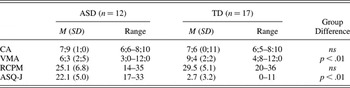
Data from 12 children with ASD (1 female, 11 male), as well as 17 TD children (8 female, 9 male) were included in the analyses. An additional 8 children (6 ASD, 2 TD) also participated in the study but were excluded from the analyses because of failure to watch the stimulus during recording (3 ASD), technical problems (1 ASD), or not reaching inclusion criteria during familiarization trials (2 ASD, 2 TD; see Procedure for details). Children with ASD included in the final analyses had been diagnosed with autistic disorder (6), Asperger disorder (1), pervasive development disorder—not otherwise specified (1), or pervasive developmental disorder (without a detailed diagnosis, 4) by at least one child psychiatrist or pediatrician. To confirm their clinical manifestation, the Japanese version of the Autism Screening Questionnaire (Berument, Rutter, Lord, Pickles, & Bailey, Reference Berument, Rutter, Lord, Pickles and Bailey1999; Dairoku, Senju, Hayashi, Tojo, & Ichikawa, Reference Dairoku, Senju, Hayashi, Tojo and Ichikawa2004) was administered to all of the children. All the children with ASD scored above the cutoff point (13), and all the TD children scored below the cutoff point. Verbal and nonverbal intelligence was measured with the Japanese version of the Picture Vocabulary Test (Ueno, Nadeo, & Iinaga, Reference Ueno, Nadeo and Iinaga1991) and the Japanese version of Raven's Coloured Progressive Matrices (Raven, Reference Raven1956; Sugishita & Yamazaki, Reference Sugishita and Yamazaki1993). Children's scores for each test, as well as their chronological ages and scores of the Japanese version of the Autism Screening Questionnaire, are summarized in Table 1. All the children were recruited from a local school, and written informed consent was obtained from one of the children's guardians before the study. This study has been approved by the Research Ethics Committee of the Graduate School of Arts and Sciences, University of Tokyo.
Mean (standard deviation) scores for CA, VMA, RCPM, and ASQ-J for children with ASD and TD children

Note: CA, chronological age; VMA, verbal mental age; RCPM, Raven Coloured Progressive Matrices; ASQ-J, Japanese version of the Autism Screening Questionnaire; ASD, autism spectrum disorder; TD, typically developing. Age values are in years;months.
Eye-tracking version of the False Belief Test (ET-FB)
A Tobii (Stockholm, Sweden) 2150 Eye Tracker, integrated with a 20-in. TFT monitor, was used to present the stimuli and record eye movements. Stimulus presentation and recording were controlled via a computer with Tobii's ClearView software. Children were seated approximately 50 cm from the monitor. A 5-point calibration was completed before the stimulus presentation (for technical details about the apparatus and the calibration procedure, see von Hofsten, Dahlström, & Fredricksson, Reference von Hofsten, Dahlström and Fredricksson2005).
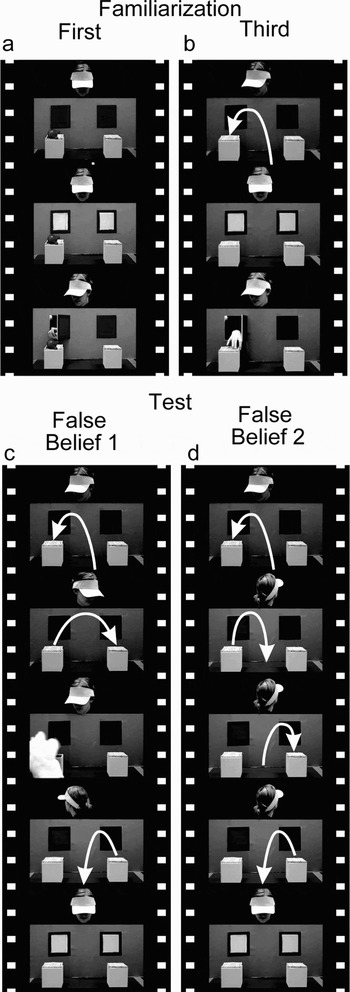
The stimuli consisted of four familiarization trials, followed by one of two test trials. All the stimuli, except for the first two familiarization trials, were identical to those used in our previous study (Southgate et al., Reference Southgate, Senju and Csibra2007). The same familiarization trials were presented to all the participants, in the same order, and each participant observed one of two versions of the test trial (FB1 or FB2). The general setup of the scene was the same for all trials: an actor was seated behind a panel containing two windows, and in front of each window there was an opaque box with a lid (Figure 1).
Selected frames from the events used in the experiment. White arrows indicate the relocation of the object. (a) In the first familiarization trial, an object was placed on the left box. (b) In the third familiarization trial, a puppet put the object into the left box. The second and the fourth familiarization trials were the same as the first and the third trials, respectively, except that the object was placed to the right. In each case, the windows were then illuminated and the actor reached through the window to the object. In the test trial, the puppet initially put the object in the left box, but the subsequent events differed between the conditions. (c) In one condition, the puppet moved the object to the right box and then returned to the left box to close the lid; after the actor turned around, the puppet removed the object from the scene. (d) In the other condition, the actor turned around before the puppet moved the object to the center and then the right-hand box and then removed the object from the scene. In both conditions, after the puppet removed the object, the actor turned back to the scene and the windows were illuminated.

The purpose of the familiarization trials was (a) to show that the actor's goal was to obtain the ball and (b) to teach the child the contingency between the windows being illuminated and a corresponding “chime” sound and the subsequent opening of one of the windows by the actor. Two additional familiarization trials were included at the beginning of the study to maximize the chances that children would learn this contingency by the test trial (see Results). In both of these extra familiarization trials, participants saw a red toy whale sitting on top of the left-hand (Trial 1) or right-hand (Trial 2) box. Both windows were then illuminated and a chime sounded. After a 1750-ms delay, the actor reached through the window behind the box on which the toy whale sat (Figure 1a). The third familiarization trial started with the actor watching a puppet as it appeared, opened the lid of the left-hand box, placed a brightly colored ball in the box, closed the lid, and disappeared. After the puppet disappeared, the two windows were illuminated and a chime sounded as in the preceding familiarization trials. Again, after a 1750-ms delay, the actor reached through the left-hand window, opened the lid of the left-hand box, reached into it, and retrieved the ball (Figure 1b). The fourth familiarization trial was identical to the third familiarization trial except that the puppet put the ball in the right-hand box, the actor reached for the right-hand box, and the video stopped at the point when the actor's hand made contact with the lid of the box.
In the FB1 condition (Figure 1c), the puppet appeared at the center of the stage, deposited the ball in the left-hand box, and returned to the center. The puppet then went back to the left-hand box, opened the lid, took the ball, and placed it in the center. The puppet then opened the lid of the right-hand box, retrieved the ball, and put it inside the box, and closed the lid. The puppet then returned to the left-hand box (while the actor's attention followed), closed the lid, and disappeared. At this point, the sound of a phone ringing was played and the actor turned around as if she was attending to this sound. As soon as the actor turned away, the puppet reappeared, opened the right-hand box, retrieved the ball, closed the lid, and disappeared with the ball. If the participants could represent the actor's false belief, they should be able to deduce that (a) the ball is no longer in the right-hand box, but (b) the actor did not see it disappear, therefore (c) she should have the false belief that the ball is still in the right-hand box. On the basis of this false belief attribution, children should predict that (d) the actor would reach through the right-hand window once the window was illuminated. As soon as the puppet disappeared, the phone stopped ringing and the actor turned back. Then the windows were illuminated and a chime sounded. After that, the actor remained still for the following 5 s.
In the FB2 condition (Figure 1d), the puppet first placed the ball in the left-hand box and disappeared. This was immediately followed by the phone ringing, at which point the actor turned away. Then the puppet reappeared, took the ball out of the left-hand box, and closed the lid. The puppet then placed the ball into the right-hand box, closed the lid, and went back to the center. Then the puppet returned to the right-hand box, removed the ball, closed the lid, and disappeared with the ball. If the participants could represent false beliefs, they should predict that the actor would reach through the left-hand window to the box in which the ball was placed as she was watching. As in the FB1 condition, once the puppet disappeared, the phone stopped ringing and the actor turned back. The windows were then illuminated and the chime sounded. After that, the actor remained still for the following 5 s.
Two controls were incorporated to eliminate any cues that might affect participants' looking behavior. First, the actor wore a visor, which made the actor's eyes invisible and prevented the participants from following, or attempting to follow, the actor's eye gaze. Second, after turning back toward the stage in the test trials, the actor kept her head centered and made no movement, so as not to give any cues as to where she would search. Our previous study confirmed that, when asked, naive adults were unable to correctly identify the window the actor would open based on the actor's posture and movement after she turned back to the stage (Southgate et al., Reference Southgate, Senju and Csibra2007).
After the stimulus presentation, the experimenter asked the participants the following question: “Which window will the actor open?” to also obtain a verbally elicited measurement of the participants' false belief understanding in this task.
Standard False Belief Test (S-FB)
Participants sat in front of a table, on which two boxes (one red and one blue) were set side by side. One of the two experimenters (Experimenter A) was seated next to the participant, and the other experimenter (Experimenter B) sat at the opposite side of the table, facing the participant and Experimenter A. Throughout the testing, Experimenter B manipulated a pair of puppets and a toy object to present false belief stories to the participant. Experimenter A monitored the participants, asked questions to the participants, and wrote down their verbal responses. To double check participants' responses, the whole testing session was recorded with a video camera, which was situated behind Experimenter B, facing the participant
The testing consisted of three trials. Different pairs of puppets and a different object were used for each trial. Each trial consisted of five phases: (a) Experimenter B introduced one of the puppets (Puppet A) to the participant. Puppet A then put an object into one of the boxes and disappeared underneath the table. (b) Experimenter B introduced the other puppet (Puppet B) to the participant. Puppet B then took the object out of the box, put it into the other box, and disappeared. (c) Experimenter A asked the participants three questions to confirm their memory of the events so far. “Which box is the [name of the object] in now?” “Who put the object in the box?” “In which box did [the name of Puppet A] put the [name of the object]?” (d) Puppet A appeared on the stage and said “Hello [name of participant]. I'm going to get the [name of object]!” (e) Experimenter A asked the participant a question about the false belief of puppet A: “To which box is [name of Puppet A] going to go in order to get the [name of object]?” After the participant's response, Experimenter A praised the participant regardless of their response. Then Experimenter B started the next trial with a different pair of puppets and a different toy object.
Data reduction
Eye-tracking data from the ET-FB was analyzed as follows: after recording, a gaze replay file showing the exact location of each participant's gaze was exported at 25 frames per second with the ClearView program. From the exported data, the point of fixation was coded frame by frame starting from the point when the windows were illuminated to the end of stimulus presentation. Having obtained the total looking time to each of the two windows, a differential looking score (DLS) was calculated by subtracting the total looking time to the incorrect window from looking to the correct window, and by dividing it by the sum of looking time to correct and incorrect windows. The DLS can range between 1 and −1, being closer to 1 if the participant spent most time looking at the correct location, and closer to zero if the participant looked randomly to both windows. We also coded the direction of first saccade after the illumination of the windows.
Children in the ET-FB task also showed characteristic gaze alternation between the actor and the puppet, which could reflect checking whether the actor is attending to the puppet's actions. Thus, we coded the number of times that this “gaze checking” occurred, that is, the number of gaze alternations from the puppet to the actor from the point at which the actor looked away to the point at which the actor turned back to the scene.
The number of correct responses in the three trials of S-FB were summed and used as the score of false belief understanding on a standard verbal test.
Results
To be included in the analyses, participants were required to understand the contingency between the illumining of the windows (and the chime) and the actor's impending reaching, and had to display anticipatory looking toward the correct window by the fourth familiarization trial. Thus, only participants who looked longer to the correct, than the incorrect, window on this fourth familiarization trial were included in subsequent analyses. Preliminary analyses in the TD group found no effects of participants' sex, and so data were pooled over this factor. Scores on the S-FB test were analyzed using an independent samples t test, and the scores on the ET-FB task were analyzed using a two-way analysis of variance (ANOVA) with group (ASD or TD) and condition (FB1 or FB2) as between-subjects factors.
As predicted, we found a significant group difference on the S-FB task (mean score = 2.35 in TD, mean score = 1.41 in ASD children), t (27) = 2.19, p = .038, Cohen d = 1.14. However, this difference did not remain significant when VMA was covaried out, F (1, 26) = 1.29, p = .27, ηp2 = 0.047, which suggests that the group difference on the S-FB test in the current sample was mainly because of differences in verbal ability, as was also suggested in a meta-analysis by Happé (Reference Happé1995). Moreover, the group difference was also not significant when the participant's score on the ET-FB task was covaried out, F (1, 26) = 1.28, p = .27, ηp2 = 0.047. This suggests that the group difference on the S-FB task, at least within the age range of the current participants, can also be explained by the performance on the ET-FB.
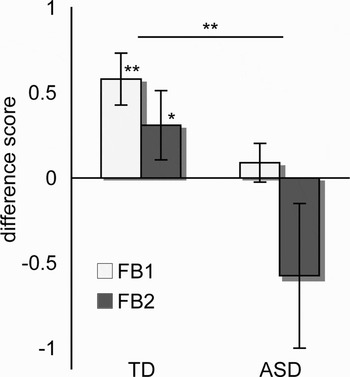
In the ET-FB task, children with ASD showed significantly lower DLS than did TD children (Figure 2), main effect of group: F (1, 25) = 11.10, p = .003, ηp2 = 0.31. In contrast to the S-FB task, the group difference in the ET-FB task remained significant when chronological age, VMA, Raven's Coloured Progressive Matrices, and even the participant's score on the S-FB task were covaried out (all Fs > 8.11, all ps < .009, all ηp2s > 0.25). These results indicate that the group differences in DLS in the ET-FB task cannot be explained by the performance on the S-FB task, the children's age, or by their verbal or nonverbal abilities. Follow-up t tests for the ET-FB task revealed that TD children scored significantly above zero (mean = 0.43), t (16) = 4.53, p < .001, Cohen d = 1.10, whereas the DLS in children with ASD did not differ from zero (mean = −0.077), t (11) = −0.39, p = .70, Cohen d = 0.11. The main effect of condition was also significant in the two-way ANOVA, F (1, 25) = 5.14, p = .032, ηp2 = 0.17, because of the higher scores in the FB1 than in the FB2 condition. This effect may indicate that, because of the longer duration of the events between the point when the actor looked away and when the she turned back, the FB2 situation demanded more memory than did the FB1 sequence. It is possible that such higher memory load may have impaired children's ability to keep track of the actor's mental states. Note, however, that follow-up t tests confirmed that TD children scored significantly above zero in both the FB1, t (7) = 3.80, p = .007, Cohen d = 1.34, and the FB2, t (9) = 2.74, p = .035, Cohen d = 0.91, conditions, but the scores of children with ASD did not differ from zero in either condition (both ts < 1.37, both ps > .30). The interaction between group and condition in the two-way ANOVA was not significant, F (1, 25) = 0.90, p = .35, ηp2 = 0.035.
Mean difference scores in action anticipation for each group and each condition. TD, typically developing children; ASD, children with autism spectrum disorder; FB1, false belief scenario 1; FB2, false belief scenario 2; *p < .05, **p < .01; error bars indicate standard errors.

It was interesting that children with ASD showed less gaze checking than TD children (average frequency = 2.9 times for ASD and 5.3 times for TD), F (1, 25) = 6.04, p = .002, ηp2 = 0.20. This suggests that children with ASD were less attentive to the actor's head direction than were the TD children, which may plausibly have affected the encoding of the knowledge status of the actor during the task. However, this reduced checking behavior did not fully account for the group difference in DLS, because this difference remained significant even after the frequency of checking behavior was covaried out, F (1, 24) = 9.20, p = .006, ηp2 = 0.28. Note also that the covariant (i.e., the checking frequency) was not significant in this analysis, F (1, 25) = 0.05, p = .82, ηp2 = 0.002. The main effect of condition was also significant in this analysis, F (1, 25) = 5.27, p = .030, ηp2 = 0.17, probably because the FB2 condition included a longer period of the actor's looking away than did the FB1 condition. The interaction between group and condition was not significant, F (1, 25) = 0.70, p = .41, ηp2 = 0.027.
When we compared the number of children who made their first eye movement after the illumination of the windows toward the correct location, we did not find a significant difference between the groups (p = .39, Fisher's exact test, two tailed). In fact, the number of children making a correct saccade first (11 children in the TD group, 5 children in the ASD group) was not significantly different from chance in either group. However, it may be more appropriate to assess anticipatory looking toward the correct location at the same delay (1750 ms) after window illumination as the children had experienced during the familiarization trials. Thus, we analyzed participants' fixations between 1.5 and 2 s after window illumination. Out of 17 TD children included in the analysis, 12 fixated at the correct window, 2 fixated at the incorrect window, 1 made a fixation to both of the windows, and the other 2 looked at the actor's face and made no fixations to either window. Such asymmetric distribution of fixations was significantly different from chance (p = .013, McNemar Test). For children with ASD, 4 fixated at the correct window, 4 fixated at the incorrect window, 2 made fixations to both windows, and the other 2 looked only at the actor's face, which was not different from chance (p = 1.0, McNemar test).
Fifteen out of 17 TD children gave the correct answer to the verbal question in the ET-FB task, which was significantly above chance (0.5; p = .002, binominal test), whereas only 5 out of 12 children with ASD answered correctly, which did not differ from chance (0.5; p = .77, binominal test). The group difference approached significance (p = .092, Fisher's exact test, two tailed).
Discussion
As with younger children (Southgate et al., Reference Southgate, Senju and Csibra2007), the use of eye tracking in the current study demonstrated that older TD children spontaneously anticipate an actor's action based on her inferred false belief: they made longer fixations toward the correct window, particularly at the point when they had learned the actor was likely to open one of the windows and reach for the box. In fact, their score on the ET-FB task correlated significantly with performance on the S-FB task (Spearman ρ = 0.54, p = .023), strongly suggesting that, like the S-FB task, our ET-FB task taps the ability to attribute false beliefs. Children with ASD, in contrast, did not show evidence of such spontaneous anticipatory looking on test trials. As all the children included in the final analyses exhibited correct anticipatory looking behavior on the final familiarization trial, this failure was unlikely because of a general difficulty or lack of motivation to look in anticipation at locations where something is expected to happen, or to a difficulty in anticipating human actions in general. In addition, as the ET-FB task includes no verbal component and demands minimal executive functioning so that even 24-month-old toddlers can pass the task, it is highly unlikely that the lower performance of children with ASD in the ET-FB task stems from their deviance in verbal development (Happé, Reference Happé1995) or executive functioning (Russell, Saltmarsh, & Hill, Reference Russell, Saltmarsh and Hill1999). Moreover, the lack of anticipatory looking in the ASD group cannot be explained by their lower performance on the standard false-belief task alone, because the group difference remained significant even when the scores on the S-FB task were covaried out. The results of the verbal control question corroborates the eye-tracking results by demonstrating that children with ASD, unlike control children, did not anticipate which window would open based on the actor's mental states.
There are several possible reasons why children with ASD fail to show anticipatory looking behavior in this task. One possibility is that children with ASD are not motivated to monitor others' mental states. Unlike previous studies, our task did not include any instruction but required that children spontaneously monitor others' epistemic mental states in order to be able to anticipate their subsequent behavior. Thus, it is possible that children with ASD did not exhibit correct anticipatory looking in our study because they lack the social motivation for tracking the actor's knowledge state that would have been a necessary prerequisite for successful performance (Dawson, Webb, & McPartland, Reference Dawson, Webb and McPartland2005). In the current study, children with ASD showed less “checking” behavior when the actor was looking away, which suggests that they were less attentive to the actor's potential perceptual state. Note that this account does not entail that children with ASD would never anticipate actions. In fact, all the children included in the final sample correctly and spontaneously predicted the actor's behavior in the final familiarization trial, suggesting that they did anticipate the person's behavior based on her goal and the object's location. Ruffman, Garnham, and Rideout (Reference Ruffman, Garnham and Rideout2001) also found that children with ASD tend to make less spontaneous anticipatory looking for social stimuli even when no false belief attribution is required. In their study, children were told stories, in which protagonists chose one of two locations based on their desire (i.e., the one where a desired object had been placed) or on social information (i.e., the one that the protagonist's father had told was safe). In this situation, children with ASD tend to show less correct looking than control children, whereas the two groups performed equally in verbal measures. It is thus more likely that the difficulty of action anticipation in children with ASD is limited to situations that require spontaneous monitoring of others' epistemic mental states.
Another possibility is that individuals with ASD have a fundamentally cognitive (and perhaps modular) impairment in theory of mind (Leslie, Friedman, & German, Reference Leslie, Friedman and German2004). Ozonoff and Miller (Reference Ozonoff and Miller1995) demonstrated that explicit and systematic teaching of social–cognitive principles can improve performance on the false belief task in children with ASD, but it does not affect their social competence in daily life. They even argued that “we were more successful in teaching our subject to ‘hack out’ rules and strategies to infer the mental states of others” (Ozonoff & Miller, Reference Ozonoff and Miller1995, p. 429). In addition, Happe (1995) conducted a meta-analysis and found that children with ASD need more than twice (9.2 years) the VMA than TD children (4 years) to pass the standard false belief task. This could also suggest that children with ASD are using verbally mediated compensatory cognitive skills to succeed on false belief tasks. As the current ET-FB task involved no verbal cues or instructions that could have promoted the use of such compensatory strategies, children with ASD, who may have difficulty in attributing epistemic mental states, had no basis for predicting the actor's behavior. Whichever account proves to be a better explanation, the current results strongly suggest that the impairment in false belief understanding in children with ASD is not simply because of the difficulty in understanding verbal instruction, or in interpreting the meaning of mental state verbs such as see, know, or think.
The current results suggest that the difficulty in passing the false belief task in children with ASD cannot be reduced to their delayed or deviant development of verbal skills (Happé, Reference Happé1995) or executive functions (Russell et al., Reference Russell, Saltmarsh and Hill1999). By contrast, the reduced spontaneous checking behavior to the actor's face during the task is consistent with recent literature suggesting atypical social orienting in children with ASD (Kikuchi, Senju, Tojo, Osanai, & Hasegawa, Reference Kikuchi, Senju, Tojo, Osanai and Hasegawa2009; Klin, Lin, Gorrindo, Ramsay, & Jones, Reference Klin, Lin, Gorrindo, Ramsay and Jones2009; Osterling, Dawson, & Munson, Reference Osterling, Dawson and Munson2002). It may even suggest that the atypical development of theory of mind in ASD is based on an atypical pattern of social orienting, which is hypothesized to be caused by atypical functioning of subcortical structures such as amygdala, and its communication with cortical structures (e.g., Dawson et al., Reference Dawson, Webb and McPartland2005; Johnson, Reference Johnson2005; Schultz, Reference Schultz2005). This hypothesis is consistent with neurological evidence suggesting the involvement of the amygdala in both theory of mind processing (Fine, Lumsden, & Blair, Reference Fine, Lumsden and Blair2001; Stone, Baron-Cohen, Calder, Keane, & Young, Reference Stone, Baron-Cohen, Calder, Keane and Young2003) and social orienting (Adolphs, Gosselin et al., Reference Adolphs, Gosselin, Buchanan, Tranel, Schyns and Damasio2005; Spezio, Huang, Castelli, & Adolphs, Reference Spezio, Huang, Castelli and Adolphs2007). However, further studies will be required to examine the relations between spontaneous checking behavior and correct anticipation based on mental states, as the current study did not find a significant correlation between these measures and the difference in the frequency of face gaze did not account for the group differences in correct anticipation.
A number of limitations in the current study make us cautious to generalize the current results beyond the range of the age and verbal/nonverbal skills of the children with ASD who participated in the current study. First, because of the small sample size and the lack of quantitative measurements of autistic symptoms such as ADI or ADOS, it is difficult to clarify whether the performance in the current task relates to the degree of autistic symptoms or the difference between the subgroups (i.e., autism, Asperger disorder, and pervasive development disorder—not otherwise specified). Although this does not lessen the main result that children with ASD, as a group, did not demonstrate the correct anticipatory looking based on the actor's false belief, further studies will be beneficial to explore the possible differences in the theory of mind skills within the “autism spectrum.”
Second, because the participants with ASD in the current study also showed lower performance on the standard false belief task, possibly because of lower VMA, we cannot rule out the possibility that nonspecific developmental characteristics, such as VMA, have affected the current results. Note that this does not mean that the current results can be explained by the higher VMA in the control group than the ASD group, mainly because our previous study has demonstrated that even 25-month-old TD toddlers show correct anticipatory looking (Southgate et al., Reference Southgate, Senju and Csibra2007). In addition, the group difference in ET-FB task remained significant when the VMA is covaried out. Moreover, another recent study has revealed that even adults with ASD, who easily pass standard FB tasks, still fail to show spontaneous anticipatory looking based on an actor's false belief (Senju, Southgate, White & Frith, Reference Senju, Southgate, White and Frith2009), suggesting that high VMA does not necessarily result in successful spontaneous false belief attribution in ASD. Further studies will be beneficial with multiple control groups matched with chronological, verbal, and nonverbal mental ages, as such matching has the potential to reveal further details of the cognitive profile of ASD (e.g., Burack, Iarocci, Bowler, & Mottron, Reference Burack, Iarocci, Bowler and Mottron2002; Russo et al., Reference Russo, Flanagan, Iarocci, Berringer, Zelazo and Burack2007). In addition, even though we did not find any effect of participants' gender in the current study, further studies with larger sample sizes would be necessary for exploring gender differences which do not always have large effect sizes.
To conclude, the current study demonstrates that children with ASD, at least in the age range included in the current study, fail to spontaneously anticipate others' actions when such anticipation requires the attribution of a false belief to the actor. Thus, these results suggest an impairment in mentalizing skills in these children that is independent of their verbal abilities. The development of nonverbal tasks has opened up new opportunities to examine the early development of theory of mind not only in typical development, but also, as demonstrated here, in atypical development such as ASD. Further research is needed to explore whether one can detect the impairment in theory of mind in much younger children with ASD and whether such early impairments predict later manifestation of autistic symptoms. In addition, the positive correlation between the performance on our nonverbal tasks and the traditional false belief task opens up a real possibility for use with patients with language difficulties as well as preverbal children. The current results have demonstrated that the ET-FB task can be applied to school-aged children as well as toddlers, which make it a feasible tool for assessing the developmental trajectory of the capacity to encode false belief from early childhood to adulthood (Senju et al., Reference Senju, Southgate, White and Frith2009).