Introduction
There are two types of life cycle in aphids: autoecious (host-specific) and heteroecious (host-alternating). Autoecious species live on one or a few species of a particular plant genus, whereas heteroecious species usually spend the summer on herbaceous plants and pass other seasons on a woody host (Dixon, Reference Dixon1998). The cotton-melon aphid, Aphis gossypii Glover, has a heteroecious life cycle in the Yangtze River Valley of China. Populations overwinter mainly on the hibiscus plant, Hibiscus syriacus L., and in late spring and early summer migrate from the primary (winter) hosts to secondary (summer) hosts, including various vegetable, horticultural and field crops, such as cucurbits, chrysanthemum and cotton. After more than 20 parthenogenetic generations on the secondary hosts, A. gossypii populations produce winged sexuparae in autumn, which then undergo the reverse migration to the primary host where the sexual forms mate and cold hardy overwintering eggs are laid (Ding & Su, Reference Ding and Su2002). Thus, seasonal migration plays an important role in the heteroecious life cycle and population process.
Empirical studies have shown that cotton-melon aphids possess a great potential for migration between the primary and secondary hosts, and some individuals can even ascend beyond the boundary air layer and be transported by air current or wind over large geographical distances (Isard et al., Reference Isard, Irwin and Hollinger1990; Reynolds et al., Reference Reynolds, Mukhopadhyay, Riley, Das, Nath and Mandal1999). Tethered flight tests have further demonstrated that winged A. gossypii, collected from the primary host H. syriacus in Nanjing, China, can fly continuously for some 4–6 km under laboratory conditions and most such aphids had gonads with less than seven ovarioles each (Liu et al., Reference Liu, Zhang and Zhai2003b). However, it is unclear whether there is differentiation in flight capacity within A. gossypii spring populations, with migratory genotypes leaving the primary host whilst non-migratory ones remain on it. In order to address these issues, the present study was conducted to: (i) investigate the possibility of differentiation in gonad development and flight tendency in a spring population; and (ii) examine the genetic basis for the intra-population differentiation of A. gossypii.
Because of their small body size, aphids can generate only relatively small flight forces (Byrne et al., Reference Byrne, Buchmann and Spangler1988), and their displacement relative to the ground during flight is largely governed by air movement (Taylor et al., Reference Taylor, Woiwod and Taylor1979). Therefore, the takeoff behaviour leading to ascent beyond the boundary air layer where such small insects are carried by wind over large distances is often tested to measure the potential for migration in aphids (Gatehouse, Reference Gatehouse1997; Dixon, Reference Dixon1998). However, the takeoff behaviour of aphids is highly variable among individuals. Such variability is often related to the number of ovarioles in their gonads. For instance, aphids with few ovarioles are known to take off more readily and at a steeper angle than those with more ovarioles (Walters & Dixon, Reference Walters and Dixon1983; Zhang & Wang, Reference Zhang and Wang1991; Dixon, Reference Dixon1998; Liu et al., Reference Liu, Zhai, Zhang and Xiong2003a). In our study, we, therefore, conducted field observation on a spring population, measured the tethered flight capacity, takeoff frequency and takeoff angle of winged A. gossypii, sampled from the spring population on hibiscus trees, and examined the number of ovarioles in their gonads to assess population differentiation related to migratory potential. The genetic basis of population differentiation in migration was also investigated through bi-directional selection and cross-breeding experiments.
Materials and methods
Field survey on a spring population
Field surveys of A. gossypii populations were conducted on 15 hibiscus trees on the campus of Nanjing Agricultural University, China (32°04′N, 118°50′E). Five 20-cm-long branches with A. gossypii were selected from each of these trees and labelled in the first observation. Aphids on these labelled branches were surveyed every four to seven days from June to October in the years 2003, 2004 and 2006. The number of A. gossypii populations found during the whole of August was very important because, if the aphids on hibiscus can live through this month, they probably have the ability to undergo the host-specific life cycle on the primary host plant.
Experimental aphids
Branches with winged A. gossypii nymphs were collected from the primary host plant, H. syriacus, on the campus of Nanjing Agricultural University in April. The collected branches were cultivated in bottles of water at room temperature in a laboratory. Upon emergence, all winged adults were removed daily from the branches. Random samples were taken from these field-derived winged adults to test takeoff behaviour, tethered flight capacity and to examine the number of ovarioles in their gonads.
Tethered flight test
The tethered flight capacity of the newly emerged A. gossypii was tested in a computer-linked 32 flight-mill system with a design similar to that described in Riley et al. (Reference Riley, Downham and Cooter1997). Here, a thin pin was vertically placed and suspended by two magnets in a flight mill unit, and a balance arm (3.8 cm in length) made of thin copper wire was fixed onto the pin. The sternum of the aphid thorax was attached to one end of the balance arm using 502 glue (Guangzhou Baoshenda Chemical Industry Co. Ltd., China). Each test lasted for four hours. Recordings of the distance and time of each flight, as well as the frequency of flights performed per aphid, were registered using a PC computer. Lastly, the cumulative flight duration of an individual over the testing period was used to assess its flight capacity. The frequency distribution of aphids with different cumulative flight durations was analysed.
Gonad dissection
One-day-old newly moulted winged aphids collected from hibiscus branches were dissected in a drop of water under a stereoscopic microscope to examine the number of ovarioles in their gonads. In total, 179 such aphids were used for this purpose.
Observation of take-off behaviour
The takeoff behaviour of winged A. gossypii was observed at the age of one, two and three days after attaining adulthood, using apparatus modified from Zhang & Wang (Reference Zhang and Wang1991) within a screen cage. This apparatus consisted of a small circular island (diameter, 2.5 cm; height, 1.6 cm) and a cylindrical plastic cage (bottom diameter, 8.1 cm; top diameter, 5.5 cm; height, 12.5 cm; angle between cage wall and bottom, 80 degrees). The isolated island was surrounded by a water trough, whilst two 60 W incandescent electric filament lamps were placed above the cage. Eight to ten newly emerged winged aphids were transferred onto the island and covered by the cage. Observation of takeoff behaviour was begun immediately and lasted 20 min. During this observation period, the duration spent in preparing for takeoff was recorded by a digital timer (Joerex® by Mesuca Creations, 1/100 s, Japan). Any aphid that took off upward and touched the wall of the cage was considered to be a migratory individual. The stop position was marked quickly after an individual aphid had touched the wall. At the end of the trial, the distance from the stop position to the bottom of the cage was measured with a millimetre ruler. According to the distance, the takeoff angle of each aphid was then calculated. Aphids that remained on the island or in the water trough were regarded as sedentary. During the test, constant illumination was maintained and temperature was kept at around 28°.
Selection based on takeoff behaviour
Ninety-six moulted-winged aphids newly emerged from the collected hibiscus braches were randomly chosen and tested for their takeoff behaviour with the apparatus and procedure described above. Twenty-three individuals that showed takeoff behaviour within 20 min were used to initiate the migratory line, whilst 73 individuals that did not takeoff were allocated to the sedentary line. The two categories were reared as separate asexual lineages on cotton seedlings under the same conditions in growth chambers at a L12:D12 photoperiod, 24°C ambient temperature and 70% R.H. In order to diminish the effect of migratory urge on takeoff behaviour, directional selection was imposed on each of the migratory and sedentary lines when they produced more than 100 alatae. This selection was conducted over four consecutive generations or times (because of the generation overlapping) for the migratory lines (named M1–M4) and twice for sedentary lines (named S1 and S2). In total, 122, 581, 462 and 232 aphids were measured in lines M1, M2, M3 and M4, respectively, and 60 individuals each for lines S1 and S2. A selected line was considered to be a migratory genotype (M) or sedentary genotype (S) when their takeoff angle or sedentary rate became steady, respectively. The M and S lineages were maintained for induction of sexual morphs. In the meantime, another 96 winged aphids, collected randomly from hibiscus branches, were used to maintain a non-selected line to act as a control. This control line was reared on cotton seedlings under the same conditions as the selected lines, and the same testing procedure was applied, with 60–80 aphids tested per different generations or times.
Cross-breeding experiment
Sexual forms from the selected migratory (M) and sedentary (S) genotype aphids were reared on cotton plants under low temperature (20°C) and short photoperiod (L10:D14) conditions in growth chambers, using methods as described by Gong & Zhang (Reference Gong and Zhang2001). The reared female and male aphids from the M and S lines were paired to allow copulation in groups on cotton plants at 20°C. Eighteen pairs of M♀×S♂ and 23 pairs of S♀×M♂ successfully produced 27 and 11 eggs, respectively, after 20 days. These were incubated on cotton plants in a growth chamber at a temperature-photoperiod regime simulating the winter and spring seasons (i.e. temperature gradually decreased from 20°C to 4°C, and then increased to 24°C by 2°C over four days, respectively; and photophase, firstly shortened to 8 h, then lengthened to 10, 12 and 14 h as the temperature increased to 8, 14 and 20°C, respectively). After some three months, the fundatrix aphids hatched, and the rearing conditions were returned to 24°C, L12:D12. Meanwhile, the M and S aphids were maintained parthenogenetically. When winged aphids were produced, the takeoff behaviour of the hybrids and parthenogenetic offspring were tested as described above.
Statistical analysis
Differences in takeoff angle, takeoff rate and pre-takeoff time in relation to age, selected generations (times) and genotypes were analysed with ANOVA and followed by multiple comparisons using Tukey method (P<0.05) to separate mean values. The Pearson correlation coefficient was applied to determine the relationship between takeoff angle, takeoff rate and pre-takeoff time. All these statistical analyses were performed using SAS software (SAS Institute Inc., 2001). The frequency distributions of individuals with different flight duration or ovarioles was analysed by a curve estimation method, using the ‘curve-fit all equations’ process of the TableCurve 2D 5.0 software system (SPSS Inc., 2000), whilst the goodness-of-fit to a curve was tested by ANOVA (F-statistic, P<0.05) along with the correlation of determination (r2). The curve equation with maximum r2 value and which passed the F-statistic test was accepted. The forms of the accepted curves were outlined in fig. 1 and fig. 2, and both of them exhibited two peaks.
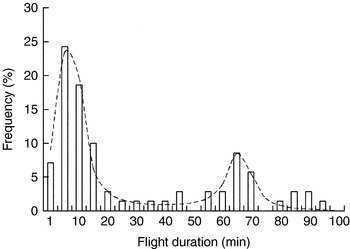
The distribution frequency of Aphis gossypii on the primary host plant with different accumulative flight durations (n=70). The relationship between the frequency (Y) and flight durations (X) can be simulated well by a bimodal curve model, the dashed curve (the model: Y=(7.199−0.226X−0.00324X2−0.000013X3)/(1−0.244X+0.0217X2−0.0005X3+0.0000034X4), r2=0.942, F7, 13=30.299, P<0.001).

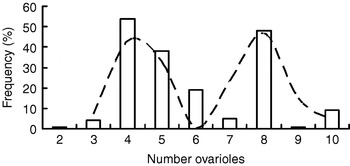
The frequency distribution of Aphis gossypii on the primary host plant with different numbers of ovarioles in their gonads (n=179). The bimodal mode between the frequency (Y) and number of ovarioles (X) is exhibited by the dashed curve (the model: Y=26.23∗sin2(2πX/7.13+0.892), r2=0.681, F6, 2=6.412, P=0.0324)

Results
Population differentiation
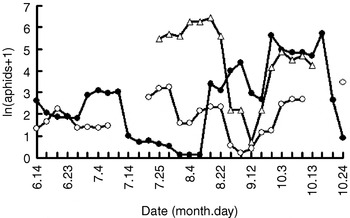
In the field, a small proportion of A. gossypii remained on the primary host plant, hibiscus, in Nanjing, China, over the summer seasons of 2003, 2004 and 2006 (fig. 3), although a large proportion of this population migrated to secondary hosts. The tree-dwelling aphids existed permanently throughout the year. The result strongly suggests that there may be intra-population differentiation in migratory behaviour in A. gossypii and that the host-specific tree-dwelling aphids show a generally poor migratory capacity whereas the host-alternative aphids show a strong such capacity.
The population dynamics of Aphis gossypii on the 20 cm branch of hibiscus trees (a primary host plant) in 2003, –○–; 2004, –•– and 2006, –△–. There was no investigation from 11 to 18 July in 2003.

The cumulative flight duration in the newly emerged, tethered aphids revealed significant variation within the spring population taken from the primary host plant. The frequency of aphids with different flight durations displayed a bimodal distribution, which could be simulated well by a bimodal curve equation (r2=0.942, F7, 13=30.299, P<0.001; fig. 1). The first peak represents the short-flying phenotype with flight durations of <~30 min, whilst the second peak corresponds to the long-flying phenotype with flight durations of >30 min.
The number of ovarioles in one-day-old post-moulting winged aphids from the primary host plant in spring ranged from two to ten (fig. 2). Of the 179 aphids tested, ~65% possessed less than seven ovarioles in their gonads, whilst ~35% aphids had more than seven ovarioles, displaying a weak bimodal distribution in the frequency of aphids with different numbers of ovarioles (r2=0.681, F2, 6=6.412, P=0.0324; fig. 2).
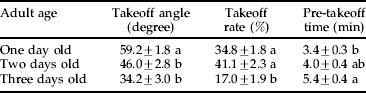
The takeoff behaviour was related to the age of these individuals (table 1). There were significant differences in takeoff angle, takeoff rate and pre-takeoff time between one-, two- and three-day-old post-moulting winged aphids (takeoff angle: F2, 225=15.11, P<0.001; takeoff rate: F2, 82=5.13, P<0.01; pre-takeoff time: F2, 225=2.87, P=0.05). The one-day-old aphids took off more readily and at a steeper angle, with a significantly higher takeoff rate, as compared to three-day-old individuals. Therefore, the one-day-old alate aphids were suitable for screening the migratory and sedentary genotype populations.
The takeoff angle, takeoff rate and pre-takeoff time of Aphis gossypii at different post-emergence ages.
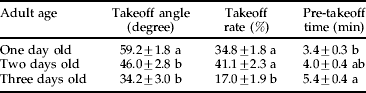
Means are presented with their standard errors (±SE). Means within columns followed by different letter(s) are significantly different (P<0.05).
Response to selection based on take off behaviour
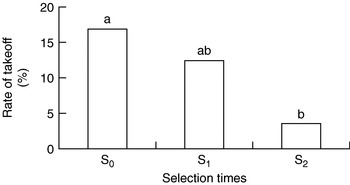
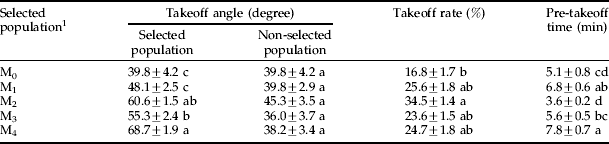
A. gossypii population showed significant response to selection on takeoff behaviour (table 2). In the migratory line, the average takeoff angle significantly enlarged in response to selection (F4, 428=13.199, P<0.001). It increased from 39.8±4.2 degrees in the base population to 68.7±1.9 degrees after four generations (times) of selection, whilst average takeoff angle in the unselected line (control) varied little over generations (times) and was not significantly different (F4, 74=0.525, P=0.718). After two rounds of selection, the takeoff angle of migratory line M2 reached and persisted at about 60°, whilst there was no significant difference between M2 and M4 (table 2). Therefore, these individuals with takeoff angles of around 60° may indeed be considered as the migratory genotype. On the other hand, the correlated responses in the takeoff rate and pre-takeoff times were not very strong and regular over the four rounds of selection, although there were significant differences among different times (F4, 134=4.040, P=0.004 in takeoff rate; F4, 428=16.421, P<0.001 in pre-takeoff time). In fact, there was no significant correlation of takeoff angle with takeoff rate (r=0.582, df=4, P=0.303) or with pre-takeoff time (r=0.267, df=4, P=0.664). In contrast, selection against take-off behaviour significantly altered the takeoff rate in the sedentary line compared to the base population (F2, 12=3.892, P=0.05), decreasing from 16.8±8.1% in the base population to 12.4±10.4% in S1 and 3.5±9.0% in S2, whilst there was no significant difference between S1 and S2 (fig. 4). Therefore, we consider the virtually ‘non-takeoff’ individuals from S2 as the sedentary genotype.
Change in takeoff rate of the sedentary line due to negative selection on takeoff behaviour. Means labelled with the same letter(s) are not significantly different (P>0.05).

The takeoff angle, takeoff rate and pre-takeoff time of Aphis gossypii in the migratory line of four times of selection.
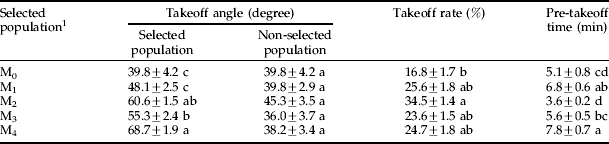
Means are presented with their standard errors (±SE). Means within columns followed by different letter(s) are significantly different (P<0.05).
1 M0, the original population for selection; M1–M4, the population selected for 1–4 times, respectively.
Inheritance of takeoff behaviour
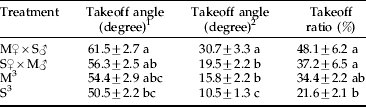
There were significant differences in takeoff angle and takeoff rate among the hybrid offspring and the asexual parental lineages (F3, 214=3.154, P<0.05 in takeoff angle; F3, 64=8.432, P<0.001 in takeoff rate) (table 3). Takeoff rate in the hybrid offspring was significantly higher than that in the migratory phenotype (M) and sedentary phenotype (S), being ranked as M♀×S♂=S♀×M♂>M>S. The takeoff rate had no maternal effect in the inheritance. The average takeoff angle was ranked as M♀×S♂>S♀×M♂>M>S, though only the hybrid offspring from M♀×S♂ could be statistically separated from the sedentary phenotype. If the takeoff angle of aphids that did not perform takeoff behaviour was considered as zero, the takeoff angles of the hybrid offspring and the asexual parental lineages were significantly different (F3, 715=15.251, P<0.001), and ranked as M♀×S♂>S♀×M♂=M>S. These results indicate the presence of a maternal effect in the inheritance of takeoff angle.
Takeoff angle and takeoff rate in hybrid offspring as well as migratory (M) and sedentary (S) genotype of Aphis gossypii.
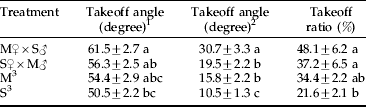
Means (±SE) within columns followed by different letter(s) are significantly different (P<0.05).
1 Mean takeoff angle of all the aphids that performed takeoff.
2 Mean takeoff angle of all tested aphids in which the angle of the non-takeoff aphid was considered as zero.
3Asexual parents.
Discussion
As outlined in the introduction, the cotton-melon aphid, A. gossypii, is known to be a holocyclic species exhibiting host alternation, overwintering in the egg stage on a woody host and propagating parthenogenetically on various herbaceous secondary hosts in the summer (Blackman & Eastop, Reference Blackman and Eastop1984, Reference Blackman and Eastop1994; Ding & Su, Reference Ding and Su2002). However, as this study has demonstrated, in the Yangtze River Valley of China, a small proportion of the population remains on the primary host plant (hibiscus trees) throughout the summer period. The fact that not all the aphids overwintering on hibiscus leave the primary host plant and emigrate to the secondary hosts reveals the presence of two phenotypes, host-specific and host-alternating, in the same spring population. A similar phenomenon was observed for A. gossypii in northern Italy by Ferrari & Nicoli (Reference Ferrari and Nicoli1994). It is also known in the case of the damson-hop aphid, Phorodon humuli (Schrank), in the UK and in the USA on its primary host, Prunus spp., especially P. spinosa (Wright et al., Reference Wright, Pike, Allison and Cone1995; Loxdale et al., Reference Loxdale, Brookes, Wynne and Clark1998). The coexistence of two types of life-history in A. gossypii populations may have resulted from weather conditions selecting for population genetic differentiation in flight capacity.
Weather conditions influence the takeoff behaviour and migratory flight of insects, especially small ones; for example, an increase in wind speed can delay or decrease the takeoff incident of aphids (Walters & Dixon, Reference Walters and Dixon1984) and whiteflies (Rufus et al., Reference Rufus, Willis and Byrne1999). In Nanjing, China, the emergence peak of alate A. gossypii on the primary host occurs at around 21:00 h, and the migration peak of aphids usually occurs at midday (Dixon, Reference Dixon1998; Liu et al., Reference Liu, Zhang and Zhai2003b). Additionally, the one- or two-day-old post-moulting winged aphids are able to perform the larger takeoff angle and stronger migratory urge (table 1), so suitable weather conditions prevailing during 15 h and 39 h after adult emergence are vital for the occurrence of migration in this aphid species. If rainy or windy weather occurs during the migratory period, the winged aphids are forced to cease migrating and produce offspring on the primary host plant instead. The offspring of these may, in turn, become the source of aphids on hibiscus trees over the summer season. However, weather conditions alone are not capable of explaining the phenomena observed in Italy over the period 1992–1993 (Ferrari & Nicoli, Reference Ferrari and Nicoli1994) nor in China from 2003–2006.
Intra-population differentiation in migratory behaviour may explain the coexistence of host-specific and host-alternating life cycles in A. gossypii, as in other biological characters observed in different aphid species (Sunnucks et al., Reference Sunnucks, De Barro, Lushai, Maclean and Hales1997, Reference Sunnucks, Chisholm, Turak and Hales1998; Fuller et al., Reference Fuller, Chavigny, Lapchin and Valerberghe-Masutti1999). The spring populations on hibiscus are likely to differentiate into migratory and sedentary genotypes in the Yangtze River Valley of China. The migratory aphids will leave hibiscus when the quality of the primary host deteriorates and the climate becomes hot, whilst the sedentary ones remain on the tree because of low takeoff tendency and poor flight capacity. There is substantial variation in flight capacity and the number of ovarioles in the gonads of A. gossypii (figs 1 and 2). Our previous studies suggested the presence of an oogenesis-flight syndrome in the population of A. gossypii, since significantly fewer ovarioles were found in the winged aphids caught at a height of 20 m above ground than in those collected from the primary host (Liu et al., Reference Liu, Zhai, Zhang and Xiong2003a,Reference Liu, Zhang and Zhaib). Thus, empirical data obtained from both previous studies, as well as the present one, support the hypothesis of differentiation in migratory behaviour within the spring population of this aphid species. Similar phenomena have been found previously, including by Kidd and Cleaver (Reference Kidd and Cleaver1984, Reference Kidd and Cleaver1986) in the black bean aphid, Aphis fabae Scopoli, and by Blackmer et al. (Reference Blackmer, Byrne and Tu1995) in whitefly, Bemisia tabaci (Hemiptera: Aleyrodidae). In A. fabae, some alate asexules reproduce before taking off (‘flyers’) while others do not (‘migrants’), and the migrants have an innately greater urge to take off than flyers (Kidd & Cleaver, Reference Kidd and Cleaver1984, Reference Kidd and Cleaver1986). In whitefly populations, there are long- and short-distance flyers, and settled individuals, and these exhibit behavioural, morphological and physiological differences (Blackmer & Byme, Reference Blackmer and Byme1993; Blackmer et al., Reference Blackmer, Byrne and Tu1995).
The present study provides further evidence that the intra-population variability of migratory behaviour in A. gossypii is of genetic origin, since the population displayed significant response to bidirectional selection on takeoff behaviour. The individual aphids with larger takeoff angles are presumably more likely to reproduce winged offspring than those with smaller takeoff angles, so that a greater part of the population of winged offspring would derive from the aphids performing larger takeoff angles in selection experiments. As such, the average takeoff angle of the offspring population was enlarged after successive rounds of selection. Indeed, our previous study demonstrated that the migratory line produces winged offspring more readily than the sedentary line (Liu et al., Reference Liu, Zhai, Liang, Xu and Gong2006).
The results of reciprocal crossing between sexual forms of the migratory and sedentary genotypes confirm the genetic control of takeoff behaviour in A. gossypii. Interestingly, takeoff angle of the hybrids from the cross M♀×S♂ was significantly larger than that of the offspring from the cross S♀×M♂, suggesting inheritance of takeoff angle involves a maternal effect, as for a migratory trait in the cowpea weevil, Callosobruchus maculatus (F.) (Coleoptera: Chrysomelidae) (Messina, Reference Messina1987), and wing morphs in brown planthopper, Nilaparvata lugens (Stål) (Hemiptera: Delphacidae) (Wang et al., Reference Wang, Du and Cheng1997). Although the takeoff rate was also heritable, it did not show any sex-linkage and maternal effect, since takeoff rate was compatible between offspring from the crosses M♀×S♂ and S♀×M♂.
The genetically based intra-population differentiation might be of adaptive significance and, hence, reflect an evolutionary consequence in A. gossypii, as in other heteroecious species (Sunnucks et al., Reference Sunnucks, De Barro, Lushai, Maclean and Hales1997, Reference Sunnucks, Chisholm, Turak and Hales1998; Fuller et al., Reference Fuller, Chavigny, Lapchin and Valerberghe-Masutti1999). Long-distance, host-orientated migration in aphids has the risk of starvation and even death (Dixon, Reference Dixon1998; see also Loxdale et al., Reference Loxdale, Hardie, Halbert, Foottit, Kidd and Carter1993; Loxdale & Lushai, Reference Loxdale and Lushai1999). Some A. gossypii individuals always remained settled on the primary host hibiscus, whereas a great part of the spring population migrates in order to find summer host plants both in northern Italy (Ferrari & Nicoli, Reference Ferrari and Nicoli1994) and the Yangtze River Valley. Our findings suggest that the presence of A. gossypii individuals (genotypes) remaining on the primary host over the summer season is not accidental; rather, it is an evolved strategy for ecological adaptation to variable environmental conditions.
Acknowledgements
This research was supported by the National Science Fund of China (No. 30771418, 30571222) and the Youth Innovation Fund in Science & Technology of Nanjing Agricultural University (No. KJ05004). We thank two anonymous reviewers for helpful comments for improving the manuscript.