Returning fresh from her summer vacation, the suntanned managing director of Gothenburg City Theatre, Karin Kavli (1906–90), proudly announced at a press conference in early August 1955 that she had secured the rights to produce the European premiere of Tennessee Williams's acclaimed play Cat on a Hot Tin Roof. Footnote 1 Well aware of the importance of creating a balanced repertoire that would satisfy the more artistically and literally minded audience and those who wanted some lighter forms of entertainment, Kavli understood that hosting the premiere of Williams's latest drama was quite a coup, especially in an age when television had begun to pose a great threat to theatre.
While research on Williams and Cat is rich and diverse, little effort has been made to understand the play's impact and reception on the other side of the Atlantic. This essay proposes a case-study approach to examine how the initial European production of Cat was received and, by implication, how one of the defining American playwrights of the twentieth century was discussed in Sweden. It focuses on the process of cultural translation and, more precisely, the question of how Swedish ensembles interpreted a foreign playwright who was known for breaking sexual taboos. Unpacking the cross-cultural and transnational dialogue that was established when Cat made its first appearance on a European stage, the essay teases out the cultural tensions and the negotiation of national identity that took place when Williams's play was transposed from the Mississippi Delta to a more northern latitude. I argue that the stage and the cultural sections of the newspapers offered a forum for Sweden to negotiate some of the country's sexual anxieties by making use of American cultural products and firmly situating them in an exoticized American context whose values were deemed to conflict with European, and more specifically Swedish, cultural identity.
The Importance of Being Swedish
Between 1946, when The Glass Menagerie opened in Stockholm, and the late 1950s Williams was the most successful foreign playwright in Sweden. Only Jean Anouilh rivaled him in popularity. Almost forty different professional productions of his works were staged in addition to several radio broadcasts based on his plays. Importantly, his canonical works, including The Glass Menagerie, Cat on a Hot Tin Roof, Suddenly Last Summer, Sweet Bird of Youth, and The Night of the Iguana, had their European premieres in Sweden. That Sweden became a gateway for American drama in Europe in those years was no coincidence. The reasons can be traced back to several factors that were part of the cultural landscape of the immediate postwar era. While many countries were slowly rebuilding their economy and infrastructure after World War II, Sweden, neither bombed nor occupied, was less devastated by the war. Its theatres were hungry for new plays, especially contemporary American drama. From the early 1940s, theatre agent Lars Schmidt (1917–2009) made regular trips to New York to acquire the foreign rights to produce the latest stage works. One of his secret weapons was the personal contacts he cultivated with playwrights and composers all over the world; sometimes these relationships ensured that he would gain the right to produce a dramatic text before it was even completed.Footnote 2 In addition to spoken drama, he obtained the Nordic licenses for Rodgers and Hammerstein's complete works in 1947, which solidified his position as one of the most powerful agents in Europe. Schmidt demonstrated his shrewd and commercially savvy politics in the spring of 1949, when he sold A Streetcar Named Desire to six different Swedish theatres in addition to several companies in neighboring Nordic countries, a move that ensured that it was the play of the season and that established Williams as his period's most popular playwright in the region.
Among Schmidt's most enthusiastic clients were the recently established city theatres (modeled after the German Stadttheater), particularly in Gothenburg and Malmö, which competed with the national stage, the Royal Dramatic Theatre in Stockholm, to become the first to stage contemporary international plays. The city theatres not only presented cutting-edge drama for audiences outside of the capital; they also offered a platform where both up-and-coming and established actors and directors could gain valuable experience.Footnote 3 Perhaps one of the best examples of this is the fact that Kavli herself played Blanche in A Streetcar Named Desire in Gothenburg in 1949 and Serafina in The Rose Tattoo in Norrköping in 1951, both times under the direction of Ingmar Bergman.
English-speaking countries in Europe were subjected to different degrees of censorship, a fact that further precipitated Sweden's leading role in introducing midcentury American drama to a European audience. The infamous Lord Chamberlain heavily monitored the United Kingdom's theatre system, and debates about Cat's sexual content delayed a national premiere until 1958, when it was directed by Peter Hall at the members-only New Watergate Club housed under the roof of the Comedy Theatre.Footnote 4 The Censorship Board in Ireland, which had the authority to ban printed material, forbade the book publication of Cat. Plans for a stage production in Ireland were abandoned after the arrest and prosecution in May 1957 of director Alan Simpson, who refused to cancel a performance of the allegedly indecent The Rose Tattoo at The Pike.Footnote 5 In fact, in Europe, most of Williams's canonical plays were first presented in Swedish translation (which underscores the importance of this study). Under the title Katt på hett plåttak, Williams's play was translated by Sven Barthel (1903–91), who had a significant influence on popularizing American drama—including Williams, Eugene O'Neill, Arthur Miller, and Edward Albee—in Sweden. His critically acclaimed translations, for which he won several prestigious prizes, including an award by the Swedish Academy in 1964, remained faithful to the original text. They captured and respected the playwright's individual tone and style yet at the same time sounded convincing, natural, and enjoyable to a Swedish audience. Nevertheless, the subtleties and idiomatic expressions of U.S. southern speech were inevitably lost in Barthel's Standard Swedish (rikssvenska) translation of Cat.Footnote 6
The American South Seen through a Nordic Lens
A defining characteristic of Kavli's reign at Gothenburg City Theatre was that she hired young talents to keep her ensemble fresh and vital. Newcomers for the 1955–6 season included director Åke Falck (1925–74) and actress Gunnel Broström (born 1922), both of whom had a significant influence on Cat. The play is set on a cotton plantation in the Mississippi Delta, and Falck was very careful to establish his own creative vision of this foreign, southern environment. Most of his professional experience came from his work at Sveriges Radio, where his tasks included working as a commentator, a news reporter, a disc jockey, a conversationalist, and, eventually, a director of radio plays, among them a version of The Glass Menagerie in 1953.Footnote 7 For his first major stage production, he collaborated closely with set designer Carl-Johan Ström (1914–92), who by the mid-1950s had established himself as one of the country's foremost scenographers and who knew all the intricacies of the city theatre's advanced stage machinery. Ström's innovative creations combined artistic talent with technological skills and were the result of careful study. He sought to have each new set take the audience by surprise. For Bergman's production of A Streetcar Named Desire a few years earlier, Ström had created an impressive reproduction of the French Quarter in New Orleans. For Cat, he designed another one of his signature realistic sets that paid close attention to detail in order to situate the play in a well-defined environment and convey the appropriate atmosphere. Ignoring most of Williams's poetic stage directions that demanded a “Victorian [room] with a touch of the Far East,” where “the walls below the ceiling should dissolve mysteriously into air,”Footnote 8 Ström created a room that was described as a “mixture of a decaying past and a cracking modernism.”Footnote 9 As documented by photographs and a preserved miniature of the set (see Fig. 1), the house right side of the stage was dominated by a double bed with a green blanket that harmonized with the pale green walls with decorative moldings. The door to the bathroom was also located at house right, and Brick's couch was placed downstage at house left. In the center of the room were a small coffee table, a carpet, two violet armchairs, and a television set—a sign of the times. On the couch table lay a copy of Life magazine, a singular detail that helped establish the American context. A small landing upstage on the house left side led to a slightly raised mezzanine demarcated by a white decorative fence. From this mezzanine, French doors with Venetian blinds led to the terrace of the Pollitt mansion, where exotic palm trees cast their shadows.
Designer Carl-Johan Ström's original miniature consisting of wood, cardboard, and paper on a masonite plate represents the realistic set he created for Cat on a Hot Tin Roof. Courtesy of Theatre Collections at Gothenburg City Museum. Photographer unknown.

At the start of the performance, to further situate the play in the U.S. South, part of the musical backdrop consisted of recorded Negro spirituals, which could be heard in the imaginary garden purportedly located behind the French doors. Before Maggie entered the stage, the audience heard her complaining about needing to change her clothes. When she came into the room to denounce her nieces and nephews, the “no-neck monsters” who had stained her dress, the laughter of the little girl Dixie was heard outside followed by her mother Mae's voice telling the children to be quiet. Songs and music from Big Daddy's grotesque birthday party in the garden continued throughout the first act. During the climactic family struggles in the third act, light and sound effects created a thunderstorm behind the blinds. The director and the designer took advantage of the technological possibilities of the stage system and used the sprinkler system to simulate rain. The combination of Ström's rich experience and technological savoir faire and Falck's well-trained ear from his years in radio theatre resulted in a three-dimensional production in which visual and aural effects gave the audience the impression that the large cotton plantation, the “twenty-eight thousand acres of the richest land this side of the valley Nile”Footnote 10 over which the characters fight, literally stretched out behind the French doors.
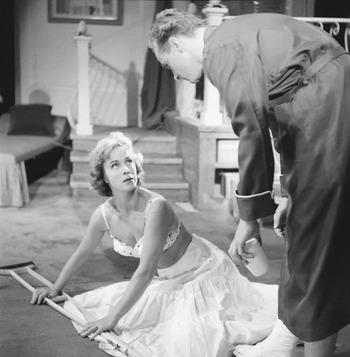
Combining the bedroom with a living room allowed for great flexibility and variation; the actors could move around freely and play on two different levels as well as enter and exit the stage through several doors. The production benefited from this varied and dynamic blocking, especially in light of the fact that for most of the play only two characters are seen onstage at any one time, despite frequent interruptions. A recurrent motif in Falck's mise-en-scène was to position two actors at different levels, making full use of the possibilities that Ström's set offered. For instance, Maggie (Broström) would sit on the floor, desperately holding on to Brick's (Herman Ahlsell) crutch while he bent over her (see Fig. 2). At times, he would try to escape from her by seeking refuge on the upper floor. When Big Mama, played by managing director Kavli, tried to talk sense into him, she sat on the bed while he sat on the floor, staring into oblivion and balancing his drink on the crutch. Occasionally two actors played on the same level, but one of them would struggle to get loose, as demonstrated when Big Daddy (Kolbjörn Knudsen) wanted to get rid of Big Mama when she sat down next to him on the bed and tried to hug him. The loss of communication and mutual frustrations and the resulting power struggles in the Pollitt family were thus visually and corporeally expressed in the characters' positions. Throughout the second act, Falck used the different levels of the stage to great effect. When Big Daddy confronted Brick with the allegation that he had refused to sleep with Maggie since his friend Skipper had died, the old man stood on the mezzanine pointing his cigar accusingly at his son, who was pouring himself a drink in the lower part of the room (see Fig. 3). This elevated position enhanced his patriarchal authority and made Brick appear even more lost.
Gunnel Broström (Maggie) and Herman Ahlsell (Brick) in Cat on a Hot Tin Roof. Frequently cast in comical roles or as a tough boy with a soft core, Ahlsell (1919–94) took his acting career to the next level with the character of Brick by showing hitherto unseen sides of his talent. He eventually became an acclaimed director at Gothenburg City Theatre. Courtesy of Theatre Collections at Gothenburg City Museum. Photographer: Georg Cassirer.

Ahlsell and Kolbjörn Knudsen (Big Daddy) in Cat on a Hot Tin Roof. Aiming at a complete identification with the role he was playing, Knudsen (1897–1967) grew a beard and used a touch of yellow makeup to reveal the advanced stages of Big Daddy's cancer. Courtesy of Theatre Collections at Gothenburg City Museum. Photographer: Georg Cassirer.

In the eyes of a postwar Swedish audience, Ström's elaborate stage design for the Gothenburg production of Cat perfectly evoked a Mississippi Delta plantation, and the weather effects the stage crew generated behind the French doors created a suitably exotic, subtropical atmosphere. Most Swedish theatregoers would have been familiar with the South only through cultural representations in movies such as Gone with the Wind (1939) and A Streetcar Named Desire (1951). Unlike Elia Kazan, who undermined the conventions of realistic representation and used a relatively spare set designed by Jo Mielziner in the original Broadway production of Cat and occasionally had the characters address the audience directly,Footnote 11 Falck and Ström placed greater emphasis on a theatrical illusion of a fourth, invisible wall. Critics of course compared the European premiere to the Broadway production, and their opinions about the choice of realistic stage aesthetics varied considerably. While some of them regretted that Gothenburg presented “a conventional reproduction, not a daring cocreation”Footnote 12 and spoke of its “overloaded realistic scenery,”Footnote 13 others claimed that Ström's “homey and colorful scenery created a beautiful and dignified framing”Footnote 14 that conveyed “a credible image of the South.”Footnote 15 Williams, who attended the opening night, was decidedly unconvinced and admitted to the director that he was shocked at Swedes' perceptions of what a southern home looked like.Footnote 16
Falck's choice of material realism in the stage design was consistent with his focus on the psychological complexities and development of the characters. Most reviewers expressed their admiration for this caring director, who paid great attention to his actors and devoted much consideration to the nuances of the dialogue, a combination of skills that succeeded in establishing a well-balanced ensemble play. The lead actors strove to achieve a complete identification with their characters and penetrate their psychology and motivations. This approach facilitated audiences' identification with the characters and strengthened the illusion that the members of the Pollitt family truly existed and interacted with one another in this particular environment.Footnote 17 A defining characteristic of the production was the tension between realistic stage design and recognizable characters and a foreign environment that engendered a sense of distance and allowed for a full exploration of the sexual conflicts in the play.
Albert Devlin has convincingly argued that with Cat Williams exploited audiences' romanticized notions of a cotton plantation to the fullest by feeding into the myth of the South as both less developed and morally and sexually suspicious. Exoticization was a cunning commercial tool for the playwright, who after the failure of the experimental Camino Real on Broadway (a play that was not even produced in Sweden) was in need of a success to rekindle the interest of both critics and audiences. “If only in naming the Pollitts—Big Daddy and Big Mama, Mae and Gooper and their ‘no-neck monsters,’ and of course Maggie the Cat—Williams seemed to address an audience well accustomed to the bizarre ethnicity of the South,” Devlin writes.Footnote 18 In his interpretation, which presented itself under the guise of theatrical realism, Falck embraced this potential for exoticization and, as we shall see, encouraged the Gothenburg audience to peep into the allegedly perverse social and sexual dynamics of the Deep South. Carl Björkman, the critic for Vecko-Journalen (The Weekly Journal), further fed into the misrepresentation of the South. Swept away by his own enthusiasm for the play, he used several personifications as a literary device to describe
the hot, compressed atmosphere where the air is trembling over the dissatisfaction and where Lust is burning without finding the Easily Persuaded One to extinguish it. Tennessee Williams shades his eyes with his hand and contemplates Fornication's prairie fire as it rages across Southern plantations, now and then throwing a torch into the farms that it sweeps by.Footnote 19
A Purebred and Disturbingly Beautiful Cat
Maggie Pollitt, whose anxious longing for her husband's unrequited affection makes her feel like a “cat on a hot tin roof,” was embodied by the youthful Gunnel Broström, best known to an international audience as a supporting actress in Bergman's Wild Strawberries (Smultronstället, 1957). After receiving rave reviews in 1949 for her breakthrough performance as Stella in A Streetcar Named Desire in a production at the Royal Dramatic Theatre directed by Olof Molander, Broström seemed well on her way to a successful career—until she met and married an American pilot and moved to California to become a full-time mother and housewife. Driven by the hunger to perform again and unable to establish herself as an actress in the United States, she eventually returned to Sweden and attempted a comeback. After several years of struggle, she finally got her chance when Kavli hired her to play Maggie. This successfully launched the second part of her career and became her signature role.Footnote 20 Her debut at Gothenburg City Theatre was an “immediate victory.”Footnote 21 Under Falck's direction, she gave “an authentic life”Footnote 22 to the character and convinced critics and audiences by her very assured acting, attention to details and “a richly nuanced scale . . . [and] a strength and a resilience in both her voice and facial expressions.”Footnote 23 Reviewers enthusiastically called her “a truly purebred cat”Footnote 24 who brought “intensity and physical attraction”Footnote 25 to the role. In addition to her unquestionable acting talents, her good looks and her red hair also mesmerized critics. According to one evening paper, “Broström got to show her disturbing beauty and her pure and strong temperament.”Footnote 26 The actress pointed out that her experiences in the United States had helped her develop the character. Not only had she been able to observe at close range the important role of the mother in an American family, but she also stressed that she “had been to the Southern states and experienced their family pride, their special class spirit, a society that doesn't exist anywhere else in the world.”Footnote 27 Williams himself praised Broström's ability to “congenially express American mentality” and enthusiastically stated: “I didn't know I had written such a good part.”Footnote 28
The formation and the reception of the character, just like the stage design, were influenced by Swedish perceptions of life in America. When reviewers complimented Broström for the authenticity that she brought to the part, they referred to her ability to embody a complex, three-dimensional human being and render Maggie intelligible for a Swedish audience. At the same time, however, her acting talents seemed inseparable from her physical attraction, leading critics (and audiences) to believe that they witnessed a genuine representation of an American sex kitten, the supposed authenticity of whom was underlined by recurring reminders of the actress's personal relationship to and experience of U.S. culture. These elements explained and othered the character Maggie as a product of the Deep South. The trope of this firsthand witness account is significant; Broström used her knowledge, observations, and memories as a way to authenticate the representation of the foreign family and the replication of the imaginary plantation, thus validating and enhancing the production's exoticization. In this process of cultural translation, Maggie's untamed sexuality was further underscored by the use of one of the most iconic fashion items of the immediate postwar period—the bra.
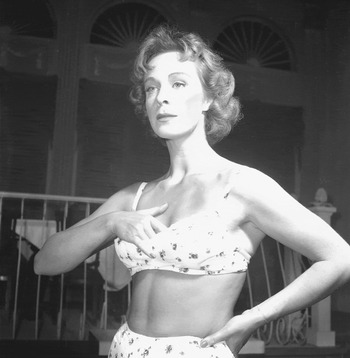
Cat begins with Maggie coming into the bedroom to change her stained dress while Brick is offstage taking a shower. That the title character appears in an unclothed state during most of the first act only heightens the erotic tension in any production of the play. In Gothenburg in 1955, Maggie's sexuality was significantly more pronounced than it had been on Broadway. According to Brenda Murphy, Kazan (who had encouraged Williams to create a more sympathetic and likable Maggie) hired “the wholesome Barbara Bel Geddes . . . to project an image of the healthy, loving young wife.” Although he had her play with an ice cube that she slid down her bosom, Kazan “did not want the sense of a calculating use of sexuality that was hinted at in Maggie's wearing pajamas. . . . Rather than going into the closet to change into pajamas, she took her stained dress off on stage and played the first act in a slip.”Footnote 29 The Swedish Maggie went one step further and played these first scenes, when she tried to seduce her alcoholic husband into having a baby with her, in nothing but panties and a bra. These actions were partially motivated by a desperate attempt to reassure herself of his love and a desire to secure her part of a large inheritance to be distributed after Big Daddy's death (see Fig. 4).
Maggie (Broström) unconsciously scratches her breasts, further drawing attention to her half-naked state. Courtesy of Theatre Collections at Gothenburg City Museum. Photographer: Georg Cassirer.

It was highly unusual for an actress to perform on a public stage in nothing but her underwear in serious drama in the 1950s. The first women to wear erotic lingerie and cosmetics in the late nineteenth century were actresses and prostitutes. Although it was invented in the nineteenth century, the bra did not become a widespread fashion item until the postwar period. Dress historians have pointed out the influence of the American entertainment industry, since Hollywood played a major part in introducing the bra as a new fashion item that molded the female body and adjusted it to changing ideals of beauty: “The bust [in the 1950s] was supposed to be strongly marked, high and conical with the breasts clearly separated, striving toward different directions like two missiles. This was as far from a natural silhouette as one could go and could be achieved with the right bra.”Footnote 30 Broström's rather simple floral-patterned bra might not have been an example of the latest fashion, but it raised the tension in the first act considerably. Fashion scholar Valerie Steele stresses that the half-naked body is often perceived as much more titillating than the naked one because it stimulates erotic curiosity and fantasies: “Normally concealed from sight, like the body that it touches, underwear also implicitly alludes to the act of undressing as a prelude to sexual intimacy.”Footnote 31 It is precisely this thrill of anticipation and titillation that the opening scenes of Cat played with, a fact that was not lost on the critics.Footnote 32 For example, Ivar Harrie from Expressen (The Express) started his (very positive) review with the following description:
He comes out of the shower, she is changing her dress. That is the introductory scene. Tennessee Williams's approach is that we soon are going to see this human couple naked, their bodies get to be part of the play and speak out. They are supposed to be very beautiful to watch, beautiful in a classical sense: he resembles a Greek sportsman, she resembles Aphrodite—and a cat.Footnote 33
A defining characteristic of Cat and other Williams plays is not only that the characters sometimes appear half naked but also that they change onstage, thereby exposing themselves to the gaze of the other protagonists and the audience. In the process, different fantasies and desires are negotiated. At times, Maggie goes so far as to express a direct awareness of the reactions that her body causes. She tells Brick how many times she has seen Big Daddy's lustful looks resting on her body and points out that his desire could work to their advantage in their efforts to secure the inheritance of the large plantation: “In fact!—I sometimes suspect that Big Daddy harbors a little unconscious ‘lech’ fo' me. . . . Way he always drops his eyes down my body when I'm talkin' to him, drops his eyes to my boobs an' licks his old chops! Ha ha!”Footnote 34 While lines like these illustrate how Williams exposed the intersections of the politics of the body, sexuality, and capitalism, they also raise questions about the representation of women onstage. Interestingly, the reception of Broström's daring choice of costume was rather contradictory, and, as I will outline, it was not necessarily the serious and professional reviewers who expressed their concern. Refusing to remain confined in the cultural sections and theatre reviews of the morning and evening papers, the production had cultural implications that affected popular weekly magazines, whose journalists further sensationalized the play. In addition, motivated by the general cultural climate that was characterized by concerns about female sexuality, general readers started writing letters to the editor in which they made reference to Cat.
While some professional theatre critics were somewhat skeptical and wondered whether Broström's attire in the first act was a cheap visual effect,Footnote 35 the theatre magazine Scen och salong (Stage and Auditorium)—in what was actually a very positive review—was the only one that seemed genuinely worried:
Brick's wife plays the larger part of the first act in a very naked state—in New York the corresponding actress wore a slip the whole time, which should be a reason for consideration of certain tendencies in modern Swedish theatre. There is a whiff of sensationalism in the performance that it certainly would have benefited from avoiding.Footnote 36
Indeed, postwar theatre in Sweden became increasingly daring in its representation of the human body. Another Williams production, The Rose Tattoo (Norrköping, 1951), had previously raised some eyebrows when Bergman directed Kavli as a particularly scantily clad Serafina. This production contributed to both Bergman's and Williams's reputation for pushing sexual boundaries. Three weeks after the opening night of Cat, Falck's production was also receiving attention for its audacity. In an anonymous article in Göteborgs-Posten (The Gothenburg Post) comparing the New York and the Gothenburg interpretations, the newspaper published two pictures to illustrate the sartorial differences between the Maggies and encouraged its readers to use this “material for further discussion of Swedish boldness and the Swedish perception of what is ‘American.’”Footnote 37 The Swedish counterpart of Life magazine, the photojournalistic magazine Se (See) asked in its headline: “How Far Can Theatre Go?”
How close to reality does modern Swedish theatre dare go? At Karin Kavli's City Theatre in Gothenburg, one does not beat about the bush when it comes to sexuality, and therefore Cat on a Hot Tin Roof—with Gunnel Broström in the lead under Åke Falck's direction—has become the play that everyone talks about right now.Footnote 38
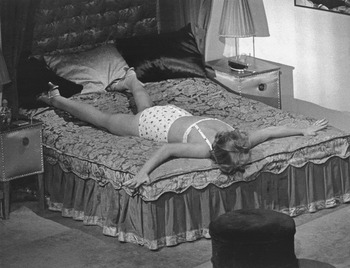
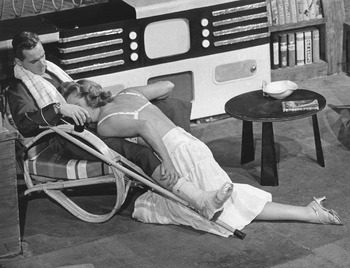
A two-page spread included nine pictures of Broström as Maggie trying to reach out to and make contact with her indifferent husband. Inspired by the aesthetics of contemporary cinema, the photo-essay presented a series of sequential images that captured the character's movements and actions onstage: she came into the room, sat on the bed, started taking off her skirt and then sat again, and eventually lay on the bed, clad in nothing but her underwear. Each of these pictures was illustrated with a quote from the play. For instance, in one photo Maggie lay face down on the bed with her head buried in the blanket (see Fig. 5). The picture was accompanied by the following line: “You know, our sex life . . . it's going to revive again, just as sudden as that. I'm confident of it. That's what I'm keeping myself attractive for. For the time when you'll see me again like other men see me.”Footnote 39 Another picture depicted her kneeling in front of the seated Brick with her head buried in his lap (see Fig. 6). This particular image, a not-so-subtle reference to fellatio, was accompanied by the statement: “[W]e were blissful, yes, hit heaven together ev'ry time that we loved.”Footnote 40
The famous photographer Lennart Nilsson documented the sexualized theatre production for the magazine Se. Courtesy of Scanpix. Photographer: Lennart Nilsson.

Another picture from the series Se published on the production. Founded in 1938 and initially a political news magazine distinguished by its rich photographic essays, Se increasingly addressed a male readership after World War II. In the 1960s it acquired a more pornographic touch. Courtesy of Scanpix. Photographer: Lennart Nilsson.

Se did not use readily available press pictures. Instead, it commissioned photographer Lennart Nilsson.Footnote 41 Although his photos from Cat clearly documented how sexualized Falck's production was, the essay in Se further emphasized this quality of the production through its own mode of representation. While the whole photo spread pretended to offer a summary of Maggie's long monologue in the first act, it was arranged and displayed like a striptease story designed to titillate a heterosexual male reader. With a mixture of fake moral indignation and patriarchal voyeurism, both the pictures and dialogues were ripped out of context. The resulting impression was more reminiscent of midcentury pinups than a report on serious drama. Not without a sense of humor, the article also noted that Broström's underwear was “unfortunately so monstrously ugly that it is a single cry for help for increased state funding for the theatre.” It observed that “[w]inding on the double bed in a choreography that would do honor to any sexual manual, [Maggie] is begging for a night that no normal man would deny her” and crudely concluded, “the cat on a hot tin roof is good in bed.”Footnote 42
What exactly was considered to be so fascinating and provocative about the production—the fact that the lead actress appeared in her underwear, or that she played an aggressively desiring woman? David Savran points out that Williams's female characters are very complex and three-dimensional; they are often at the center of the narrative and undergo a development and transformation usually reserved for male characters in midcentury American drama. Moreover, the Williams heroine is often “constituted as the primary desiring subject,”Footnote 43 something that is evident in Cat, where Maggie is unashamed of her sexuality and her need to be physically intimate with Brick. While Brick's sexuality is ambiguous because his true feelings for the dead Skipper are never fully revealed, Maggie is undeniably heterosexual. Nevertheless, her outspokenness and desire to take control of her husband disturb contemporary norms by destabilizing and undermining midcentury understandings of femininity and female sexuality.Footnote 44 Instead of performing the role of a docile and silent wife, she openly admits that she misses being intimate with Brick because he used to be “[s]uch a wonderful person to go to bed with.”Footnote 45 However, Maggie's central position is not uncontested, given the cultural conventions and the gender order of the period. As Savran notes, Williams's female protagonists become trapped between their position as desiring subject and a male-dominated society that will not allow them to express and act on these desires fully:
Williams's transposition of gender effects a destabilization of classic narrative, producing a female character who is both an actively striving subject and an object of the desire of others. Because of her position in the narrative structure, she must desire, but because of various social (i.e., contextual) proscriptions, she is not allowed to act on her desires authoritatively or to articulate them completely.Footnote 46
This prohibition against Maggie being in control of and entitled to her own sexuality, I suggest, was illustrated by the photo essay in Se. Reacting strongly against the challenging representation of female sexuality, Se stripped Maggie/Broström of her agency and turned her into an object of desire for its male readership, thereby forcing her into a normative patriarchal gender order. Many years later, managing director Kavli revealed her own issues and hesitations when she confessed that among the many works she had presented during her time in Gothenburg, Cat was the only one she had ever second-guessed:
I really regret that we played Tennessee Williams's Cat on a Hot Tin Roof. It was a superbly written play. But it was, in the deepest sense of the word, a truly immoral play. I said pooh, no, ugh, phew to myself as I was reading the play about the drunkard who is being seduced and gets a bottle of booze as a reward. But we played it. And it became a popular success. Later I met a managing director in Vienna who had declined the play for the same reasons that I had felt. Since then I regret that I didn't say phew and no with more emphasis.Footnote 47
According to Kavli, Maggie was the evil temptress whose determination and sexual hunger were the most provocative aspects of a play that was remarkable for its outspokenness on more than one issue. Kavli later also complained about Williams's Sweet Bird of Youth and stressed that she had refused to finish reading the story, relegating its subject matter of an aging, substance-abusing actress who needs to be resuscitated with oxygen to the other side of the Atlantic: “Such hard-boiled plays the Americans can keep to themselves.”Footnote 48
To a large degree, the general Swedish reception of Williams, and of Cat in particular, was governed by preconceptions and prejudices about the United States. This allowed both directors and reviewers to aggrandize and sensationalize the stage works. Literary scholar Jesper Gulddal argues that anti-Americanism is a discursive strategy by which Europeans reaffirm their self-imagined cultural superiority. He traces the roots of anti-American stereotypes back to the Romantic movement and identifies a number of recurring complaints in cultural products since the late eighteenth century, including literary texts, philosophical treatises, travel diaries, and letters: the worship of the dollar, religious fanaticism, the absence of historical and cultural traditions, unrefined manners and behavior, and the flawed realization of the concepts of liberty and equality. Gulddal further argues that
anti-Americanism is systematic in the sense that the scorn it pours on the United States is aimed at all aspects of the country, i.e. not exclusively at the government and its policies, but at the “Americanness” of America—American culture, American values, American society, and the American as a national type. In its purest, most aggressive form, anti-Americanism posits an unalterable and inescapable American essence which is inherently corrupt, and of which all the repulsive aspects of American life are simply examples.Footnote 49
While such anti-Americanism is undeniably clear in the material presented so far, it is not the only explanation for the ambiguous Swedish reception of Williams's works in general and Cat in particular. In fact, situating the play firmly in the United States and then condemning it as an American product was a convenient way for Swedes to mask how busy they were negotiating their own national and sexual anxieties.
A Deeply Immoral Play for a Deeply Immoral Country
The fascination and insecurities Williams's female characters elicited emerged in the context of a lively debate on Swedish women's sexuality that erupted in the 1950s, both abroad and on the domestic level. Sparked by an April 1955 Time magazine article with the saucy headline “Sin & Sweden,”Footnote 50 the country had begun to gain a dubious international reputation by the time Cat opened. Although the article was a very misinformed piece of journalism that was riddled with inaccuracies, exaggerations, and false statements, it became the starting point for a flood of similar articles in a large number of international publications that reported on what would become known as the “Swedish Sin.”Footnote 51 During the summer and fall of 1955, U.S., British, and French tabloids picked up the theme of the Time article: the alleged sexual promiscuity and immorality of Swedes. These publications used scandalous headlines to promote stories that claimed that premarital sex was encouraged, adultery was considered respectable, abortion was fully legalized, and schoolchildren were taught the techniques of intercourse. Foreign observers might have begun the debate, but domestic journalists soon began describing these scandalous international reports for their readers. As a result, people wrote letters to editors in which they pointed out the damage done to the nation and expressed their concern about the false reputation of Swedish women as unrestrained and promiscuous.
Intellectual historian Lena Lennerhed argues that the international obsession with sex in Sweden was part of a larger process of vilification of the social democratic welfare state and its proclaimed politics of neutrality during the cold war. She identifies two major factors that started the debate: in addition to the fact that in 1955 Sweden was the first country in the world to introduce sex education into the curriculum, cultural representations also implemented and contributed to the myth of the “Swedish Sin.”Footnote 52 Among the movies Lennerhed identifies as playing a crucial role in this process are Arne Mattson's One Summer of Happiness (Hon dansade en sommar, 1951) and Bergman's Monika (Sommaren med Monika, 1953). These films had a large international impact and were instrumental in shaping foreign audiences' perception of Sweden as sexually liberated and shameless. Both movies notoriously incorporated the subject of premarital sex; in the words of Frederick Hale, “the familiar themes of nude swimming and the like . . . cement[ed] in the eyes of cinema-goers on an intercontinental basis the conviction that they had gained a glimpse into representative Swedish conduct.”Footnote 53Monika, for instance, was explicitly marketed by American distributors as an example of the exoticness of “the beautiful lake country of Sweden” and as “the story of a bad girl” who was “naughty and nineteen.”Footnote 54
Barton Palmer argues that European art cinema (which was not dependent on the infamous U.S. Production Code Administration and could therefore explore sexual themes with frankness and candor) was central to the development of the new subgenre of the Hollywood adult art movie, which is best represented by Kazan's 1951 screen version of A Streetcar Named Desire.Footnote 55 While European film influenced both Hollywood and U.S. popular culture, I suggest that this relationship was far from being unidirectional. If American audiences were falsely lured into an inaccurate version of Swedish culture through Mattson's and Bergman's “summer” movies, then Williams's plays (and the films based on them) offered Swedish audiences a distorted glimpse of American culture. This process of transatlantic negotiation also helped establish an interesting contradiction: while the foreign press was busy cementing the myth of the “Swedish Sin” (not least by referring to Swedish movies), Swedish theatre, because of its fascination with contemporary American drama, could push the representation of female sexuality another step further by securely anchoring it in a U.S. setting. In our case, this artistic and ideological move allowed both the ensemble and the critics to explore Cat's sexual politics to the fullest while paradoxically keeping them at a safe distance.Footnote 56
A look at the larger newspapers from the Gothenburg region for the month of September 1955, when Cat premiered, offers further evidence of the relationship between the reception of Williams's play and a cultural climate characterized by sexual anxieties and national insecurities. When the British tabloid Daily Sketch published an article series on sex education in Swedish schools, which it characterized as “The Most Daring Experiment in the World,” it focused on allegedly high rates of teenage pregnancies and divorce.Footnote 57 The foreign correspondent of Göteborgs-Tidningen (The Gothenburg Paper) complained about this defamation—on the same day that the first article in the British series was published—on page one.Footnote 58 Similarly, Göteborgs-Posten reported on an article in another British tabloid, the weekly Reveille,Footnote 59 for which a journalist interviewed a doctor who had visited Sweden and confessed to be shocked and morally outraged by the sexual promiscuity and the high rate of abortion in Sweden.Footnote 60 However, Swedish newspapers also produced their own scandalous reports as part of a growing debate on national identity and sexuality. In the same issue that contained the previously mentioned photographs comparing the New York and Gothenburg productions of Cat, Göteborgs-Posten printed an article arguing that the unrestrained behavior of Swedish female students in Paris damaged the national character.Footnote 61 Immediately, concerned readers responded with letters to the editor. Reactions ranged from appeals to politicians to cancel sex education and teach schoolchildren that sex was acceptable only within marriage, to complaints raised by a group of women who were shocked by the visible prostitution they had seen in the French capital and were annoyed by French men's questions about whether it was true that all the Swedish girls loved to go skinny-dipping. Another letter complained about German pubs playing a recording of a march titled “Der alte Schwede,” a song about the “old Swede” who was drunk on punch and wanted to kiss all the girls. The letter writer strongly recommended that Swedes should get up and leave such establishments when such songs were played in order avoid further damaging the population's moral fiber. Most interestingly, he cited the pictures of the two productions of Cat to prove his point about the problematic reputation of Swedes.Footnote 62 Catching Sweden at a defining moment in its history of sexuality, Williams, Falck, and Cat made waves that spread beyond the stage of Gothenburg City Theatre and touched upon a larger process of negotiating national identity, a conflict that was to a large degree projected onto the female body and, as we shall see, onto the homosexual man.
Post-Kinsey America Embodied
Falck followed the script of the “Broadway version” of Cat, which included several modifications Kazan had advocated in order to guarantee a hit production.Footnote 63 Most reviewers were well aware that this cat had two tails and declared that Williams had made a mistake when he listened to Kazan's advice, not least because the happy ending, which hinted at a reconciliation between Brick and Maggie, seemed implausible and contrived—“optimistically American,” as Ny Tid (New Time) put it.Footnote 64Svenska Dagbladet (The Swedish Daily Paper) expressed doubt that people would change so fast and dismissed the third act for its “obtrusive happy end, cocksure as a conclusion in American popular psychology.”Footnote 65 Half a year later, Falck admitted that he and the cast had struggled with the ending, which he explained as an American product: “Let us not call it mendacity, but let us call it Broadway. The heterosexual happiness into which the plays fizzles, has actually considerably less fire than what is told of the possibility of a homosexual unhappiness.”Footnote 66 Here, the director alluded to Williams's brave attempts to drag the subject of homosexuality out of the closet and show the effects of homophobia in an age characterized by social paranoia and McCarthyism.Footnote 67 Brick's ambiguous relationship to his dead friend Skipper provoked a number of interesting critical reactions. As I have shown elsewhere, Swedish reviewers were very outspoken about the theme of Brick's potential homosexuality but quickly dismissed it as a question only of interest to an American audience, which was said to be obsessed with sexual deviance. Moreover, they condemned the obscure nature of Brick and Skipper's friendship as a scandalous element that Williams had used to titillate and shock his audiences.Footnote 68
A few selected quotes from influential cultural personalities illustrate the argument and further explain how the reception of Cat was governed by thinly veiled anti-American sentiments that deflected attention away from domestic homophobia. Harry Schein, a social democratic cultural politician and later the founder and first managing director of the Swedish Film Institute, noted: “It is curious to observe how homosexuality in recent years has become a topic of debate in American fiction and drama.”Footnote 69 Marxist critic and literature scholar Kurt Aspelin was appalled by the play, which he deemed to be full of sensationalist topics that included cancer, alcoholism, perverse desires, and capitalist greed. He vented his frustration about the illogical reconciliation between Maggie and Brick at the end of the play:
Financial greed therefore gets the last word, . . . a moral lesson that could possibly satisfy a cynical capitalist outlook but hardly goes down with spectators on this side of the Atlantic. Also the description of the homosexual problem was apparently supposed to speak to even the most prejudiced spectator of the American middle class.Footnote 70
According to Aspelin, not only were Swedish audiences an enlightened, antihomophobic people, but they were also raised to be anticapitalist. The weekly literary magazine IDUN understood the play as an example of the fascination with Freudian psychoanalysis in the United States and stated that both Brick and Maggie had “been hit by thorough German neuroses in the American style.”Footnote 71 Finally, Arbetet (The Work) complained not only about the theme of “homosexuality (which since the Kinsey Reports has become such a popular theme in the United States)” but also about Williams's portrayal of “female erotic dissatisfaction (a phenomenon that was once taboo, but whose existence during the landslide of the postwar era has dawned on the descendants of the Puritans and is nowadays openly vented).”Footnote 72
The Swedish translation of the first Kinsey Report appeared in 1949 (that is, within a year after its original publication). Initial interest was very high, not only in scientific journals but also in the political and popular press, which spread the knowledge and insights produced by Kinsey and debated his results, mostly in positive terms.Footnote 73 Unfortunately, the publication of the report and its suggestion that homosexual behavior among men was far more common than was previously assumed also intensified the already prevailing homophobia and sparked a new wave of social paranoia about the alleged dangers posed by homosexuals. Historian of sexuality Jens Rydström describes the moral hysteria that was instigated by both conservative and left-wing politicians who were afraid that young people would get seduced into a “degenerate” lifestyle. Several political scandals (one of which consisted of blackmail connected to an affair that involved King Gustaf V and another that led the Minister of Ecclesiastic Affairs to resign from his post) received large media coverage and raised speculation about the existence of secret networks of homosexuals. In addition, concerns were raised that young men and soldiers were prostituting themselves. One result of this wave of homophobia was the instigation of a committee that registered homosexual men and women, an activity that would continue until at least 1964.Footnote 74
Unlike what the theatre critics would like us to believe, Swedish society in the 1950s was highly intolerant and preoccupied with numerous anxieties about homosexuality. Received as a quintessentially American post-Kinseyan play, Cat gave the reviewers the opportunity to describe postwar America as obsessed with (homo)sexuality and therefore significantly different from Sweden. At the same time, this alleged Americanness was a convenient excuse to write openly about the sexual content of the play and in the process negotiate domestic anxieties. To borrow from Foucault, reviewing the latest Williams play offered the critics an “institutional incitement to speak”Footnote 75 about sex, both onstage and in the media. Rather than condemning Williams's sexual politics, the media displayed an obsessive fascination with them and used his plays as an invitation to speak of the forbidden. By the mid-1950s, the stage had become the locus where the Swedish public could negotiate contemporary anxieties about sexuality, gender, and nation; it was a site where the “multiplication and intensification of pleasures connected to the production of the truth about sex”Footnote 76 could be enjoyed. The pleasure of this process was then prolonged in the days and weeks after the premiere, when lively theatre criticism, weekly illustrated magazines, ladies' journals, and private citizens who wrote concerned letters to the editor would delve into the subjects raised by Cat, thereby adding an additional layer to the sexual discourse.
Conclusion
While it is easy to dismiss Swedish theatre as being of regional interest, this essay demonstrates the country's importance as a gateway for the introduction of midcentury American drama to European audiences. In the process of cultural translation, the United States and Broadway were conceptualized as Europe's theatrical “Other,” and the representation of sexuality became a key tool for consistently contrasting and judging Swedish values, norms, aesthetic ideals, and cultural identity against their imagined American counterparts. The female body and the homosexual man in particular emerged as central concerns in this process of mutual exoticization. Williams was not the only playwright to push sexual boundaries during the period in question, but he certainly was the most popular and most accessible.Footnote 77 While further study is required to draw more general conclusions about the production and reception of Williams in Europe, this essay hints at some important cultural differences, which prove that no definite, essentializing statement about his impact on the other side of the Atlantic is possible. Europeans negotiated Williams as an American playwright obsessed with sex in order to project a false idea of their own cultural and moral superiority, but we also need to keep in mind some crucial national, political, and religious differences. Under the United Kingdom's severe censorship laws, the Lord Chamberlain denied Cat a license, whereas in Catholic Ireland directors succumbed to social pressure and hesitated to stage the play. Theatres in Paris frequently staged Williams's major dramas, but French critics were usually quite hostile in their assessments.Footnote 78 It is also important to remember that because of cold war cultural politics and the division of Europe, productions behind the Iron Curtain were delayed by several decades. In the USSR, for instance, Cat did not open until December 1981. Swedish theatres, in contrast, were competing with each other to host a prestigious European premiere of one of the most popular playwrights of the period. As they staged the European premiere of Cat on a Hot Tin Roof, Åke Falck and the Gothenburg City Theatre contributed to a process of negotiating Sweden's national and sexual anxieties. Although their production of Williams's play caused a fair amount of controversy, it was hailed as a major cultural event and was given its due respect by critics and audiences alike.