Recently, interest in the positive end of the emotional spectrum has increased in psychology, whereas, traditionally, the focus has been on negative emotions (Moksnes et al., Reference Moksnes, Løhre, Byrne and Haugan2014). Proponents of positive psychology have identified subjective well-being (SWB) as an important focus in positive approaches. In fact, there has been an increase in published research on SWB over the last twenty years, having an impact on many areas of social and health sciences (Tomás et al., Reference Tomás, Gutiérrez, Sancho and Romero2015).
Subjective Well-being
SWB is defined as “a person’s cognitive and affective evaluations of his or her life” (Diener et al., Reference Diener, Lucas, Oishi, Snyder and López2002, p. 63). These evaluations consist of cognitive and affective components. Positive affect and negative affect are the affective components of SWB. Life satisfaction (LS) and domain satisfactions are considered to be cognitive components (Diener et al., Reference Diener, Suh, Lucas and Smith1999).
LS is a “global judgment that people make when they consider their life as a whole” (Diener, Reference Diener1994, p. 107). LS is considered to be a central construct of SWB. LS is associated with factors such as dispositional influences, adaptation, goals, and coping strategies (cf. Diener et al., Reference Diener, Suh, Lucas and Smith1999). Also, evidence has shown that LS is positively associated with longevity, self-rated health (SRH), and positive health behaviors. Conversely, LS has been shown to be negatively associated with psychiatric morbidity and mortality (Koivumaa-Honkanen et al., Reference Koivumaa-Honkanen, Honkanen, Viinamäki, Heikkilä, Kaprio and Koskenvuo2000).
SRH refers to a subjective measure of either the individual’s general health or different dimensions of their own health. SRH is a powerful predictor of mortality (Idler et al., Reference Idler, Leventhal, McIaughlin and Leventhal2004). Diener et al. (Reference Diener, Suh, Lucas and Smith1999) pointed out that there is a strong relationship between SWB and SRH.
The relationship between LS and SRH has occasionally been studied, finding, for example, that happier people and those with higher LS had better SRH when followed up after 2 years (Siahpush et al., Reference Siahpush, Spittal and Singh2008).
At present, the increase in volume of research conducted with younger populations facilitates researchers’ understanding the relationship between SWB and social adjustment, mental health, and school performance (Oberle et al., Reference Oberle, Schonert-Reichl and Zumbo2011). Further increasing the volume of research in this field is essential, because well-being could have a protective role in health maintenance (Steptoe et al., Reference Steptoe, Deaton and Stone2015). Indeed, Diener (Reference Diener2013) suggests that people who experience high SWB are likely to live longer and healthier lives.
Gender and Age in Life Satisfaction
Among adolescents, LS is associated with emotional, social and behavioral constructs (cf. Gilman & Huebner, Reference Gilman and Huebner2003, and Proctor et al., Reference Proctor, Linley and Maltby2009). For example, a positive association has been found between LS and self-efficacy (Pinquart et al., Reference Pinquart, Silbereisen and Juang2004) and a good relationship with family members (Oliva & Arranz, Reference Oliva and Arranz2005). A negative association has been found between LS and risk-taking behaviors, such as substance abuse (Piko et al., Reference Piko, Luszczynska, Gibbons and Teközel2005). Proctor et al. (Reference Proctor, Linley and Maltby2009), in a literature review, conclude that the literature on LS in children and adolescents provides clear evidence to suggest that LS is an important predictor of psychological states and psychosocial systems. Research on LS in children and adolescents has variously indicated that LS is negatively associated with depression, anxiety, and social stress (Funk et al., Reference Funk, Huebner and Valois2006; Gilman & Huebner, Reference Gilman and Huebner2003, Reference Gilman and Huebner2006). More recently, further studies have been published with similar results with respect to these variables (e.g. Moksnes et al., Reference Moksnes, Løhre, Byrne and Haugan2014). Zullig et al. (Reference Zullig, Valois, Huebner and Drane2005) explored the relationship between LS and SRH in a sample of American adolescents. The results obtained showed that adolescents who reported greater dissatisfaction with their lives also reported poorer SRH, poorer physical health, poorer mental health, and a higher number of activity limitation days.
Research on gender and age differences in LS has produced conflicting results in adult samples (Jovanović et al., Reference Jovanović, Joshanloo, Đunda and Bakhshi2017). Similarly, research on gender and age differences in LS in adolescent samples is also conflicting. For example, literature reviews carried out by Gilman and Huebner (Reference Gilman and Huebner2003) and by Proctor et al. (Reference Proctor, Linley and Maltby2009) reach different conclusions. In the Gilman and Huebner (Reference Gilman and Huebner2003) review of LS research in children and adolescents, it was noted that consistent findings have been obtained in the research on relationships between LS, age, and gender, suggesting that LS remains invariant across age and gender. However, the Proctor et al. (Reference Proctor, Linley and Maltby2009) review indicates that international research suggests that LS declines slightly with the onset and progression of adolescence. Recent empirical studies on LS in youths also show different results regarding age and gender differences in LS. For example, with respect to age, Burger and Samuel (Reference Burger and Samuel2017), using a longitudinal design and data collected from a representative sample of young people in Switzerland, found that the average level of LS in participants seemed to remain stable over time when the effects of changes in variables such as stress and self-efficacy were taken into account. Nevertheless, a study by Moksnes et al. (Reference Moksnes, Eilertsen, Ringdal, Bjørnsen and Rannestad2019), using a cross-sectional study of secondary school students from Mid-Norway, found a weak negative association between LS and age.
With respect to gender, empirical studies also show conflicting results, although in the most recent studies results show that boys had higher mean scores of LS than girls. For example, Piko and Hamvai (Reference Piko and Hamvai2010), in a sample of Hungarian secondary school students, did not find gender differences in LS. Moksnes et al. (Reference Moksnes, Løhre, Byrne and Haugan2014), however, in a sample of adolescents from Norway, found that boys had higher mean scores of LS than girls. Recently, studies by Ginevra et al. (Reference Ginevra, Magnano, Lodi, Annovazzi, Camussi, Patrizi and Nota2018), Nie et al. (Reference Nie, Teng, Bear, Guo, Liu and Zhang2019), and Moksnes et al. (Reference Moksnes, Eilertsen, Ringdal, Bjørnsen and Rannestad2019), in samples of Italian, Chinese, and Norwegian adolescents respectively, have also found that boys scored higher in LS than girls.
Gender and Age in Self-Rated Health
Research on gender and age differences in SRH has also produced ambiguous results in adult samples (Bardage et al., Reference Bardage, Pluijm, Pedersen, Deeg, Jylhä, Noale, Blumstein and Otero2005; Leinonen et al., Reference Leinonen, Heikkinen and Jylhä1998). SRH research in adolescents is especially relevant for a better understanding of health development because SRH has been demonstrated to have both immediate and long-term consequences for adolescents’ health (Simonsen et al., Reference Simonsen, Ylönen, Suominen, Roos, Välimaa, Tynjälä and Kannas2017). Research on gender and age differences in SRH seems to produce more consistent results in adolescents. In empirical studies on SRH in youths, girls report a lower SRH than boys, and this gender difference increases with age. For example, Haugland et al. (Reference Haugland, Wold, Stevenson, Aaroe and Woynarowska2001) found, in a cross-national comparison of adolescents from Finland, Norway, Poland, and Scotland, that, consistent with previous studies, girls reported more health complaints (e.g. headache, nervousness or sleeping difficulties) than boys, and that gender differences increased with age. These results were also obtained in a subsequent study by Woynarowska et al. (Reference Woynarowska, Tabak and Mazur2004), which presented data from 31 countries on the variables studied in students aged between 11 and 15 years of age. Jerdén et al. (Reference Jerdén, Burell, Stenlund, Weinehall and Bergström2011) also found, in a sample of Swedish adolescents, that girls reported lower SRH than boys, and that this gender difference increased with age. More recently, Meireles et al. (Reference Meireles, Xavier, Andrade, Friche, Proietti and Caiaffa2015) found, in a sample of Brazilian adolescents, that SRH decreased with age, and that this effect was more pronounced in girls. In addition, a recent study by Zullig et al. (Reference Zullig, Ward, Huebner and Daily2018), in high school adolescents from Arizona, found that SRH was higher in males.
It has been reported that health complaints increase with age, suggesting that the subjective health complaints reported could be explained as a negative outcome of the developmental process (Haugland et al., Reference Haugland, Wold, Stevenson, Aaroe and Woynarowska2001).
Study Purpose and Hypotheses
The aims of the present study are to contribute to the understanding of the role of gender and age on LS and SRH, and to explore the relationships between SRH, measured using multiple complementary indicators (overall same-day perceived health, health status in the past 12 months, and health problems) and LS, specifically in a sample of Spanish adolescents. We believe that the study topic is interesting, since we still have a lot to find out about how age and gender in adolescence may be affecting perceptions of health and well-being. The literature has shown that the relationship between these demographic variables and adolescents’ health and well-being perceptions is rather weak. However, the contribution of these demographic variables may be that they modulate the relationship between health and well-being variables. Taking into account previous evidence, specific hypotheses have been developed for the present research:
Hypothesis 1: Both LS and SRH scores will be average to high, because the samples consist of healthy adolescents.
Hypothesis 2: Demographic variables (gender and age) will be related to self-rated variables.
Hypothesis 3: Adolescents will show age differences in LS and SRH, specifically, the older group will have lower scores than the younger group.
Hypothesis 4: Adolescents will show gender differences in LS and SRH, specifically, boys will have higher scores than girls.
Method
Sample and Study Design
The data reported in this paper are part of a broader cross-sectional study on health-related quality of life in different diseases. Students (n = 1,141) were recruited from public schools (n = 11) from the Valencian Community in Spain. A convenience sampling was used in the study.
Questionnaires were administered by trained research assistants to classroom groups during school hours. The proportion of questionnaires with missing values was low, ranging from .1% to 1.4%.
Participants
A sample of 1,141 Spanish students from the Valencian Community, with the following profile (522 males; 619 females; age: M = 14.44 years, SD = 1.48), participated in this study. The adolescents’ parents were informed about the study and asked to consent to their child’s participation in the study.
Measures
The evaluation included collection of demographic data (gender and age of the adolescent), LS, and SRH.
Life satisfaction (LS) was assessed with the Satisfaction with Life Scale (SWLS; Diener et al., Reference Diener, Emmons, Larsen and Griffin1985). The SWLS is a widely used measure of the cognitive-judgmental component of subjective well-being. In this study, we have used the Spanish version of SWLS (Atienza et al., Reference Atienza, Pons, Balaguer and García-Merita2000). This version has been shown to have adequate psychometric properties (Atienza et al., Reference Atienza, Balaguer and García-Merita2003; Atienza et al., Reference Atienza, Pons, Balaguer and García-Merita2000).
SRH was assessed with the Spanish version of the EQ–5D–5L (Herdman et al., 201; The EuroQol Group, 1990). The EQ–5D–5L is a generic instrument for describing health. It is based on a descriptive system that defines health in terms of 5 dimensions: Mobility, Self-Care, Usual Activities, Pain/Discomfort, and Anxiety/Depression. There are five responses available for each dimension. The responses record five levels of severity (no problems/slight problems/moderate problems/severe problems/extreme problems) within a particular EQ–5D dimension.
Respondents also rate their overall same-day perceived health on a 200 mm hash-marked, vertical visual analogue scale (VAS) with endpoints labeled the best health you can imagine and the worst health you can imagine. This instrument is validated for use with a wide range of health conditions and treatments.
SRH was also assessed with one item from the 2011–2012 Spanish National Health Survey that assesses the health status of the past 12 months (Ministerio de Sanidad, Servicios Sociales e Igualdad, 2014). This item is scored on a 5-point Likert scale ranging from very good to very bad. The question is “In the last twelve months, would you say your health has been very good, good, fair, bad, very bad?”
Statistical Analyses
Analyses were conducted with SPSS Version 21. The percentage of adolescents reporting problems in the five dimensions of the EQ–5D–5L and in the levels of SRH status in the past 12 months was calculated. The subjects’ responses to the five dimensions of the EQ–5D–5L were dichotomized into “no problems” (i.e. level 1) and “problems” (i.e. levels 2 to 5) because the total number of problems reported was low. The data from the SRH status in the past 12 months were also dichotomized into two categories (“very bad, bad, fair” and “good, very good” for the same reason. Age data were also dichotomized into two categories (“12–14 years” and “15–17 years”). The distributions of the mean (M) and the standard deviation (SD) were calculated for the same-day perceived health score and the LS score. The percentages for each response in the five dimensions (Mobility, Self-Care, Usual Activities, Pain/Discomfort, and Anxiety/Depression) and for each point on the Likert scale used to measure perceived health in the past 12 months were obtained.
To examine the relationships between theoretically related variables, correlational analyses were conducted. Correlations between LS, overall same-day perceived health, health status in the past 12 months, problems in EQ–5D dimensions, and age were expected a priori. To analyze these correlations, Spearman’s correlation coefficients were calculated. Following the suggestions of Nunnally and Bernstein (Reference Nunnally and Bernstein1994) and Terwee et al. (Reference Terwee, Bot, de Boer, van der Windt, Knol, Dekker, Bouter and de Vet2007), correlation coefficients between .1 and .3 were to be interpreted as suggesting the presence of weak correlation; those from .31 to .5 a moderate correlation; those exceeding .5 would indicate the presence of a strong correlation. Finally, in order to study the information contained in the variables analyzed in a two-dimensional space, a nonlinear canonical correlation analysis was carried out. Taking into account the mentioned inconsistences and the difficulty of using linear analyses to understand the roles of gender and age in LS and SRH in adolescent health, a nonlinear canonical correlation analysis could contribute to this knowledge through the method known as OVERALS: A form of homogeneity analysis in which K sets of variables are compared, after linear dependencies within each set are removed. For this purpose, the variables were divided into two groups. In the first group were the variables LS, health status in the past 12 months, problems in EQ–5D dimensions, and overall same-day perceived health. In the second group, the variables age and gender were included. The relationships between and within these two groups of variables were analyzed using OVERALS. The goal was to explain the variance in the relationships between two or more sets of variables in a dimensional space. The variables can be scaled as either nominal, ordinal, or numerical, and in OVERALS no assumptions about the underlying distribution of the data are necessary, allowing nonlinear relationships between variable sets to be analyzed.
Results
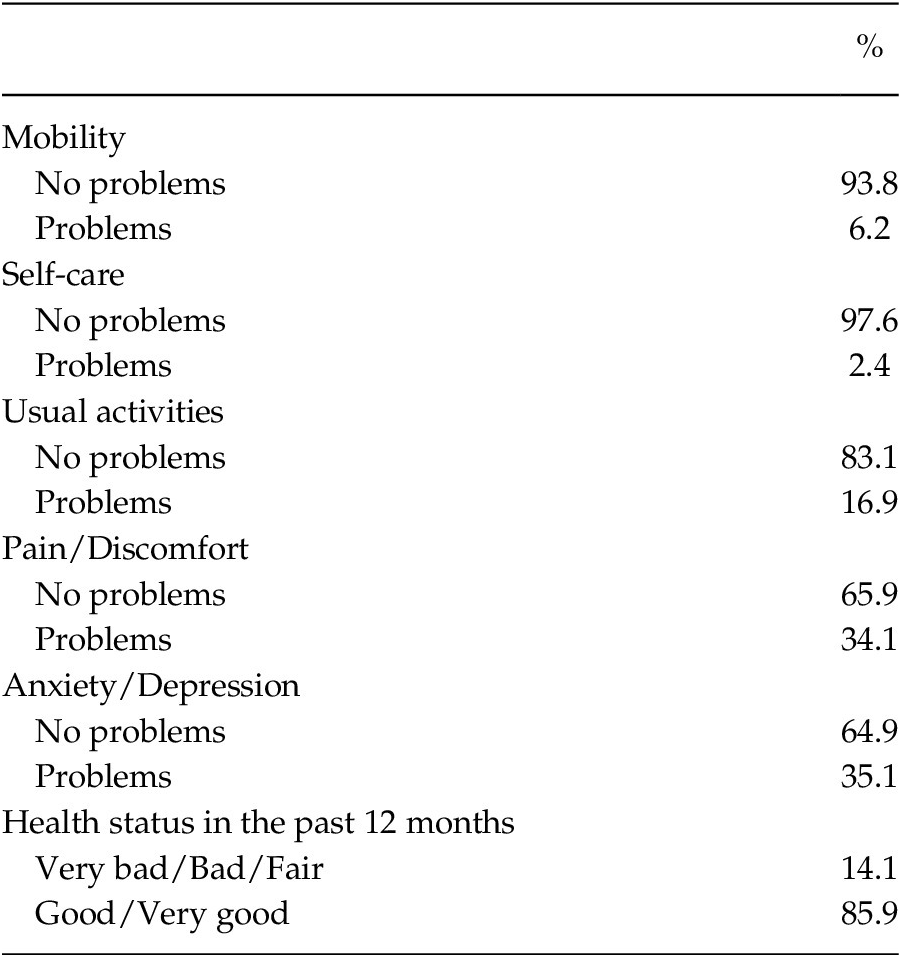
Item means for LS (M = 3.63; SD = .83) and same-day perceived health (M = 82.48; SD = 14.64) were negatively skewed and showed considerable kurtosis, suggesting a non-normal distribution, particularly for the LS score (LS: skewness = –1.36, kurtosis = 2.52; same-day perceived health: skewness = –.46, kurtosis = –.18). The percentages obtained in the dichotomized variables of SRH are presented in Table 1. The percentages also showed an unequal distribution of the subjects. For age, nevertheless, the distribution of the subjects showed an equal distribution (51.8% of adolescents, n = 591 for the 12–14 years of age category and 48.2 %, n = 550 for the 15–17 years of age category). The percentage of adolescents with problems of mobility or self-care was negligible. For this reason, these variables were not considered in subsequent analyses. A very high percentage of adolescents had no problems with the usual activities and rated their health status in the past 12 months as good or very good. However, the percentage of adolescents without problems of pain/discomfort or anxiety/depression was lower.
Subjects’ Responses as Percentages for Dichotomized Variables of Self-rated Health

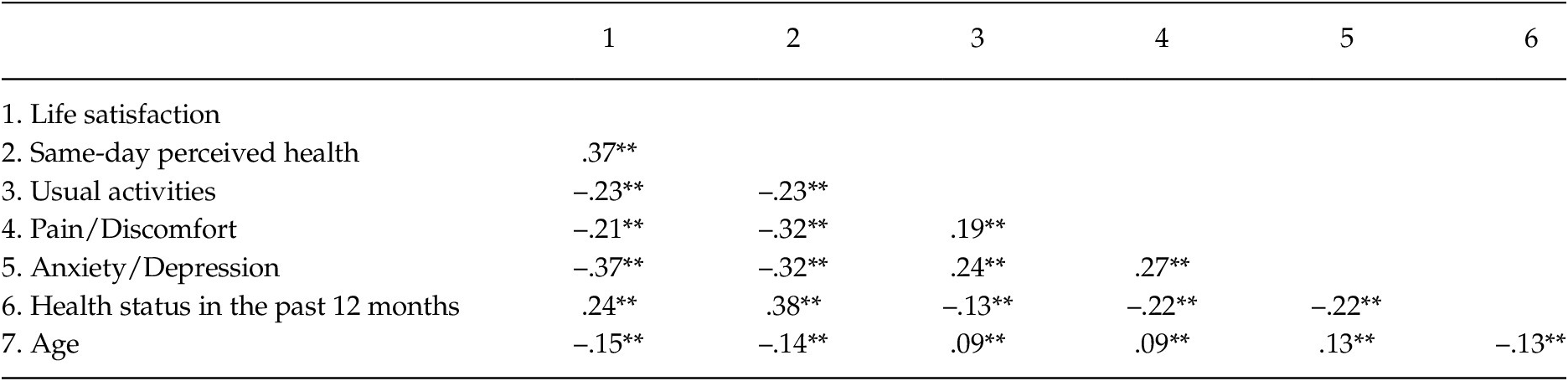
The Spearman’s correlation coefficients are presented in Table 2. While all the coefficients obtained were statistically significant, probably the lower coefficients obtained in some variables are the result of the sample size. No large correlation coefficients were obtained. Some coefficients were moderate and most correlation coefficients obtained were low. The lower coefficients were obtained for age. LS was moderately positively correlated with same-day perceived health (r = .37) and moderately negatively correlated with anxiety/depression (r = –.37). Same-day perceived health was moderately positively correlated with health in the past 12 months (r = .38) and moderately and negatively correlated with pain/discomfort (r = –.32) and with anxiety/depression (r = –.32).
Spearman’s Correlation Coefficients

Note. ** p < .01 (two-tailed).
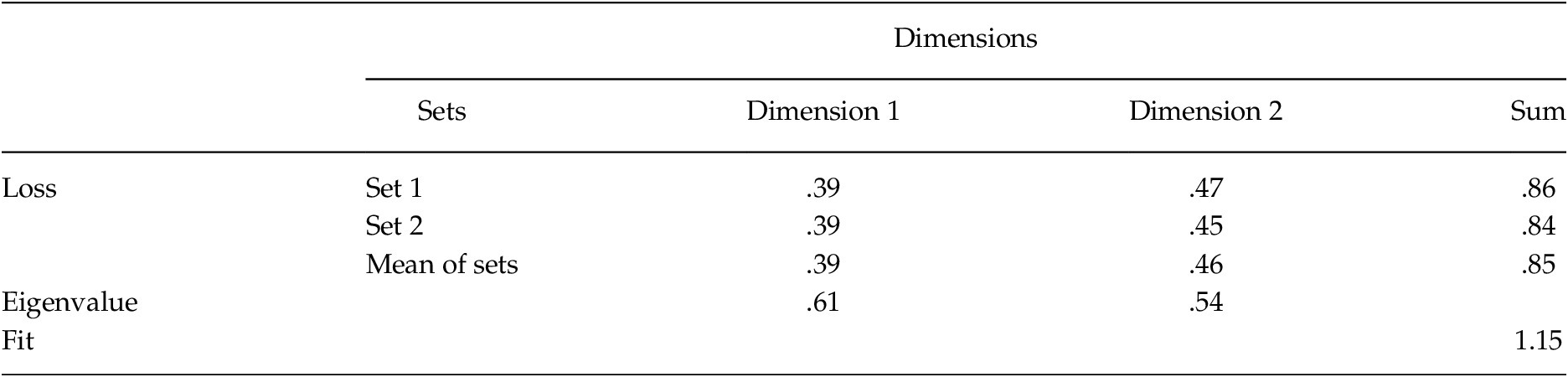
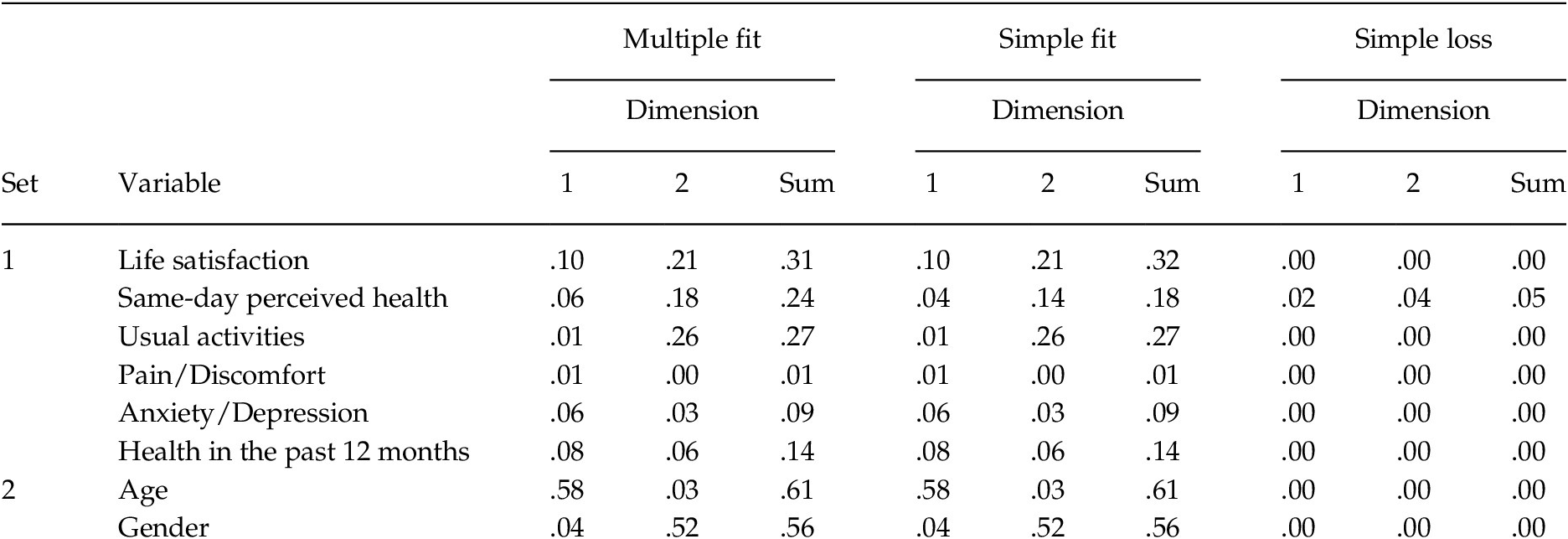
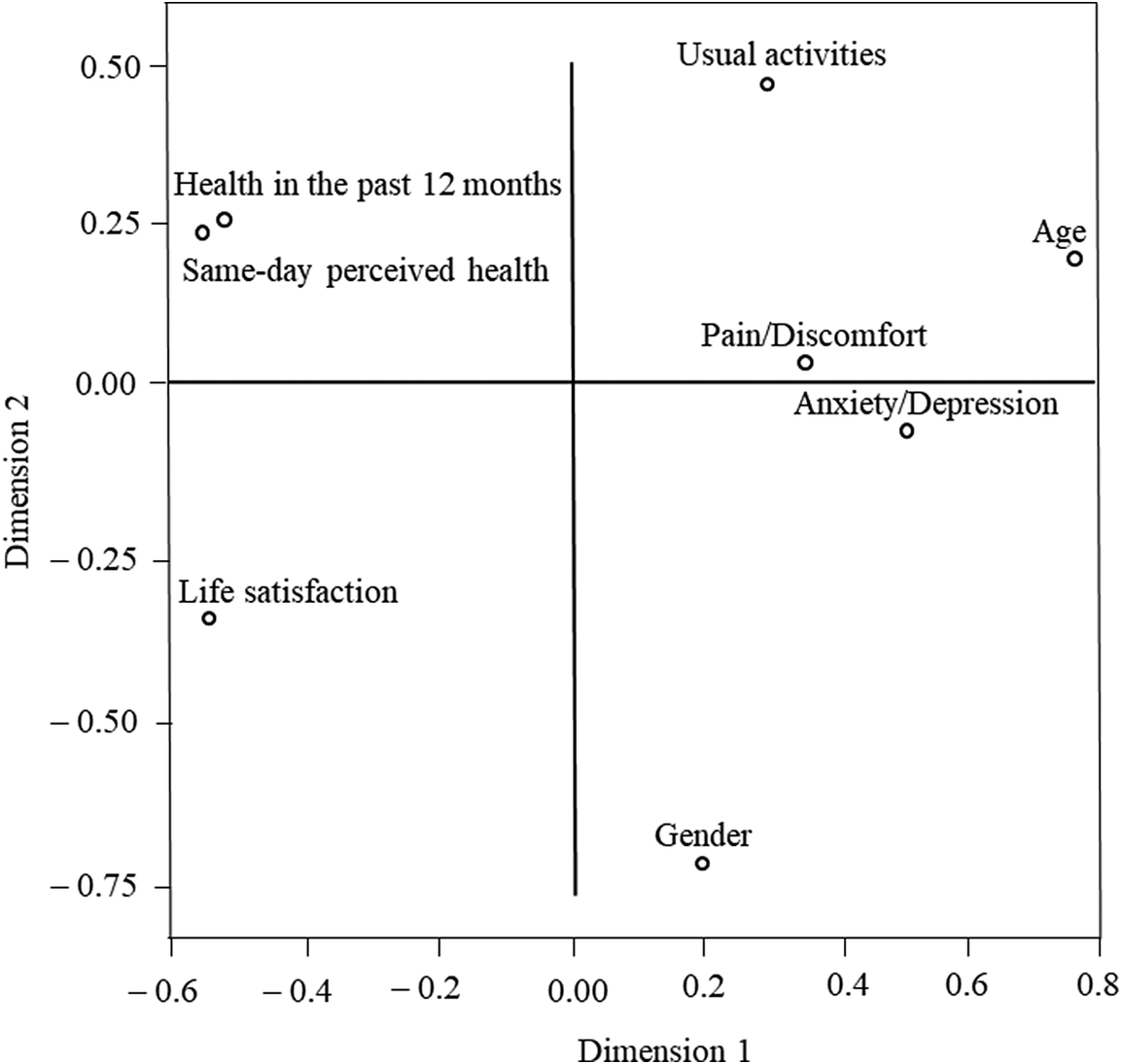
The results obtained in the nonlinear canonical correlation analysis are presented in Tables 3 and 4, and in Figure 1. Loss, eigenvalues, and fit values are presented in Table 3.
Two-dimensional Solution Results for the Analyzed Data

Fit for the Analyzed Data

Component Loadings for the Analyzed Data.

The Eigen values obtained show that 53% (.61/1.15) of the real fit is accounted for by the first dimension and 47% (.54/1.15) of the real fit is accounted for by the second dimension. The total fit obtained was 1.15, indicating that 57% (1.15/2) of the variance was accounted for in the analysis. The average loss in the two sets of variables is .85, and the sum of the average loss and the total fit is equal to the number of dimensions. The number of dimensions is equal to the maximum total fit. The partition of the fit between multiple and simple fit is presented in Table 4.
Multiple and simple fit values are equal or almost equal, which means that multiple coordinates lie almost on a straight line. Multiple fit makes it possible to view variables that discriminate better. The multiple fit values, added along the two dimensions, show that demographic variables age (.61) and gender (.56) are the variables with the best discriminatory power. The following discriminating variables are LS (.31), usual activities (.27), same-day perceived health (.24), and health in the past 12 months. Finally, the multiple fit values show that anxiety/depression (.09) and pain/discomfort (.01) are the variables with the least discriminatory power. Simple fit values in the two dimensions show that age discriminates best in the first dimension, and gender, LS, usual activities, and same-day perceived health discriminate best in the second dimension.
The relationships among variables can also be analyzed with the graphical display of component loadings (Figure 1) and centroid plots of the variables with discriminatory power. Figure 1 facilitates the interpretation of variables according to these variables’ distances from the origin. In this case, there are two groups of related variables. One group composed of LS, usual activities, and age (lower left and upper right corners), and another group composed of gender, same-day perceived health, and health in the past 12 months (upper left and lower right corners).
According to the spatial position of the variables, and the centroid plots for age, LS, and usual activities variables, it was shown that the younger adolescents (12–14 years) are moderately or extremely satisfied with their lives and that they do not have problems in their usual activities. The older adolescents (15–17 years), in contrast, are variously neutral, or moderately to extremely dissatisfied with their lives, and some of them refer to having problems in their usual activities.
On the other hand, centroid plots for gender, same-day perceived health, and health in the past 12 months showed that the girls tend to give worse ratings about their same-day perceived health and health in the past 12 months. The higher ratings about same-day perceived health and in the past 12 months, however, seem to be coming from the boys.
Discussion
Research on relationships between LS and SRH has revealed an association between these variables, with there being a negative relationship between LS and health problems and a positive relationship between LS and having a positive perception of health (e.g. Koivumaa-Honkanen et al., Reference Koivumaa-Honkanen, Honkanen, Viinamäki, Heikkilä, Kaprio and Koskenvuo2000; Kööts-Ausmees & Realo, Reference Kööts–Ausmees and Realo2015). Research on gender and age differences in LS has produced conflicting results in adult and adolescent samples (e.g. Jovanović et al., Reference Jovanović, Joshanloo, Đunda and Bakhshi2017; Piko & Hamvai, Reference Piko and Hamvai2010). On the other hand, research on gender and age differences in SRH has also produced ambiguous results in adult samples (Bardage et al., Reference Bardage, Pluijm, Pedersen, Deeg, Jylhä, Noale, Blumstein and Otero2005). In samples of adolescents, however, the results are more consistent, with girls reporting lower SRH than boys and this gender difference increasing with age (Haugland et al., Reference Haugland, Wold, Stevenson, Aaroe and Woynarowska2001).
The results indicate that the sample consisted of healthy adolescents with few health problems, as the first hypothesis proposed. This was observed in the high scores of LS and the good SRH demonstrated in the sample.
The results of the bivariate correlation analysis support those found in previous studies (e.g., Koivumaa-Honkanen et al., Reference Koivumaa-Honkanen, Honkanen, Viinamäki, Heikkilä, Kaprio and Koskenvuo2000; Kööts-Ausmees & Realo, Reference Kööts–Ausmees and Realo2015) about the relationships between LS and SRH, and they support our second hypothesis. A moderate positive relationship between LS and same-day perceived health was observed, and a moderate negative relationship was observed between LS and anxiety/depression, as in previous studies (e.g. Strine et al., Reference Strine, Chapman, Balluz, Moriarty and Mokdad2008). A moderate positive relationship between same-day perceived health and health in the past 12 months was observed, and moderate negative relationships between same-day perceived health and both pain/discomfort and anxiety/depression were observed. These results suggest that the SRH indicators analyzed were complementary and that their combined use provides more complete information about the relationships between LS and SRH.
Weaker relationships were observed in analyses involving age, suggesting a weak association between age and both LS and SRH. However, the nonlinear canonical correlation analysis provided further evidence for the relationship between LS, SRH, gender, and age in adolescents. The contribution of these demographic variables may be that they act as moderators in the relationship between health and well-being variables. The results obtained showed that age and gender were the variables with the most discriminatory power and anxiety/depression and pain/discomfort were the variables with the least discriminatory power. LS, usual activities, same-day perceived health, and health in the past 12 months were variables with an intermediate level of discriminatory power. The nonlinear canonical correlation analysis also revealed that there were two groups of related variables. One group was composed of LS, usual activities and age, suggesting that the younger adolescents were moderately or extremely satisfied with their lives and they did not have problems in their usual activities, whereas older adolescents, conversely, were neutral in outlook, or either moderately or extremely dissatisfied with their lives, and some of them referred to having problems in their usual activities. The other group of related variables was composed of gender, same-day perceived health, and health in the past 12 months, suggesting that girls tended to give worse ratings about their same-day perceived health and in the past 12 months. Boys, on the other hand, gave higher ratings about their same-day perceived health and in the past 12 months. These results are in agreement with previous evidence and support the third and fourth hypotheses.
We consider that the results obtained in the present study contribute to the understanding of the relationships between self-reported LS, SRH, gender and age in adolescents. The complementary nature of the SRH indicators analyzed, with different levels of discriminatory power, suggests that it is advisable that they be used together to provide more complete information about the relationships between LS and SRH. A non-linear analysis better explains the relationships between LS, SRH, gender, and age in adolescents, showing that age and gender have a high level of differential discriminatory power for LS and SRH.
This study contributes to our knowledge of health functioning in adolescence and how demographic variables play an important role. Previous studies have determined the importance of understanding LS and SRH trajectories during the transition from adolescence to young adulthood (e.g. Burger & Samuel, Reference Burger and Samuel2017). Adolescents suffer multiple changes that could be related to a decrease in levels of LS (Casas, Reference Casas2011) and variations in SRH (Zullig et al., Reference Zullig, Ward, Huebner and Daily2018) during this developmental stage. For these reasons, investigating these variations throughout adolescence and young adulthood is important to directing preventive efforts (Sokol et al., Reference Sokol, Ennett, Gottfredson and Halpern2017) and to facilitating health psychologists in creating programs in schools that would adjust to adolescents’ needs. These programs could be aimed at reducing or preventing risk behavior or physical inactivity, thus improving the academic performance and social life of adolescents.
While these findings make a valuable contribution to the understanding of the relationships between LS, SRH, and demographic variables, there are some limitations to the study. These include the use of a cross-sectional design that may result in the use of a sample that is not nationally or internationally representative. The present study has used convenience sampling, a non-random sampling technique and, therefore, the results obtained cannot be generalized to the population. The size of our sample may also imply that some of the correlations observed lack practical significance. For this reason, we wish to highlight the need for further studies to establish the validity of the results obtained. The results are associations and cannot provide evidence for the presence of causative relationships. Further research that increases the meaningfulness of the association between SWB, SRH, and related variables is recommended. In addition to studying the relationship between SWB and health, future lines of research should seek to determine what the key determinants of adolescent SWB are.