INTRODUCTION
The loggerhead turtle, Caretta caretta, one of the seven extant sea turtle species, is circum-globally distributed in tropical and warm-temperate regions and is currently listed as endangered by the IUCN (IUCN, 2007). Colonization of the Mediterranean Sea by loggerhead turtles presumably occurred after the last glacial era some 12,000 years ago (Bowen et al., Reference Bowen, Avise, Richardson, Meylan, Margaritoulis and Hopkins-Murphy1993). Although this is a short period on an evolutionary time scale, studies using both nuclear and mtDNA markers have shown that the Mediterranean population is reproductively and genetically independent from the Atlantic population (Bowen et al., Reference Bowen, Avise, Richardson, Meylan, Margaritoulis and Hopkins-Murphy1993). A genetic structure was reported within the Mediterranean region by Schroth et al. (Reference Schroth, Streit and Schierwater1996) and lately corroborated by Carreras et al. (Reference Carreras, Pascual, Cardona, Aguilar, Margaritoulis, Rees, Turkozan, Levy, Gasith, Aureggi and Khalil2007) and Garofalo et al. (Reference Garofalo, Mingozzi, Micò and Novelletto2009) who distinguished genetically different nesting units, most of them characterized by one exclusive mtDNA haplotype: Greece and the adjoining Ionian Islands, eastern Turkey, Israel, Cyprus and Italy. However, the overall variability of the mtDNA control region was low compared with that of the Atlantic populations (Carreras et al., Reference Carreras, Pascual, Cardona, Aguilar, Margaritoulis, Rees, Turkozan, Levy, Gasith, Aureggi and Khalil2007).
Genetic techniques have also permitted evaluation of the incidence of multiple paternity in the Mediterranean loggerhead population. In Zakynthos (Greece), the biggest nesting rookery in this basin, it has been estimated that 93% of the nests have been fecundated by more than one male (Zbinden et al., Reference Zbinden, Largiadèr, Leippert, Margaritoulis and Arlettaz2007). This phenomenon is common among sea turtles (Ireland et al., Reference Ireland, Broderick, Glen, Godley, Hays, Lee and Skibinski2003; Jensen et al., Reference Jensen, Abreu-Grobois, Frydenberg and Loeschcke2006; Theissinger et al., Reference Theissinger, Fitzsimmons, Seitz, Frick, Panagopoulou, Rees and Williams2006) but there is some variability between species or among different populations of the same species (Rieder et al., Reference Rieder, Parker, Spotila, Irwin, Byles and Fernandez1998; Crim et al., Reference Crim, Spotila, Spotila, O'Connor, Reina, Williams and Paladino2002).
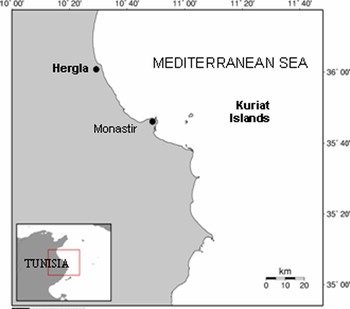
In the Mediterranean Sea, loggerhead turtle nesting is almost confined to the eastern basin along the Greek, Turkish, Cyprus and Libyan coasts. A lower but regular nesting is also reported from several other countries in this region such as Egypt, Israel, Lebanon, Italy and Tunisia (Margaritoulis et al., Reference Margaritoulis, Argano, Baran, Bentivegna, Bradai, Caminas, Casale, De Metrio, Demetropoulos, Gerosa, Godley, Houghton, Laurent, Lazar, Bolten and Witherington2003). The loggerhead is the only sea turtle species nesting along the Tunisian coasts and a mean of 19 nests are recorded annually (Jribi et al., Reference Jribi, Bradai and Bouain2006; Bradai & Jribi, Reference Bradai and Jribi2007) in the main nesting site of the Kuriat Islands. This site, consisting of two small islands located on the eastern side of the country (Figure 1), is the unique one characterized by a regular nesting activity. In the past, it has been reported that nesting was more intense and widespread along Tunisian coasts mainly on the beaches of Nabeul, Hergla, Chebba, Kerkennah and Zarzis. However, nesting has collapsed because of habitat degradation and intense fishing activities (Bradai et al., Reference Bradai, Karaa, Jribi, Elouaer, Chaieb, Elhili, Ben Naceur and Maatoug2008).
Location of the analysed site: Kuriat Islands.

The Kuriat Islands have been the focus of many conservation activities. Since 1997, the nesting activity on the islands is monitored in the framework collaboration between the National Institute of Marine Sciences and Technologies (INSTM), the Regional Activity Centre for Specially Protected Areas (RAC/SPA) and the Coastal Protection and Planning Agency (APAL). Major information about reproductive biology and ecology of the local nesting population has been gleaned from field surveys (Jribi et al., Reference Jribi, Bradai and Bouain2002). However, no information on genetic make-up of this small rookery is available.
In this study, two genetic markers were used to characterize the loggerhead turtles nesting on the Kuriat Islands. Allozymes were used in order to evaluate the incidence of multiple paternity in this population. We also analysed the rapidly evolving mtDNA control region, a marker of choice for marine turtle nesting population surveys (Fitzsimmons et al., Reference Fitzsimmons, Moritz, Bowen, Eckert, Bjorndal, Abreu-Grobois and Donnelly1999), in order to assess genetic diversity.
MATERIALS AND METHODS
Protein analysis
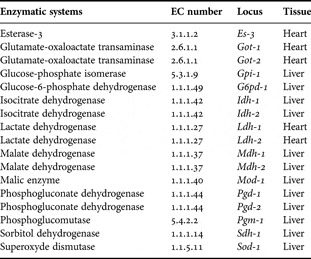
Four nests were sampled during two consecutive nesting seasons (N = 14 and 25 (2002) and N = 12 and 12 (2003)). After emergence, freshly dead hatchlings were sampled. Samples of liver, heart, kidney, lung and gonad were removed from each specimen and homogenized in an equal volume of an aqueous homogenizing buffer pH 6.8. After centrifugation of resultant homogenates at 14,000 rpm for 35 minutes at 4°C, the supernatants were stored at −80°C. Seventeen loci coding for twelve enzymatic systems were examined for polymorphism using horizontal starch gel (13%). Electrophoresis procedures follow Pasteur et al. (Reference Pasteur, Pasteur, Bonhomme, Catalan and Britton-Davidian1987). For all loci scored we used one buffer system Tris Citrate pH 6.7. Multiple loci encoding a single protein were designated with a hyphenated number indicating the relative migration of their products, the slowest (less anodal) being designated as 1. Alleles were identified by their electromorph mobility relative to that of the most common electromorph mobility assigned as 100. For each protein resolved, tissue type and enzyme commission number (EC) are listed in Table 1.
Enzymes and electrophoretic conditions used. Names, enzyme commission numbers (EC), and abbreviations follow Murphy & Crabtree (Reference Murphy and Crabtree1985).

Overall genetic variability was estimated, including allele frequencies, percentage of polymorphism at the 95% criterion (P0.95) (a locus was polymorphic if the frequency of the most common allele was lower than 95%), the observed and expected heterozygosities (Ho, H exp) and mean number of alleles per locus (A) using the Genetix 4.03 software (Belkhir et al., Reference Belkhir, Borsa, Chikhi, Raufaste and Bonhomme2001).
Mitochondrial DNA analysis
Considering the small Tunisian nesting population size in comparison with the other Mediterranean rookeries, 54 hatchlings were analysed over seven years of sampling campaigns (from 2002 to 2008), of which one individual comes from the adjoining nesting site of Hergla (Figure 1). However, in order to avoid pseudoreplication, only 16 individuals belonging to different nesting females were considered for subsequent analysis (see Results below). These 16 individuals were sampled from clutches laid within a 15-day window, corresponding to the inter-nesting interval (Dodd, Reference Dodd1988), and over two years (2006 and 2007) as loggerhead females return to nest each two or three years (Dodd, Reference Dodd1988).
Muscle or skin samples were collected from freshly dead embryos and stored at −20°C. Whole genomic DNA was isolated by standard phenol chloroform extraction (Hillis et al., Reference Hillis, Mable, Larson, Davis, Zimmer, Hillis, Moritz and Mable1996). A fragment of 510 base pairs (bp) of the mitochondrial DNA control region was amplified by polymerase chain reaction (PCR) using the primers L71 and H599 (Laurent et al., Reference Laurent, Casale, Bradai, Godley, Gerosa, Broderick, Schroth, Schierwater, Levy, Freggi, Abd El-Mawla, Hadoud, Gomati, Domingo, Hadjichristophorou, Kornaraky, Demirayak and Gautier1998). The PCR protocol was 94°C for 5 minutes, followed by 35 cycles at 94°C for 1 minute, 56°C for 1 minute and 72°C for 1 minute with a final extension at 72°C for 10 minutes. The PCR amplifications included negative control reactions to guard against contamination. The PCR products were visualized in a 1% agarose gel and purified using Qiagen Qiaquick Spin PCR purification kit according to the manufacturer's instructions. Purified products were sequenced on a Beckman CEQ 2000XL automatic sequencer using the Dye-Terminator cycle sequencing kit.
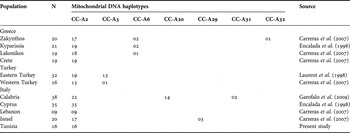
Sequences were aligned using the BioEdit program v. 5.0.9 (Hall, Reference Hall1999) and compared with previously 380 bp described loggerhead haplotypes published in the Archie Carr Centre of Sea Turtle Research DNA database (http://accstr.ufl.edu/). Genetic differentiation between our population and published Mediterranean nesting populations of Greece, Turkey, Italy Cyprus, Lebanon and Israel (Table 2) (Carreras et al., Reference Carreras, Pascual, Cardona, Aguilar, Margaritoulis, Rees, Turkozan, Levy, Gasith, Aureggi and Khalil2007; Garofalo et al., Reference Garofalo, Mingozzi, Micò and Novelletto2009) was verified with the exact test of population differentiation (Raymond & Rousset, Reference Raymond and Rousset1995) as implemented in the software Arlequin v. 2.0.0 (Schneider et al., Reference Schneider, Roesslli and Excoffier2000).
Mitochondrial DNA haplotype distribution of loggerhead turtles occurring in different Mediterranean nesting sites, number of analysed individuals (N) and source.

RESULTS
Protein analysis
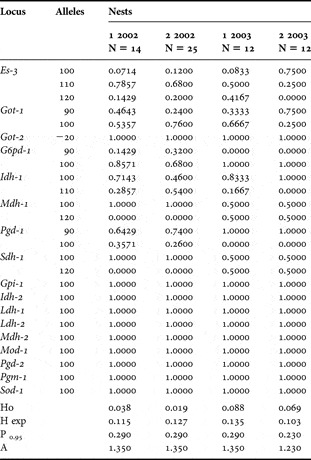
Seven of the 17 scored loci were polymorphic (Got-1, Es-3, G6pd-1, Idh-1, Mdh-1, Pgd-1 and Sdh-1) with three alleles in the Es-3 locus and two in each of the other six loci. Allelic frequencies, recorded for all the loci are provided in Table 3. A low genetic difference was observed between the clutches with a presence of more or fewer alleles among polymorphic loci. Both clutches of 2002 and the first clutch of 2003 showed five polymorphic loci, whereas the second clutch of 2003 showed only four polymorphic loci.
Allele frequencies in the 17 loci and genetic parameters calculated for the four clutches.

A, mean number of alleles per locus; H exp, expected heterozygosity; Ho, observed heterozygosity; P0.95, level of polymorphism at 95%.
Estimates of the genetic variability were provided by the following parameters: A, P and H reported in Table 3. The mean number of alleles per locus (A) and the percentage of polymorphic loci (P0.95) were quite similar for all the four clutches surveyed and were respectively on average of 1.32 and 0.27. The observed heterozygosity values were low and varied from 0.019 in the second clutch of 2002 to 0.088 in the first clutch of 2003. The comparison between observed and expected heterozygosity among the four clutches showed heterozygote deficiency. A relatively high genetic heterozygosity (0.019 < Ho < 0.088) was observed in comparison with previous studies on Caretta caretta in Queensland, Australia (Ho = 0.016; Gyuris & Limpus, Reference Gyuris and Limpus1988) and on green turtles Chelonia mydas (0.00 < Ho < 0.04; Bonhomme et al., Reference Bonhomme, Salvidio, Lebeau and Pasteur1987).
Moreover, the examination of the hatchling genotypes revealed that in half of the clutches, the Es-3 locus exhibited three alleles, and the genotypic composition of these two clutches did not correspond to Mendelian inheritance expected from the null hypothesis of single paternity. Indeed, in the first clutch of the season 2002, two homozygote genotypes have been observed: Es-3100/100 and Es-3110/110 and one heterozygote genotype Es-3110/120. In the first clutch of 2003, two different homozygote genotypes were present: Es-3110/110 and Es-3120/120 as well as two different heterozygote genotypes Es-3100/110 and Es-3110/120. Overall, these data support the idea that at least two males intervened in the fertilization of each female in both cases.
Mitochondrial DNA analysis
The DNA investigation showed only one haplotype CC-A2 among 53 individuals, including the sample from the site of Hergla. This haplotype is shared by both Mediterranean and Atlantic nesting populations although it occurs at much higher frequencies in the Mediterranean region (Encalada et al., Reference Encalada, Bjorndal, Bolten, Zurita, Schroeder, Possardt, Sears and Bowen1998; Laurent et al., Reference Laurent, Casale, Bradai, Godley, Gerosa, Broderick, Schroth, Schierwater, Levy, Freggi, Abd El-Mawla, Hadoud, Gomati, Domingo, Hadjichristophorou, Kornaraky, Demirayak and Gautier1998; Carreras et al., Reference Carreras, Pascual, Cardona, Aguilar, Margaritoulis, Rees, Turkozan, Levy, Gasith, Aureggi and Khalil2007). One individual showed a heteroplasmy at Site 157 of 380 bp. Heteroplasmy in sea turtles' control region has been reported previously (in loggerhead turtles by Laurent et al., Reference Laurent, Casale, Bradai, Godley, Gerosa, Broderick, Schroth, Schierwater, Levy, Freggi, Abd El-Mawla, Hadoud, Gomati, Domingo, Hadjichristophorou, Kornaraky, Demirayak and Gautier1998 and in green turtles by Formia, Reference Formia2002) and the sequence was excluded from the analysis. Only 16 individuals, representing the mean number of different females nesting on the Kuriat Islands, were considered for analyses. A comparison of haplotype frequencies indicated that the present population is not genetically different from the Mediterranean rookeries of Greece, Lebanon, Israel and Cyprus but significantly different from those of eastern Turkey and of Calabria, Italy (P < 0.005).
DISCUSSION
As reported in previous studies carried out on different sea turtle species (Bonhomme et al., Reference Bonhomme, Salvidio, Lebeau and Pasteur1987; Gyuris & Limpus, Reference Gyuris and Limpus1988), a low genetic diversity has been detected by protein electrophoresis. This technique allowed detecting the presence of multiple paternity in half of the clutches analysed, which indicated that multiple paternity is also common in this small population. The lower frequency of multiple paternity reported here compared with that found by Zbinden et al. (Reference Zbinden, Largiadèr, Leippert, Margaritoulis and Arlettaz2007) in Greece and estimated at 93% using microsatellite markers, can be explained by the low variability of the genetic marker we used compared to microsatellites and by the small number of offspring analysed. However, it cannot be excluded that there is a different incidence of multiple paternity between loggerhead populations in the Mediterranean region. Previous analyses of different populations of the same sea turtle species have shown variable levels of multiple paternity (Chelonia mydas: Fitzsimmons, Reference Fitzsimmons1998; Lee & Hays, Reference Lee and Hays2004; Lepidochelys species: Hoekert et al., Reference Hoekert, Neuféglise, Schouten and Menken2002; Jensen et al., Reference Jensen, Abreu-Grobois, Frydenberg and Loeschcke2006). It has been documented that the rate of multiple paternity is likely to be affected by behaviour in the breeding area, mating opportunities along migration paths, sex-ratio of turtles at breeding sites (Zbinden et al., Reference Zbinden, Largiadèr, Leippert, Margaritoulis and Arlettaz2007) and breeding population size (Jensen et al., Reference Jensen, Abreu-Grobois, Frydenberg and Loeschcke2006). Further analyses are required to understand the effective incidence of multiple paternity in the Mediterranean Sea. Such reproductive behaviour could be of great importance in improving the genetic diversity of our population. In fact, it has been admitted that multiple paternity has several benefits on genetic diversity of offspring by avoiding inbreeding and a possible genetic incompatibility and permitting the fertilization of the ovocytes by the most competitive sperm (Stockley et al., Reference Stockley, Searle, Macdonald and Jones1993; Vala et al., Reference Vala, Breeuwer and Sabelis2000).
The mitochondrial DNA analysis revealed the presence of only one haplotype CC-A2 which is the haplotype most commonly found in the Mediterranean Sea. It was therefore, not possible to genetically differentiate the present population from the other Mediterranean nesting populations except from the eastern Turkey and Calabria rookeries which are characterized by the high frequency of the haplotypes CC-A3 and CC-A20 respectively (Laurent et al., Reference Laurent, Casale, Bradai, Godley, Gerosa, Broderick, Schroth, Schierwater, Levy, Freggi, Abd El-Mawla, Hadoud, Gomati, Domingo, Hadjichristophorou, Kornaraky, Demirayak and Gautier1998; Garofalo et al., Reference Garofalo, Mingozzi, Micò and Novelletto2009).
The low genetic diversity detected by both mitochondrial and nuclear markers and the very small nesting effort recorded on the Kuriat Islands could be the consequences of a relative recent bottleneck event caused by intense harvest and habitat destruction that have occurred during recent years (Bradai, Reference Bradai1996; Jribi et al., Reference Jribi, Bradai and Bouain2002). In the past, significant nesting activity likely existed along southern Tunisian beaches but then disappeared due to the intense fishing activity (Bradai, Reference Bradai1995). The Kuriat nesting site may have survived because the islands are desert and are located 18 km from the mainland (Figure 1). However, in recent years, human activities consisting mainly of tourists' tours to the islands during the summer and intense fishing activity (Jribi et al., Reference Jribi, Bradai and Bouain2002) raised our concern about the survival of the loggerhead population at this site.
The low genetic diversity observed in this study suggests that strong conservation efforts should be taken. This area, which constitutes one of the very few regular nesting sites for this species in the central Mediterranean, should be designated as a special protected area of high importance for the marine biodiversity (Bradai, Reference Bradai1996). Recently, some encouraging results have been obtained owing to monitoring campaigns. In fact the number of nests recorded has increased since 1997 from 11 to 29 in 2007 (Jribi et al., Reference Jribi, Bradai and Bouain2006; Bradai & Jribi, Reference Bradai and Jribi2007).
This study has permitted us to obtain the first data on genetic diversity of the Tunisian loggerhead turtle nesting population. Analysing other Tunisian nesting sites, even those with irregular nesting activities, would be interesting to assess a possible local genetic structuring which could potentially result in modification of management strategies. In this sense, recent genetic surveys of nesting populations have uncovered genetic differences and restricted gene flow between neighbouring Mediterranean rookeries suggesting the existence of several management units (Encalada et al., Reference Encalada, Bjorndal, Bolten, Zurita, Schroeder, Possardt, Sears and Bowen1998; Carreras et al., Reference Carreras, Pascual, Cardona, Aguilar, Margaritoulis, Rees, Turkozan, Levy, Gasith, Aureggi and Khalil2007; Garofalo et al., Reference Garofalo, Mingozzi, Micò and Novelletto2009). Moreover, as mtDNA ignores male-mediated gene flow, analysing highly polymorphic and biparentally inherited nuclear markers (e.g. microsatellites), combined with the available data on other Mediterranean nesting sites could provide additional insights into the phylogeography of this species in the Mediterranean region.
ACKNOWLEDGEMENTS
This study would have not been possible without the collaboration of the staff of the following institutions: INSTM (Institut National des Sciences et Technologies de la Mer), the RAC/SPA (Regional Activity Centre for Specially Protected Areas) and APAL (Agence de Protection et Aménagement du Littoral). We would like to thank I. Jribi, S. Karaa and S. Ben Hassine for their help and collaboration to provide samples from the Kuriat Islands. We are also grateful to the team of the Molecular Evolution Laboratory from the Stazione Zoologica of Naples, and especially to Professor G. Bernardi, for their assistance on molecular analysis. The authors wish to acknowledge use of the Maptool program (www.seaturtle.org) for the drawing of Figure 1.