1 Introduction
Vocabulary plays a critical role in reading comprehension. “A reader who can pronounce a word but does not know its meaning or crucial facts about it is at a disadvantage in comprehending the text in which it occurs” (Stanovich, West and Cunningham Reference Stanovich, West, Cunningham, Brady and Shankweiler1991). As the National Reading Panel (NRP 2000) concluded: “Vocabulary is one of the most important areas within comprehension and should not be neglected.”
This article focuses on one particular aspect of vocabulary learning – learning word meaning from example contexts. Word meaning includes both denotation (objective meaning) and connotation (implied meaning and associations; Chandler Reference Chandler2004). For full mastery of a word, children need to learn both the core meaning and the appropriate use of a word. Since readers must acquire both aspects, effective vocabulary instruction combines explicit explanation with multiple examples of vocabulary in varied contexts (Bolger et al. Reference Bolger, Balass, Landen and Perfetti2008).
Contexts give clues to semantics but also convey many other lexical properties, such as part of speech (POS), morphology, and pragmatics, which help enrich a child's word knowledge base. From the fields of psychology and the learning sciences, it is well established that children can learn word meaning incidentally from contexts (Jenkins, Stein and Wysocki Reference Jenkins, Stein and Wysocki1984; Nagy, Herman and Anderson Reference Nagy, Herman and Anderson1985; Schatz and Baldwin Reference Schatz and Baldwin1986; Herman et al. Reference Herman, Anderson, Pearson and Nagy1987; Nagy, Anderson and Herman Reference Nagy, Anderson and Herman1987; Schwanenflugel, Stahl and McFalls Reference Schwanenflugel, Stahl and McFalls1997; Kuhn and Stahl Reference Kuhn and Stahl1998; Fukkink, Blok and Glopper Reference Fukkink, Blok and Glopper2001). However, studies also show that incidental vocabulary learning from context is limited and inefficient, and not all contexts are equally appropriate and effective (Beck, McKeown and McCaslin Reference Beck, McKeown and McCaslin1983). A particular context might not carry enough information to determine the meaning of the word, containing some information but omitting key facets. In fact, most natural contexts are insufficient to infer word meaning (Beck, McKeown and Kucan Reference Beck, McKeown and Kucan2002), especially for younger readers.
Accordingly, one key issue in vocabulary instruction is identifying how to find or create good example contexts to help learn new words, besides the text where children initially encounter them. Example contexts are usually created by teachers, parents, authors, lexicographers, or, occasionally, educational researchers (McKeown Reference McKeown1985; Bolger et al. Reference Bolger, Balass, Landen and Perfetti2008). A human expert may generate excellent examples, but this process takes time, costs money, and may not be available when needed. Also, human-generated contexts are shaped by the cognitive retrieval and production processes of a person who already knows the word, and might be influenced by when and where the person generates the examples. In contrast, computer-generated contexts can provide systematic and comprehensive coverage.
A standard method to identify good contexts is to retrieve them from an existing corpus. In contrast, we adopt a generation-based approach. Once we have described it, we can explain in detail (in Section 7, “Relation to Prior Work”) our motivation for adopting it instead of traditional retrieval methods. However, three features of a generation-based approach are worth mentioning here at the beginning of the article. The first is that some of the advantages of a retrieval-based approach, such as providing the word with its common collocates, also apply to a generation-based approach. The second is that some of the limitations of a generation-based approach, such as the need for hand vetting, also apply to retrieval approaches applied to large corpora: A very large corpus based on general English usage is likely to contain sentences that for one reason or another are not well suited for use in teaching vocabulary to children. (A corpus developed specifically for children would have already had its hand-vetting applied in advance, at corpus construction time, so the work is moved around in time but not avoided entirely.) The third feature is that in various ways a generation-based approach might improve on a selection-based approach: for example, generated examples might provide examples that are better for a specific purpose than those that are available in the corpus; a generation-based approach might also be more efficient because it can test example contexts for suitability as it generates them rather than retrieving all examples and then filtering them for suitability.
This article describes a system called VEGEMATICFootnote 1 (for “Vocabulary Examples GEnerated autoMATICally”), which generates example contexts to help children learn vocabulary. We focus on “Tier 2” words (Beck et al. Reference Beck, McKeown and Kucan2002) – high-frequency words used by mature language users across several content areas. These words are unknown to most young children, but important to know. While the method is not intrinsically restricted to Tier 2 words, the article focuses on such words since they are important to teach.
The article also focuses on teaching the core meaning of a word rather than teaching fine-grained distinctions, in line with the reading research literature. For example, declare can be used in the sense state for the record as in declare your age, or issue a decree as in declare an emergency, or make a geopolitical claim as in declare victory. The core sense that encompasses all of these is formally state, which not only covers these three fine-grained senses but also such uses as declare my candidacy, declared persona non grata, declare under penalty of perjury, and so forth.
The rest of this article is organized as follows. Section 2 describes how VEGEMATIC generates candidate contexts. Section 3 describes constraints on good contexts, and heuristics to operationalize these constraints. Section 4 reports the pilot evaluation of an early version of VEGEMATIC. Section 5 describes extensions that the pilot evaluation motivated. Section 6 evaluates the resulting version on an unseen test set. Section 7 relates VEGEMATIC to previous work and discusses why VEGEMATIC takes a generation approach rather than a traditional selection approach, and Section 8 concludes. The Appendix lists examples of VEGEMATIC's output.
2 Context generation
We now describe how VEGEMATIC concatenates overlapping n-grams to generate contexts.
2.1 Data set
We use Google N-grams (Brants and Franz Reference Brants and Franz2006) to generate candidate contexts. Google N-grams consists of over one billion n-grams and their counts in over one trillion words of text extracted from public web pages, tokenized into lexemes, and segmented into sentences. Google N-grams lists only n-grams with counts of forty or more. It has been used for many tasks, including spelling correction (Carlson and Fette Reference Carlson and Fette2007), machine translation (Hermjakob, Knight and Iii Reference Hermjakob, Knight and Iii2008), and other applications (Yu et al. Reference Yu, Wu, Philpot and Hovy2007; Durme, Qian and Schubert Reference Durme, Qian and Schubert2008).
Google N-grams contain n-grams for n from one to five. We use five-grams to generate contexts, as five-grams are the longest n-grams in Google N-grams and hence provide more information about target words. There are 1,176,470,663 five-grams, such as the following:

Here the number listed after each five-gram is its count.
2.2 Generation methods
VEGEMATIC performs heuristic search in a space of candidate word sequences, starting with a set of five-grams that contain the target word, e.g., been extinct Footnote 2for millions of. It repeatedly selects a candidate and extends it one word to the left or right by choosing a five-gram (underlined below) that matches the first or last four words, e.g.:

As Section 3 describes, VEGEMATIC incorporates filters to prune candidates that violate constraints. Using only five-grams containing the target word, it generates contexts of at most nine words long with the target word in the middle and four words on each side of the target word.
This generation method is similar to that used in the context-based machine translation system by Carbonell et al. (Reference Carbonell, Klein, Miller, Steinbaum, Grassiany and Frey2006). It finds target n-gram translation candidates that overlap maximally with translation candidates for the previous and following n-grams. We exploit the same underlying intuition, namely that generated contexts are locally coherent because the n-grams are long, come from human-written text, and overlap substantially.
In particular, we assume that if one five-gram overlaps with another by four words, then they come from the same set of sentences in the original corpus. When this heuristic assumption holds true, the method reconstructs part or all of one of these sentences. However, when this assumption does not hold true, the method can generate a novel word sequence. We call this phenomenon “crossover” because it combines five-grams from different sentences. The resulting sequence is still locally coherent because each successive five words constitute an authentic five-gram. The longer the generated context, the higher is the risk of crossover.
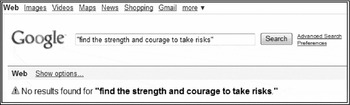
On the positive side, this ability to generate novel contexts can potentially improve on the original contexts, e.g., by streamlining them to eliminate undesirable complexity. For example, the generated context, find the strength and courage to take risks, is novel, as is shown in Figure 1. On the negative side, crossover can produce global inconsistencies. For example, Dollars can make a tremendous amount of work done is incoherent, although the five-grams are locally consistent.
Screenshot of search results for “find the strength and courageto take risks” (July 22, 2009).

3 Context constraints
Not all contexts constructed by concatenating overlapping Google N-grams are good examples. We identified several constraints that characterize good contexts, based partly on expert knowledge and partly on observed deficiencies of some generated contexts.
This section describes each constraint and how we operationalize it as one or more heuristic filters. A filter either eliminates candidate contexts that violate a constraint, or prefers contexts that satisfy the constraint to a greater degree or with higher probability.
3.1 Comprehensible to children
We want contexts that help children learn vocabulary. For a context to help, the child must understand it. If a context contains too many unfamiliar words besides the target word, the child will not understand it well enough to help in learning the target word. For example, the context, It is time to declare victory and go home, is reasonably understandable, assuming the child knows the word victory. In contrast, any context containing . . .penalties of perjury solemnly declare. . . is useless for teaching declare to a child who does not know the words penalties, perjury, or solemnly.
One comprehensibility filter eliminates candidates containing more than two hard words. We operationalize “hard” as words that Biemiller (Reference Biemiller2009) classifies above grade 2 (typically ages 6–7). For words that Biemiller's list omits, we consult a similar list (Paynter, Bodrova and Doty Reference Paynter, Bodrova and Doty2005).
Syntactic complexity is another impediment to understanding a context. Therefore, a second filter eliminates candidates that contain relative pronouns, such as who or that.
3.2 Grammatically correct and complete
Good contexts should be complete grammatical sentences. Some generated candidates are not grammatical, such as Southpaw Stout Dem Blog The Scarlet. (Google N-grams come from text that includes many lists.) Some candidates are incomplete fragments of grammatical sentences, e.g., Jennifer is very anxious to know about the.
To filter out ungrammatical contexts, we use the Link Grammar Parser (Sleator and Temperley Reference Sleator and Temperley1993), a syntactic dependency parser, as a grammar checker. VEGEMATIC eliminates candidates that the parser cannot parse as syntactically valid English. While use of an existing parser is not a perfect solution to the challenge of ungrammatical contexts, it does eliminate many of the worst, such as Jennifer is very anxious to know about the, which is clearly incomplete and thus not a grammatical sentence.
To filter out incomplete contexts, a second filter requires candidates to start and end with Google N-grams' sentence start and end symbols <S> and </S>.Footnote 3 Another filter eliminates candidates that end with modal or auxiliary verbs.
3.3 Word-sense appropriate
Sometimes a target word has multiple senses, only one of which is the target meaning to be taught. A good context is consistent with the target meaning. Contexts that use some other sense of the target word are unhelpful and even confusing. To eliminate them, VEGEMATIC requires contexts to use the target word with a part of speech (POS) compatible with the target meaning.
A filter uses the Stanford POS tagger (Toutanova and Manning Reference Toutanova and Manning2000; Toutanova et al. Reference Toutanova, Klein, Manning and Singer2003) to determine the target word's POS in a candidate context. If it does not match the POS of the target meaning, the filter eliminates the candidate. For example, if the target meaning of force is a “group of people,” a noun, this filter eliminates the context do not try to force her to marry a man, where force is a verb.
A stronger filter would also exclude contexts with the right POS but a wrong sense of the target word force, such as “strength.” Deciding whether the word sense used in a short context matches the target meaning is a tough challenge for the already difficult problem of word sense disambiguation. Instead, Mostow and Duan (Reference Mostow and Duan2011) used the target meaning to constrain VEGEMATIC's generation process in the first place. However, that work is outside the scope of this article.
3.4 Informative about word meaning
A highly informative context imposes strong semantic constraints on the target word. Such constraints play a substantial role in learning word meanings (Bolger et al. Reference Bolger, Balass, Landen and Perfetti2008).
VEGEMATIC operationalizes semantic constraints as multiple filters. One filter prefers longer contexts as likely to provide more information. A second filter prefers content words to function words (specified by a list) because content words tend to provide more information about meaning of a target word. This filter eliminates contexts that contain fewer than three content words, including the target word. A third filter prefers words related to the target word, and requires initial five-grams to contain one or more of one hundred most closely related content words. We measure relatedness of two words based on their occurring more frequently than by chance:
 \begin{equation*}
{\rm Relatedness}(w_1, w_2) = P(w_1, w_2) - P(w_1)P(w_2).
\end{equation*}
Overall, these filters prefer contexts with more words overall, more content words, and more related words. For example, consider these two contexts:
Find the strength and courage to take risks
We know it takes courage to do so
Both contexts are eight words long, but the filters prefer the first context because it contains more content words, including strength and take, which co-occur with courage more often than by chance.
3.5 Ordinary prose
Good contexts use normal, classroom-appropriate English. However, we noticed that some of the generated contexts were very web-specific, and likely unfamiliar to young children, e.g., a Merchant ID and password.
A lexical filter to avoid web jargon prohibits words much more common on the web than in print, such as copyright, password, and download. We construct a list of web-specific words by comparing word counts in Google N-grams against the ANC text corpus (http://americannationalcorpus.org/), a broad sample of ordinary English. Of the 1,000 most frequent words in Google N-grams, we classify as web-specific those whose unigram counts in Google N-grams are 20,000 higher than in ANC. (Here 1,000 and 20,000 are heuristic values based on trial and error.) Similar filters prohibit fifty-three taboo words and phrases, and special symbols such as @.
The web contains many word lists, which lack syntactic structure. Accordingly, a filter eliminates candidates containing more than four consecutive numerals or capitalized words, e.g., Break Southpaw Stout Dem Blog. Other filters eliminate contexts containing capitalized words other than the first word, the target word, or named entities identified by the Stanford named-entity recognizer (Finkel, Grenager and Manning Reference Finkel, Grenager and Manning2005).
3.6 Typical of usage and situation
Typicality is an important property of contexts. Helpful contexts should show how words are commonly used, and in what situations. For example, celebrate is often used in situations like birthdays and anniversaries. A context with the words My parents are throwing a party to celebrate my birthday is more typical than He is celebrating a pencil.
We use five-gram counts to operationalize typicality. One filter prefers high-count five-grams in constructing contexts. Another filter prefers candidates with high typicality scores. We score the typicality of a context by averaging the counts of its five-grams.
3.7 Varied and not redundant
Children need to see a word in several varied contexts in order to build up a representation of the word's meaning and acquire enough retrieval cues to access it reliably and efficiently (Bolger et al. Reference Bolger, Balass, Landen and Perfetti2008). Google N-grams are numerous enough for VEGEMATIC to generate diverse contexts for a target word, for example:
Members are asked to declare that you are 18
He was forced to declare a state of emergency
It is time to declare victory and go home
However, some generated contexts are very similar, e.g.:
Just declare victory and go home
We should declare victory and go home
It 's Footnote 4time to declare victory and go home
In order to eliminate redundancy, we developed the following algorithm:
1. Partition candidate contexts into clusters that share the same three content words.
2. Locally, score contexts in the same cluster. To avoid overly similar contexts, pick the highest scored context of each cluster as its representative.
3. Globally, score and rank the representatives. Output the top k, where k is the number of contexts needed for vocabulary teaching. If there are fewer than k, output them all.
The scoring function used in steps 2 and 3 combines four context features: typicality, length, number of content words, and number of target-related words. To normalize each feature, we divide it by its average value over the set being scored. In step 2, this set is a single cluster; in step 3, it consists of the representatives. We score each context as the mean of its normalized features. A score of 1 indicates average quality. Since feature values are normalized relative to a particular set, a context score depends on the set relative to which it is scored; thus, a context chosen as a representative may have different scores in steps 2 and 3.
3.8 Summary and order of filters applied
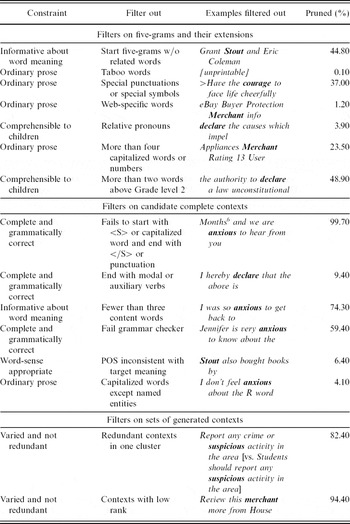
Table 1 lists in order of application the filters that operationalize the constraints discussed above, with an example and the percentage of remaining candidates pruned by each filter. For efficiency, VEGEMATIC applies filters as early as possible in its heuristic search (Mostow Reference Mostow, Michalski, Carbonell and Mitchell1983). The earliest filters apply to initial five-grams, their extensions, and the five-grams used to extend them. Later filters apply to candidate complete contexts. The final filters apply to sets of similar complete contexts in order to choose among them.
Context constraints in order applied in VEGEMATIC

4 Pilot study
How good are the generated contexts? We did a pilot evaluation of VEGEMATIC as we developed it. Section 4.1 explains how we evaluated contexts; Section 4.2 reports results.
4.1 Methodology
In order to evaluate the pilot version of VEGEMATIC, we compared the contexts it generated for ten target words against human-authored contexts. To choose the target words, we started with the 789 words that our vocabulary expert had classified as the “Tier 2” words (Beck et al. Reference Beck, McKeown and Kucan2002) in the stories used in Project LISTEN's Reading Tutor (Mostow and Aist Reference Mostow and Aist1999). Tier 2 words are used in many situations but unknown to most children, and thus important to teach. Of fifteen such words that occurred in two stories, once in each story, we excluded five words with multiple parts of speech, and chose the other ten: anxious, courage, declare, extinct, merchant, remarkable, slender, stout Footnote 5, suspicious, and tremendous.
To lighten the expert's burden, we used only the six highest scored contexts output by VEGEMATIC for each target word (or all of them if fewer than six). We compared against two sources of human-authored contexts. As a gold standard, we used all example sentences from the WordSmyth children's dictionary (www.wordsmyth.net), which are specifically crafted to illustrate the meaning of each word sense listed. As a sample of naturalistic contexts in which a child would encounter the word during normal reading, we used the Reading Tutor story sentences containing the word. The pilot evaluation set totaled ninety-eight contexts: fifty-seven generated contexts, twenty-one dictionary sentences (one to three per word, depending on the number of senses listed), and twenty story sentences.
Our vocabulary expert, blind to source, rated all ninety-eight contexts on the five-point Likert scale (1 = poor, 3 = OK, and 5 = good), both on general quality, and on three specific aspects that she proposed to capture finer-grained properties of the generated contexts. The three aspects were as follows: (1) good use of words, i.e., correct or meaningful use in the intended target sense; (2) the degree to which the context is constraining, or reveals elements of the word meaning; and (3) expected comprehensibility to children based on other words or concepts in the context and on its syntactic complexity.
4.2 Results and discussions
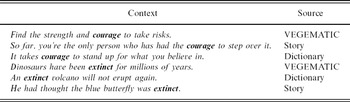
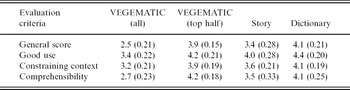
As Table 2 illustrates, all three sources of contexts included some that the expert rated as 5. But how did they compare more broadly? Table 3 shows mean ratings and standard errors for each source of contexts. ANOVA revealed a main effect of source for the general score (F = 10.9, p < 0.001), good use of words (F = 4.4, p < 0.05), constraining context (F = 3.7, p < 0.05), and comprehensibility (F = 7.1, p < 0.01). Pairwise comparisons showed that dictionary contexts surpassed the VEGEMATIC examples in general score (p < 0.001), in good use of words (p < 0.05), in constraining context (p < 0.05), and in comprehensibility to children (p < 0.05). There was also a trend for the story sentences to be better than the VEGEMATIC contexts in general score (p = 0.051). No other differences were statistically significant.
Examples of contexts rated 5 by expert for target words courage and extinct

Expert ratings of contexts from pilot version of VEGEMATIC and other sources

When two methods differ significantly in average performance, one method might be uniformly worse than the other – or it might usually be worse, with exceptions where it performs reasonably well. If in the latter case the automatically generated contexts contain enough good examples, then a human rater or some automated process could potentially select such examples in a subsequent stage. To determine whether this was the case, we examined the top half of the generated contexts (as rated by our expert). They compared favorably to story sentences, which suggested that refining VEGEMATIC to filter out the lowest half could make its output as good as story sentences. However, such predictions are overly optimistic because we “tested on the training data,” in that we designed some of the filters specifically to eliminate bad sorts of contexts generated for the ten test words. The pilot evaluation served to guide development to improve VEGEMATIC by fixing observed deficiencies. In contrast, Section 6 will report evaluation on an unseen test set so as to predict future performance of the improved system. But first we describe the improvements it incorporates.
5 Improvements to VEGEMATIC
The pilot test revealed problems with various aspects of automatically generated contexts.
• Typicality: Some low-rated contexts had spuriously high frequency, e.g., Please check the merchant store. Such contexts were composed of five-grams with high counts; VEGEMATIC chose them because it averaged five-gram counts to quantify typicality of usage. However, as the pilot study revealed, the high counts were not due to actual common usage in English but rather to replication of documents on the web. Five-grams in particular seem surprisingly vulnerable to such spuriously high counts, as will be discussed in Section 5.1.
• Completeness: Some low-rated contexts were incomplete or ungrammatical.
• Balance: The pilot version scored candidates by averaging their normalized scores on multiple criteria (typicality, context length, number of content words, and number of target-related words), as described in Section 3.7. This formula implicitly assumed that a higher score on one feature compensates for a lower score on another. However, reflecting on the examples produced by the pilot version made clear that context quality depends on satisfying all the criteria, not just some of them.
• Diversity: The clustering method still output many redundant contexts.
To generate typical, complete, well-rounded, and diverse contexts, we improved how VEGEMATIC generates candidates, scores them, and promotes diversity.
5.1 Generate more typical contexts
In order to make example contexts more typical, VEGEMATIC no longer starts by picking high frequency five-grams that contain the target word. Instead, it first chooses the most frequent trigrams containing the target word. Then, for each selected trigram, it chooses the most frequent five-gram that contains the selected trigram. Trigram frequency reflects typicality more reliably than five-gram frequency because trigrams aggregate information across more sentences. Not only are their counts better estimated, but they are less distorted by widely replicated documents that render some five-gram frequencies spuriously high.
5.2 Generate complete contexts
In order to generate complete contexts, VEGEMATIC now uses Google start five-grams (which start with <S>) and end five-grams (which end with </S>) in two ways – as filters to check whether a generated candidate is complete, and if not, as extensions to complete it. In the latter case, VEGEMATIC extends the candidate with a start and/or end five-gram that overlaps it by three words so as to make it complete but keep it coherent.
5.3 Score multiple criteria
In order to balance multiple criteria more appropriately, VEGEMATIC first ranks each context by each criterion, and then sorts the ranks worst-first. For example, suppose a context ranks 6th on typicality, 10th on length, 4th on number of content words, and 6th on number of related words. Sorting these ranks worst-first yields the rank vector [10 6 6 4]. VEGEMATIC orders contexts lexicographically by rank vector, e.g., it prefers [10 6 6 4] to [10 7 1 1]. VEGEMATIC uses this order locally to select the best representative of each cluster of similar contexts, and globally to select the best context overall. That is, it prefers better-ranked features but prioritizes the worst-ranked features. In other words, a context is only as good as its worst feature. For example, even the best possible typicality score will not rescue a context with no content words. (Using z-scores instead of ranks might produce a similar order, but our measures do not have normal distributions.)
5.4 Select diverse contexts
In order to maximize diversity, VEGEMATIC uses novelty detection globally to control the order in which it outputs representative contexts after the first one. In selecting which context to output next, it greedily picks the one least similar to any of the contexts already output. It measures the similarity of an old context to a proposed new context as the number of content words they share, divided by the total number of content words in the new context.
This process is related to the novelty detection task in TREC (http://trec.nist.gov): Find sentences both relevant and novel from an ordered sentence list, where a sentence is considered similar to or redundant with previously chosen sentences if its proportion of overlap with them exceeds some threshold. We use such a metric too, but to order contexts rather than to classify them as novel or redundant. Our method resembles the Maximal Marginal Relevance (Carbonell and Goldstein Reference Carbonell and Goldstein1998) in that it greedily selects the most novel context.
6 Evaluation on unseen test data
How good are the contexts generated after the improvements described in Section 5? Sections 6.1 and 6.2 describe their evaluation by expert and lay judges, respectively. Section 6.1 focuses on measuring quality of the generated contexts by comparing them with the existing context materials. Section 6.2 focuses on evaluating the productivity of VEGEMATIC by measuring context generation coverage and precision.
6.1 Expert rating of context quality
In order to evaluate the improved version of VEGEMATIC, we selected ten previously unseen target words at random from the 789 Tier 2 words in the Reading Tutor stories: advice, budge, concerned, gained, imagine, intense, obliged, pierced, released, and vanished. (Note that some target words are root words, while others are inflected.) We evaluated the first ten contexts that VEGEMATIC output for each target word.
For comparison we chose four sources of human-authored contexts. As in the pilot study, we used examples from the WordSmyth dictionary as a gold standard, and sentences from children's stories as a sample of naturalistic contexts. We added examples that people posted in WikiAnswer (http://wiki.answers.com/Q/FAQ/5070) in response to the Example Sentences Questions of the form “What is a sentence using word ‘target_word’?” Finally, we also queried each target word in Google and selected the first English sentence containing it in the top ten retrieved results. To better sample ordinary English, we excluded definitions from online dictionary websites such as the Merriam-Webster Online Dictionary. The resulting test set comprised 192 contexts: one hundred generated contexts, thirty-two dictionary sentences, thirty-six story sentences, fourteen sentences from WikiAnswer, and ten contexts from Google.
Our vocabulary expert, blind to source, started to rate all 192 contexts the same way as described in Section 4.1, but part-way through asked us to group all the contexts for each target word together for efficiency, commenting that the contexts were “so repetitive—small variations on similar themes or what looks to be different parts of the same context.” Therefore, we added the novelty detection heuristic described in Section 5.4, used the modified VEGEMATIC to output a new set of one hundred contexts, and pooled them with the human-authored contexts into an updated set of 192 contexts (randomized within word) to re-rate from scratch. The quality criteria applied only to individual contexts, and not the diversity of the contexts for each target word, so our “peek at unseen data” did not invalidate our results even though it led us to modify VEGEMATIC.
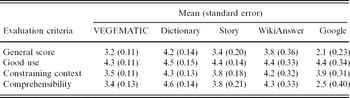
Table 4 shows the mean ratings and standard errors for each source of contexts. ANOVA showed significant effects of source on general score (F = 9.3, p < 0.001), constraining context (F = 4.3, p < 0.01), and comprehensibility (F = 9.8, p < 0.001), but not on good word use. Dictionary examples significantly beat the VEGEMATIC examples on general score, constraining context, and comprehensibility. VEGEMATIC examples, story sentences, and Wiki Answers did not differ significantly on general score, but (along with dictionary examples) significantly outscored Google contexts.
Expert ratings of contexts from various sources for ten target words

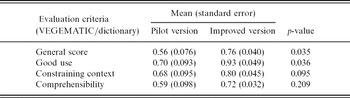
We wanted to see if the improvements helped. Ideally we would compare the pilot and improved version on the same test set. However, we did not consider it worth our busy expert's time to rate contexts that we expected would be inferior. Instead, we compared the improved version's output on unseen test data against the pilot version's already-rated output on the words used to guide its development. Such a comparison is biased in favor of the pilot version, but informative if the improved version turns out to do better anyway.
We needed to control for differences between the two sets of words and for possible changes in expert ratings over time. Therefore we normalized ratings of the VEGEMATIC output relative to the expert's contemporaneous ratings of dictionary examples for the same word. More precisely, we computed the quality ratio for a word as the mean rating of its VEGEMATIC output divided by the mean rating of its dictionary examples. Intuitively, a quality ratio of q asserts that the VEGEMATIC output is q times as good as dictionary examples, and q is generally less than 1. Higher ratios indicate higher quality.
Table 5 demonstrates that the improved version out-rated the pilot version in quality ratios for all four criteria. ANOVA shows significant differences for general score (p < 0.05) and good use of words (p < 0.05).
Quality ratio of VEGEMATIC to dictionary examples for pilot vs. improved versions

6.2 Lay judgment of coverage and precision
Our evaluation of quality was limited in two important respects. First, although it included one hundred VEGEMATIC contexts, they were for only ten target words. Second, although it employed careful ratings by a leading expert on vocabulary learning and instruction, this level of expertise is not typically available in situations where we envision VEGEMATIC being used to help create educational materials.
In order to address both limitations, we asked two college-educated native English speakers (“rater A” and “rater B”) to rate the VEGEMATIC output simply as acceptable or not acceptable. Besides the ten target words used in Section 6.1, we randomly selected forty more of the 789 Tier 2 words in the Reading Tutor stories, excluding the pilot words used in Section 4.1. As the Appendix shows, VEGEMATIC output at least one example for each of the fifty words. For each target word, the raters rated the first ten contexts output by VEGEMATIC, or all of them if there were fewer than ten, for a total of 449 contexts.
But first we had to define an acceptability criterion clear enough for our raters to apply with high inter-rater reliability. This goal turned out to be difficult enough that it seems worthwhile to discuss our successive attempts as a useful cautionary tale before reporting the evaluation results.
We initially asked raters to evaluate each context according to three questions intended both to enforce the constraints in Section 3, and to identify which ones VEGEMATIC violated the most so as to shed light on the aspects that future work should prioritize (grammaticality vs. semantic constraint vs. comprehensibility). A simple rating interface incrementally displayed each context and the three questions about it, recording the rater's response and response time to each question:
Please read the sentence silently and then press Enter:
We are willing and anxious to learn more!
Is this example a good English phrase or sentence? [y/n]
Does this example provide useful information about what “anxious” means? [y/n]
Is this example appropriate for a second grader? [y/n]
The program then cleared the screen and went on to the next example.
We used fifty-seven pilot contexts to evaluate inter-rater reliability. Cohen's Kappa for the two raters' responses to the first, second, and third questions was respectively only 0.270, 0.166, and 0.354, and 0.096 for the conjunction of all three responses. Kappa of 0.4–0.6 is considered moderate, 0.6–0.8 substantial, and 0.8–1 outstanding (Landis and Koth Reference Landis and Koth1977). Our low Kappa values revealed the raters' lack of consensus, presumably due to differing interpretations of the questions.
In order to elucidate these differences, we selected examples where the raters disagreed and asked them to explain their answers. For each of the three questions, we randomly selected ten examples where the raters disagreed, five rated “Yes” by rater A and “No” by rater B, and the other five vice versa. Analysis of their explanations showed differing interpretations of vague and ambiguous phrases, such as “good English.”
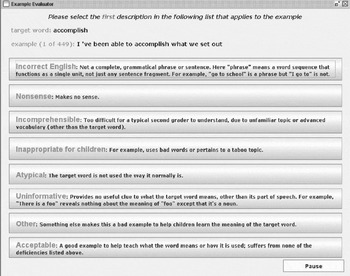
In order to clarify instructions, we rephrased them in terms of eight finer grained, more specific categories, e.g., “inappropriate for children,” added a brief clarification of each one, e.g., “uses bad words or pertains to a taboo topic,” and asked the raters to select the first applicable category for each example. We then calculated their inter-rater reliability both for overall acceptability and for the category selected, since they rejected some of the same contexts for different reasons. Both inter-rater reliabilities were still low, between 0.2 and 0.3, so we asked the raters to discuss the examples they disagreed on until they reached consensus.
As Figure 2 shows, we modified the rating interface accordingly. It displayed the target word and a context, and prompted the rater to click on the first applicable category. To encourage raters to check for each listed deficiency, the menu of categories listed “Acceptable” last.
Context-rating interface.

The same two raters used the revised rating interface to rate the 449 contexts generated by the improved version of VEGEMATIC, averaging 9.9 seconds per context. In deciding whether an example was acceptable overall, they achieved inter-rater reliability of Kappa = 0.422, which was considered moderate. However, their inter-rater reliability in selecting the specific category was still low (Kappa = 0.278), reflecting the difficulty of pinning down what is wrong with the context.
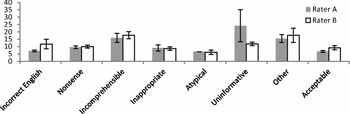
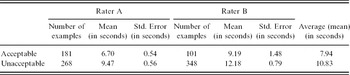
We hoped that response times might provide a more sensitive measure of acceptability. However, although correlation between the two raters' response times was significant (p < 0.01), it was too small (0.241) to use response time as a reliable measure. Nevertheless, response times were still informative. Table 6 shows the two raters' mean response times, disaggregated by acceptable and not acceptable. Both raters averaged about 3 seconds longer on contexts they rejected, presumably to diagnose their deficiencies. Figure 3 shows mean response times disaggregated by the selected category. The two raters had similar patterns of response times, identifying some deficiencies, e.g., “Incorrect English” and “Atypical,” faster than others, e.g., “Incomprehensible.” Assuming that raters considered successive categories in the order listed on the menu, and selected the first applicable category, one would naturally expect them to take longer to select categories further down on the list. However, category position in the menu did not correlate with response time, so it does not explain these differences.
Response times (in seconds, with standard error bars), disaggregated by category selected.

Raters' response times disaggregated by acceptable vs. not acceptable

Finally, armed with a moderately reliable acceptability criterion, we evaluated two metrics: coverage, the percentage of words with at least one context rated acceptable; and precision, the percentage of contexts rated acceptable. As Table 7 shows, coverage and precision across the two raters averaged 85% and 28%, respectively. If both raters must agree that a context is acceptable, coverage and precision drop to 76% and 19%, respectively.
Coverage and precision based on two lay raters

Has VEGEMATIC reached the point where it is faster to use than to write contexts by hand? Our content developers reported taking 30 seconds to 3 minutes to create the first context for a word by hand, and actually slightly longer for each additional context. In comparison, raters averaged about 10 seconds to classify a context as acceptable or not, and about 27 seconds to find the first context they accepted for a word. (We ignore the time to run VEGEMATIC because it could be done off-line.) Thus, hand-vetting VEGEMATIC's output and resorting to manual authoring only if none of the output is acceptable may already be faster than creating a context by hand. However, two caveats are important to mention. First, 27 seconds to find the first acceptable context in a list does not say how long it would take to find additional contexts, especially if they must be diverse. Second, even if judged acceptable by lay raters, VEGEMATIC's output may not be as good as contexts written by specialists.
7 Relation to prior work
Many sources of knowledge have been utilized in order to help children learn vocabulary, including machine-readable dictionaries and thesauruses such as WordNet (Fellbaum Reference Fellbaum1998), pictures and sounds for concrete vocabulary, and explanations of words in terms of other words. While other work on tutoring reading (Aist Reference Aist2001, Reference Aist2002; Brown, Frishkoff and Eskenazi Reference Brown, Frishkoff and Eskenazi2005; Heiner, Beck and Mostow Reference Heiner, Beck and Mostow2006) has explored some of these other resources, VEGEMATIC focuses on providing additional contexts to help students learn the meaning of words, and thus VEGEMATIC is most related to prior work on generation and selection of example sentences.
Context generation is a kind of natural language generation, which aims to produce understandable texts in human language from some underlying meaning representation, normally via a three-stage process consisting of content selection, sentence planning, and surface realization (Reiter and Dale Reference Reiter and Dale2000). Selection of the best realizations has used symbolic, knowledge-based, and statistical methods, e.g., n-gram language models. However, natural language generation typically proceeds from the meaning level to a surface string. In contrast, VEGEMATIC starts from surface-level contexts in the form of n-grams, and uses information at the meaning level (such as related words) to guide their extension into contexts that convey some of the meaning of the target word.
Some related work has automated the generation of example sentences in spoken dialogue systems. Dowding et al. (Reference Dowding, Aist, Hockey and Bratt2003) used a grammar to generate example sentences containing specific words (e.g., pressure and commander in the sentence Measure the pressure at the commander's seat) for targeted help in spoken dialogue systems. Our work involves a different population (children), purpose (vocabulary development), and method (combining n-grams).
Other related work has automated the selection of example sentences for vocabulary learning and assessment (Brown et al. Reference Brown, Frishkoff and Eskenazi2005; Liu et al. Reference Liu, Wang, Gao and Huang2005; Pino, Heilman and Eskenazi Reference Pino, Heilman and Eskenazi2008). Some selection criteria (Pino et al. Reference Pino, Heilman and Eskenazi2008) resemble constraints incorporated in VEGEMATIC as filters. However, the previous methods select complete sentences from an existing language corpus, whereas VEGEMATIC generates contexts. Why prefer generation to selection?
First, context generation can produce more examples than context selection. A simple theoretical argument illustrates this point: Given any corpus, the sentences in that corpus can be recombined to produce (generate) additional possible sentences, many of which are not already in the corpus and hence cannot be selected from it. The novel sentences generated by crossover vary in quality, but some of them are good, such as Find the strength and courage to take risks. Other methods to generate new sentences are possible, such as grammar-based approaches, template generation, and genetically inspired recombination.
Second, context generation can also produce more typical contexts than done by context selection. N-grams aggregate information across many sentences, so their counts reflect typicality of usage. In contrast, the corpus count of a complete sentence is usually 1, which does not indicate if it uses the target word in a typical way.
Third, context generation could potentially customize output to meet particular goals, somewhat as Oberlander et al. (Reference Oberlander, Karakatsiotis, Isard and Androutsopoulos2008) personalize object descriptions in Second Life museums. In the realm of vocabulary learning many customizations are possible, such as using a child's name, characters from a story, or recently mentioned concepts or words when explaining a difficult word.
8 Conclusions
We now summarize research contributions, limitations, and future work.
8.1 Contributions
This article makes several contributions to automated generation of example contexts to help children learn vocabulary.
First, we introduce the problem of automatic context generation for learning vocabulary. Although the importance of context to learning vocabulary is well known, context examples used in education have been created manually or selected automatically from a corpus, and we know of no prior work on generating them automatically.
Second, we show how to generate contexts by combining Google five-grams. We identify several constraints on generating good example contexts, and describe filters to operationalize these constraints. We present heuristic methods for clustering, scoring, and selecting among generated examples. This framework is flexible enough to fit other instructional purposes. For example, we adapted VEGEMATIC to generate contexts for fluency practice simply by disabling filters related to word meaning.
Third, we evaluate quality, coverage, and precision. A vocabulary expert rated VEGEMATIC's output below dictionary examples but approximately as good for teaching target word meaning as sentences from children's stories, and better than sentences retrieved by Google. VEGEMATIC achieved over 80% coverage of the target words in terms of outputting at least one context rated acceptable by lay judges, and almost 20% precision in terms of the proportion of contexts they rated acceptable. Vetting contexts was fast enough to suggest that sifting through VEGEMATIC's output to find acceptable contexts may already be more efficient than creating them manually.
8.2 Limitations and future work
VEGEMATIC has limitations at syntactic, semantic, pragmatic, and social levels. Although addressing these remaining limitations is not the main direction of this article, doing so could serve as fruitful directions for future research.
At the syntactic level, some generated contexts are incomplete or ungrammatical mainly due to noise in Google N-grams and limitations of the grammar checker. For example, some end-of-sentence five-grams are not really the ends of sentences. A better grammar checker would filter out ungrammatical contexts more thoroughly.
At the semantic level, VEGEMATIC ignores the issue of multiple word senses with the same POS. Overcoming this limitation requires constraining VEGEMATIC to generate contexts tailored to specific target meanings, which is addressed in a separate paper (Mostow and Duan Reference Mostow and Duan2011).
At the pragmatic level, crossover generates some contexts with long-distance inconsistencies. For example, I will have a tremendous impact on my life is semantically acceptable, but pragmatically awkward.
At the social level, contexts must suit their intended audience. VEGEMATIC outputs some contexts that children lack the background to understand, such as I declare the motion carried. Likewise, VEGEMATIC outputs some contexts that violate social norms even though they contain no taboo words, e.g., She reaches her slender fingers towards my exploding. A topic filter might mitigate both problems, but human judgment will likely remain necessary to weed out socially inappropriate contexts.
A key follow-on question is how much, how well, and how easily students in the target population can learn vocabulary from contexts generated by VEGEMATIC. Comparison might also be made to additional sources of text, such as example sentences written by in-service teachers whose expertise on children's vocabulary learning presumably lies somewhere between our vocabulary expert's and our lay judges'.
Appendix: Examples of Contexts Output by VEGEMATIC
In order to give a flavor of VEGEMATIC's output, both good and bad, we present a representative sample selected from the examples rated by lay judges as described in Section 6.2. To avoid unconscious bias, we used the following selection procedure:
1. For good examples, choose randomly from the examples rated acceptable by both raters, marked +. If none, choose randomly from examples rated acceptable by only one rater, marked +?. If none, show a blank line, marked +/.
2. For bad examples, choose randomly from the examples rated unacceptable by both raters, marked –. Every word had at least one such unacceptable example.