


It has been suggested that specialised services should be developed to help people with schizophrenia who have associated substance misuse (Scottish Office, 1997). Before doing so, the extent of the problem needs to be known. The prevalence of substance misuse in people with schizophrenia is not easy to assess. A widely quoted American study (Reference Regier, Farmer and RaeRegier et al, 1990) reported a lifetime prevalence of 47%. Rates in UK studies range from 9 to 36% (Reference Bernadt and MurrayBernadt & Murray, 1986; Reference Duke, Pantelis and BarnesDuke et al, 1994; Reference Menezes, Johnson and ThornicroftMenezes et al, 1996; Reference BrownBrown, 1998). Accurate case definition is absent from earlier studies, few have made direct comparisons with the local population and most have taken place in cities. In addition to alcohol and drug misuse, cigarette smoking is common in many people with schizophrenia (Reference Hughes, Hatsukami and MitchellHughes et al, 1986). No previous studies have examined patterns of drug, alcohol and tobacco use in both urban and rural environments, and compared them with patterns of use by members of the general population. Our study has attempted this.
METHOD
Settings
The study took place in three sites. Nithsdale in south-west Scotland (population 57 000) is largely rural; the only town of any size is Dumfries (population 30 000). Part of west Glasgow (population 53 000) is inner city, with mainly high-density tenemented and high-rise accommodation. In Aberdeen patients were drawn from five general practices (population 32 000) that serve roughly equal numbers of owner-occupied and rented houses in suburban settings.
Subjects
Case finding in Nithsdale uses the ‘key informant’ method (Reference McCreadieMcCreadie, 1982). Regular censuses identify all current inpatients, day patients and out-patients at Crichton Royal Hospital, Dumfries and patients supported by community psychiatric nurses. These patients have a consensus clinical ICD-10 diagnosis of schizophrenia (World Health Organization, 1992) and a home address in Nithsdale. In addition, general practitioners (GPs), mental health officers (social workers) and voluntary agencies identify any others known to them. The key informant method was also used to identify patients in west Glasgow and Aberdeen.
As stated above, all patients had a consensus clinical diagnosis of schizophrenia. In addition, patients' records were examined and the Operational Checklist for Psychiatric Disorders (OPCRIT; Reference McGuffin, Farmer and HarveyMcGuffin et al, 1991) completed. The OPCRIT-associated computer program was used to generate research ICD-10 and DSM-IV (American Psychiatric Association, 1994) diagnoses.
General population controls
In Nithsdale and Glasgow, through the use of the Community Health Index (a national database that holds details for all patients registered with a Scottish GP), and in Aberdeen, through scrutiny of patients' lists in the five general practices, a general population control was identified for each patient, matched for gender, age (within 1 year), and postcode area of residence (matched to five characters). Controls were not sought for patients continuously an in-patient for more than 6 months.
Assessment of rates of drug, alcohol and tobacco use
Research nurses interviewed all patients and controls. Prevalence rates of use of drugs and alcohol in the previous year, and at any time before then, were measured using sections 11 and 12 of the Schedules for Clinical Assessment in Neuropsychiatry (SCAN; World Health Organization, 1994). Subjects were then classified as having no use, harmful use, dependence or problem use (harmful use and/or dependence) on the basis of ICD-10 criteria in the year before the interview, or at any time before then. Current substance use was also assessed in patients through keyworker ratings, using a five-point scale: abstinence; use without impairment; misuse; dependence; and severe dependence (Reference Drake, Osher and WallachDrake et al, 1989; Reference Menezes, Johnson and ThornicroftMenezes et al, 1996). Patients and control subjects completed a questionnaire on smoking recently used in a health and lifestyle survey of the general population in south-west Scotland (Reference Waldron, Chalmers and BoneWaldron et al, 1995).
As a check on patients' and control subjects' reports, every 20th patient and control was asked to give a hair and urine sample, the former to assess use in the past 3 months of amphetamines, metamphetamines, benzodiazepines, methadone, opiates and cocaine, and the latter to assess cannabis use.
Statistical analysis
For univariate comparisons between cases and controls, chi-squared tests for differences in proportions were used, together with calculation of odds ratios and confidence intervals. Multivariate analysis to determine the independence of factors was based on conditional logistic regression. Differences significant at least at the 5% level are reported.
Ethical approval
The study was approved by the relevant local research ethics committees. All patients and controls gave written informed consent.
RESULTS
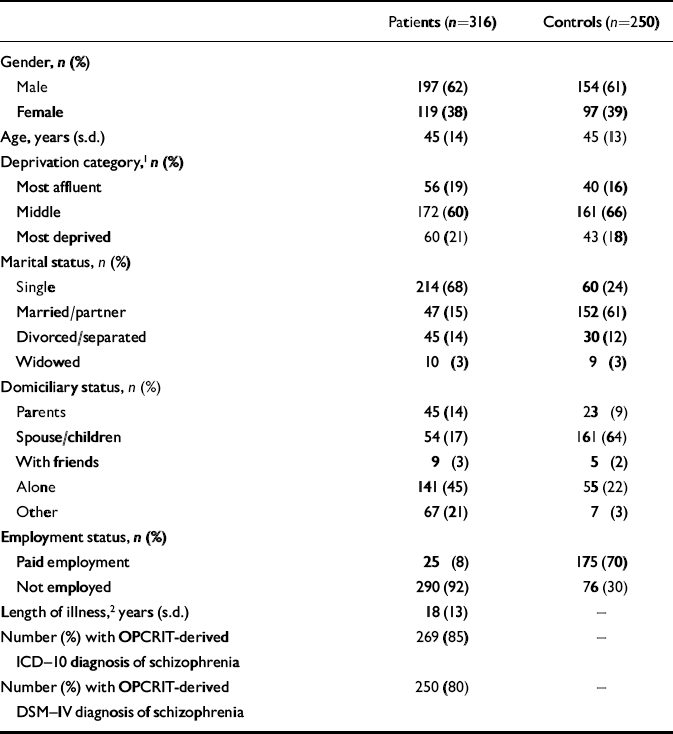
Of 446 patients identified there were 179 in Nithsdale (point prevalence: 3.14/1000 general population), 168 in Glasgow (3.17/1000 general population) and 99 in Aberdeen (3.09/1000 general practice population). A total of 136 (76%) Nithsdale patients, 111 (66%) Glasgow patients and 69 (70%) Aberdeen patients were interviewed. Demographic and clinical data are shown in Table 1. Those who were interviewed (n=316, 71%) did not differ from those not interviewed (n=130, 29%) in age, gender distribution, duration of illness, deprivation scores (Reference Carstairs and MorrisCarstairs & Morris, 1991) and OPCRIT diagnoses. Matched controls were recruited for 250 (79%) patients, 114 in Nithsdale, 76 in Glasgow and 60 in Aberdeen. Controls were not sought for 27 patients in long-term hospital care. Despite identifying up to six potential controls per patient, controls could not be recruited for 39 (12%).
Social, demographic and clinical data in patients and controls
| Patients (n=316) | Controls (n=250) | |
|---|---|---|
| Gender, n (%) | ||
| Male | 197 (62) | 154 (61) |
| Female | 119 (38) | 97 (39) |
| Age, years (s.d.) | 45 (14) | 45 (13) |
| Deprivation category,1 n (%) | ||
| Most affluent | 56 (19) | 40 (16) |
| Middle | 172 (60) | 161 (66) |
| Most deprived | 60 (21) | 43 (18) |
| Marital status, n (%) | ||
| Single | 214 (68) | 60 (24) |
| Married/partner | 47 (15) | 152 (61) |
| Divorced/separated | 45 (14) | 30 (12) |
| Widowed | 10 (3) | 9 (3) |
| Domiciliary status, n (%) | ||
| Parents | 45 (14) | 23 (9) |
| Spouse/children | 54 (17) | 161 (64) |
| With friends | 9 (3) | 5 (2) |
| Alone | 141 (45) | 55 (22) |
| Other | 67 (21) | 7 (3) |
| Employment status, n (%) | ||
| Paid employment | 25 (8) | 175 (70) |
| Not employed | 290 (92) | 76 (30) |
| Length of illness,2 years (s.d.) | 18 (13) | - |
| Number (%) with OPCRIT-derived | 269 (85) | - |
| ICD-10 diagnosis of schizophrenia | ||
| Number (%) with OPCRIT-derived | 250 (80) | - |
| DSM-IV diagnosis of schizophrenia |
More matched than unmatched patients were in the most deprived social categories (6 or 7), (23 (37%) v. 42 (17%), χ2=12.1, d.f.=1, P=0.001, OR=0.4, 95% CI 0.2-0.7). Consequently, only matched patient—control pairs were included in the comparisons between patients and controls. More patients were single (162 (65%) v. 60 (24%), χ2=84.3, d.f.=1, P<0.001, OR=5.8, 95% CI 3.9-8.6), lived alone (116 (46%) v. 55 (22%), χ2=33.1, d.f.=1, P<0.001, OR=3.1, 95% CI 2.1-4.5) and were unemployed (225 (90%) v. 76 (30%), χ2=187.4, d.f.=1, P<0.001, OR=21.5, 95% CI 13-35.4).
Use of drugs
Taking all patients into account, 22 (7%) reported problem use of drugs in the past year (5 problem use with opiates and 13 with cannabis), and 66 (21%) at some time before then. Those who had problem use over the past year were more often male (19 (10%) v. 3 (3%), χ2=5.8, d.f.=1, P=0.02, OR=4.1, 95% CI 1.2-14.3), younger (mean age 34 years (s.d. 6 years) v. 46 years (s.d. 14); t-test: t=3.9, d.f.=314, P<0.001; 95% CI for difference between means 6.1-18.7) and lived in more deprived areas (most deprived: 12 (55%) v. 53 (18%): χ2=16.5, d.f.=2, P<0.0001, OR=5.4, 95% CI 2.2-13.1).
Significantly more patients than controls reported harmful use, dependence or problem use of drugs, both in the past year and at some time before (Table 2).
Drug use

| Patients | Controls | Chi-squared | Case/control OR | |
|---|---|---|---|---|
| (n=250) | (n=250) | P | (95% CI) | |
| n (%) | n (%) | |||
| Past year | ||||
| Harmful use | 17 (7) | 5 (2) | 0.013 | 4.0 (1.3-11.9) |
| Dependence | 14 (6) | 2 (1) | 0.010 | 7.0 (1.6-30.8) |
| Problem use | 18 (7) | 5 (2) | 0.009 | 4.2 (1.4-12.6) |
| At any time before past year | ||||
| Harmful use | 48 (19) | 14 (6) | <0.001 | 5.2 (2.5-11.2) |
| Dependence | 38 (15) | 9 (4) | <0.001 | 5.1 (2.3-11.6) |
| Problem use | 50 (20) | 15 (6) | <0.001 | 4.9 (2.4-10.0) |
Of 316 patients rated by key informants, 26 (9%) had current misuse, dependence, or severe dependence on drugs. Through the SCAN, 14 of these 26 were rated as having problem use of drugs over the past year. Of 56 urine samples tested for cannabis, one was positive, a patient who had reported recent use. Of 40 hair samples tested, 7 (18%) yielded positive results for any drug (5 for opiates, 1 patient and 4 controls). The patient and one control had reported recent use. One patient and one control tested positive for sedatives, and although neither reported use, the patient had received a prescribed sedative. One control tested positive for stimulants and had not reported use.
Use of alcohol
Taking all patients into account, 49 (16%) reported problem use of alcohol in the past year and 122 (39%) at sometime before then. Those who had problem use of alcohol over the past year were more often male (39 (20%) v. 10 (8%), χ2=7.4, d.f.=1, P=0.006, OR=2.7, 95% CI 1.3-5.6), and younger (mean age 39 years (s.d. 10) v. 46 years (s.d. 14); t-test: t=3.4, d.f.=314, P=0.001, 95% CI for difference between means 3.1-11.5). Significantly more patients than controls reported harmful use, dependence or problem use of alcohol in the past year and dependency at some time previously (Table 3).
Alcohol use

| Patients | Controls | Chi-squared | Case/control OR | |
|---|---|---|---|---|
| (n=250) | (n=250) | P | (95% CI) | |
| n (%) | n (%) | |||
| Past year | ||||
| Harmful use | 41 (16) | 23 (9) | 0.016 | 2.0 (1.1-3.5) |
| Dependence | 17 (7) | 7 (3) | 0.040 | 2.7 (1.00-6.8) |
| Problem use | 42 (17) | 25 (10) | 0.027 | 1.8 (1.1-3.2) |
| At any time before past year | ||||
| Harmful use | 97 (39) | 84 (34) | 0.206 | 1.3 (0.9-1.9) |
| Dependence | 47 (19) | 21 (8) | 0.001 | 2.6 (1.5-4.7) |
| Problem use | 99 (40) | 84 (34) | 0.145 | 1.3 (0.9-1.9) |
When rated by key informants, 41 (15%) of 316 patients had current misuse, dependence or severe dependence on alcohol. Through the SCAN, 22 of these 41 were rated as having problem use of alcohol over the past year.
Alcohol and/or drug use
More patients than controls had problems with alcohol or drugs in the past year (64 (20%) v. 30 (12%); χ2=6.9, d.f.=1, P=0.008, OR=1.9, 95% CI 1.2-2.9), but not at some time previously. Seven patients and one control had problems with both drug and alcohol use in the past year.
Use of tobacco
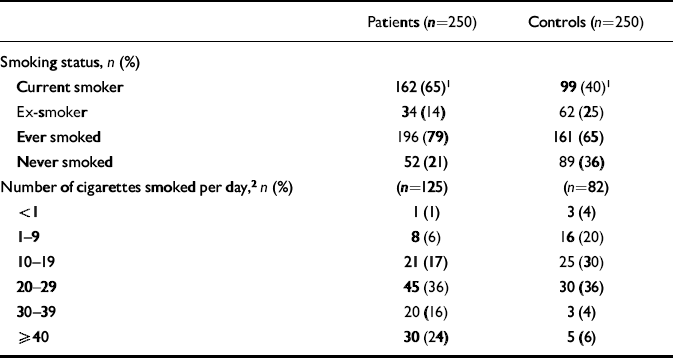
Taking all patients into account, 205 (65%) were current smokers. More male than female patients were current smokers (141 (72%) v. 64 (54%), χ2=10.1, d.f.=1, P=0.002, OR=2.2, 95% CI 1.3-3.5) and current smokers were younger (mean age 43 years (s.d. 13) v. 49 years (s.d. 16); t-test: t=3.3, d.f.=314, P=0.001, 95% CI for difference between means 2.4-9.1).
Significantly more patients than controls were current smokers (162 (65%) v. 99 (40%), χ2=33.0, d.f.=1, P<0.001, OR=2.9, 95% CI 1.9-4.1), and of those who smoked cigarettes as opposed to ‘roll-ups’, more patients were heavy smokers (20 or more cigarettes/day; Table 4) (95 (76%) v. 38 (46%), χ2=18.9, d.f.=1, P<0.001, OR=3.7, 95% CI 2.0-6.7).
Tobacco use
| Patients (n=250) | Controls (n=250) | |
|---|---|---|
| Smoking status, n (%) | ||
| Current smoker | 162 (65)1 | 99 (40)1 |
| Ex-smoker | 34 (14) | 62 (25) |
| Ever smoked | 196 (79) | 161 (65) |
| Never smoked | 52 (21) | 89 (36) |
| Number of cigarettes smoked per day,2 n (%) | (n=125) | (n=82) |
| <1 | 1 (1) | 3 (4) |
| 1-9 | 8 (6) | 16 (20) |
| 10-19 | 21 (17) | 25 (30) |
| 20-29 | 45 (36) | 30 (36) |
| 30-39 | 20 (16) | 3 (4) |
| ≥ 40 | 30 (24) | 5 (6) |
Multivariate analysis
Conditional logistic regression, comparing patients with controls, was carried out using the following factors: site (Nithsdale, Glasgow, Aberdeen), current smoking, problem with drugs and problem with alcohol. The analysis was carried out for problems both in the past year and at any time before that. Numbers of current smokers were significantly different in both analyses (P<0.001 in both cases), as were numbers with problems with drugs (P=0.04, P<0.001). Although there were no differences in numbers having problems with alcohol, further analyses examining harmful use and dependence found that more patients had harmful use in the past year (P=0.04) and dependence at some time previously (P=0.03).
DISCUSSION
In this study 316 of 446 people with schizophrenia and 250 controls identified in three different settings in Scotland were interviewed to elicit the extent of their alcohol, drug and tobacco use. The most striking difference between patients and controls was in tobacco consumption. Although there were statistically significant differences between patients and controls in the numbers who had problem use of drugs and alcohol, the number of patients was small, especially for drugs.
Methodological issues
Identification of patients
With regard to identification of patients, it was probably more comprehensive in Nithsdale than in Glasgow and Aberdeen as there has been over 20 years' experience in that area in identifying patients by the key informant method. This is reflected in similar prevalence rates in the three areas; the prevalence of schizophrenia is probably less in a rural area (Reference Torrey and BowlerTorrey & Bowler, 1990).
Identification of controls
The identification of control subjects was slightly different in the three areas. Although in all three centres controls were obtained through GPs' patient lists, in Nithsdale and Glasgow it was through a national database, but in Aberdeen it was through a search of patient records in GPs' surgeries.
Not all patients identified were interviewed. It is possible that more of the patients identified but not interviewed had drug or alcohol problems. Yet, the distribution of the demographic factors associated with problem use (age and gender) was the same in those interviewed and not interviewed. It is also possible that patients and controls underreported their use. Hair and urine analysis, albeit in a small number of people, did not identify recent use of any non-prescribed drug in any patient who denied it; in contrast, four controls tested positive and had not reported use.
On SCAN interview patients reported alcohol and drug problems which key workers failed to identify, and vice versa. Although we cannot be certain, we believe that a detailed interview lasting 1-2 hours by a research nurse will give more accurate information than a brief interview with a keyworker. In previous reports, one found that keyworkers overestimated and the other found they underestimated drug misuse (Reference Menezes, Johnson and ThornicroftMenezes et al, 1996; Reference BrownBrown, 1998).
Comparison with other studies
Problem use of drugs over the previous year (7%) was a little lower than in a 6-month prevalence study of community patients in a rehabilitation service in Southampton, UK (Reference BrownBrown, 1998), where 10% reported misuse of illicit drugs and 15% misuse of prescribed drugs over the previous 6 months, and in patients with psychosis in a community in south London (Reference Menezes, Johnson and ThornicroftMenezes et al, 1996), where 11% reported misuse in the previous year. In both these urban-based studies, however, patients were considerably younger. In both these studies and ours, a younger age was associated with more drug misuse.
The number of patients reporting problem use of alcohol in the past year (16%) is similar to that in Southampton (18%; Reference BrownBrown, 1998) but lower than in south London (32%; Reference Menezes, Johnson and ThornicroftMenezes et al, 1996). However, the latter study contained patients with depressive psychosis, of whom two-thirds had a problem with alcohol. Problem use at some time previous to the year before assessment in our study (39%) was higher than lifetime problem use in a community sample of patients with schizophrenia in inner London (Reference Duke, Pantelis and BarnesDuke et al, 1994).
Although absolute numbers were small, more people with schizophrenia than control subjects had problems with drugs both in the past year or at some time previously and, with regard to alcohol, harmful use in the past year or dependence at some time previously. What leads more people with schizophrenia to substance misuse has been discussed extensively (Reference SiegfriedSiegfried, 1998; Reference Blanchard, Brown and HoranBlanchard et al, 2000). They may misuse drugs for the same reasons as the rest of the population (to relax, increased availability, increased acceptability). Drugs might be used to ‘self-medicate’ symptoms of illness or drug side-effects. Finally, genetic factors could lead to both drug misuse and schizophrenia. We would like to emphasise, however, that in our study 93% and 84% of patients respectively did not have problem use of drugs or alcohol in the previous year.
Tobacco
Use of alcohol or drugs in our patients was greatly overshadowed by use of tobacco. Almost two-thirds of our patients were current smokers, and most who smoked were heavy smokers. These findings are similar to a recent survey of smoking in south-west Scotland (Reference Kelly and McCreadieKelly & McCreadie, 1999), but it is a somewhat lower rate than that found in a widely quoted American study (Reference Hughes, Hatsukami and MitchellHughes et al, 1986), where 88% of out-patients with schizophrenia were smokers. A future paper (further details available from the author upon request) will examine service use by those who do and do not have current problem use of drugs or alcohol, and discuss the need, or otherwise, for dual diagnosis clinics. However, in our view the most important dual diagnosis is schizophrenia and tobacco use. Patients with schizophrenia die early, especially from smoking-related diseases (Reference Brown, Barraclough and InskipBrown et al, 2000). Attempts to help people with schizophrenia give up smoking should be a top priority.
CLINICAL IMPLICATIONS
-
▪ Problem use of alcohol and drugs in people with schizophrenia is greater than in members of the general population, but absolute numbers are small.
-
▪ A total of 93% and 84% of patients, respectively, did not have problem use of drugs or alcohol in the previous year.
-
▪ Almost two-thirds of patients were smokers; this is by far and away the most important dual diagnosis in schizophrenia.
LIMITATIONS
-
▪ Success in identifying patients was probably greater in the rural than in the urban or suburban areas.
-
▪ Detailed interviews of subjects by a research nurse and brief interviews by keyworkers produced conflicting results.
-
▪ In a small sample of controls who did not report drug use, hair analysis suggested otherwise.
Acknowledgements
Members of the Scottish Comorbidity Study Group: Crichton Royal Hospital, Dumfries: R. McCreadie, V. Sharkey, J. Halliday, S. Macdonald, T. MacEwan, S. Farrington. Gartnavel Royal Hospital, Glasgow: R. Cantwell, C. Kelly, A. Burns, M. Smith, C. Melville, J. White. Royal Cornhill Hospital, Aberdeen: J. Eagles, P. Sclare, P. Gordon, A. Lawrie. Health Services Research Unit, University of Aberdeen: S. Naji, J. Gibb, J. Andrew.




eLetters
No eLetters have been published for this article.