1. Introduction
The prevailing view is that distance between two languages or varieties cannot be measured appropriately by using a well-established score because they may differ in many complex linguistic aspects such as phonetics, phonology, lexicography, morphology, syntax, semantics, pragmatics, and so on. In addition, languages change (even their spelling rules) throughout their history (Millar and Trask Reference Millar and Trask2015), so it is also difficult to measure the diachronic distance within the same language.
Considering all these aspects and reduce them automatically to a single language distance measure between languages or historical periods of the same language is a difficult task which is far from being fulfilled or at least appropriately addressed, perhaps because it has not yet been a priority in natural language processing.
However, there have been different approaches, not always based on corpus linguistics, to obtain language distance measures, namely in phylogenetic studies within historical linguistics (Petroni and Serva Reference Petroni and Serva2010), in dialectology (Nerbonne and Heeringa Reference Nerbonne and Heeringa1997a), in language identification (Malmasi et al. Reference Malmasi, Zampieri, Ljubeši, Nakov, Ali and Tiedemann2016), and in studies about learning additional languages within the field of second language acquisition (Chiswick and Miller Reference Chiswick and Miller2004).
Our work falls within the broader scope of understanding language variation. For this we have created a methodology that is corpus-driven and more exploratory in nature in comparison to other (more traditional) approaches. Thus this article proposes a corpus-driven methodology for calculating a diachronic language distance between languages from historical corpora. We consider that the concept of language distance is closely related to the process of language identification (Gamallo, Pichel, and Alegria Reference Gamallo, Pichel and Alegria2017a). In fact, the more difficult the identification of differences between two languages or language varieties is, the shorter the distance between them.
In our previous research, perplexity-based measures were used for language identification (Gamallo et al. Reference Gamallo, Alegria, Pichel and Agirrezabal2016), to measure the distance between languages (Gamallo, Pichel, and Alegria Reference Gamallo, Pichel, de Compostela and Alegria2017b), and to quantify the diachronic distance in a language (Pichel, Gamallo, and Alegria Reference Pichel, Gamallo and Alegria2018). The results are encouraging because it is an unsupervised method and only raw historical corpora are required.
The objective of the present article is to apply this perplexity-based measure to study and compare the distance among historical periods, performing experiments in three different languages: European English, European Portuguese, and European Spanish, from the twelfth to twentieth century. As a result, two kinds of results are reported: the first one uses our perplexity-based method in historical corpora with an orthography closely related to that of the original texts; the second experiment was conducted using transliterated corpora in order to use the same transcribed orthography for all varieties and languages. The results of the second experiment show how this orthographic transcription smooths the distance between historical periods of languages.
As the evaluation of the distance is not a trivial task, the objective is to verify whether the distance fits with the opinions of the experts. More specifically, this research tries to observe if the three languages evolved in the same way or whether, on the contrary, there are periods of a language with more changes and to what extent spelling plays a role in that distance. In addition, previous work Gamallo et al. (Reference Gamallo, Pichel and Alegria2017a) can help to compare the historical distance between periods of a language with the current and synchronic distance between languages.
This article is organized as follows: First, some studies on language distance are introduced in Section 2. Then, the experimental method and the language distance measure are described in Section 3, while each one of the historical corpus created ad hoc with its main characteristics by language is presented in Section 4. In Section 5, the two above-mentioned experiments are described and the results discussed. Finally, a final discussion interpreting the results of the previous experiments and some conclusions are addressed in Sections 6 and 7, respectively.
2. Related work
Language distance has been measured and defined from different perspectives using different methods. Many of the methods compare lists of words in order to find phylogenetic links or dialectological relations (Wieling and Nerbonne Reference Wieling and Nerbonne2015). In addition, other language identification and language distance approaches have been developed, both working from the comparison of probability distributions using different measures obtained from linguistic corpora. Each of them is described below.
2.1 Language identification
Language identification is a subfield of Computational linguistics that has been extensively studied. For this purpose language identification has used n-gram language models, word pockets, dictionaries based on word lists, and heuristics (spelling, morphology, syntactic characteristics). Among the most relevant studies we can highlight the following: “N-gram-based text categorization” (Cavnar et al. Reference Cavnar, Trenkle and John1994) which is one of the first papers to use n-grams for Language Identification or “Statistical Identification of Language” (Dunning Reference Dunning1994).
Language identification was one of the first natural language processing problems for which a statistical and corpus-based approach was used. The best language identification systems are based on n-gram models of characters extracted from textual corpora (Malmasi et al. Reference Malmasi, Zampieri, Ljubeši, Nakov, Ali and Tiedemann2016). As a result, character n-grams encode not only lexical and morphological information but also phonological features since phonographic written systems are related to the way languages were pronounced in the past. In addition, long n-grams (>=5-grams) also encode syntactic and syntagmatic relations as they may represent the end of a word and the beginning of the next one in a sequence. For instance, the 7-gram ion#de# (where “#” represents a blank space) is a frequent sequence of letters shared by several Romance languages (e.g., French, Spanish, or Galician). This 7-gram might be considered as an instance of the generic pattern “noun-prep-noun” since ion (the stress accent (e.g., ión) has been removed to simplify language encoding) is a noun suffix and de a very frequent preposition (of in English), introducing prepositional phrases.
However, there are still big challenges such as classifying some closely related varieties of the same language (e.g., Nicaraguan Spanish and Salvadoran Spanish) and Ausbau languages (Kloss Reference Kloss1967) (e.g., Czech and Slovak), or languages by development, which are languages that can be constructed at different historical moments to relate to or to separate. Thus, there have been remarkable works to discriminate among these two kinds of languages (Malmasi et al. Reference Malmasi, Zampieri, Ljubeši, Nakov, Ali and Tiedemann2016; Zampieri et al. Reference Zampieri, Malmasi, Nakov, Ali, Shon, Glass, Scherrer, Samardžić, Ljubešić and Tiedemann2018; Kroon, Medvedeva, and Plank Reference Kroon, Medvedeva and Plank2018), and also for language detection on noisy short texts such as tweets (Gamallo, Sotelo, and Pichel Reference Gamallo, Sotelo and Pichel2014; Zubiaga et al. Reference Zubiaga, Vicente, Gamallo, Pichel, Alegria, Aranberri, Ezeiza and Fresno2015).
In recent years reasonable results have been achieved even for very closely related varieties using corpus-based strategies. For instance, Zampieri, Gebre, and Diwersy (Reference Zampieri, Gebre and Diwersy2013) reported an approach using a log-likelihood estimation method for language models built on orthographical (character n-grams), lexical (word unigrams), and lexico-syntactic (word bigrams) features. As a result, they reported an extremely high accuracy of 0.998 for distinguishing between European Portuguese and Brazilian Portuguese, and 0.990 for Mexican and Argentinian Spanish.
To conclude, the VarDial workshop has become the reference in this area in recent years (Zampieri et al. Reference Zampieri, Malmasi, Nakov, Ali, Shon, Glass, Scherrer, Samardžić, Ljubešić and Tiedemann2018). In the German Dialect Identification task in 2016 the best language identification systems were based on n-gram models (Malmasi et al. Reference Malmasi, Zampieri, Ljubeši, Nakov, Ali and Tiedemann2016). Finally, in 2018 the two best systems are using n-gram models (character 4-gram in the first ranked system).
2.2 Linguistic phylogenetics
According to Borin (Reference Borin2013), genetic linguistics (also known as “phylogenetics” or “comparative-historical linguistics”) and dialectology are the most popular fields dealing with language distance. This author claimed that “traditionally, dialectological investigations have focused mainly on vocabulary and pronunciation, whereas comparative-historical linguists put much stock in grammatical features.” However, “we would expect the same kind of [language distance] methods to be useful in both cases” (Borin Reference Borin2013, p. 7).
The objective of linguistic phylogenetics, a subfield of historical and comparative linguistics, is to classify the languages building a rooted tree describing the evolutionary history of a set of related languages or varieties.
In order to automatically build phylogenetic trees, many researchers made use of a specific technique called lexicostatistics, which is an approach of comparative linguistics that involves quantitative comparison of lexical cognates, which are words with a common historical origin (Nakhleh, Ringe, and Warnow Reference Nakhleh, Ringe and Warnow2005; Holman et al. Reference Holman, Wichmann, Brown, Velupillai, Muller and Bakker2008; Bakker et al. Reference Bakker, Muller, Velupillai, Wichmann, Brown, Brown, Egorov, Mailhammer, Grant and Holman2009; Petroni and Serva Reference Petroni and Serva2010; Barbançon et al. Reference Barbançon, Evans, Nakhleh, Ringe and Warnow2013). More precisely, lexicostatistics is based on cross-lingual word lists (e.g., Swadesh list Swadesh Reference Swadesh1952 or ASJP database Brown et al. Reference Brown, Holman, Wichmann and Velupilla2008) to automatically measure distances using the percentage of shared cognates. Among these studies, Kolipakam et al. (Reference Kolipakam, Jordan, Dunn, Greenhill, Bouckaert, Gray and Verkerk2018), List et al. (Reference List, Walworth, Greenhill, Tresoldi and Forkel2018), and Satterthwaite-Phillips (Reference Satterthwaite-Phillips2011) can be highlighted. Levenshtein distance among words (Yujian and Bo Reference Yujian and Bo2007) in a cross-lingual list is one of the most common metrics used in this field (Petroni and Serva Reference Petroni and Serva2010). Ellison and Kirby (Reference Ellison and Kirby2006) present a method, called PHILOLOGICON, to build language taxonomies comparing lexical forms. The method only compares words language-internally and never cross-linguistically. Finally, Satterthwaite-Phillips (Reference Satterthwaite-Phillips2011) and Rama and Singh (Reference Rama and Singh2009) test four techniques to construct phylogenetic trees from corpora: cross-entropy, cognate coverage distance, phonetic distance of cognates, and feature N-Gram. They conclude that these measures can be very useful for languages which do not have linguistically handcrafted lists.
Finally, using perplexity-based distance we built a tree which represents the current map of similarities and divergences among the main languages of Europe (Gamallo et al. Reference Gamallo, Pichel and Alegria2017a).
2.3 Language distance
To measure language distances, there were first approaches such as those of Nerbonne and Heeringa (Reference Nerbonne and Heeringa1997b) and Kondrak (Reference Kondrak2005) from cross-lingual comparison of phonetic forms, “but some researchers have argued against the possibility of obtaining meaningful results from cross-lingual comparison of phonetic forms” (Singh and Surana Reference Singh and Surana2007).
More complex language models have been built from large cross-lingual and parallel corpora to obtain language distances automatically. In these works, models are mainly built with distributional information on words, that is, they are based on co-occurrences of words, and therefore languages are compared by computing cross-lingual similarity on the basis of word co-occurrences (Liu and Cong Reference Liu and Cong2013; Gao et al. Reference Gao, Liang, Shi and Huang2014; Asgari and Mofrad Reference Asgari and Mofrad2016).
Recently, Degaetano-Ortlieb et al. (Reference Degaetano-Ortlieb, Kermes, Khamis and Teich2016) have presented an information-theoretic approach based on entropy to investigate diachronic change in scientific English, Rama et al. (Reference Rama, Borin, Mikros, Macutek, Rama and Borin2015) have used cross-entropy to measure distances, and Degaetano-Ortlieb and Teich (Reference Degaetano-Ortlieb and Teich2018) have used relative entropy for detection and analysis of periods of diachronic linguistic change.
Works that address other computational linguistics tasks from a diachronic perspective (e.g., stance evolution reported in Lai et al. Reference Lai, Patti, Ruffo and Rosso2018) can also be cited.
3. Methodology
The proposed method consists of applying a distance measure on different periods of a historical corpus. In the following, we define the distance measure (Subsection 3.1) and how it is used in a historical corpus (Subsection 3.2).
3.1 Perplexity-based measure
The distance measure of our method is based on perplexity, which is a widely used evaluation metric for language models. It has been used as a quality measure for language models built with n-grams extracted from text corpora. It has also been used in very specific tasks, such as to classify between formal and colloquial tweets (González Reference González2015), to identify varieties of very related languages (Gamallo et al. Reference Gamallo, Alegria, Pichel and Agirrezabal2016), or to measure distances among languages (Gamallo et al. Reference Gamallo, Pichel and Alegria2017a).
More formally, the perplexity, PP, of a language model on a textual test is the inverse probability of the test. For a test of sequences of characters CH = ch 1, ch 2, …, ch n and a language model LM with n-gram probabilities P(·) estimated on a training set, the perplexity PP of CH given a character-based n-gram model LM is computed as follows:
 $$PP(CH,LM) = \root n \of {\prod\limits_i^n {{1 \over {P(ch_i |ch_1 ^{i - 1} )}}} }$$
where n-gram probabilities P(·) are defined in this way:
 $$P(ch_n |ch_1 ^{n - 1} ) = {{C(ch_1 ^{n - 1} ch_n )} \over {C(ch_1 ^{n - 1} )}}$$
Equation (2) estimates the n-gram probability by dividing the observed frequency (C) of a particular sequence of characters by the observed frequency of the prefix, where the prefix stands for the same sequence without the last character. To take into account unseen n-grams, we use a smoothing technique based on linear interpolation.
A perplexity-based distance between two languages or two periods of the same language is defined by comparing the n-grams of a text in one language or period of language with the n-gram model trained for the other language or period of language. This comparison must be made in the two directions as PP is a divergence with asymmetric values. Then, the perplexity of the test text CH in language L2, given the language model LM of language L1, as well as the perplexity of the test text in L1, given the language model of L2, are used to define the perplexity-based language distance, PLD, between L1 and L2 as follows:
 $$PLD(L1,L2) = (PP(CH_{L2} ,LM_{L1} ) + PP(CH_{L1} ,LML_{L2} ))/2$$
The lower the perplexity of both CH L2 given LM L1 and CH L1 given LM L2, the lower the distance between languages (or language periods) L1 and L2. Notice that PLD is the symmetric mean derived from two asymmetric divergences: PP(CH L2, LM L1) and PP(CH L1, LM L2).
PLD distance has been firstly defined in Gamallo et al. (Reference Gamallo, Pichel, de Compostela and Alegria2017b). In order to have comparable results, we configured the PLD distance and the corpora with the same hyper-parameters than those used in that work to measure contemporary European languages. So, PLD has been configured with 7-grams and train/test corpora with 1,25M/250K words, respectively.
3.2 Task description
Our methodology is based on the application of PLD measure to a language historical corpora (also called “diachronic corpora”), in order to obtain a diachronic language distance between periods in both original spelling and transcribed spelling. In the experiments reported later, it will be applied to three international languages in their European variety: English (United Kingdom), Portuguese (Portugal), and Spanish (Spain). For this purpose, a representative and balanced historical corpus is required for each language.
The corpora are divided into two parts: train and test subcorpora. Also, train and test must be divided into different language periods, which have been previously defined according to historical linguistics criteria. Taking into account PLD measure and perplexity requirements, the test corpus should contain roughly 20% number of words with regard to the train corpus. It is worth mentioning that the train partitions are not manually annotated as our method is fully unsupervised. Finally, we must emphasize that no test partition is included in the train, being a different corpus.
More precisely, to apply PLD on diachronic corpora for computing the distance between periods, our method is divided into the following specific tasks:
To obtain diachronic corpora in original spelling: First, we need to obtain text sources to create our diachronic corpora with a spelling as close as possible to the original for each language. It is important to check first if these corpora already exist as open access and if they are total or partially in orthography as close as possible to the original. Once the textual sources have been selected, we must eliminate noise from the documents, specially texts in other languages.
To define historical periods for diachronic corpora: Attending to Klarer (Reference Klarer2013): “The convention of periodical classification must not distract from the fact that such criteria are relative and that any attempt to relate divergent texts ‘with regard to their structure, contents, or date of publication’ to a single period of literary history is always problematic.” These periods of linguistic change and lexical and grammatical features contributing to change could be detected automatically for each language using the method of Degaetano-Ortlieb and Teich (Reference Degaetano-Ortlieb and Teich2018) or the method of identification of stages done by Th. Gries and Hilpert (Reference Th. Gries and Hilpert2008). Because we want to compare the historical change in the three languages, a matter that will be explained in (6), we have chosen to define common periods for the three languages manually. Thus, we have chosen to use broader historical periods: medieval period (XII–XV), modern age (XVI–XVIII), and contemporary age (XIX and XX). As in our case we have carried out experiments for English, Portuguese, and Spanish, and the latter have undergone different orthographic changes since the end of the eighteenth century, we have divided the contemporary age into two subperiods per century.
To select representative/balanced diachronic corpora: We must select representative and balanced historical corpora. In order to design a corpus that is representative according to Biber (Reference Biber1993): “variability can be considered from situational and from linguistic perspectives, and both of these are important in determining representativeness. Thus a corpus design can be evaluated for the extent to which it includes: (1) the range of text types in a language, and (2) the range of linguistics distributions in a language.” For this purpose, texts from several genres and topics must be retrieved. For our corpus, texts from both non-fiction and fiction for each period have been collected, including fiction subgenres such as narrative, poetry, theater, and religious texts for the medieval period, whereas for the non-fiction essays were mostly used. In addition to the size of the corpus, we have opted for the same size as the Helsinki Corpus of Historical English (Rissanen, Kytö, and Palander-Collin Reference Rissanen, Kytö and Palander-Collin1993): “The first problem to be decided upon in compiling a corpus is its size” and “The size of the basic corpus is c. 1.5 million words.”
To set Train and Test subcorpora in original spelling: Once the textual sources of our corpora have been selected and the periods have been established, two subcorpora are created for each period: one for the train and the other for the test. In the train, we include for each period texts in original spelling in fiction and non-fiction. In total there must be at least 1,250,000 words per period. In the test we do the same, obtaining per period original spelling texts in fiction and non-fiction with a number of words of at least 20% of the train, that is between 250,000 and 350,000 words. In order to facilitate a better representation of the language for each period, the fiction and non-fiction texts in both the train and the test per period should be balanced at approximately 50% (the test and train texts are distinct sets).
To set Train/Test subcorpora in transcribed spelling: A spelling normalization is applied on all the texts and a transcribed version is obtained for each corpus. The final alphabet consists of 34 symbols, representing 10 vowels (including accents) and 24 consonants, designed to cover most of the commonly occurring sounds, including several consonant palatalizations and a variety of vowel articulation. The encoding is thus close to a phonological one and, then, makes it possible to simplify and homogenize cases in which similar sounds (generally palatalizations) are transcribed differently in different languages. For instance, the palatalized nasal sound is transcribed by our normalizer as “ny,” thus unifying the Portuguese spellings “nh” and the Spanish “ñ.” Similarly, the palatalized lateral is transcribed as “ly,” simplifying the two different spellings: “lh” in Portuguese and “ll” in Spanish. The palatal affricate sound in English, represented by the spelling “ch,” is transcribed into “ĉ,” as well as in Spanish and Portuguese.
To compute PLD: Finally, we perform the PLD calculations between all the different periods in the two spellings: original and transcribed texts.
This strategy was applied to a specific historical corpus, and the results are evaluated and analyzed in the next section.
4. Corpus
The corpus that we have used for our experiments, called Carvalho, is freely availableFootnote a and contains the diachronic corpus for the three languages: Carvalho–EN–UK (for English in the United Kingdom), Carvalho–PT–PT (for Portuguese in Portugal), and Carvalho–ES–ES (for Spanish in Spain).
Initially, our intention was to classify the historical periods in three fundamental stages: medieval period (XII–XV), modern age (XVI–XVIII), and contemporary age (XIX–XX), following the classification for English provided by Corpus Helsinki (Rissanen et al. Reference Rissanen, Kytö and Palander-Collin1993). However, as we have previously explained in stage 2 of our methodology (“Define historical periods for diachronic corpora”) the six historical periods used to divide temporal axis of the three target languages are XII–XV, XVI–XVIII, XIX–1, XIX–2, XX–1, and XX–2.
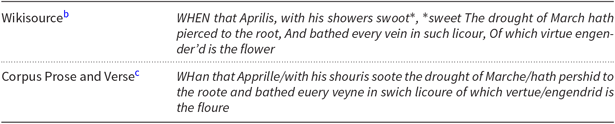
One of the main problems in the process of selecting texts from different historical periods is that, on many occasions, the same text can appear in original spelling in one source but also edited or adapted in another one. For example, Table 1 shows the same English medieval excerpt extracted from two different sources: one version has been edited and adapted (first row), and the other version is close to the original (second row). Given that our experiments will be carried out on texts written in original spelling or automatically transcribed from the original spelling, we have decided to create a historical corpus whose spelling has never been edited or modified, being as close as possible to the original. Bearing this aim in mind, adapted or edited versions have been ruled out.
The same excerpt from the medieval book “The Canterbury Tales by George Chaucer.” The first row, extracted from Wikisource, is edited while the second one, from Corpus of Middle English Prose and Verse, is in original spelling

In the following section we will outline the characteristics of the diachronic corpus that we have created for each language. We will focus on the resources used to extract all the texts of our corpus, their distribution in fiction and non-fiction, as well as the size of the different partitions. In addition, some historical studies are cited for each language. These references were used to identify the periods of each language, situate the texts in their corresponding period, and classify them by genre (fiction/non-fiction). They were also useful to learn how to distinguish between original and adapted spelling.
4.1 English corpus
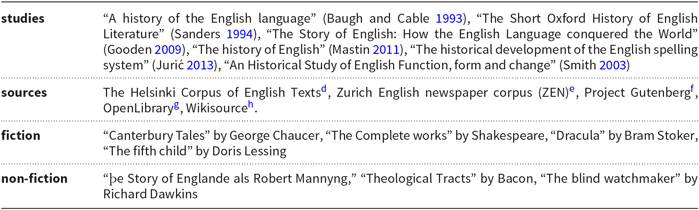
Table 2 shows some relevant information required to build the Carvalho–EN–UK corpus: the historical studies we used to prepare the material, the corpus resources from which the documents in original spelling were selected, and some samples of fictional and non-fictional documents taking part in the final corpus.
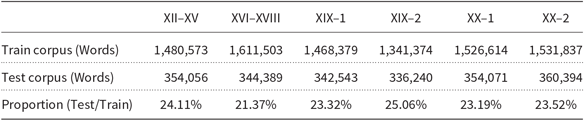
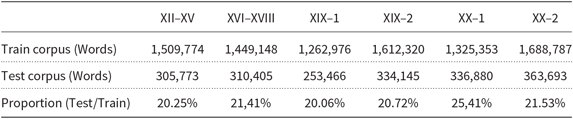
As it has been mentioned in the methodology section, we extracted 1.25/1.5M words for the train partitions, and 250/350K words (between 20% and 25% of the train) for the test ones. Table 3 shows the quantitative data of all partitions in Carvalho–EN–UK.
4.2 Portuguese corpus
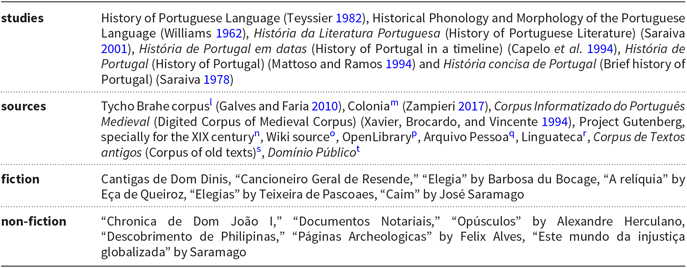
Table 4 shows the historical work, resources, and samples of fictional and non-fictional documents taking part in the final Carvalho–PT–PT corpus. It is worth noting that documents that are not in original orthography have been carefully removed; even some modern ones from the early twentieth century. For example, the spelling “ph” was used for the phoneme /f/ in texts of the XIX and XXth centuries, and in many available digital versions the texts were adapted to modern spelling by replacing “ph” with “f.” But we discarded these versions.
Qualitative data on Carvalho–EN–UK corpus: historical studies, corpus resources, and an ordered sample from the middle age to the twentieth century of fictional and non-fictional writings.

Size of Train and Test partitions in Carvalho–EN–UK.

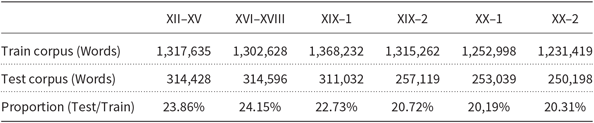
Once all the texts have been obtained, we have divided them into two groups, train and test. In Table 5 we show the number of words in the train and test per period, which are similar to the numbers of the English version. Balanced train–test pairs might help to compute PLD measure without bias.
4.3 Spanish corpus
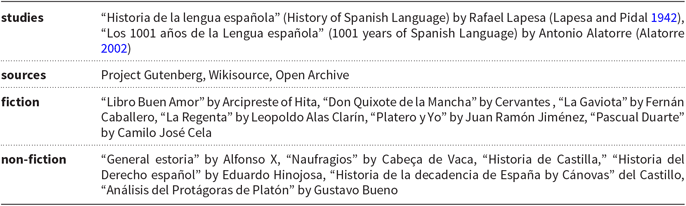
Table 6 shows the historical work, resources, and samples of fictional and non-fictional documents taking part in the final Carvalho–ES–ES corpus. In Spanish there are different well-known historical corpus such as corpora CORDEFootnote i, ADMYTEFootnote j, Corpus del españolFootnote k, but they are not usually open since they only allow online access to the texts. Furthermore, the texts do not necessarily have to be in spellings close to the original as they may be edited or adapted. This is one of the reasons why we have chosen to create our own diachronic corpora of Spanish that have been obtained mainly from the following online repositories: Project Gutenberg, Wikisource, and Open Archive.
Since medieval times, there has been a will to standardize the Castilian language, starting with Alfonso X in the thirteenth century (Del Valle Reference Del Valle2013). However, none of the varied orthographies used until the eighteenth century crystallized. It was only after the reforms of the Royal Academy (RAE) in 1741 that the process of standardization of the written system was actually consolidated as a result of the removal by the RAE of common spelling with other Romance languages such as “ss,” “ç,” and latinisms (Alatorre Reference Alatorre2002). Thus, a medieval text can be written like this “dios llamo a moysen dela tienda del paramjento y dixole fabla con los fijos de israel y diles todo onbre de vos que diere ofrenda a dios de ganados esto es de buyes o de ovejas o fazer sacrifiçios” in Biblia Prealfonsi and a nineteenth century text is written as follows: “Se embozó en su capa, y se puso a dar paseos. Entonces vio al alemán sentado en un banco, y mirando al mar”, with the same spelling as the current one.
Qualitative data on Carvalho–PT–PT corpus: historical studies, corpus resources, and an ordered sample from the middle age to the twentieth century of fictional and non-fictional documents.

Size of Train and Test partitions in Carvalho–PT–PT.

Qualitative data on Carvalho–ES–ES corpus: historical studies, corpus resources, and an ordered sample from the middle age to the twentieth century of fictional and non-fictional documents.

Table 7 shows the quantitative data of both train and test partitions.
Size of Train and Test partitions in Carvalho–ES–ES.

5. Experiments
Since our aim is to test our methodology in different languages (English, Portuguese, and Spanish), linguistic models were generated using a collection of documents in various periods of each language, as explained above. These documents are not translations of each other and are made up of a balanced combination of genres (both fiction and non-fiction) from period to period. As a result, we created a set of comparable and balanced corpora of fiction and non-fiction in six different periods of the three languages containing relevant text in original orthography. The experiments consist in calculating the PLD distance between pairs of periods within each language in two steps: first, using texts written with original spelling, and then using the same texts automatically transcribed into a common orthography.
To perform these experiments, a set of scripts has been developed (https://github.com/gamallo/Perplexity) to create a train 7-gram diachronic language model, period by period. As a result, six 7-gram diachronic language models are obtained. Then, we have generated 7-gram models from all test corpora.
Once all models have been created, PLD is computed for each possible train–test pair of models in original spelling. Next, the experiments are performed again to obtain the PLD between transcribed models (as it was described in the Methodology section).
Next, we will show the PLD computation for each language with original and transcribed spelling, and discuss the results.
5.1 English
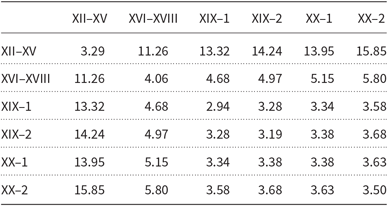
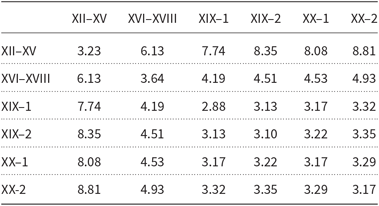
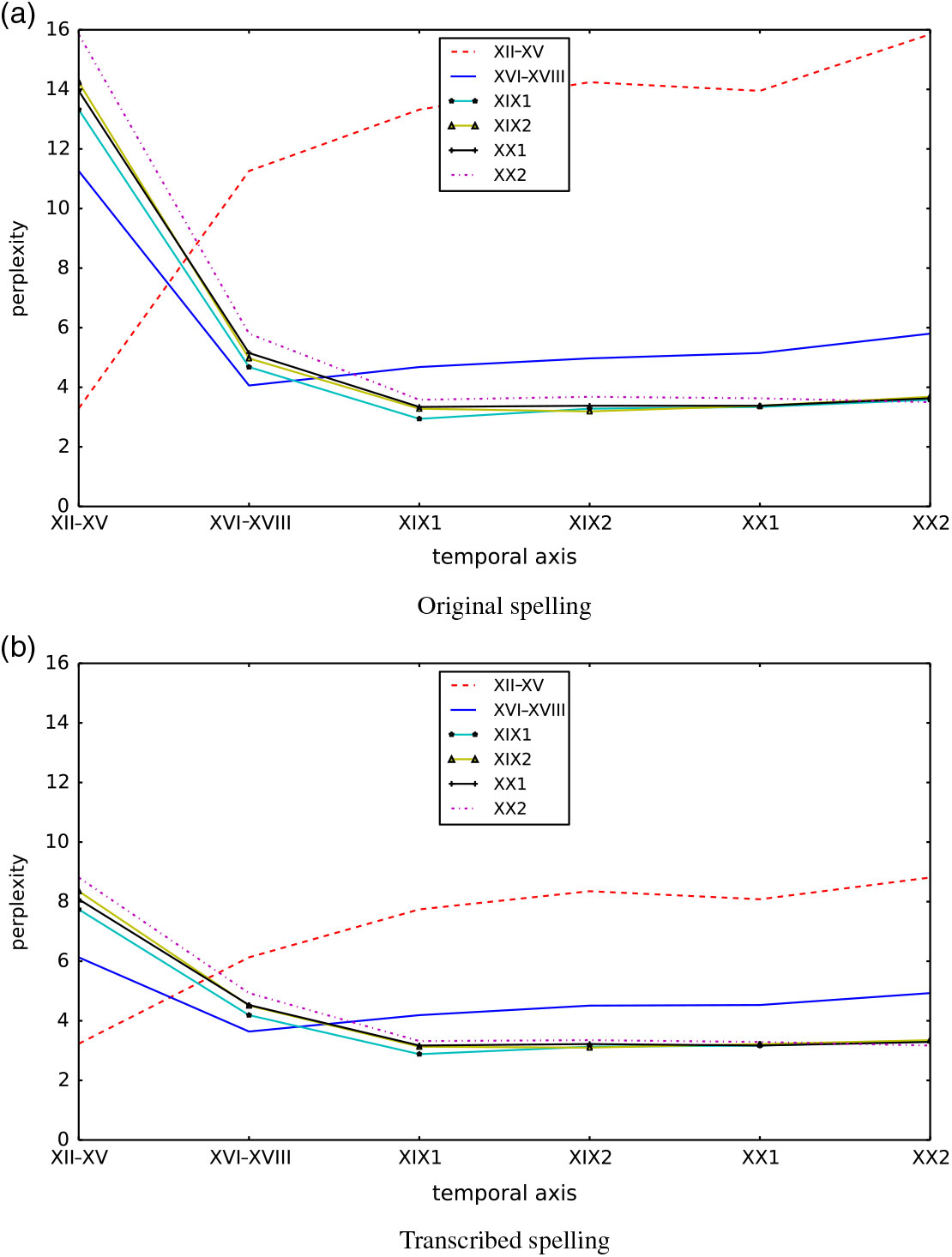
First, we will see in Table 8 the results of calculating the PLD in original orthography between all periods of English within the Carvalho–EN–UK corpus. Second, Table 9 shows the results of performing the same experiment but with the characteristic of transcribing all periods to the same spelling. Finally, in order to see more clearly the data, Figure 1(a) compares the distance evolution across all periods in original spelling while Figure 1(b) compares the same but with transcribed spelling.
PLD diachronic measure in original spelling (Carvalho–EN–UK corpus)

PLD diachronic measure in a common transcribed spelling (Carvalho–EN–UK_norm corpus.)

In (a) we compare the English PLD distances between XII–XV and XX–2 across all periods in original spelling. In (b) the same comparison using a transcribed spelling.

5.1.1 PLD with original spelling
Different phenomena can be observed in Table 8: first, the medieval period is steadily and considerably distanced from all other periods: the PLD distance from XVI–XVIII is 11.26 while its distance from the second half of the XX century is 15.85; second, from XVI–XVIII to XX–2 figures are quite homogeneous: the highest PLD value between different periods is 5.80, while the lowest point is 3.28 (between the two halves of the nineteenth century).
In the case of Figure 1(a) it can be seen more clearly how the medieval period (XII–XV) is progressively separated from the other periods of English, the distance being very large with respect to all periods. In the case of the XV–XVIII period, the distance with regard to the medieval period is much larger than with regard to the rest of the periods (XIX and XX). Finally, it is perceived that there is very little difference between the four subperiods of the nineteenth and twentieth centuries: 0.40 between the maximum value and the minimum one.
5.1.2 PLD with transcribed spelling
In a second experiment, we have converted the Carvalho–EN–UK corpus into a new common spelling: Carvalho–EN–UK_norm. After this transformation, the same experiment as for Carvalho–EN–UK has been performed. The same will be done for Portuguese (Carvalho–PT–PT and Carvalho–PT–PT_norm) and Spanish (Carvalho–ES–ES and Carvalho–ES–ES_norm).
By unifying the same orthography between all the English periods, we see that the medieval period is much less distant, though still far away, from the rest of the English periods. Thus, in Table 9, we can observe how the PLD drops from 11.26 to 6.13 with regard to the XVI–XVIII period, an important decrease in distance, only caused by orthographic normalization.
In the case of Figure 1(b) we can see again a significant drop in the distance between the medieval period and the rest of the English periods, making the distance even smoother with the second half of the twentieth century. At the same time, we can also observe that the distance between the XV–XVIII period and the rest of the periods (XIX and XX) is no significantly smaller. Finally, the four periods of the nineteenth and twentieth centuries (submatrix 4×4), once normalized, are practically identical in terms of PLD distance: from 3.13 (the lowest value in Table 9) to 3.35 (the highest one). In fact, these values are on the same scale as the ones we get when we compare the periods with themselves on the diagonal.
5.1.3 Discussion for English results
These results allowed us to find that the distance between the medieval period and the second half of the twentieth century taking into account the original spelling is very substantial (PLD: 15.85 with the same size for train and test). In addition, it can be observed how the distance starts from the Renaissance period with a PLD of 11.29 and progressively reaches the PLD mentioned above.
But after converting all periods to a comparable spelling, the PLD falls to 8.81, a distance slightly greater than that indicated by perplexity, in the same article (Gamallo et al. Reference Gamallo, Pichel, de Compostela and Alegria2017b), between current Spanish and current Portuguese, with a PLD of 7.77. That is to say, it could be claimed that medieval English (XII–XV) and the English of the last half of the XX–2 century are different but very closely related languages after sharing a common spelling.
Finally, we can see how since the Renaissance period (XV–XVIII) the English language does not undergo important changes, with only a small distance between this period and the rest of historical periods (XIX and XX). The diachronic distance is practically irrelevant between these last two periods.
5.2 Portuguese
The same two experiments will be performed for Portuguese: the first one consists in applying PLD measure on a Portuguese historical corpus (Carvalho–PT–PT) keeping the original spelling to all and between all historical periods. In the second experiment, we apply the same PLD measure to the same historical documents, but transcribed automatically by means of a normalization process.
5.2.1 PLD with original spelling
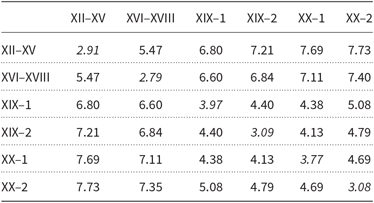
We can observe in Table 10 the following phenomena:
PLD diachronic measure in original spelling (Carvalho–PT–PT corpus)

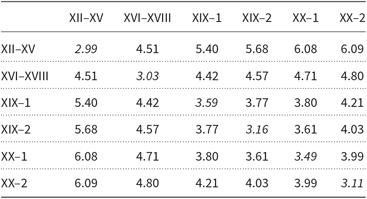
First, the medieval period is progressively but gently distant from the rest of the language periods: 5.47 from XVI–XVIII, 6.80 from the first half of the XIXth century, and 7.73 from the second half of the XXth century.
Second, the differences in PLD between the recent periods (XIX–1, XIX–2, XX–1, and XX–2) are small but distinguishable, namely almost 1 point between the extreme values: the distance in the 4x4 sub-matrix from the 19th–1st century to the 20th–2nd century has a maximum PLD value of 5.08 between the first half of the nineteenth century and the second half of the twentieth century, while the minimum PLD value is 4.13 between the second half of the nineteenth century and the first half of the twentieth century.
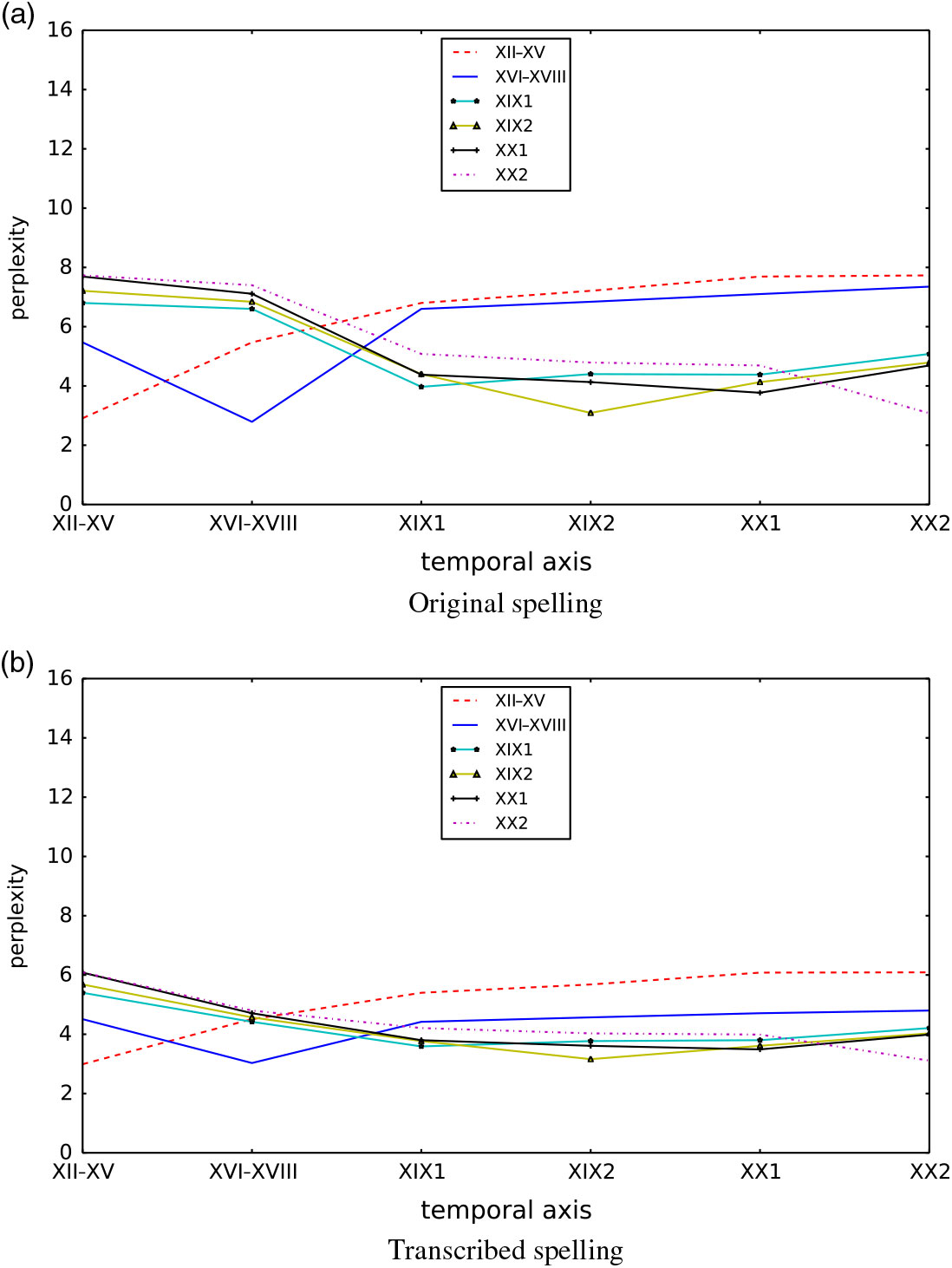
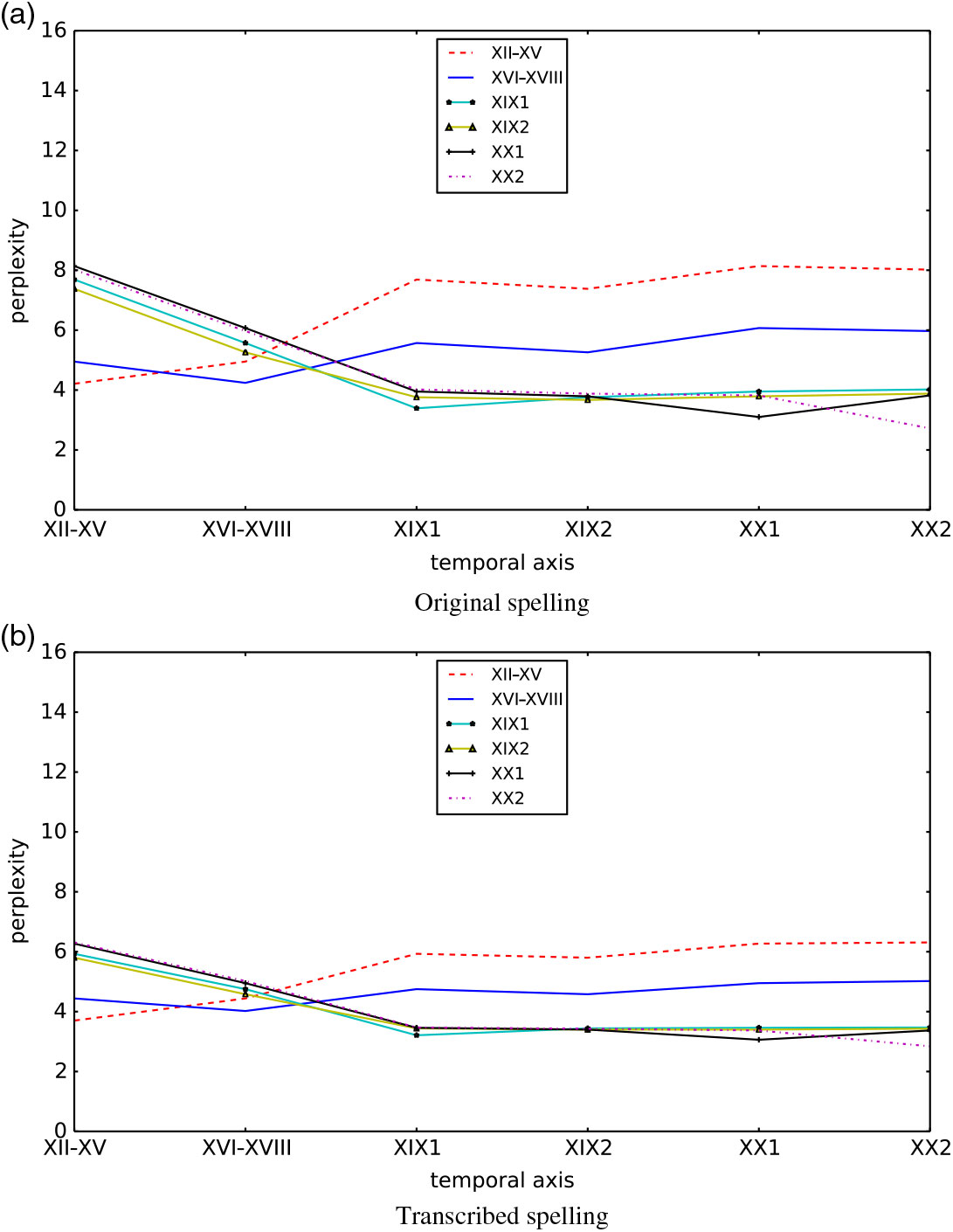
Finally, Figure 2(a) helps us see that the distance between the XIX and XXth centuries with regard to the two oldest periods (XII–XV and XVI–XVIII) is quite wide but quite similar. Hence, since the XIXth century, the two previous periods are seen as distant but almost indistinguishable.
In (a) we compare the Portuguese PLD distances between XII–XV and XX–2 across all periods in original spelling. In (b) the same comparison using a transcribed spelling.

5.2.2 PLD with transcribed spelling
In this new experiment on Carvalho–PT–PT_norm, the PLD distances shown in Table 11 are very similar to those of the previous experiment (Table 10). However, if we look carefully at Table 11, it can be observed that the orthographic transformation approximates some periods that were separated in the original orthography.
In Figure 2(b), we can see how the transformation of orthography turns a relevant leap between the Renaissance period (XV–XVIII) with respect to the 19th–1st and successive centuries, into a much shorter distance. Tables 10 and 11 show how the difference drops: with original orthography, the PLD distance between XVI–XVIII and XIX–1 is 6.60, by contrast, for the same periods, the distance drops to 4.42 with normalized spelling. This trend continues until the last half of the XX–2 century, where the PLD falls from 7.40 in original orthography to 4.80 n normalized one.
PLD diachronic measure in a common transcribed spelling (Carvalho–PT–PT_norm corpus.)

Finally, it can be observed that the differences in PLD between the periods XIX–1, XIX–2, XX–1, and XX–2 when orthography is normalized remain small but still distinguishable. The distance in the 4x4 sub-matrix from the 19th–1st period to 20th–2nd period has its maximum PLD value at 4.21 between the first half of the nineteenth century and the second half of the twentieth century, while its minimum PLD score is 3.61 between the second half of the nineteenth century and the first half of the twentieth century.
5.2.3 Discussion for Portuguese results
The XII–XV and XVI–XVIII periods have a PLD distance of 5.47 with the original orthography and 4.51 with the normalized spelling. From this, we can infer that the Portuguese of the middle ages (galego-português) and the Portuguese of the Renaissance, even if they keep some distance, have small orthographic differences.
Furthermore, it can be concluded that the distance between the medieval period and the second half of the twentieth century is not very high, taking into account both original and transcribed orthography. After spelling normalization this distance goes from 7.73 to 6.09. By considering the results reported in Gamallo et al. (Reference Gamallo, Pichel, de Compostela and Alegria2017b), this last score is in the same range as the distance between diatopic varieties or Ausbau languages (e.g., Bosnian-Croatian, PLD = 5.90). We could affirm that medieval Portuguese and Portuguese from the second half of the twentieth century are historical variants of the same language.
For the rest of the periods, we can infer that orthography is relevant in the first half of the nineteenth century to mark differences with the medieval and Renaissance periods. PLD distance between periods XVI–XVIII and XIX–1 goes from 6.60 (with original orthography) to 4.42 (with transcribed orthography). It is worth noting that, in the last quarter of XVIIIth century, Portuguese language started to deploy an etymological orthography very related to Latin and Greek (e.g., philosofia instead of filosofia).
We also see in Figure 2(a) and (b) that the distance, although small, between the different subperiods of the nineteenth and twentieth centuries with original orthography does not disappear if the orthography is normalized. From this, we can deduce that orthography is not totally relevant to keep significant distances in the nineteenth and twentieth centuries in European Portuguese.
To sum up, we may claim, on the one hand, that historically Portuguese, with a distance (PLD = 7.73) between the medieval period and the second half of the twentieth century in the original spelling, has a relevant distance. And on the other hand, if we take into account the PLD distances between the European languages reported in Gamallo et al. (Reference Gamallo, Pichel, de Compostela and Alegria2017b) built with a common transcribed orthography, and compare it with the distance in a common orthography for all periods of Portuguese, we can say that Portuguese, regarding its most distant periods (XII–XV vs XX–2: 6.09), is in the same range as the distance between diatopic varieties or languages Ausbau (e.g., Bosnian–Croatian, PLD = 5.90).
5.3 Spanish
Here, too, both experiments have been carried out. The first one consists in applying PLD measure on a Spanish historical corpus (Carvalho–ES–ES) and a second one applying the same PLD measure to the normalized documents.
5.3.1 PLD with original spelling
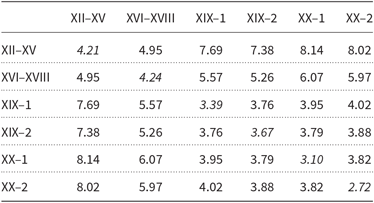
Table 12 shows that the Renaissance and Medieval periods are quite similar: only 4.95 between the two periods. However, between the medieval period and the first half of the nineteenth century (XIX–1), the PLD reaches 7.69, increasing progressively in later periods and reaching the maximum in the second half of the twentieth century (XX–2), with a PLD of 8.02.
PLD diachronic measure in original spelling (Carvalho–ES–ES corpus)

Besides, the differences in PLD between the periods XIX–1, XIX–2, XX–1, and XX–2 are small but distinguishable: almost 1 point, as in Portuguese. More precisely, the distance has a maximum PLD point of 5.08 between the first half of the nineteenth century and the second half of the twentieth century, and a minimum PLD point 4.13 of between the second half of the nineteenth century and the first half of the twentieth century.
In Figure 3(a), it can be clearly seen that the first half of the nineteenth century (XIX–1) is almost equally distant from the medieval period as from the Renaissance period. Finally, the XIX–1 period is almost linearly distanced from the rest of recent periods: XIX–2, XX–1, and XX–2.
In (a) we compare the Spanish PLD distances between XII–XV and XX–2 across all periods in original spelling. In (b) the same comparison using a transcribed spelling.

5.3.2 PLD with transcribed spelling
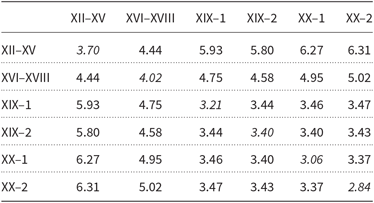
If we look at Table 13 we see that the orthographic transformation approximates in a significant way the medieval period and the Renaissance periods from the rest, as in Portuguese (recall that in English only the medieval period approached the rest with the transcribed orthography).
PLD diachronic measure in a common transcribed spelling (Carvalho–ES–ES_norm corpus.)

Table 13 shows that the Renaissance and Medieval periods continue to be very similar with a PLD of between the two periods. Furthermore, between the medieval period and the first half of the nineteenth century (XIX–1) the PLD decreases to 5.69, an important leap that increases progressively in later periods and reaches the maximum in the second half of the twentieth century (XX–2), with a PLD of 6.31, well below the PLD of 8.02 in original orthography.
Figure 3(b) shows more clearly how orthography is relevant for approaching the medieval (XII–XV) and Renaissance (XV–XVIII) periods with respect to the XIX–1 and successive centuries.
Finally, it is also observed that orthography unifies the distances of the four Spanish subperiods in the nineteenth and twentieth centuries, so the greatest PLD distance between these subperiods is just 0.1: it goes from 3.37 (lowest value) to 3.47 (highest value).
5.3.3 Discussion for Spanish results
The XII–XV and XVI–XVIII periods have a PLD distance of 4.95 in the original spelling and 4.44 in the normalized spelling. From this, it is deduced that the medieval Spanish and the Golden Age periods are not very different, and, in addition, there are no important spelling changes, as the transcription to a generic spelling does not influence the PLD distance. It can be stated that medieval Spanish and the Spanish of the Golden Age have not diverged too much.
On the contrary, it has been discovered that the distance between the medieval period and the second half of the twentieth century taking into account the original orthography is relevant (PLD = 8.02). If we normalize this orthography between all periods, this distance falls to 6.31. By considering the results reported in Gamallo et al. (Reference Gamallo, Pichel, de Compostela and Alegria2017b), the score in the second case, it is in the same range as the distance between diatopic varieties or Ausbau languages (e.g., Bosnian-Croatian, PLD = 5.90).
Looking at the PLD distance it can be stated that with original orthography, medieval Spanish and Spanish of the second half of the twentieth century might be considered as different but very close languages, and with transcribed orthography, these two Spanish periods become historical varieties of the same language.
It is also worth noting that there is an important distance (7.69 and 5.57) between the first half of the nineteenth century (XIX–1) with regard to both the medieval period (XII–XV) and the so-called Golden Age (XVI–XVIII). If we normalize orthography in all periods, there is no such distance, since it falls to 5.93 and 4.75, respectively. Therefore, it seems that, at the end of the XVIII century, the orthographic changes of the Real Academia Española, already commented in Section 4, had an impact on the distance between the oldest and the more recent periods concerning the original spelling.
On the other hand, as Figure 3 shows, orthographic normalization makes the distances between the four subperiods of the nineteenth century and the twentieth century minimal.
6. Final discussion
The medieval and Renaissance periods are not very distant in Portuguese and Spanish in both original and transcribed orthography (over 4.5 when the texts are normalized). On the contrary, in English there is a great difference between these two periods, even though the distance decreases considerably (PLD: 11.26 → 6.13) when we normalize orthographies. In case of Portuguese language, the difference between the two periods decreases a little when spelling is normalized (PLD: 5.47 → 4.51), but in the case of Spanish there are almost no differences (PLD: 4.95 → 4.44). Therefore, spelling is an important distance mark in English, while it is not very important in the case of Portuguese and Spanish for these two ancient periods.
Concerning the most distant periods (XII–XV and XX–2), the distance in English is very large, giving resulting in separate languages, particularly if we consider the original orthography. However, this distance is shortened by more than half with normalization (PLD: 15.85 → 8.81), being equivalent to the distance between the medieval period and XX–2 in original orthography in Spanish and Portuguese. Also, it can be observed that the orthographic normalization in Portuguese and Spanish gives rise now to significant changes bringing these language periods much closer. More precisely, Portuguese goes from 7.73 to 6.09 and Spanish from 8.02 to 6.31. The same trend is observed when comparing the medieval period with the other periods of the nineteenth and twentieth century.
The importance of the orthographic changes in Portuguese and Spanish is probably due to the official reforms of mid and late eighteenth century. In the case of Portuguese, the language of “Os Lusíadas” (XVI-XVIII) is much closer to the language of the first half of the nineteenth century with the transcribed orthography than with the original one. In the case of Spanish, the same situation is found: the recent periods have similar values with both original and transcribed spelling, but the distances are smoother with the transcribed text than with the original one.
Finally, in the case of English, it is observed that from the Renaissance to the present day this language does not undergo great changes, regardless of the original spelling being considered. This long period represents one block separated from the medieval period. On the contrary, in the case of Portuguese and Spanish, although languages are more compact in their history than English, there are two distinct historical blocks. A first block that encompasses the medieval (XII–XVI) and Renaissance (XVI–XVIII) periods, and a second block that encompasses the nineteenth and twentieth centuries, both marked by the emergence of Academies of Languages of prescriptive character. In the case of Portuguese with more orthographic variations than the second one.
7. Conclusions and future work
7.1 Conclusions
A new diachronic language distance measure, PLD, has been defined to measure the distance between historical language periods. This measure was previously used to calculate the distance between different languages at present (Gamallo et al. Reference Gamallo, Pichel, de Compostela and Alegria2017b) and diachronic language distance applied to a language (Pichel et al. Reference Pichel, Gamallo and Alegria2018), and as far as we know, this is the first attempt to use it to measure the distance between historical periods from a diachronic perspective for several languages: two related languages belong to the same linguistic family (European Portuguese and European Spanish) and one is more distant as it belongs to another family (European English). Thus, its application to both of them allows to quantify and compare its historical evolution as well as its main standardization changes over time.
From the experiments performed, let us conclude that medieval English is far distant from the rest of the historical periods of English, if the original orthography is considered. However, using a common transcribed orthography we see that the distance from the rest of the English periods decreases considerably, although not sufficiently to keep a significant distance from them. Therefore, the orthography in English is an important factor of separation between medieval and modern periods, but it is no longer a factor for change within the modern ones. Thus, it is noted that English has a soft and linear historical evolution since the Renaissance period (XVI–XVIII), similar to the one maintained in later centuries (XIX and XX) by Portuguese and Spanish.
By contrast, Spanish and Portuguese maintain a smoother and more linear evolution along all the historical periods, being the orthography an important factor of separation, especially between the periods of the nineteenth and twentieth centuries with respect to middle age and Renaissance (specially in Portuguese).
Therefore, taking into account the experiments, it can be stated that historical language distance is not only related to grammatical or lexical matters since orthography also helps to distance or approximate the different periods.
In addition to all these observations, one of the main contributions of this work is the compilation of freely available diachronic corpora for three languages in closer original spelling: Carvalho. These corpora have been collected from different open historical corpora and texts repositories,Footnote u.
7.2 Further work
Based on these results, we are planning to test PLD to measure inter-linguistic language distance to quantify the diachronic convergence/divergence among languages. For example, between languages that have had historical periods of convergence/divergence with other ones they are intimately related with: Spanish, Galician, and Portuguese; Serbian, Bosnian, and Croatian; Flamish and Dutch and Moldavian and Romanian. In order to do this, we will take into account works already done in Slavic languages that analyze the relationship between orthography and distance between languages such as Jágrová et al. (Reference Jágrová, Avgustinova, Stenger and Fischer2019), Stenger et al. (Reference Stenger, Jágrová, Fischer, Avgustinova, Klakow and Marti2017), and Jágrová et al. (Reference Jágrová, Stenger, Marti and Avgustinova2016).
In addition, our aim is to apply PLD to measure the synchronic and diachronic distance between diatopic varieties of languages such as Portuguese and Spanish (e.g., testing if the distance between Mexican Spanish and European Spanish is increasing or decreasing?)
Besides we would also like to investigate the relationship between the language distance using PLD and Quality estimation (Specia, Scarton, and Paetzold Reference Specia, Scarton and Paetzold2018).
Moreover, we aim at using PLD with different language models: for example, n-grams calculated from relevant linguistic words, more complex phonological rules modifying the spelling, word embeddings, etc.
Finally we will test our diachronic corpora Carvalho Footnote v with other divergence measures, namely Kullback–Leibler divergence (KLD). For this we will take into account the work of Pechenick et al. (Reference Pechenick, Danforth and Dodds2015) which studies how to validate corpora for analysis of cultural and linguistic evolution, the research performed by Bochkarev, Solovyev, and Wichmann Reference Bochkarev, Solovyev and Wichmann2014 where KLD is applied to Google Books Corpus to compare historically the change in the frequency distribution of words within one language and across languages. Also, Degaetano-Ortlieb and Teich (Reference Degaetano-Ortlieb and Teich2018) measure the diachronic change at the lexical and grammatical level in scientific writing and Barron et al. (Reference Barron, Huang, Spang and DeDeo2018) apply KLD to investigate how ideas evolve in Parliamentary transcripts of the French Revolution Corpus. Finally, KLD has been also used to measure the divergence between different social groups (old and young people, people with and without university studies, etc.) in relation to the language used (Iriarte, Gamallo, and Simões Reference Iriarte, Gamallo and Simões2018).
Acknowledgements
The authors thank the referees for their thoughtful comments and helpful suggestions. The authors are very grateful to Marcos Garcia of the University of A Coruña for his contributions to the development of the experiments. Special acknowledgments are due to Jose Antonio Souto Cabo and Carlos Quiroga of the University of Santiago de Compostela for their expertise in the history of Portuguese, Maria Isabel Fernandez Dominguez for her expertise in the history of Spanish, Teresa Moure Pereiro of the University of Santiago de Compostela for her contributions in linguistics, and Alfonso Barata Villapol for his bibliographical contributions on the history of the English language and proofreading support. This work has been partially supported by the DOMINO project (PGC2018-102041-B-I00, MCIU/AEI/FEDER, UE). It also has received financial support from the Conselleria de Cultura, Educacion e Ordenacion Universitaria (accreditation 2016-2019, ED431G/08), and the European Regional Development Fund (ERDF).