Introduction
Retirement used to be characterised as a definite and abrupt exit from the workforce after a long working career (Hardy Reference Hardy2002). Recently, however, it has come to be seen as a more dynamic and gradual transition from a working to a non-working life, where deliberate choices are made with respect to the timing of retirement and the preferred level of occupational activity (Wang et al. Reference Wang, Zhan, Liu and Shultz2008). This more dynamic process is protracted and leads to different outcomes depending on the specific regulations that apply, from early retirement through part-time retirement to re-entry into the labour force (Hardy Reference Hardy2002). Recent studies indicate that a substantial number of early retirees (i.e. older workers who leave the labour force before the mandatory retirement age) re-enter the workforce after early retirement (Henkens, van Dalen and van Solinge Reference Henkens, van Dalen and van Solinge2009). The reasons for returns are diverse: a need for social contacts and recognition as well as financial imperatives may contribute to the aspiration to remain active in the labour market (Kim and Feldman Reference Kim and Feldman2000; Wang et al. Reference Wang, Zhan, Liu and Shultz2008). While older workers have some agency about whether to retire from work or to enter self-employment (Bruce, Holtz-Eakin and Quinn Reference Bruce, Holtz-Eakin and Quinn2000), retired workers' prospects of returning to the labour force are largely determined by employers and the availability of jobs (Henkens, van Dalen and van Solinge Reference Henkens, van Dalen and van Solinge2009). A number studies have indicated that employers are more likely to retain older workers than to recruit them (Conen, Henkens and Schippers Reference Conen, Henkens and Schippers2011; Daniel and Haywood Reference Daniel and Haywood2007; McNair, Flynn and Dutton Reference McNair, Flynn and Dutton2007). Yet not much is known about the factors that affect managers' decisions to re-employ early retirees. The current study aims to fill this void. The main research question addressed is: what factors influence managers' decisions concerning the re-employment of early retirees?
Recent research among employers and employees has shown that stereotypes against older workers are widespread (van Dalen, Henkens and Schippers Reference van Dalen, Henkens and Schippers2010). Many studies demonstrate that employers often see older workers as inflexible and unwilling (or unable) to adapt to the changing work environment, less productive and more expensive than their younger colleagues (Chiu et al. Reference Chiu, Chan, Snape and Redman2001; Finkelstein and Burke Reference Finkelstein and Burke1998; Lee and Clemons Reference Lee and Clemons1985; Loretto, Duncan and White Reference Loretto, Duncan and White2000; Taylor and Walker Reference Taylor and Walker1998). Moreover, McCann and Giles (Reference McCann, Giles and Nelson2002) suggested that in many organisations the belief prevails that older workers want to retire as soon as possible. However, the same studies that present negative features of older workers also indicate that older workers are valued for their trustworthiness, specific knowledge and interpersonal skills (Chiu et al. Reference Chiu, Chan, Snape and Redman2001; Finkelstein and Burke Reference Finkelstein and Burke1998; Lee and Clemons Reference Lee and Clemons1985; Taylor and Walker Reference Taylor and Walker1998).
While older workers can still be valuable and valued employees, there is evidence that many older unemployed workers and early retirees who re-enter the workforce take up jobs in the secondary labour market: they tend to find jobs of a lower status than held previously and are engaged for fewer hours (Jorgensen and Taylor Reference Jorgensen and Taylor2008; Taylor and Walker Reference Taylor and Walker1998). It is not clear to what extent these outcomes reflect the preferences of retirees or are conditioned by employers. Evidence from the United Kingdom suggests that older workers prefer part-time jobs (Smeaton, Vegeris and Sahin-Dikmen Reference Smeaton, Vegeris and Sahin-Dikmen2010; Vickerstaff et al. Reference Vickerstaff, Loretto, Billings, Brown, Mitton, Parkin and White2008), but it has also been suggested that older workers who work part-time do so not as a result of free choice but rather because they lack opportunities to work full-time; many older workers indicate that they wish to increase their labour-market participation and work more (Taylor Reference Taylor, Chiva and Manthorpe2008).
Moreover, a recent study in The Netherlands has shown that a substantial number of early retirees re-enter the workforce after retirement, yet others failed to regain employment, even though they express a wish to re-enter the labour force (Henkens, van Dalen and van Solinge Reference Henkens, van Solinge and Cozijnsen2009). This raises the questions: What barriers to re-entry to the labour market do (early) retirees face? What characteristics enhance and limit the employability of early retires? As impediments to the re-entry of retirees into the workforce will become more important because of anticipated labour-force shortages, it is important to gain more understanding of the processes involved in their re-employment.
The study was carried out in The Netherlands, where labour-market policies have recently changed substantially, from the encouragement of early exits (supported by financially attractive early retirement programmes) to exhortations to work longer. The Netherlands is, however, still characterised by a strong early-exit culture and low job mobility among older workers (Organisation for Economic Co-operation and Development 2006). Age discrimination is one of the forces that are assumed to be behind these phenomena. A substantial number of retirees that retired before the mandatory retirement age of 65 years consider their transition into retirement as involuntary (van Solinge and Henkens Reference van Solinge and Henkens2007). Although the government has introduced specific macro-level regulations to combat age discrimination, Koppes et al. (Reference Koppes, De Vroome, Mol, Janssen and van den Bossche2009) showed that age discrimination is still seen as substantial in The Netherlands: the self-reported rate of age discrimination among older (55–64 years) workers is 20 per cent. In recent years, attempts have been made to increase the labour-market participation of older workers. Early-exit schemes have been tightened and the re-entry of (early) retirees is, in most cases, not restricted by labour-force regulations or law (i.e. employers can hire older workers even after the age of 65). Moreover, various tax reforms have been introduced: employers can receive a contribution to the sickness allowances for older workers as well as a tax reduction if they hire older workers (aged 50 or more years) or retain older workers already employed (aged 62 or more years) (for more details seeEuwals, De Mooij and Van Vuuren Reference Euwals, De Mooij and Van Vuuren2009). These policies were intended to simulate the labour-market participation of older workers, but it has yet to be seen whether employers' decisions have aligned with the revised macro-level policies.
The analysis reported in this paper focuses on how different characteristics of retirees and organisations affect the likelihood of re-employment of a given retiree. To investigate specific employment decisions, a factorial study was designed. This method allows the exploration of actions in context and clarifies people's judgements (Rossi and Anderson Reference Rossi, Anderson, Rossi and Nock1982). Factorial design offers an opportunity to simulate employment decisions regarding early retirees. More specifically, we examined virtual hiring decisions of Dutch managers and business students. This extends previous work in the field of employment decisions towards older workers where students were the primary respondents (e.g. Avolio and Barret Reference Avolio and Barret1987). Students may have theoretical knowledge and familiarity with the issues under discussion but little or limited practical experience. Our focus on students and managers allowed us to explore the differences between them in how they perceived older workers and the ways in which they evaluated early retirees.
The remainder of this article is organised as follows: the next section presents the theoretical background and introduces the hypotheses tested, and the section following discusses the methods of data collection and the study design. The results of the analysis are then discussed and finally the conclusions are presented.
The determinants of hiring desirability
A basic tenet of organisational theory is that organisations are goal-oriented systems that strive towards profit maximisation, continuity and maintaining a healthy market position (Kalleberg et al. Reference Kalleberg, Knoke, Marsden and Spaeth1996). Managers are supposed to contribute towards these goals by realising high production levels and low costs, low absenteeism and good labour relations, and by nurturing good sources of knowledge and contacts. Similarly, the achievement of organisational goals depends on recruiting qualified staff (Kalleberg et al. Reference Kalleberg, Knoke, Marsden and Spaeth1996). Managers are expected to react to organisation workforce shortages by choosing the best candidates from those who apply. In the selection process, the costs and benefits of hiring different people are evaluated. Managers take these decisions under uncertainty, as individual productivity capabilities are not known at the time an employer hires an applicant (Phelps Reference Phelps1972; Spence Reference Spence1973). Moreover, because workers often change positions over their lifecourse, it is difficult to assess the productivity in and skills for different occupations. Managers deal with this uncertainty by evaluating a combination of observable attributes (Phelps Reference Phelps1972; Spence Reference Spence1973). Successful applicants are thus the ones believed to be the most capable of fulfilling the assigned tasks. The same mechanism applies to the employment of early retirees. A manager decides to hire an early retiree if he or she is expected to contribute well towards achieving the organisation's goals.
The decision regarding the hiring of retirees is generally taken by a manager or supervisor but is always embedded in the broader context of a dynamically changing organisation. Macro-level developments (e.g. economic changes and labour-force shortages) influence the managers' choices. When organisations shed jobs during an economic downturn, managers are assumed to assign less priority to hiring retired workers. Hiring retirees has been seen as hampering the work prospects of younger workers and in conflict with norms of generational employment equity. On the other hand, managers facing structural or incidental labour-force shortages may be inclined to hire retirees as a remedy. Therefore we expect that managers are more inclined to hire early retirees when the organisation faces labour-force shortages.
Moreover, organisations facing incidental labour-force shortages may require short-term or project-based support. In such situations, staff that accept on-call arrangements, i.e. they work only as needed (DiNatale Reference DiNatale2001), are required or preferred. There is some evidence that employers are prone to offer older workers part-time, flexible positions (Taylor Reference Taylor, Chiva and Manthorpe2008). On-call arrangements are attractive to organisations because they enable erratic staffing needs to be met without the commitment of permanent employment. Consequently, we expect that managers are more likely to hire retirees who accept on-call contracts.
Hiring decisions also involve the evaluation of an applicant's various attributes. Human capital is one of the most important features considered at the time. In line with human capital theory (Becker Reference Becker1975), investments in human capital are mostly during a person's education, although the skills and experience that accumulate over a long working career have a strong influence on the individual's productivity in different roles (Thurow Reference Thurow1975; Van Eijs and Heijke Reference van Eijs, Heijke, Heijke and Muysken2000). This job-specific experience is an important influence on managers' selections. Thurow (Reference Thurow1975) found that managers take into account potential training cost differences and favour candidates who require less training. The costs of hiring a retiree whose skills and experience are in alignment with the job requirements are significantly lower than those without the matching skills. Consequently, we expect that managers are more likely to hire retirees who apply for a position that is similar to their previous occupation.
Human capital accumulated during one's educational and professional careers is an important indicator of an early retiree's potential productivity. Further ‘investment’ in human capital can build it up, but if there is none, deterioration is likely. As indicated by Blanchard and Summers (Reference Blanchard, Summers and Fischer1986), unemployed workers lose the opportunity to maintain and update their skills. By the same token, the human capital of an early retiree may become more and more obsolete the longer they are out of the workforce. Various studies show that employers perceive obsolete skills to go hand-in-hand with lower productivity (Remery et al. Reference Remery, Henkens, Schippers and Ekamper2003; Taylor and Walker Reference Taylor and Walker1994). This, in turn, may result in less support for hiring an early retiree. Therefore we expect that managers are less inclined to hire early retirees who have been absent from the labour force for longer periods.
The health of an older worker is regarded as an important predictor of retention, and we assume that when evaluating the desirability of hiring an early retiree, managers consider the applicant's health condition. Poor health puts the productivity of the worker at risk and cast doubts about performance continuity. Although research shows that older people are less often absent due to sickness, but that once ill they need more time to recover (Gellatly Reference Gellatly1995; McCann and Giles Reference McCann, Giles and Nelson2002). Also, their illness is likely to be more severe and consequently the duration of absenteeism is higher. As a result, managers may be reluctant to hire retirees whose health condition casts uncertainty about performance continuity. We expect therefore that managers are more inclined to hire early retirees who are in good health.
A not necessarily related characteristic is the age of an early retiree. Although age discrimination is prohibited in The Netherlands, it is well established in the literature that there are negative stereotypes about ‘older workers’. They are deemed to suffer more often from health deterioration, and thought to be less productive and less willing to be trained (Chiu et al. Reference Chiu, Chan, Snape and Redman2001; Finkelstein and Burke Reference Finkelstein and Burke1998; Finkelstein, Burke and Raju Reference Finkelstein, Burke and Raju1995; Hassel and Perrewe Reference Hassell and Perrewe1995; Henkens Reference Henkens2005; Taylor and Walker Reference Taylor and Walker1994, Reference Taylor and Walker1998; Warr and Pennington Reference Warr, Pennington, Taylor, Walker, Casey, Metcalf, Lakey, Warr and Pennington1993). While only a few studies have examined the different stereotypes held about workers aged in the fifties as compared to the early sixties (McGregor and Gray Reference McGregor and Gray2002), we assume that negative stereotypes are associated with greater age. Therefore we expect that managers are more inclined to hire younger early retirees.
The last influence on the propensity to hire a retired worker that we have taken into consideration is the disposition of the retiree to re-enter the workforce. The motivation to return to an occupational career, demonstrated by sending an unsolicited application, might be a positive sign of the retiree's employability and self-management (Fugate, Kinicki and Ashforth Reference Fugate, Kinicki and Ashforth2004). This proactive attitude in search of a position that matches the applicants' preferences and skills contradicts the stereotypical image of an older person as being inactive (Berger Reference Berger2009; Chiu et al. Reference Chiu, Chan, Snape and Redman2001; Loretto and White Reference Loretto and White2006; Taylor and Walker Reference Taylor and Walker1998). This, in turn, may positively influence a manager's attitude towards the hiring of an early retiree. Consequently, we expect that managers are more likely to hire retirees who send an unsolicited application.
Methods
To answer the research question that we have posed, a vignette study was administered to both managers and business students. A vignette study (factorial survey) is a method used to investigate human actions (Ganong and Coleman Reference Ganong and Coleman2006; Wallander Reference Wallander2009). The basic item of the survey is a vignette – a card with a short description of a situation or a person, generated by combining characteristics randomly manipulated by the researcher (Ganong and Coleman Reference Ganong and Coleman2006). An important requirement is that the number of characteristics is restricted because participants typically are unable to process large amounts of information. If too many dimensions are introduced, it becomes difficult for the participant to visualise the hypothetical person and the situation clearly (Rossi and Anderson Reference Rossi, Anderson, Rossi and Nock1982). In our study, hypothetical retired job applicants were described by several individual characteristics and the hiring decision was placed in a specific organisational context. Each participant was presented with a set of unique vignettes and asked to make hiring decisions regarding the various hypothetical applicants. By randomly varying the characteristics of the virtual applicant, it is possible to determine the weight that respondents attach to each.
The participants
The survey among managers and students was conducted in 2009. First, a vignette survey was administered to eight managers who attended a focus group meeting on the re-employment of older workers held in May 2009 at The Netherlands Interdisciplinary Demographic Institute (NIDI) (for details seevan Dalen et al. Reference van Dalen, Henkens, Lokhorst and Schippers2009). Conducting vignette experiments during a focus group meeting is common practice (Beaulieu et al. Reference Beaulieu, Hudon, Roberge, Pineault, Forté and Légaré1999). To increase the number of raters and the potential generalisability of the findings, managers from both public and private-sector organisations were approached using snowball sampling techniques. Snowball sampling has proved to be a valuable method of data collection for groups that are difficult to reach (Salganik and Heckathorn Reference Salganik and Heckathorn2004), as is often the case with managers. In total, 20 managers (12 males, eight females, mean age 42 years) took part in the study. The managers worked in different employment sectors: education (two), services (three), public administration (five), health services (two), construction (three), retail (two), and information and communication (three). All of the managers come from the Randstad (a conurbation in the south-west of The Netherlands which is the country's commercial and economic hub: it includes the four largest Dutch cities).
In April 2009, the survey was also administered to business students of Utrecht University. In total, 17 students participated in the study (11 males, six females, mean age 21 years). In the field of personnel psychology, students are often used as respondents (Sears Reference Sears1996). Although they may lack hands-on experience, business students take courses on personnel management, which prepares them for the role of manager. Furthermore, current business students have been confronted with the problems of an ageing society and prospects of their own extended work careers. Both education and generational experience may influence their judgement regarding the hiring of early retirees. To reiterate, the overall intention was to compare students' and managers' hiring practices and decisions.
Study design
The vignette study examined the factors that affect managers' and students' decisions to hire virtual early retirees. The instruction was:
Current general labour-force shortages mean that there may be limited opportunities for recruiting new workers. Below are various descriptions of early retirees who would like to work for your organisation. For each profile, please indicate the likelihood that you would be willing to hire this person?
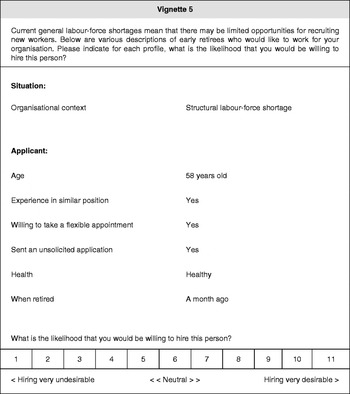
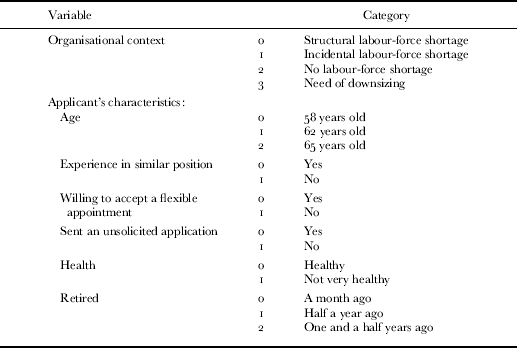
The independent variables used in the construction of the vignettes were: organisational context (e.g. organisation faced: structural labour-force shortage, incidental labour-force shortage, no labour-force shortage, need for downsizing); willingness to accept an on-call appointment (yes/no); experience in a similar position (yes/no); length of retirement (retired one month ago, half a year ago, or one and a half years ago); health condition (healthy/not very healthy); applicant's age (58, 62 or 65 years old); and, whether a retiree has sent an unsolicited application (yes/no) (see Table 1 for an overview). Given the seven dimensions and their variable number of categories, the possible number of unique combinations or vignettes (the vignette universe) was 576 (i.e. 4×2×2×3×2×3×2). Contrary to a factorial design in which all possible combinations are evaluated, in a vignette survey only a random selection from the vignette universe is judged by respondents (Wallander Reference Wallander2009). This makes it possible to include a larger number of vignette dimensions and levels in the design, thereby enhancing the resemblance between the real and experimental worlds (Wallander Reference Wallander2009). In our study, each participant received a random sample of 12 vignettes and rated items on 11-point scales, ranging from ‘1’ (hiring very undesirable/low priority) to ‘11’ (hiring very desirable/high priority). For an example of a vignette, see Figure 1.
An example vignette.

The organisational contexts and job applicant's characteristics in the vignette
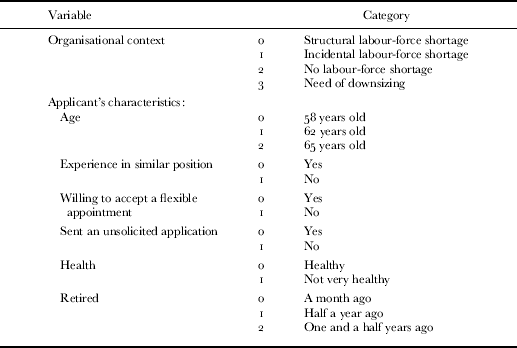
Analysis
The unit of analysis is the vignette (Ganong and Coleman Reference Ganong and Coleman2006). The total number of observations in this study is 240 for the managers' sample and 204 for the students' sample. We used ordinary least-squares multivariate linear regression analysis to determine which characteristics played a role in the respondents' assessments of the desirability of hiring the virtual older retirees. In order to control for a design effect, we adjusted for clustering at the participant level. We applied robust regression analysis, using the SURVEY command in STATA (Stata 2003). Without controlling for design effects, we would be likely to produce standard errors that are much smaller than they should be. To test for group differences between the managers and students, we used a Chow test of equality between coefficients (Gould Reference Gould2002). All independent variables used in the analysis were coded as dummy variables. Variables that originally contained three or four categories (e.g. organisational context, age of early retirees and length of retirement) were also transformed into dummy variables representing each category and were included in the analysis with one category serving as a reference category. The dichotomous coding of each level of each predictor through means the magnitude of each observed slope provides meaningful information as to the magnitude of the respondents' ratings. Consequently, the weights estimated for each factor included in the analysis are comparable to one another. This applies not only to comparisons between the different characteristics (e.g. the weights assigned by the managers to experience and to health), but also to the comparisons between managers and business students (i.e. whether managers and business students rated characteristics differently).
The findings
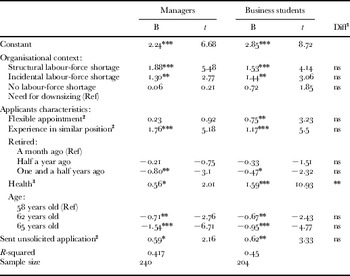
Table 2 presents the results. The first column shows the results from the managers and the second column those from the students. The impact of the organisational context on the hiring decisions of managers was in line with our expectations. Both managers and students were more inclined to hire early retirees if an organisation faced structural labour-force shortages, as compared to the reference category (organisation needed to shed jobs). The desirability of hiring was less pronounced in organisations that faced incidental labour-force shortages but was still positive and significant as compared to the reference category. The context of institutions that faced no labour-force shortages or that needed to shed labour did not affect the managers' and students' decisions significantly. In other words, the hiring of older retirees was most likely to occur when an organisation faced structural or, to a lesser extent, incidental labour shortages.
Multivariate regression of the impact of organisational and individual characteristics on the chance of hiring early retirees

Notes: Ref: reference category. 1. Difference between coefficients. 2. 1=yes, 0=no. 3. 1=healthy, 0=not very healthy.
Significance levels: * p<0.05, ** p<0.01, *** p<0.001, ns: not significant.
With respect to the retirees' willingness to accept on-call contracts, a discrepancy was evident between the managers' and students' evaluations. Whether a retiree was willing to accept an on-call contract did not affect a manager's decision-making process significantly. Students were more inclined, however, to hire retirees who were willing to work flexibly. The applicants' human capital was of great importance for the retirees' chances for re-employment. The managers were more inclined to recruit early retirees who had experience in a similar position to that applied for. Among students, also, the experience of the retiree played an important role in their assessment of the desirability of hiring.
While accumulated human capital increased the managers' disposition to re-employ, its potential decline – as indicated by longer absence from the labour force – diminished hiring desirability. Managers' propensity to hire retirees was not affected by a retiree's absence of half-a-year as compared to one month, but the managers were much less likely to hire somebody who had been unemployed for more than one and a half years (as compared to the reference category). A similar pattern held for the student sample. With regard to the applicants' health, both managers and students were more inclined to hire early retirees with good health. In fact, health condition was found to be the most important influence on the hiring decisions of the business students.
We also investigated how the age of the early retirees affected managers' and students' willingness to recommend re-employment. In line with our hypothesis, higher age negatively related to managers' and students' willingness to hire early retirees. Managers were much less inclined to hire a retiree aged 62 years than one aged 58 years (the reference category). Retirees at the age of 65 obtained the lowest score, in both managers' and students' samples. While this pattern was similar from both samples, the respective scores show that managers were more negative about hiring the oldest early retirees. The last aspect considered was the perceived disposition of retirees to re-enter the workforce. The results confirm the hypothesis: both managers and students were more inclined to hire an early retiree who had sent an unsolicited application. Although all vignettes presented profiles of applicants motivated to return to the labour force, the raters were more likely to select those who took additional action to gain employment. In other words, this extra activity on the part of early retirees ‘paid off’.
Hiring desirability
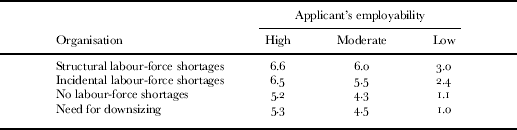
To gauge the priorities that managers assigned when deciding whether to hire early retirees, the ‘hiring desirability’ scores for different groups of applicants were calculated. Based on the employability of applicants, i.e. the ability of a person to gain and maintain employment and to change jobs (Fugate, Kinicki and Ashforth Reference Fugate, Kinicki and Ashforth2004), we distinguished three categories: ‘high’, ‘moderate’ and ‘low’ employability. A retiree with high employability was identified as an applicant who had experience in a similar position, retired a month ago, was healthy, 58 years old, and had sent an unsolicited application. Moderate employability referred to an applicant who had experience in a similar position, retired no more than half-a-year ago, was healthy, 62 years old, and had sent an unsolicited application. Low employability described an applicant who did not have experience in a similar position, retired at least one and a half years ago, was healthy, 65 years old, and had sent an unsolicited application. The scores for each category of retirees were computed and are presented in Table 3.
Hiring desirability of different categories of early retirees – managers' scores
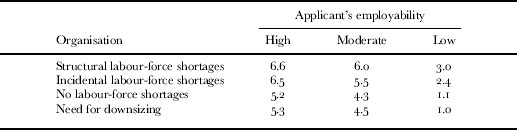
In general, the managers displayed only a moderate disposition to hire the retirees. Even for the applicants of the highest employability, namely with all characteristics favourable, and for organisations facing structural labour-force shortages (as in the example shown on Figure 1), the overall mean ‘desirability of hiring’ score was 6.6 on a scale from 1 to 11. This score has almost a neutral value. For retirees with different and therefore less favourable profiles, the scores were lower, and they were lowest for the applicants with low employability, indicating that re-employment was seen as undesirable or very undesirable. We also observed that virtually identical low scores were assigned to the various applicant profiles in organisations with no labour-force shortages and that needed to downsize.
Differences between managers and students
The results of the vignette study show that when making decisions about the desirability of hiring of retirees, managers and business students evaluated similar factors in the same way but with some differences in weights. To indicate whether business students differed significantly from managers in their assessments, and the extent to which there were significant differences in their evaluations of the various vignette characteristics, we examined the regression coefficients and used the Chow test (Gould Reference Gould2002). Interestingly, managers did not attach as much importance to health status as business students (managers B=0.56, students B=1.59, F (degrees of freedom 1, 420)=11.19, p<0.001). In fact, the retiree's health condition was the most important factor affecting students' evaluations of hiring desirability. Other factors related to individual and organisational attributes did not differ significantly, indicating that fairly consistent weights were assigned by both groups of evaluators.
Discussion and conclusions
This study has investigated the factors that affect decisions to recruit early retirees. The research question was: what are the factors influencing managers' decisions of re-employment of early retirees? A vignette survey was used to collect data on the hiring decisions of managers and business students. In the vignette survey, profiles of hypothetical retirees were presented to the participants who accordingly made recruitment decisions. The analysis focused on the impact of organisational labour-force shortages and various characteristics of potential applicants on managers' propensity to hire early retirees. Multivariate regression tools for clustered data were applied to analyse the data and the weights assigned to each factor were assessed.
It has been shown that managers' employment hiring decisions about early retirees are affected by the organisational context. Managers in organisations facing structural or incidental labour-force shortages are more inclined to hire early retirees, while this issue is irrelevant in other organisations. The results suggest that re-employment comes into the picture only when organisations have recruitment problems, which corroborates earlier evidence. Remery et al. (Reference Remery, Henkens, Schippers and Ekamper2003) suggested that although Dutch managers do not actively recruit older workers, a significant share would consider doing so in the case of labour-force shortages, because other sources can quickly ‘run dry’. Our results imply that while labour-force shortages may be beneficial to early retirees' employment prospects, their chances for re-employment are low when labour-force supply is sufficient and positions can be filled by younger applicants.
Considering the individual characteristics of the applicants, we found that experience in a position similar to that applied for increases the chance of re-employment. While this aspect contributed significantly to managers' approval, there is another side to the coin: if managers highly value specific forms of human capital, they may be less willing to employ retirees without the endowment. This suggests that the opportunity structure available for retirees is contingent on earlier work experience and, moreover, that access to different occupations is limited. With respect to the age of retirees, our study has clearly shown that despite anti-discrimination policies, managers' assessments are still greatly influenced by age, and were much less inclined to employ older than younger early retirees. This finding puts into perspective employees' and job applicants' complaints about age discrimination. As shown by Koppes et al. (Reference Koppes, De Vroome, Mol, Janssen and van den Bossche2009), older workers often indicate they are subjected to age-related discrimination, and Berger (Reference Berger2009) found that applicants perceive age discrimination in selection processes. Our results suggest that such complaints may reflect actual hiring practice, and that recruitment has not yet implemented anti-discriminatory public policies.
The influence of perceived attitudes of retirees towards re-employment – represented by sending an unsolicited application – was also found substantial. As illustrated in a recent study by Henkens, van Solinge and Cozijnsen (Reference Loretto, Duncan and White2009), a worker's perceived motivation to retire was an important weight in managers' decisions of whether to retain them (or to advise early retirement). In a similar vein, Sterns and Kaplan (Reference Sterns, Kaplan, Adams and Beehr2003) emphasised the importance of skills maintenance for the employment success of older workers. The prominence of retirees' self-management is also evident in our findings, because it swayed managers to consider hiring retirees. This result suggests that managers value applicants whose profile promises continuing employability. Moreover, this result implies a more active role of retirees in the re-employment process; their employment chances may be more influenced by their own circumstances than the managers' preconceptions or structural constraints. Also, the managers' and students' decisions regarding early retirees clearly show the importance of employment continuity. The results suggest that only a short absence is tolerated; longer episodes of unemployment are punished. This implies that early retirees who are not able to regain employment soon after retirement are at risk of a permanent and involuntary exclusion from the labour force.
Another issue addressed in the paper is the differences between the managers and the business students in their assessments of the desirability of hiring early retirees. We found that they differed primarily with respect to the weight assigned to an applicant's health, for on no other factor did a significant difference emerge. For the students, health condition was the most important influence on their judgement. Most were probably young and healthy, which may have predisposed them to see good health as a prerequisite for employment.
We conclude with some methodological remarks. As is true of studies conducted in laboratory settings, one advantage of a factorial survey is that the researcher controls the various levels of the independent variables. Factorial surveys are therefore very suitable for investigations of issues that are normally difficult to examine because they are rare events or involve complex multi-attribute situations. A clear advantage of this method is that a relatively small number of respondents create a large data set with which to analyse a complex decision-making process (Ganong and Coleman Reference Ganong and Coleman2006; Wallander Reference Wallander2009). The method also has some disadvantages, however, with the major limitation being that the respondents assess a hypothetical situation. The participants may act or decide in ways that would be different in a real-life situation. Another limitation of the particular application was the relatively few participants, which did not allow the incorporation of either their characteristics (e.g. gender and age) or those of the companies. Combining a large-scale survey and a vignette study would increase the possibility of disentangling the different aspects of the hiring process. This design, with a considerably larger sample of the managers, would permit the application of multilevel modelling and consequently answer the research questions more adequately. Also, our study did not allow a more comprehensive exploration of managers' attitudes towards different facets of flexible working arrangements (e.g. part-time versus full-time or permanent versus temporary posts). Clearly, these issues deserve more attention in future research.
Moreover, our study did not take the gender of the early retiree into account for country-specific reasons. The employment of older women is rather limited in The Netherlands, and so few women can or intend to return to the labour force. The predominant picture in the Dutch context is thus the one of the male early retiree. We recognise, however, that with current changes in the labour market and the increasing participation of women, future research will need to examine gender-related differences in hiring practices (Duncan and Lorreto Reference Duncan and Loretto2004).
The findings show that early retirees are not received with open arms by employing organisations; in the best case, managers are moderately positive about hiring them, but overall the likelihood of hiring early retirees is relatively low. This is an important observation in view of the changing dynamics of retirement in The Netherlands. As indicated before, labour-market exits are changing, but which new trajectories and patterns become available depend largely on employers' and managers' support. Our study demonstrates that managers are hindering the dynamics of change by restricting the re-employment of people who are around the retirement age.
Acknowledgements
The authors would like to thank Douglas Hershey and colleagues at NIDI for their valuable comments on the earlier drafts of the paper.