1. Introduction
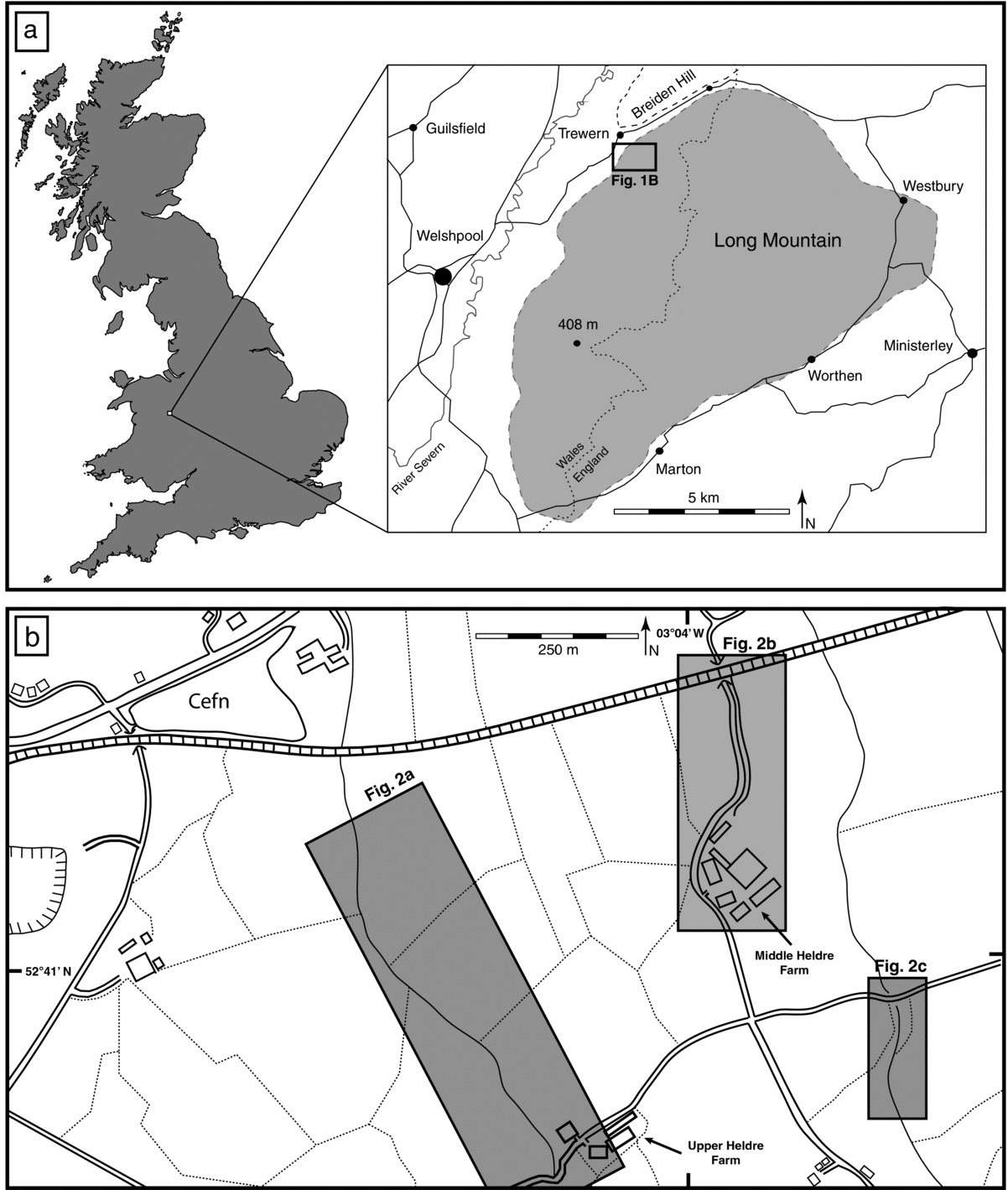
Traditionally, graptolites have provided a high-resolution biostratigraphy for rocks of Ordovician and Silurian age in Wales (Rushton, Reference Rushton1990; Zalasiewicz, Reference Zalasiewicz1990; Zalasiewicz et al. Reference Zalasiewicz, Taylor, Rushton, Loydell, Rickards and Williams2009). More recently, chitinozoans have been used, often in conjunction with graptolites, to evaluate Upper Ordovician (Vandenbroucke, Rickards & Verniers, 2005; Vandenbroucke, Reference Vandenbroucke2008; Vandenbroucke et al. Reference Vandenbroucke, Hennissen, Zalasiewicz and Verniers2008a, Reference Vandenbroucke, Williams, Zalasiewicz, Davies and Waters2008b, Reference Vandenbroucke, Ancilletta, Fortey and Verniers2009), Llandovery (Mullins & Loydell, Reference Mullins and Loydell2001, Reference Mullins and Loydell2002; Davies et al. Reference Davies, Waters, Molyneux, Williams, Zalasiewicz, Vandenbroucke and Verniers2013), Wenlock (Verniers, Reference Verniers1999) and Ludlow successions (Sutherland, Reference Sutherland1994) of the Welsh Basin and its margins. This paper examines chitinozoan distribution patterns through the uppermost Wenlock and lowermost Ludlow strata of the Long Mountain, Powys, Wales (Fig. 1a). In particular, it attempts to provide a more high-resolution definition of the Wenlock–Ludlow boundary beds in rocks where graptolites are only sporadic in their occurrence. The Silurian succession of the Long Mountain comprises upper Llandovery, Wenlock and Ludlow strata that include laminated, intermittently graptolitic mudstones formed on the palaeoslope of the Early Palaeozoic Welsh Basin to the west of the Church Stretton Fault (Cherns et al. Reference Cherns, Cocks, Davies, Hillier, Waters, Williams, Brenchley and Rawson2006). The Wenlock succession includes some 450–475 m of hemipelagic and graptolitic mudstones of the Trewern Brook Mudstone Formation, which incorporates the burrow-mottled and shelly lithofacies of the Mottled Mudstone Member in its upper part (D. Palmer, unpub. PhD thesis, Trinity College, Dublin, 1972; Cave, Reference Cave2008). The Trewern Brook Mudstone Formation is succeeded by graptolitic mudstones of the lower Ludlow Gyfenni Wood Shale Formation, and in turn by the Irfon Formation (see Cave, Reference Cave2008). Systematic collecting through the upper Wenlock and lower Ludlow succession has identified some 48 chitinozoan species that can be used to recognize four chitinozoan biozones, two subzones and an interregnum. The chitinozoan biozones can be correlated with the existing graptolite biozones in the Long Mountain (D. Palmer, unpub. PhD thesis, Trinity College, 1972), and together these provide a high-resolution tool for correlating the late Wenlock – early Ludlow succession in the Welsh Basin with those of the stratotype area in the Welsh Borderland.
(a) Location of the Long Mountain sections. (b) Schematic map of the wider Cefn area showing the specific location of the Long Mountain sections. Coordinate lines are shown. See Figure 2 for legend.

2. Methods
2.a. Sections studied
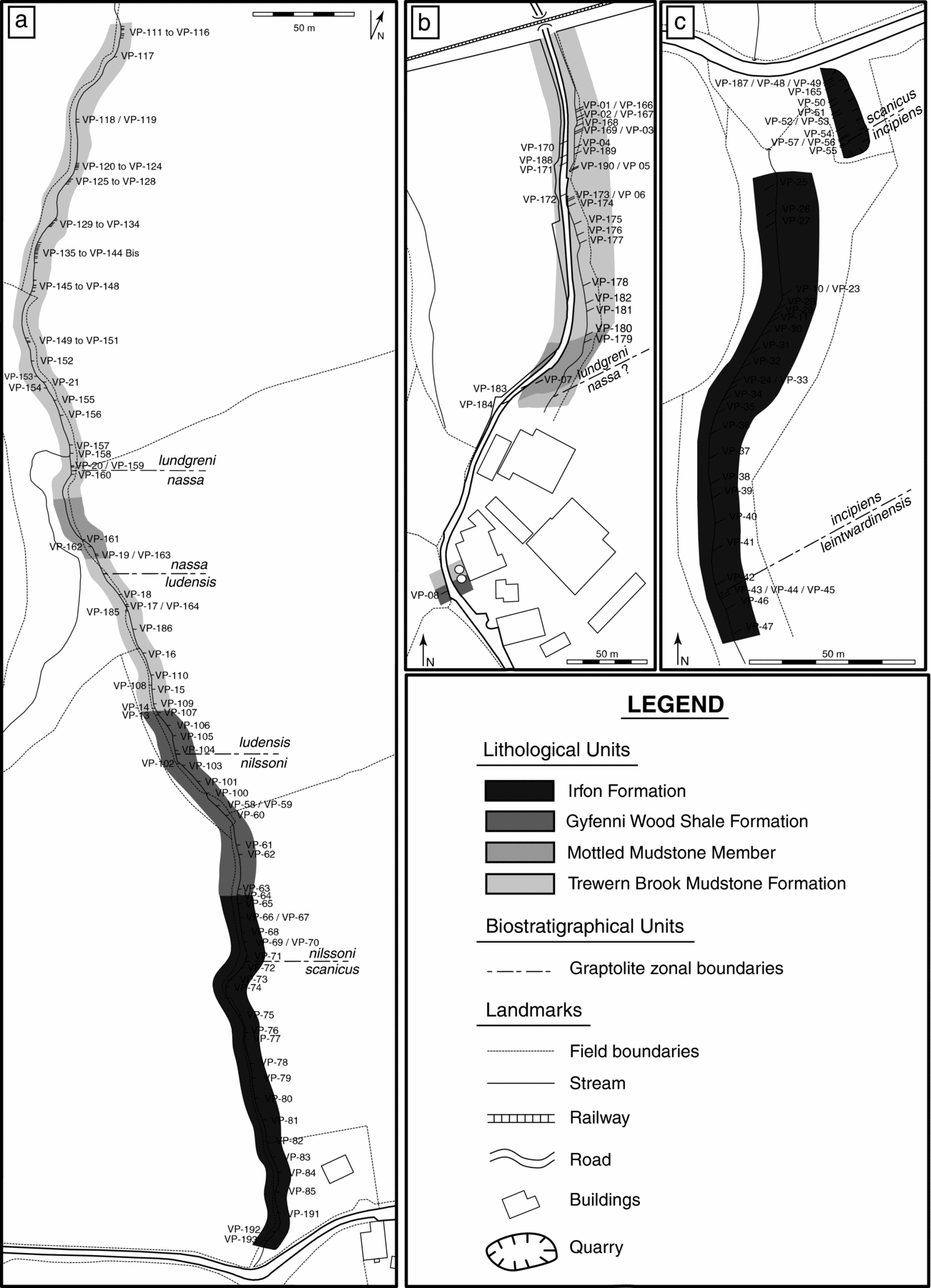
Three stream sections were selected for study (Fig. 1b): Upper Heldre (Fig. 2a), Middle Heldre (Fig. 2b), and Brunant (Fig. 2c). Palmer (unpub. PhD thesis, Trinity College, 1972) sampled all three sections for graptolites, and we have largely followed his account of the graptolite biostratigraphy. In transferring graptolite data from Palmer's original observations plotted onto old Ordnance Survey maps to modern OS maps, there is the possibility of some positional error being introduced. We have attempted to reduce this error by recognizing particular geographical features that are common between the different generations of maps. We have also compared the graptolite biozonation of Palmer with respect to the position of formation boundaries recently mapped by the British Geological Survey through this region of Wales (see Cave & Waters, Reference Cave and Waters2008) and with our own systematic field collections. This information is summarized in Figures 2–5.
Sampling points for (a) the Upper Heldre section, (b) the Middle Heldre section and (c) the Brunant section. Graptolite biozonal and lithostratigraphic boundaries, mapped by Palmer (unpub. PhD thesis, Trinity College, 1972) and by the British Geological Survey (see Cave & Waters, Reference Cave and Waters2008) respectively, are also shown. VP – samples collected by the authors during the spring and summer of 2013.

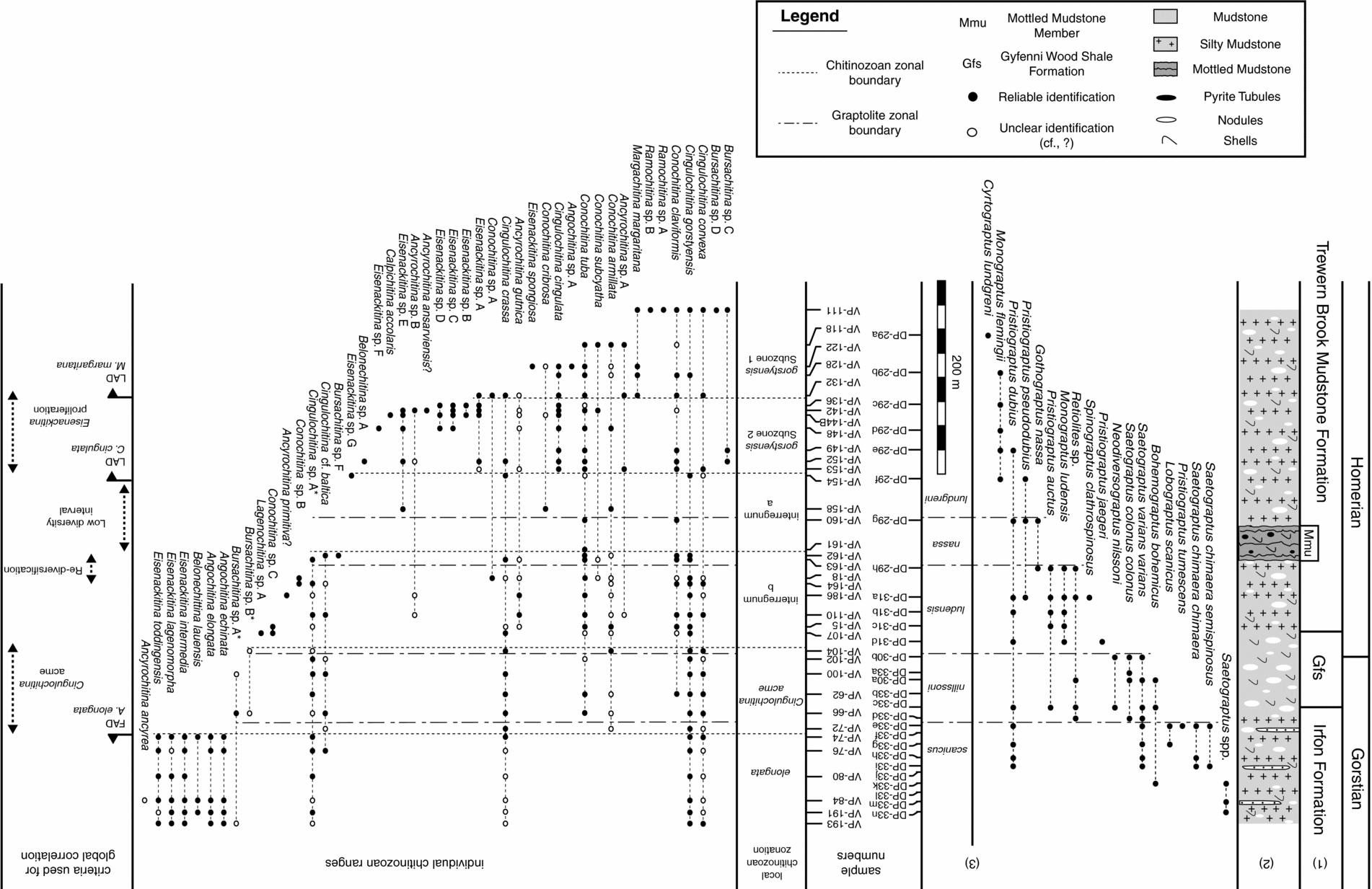
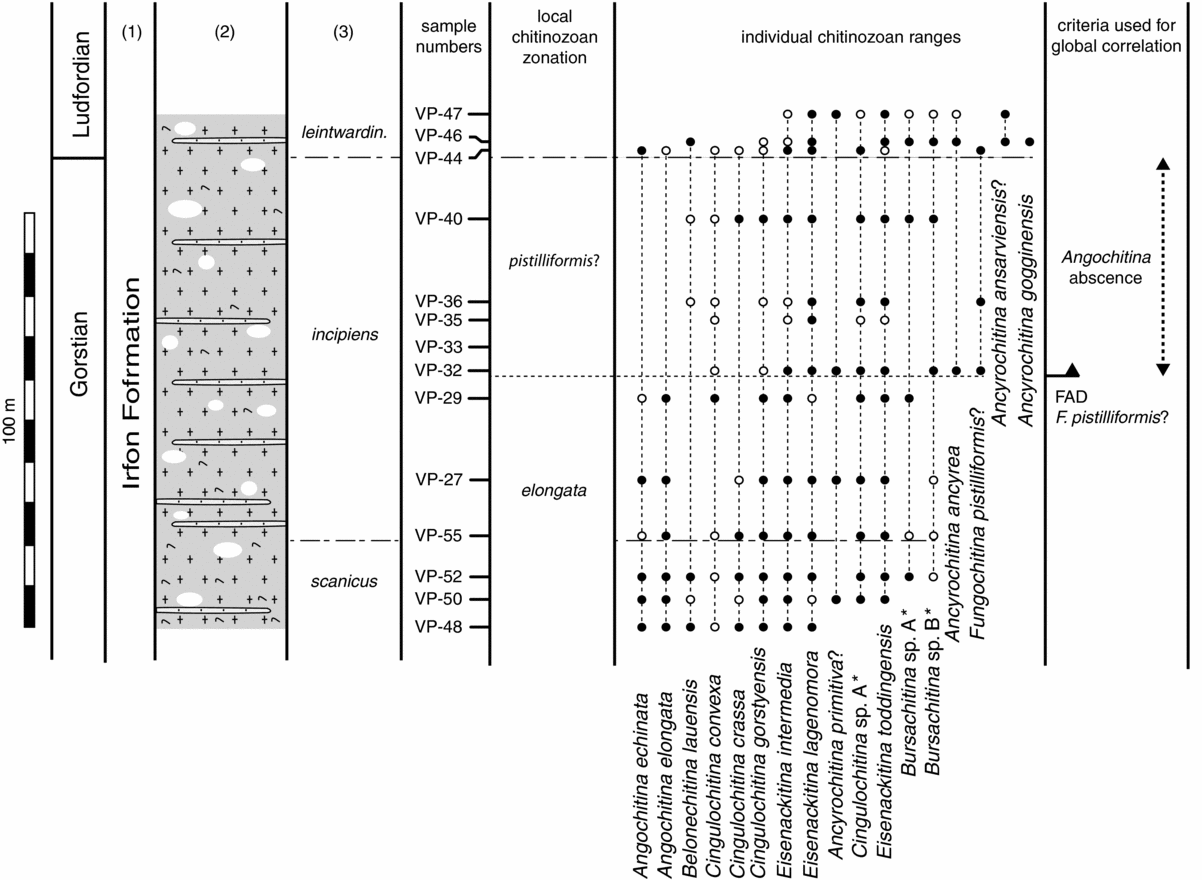
Distribution of chitinozoans in the Upper Heldre section. (1) Lithostratigraphic units after Cave & Waters (Reference Cave and Waters2008). (2) Lithology. (3) Individual graptolite ranges and graptolite biozonal boundaries after Palmer (unpub. PhD thesis, Trinity College, 1972). Sample numbers ‘DP’ (left) are as given in Palmer (1972). VP – samples collected by the authors during the spring and summer of 2013; * – sensu Sutherland (Reference Sutherland1994).

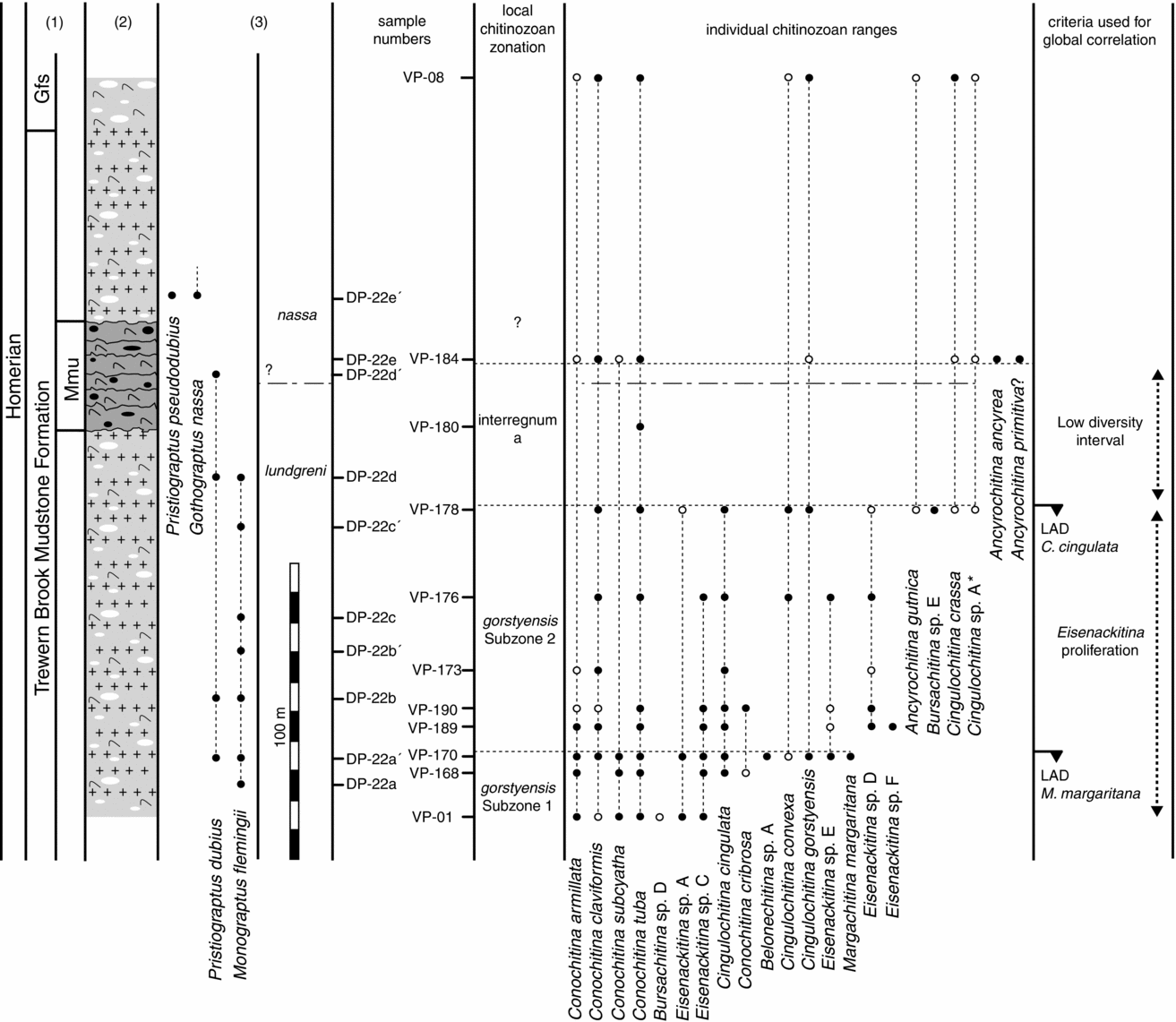
Distribution of chitinozoans in the Middle Heldre section. (1) Lithostratigraphic units after Cave & Waters (Reference Cave and Waters2008). (2) Lithology. (3) Individual graptolite ranges and graptolite biozonal boundaries after Palmer (unpub. PhD thesis, Trinity College, 1972). Sample numbers (‘DP’, left) are as given in Palmer (unpub. PhD thesis, 1972). VP – samples collected by the authors during the spring and summer of 2013. See Figure 3 for legend.

Distribution of chitinozoans in the Brunant Heldre section. (1) Lithostratigraphic units after Cave & Waters (Reference Cave and Waters2008). (2) Lithology. (3) Graptolite biozonal boundaries after Palmer (unpub. PhD thesis, Trinity College, 1972). See Figure 3 for legend.

The Upper Heldre section begins in strata of the Trewern Brook Mudstone Formation that are assignable to the Cyrtograptus lundgreni graptolite Biozone (Fig. 2a), and are characterized by graptolitic mudstone with occasional interbedded massive to bedded calcareous mudstone. In the stratigraphically upper part of the lundgreni Biozone, beds become massive and irregular; this is a product of bioturbation and an increase in shelly benthonic epifauna that identifies the beginning of the Mottled Mudstone Member. Graptolites indicative of the Gothograptus nassa and Colonograptus ludensis biozones of the uppermost Wenlock strata were identified by Palmer (unpub. PhD thesis, Trinity College, 1972) in this section (Fig. 2a), but the boundary between the ludensis and succeeding earliest Ludlow Neodiversograptus nilssoni Biozone in the Gyfenni Wood Shale Formation is poorly exposed in the Upper Heldre section. The biozonal index species for the succeeding Lobograptus scanicus graptolite Biozone is found upwards in the succession, and appears within the Irfon Formation as mapped by the British Geological Survey (Fig. 2a).
The stream and roadside cuts immediately north of Middle Heldre farm yield a near-complete succession through the upper part of the lundgreni Biozone with abundant graptolites (Fig. 2b). At stratigraphically higher levels the graptolitic mudstone is replaced by irregularly bedded, shelly siltstone with pyrite-filled burrows, identifying the Mottled Mudstone Member of the Trewern Brook Mudstone Formation. Within this succession, rare finds of graptolites including Gothograptus nassa and Colonograptus lundensis indicate strata of late Wenlock biostratigraphical age (Fig. 2b).
The Brunant section begins with graptolites indicative of the Lobograptus scanicus graptolite Biozone within a 90–105 m thickness of strata assignable to the Irfon Formation (Fig. 2c). Saetograptus leintwardinensis makes its first appearance up sequence, signalling the beginning of its eponymous biozone within the upper part of the Irfon Formation.
2.b. Palynological analysis
Some 62 samples were processed for palynology from the three sections of the Long Mountain, yielding 10563 specimens of which 8341 have been assigned to a genus. Specimens were generally moderately well preserved, which is reflected in the 3953 specimens (c. 37% of total) that were identified to the species level. Chitinozoan ranges and biozones through the three sections of the Long Mountain are shown in Figures 3–6. Selected species are illustrated in Figures 7 and 8. Absolute and relative abundances of the chitinozoan taxa recovered from the Long Mountain can be found in online Supplementary Table S1 (available at http://journals.cambridge.org/geo).
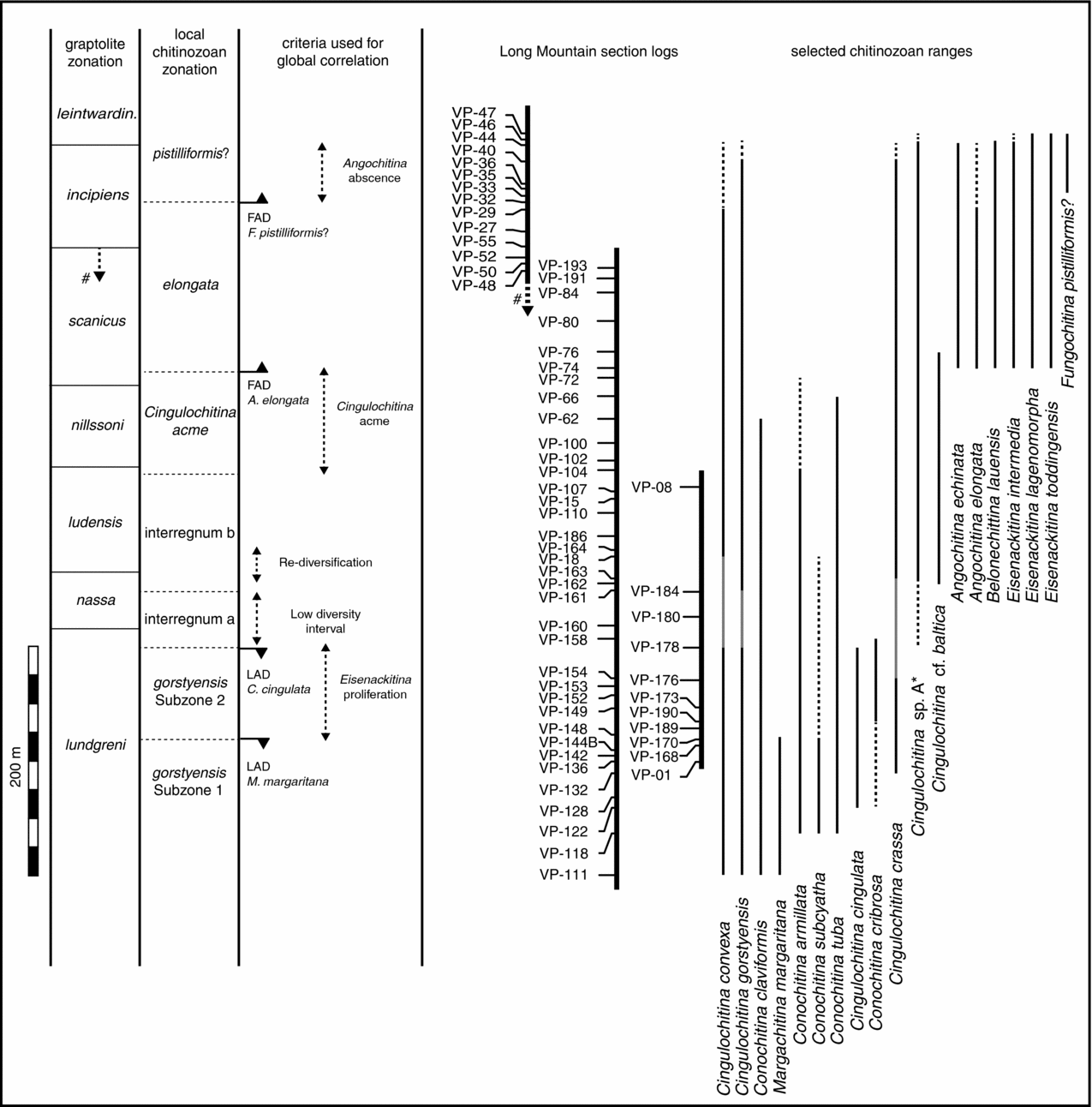
Distribution of selected chitinozoan species in the Long Mountain succession together with the Long Mountain chitinozoan biozonation and grounds for global correlation through the upper Wenlock – lower Ludlow succession. Grey lines represent sample intervals where selected species are missing during the interregnum interval. # – due to section incompleteness, the first occurrence of the graptolite Saetograptus leintwardinensis incipiens in the Upper Heldre section (above VP-193) is ill-defined; this might imply a potential adjustment of the correlation between the Upper Heldre and Brunant sections as indicated with the dashed arrow. See Figure 3 for legend.

3. Taxonomic notes
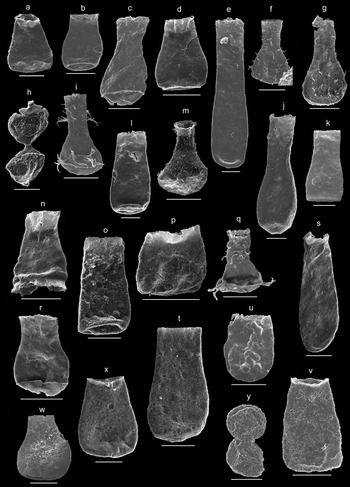
The overall flattening of the Long Mountain chitinozoan specimens impinges on the accuracy with which certain morphological features can be assessed. This has particularly affected the accuracy of identification for specimens of Eisenackitina and Cingulochitina, which is predicated on the convexity of the vesicle base or flanks, these being deformed when specimens are flattened (see use of open nomenclature in supplementary Table S1; i.e. numbers in parentheses). For instance, the upper part of the lundgreni graptolite Biozone of the Long Mountain is characterized by the occurrence of a whole suite of Eisenackitina taxa, including Eisenackitina spongiosa (Fig. 7p), Eisenackitina sp. A (Fig. 7t), Eisenackitina sp. B and so forth (Fig. 7u–x), showing substantial morphological variation. Similar problems of identification pertain to the Cingulochitina taxa, for example to the distinction of Cingulochitina convexa (Fig. 7c) from Cingulochitina crassa (Fig. 7r). These two taxa were first described from the upper Wenlock of the eastern Baltic region (Nestor, Reference Nestor1994) and from the Ludlow succession of Gotland (Laufeld, Reference Laufeld1974), respectively. C. crassa and C. convexa are readily distinguishable from other Cingulochitina taxa by their distinct convex base, but only differ subtly from one another by their length/diameter (L/D) ratio (<1.6 in C. crassa; >1.6 in C. convexa; Laufeld, Reference Laufeld1974; Nestor, Reference Nestor1994; Sutherland, Reference Sutherland1994) and by the absence of fine rugose ornamentation on the vesicle surface in C. convexa. However, the original diagnosis of C. crassa indicates the occurrence of specimens with a completely smooth surface (Nestor, Reference Nestor1994). Further, Laufeld (Reference Laufeld1974, p. 99, fig. 58b) clearly shows a ‘C. convexa’ chitinozoan specimen with L/D ~ 1.46 and potential fine rugose ornamentation. Although the distinction between these species may therefore be artificial, several specimens with L/D that clearly exceed 1.6 were recovered from the lundgreni Biozone of the Long Mountain succession, and therefore merit placement in C. convexa. This would extend the total stratigraphical range of C. convexa to a lower horizon than previously considered (see Section 6).
4. Chitinozoan biozonation for the upper Wenlock and lower Ludlow strata of the Long Mountain
Based on the distribution of chitinozoans, four biozones and an interregnum are identified through the upper Wenlock and lowermost Ludlow succession of the Long Mountain. We also subdivide our lowermost Cingulochitina gorstyensis Biozone into lower and upper subzonal intervals (Figs 3–6). In this section the biozones are described and the key biostratigraphically important taxa are identified.
4.a. The Cingulochitina gorstyensis Biozone – Subzone 1
The stratigraphically lowest chitinozoan record from the succession studied in the Long Mountain comprises an assemblage of typical upper Wenlock taxa characterized by, among others, Margachitina margaritana (Fig. 7h) and Cingulochitina cingulata (Fig. 7n). These two species have their first originations much earlier in the Wenlock, and have their respective first appearance datums (FADs) around the base and in the middle of the Sheinwoodian succession, respectively (Verniers et al. Reference Verniers, Nestor, Paris, Dufka, Sutherland and Van Grootel1995). The occurrences in the Long Mountain of M. margaritana and C. cingulata near the end of their ranges explain why we have not used them as biozonal names. The gorstyensis Biozone – Subzone 1 is defined by the co-occurrence of C. gorstyensis (Fig. 7d), M. margaritana and C. cingulata (Figs 3, 4). The top of the gorstyensis Biozone – Subzone 1 is defined as the last appearance datum (LAD) of M. margaritana (within the upper part of the lundgreni graptolite Biozone), which roughly coincides with a proliferation in Eisenackitina taxa (Figs 3, 4). Other components of the assemblage include (in order of local first occurrence): Bursachitina sp. C (Fig. 7a); Bursachitina sp. D (Fig. 7b); Cingulochitina convexa (Fig. 7c); Conochitina claviformis (Fig. 7e); Ramochitina sp. A (Fig. 7f); Ramochitina sp. B (Fig. 7g); Ancyrochitina sp. A (Fig. 7i); Conochitina armillata (Fig. 7j); Conochitina subcyatha (Fig. 7k); Conochitina tuba (Fig. 7l); Angochitina sp. A (Fig. 7m); some questionable specimens of Conochitina cribrosa (Fig. 7o); Eisenackitina spongiosa (Fig. 7p); some questionable specimens of Ancyrochitina gutnica (Fig. 7q); Cingulochitina crassa (Fig. 7r); Conochitina sp. A (Fig. 7s); and Eisenackitina sp. A (Fig. 7t).
4.b. Cingulochitina gorstyensis Biozone – Subzone 2
The base of the Cingulochitina gorstyensis Biozone – Subzone 2 is constrained by the LAD of M. margaritana (Figs 3,4) and is characterized by the co-occurrence of C. gorstyensis and C. cingulata together with a suite of morphologically variable Eisenackitina taxa (Eisenackitina sp. B through E; Fig. 7u–x). These Eisenackitina taxa, as well as Calpichitina acollaris (Fig. 7y), Ancyrochitina ansarviensis? (Fig. 8a), Ancyrochitina sp. B (Fig. 8b) and Belonechitina sp. A (Fig. 8c), make their first appearance around the same level where M. margaritana disappears. In the Middle Heldre section, specimens of Conochitina cribrosa characterize this biozone. Higher in the succession Eisenackitina sp. F (Fig. 8d) makes its first appearance. Some questionable specimens of Cingulochitina sp. A sensu Sutherland, Reference Sutherland1994 (Fig. 8e) were recovered from just below the base of the chitinozoan-defined interregnum that follows the gorstyensis Biozone – Subzone 2 in the Middle Heldre section. The LAD of C. cingulata is used to define the top of the gorstyensis Biozone – Subzone 2.
4.c. Interregnum
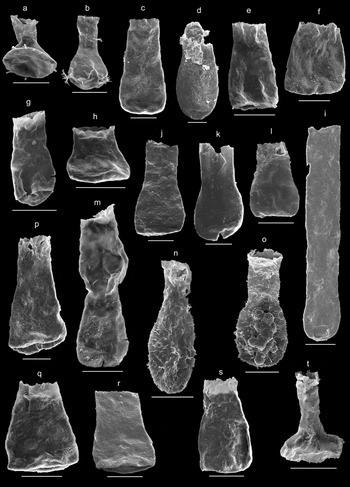
Above the gorstyensis Biozone – Subzone 2, the rock succession is characterized by a chitinozoan-defined interregnum which can be divided into lower and upper parts. The lower interval is referred to as ‘interregnum a’ and is characterized by a decline in chitinozoan diversity, with only taxa of Ancyrochitina and Conochitina present in substantial quantities. Most notable is the near-complete absence of Cingulochitina taxa; this is unusual in that Cingulochitina are abundant through the rest of the Long Mountain succession, both above and below this interval. This low-diversity interval seems to coincide with the uppermost part of the lundgreni graptolite Biozone and with most of the succeeding nassa graptolite Biozone (Figs 3, 4). In the Upper Heldre section, Eisenackitina sp. G (Fig. 8f) is characteristic of this interval.
Succeeding interregnum a, the beginning of interregnum b is marked by the gradual reappearance of taxa which were present in the upper part of the lundgreni Biozone and that did not suffer from the effects of the Mulde extinction (see Section 7). These appear together with the introduction of Ancyrochitina ancyrea, Cingulochitina cf. baltica (Fig. 8g) and Bursachitina sp. F (Fig. 8h). In the Upper Heldre section, the first specimens of Cingulochitina sp. A sensu Sutherland, Reference Sutherland1994 appear just above the base of interregnum b. Interregnum b corresponds to the uppermost part of the nassa graptolite Biozone and almost the entirety of the succeeding ludensis graptolite Biozone. Ancyrochitina primitiva?, Conochitina sp. B (Fig. 8i), Conochitina sp. C (Fig. 8j) and Lagenochitina sp. A (Fig. 8k) make their first appearance higher up in interregnum b.
4.d. Cingulochitina acme Biozone
Above interregnum b, the Cingulochitina acme Biozone is identified by a marked increase in abundance of Cingulochitina taxa (as high as 98% by abundance in sample VP-100; online Supplementary Table S1, available at http://journals.cambridge.org/geo). The base of this acme biozone roughly coincides with the base of the nilssoni graptolite Biozone and it spans to just above the base of the succeeding scanicus graptolite Biozone within the Ludlow Series (Fig. 3). Well into the interval all taxa belonging to the genus Conochitina mark their last appearance in the Long Mountain succession. Bursachitina sp. B? sensu Sutherland, Reference Sutherland1994 (Fig. 8l) and Bursachitina sp. A sensu Sutherland, Reference Sutherland1994 (Fig. 8m) are also characteristic of this chitinozoan biozone.
4.e. Angochitina elongata Biozone
The base of the Angochitina elongata Biozone is defined by the FAD of the eponymous species. The biozone is characterized by an overall assemblage of 14 species and corresponds to most of the biostratigraphical interval of the scanicus graptolite Biozone and the lower part of the succeeding incipiens graptolite Biozone (Fig. 3). Together with Angochitina elongata (Fig. 8n), there is a suite of chitinozoan taxa that make their first appearance at this level which are considered typical of the Ludlow Series. These include: Angochitina echinata (Fig. 8o), Belonechitina lauensis (Fig. 8p), Eisenackitina intermedia (Fig. 8q), Eisenackitina lagenomorpha (Fig. 8r) and Eisenackitina toddingensis (Fig. 8s), as well as the continuation of most of the Cingulochitina taxa recovered from the upper Wenlock of the Long Mountain.
4.f. Fungochitina pistilliformis? Biozone
The base of the F. pistilliformis? Biozone is defined by the FAD of the eponymous species, Fungochitina pistilliformis? (Fig. 8t). Most taxa in this biozone continue from the preceding biozone. The base of the biozone corresponds to the middle part of the incipiens graptolite Biozone (Fig. 5). Ancyrochitina gogginensis was only recovered from the upper part of the F. pistilliformis? Biozone.
5. Integration between chitinozoan and graptolite biozonations
The recognition of six discrete chitinozoan-defined biostratigraphical intervals in the uppermost Wenlock and lowermost Ludlow of the Long Mountain succession provides a refined biozonation for this interval when combined with the graptolites (Figs 3–6). The Cingulochitina gorstyensis Biozone – Subzone 1 overlaps with the last occurrence of the graptolite C. lundgreni, and defines an interval in the upper part of the lundgreni graptolite Biozone. The base of the Cingulochitina gorstyensis Biozone – Subzone 2 equates to a level high in the lundgreni Biozone, postdating the latest occurrence of C. lundgreni, but overlapping with the uppermost range of Monograptus flemingii (Figs 3–4, 6). The succeeding chitinozoan interregnum largely equates to the low-diversity graptolite interval of the uppermost lundgreni, nassa and ludensis biozones. The base of the Cingulochitina acme Biozone coincides with the base of the nilssoni graptolite Biozone, and the base of the elongata chitinozoan Biozone is situated at a level in the lower part of the scanicus graptolite Biozone (Figs 3, 6). The base of the Fungochitina pistilliformis? chitinozoan Biozone is placed midway through the incipiens graptolite Biozone, subdividing that interval into lower and upper intervals (Figs 5, 6).
6. Interregional correlation
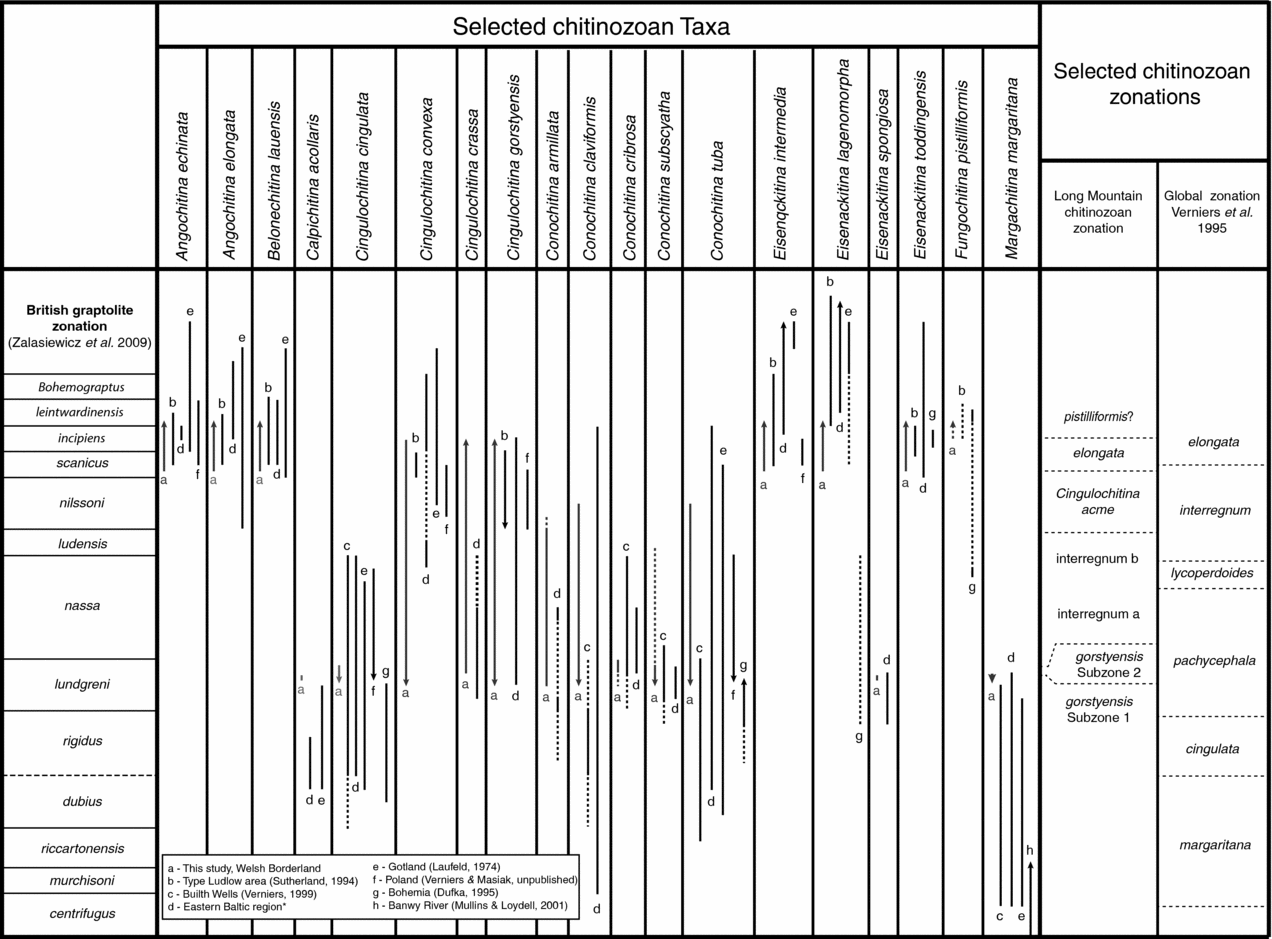
A global chitinozoan biozonation has been proposed for the Silurian (Verniers et al. Reference Verniers, Nestor, Paris, Dufka, Sutherland and Van Grootel1995). There are several local biozonation schemes for different regions of the Silurian world, especially Avalonia (Verniers, Reference Verniers1982; Louwye, Van Grootel & Verniers, Reference Louwye, Van Grootel and Verniers1992; Sutherland, Reference Sutherland1994; Verniers, Reference Verniers1999; Verniers et al. Reference Verniers, Van Grootel, Louwye and Diependale2002; Davies et al. Reference Davies, Waters, Molyneux, Williams, Zalasiewicz, Vandenbroucke and Verniers2013) and Baltica (Laufeld, Reference Laufeld1974; Wrona, Reference Wrona1980; Loydell, Nestor & Männik, Reference Loydell, Nestor and Männik2010; Nestor, Reference Nestor2012; J. Verniers & M. Masiak, unpub. data, 2010). During the Wenlock the palaeocontinents of Baltica and Avalonia were in close geographical contact with each other and also with Laurentia, while all of these regions were separated from Gondwana by a widening Rheic Ocean (Torsvik & Cocks, Reference Torsvik and Cocks2013). There is a chitinozoan record from the middle and upper Wenlock Prague Basin, situated at the periphery of Gondwana (Dufka, Reference Dufka1995). These global and local schemes are compared with and juxtaposed against the Long Mountain data, calibrated against the graptolite biostratigraphy in Figure 9 which shows the ranges of 19 selected chitinozoan taxa across these regions.
Five chitinozoan taxa of Wenlock age from the Long Mountain have similar biostratigraphical ranges in the Builth Wells succession of southern Powys, which lies some 60 km to the south of Welshpool. When calibrated against the graptolite biostratigraphies, these taxa are C. cingulata, C. claviformis, C. cribosa, C. subcyatha and C. tuba (Fig. 9). In addition, the interval of the lundgreni graptolite Biozone in both regions of Powys is characterized by abundant Eisenackitina. Between the Long Mountain and the stratotype area for the Ludlow Series in Shropshire, Welsh Borderland (Fig. 9), there is also a similar pattern of FADs for six out of eight co-occurring taxa: A. echinata, A. elongata, B. lauensis, E. intermedia, E. toddingensis and F. pistilliformis. Only the two Cingulochitina taxa (C. convexa and C. gorstyensis) have a different FAD from the graptolite biozonation. The FAD of C. convexa in the lundgreni Biozone of the Long Mountain succession extends the total stratigraphical range of C. convexa to a lower horizon than considered earlier, as previously its lowermost occurrence was the ludensis graptolite Biozone (Nestor, Reference Nestor2007). This suggests that C. convexa and C. crassa first appeared at about the same time. C. crassa was previously known only from the upper part of the Wenlock (Nestor, Reference Nestor2007; Loydell, Nestor & Männik, Reference Loydell, Nestor and Männik2010) but in the Long Mountain succession C. crassa persists into the Ludlow, extending its total range to one that coincides with that of C. convexa. The similar biostratigraphical range and apparently overlapping morphological traits (see above) suggest that, with further study of well-preserved material, C. convexa and C. crassa may prove to be conspecific.
Selected chitinozoans from the Long Mountain Succession. (a) Bursachitina sp. C; Upper Heldre section, VP-111. (b) Bursachitina sp. D; Upper Heldre section, VP-111. (c) Cingulochitina convexa (Laufeld); Middle Heldre section, VP-178. (d) Cingulochitina gorstyensis Sutherland; Upper Heldre section, VP-111. (e) Conochitina claviformis Eisenack; Upper Heldre section, VP-111. (f) Ramochitina sp. A; Upper Heldre section, VP-111. (g) Ramochitina sp. B; Upper Heldre section, VP-111. (h) Margachitina margaritana (Eisenack); Upper Heldre section, VP-122. (i) Ancyrochitina sp. A; Upper Heldre section, VP-118. (j) Conochitina armillata Taugourdeau et de Jekhowsky; Upper Heldre section, VP-107. (k) Conochitina subcyatha Nestor; Upper Heldre section, VP-118. (l) Conochitina tuba Eisenack; Upper Heldre section, VP-122. (m) Angochitina sp. A; Upper Heldre section, VP-122. (n) Cingulochitina cingulata (Eisenack); Upper Heldre section, VP-122. (o) Conochitina cribrosa Nestor; Upper Heldre section, VP-158. (p) Eisenackitina spongiosa Swire; Upper Heldre section, VP-122. (q) Ancyrochitina gutnica Laufeld; Upper Heldre section, VP-110. (r) Cingulochitina crassa Nestor; Upper Heldre, VP-154. (s) Conochitina sp. A; Upper Heldre section, VP-132. (t) Eisenackitina sp. A; Upper Heldre section, VP-142. (u) Eisenackitina sp. B; Upper Heldre section, VP-136. (v) Eisenackitina sp. C; Upper Heldre section, VP-144B. (w) Eisenackitina sp. D; Upper Heldre section, VP-136. (x) Eisenackitina sp. E; Upper Heldre section, VP-142. (y) Calpichitina acollaris Eisenack; Upper Heldre section, VP-144B. Scale bars represent 50 μm.

Selected chitinozoans from the Long Mountain Succession. (a) Ancyrochitina ansarviensis?; Upper Heldre section, VP-142. (b) Ancyrochitina sp. B; Upper Heldre section, VP-142. (c) Belonechitina sp. A; Middle Heldre section, VP-170. (d) Eisenackitina sp. F; Middle Heldre section, VP-189. (e) Cingulochitina sp. A sensu Sutherland, Reference Sutherland1994; Upper Heldre section, VP-100. (f) Eisenackitina sp. G; Upper Heldre section, VP-154. (g) Cingulochitina cf. baltica; Upper Heldre, VP-162. (h) Bursachitina sp. F; Upper Heldre, VP-110. (i) Conochitina sp. B; Upper Heldre section, VP-18. (j) Conochitina sp. C; Upper Heldre section, VP-107. (k) Lagenochitina sp. A; Upper Heldre section, VP-107. (l) Bursachitina sp. B sensu Sutherland, Reference Sutherland1994; Brunant section, VP-46. (m) Bursachitina sp. A sensu Sutherland, Reference Sutherland1994; Upper Heldre section, VP-67. (n) Angochitina elongata Eisenack; Brunant section, VP-27. (o) Angochitina echinata Eisenack; Upper Heldre section, VP-74. (p) Belonechitina lauensis (Laufeld); Upper Heldre section, VP-84. (q) Eisenackitina intermedia (Eisenack); Brunant section, VP-27. (r) Eisenackitina lagenomorpha (Eisenack); Upper Heldre section, VP-74. (s) Eisenackitina toddingensis Sutherland; Brunant section, VP-29. (t) Fungochitina pistilliformis?; Brunant section, VP-36. Scale bars represent 50 μm.

Total ranges of selected chitinozoan taxa, the local Long Mountain biozones and global chitinozoan biozonation (Verniers et al. Reference Verniers, Nestor, Paris, Dufka, Sutherland and Van Grootel1995) from the level of the C. centrifugus graptolite Biozone (uppermost Llandovery) to levels equivalent in age to the Bohemograptus proliferation interval of the Welsh Basin (lower Ludlow) of several successions across the world. Arrows mark the lowest occurrence of specific taxa at the locality. Dotted lines represent intervals with specimens described in open nomenclature. * – data for the Eastern Baltic region are a compilation of Nestor (Reference Nestor, Kaljo and Nestor1990, Reference Nestor1994, Reference Nestor and Einasto1997), Nestor & Einasto (Reference Nestor and Einasto1997), Nestor (Reference Nestor and Põldvere2003, Reference Nestor2007, Reference Nestor, Hints, Ainsaar, Männik and Meidla2008, Reference Nestor2009), Loydell, Nestor & Männik (Reference Loydell, Nestor and Männik2010) and Nestor (Reference Nestor2012). For h: see also Mullins & Aldridge (Reference Mullins and Aldridge2004).

Cingulochitina acmes and/or occurrences have been observed for different regions (Ludlow area, Belgium, East Baltic) in upper Wenlock – lower Ludlow deposits, but only where deeper shelf or slope facies are present. In the Ludlow area for example, species of this genus are absent from the Lower Elton Formation and lower part of the Middle Elton Formation, both assigned to the nilssoni graptolite Biozone (and therefore coeval to the Cingulochitina acme Biozone in the Long Mountain). However, species of the genus are common in the middle and upper part of the Middle Elton Formation (assignable to the scanicus graptolite Biozone, i.e. above the Long Mountain Cingulochitina), potentially related to a major transgression in the Middle Elton Formation (Mullins, Aldridge & Siveter, Reference Mullins, Aldridge and Siveter2004). Nestor (Reference Nestor1994) first noted that regional variability within the genus Cingulochitina could reflect an environmental effect. Species of Cingulochitina occur (abundantly) in strata signifying deeper-water facies in a series of drill cores in Estonia, while they are (almost) absent from those signifying shallow-water settings (Nestor, Reference Nestor1994, Reference Nestor2007, Reference Nestor2009). In summary, although the base of the Cingulochitina acme Biozone in the Long Mountain locally coincides with the base of the Ludlow Series, it is not a suitable marker for long-distance correlation.
Angochitina elongata Eisenack (Fig. 8n) and A. echinata Eisenack (Fig. 8o) are remarkably similar in the Long Mountain and Ludlow areas (Angochitina cf. echinata in the Ludlow area; Sutherland, Reference Sutherland1994) and share similar biostratigraphic ranges (Fig. 9). They may represent a morphological continuum encompassing Angochitina with spherical to cylindrical bodies with varying slenderness. It must be noted that this might in part reflect the poor preservation state of specimens from the Long Mountain.
7. Chitinozoan faunal dynamics through the latest Wenlock and earliest Ludlow
The middle Homerian Mulde event, also known as the ‘Big Crisis’ (upper part of the lundgreni Biozone – top ludensis Biozone), resulted in a major extinction of graptolites (Jaeger, Reference Jaeger1959, Reference Jaeger1991; Porębska, Kozłowska-Dawidziuk & Masiak, Reference Porębska, Kozłowska-Dawidziuk and Masiak2004; Cramer et al. Reference Cramer, Condon, Söderlund, Marshall, Worton, Thomas, Calner, Ray, Perrier, Boomer, Patchett and Jeppsson2012), but conodonts and chitinozoans were also affected during this interval (Calner, Reference Calner and Elewa2008). The sequence of events include a stepped extinction of graptolites (Porębska, Kozłowska-Dawidziuk & Masiak, Reference Porębska, Kozłowska-Dawidziuk and Masiak2004) and a globally reduced diversity of chitinozoophoran animals (Grahn & Paris, Reference Grahn and Paris2011) in the upper part of the lund-greni Biozone; this biodiversity loss is known from sections all over the world and almost always in association with profound lithological, sequence stratigraphical and geochemical changes recorded in the rock succession (Cramer et al. Reference Cramer, Condon, Söderlund, Marshall, Worton, Thomas, Calner, Ray, Perrier, Boomer, Patchett and Jeppsson2012). This is followed by ‘survival’ (equivalent to the interval of the nassa graptolite Biozone) and ‘recovery’ (ludensis graptolite Biozone) phases of the graptolite zooplankton. Graptolite biodiversity began to rise again in the post-recovery late Wenlock (from the ludensis graptolite Biozone) – early Ludlow interval.
The upper part of the lundgreni graptolite Biozone and the lower part of the nassa graptolite Biozone in the Long Mountain succession are characterized by a series of chitinozoan range-ends (Figs 3–4, 6). Species that disappear during this interval (nine in total) include C. cingulata, C. subcyatha, C. cribrosa and M. margaritana, as well as a suite of Eisenackitina taxa that seem limited to the uppermost part of the lundgreni Biozone. In the eastern Baltic, Nestor (Reference Nestor2007, Reference Nestor, Hints, Ainsaar, Männik and Meidla2008) noted similar extinction patterns among chitinozoans, notably the disappearance of Conochitina argillophila, Linochitina odiosa and Calpichitina acollaris at the beginning of the Mulde Event and C. cingulata in the middle of the event on Gotland, as well as in the Ohesaare core in Estonia (Nestor, Reference Nestor2007). Observed over a series of drill cores, some 8–12 chitinozoan taxa disappear during the Mulde event in the eastern Baltic region (Nestor, Reference Nestor2007, Reference Nestor, Hints, Ainsaar, Männik and Meidla2008). Nestor (Reference Nestor, Hints, Ainsaar, Männik and Meidla2008) also noted the presence of a chitinozoan-barren interval in the Ohesaare core that corresponds to the graptolite-free interval above datum 2 on Gotland (roughly at a level above the LAD of Monograptus flemingii, i.e. at a near-terminal level in the lundgreni graptolite Biozone). The barren interval in the Ohesaare core seems to correspond to the Conochitina-dominated interval (the very poorly diverse interregnum a) of the Long Mountain, upwards from the LAD of C. cingulata and also of M. flemingii. In Baltica, chitinozoans seem to recover from the base of the nassa graptolite Biozone upwards (Nestor, Reference Nestor, Hints, Ainsaar, Männik and Meidla2008). In Sardinia, Pittau et al. (Reference Pittau, Cotza, Cristini, Del Rio and Loi2006) marked a similar series of chitinozoan extinctions in the upper part of the lundgreni Biozone with the disappearance of C. subcyatha and a few regional taxa.
The uppermost part of the nassa graptolite Biozone in the Long Mountain succession is marked by the gradual reappearance of certain taxa (interregnum b) present in the upper part of the lundgreni graptolite Biozone that appear to have survived the extinction event. In total, 11 species continue through or reappear after the nassa interval including C. convexa, C. crassa, C. gorstyensis, C. armillata, C. claviformis and C. tuba. Taken at face value, this indicates that chitinozoans seem to have been affected by the Mulde Event along a similar chronology (in terms of extinction and recovery) as the graptolites, but less severely so. The temporal correspondence between the changes in the graptolites and the chitinozoans suggests that diversity drop in the chitinozoan record may represent a depletion of the original Wenlock fauna, rather than a facies-induced preservation bias.
All Conochitina taxa disappear in the upper part of the nilssoni graptolite Biozone. Just above the base of the scanicus graptolite Biozone, A. elongata together with a whole suite of typical Ludlow taxa make their first appearance (Figs 3, 6). This level defines the base of the elongata chitinozoan Biozone in the Long Mountain succession and coincides with a marked increase in chitinozoan abundance from around 50 per gram of rock to more than 750 per gram of rock (online Supplementary Table S1, available at http://journals.cambridge.org/geo). Although this level marks the end of the numerical dominance of Cingulochitina in the rock succession, Cingulochitina taxa continue to range upwards. This abrupt change in assemblage likely reflects taphonomic effects, local incompleteness of the succession or changes in sediment accumulation rates rather than an original signal; in other sections, nearby and across the world, some of these taxa arrive stepwise and progressively throughout the Ludlow succession rather than all at once (Fig. 9).
8. Conclusions
Based on analyses of 62 samples and the identification of 10563 chitinozoan specimens, four biozones and an interregnum are identified for the upper Wenlock and lower Ludlow succession of the Long Mountain, Wales (Figs 3–5). The biozones are (from bottom to top):
-
(a) the Cingulochitina gorstyensis Biozone – Subzone 1 (representing an interval in the upper part of the Cyrtograptus lundgreni graptolite Biozone), defined by the co-occurrence of both Cingulochitina gorstyensis and Margachitina margaritana;
-
(b) the Cingulochitina gorstyensis Biozone – Subzone 2 (uppermost part of the Cyrtograptus lundgreni graptolite Biozone), defined by the last appearance of Margachitina margaritana and the co-occurrence of Cingulochitina cingulata and Cingulochitina gorstyensis;
-
(c) a chitinozoan interregnum characterizes the interval of the uppermost lundgreni to ludensis graptolite biozones: its lower interval is characterized by the near absence of taxa of Conochitina and Ancyrochitina and its upper interval is marked by the gradual reappearance of certain taxa present in the upper part of the lundgreni Biozone that did not suffer any long-term effects from the Mulde extinction;
-
(d) the Cingulochitina acme Biozone (equivalent to the uppermost ludensis to lower scanicus graptolite biozones), characterized by a near-total dominance of Cingulochitina taxa;
-
(e) the Angochitina elongata Biozone (equivalent to the upper scanicus to middle incipiens graptolite biozones) defined by the first occurrence of the eponymous species, contemporary with a whole suite of typical Ludlow chitinozoan taxa; and
-
(f) the Fungochitina pistilliformis? Biozone (middle part of the incipiens graptolite Biozone), defined by the first occurrence of the eponymous species.
In-depth comparison of the chitinozoan ranges has revealed strong correlations with Wenlock and Ludlow successions in the type Ludlow area of the Welsh Borderland (Sutherland, Reference Sutherland1994) and the Builth Wells area of southern Powys (Verniers, Reference Verniers1999), as well as with more geographically distant successions. Chitinozoan range ends and an interval of reduced diversity are likely expressions of the Mulde extinction as globally observed in graptolites, but the re-appearance (or continuation) of 11 species above this interval indicates that chitinozoans suffered less severely than their macro-zooplanktonic contemporaries. The presence of a Cingulochitina acme can locally be used to recognize the Wenlock–Ludlow Series boundary, but this genus does not represent a good marker for long-distance correlation.
Acknowledgements
Douglas Palmer (Cambridge) provided invaluable access to his field maps of the Long Mountain succession that directed our fieldwork and stratigraphical understanding in Wales. Laurence Debeauvais (University of Lille1) and Sabine Van Cauwenberghe (UGent) are acknowledged for palynological analyses and Philippe Recourt (University of Lille1) for her help with SEM imaging. We thank the Leverhulme Trust (grant number RP14G0168) for funding this work. This is a contribution to IGCP project 591.
Declaration of Interest
None
Supplementary material
To view supplementary material for this article, please visit http://dx.doi.org/10.1017/S0016756815000266.