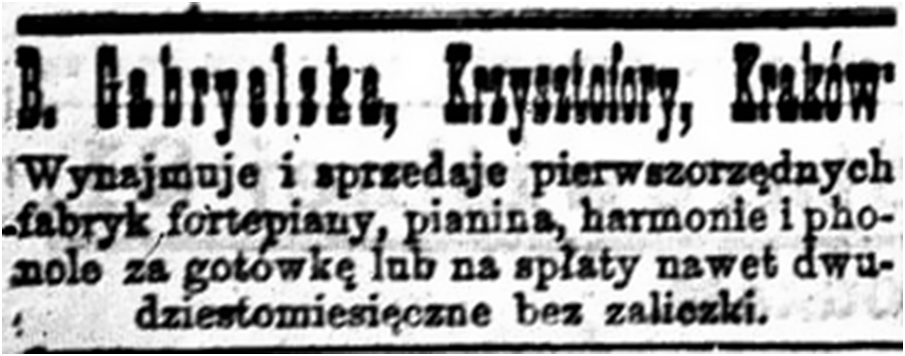
In a 1912 advertisement, the Bronisława Gabryelska piano factory, located in Kraków, stated that the firm rented and sold grand and upright pianos, as well as other musical instruments, of first-class manufacture. As payment, they accepted cash or a “twenty-month payment plan with no down payment” (Figure 1).Footnote 1 The inclusion of the payment plan option marks a trend in the piano market that corresponded with a growing cultural shift. Increasingly, from the early nineteenth century onward, the desire and ability to own a household piano had spread from the wealthiest in the upper class to the lower echelons of the nobility and then to the middle class. Teaching music to the next generation and the ability to play an instrument became increasingly important to a growing number of the population in Kraków and Lwów, the urban centers of Habsburg Galicia, as did the cultural significance of owning a piano (or at least having one in the household). The rise in the cultural significance of possessing a piano among the middle class helps to explain the continued presence of piano advertising during the war years and early interwar period, though to say that it was the only reason would be a mistake.
Commercial advertisement for the B. Gabryelska factory selling and renting pianos and other instruments, IKC, 1 September 1912, 6.

At the outset, the idea that citizens of Kraków and Lwów were interested in buying pianos while the whole region suffered under rationing and the turmoil of war seems counterintuitive.Footnote 2 However, the persistence of piano advertising, both selling and endeavoring to buy, in the popular press during these years hints at something more nuanced than just misdirected advertising. On the surface piano advertising seems to have continued throughout the war and into the postwar period with little change. Upon deeper investigation, several details emerge that tell us more about everyday social and cultural life in urban Galicia than the newspaper advertisements alone suggest. While it cannot be denied that the war was disruptive and destructive, the persistent presence of piano advertising within the popular daily press in both cities throughout the war indicates that the cultural significance of owning the piano as a status symbol was not so easily cast aside. While the piano as a cultural symbol of affluence endured, the simultaneous persistence of the advertisements is perhaps a function and representation of changes within the fluid, constructed middle class. To put it simply, a portion of the middle class (along with some in the lower levels of the nobility) found themselves in need of money as inflation rose and their fixed state salaries did not (this is explored in greater detail later in the article). As they liquidated tangible assets, such as pianos, upwardly mobile members of society in professions where salaries could rise alongside inflation (or even outpace it based on demand) now had the funds to purchase cultural symbols of affluence. For this study, the middle class can best be defined as those seeking to emulate the cultural activities of the upper-class nobility as a form of maintaining or advancing their social status. The fluidity of this group fits with the self-defining, discursive construction of class membership, as proposed by Pierre Bourdieu.Footnote 3 This article establishes how the continued presence of newspaper advertisements buying and selling pianos between 1911 and 1921 represented dynamic shifts within the middle class in Kraków and Lwów, while also providing evidence that advertising culture and the cultural significance of the piano were not fully disrupted by the war.
Urban Galicia during the War
Less than two months after the assassination of Archduke Franz Ferdinand, Imperial Russian forces were close enough to the city of Lwów on 27 August 1914 to warrant fears that they would invade overnight. Three days later the Austrian administration of the city evacuated the majority of state offices and banking officials without warning the city’s population.Footnote 4 This was followed by the evacuation west of between forty and fifty thousand of the city’s 212,000 residents. By 3 September, the Russian troops entered the city to the sounds of a military band playing. They were met by the acting mayor, Tadeusz Rutowski, and the city was handed over in relative peace.Footnote 5 During the occupation of the city, there was little violence directed at the Polish population. Most of the physical violence was perpetrated against the city’s Jewish population, largely at the hands of Cossack Russian troops, while the city’s Ruthenian population was suppressed politically and socially in an attempt to curb any Ukrainian nationalist sentiments that might spread to Ukrainian citizens of the Russian Empire. The city’s new masters attempted to implement russification policies, both in schools and on street signage, but their success was limited. The Lwów newspaper industry came under much harsher censorship, limiting the total number of daily publications to seven titles.Footnote 6 During the occupation, which lasted about ten months, the Russian military occupying force was supplemented in their administration by several former Habsburg functionaries who had not evacuated with the state administration, including police, tram drivers, and city government representatives. The Russian occupation force was not in place long enough for these officials to be fully replaced by Russian Imperial civil servants and thus had to rely upon the local expertise to keep the city functioning.Footnote 7
While Lwów was briefly occupied, the Russian army advanced further westward toward Kraków. The crownland of Galicia saw numerous refugees flee to other parts of the Austro-Hungarian Empire, especially during the early years of the war. Around sixty thousand fled Kraków in the last few months of 1914.Footnote 8 Kamil Ruszała has explored the experiences of these groups in excellent recent publications.Footnote 9 By 3 November the threat of Russian invasion was imminent enough that the authorities issued a mandatory evacuation for residents who lacked enough provisions to endure a potential siege.Footnote 10 After a successful counter-offensive by Austro-Hungarian forces, the Russian forces never took the ancient Polish capital. Momentum shifted and Habsburg forces, reinforced heavily by German troops, retook the strategic fortress at Przemysł by March 1915 and won a decisive victory in the major battle of Gorlice-Tarnów in April. By June, Habsburg and German forces had reached Lwów, and on 22 June, the Russian occupying forces retreated.Footnote 11
Requisitioning occurred early in the war, with both the Russian forces in Lwów and the Austrian forces in Kraków purchasing horses and war materials from each city’s residents. In terms of food within the cities, residents of Kraków experienced shortages much sooner than those in Lwów. The traditional supply lines that brought in foodstuffs from abroad were largely disrupted in western Galicia. Historian Bartosz Ogórek has written that much of the food brought into Kraków originated either in nearby districts in the Russian-controlled Kingdom of Poland, where trade lines were cut off by Russian Imperial border authorities upon the outbreak of war, or from further east in Galicia, where shipments were disrupted by Russian occupation.Footnote 12 These shortages would not affect Lwów until after the Russian withdrawal and the return of Habsburg control. For citizens of both cities, though, life by late 1915 began to resemble life in the imperial capital of Vienna, where, as Maureen Healy has noted, citizens had begun experiencing shortages of some food items within the first year of the war.Footnote 13 Requisitions and shortages would reach critical levels in both cities as the war continued into its later years, much as it did in the Czech lands and Vienna.Footnote 14 Life in the cities was heavily disrupted, though some modern amenities were never completely lost. The electric tram systems only experienced minor disruptions in service, and other city utilities like water, gas, and electricity continued to function, albeit with periodic limitations.Footnote 15 Prominent Jewish politician of Lwów, and Galician representative to the Austrian parliament, Herman Diamand returned to Lwów shortly after the Russian withdrawal and noted in a letter to his wife that he would need to use candles to host a meeting in their home, not because the city was without power, but because their electric meter had been taken in their absence.Footnote 16
Though Russian forces would attempt to retake Galicia in 1916, during the Brusilov Offensive, they were unsuccessful in gaining any major territory in the region. Both cities were never under direct military threat again for the remainder of the war. Poles and Ruthenians in both cities carried out pogroms during the last stages of the war, largely as the result of scapegoating the Jewish population for the shortages they experienced. Upon the end of the war in 1918, the newly formed Polish state began formally incorporating both cities into its structure. This was met with significant resistance in Lwów, where Ruthenian citizens (increasingly referred to as Ukrainians by themselves and others) launched an uprising on 1 November, taking over and occupying a majority of Lwów. By 22 November, however, Polish forces, strengthened by the transfer of many troops from the former Polish Legions to the area, took the city back and promptly accused the city’s remaining Jews of collaborating with the Ukrainians. This pogrom resulted in the deaths of many Jews, while the Poles killed no Ukrainians after retaking the city. Fighting would continue between Poles and Ukrainians in the countryside into 1919.Footnote 17
Advertising and the Scope of This Study
Several excellent works note the rise of advertising in industrialized (or industrializing) societies, including the increased appearance of advertising in newspapers. Thomas Richards and Juliann Sivulka have examined advertising’s shift from being primarily descriptive to attempting to influence buyers’ behavior as occurring from the mid-1850s onward in England and the United States, respectively, while Clemens Wischermann has written and edited works on the development of advertising specifically in urban contexts.Footnote 18 These and other contemporary studies highlight the shift in advertising around two connected themes. First, advertising as a form of spectacle, and second, marketing as a key aspect of modern advertising. They also laid the groundwork for other studies that treat advertising as a cultural touchstone, such as David Ciarlo’s examination of the relationship between advertising and imperialism in the German context and Marjorie Hilton’s examination of Russian retail culture from the late 1800s to the early Soviet period.Footnote 19 Others, still, have also recently used advertising as a tool for examining aspects of culture and daily life in the Polish context. In her work, Agnieszka Janiak-Jasińska has simultaneously summarized the Polish language historiography of advertising and provided a framework for evaluating advertising as upholding social practices or seeking to change existing trends. Agnieszka Goluch has more recently examined the products marketed to readers in the weekly women’s newspaper Dobra Gospodyni (The Good Housewife) in the Kingdom of Poland.Footnote 20 In this context, an examination of advertising in the newspapers of Kraków and Lwów can be used to evaluate aspects of culture within the two cities during this period.
The decision to focus this study on the years 1911 to 1921 was influenced by the following factors. First, it allowed for a decade of observation with roughly the same amount of time before and after the years of World War I. Second, 1911 followed shortly after the 1910 census in the Habsburg lands, and a census of the new Polish lands was completed in 1921. Last, it allows for the examination of trends from periods of varying stability. The range spans the relatively stable period of Habsburg control before the war, the war years, and the postwar years up to 1921, by which time things were mostly stable again under Polish rule, at least in the former Habsburg region of Galicia.
For this article, the popular illustrated daily titles of Ilustrowany Kurier Codzienny (Illustrated Daily Courier), henceforth IKC, from Kraków, and Wiek Nowy (New Age), from Lwów, serve as the primary source base for piano advertisement comparison. These two titles were the largest popular daily publications in each city, respectively, both in terms of circulation and page length. Each was also claimed, ostensibly, to only be a popular newspaper and not representative of one of the political parties in each city or region. To examine the breadth of piano advertising across the daily press in Kraków and Lwów additional titles were also evaluated. For Kraków, the Polish nationalist (and often antisemitic) Głos Narodu (Voice of the Nation), the liberal democrat Nowa Reforma (New Reform), the pro-Habsburg conservative Czas (Time), and the socialist democrat (and later just socialist) Naprzód (Forward), were all examined. Similarly, for Lwów, the popular non-illustrated daily Kurjer Lwowski (Lviv Courier), the pro-Habsburg conservative Gazeta Lwowska (Lviv Gazette), and the Ukrainian language daily Dilo (The Deed) were consulted. This article draws on examples of advertisements from across these titles. Another title, Słowo Polskie (Polish Word) was examined but ceased publication after the end of the Russian Occupation early in the war (its staff had openly supported the Russian Empire and was forced to flee).Footnote 21 Efforts were also made to examine German- and Yiddish-language daily newspapers from the two cities. German-language daily newspapers had largely gone out of print by this period, and none spanned the full years of this study. German- or dual-language versions of Gazeta Lwowska existed but carried the same advertisements as the Polish language version of that title. Sadly, while daily Yiddish-language newspapers existed in both cities during this period, issues were very difficult to find. Individual copies of Togblat (Daily) from Lwów were available for some days/months during the period covered in this study, and each was examined. No piano advertising was present in any of the available issues.Footnote 22
Defining the Cultural Significance of Pianos in Galicia
The role of pianos in Galician, and to a larger extent in Polish and European, culture should be considered when thinking about the importance of their appearance in newspaper advertisements across World War I. Arthur Loesser describes the rise of the cultural significance of pianos within the upper classes in Europe and America in great detail. In tracing this cultural significance, he delineates how the piano shifted from being solely accessible by the elite to being a commodity that the lower reaches of the upper class, and increasingly the growing middle class, could purchase as a symbol of their upward mobility and status.Footnote 23
Elsewhere in Europe, elite piano culture had more time to develop before the symbol of the piano shifted to being a middle-class status symbol. Jolanta Pekacz has argued that elite piano culture only gained a strong foothold in Polish lands after the partitions. Before the division of their state into Prussian, Russian, and Austrian dominion, Polish elites primarily looked to one another for cultural trends. This changed when the nobility in each partition was incorporated into a new elite structure, each with its own cultural practices. While pianos and music culture were undoubtedly present within Polish elite culture before 1772, Pekacz asserts that it was only after the partitions that the Polish elite began to acclimate fully to the musical culture found in the upper classes elsewhere in Europe.Footnote 24 Each partition now became the periphery, looking to their new respective centers for culture and trade. For the Prussian and Austrian partitions in particular this meant an increase in the importation of musical instruments, including pianos, from better-known and well-established manufacturers in Prussian and Austrian lands.
If we juxtapose Loesser’s conclusion that after the 1790s household ownership of pianos became ever more fashionable in Europe as a whole with Pekacz’s extension that Polish elite culture was only able to fully adopt piano culture beginning with the first partition in 1772, then we may conclude that Polish elites had some catching up to do to fully embracing piano culture. In Galicia, however, they were quick to rise to the task. Printed music and instrument makers began to entering the new Galician market from Vienna and the Czech lands. Previously, there had been little demand and insufficient technology to justify and support this industry. By 1804 there were six masters, nine apprentices, and five pupils producing instruments in the city of Kraków alone. By 1826 the number of master artisans producing instruments had increased to eleven.Footnote 25 Across the 1820s the lesser nobility and a growing middle class began to take more interest in owning pianos, while the piano-owning elites had begun to play their pianos at home much more frequently. These two trends facilitated the need for more sheet music, which in part led to printing presses in Galicia investing in and seeking governmental allowance first to import lithography equipment, and then, a decade later in the 1830s, movable type.Footnote 26
In 1848, a Warsaw newspaper reported that there were about “one and two-thirds pianos for each” household in the city.Footnote 27 This widespread popularity was not isolated to the Russian partition of Poland; seven domestic piano makers worked in Kraków in the nineteenth century.Footnote 28 By the time of the 1894 exhibition in Lwów, there were so many instrument (and furniture) makers in Galicia, that a newspaper in Warsaw reported that there would soon be no need to import these goods from abroad. By 1902 there were thirty-six workshops in Galicia producing pianos. While these reports and numbers exemplify the growth in the industry and market across nineteenth-century Galicia, during this period (just prior to this study) it was often still cheaper to import better-quality pianos from Germany or Austria.Footnote 29
As the middle class began to imitate and adopt the piano culture of the upper class, the upper class became more resentful of public concerts. These concerts were increasingly organized by civil servants, many of whom were of ethnic German descent. As civil servants, they were required to complete a university education, which included basic music instruction. As these civil servants were dispersed throughout the empire’s periphery, they carried with them their love of music and their appreciation for the public music culture exhibited in the empire’s center. Almost as important as their love of music was their firm position within the growing middle class. Attendance of the public music exhibitions was quickly disdained by the upper class and eschewed in favor of private concerts, and gatherings within their own homes.Footnote 30
The trend of the middle-class mimicking and then absorbing the music culture of the upper class initially remained in the public realm. However, as the availability of pianos increased, members of that class soon aspired to buy or rent pianos for their own homes. In part, having a piano indicated the familial financial stability to buy or rent such a large item, to pay to have it transported and placed in the home, and the means to continually maintain it (pianos must be tuned, after all). Piano possession and use also represented sufficient wealth to pay for lessons for family members, the means to acquire something solely for the social function of the household and as a symbol of the family’s class status, and just as importantly, the availability of leisure time for some family members to learn to play, and of others to enjoy the gatherings within the home to listen. Yet another reason for the popularity of the piano in partitioned Poland was the unique relationship between pianos and women. While the piano became more popular with the middle class because of its versatility as an instrument, it could be played by various family members, at different levels of proficiency, with or without vocal accompaniment, it also grew in popularity because it was socially acceptable as an instrument for women to play.Footnote 31
The relationship between the piano and middle-class women is significant for several reasons. It was not only a musical instrument, but also a piece of household furniture. This put it firmly in the domain of the home, which is where many urban middle-class women spent most of their time. Women had more time to practice while at home and often did so. Similarly, the piano allowed women to pursue expression through music while preserving bodily modesty. Other orchestral instruments were seen as putting women in indecent positions. These included the spreading of their legs (larger stringed instruments), twisting of their upper bodies or necks (smaller stringed instruments), or seductively pursing their lips (flutes and horns). By learning, practicing, and performing the piano, a Galician woman could entertain family and friends while engaging in self-expression, all the while displaying her family’s ability to afford musical education and own a piano in their home.Footnote 32
Thorstein Veblen, observing similar trends in contemporary America, argued that the members of a socially ascendant class often seek to emulate the class perceived as being directly above their own. The middle class seeks to exhibit that they have the ability to pursue the leisure that the upper class possesses and displays.Footnote 33 In Galicia, the upper classes continued to show disdain for this absorption and display of a culture that they felt was firmly theirs alone. Józef Reiss relates a tale from 1825 in which a member of the elite submitted an article to the Lwów weekly Rozmaitości (Variety) in which he noted that his tailor’s daughter was being taught to play the piano. The author asserted that this was socially unacceptable because when the daughter grows up and marries someone from her own class, her tastes will have been elevated beyond the capabilities of her husband to provide for them, and she will “bring her husband to bankruptcy.”Footnote 34 Other members of the elite echoed these dismayed concerns, lamenting that soon the daughters of the middle class would learn music, and that pianos would be found in the houses of craftsmen.Footnote 35 This is one example of Bourdieu’s idea of class structure as a contested discourse. As those in the upwardly mobile middle class sought to advance their social status through piano consumption (in part to establish themselves as more cultured and affluent members of that class), the elites of the upper class expressed their frustration with a perceived inferior group now being able to possess a former symbol of their higher social stratification. This mirrors trends in Warsaw around the turn of the twentieth century, where piano ownership was so widespread that it seemed inhabitants of that city could not escape the sounds of pianos being played.Footnote 36
Benjamin Vogel has argued that by the twentieth century, the prestige of the piano had waned in Polish middle-class culture and that its popularity had diminished by the outbreak of World War I.Footnote 37 The continued presence of advertising seeking to buy or sell pianos from 1911 to 1921 in the popular press in Kraków and Lwów suggests that Vogel’s argument may be somewhat overstated. Indeed, it appears that the piano culture that arose in the nineteenth century was alive and well throughout the war years and into the early interwar period. A travel guide to the city of Kraków published in 1914 even featured an advertisement for a piano seller on the cover.Footnote 38 Furthermore, Vogel’s assertion that the popularity of pianos had decreased by the time of World War I can be directly and particularly refuted by the presence of “wanted” classifieds looking for pianos to buy, which were present throughout the war years. In the 7 November 1915 edition of the newspaper IKC advertisements to buy pianos appeared alongside advertisements selling them.Footnote 39 In December of that year, a local bookstore was looking to hire young women to play the piano.Footnote 40 Even after the war, in 1919, there were not only advertisements for pianos but also for sheet music for them.Footnote 41 Additionally, advertisements both soliciting and selling pianos continued to appear into the interwar period as witnessed in an August 1921 edition of IKC. Footnote 42 If advertisements during this period only indicated the intention of selling pianos, then perhaps Vogel’s statements could be correct. Taking into account the presence of interested parties hoping to buy pianos, along with the marketing of piano-related materials, and the presence of help-wanted classifieds hoping to hire women able to play them, there is significant evidence to suggest that pianos were still a part of middle-class culture in everyday life in urban Galicia at least until the early 1920s. Furthermore, Jadwiga Rutkowska, a young middle-class diarist from Lwów and daughter of a Habsburg civil servant, wrote frequently of her piano lessons in a diary that spanned the war years. The continuation of her piano lessons was so important that her mother found a teacher for her in Zakopane, where the family briefly stayed for around two months in 1917. She was not alone in her studies, though; she also reported in her diary that her friend, Dzidka, was taking lessons from the same instructor there.Footnote 43 This is not to say that piano culture was exempt from the effects of the instability brought about by war and the early interwar conflicts. Rather, while piano culture remained a part of Galician middle-class culture, the reality of who was buying (and selling) the pianos as a function of this cultural trend is what was most affected by the uncertainty.
Advertisements for Pianos
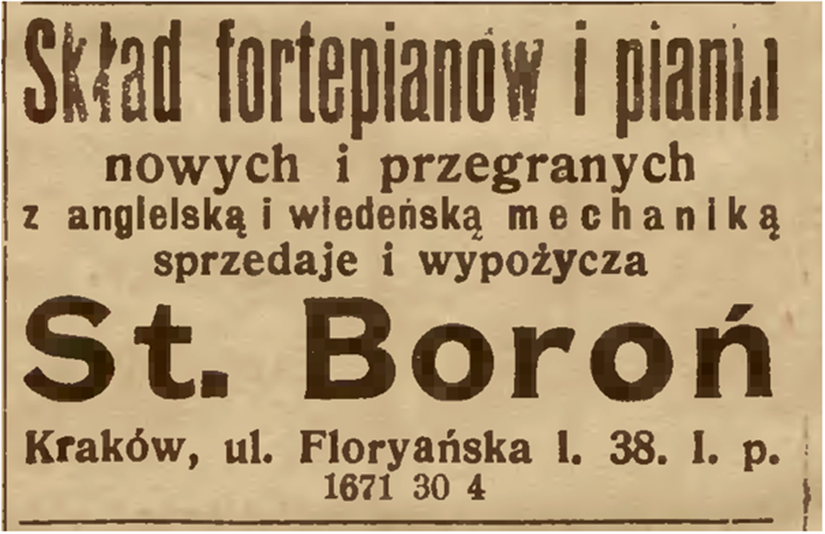
About halfway through the New Year’s Day 1911 issue of the daily newspaper Głos Narodu, surrounded by advertisements for wine, butter, laundry service, and a mail-order general store in the Czech lands sits a small, roughly one by one and half-inch advertisement for a piano store. The simple, rather staccato language of the advertisement reads, “Grand and upright piano store, new and used, of English and Viennese mechanisms, for sale and rent. St. Boroń, Kraków, Floryańska Street 1, number 38, on the first floor” (Figure 2).Footnote 44 This advertisement provides us with a good example of the main characteristics mentioned in piano advertisements by both businesses and individuals. Before approaching the changes that occurred within the piano culture and the middle class, the content and scope of piano-related advertising should be discussed.
Commercial advertisement for Stanisław Boroń’s piano store, Głos Narodu, 1 January 1911, 5.

While piano enthusiasts and practitioners may be better acquainted with the different types, sizes, shapes, styles, ornamentation, and internal working mechanisms of pianos, and how these variations affect the fullness and tone of any given instrument, the casual listener may only be familiar with the basic variations in piano design. These are most often the fortepian (grand), and the pianino (upright piano), both mentioned in the advertisement referenced above. A third type of piano is generally widely known by the populace now, and likewise, it was well known in the early twentieth century, the mały fortepian (baby grand, occasionally also called a krótki fortepian—a short grand). By and large, the advertisements in the daily newspapers in Kraków and Lwów mentioned at least one of these basic categories in their text. This suggests that, to the majority of consumers and sellers, the primary concern regarding pianos was their size, and understandably so. The purchase of a piano of any size came with the understanding that such a large instrument needed to be transported, and that one had enough room in their home or business to accommodate the instrument’s large footprint. As Ignacy Jan Paderewski put it in his memoirs, “To move a piano, like everything else, requires certain knowledge; it is not so simple as you might think.”Footnote 45
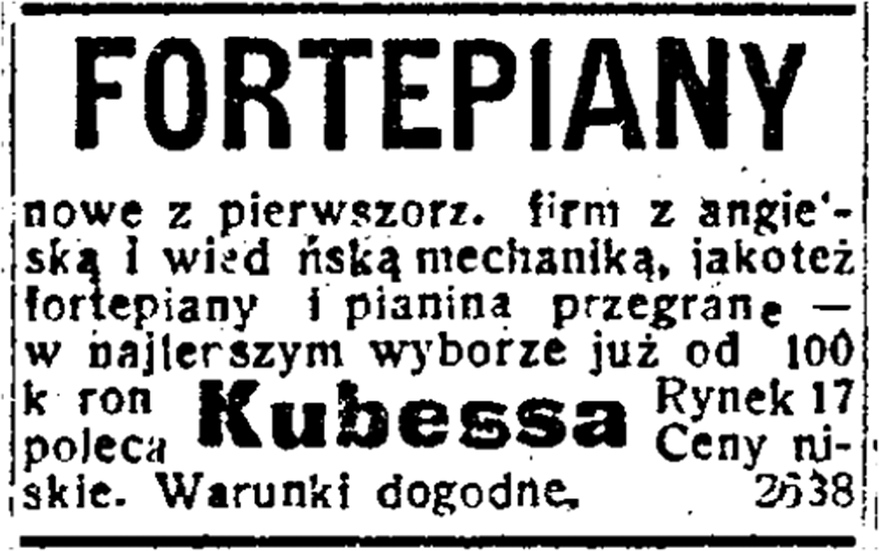
The next characteristic proffered in the Stanisław Boroń advertisement is that this shop sold both new and used pianos. Whether or not a commercial seller was offering new or used pianos was almost always included in their advertisements, while individual sellers selling pianos in classifieds often did not mention the age of their pianos, most likely because it was assumed that the piano was used. Both types of sellers, and also potential buyers, occasionally mentioned the condition of the piano that they were selling or hoping to find. Conspicuously absent from nearly all advertising, both commercial and individual, is the presence of actual prices. The 4 October 1913 Saturday edition of Kurjer Lwowski contains a rare example of a named price in an advertisement from the piano store “Kubessa,” which advertised new grand pianos but also, “used grand and upright pianos in the best condition for only 100 crowns.” After listing their address on the rynek (central square) in Lwów, the seller added, “Low prices. Flexible options” (Figure 3).Footnote 46 While the open discussion of actual pricing was rare in commercial advertising, and virtually nonexistent in classifieds, written inclusion of any pricing information was generally kept to the basic, vague description of “cheap.” Another feature exclusive to commercial advertising was the mention of “flexible options,” or payment plans, occasionally with no money down or without interest.
Kubessa advertisement with the price listed, Kurjer Lwowski, 4 October 1913, 10.

Another characteristic of piano advertisements is the presence, or lack thereof, of the maker’s name. Even by the turn of the century the name Steinway was globally synonymous with quality pianos, and within Europe, the Bechstein piano was also widely respected and played by many concert pianists, as was the Bösendorfer. While the New York-based Steinway and Sons and the Berlin-based Bechstein and Company were well-known piano manufacturers, companies such as Kerntopf and Sons in Warsaw, the Janiszewski factory in Lwów, and the B. Gabryelska piano factory in Kraków began to produce pianos for consumption within the lands of partitioned Poland. The higher quality and better name recognition of Steinway, Bechstein, and Bösendorfer pianos often correlated to a higher cost for consumers. That is not to say that these better-known makes did not appear for sale in Galicia in the newspapers and other advertising venues; rather, their appearance for sale was a rarity, compared to a slightly higher frequency of lesser-known manufacturers, such as Gabryelska, and an even greater number of advertisements that failed to mention any specific maker’s mark.Footnote 47
Establishing that piano makers from the Polish lands were active in Galicia from 1911 to 1921 is important for two reasons. First, it highlights the Polish entry into the piano manufacturing market, further exemplifying the significant place of pianos in the culture of Galicia, and Polish culture, writ large. Second, since the majority of newspaper advertisements do not mention the make of the pianos being sold, it is important to establish that by the time of this study, there were less expensive (and local) makes on the market than the more expensive premier brands. While the Gabryelska and Kerntopf pianos may have been cheaper than the more prestigious brands, their pianos still represented a major investment. The willingness of companies to offer pianos for rent or on a payment plan indicates that the desire of urban Galicians to possess these large cultural symbols was well-known by piano sellers who used that trend to their advantage.
Commercial Piano Markets in Kraków and Lwów
The Polish music scholar Vogel, mentioned above, has written a short history of pianos and piano making in the Polish lands. While his book is useful for tracing the connections between Polish piano-making and the piano-making traditions in German, Habsburg, and French lands, his focus is almost solely on makers within the Russian partition of Poland.Footnote 48 His text does, however, carry a listing of piano makers and more notable sellers throughout the partitioned Polish lands. By cross-referencing Vogel’s list with the sellers and manufacturers present in newspaper advertising and business directories a better picture of the commercial piano industry in Kraków and Lwów emerges. In Kraków, there were at least seven piano manufacturers active across the entire period of this study, from 1911 to 1921. Another two manufacturers were active in the years before the outbreak of World War I.Footnote 49 Of these nine total manufacturers, only the Bronisława Gabryelska factory seems to have advertised in the daily press in Kraków.Footnote 50 In addition to Gabryelska, there was advertising by at least another four commercial storefronts in the popular daily press, the most widespread coming from the shop of Helena Smolarska.Footnote 51
The commercial piano market in Lwów was somewhat more complex. There were eight piano manufacturers operating throughout the entire duration of this study, with another six operating for at least part of it. Artur Smutny, initially a tuner by trade, continued this service but also began producing pianos in 1912.Footnote 52 One of the larger companies, that of Franciszek Kubessa located on the main square in Lwów, ceased production in 1912.Footnote 53 Another notable manufacturer of this period was Mieczysław Janiszewski. Janiszewski began his own workshop after the factory he had previously built pianos for was bought by Konrad Kaim, and later renamed Kaim i Syn (Kaim and Son) in 1908.Footnote 54 A 1913 business directory of Lwów lists nine active piano storefronts in the city, though the true total number in the city that year was at least fifteen.Footnote 55
The majority of the piano sellers in Lwów and Kraków carried the names of male purveyors, such as Józef Hanak or Stanisław Boroń.Footnote 56 However, there were a few storefronts that carried female names. Of the twenty-one total piano storefronts identified for this study in Lwów, eighteen carried identifiably male names, two ambiguous shops only appeared in anonymous advertisements, and one, the shop of Julia Mussil, at ulica Ludwika 7 (present-day Prospect Svobody), carried the name of a woman. Mussil’s advertisements often only carried her first initial, and her last name did not carry a declension that marked it as feminine leaving her advertisements rather gender-neutral.Footnote 57 The ratio was slightly higher in Kraków. Thirteen sellers were identified for this study, ten with male names and three with female ones. These three included the Bronisława Gabryelska workshop, centrally located on the main square (Rynek 35), and the shop of M. Telesznicka just off the main square at ulica Św. Jana 2, and the Helena Smolarska storefront in Podgórze.Footnote 58 The fewer numbers of female-labeled stores are not altogether surprising, though, as census data from 1921 in both cities show that only around 22–23 percent of those identified as self-employed in the trade of goods were female.Footnote 59
Both Kraków and Lwów had a flourishing commercial piano market before the war that persisted throughout the war years and into the early interwar period. The commercial market was not the only avenue for piano sales, however. The next section will discuss the private piano market, as represented through classified advertising.
Classifieds and the Private Piano Market
First, it is important to note a peculiarity within classified advertising in the newspapers in Lwów and Kraków. It seems that there was no prohibition on businesses buying classified advertising in any of the newspapers. Or if there was a prohibition, it was not enforced. This is interesting because most of the newspapers charged more for the larger advertisements commonly used by many businesses than they did for the classifieds, which were smaller and more often used by individuals.Footnote 60 While it seems that the newspapers missed out on the opportunity to make more money from their advertisers, it stands to reason that advertising did not make up a significant enough portion of their income to risk losing advertising from businesses that wanted to buy the smaller-sized classifieds. For Kurjer Lwowski, for instance, advertising never made up more than 24 percent of the company’s income from 1914 to 1918.Footnote 61
That business advertising could appear in the classified sections of the newspapers makes examining classifieds as a window into the private piano market more difficult, but not impossible. Since almost all classifieds list an address, most of the commercial piano sellers could be identified by cross-referencing them against a list of known commercial businesses and their addresses. A base list of sellers is established by beginning with Vogel’s index of the known piano businesses in Kraków and Lwów from 1911 to 1921, then adding those shops found in Franciszek Reichman’s address guide from 1913. Next, a final, relatively comprehensive list is derived by adding both those sellers whose advertisements resided in the larger category typically used by businesses and addresses from classifieds which included specific language indicating that they were representing a business (for example, “office,” “store,” or if they resided on the ground floor of a building).
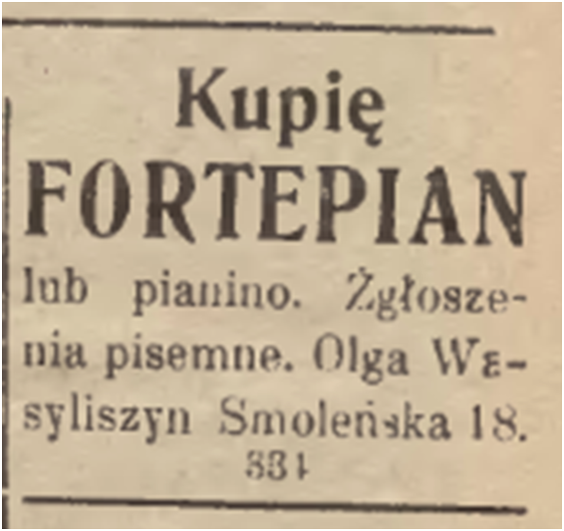
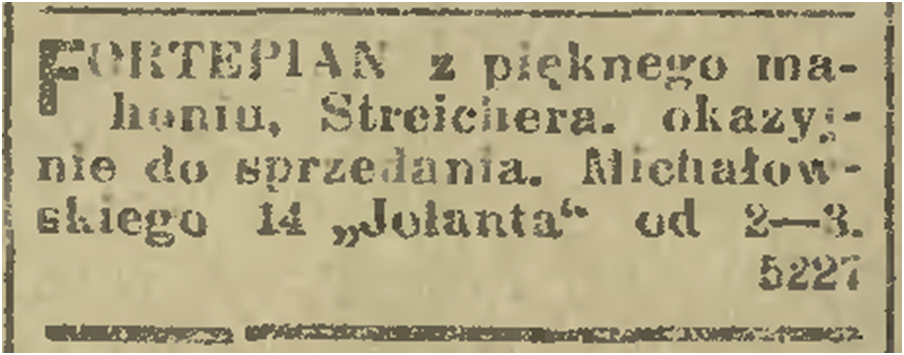
After eliminating classified newspaper advertisements that were known to be businesses, the remaining advertisements have been evaluated for language signifying that they were from an individual. This language could take several forms. If the advertiser listed a personal name as the correspondence contact, they may have been an individual. For example, in the Sunday, 4 March 1917 edition of Głos Narodu, Olga Wasyliszyn was looking to buy a grand or upright piano (Figure 4). Interested parties could write to her at her home address at Smoleńsk 18.Footnote 62 Also, individual advertisers may have chosen to use the editorial office of the newspaper as an intermediary. Doing so is an indicator that the advertisement is most likely an individual advertising, simply because a business did not need such a service. Such is the case in an advertisement from Wiek Nowy on 2 October 1915 in which the advertiser was looking to buy a piano. Interested sellers should write their correspondence to the administration of “Wiek” to the name “Pilawski.”Footnote 63 Occasionally, advertisements by individuals list a full name, or at least a contact name, along with available hours and a location. “Jolanta,” for example, asked that parties come to her address at ulica Michałowskiego 14 between 2:00 and 3:00 p.m. if they were interested in buying her “beautiful, mahogany Streicher,” in December 1919 (Figure 5).Footnote 64
Olga Wasyliszyn classified, Głos Narodu, 4 March 1917, 6.

“Jolanta” classified, IKC, 7 December 1919, 12.

Wiek Nowy had, by far, the most piano advertisements of any of the eight newspapers examined. This is not surprising, because Wiek Nowy was the largest newspaper in Lwów (by number of pages), and was one of the most popular illustrated dailies in Galicia. Additionally, Lwów had a larger network of commercial piano sellers, which may have translated to a more active private resale market. IKC and Kurjer Lwowski saw fewer classified advertisements than Wiek Nowy, but still more than other titles. This is understandable, as IKC was the most popular illustrated daily in Kraków, and Kurjer Lwowski was a widely read, non-illustrated popular daily in Lwów. Advertisements of this nature appeared in the daily politically affiliated newspapers, such as Głos Narodu, Nowa Reforma, and the Ukrainian language Dilo occasionally. Private classifieds rarely appeared in Czas and Gazeta Lwowska. As these titles were pro-imperial and conservative, it is possible that the audience these newspapers appealed to would have been more inclined to purchase goods, such as pianos, from storefronts rather than individual sellers, or that many of them belonged to the sections of society, mentioned above, that had begun to disdain the proliferation of pianos. It is also possible that this lack of private advertisements stems from the comparatively small readership of these titles. After all, individuals who bought classifieds would have most likely sought space in the newspapers that they read or that they knew would have the widest circulation.
Private piano classifieds to buy or sell were present in the newspapers in the years before the war in both cities and various titles.Footnote 65 Their appearance was affected by the war, reducing their numbers, but their publication did not cease.Footnote 66 They even continued to appear during the Russian occupation of Lwów, as exemplified by a Wiek Nowy advertisement in December 1914 seeking to buy (Figure 6).Footnote 67 The end of the war brought a change in borders and governments, but it did not change the presence of these advertisements and they continued to appear up until the end of this study in 1921.Footnote 68 Advertisements to buy and sell pianos occupied the same editions and in some cases even the same pages. Private buyers sometimes even included that they were willing to rent as seen in an advertisement from Wiek Nowy in October 1918.Footnote 69 One person interested in owning a piano was even willing to trade a man’s fur coat.Footnote 70
Classified looking to buy a piano during the Russian occupation of Lwów, Wiek Nowy, 5 December 1914, 8.

The instability in Lwów after the end of the war did not dispel advertisers, either. One of the most intriguing advertisements found was classified in which the resident of room 65 in the “Hotel Francuski,” located in the city center on plac Maryacki (present-day Mickiewicz square at the opposite end of Prospekt Svobody from the Opera House). The advertiser sought to sell their grand piano and their Underwood typewriter.Footnote 71 Room 65 was located on the fourth floor of the building, and it would have required quite a bit of logistical care and knowledge to remove an item that large from a floor at that height in a popular hotel.
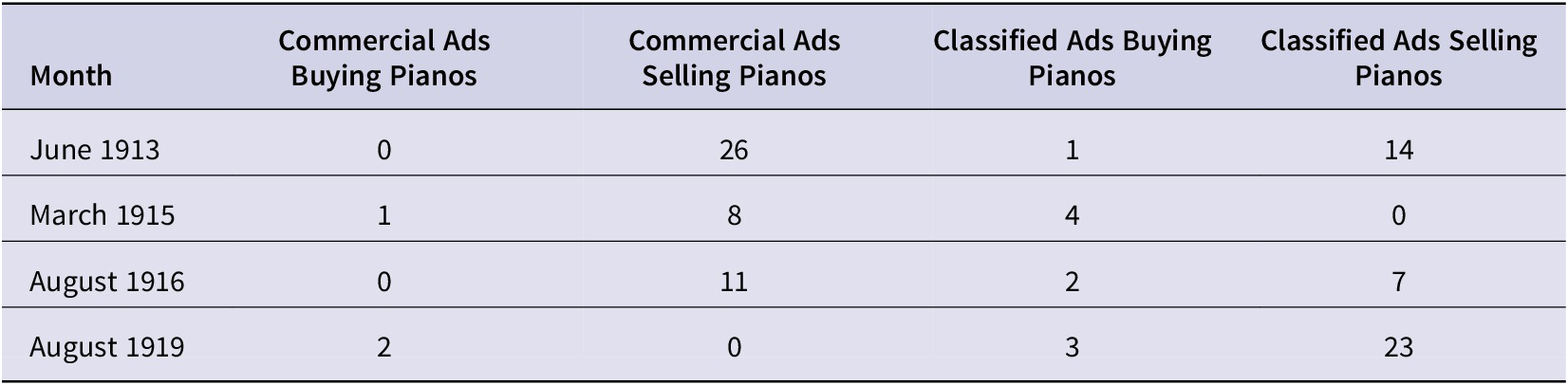
A comparative snapshot of all classified piano advertising provides more insight into advertising trends from 1911 to 1921. Based on data from Wiek Nowy, one month’s classifieds were calculated from each of the following periods: before the war (June 1913), during the Russian occupation of Lwów (March 1915), during the war, but not under occupation (August 1916), and during the early postwar period (August 1919) (Table 1).Footnote 72
Total Commercial and Classified Advertisements Selling and Buying Pianos appearing in Wiek Nowy for selected months.

In the month of June 1913, there was a thriving buyers’ market represented in the classifieds, with twenty-six commercial advertisements, and fourteen private advertisements selling used pianos. In March of 1915, during the occupation, there was a rise in private classifieds looking to purchase pianos, and even one commercial advertisement hoping to buy. These appear alongside only eight selling advertisements from businesses, and none from private sellers. We can surmise that it was perhaps the uncertainty of the occupation period that kept advertisers, commercial and private, from buying space in the classifieds to sell their pianos. A simultaneous increase in the private advertising space taken out looking to buy pianos suggests that there might have been individuals stable enough even during the uncertainty to buy a large instrument, one that was simultaneously a cultural symbol, an investment, and a focal piece of furniture.
In the month of August 1916, still during the war but after the Russian occupation had ended, there is a return of private sellers to the classifieds (seven), this stands alongside the continued presence of private buyers (two). Commercial advertising in the classifieds remained lower than the prewar level but rose slightly to eleven. By August 1919, after the end of the global conflict, but still in the midst of fighting between Poles and Ukrainians in eastern Galicia, there was a drastic rise in the number of used pianos being sold by individuals. That elevated number (twenty-three), combined with the continued presence of private classifieds seeking to buy pianos (three), stands in stark contrast to the lack of any commercial classifieds selling pianos. Only two advertisements by piano shops were present throughout August 1919, and both sought to purchase. These trends make sense in the context of World War I, the immediate regional conflict that followed, and the rise in inflation that occurred at an ever-increasing pace during the entire period of this study.
The drop of classified commercial sales listings from twenty-six in June 1913, to eight and eleven in March 1915 and August 1916, respectively, then to zero in August 1919 fits with the idea that sellers of new pianos may not have wanted to spend money on advertising during periods when they knew that the population would not have been interested or able to buy their goods. This reduction may have also occurred alongside increasing costs of advertising that were driven by inflation. The decline of private sales classifieds from fourteen in June 1913 to zero in March 1915 may have been a result of uncertainty brought on by the initial year of the war and the Russian occupation. Likewise, the rise of those same classifieds from zero during occupation, to seven in August 1916, to twenty-three in August 1919 indicates that the population of Lwów was increasingly in need of funds and was willing to sell valuable household goods to gain them. This coincides with what we know of the scarcity experienced as the war drew out and in the years immediately after its conclusion. In contrast to the fluctuating numbers of sales advertising, the number of private classifieds endeavoring to buy pianos seems relatively constant throughout the period.
The continued presence of individual piano classified advertisements hoping to buy and the increase in private advertisements selling pianos across the war years was a symptom of social and cultural change within the middle class in urban Galicia. The next section explores and explains this trend in further detail.
The Changing Middle Class and Pianos
While these trends in advertising represent a continuation of the middle-class embracing of piano culture that developed during the nineteenth century, the presence of individually purchased classifieds selling pianos shows that the piano also served as a household commodity of monetary value. For the family in Kraków or Lwów during the war and early interwar years, ownership of a piano not only established their more affluent status within the middle class, but also represented a physical piece of equity that could be sold if the family needed money. While the classifieds selling pianos seldom list prices, the willingness of a family to sell such a large piece of difficult-to-transport furniture indicates that the need to sell outweighed the difficulties of doing so. Generally speaking, the two groups that would have potentially had to sell their pianos during the war were public servants, largely in the echelons of the educated middle class, and, to a lesser extent, those aristocrats in the lower reaches of the upper class. Severe inflation during the war combined with static government incomes meant that civil servants and government employees (including those in military service) increasingly had less ability to provide for their families’ basic necessities. The contemporary economist Ludwig von Mises wrote that “[i]t is the middle classes, above all others, who have their assets invested in receiving interest payments from the public purse. Civil servants, army officers, and other professions rely on salaries from [it].”Footnote 73 Von Mises further elucidated the relationship between inflation and the wages of government employees during the war years extrapolating that “[a]s the currency is devalued, all pension payments are reduced in real terms … . [Government dependents] continue to earn only the same nominal payment, even though they can now only purchase and consume less with this amount than they were previously able to do so.”Footnote 74 The impact of governmental control over many sectors (including manufacturing) and the limits placed on organized labor meant that this economic constriction was felt across more of the population than just administrative and military workers. Rudolf Kučera highlights this in his discussion of the wartime experience of working-class laborers in Bohemia.Footnote 75
Still, other government employees might lose their jobs altogether. This was the case for the father of Jadwiga Rutkowska, our young diarist mentioned earlier. He had been a postal worker before the war, and less than a month after the outbreak of fighting, he ceased getting his paychecks from the government. He then left to join the Polish Legions (another position with a government salary), along with Jadwiga’s older brother and a family cousin.Footnote 76 Therefore, the same group that in recent decades had been able to buy pianos in their desire to emulate the upper class now had to consider selling those same symbols as fungible capital. While this is most likely the segment of the population that was forced to part with their pianos, it is also very possible that some members of the lower nobility may have also been in a position of financial need during this period. If the primary indicator of financial need during the war years was a fixed income, then conversely, individuals who were in a position to set their own wages had the best chance of weathering the storm, and could even aspire to purchase goods, such as pianos, that held the cultural significance of upward mobility. Some families, Rutkowska’s included, found ways to hold on to their pianos. She and her mother moved to a smaller apartment one floor down within the same building in September 1917 and convinced some local soldiers to help them move their piano downstairs. Keeping their piano, and the continuation of Jadwiga’s lessons throughout the entire war are even more impressive, given that her father had died a year earlier while fighting. Jadwiga notes that she is able to continue the lessons because her brother sends them money to do so (he was a junior officer in the Polish Legions by then like his father had been). Her piano lessons continued, even as she expressed hunger and scarcity of food as the war dragged on.Footnote 77 Many other families were not as fortunate. This trend spans into the postwar period, as well, and was not limited to Galicia. Anna Eisenmenger, a middle-class woman from Vienna, wrote in her diary on 30 March 1919 that she had a conversation with her smuggler. She was shocked that he would accept paper money as payment, to which he replied that he would take it back to Hungary (from where he smuggled food) because the people there would gladly bring the money with them when they came to Vienna because they could use it to purchase “furniture, fittings, pianos, carpets, which are to be had very cheaply in Vienna at the present day.” She continued to write in her diary that “[j]ust to be able to eat, people who have nothing but their well-furnished houses sell one thing after another.”Footnote 78 As these members of the upper-middle and lower-upper classes were confronted with whether or not to retain symbols of their social status, other members of society could use the economic upheaval of the war to negotiate their social status, in the Bourdieuian sense.
One type of profession that had the ability to change their own wages to keep up with inflation was the owners of furniture transport companies. Owners of the very companies that would probably be hired to transport pianos being bought and sold had the ability to change their prices based on demand and even raise their prices, possibly becoming more profitable during the years of instability. While moving to the smaller apartment in the same building, Jadwiga Rutkowska’s mother had arranged with movers to help, paying a deposit. When they didn’t show up, stealing her deposit, she complained at their office, then to the police, to no avail. She then had to hire another company, spending more money, only to have them move everything except the piano. She then had to rely on the kindness of the soldiers mentioned above.Footnote 79 Movers were by no means the only commercial category capable of adapting to the economy. Many other individuals in private service or merchant professions, such as clothes washers, room painters, sign painters, cobblers, carpenters, and piano tuners, all potentially had the same option.Footnote 80 Even the publishers of the popular newspapers had the ability to raise their prices alongside inflation (and did so). While there were limits to how much profit these types of professions could have made, given the state of the overall economy, the ability to set their own wages combined with a market presence of cheaper used pianos meant that the viability of buying and maintaining a piano was more realistic for these members of the middle class than it was for those that relied on a set wage that did not keep up with inflation.
From 1910 to 1921 the population of Kraków increased by 19 percent, while the number of independent merchants increased by roughly 69 percent.Footnote 81 The population shifts during the war of refugees both fleeing the city and entering it, and the population shift caused by the collapse of the Austro-Hungarian Empire and the formation of an independent Poland after 1918 all represent major factors in this growth. Even taking this into account, growth in the number of independent merchants outpaced the general population growth by 50 percent and represented 2.6 percent of the overall population. The number of independent merchants in Lwów in 1921 was 7,647 out of a total population of 219,388, proportionately higher than in Kraków, at 3.5 percent.Footnote 82 This represents a significant increase in self-employed merchants, the group which, as mentioned earlier, had the ability to determine their own wages in a time of high inflation. Recent demographic research by Bartosz Ogórek indicates that most of the postwar inhabitants of Kraków and Lwów had moved to the cities prior to the outbreak of the war. This implies that many of these inhabitants stayed in the cities throughout the war, or returned to them when they felt it was safe to do so during or after the war. In turn, this suggests that a number of these new merchants had become entrepreneurs after leaving other professions.
Independent merchants may not have been the only portion of the population capable of increasing their wealth during the war years and early interwar period, but the ability to identify the growth of this group by comparing census data shows that there was at least one group economically capable of purchasing large luxury items (in this case study, pianos) during a time of general economic hardship.
Conclusion
This article highlights how piano culture and the use of advertising to buy and sell pianos in the daily press persisted in early twentieth-century Kraków and Lwów. Both the desirability of piano ownership and the significance of the piano as a cultural symbol of affluence continued throughout the period of this study and persisted (at the least) to the end of the surveyed period in 1921. Even during the war, and perhaps all the more so because of it, music remained important to urban Galicians.
While the cultural significance of pianos remained steadfast, many individuals found other areas of life increasingly affected by the instability of war, imperial collapse, and the formation of new state. The wartime inflation increased exponentially as the global conflict dragged on. This inflation began early in the war, and by 1916 one notable diarist commented that people selling household items from “old junk” to pianos were already charging three times as much as these same goods had cost before the war.Footnote 83 Tracing inflation from the first month of the war to its last month in the tangible costs of one issue of the most popular newspaper in each city, IKC, and Wiek Nowy, we see an increase from a cost of six hellers to thirty hellers (500 percent) for both titles.Footnote 84 The cost per issue would continue to rise after the war. Habsburg and municipal civil servants and those dependent on fixed government incomes (a significant portion of the middle class in each city) were forced to deal with the actuality of a decline in the overall worth of their salaries, which could not keep pace with the economic reality within the empire. While those members of the middle class struggled to retain the stability and reasonable affluence that their positions had provided before the war, other members of the middle class had much more flexibility to adapt to the new economic situation. These individuals were most likely in the commercial sector, in positions that could set their wages at an increasing rate equal to (or perhaps even higher than) inflation.
At the intersection of these two trends—the continuation of piano culture and the shifts in income due to inflation—we find a potentially significant development. Individuals within the middle class with adaptable salaries could take advantage of a situation in which others within the middle class (and some in the upper class) needed to sell their pianos. In this unique context, some residents of Kraków and Lwów had the potential for more personal agency to change their own social standing, engaging in the social discourse that Bourdieu describes, advancing their class status as they understood it within the social hierarchy of the time. Those forced to sell their pianos had to grapple with maintaining their middle-class status, while those now able to buy pianos could theoretically begin to make the case that they were now a part of that same group.
This case study of piano markets and newspaper advertising allows us to venture further into an investigation about one area of apparent continuity within culture and everyday life, where the seemingly counterintuitive presence of continued advertising of a large luxury item in the midst of war and rebuilding was actually the result of shifts within the financial situation of the middle class that were directly related to the instability of the period. Piano advertising represents one example of how advertising, writ large, could continue only slightly daunted across the war years, while in reality, it continued because it was adaptable to the instability of inflation, changes in the middle class, and desire of Galicians to hold on to the cultural significance of piano culture. The case of piano advertising also highlights that some people may have actually been able to improve their own lives during the war and early postwar period despite the fact that many people suffered immensely.