Introduction
Proteases are enzymes that catalyse the hydrolysis of peptide bonds, which are widely distributed in plants, animals and microorganisms. These enzymes have been used in different biotechnological processes, such as those in the food industry, in detergents and in the leather industry (Ward Reference Ward and Moo-Young2011, Bruno et al. Reference Bruno, Coppola, di Prisco, Giordano and Verde2019, Furhan Reference Furhan2020). The proteases, obtained originally from mesophilic organisms, have an optimal temperature of catalysis of > 50°C, being inefficient at lower temperatures (Cavicchioli et al. Reference Cavicchioli, Charlton, Ertan, Omar, Siddiqui and Williams2011). For biotechnological purposes, it is necessary to find enzymes with better performance at low temperatures. In example, regarding enzymes as detergent additives, a cold-adapted protease will improve the removal of protein stains on clothes when washing with cold water instead of using warm water, requiring less heating energy, lower amounts of enzymes compared with mesophilic counterparts (Bruno et al. Reference Bruno, Coppola, di Prisco, Giordano and Verde2019) and avoiding damaging fabrics (Al-Ghanayem & Joseph Reference Al-Ghanayem and Joseph2020).
Many researchers have focused on Antarctica as a source of cold-adapted microorganisms. The Antarctic continent experiences harsh environmental conditions, such as extreme cold, low carbon and nitrogen availability (Martínez-Rosales & Castro-Sowinski Reference Martínez-Rosales and Castro-Sowinski2011, Liu et al. Reference Liu, Liu, Xing, Zhang, He and Chen2021) and high solar ultraviolet radiation. Nevertheless, life has managed to survive and thrive in this extreme environment, employing enzymes that have to be adapted to low temperatures. These cold-adapted enzymes, also called psychrozymes, usually have an optimal temperature of catalysis of ~20–45°C, being 20°C less than their mesophilic and thermophilic counterparts (Joshi & Satyanarayana Reference Joshi and Satyanarayana2013). In addition, cold-adapted enzymes have a turnover number (k cat) that is three to eight times higher than non-cold-adapted enzymes (Lonhienne et al. Reference Lonhienne, Gerday and Feller2000, Feller Reference Feller2013, Gerday Reference Gerday2013). These features show better performance at low temperatures, making them useful for biotechnological purposes (Al-Ghanayem & Joseph Reference Al-Ghanayem and Joseph2020).
Therefore, the aim of this work was to study the purified proteases from two strains of Gram-negative bacilli - Pseudoalteromonas issachenkonii P14M1-4 and Flavobacterium frigidimaris ANT34-7, isolated from King George Island, Antarctica - and to compare them with proteases from Bacillus licheniformis and Geobacillus stearothermophilus, both non-cold-adapted bacteria. The protease production capacity in liquid and solid media, the protease purification and the identification and catalytic characterization were determined. To the best of our knowledge, this is the first report of a characterization of a cold-adapted protease from F. frigidimaris.
Materials and methods
Bacterial strains and culture conditions
Two strains isolated from samples collected in expeditions to Fildes Peninsula, King George Island, and previously identified by 16S ribosomal RNA gene sequence (González-Rocha et al. Reference González-Rocha, Muñoz-Cartes, Canales-Aguirre, Lima, Domínguez-Yévenes, Bello-Toledo and Hernández2017) were studied. P. issachenkonii P14M1-4 (EU090711; 98% identity) was isolated from a seawater sample (4.2°C, pH 7.7) from Fildes Bay (a shore beach at Christian Point) in 2009 (62°11'54.5''S, 58°56'46.2''W), and the strain F. frigidimaris ANT34-7 (AB183888; 99% identity) was isolated from a water sample (2.5°C, pH 9.5) from Alta lagoon in the North Plateau in 2007 (62°11'00.2''S, 58°56'07.9''W). Due to the site of isolation, P. issachenkonii and F. frigidimaris were cultured in BD Difco™ marine agar/broth 2216 (for heterotrophic marine bacteria) and BD Difco™ R2A agar/broth (for heterotrophic bacteria that grow in low-nutrient medium), respectively, and at 15°C if no temperature information is shown.
Detection of secreted proteases in solid media
Proteolytic activity from extracellular proteases secreted by the strains under study was detected using the double-layer agar method described by Sizemore & Stevenson (Reference Sizemore and Stevenson1970), adding the respective culture medium for each strain. Each strain was incubated in its respective liquid culture medium for 3 days. Subsequently, the bacterial concentration was adjusted to 0.5 McFarland, before inoculating into Petri dishes with double-layer agar. The plates were incubated at 4°C for 15 days and at 15°C and 30°C for 7 days. The proteolytic activity in plate (PAP) was detected through the presence of a clear halo around each bacterial colony. The PAP was quantified as follows:
 $${\rm PAP} = \displaystyle{{( {P-C} ) } \over C}$$
where P is the proteolytic halo diameter and C is the colony diameter. A PAP value > 1.0 classified the strain as having ‘significant activity’ (Krishnan et al. Reference Krishnan, Convey, Gonzalez-Rocha and Alias2016). All assays were performed in duplicate.
Proteolytic activity assay with azocasein
Proteolytic activity in liquid medium was quantified using the Millet method (Millet Reference Millet1970) with modifications. Briefly, 100 μl of sample with proteases was mixed with 900 μl of 0.5% w/v azocasein (Sigma-Aldrich) in 200 mM Tris/HCl buffer at pH 8.0. The mixture was incubated at 25°C for 30 min. In order to stop the reaction, 500 μl of 10% w/v trichloroacetic acid (TCA, Merck) was added. Subsequently, the mixture was centrifuged at 12 000 × g for 10 min. The supernatant was separated and its absorbance at 340 nm was measured. A protease sample was added as a blank after TCA addition in an incubated azocasein solution. The enzymatic activity (EA) was defined as the amount of protease that increases the absorbance at 340 nm by 0.1 under assay conditions. All assays were performed in triplicate.
Protease production in liquid medium
To evaluate protease production, 100 ml of the respective liquid medium was placed in a 250 ml Erlenmeyer flask and then sterilized. The flasks were inoculated with 0.1 ml of the respective culture, with the bacterial concentration adjusted to 0.5 McFarland. Bacterial cultures were incubated at 10°C and 20°C with orbital agitation at 200 rpm. In order to track bacterial growth, 1 ml samples were withdrawn and monitored by measuring the absorbance at 560 nm. To measure protease production, the samples were centrifuged at 10 000 × g for 10 min at 4°C. From the supernatant obtained, azocasein assays were performed as previously indicated. All cultures were performed in triplicate.
Enzyme purification
To collect proteases for purification and characterization, flasks with the respective liquid medium were inoculated as described above. Then, each flask was incubated at 10°C with constant agitation at 200 rpm for 96 h and centrifuged twice at 10 000 × g for 10 min at 4°C, and the bacterial pellet was removed.
Extracellular protease from the P. issachenkonii P14M1-4 culture was purified by 90% w/v ammonium sulphate precipitation of the supernatant. Precipitated proteins were suspended and dialyzed against 50 mM Tris/HCl buffer, pH 9.0, supplemented with 10 mM CaCl2. Afterwards, the sample was applied to an anion exchange column (HiLoad 16/10 Q-Sepharose, GE Healthcare). Proteins were eluted with the same buffer as shown previously, supplemented with 250 mM, 500 mM and 1 M NaCl, at a flow rate of 1 ml/min. The fractions with the highest proteolytic activity (azocasein assay) were collected and stored at -20°C for further analysis.
Extracellular protease from the F. frigidimaris ANT34-7 culture was purified by ammonium sulphate precipitation in the fraction between 35% and 65% w/v. The protein pellet was suspended and dialyzed against 25 mM Tris/HCl buffer, pH 7.5. The samples were centrifuged twice for 30 min at 15 000 × g and 4°C, for the removal of bacterial pigments. Then, the samples were applied to an anion exchange column (HiLoad 16/10 Q-Sepharose, GE Healthcare). Proteins were eluted in the lineal gradient mode with the same buffer as shown previously, supplemented with 1 M NaCl (0–100% for 100 min), at a flow rate of 1 ml/min. The fraction with the highest proteolytic activity (azocasein assay) was collected and stored at -20°C for further analysis.
Protein determination, SDS-PAGE and zymogram
Protein content was measured according to the Bradford method (Bradford Reference Bradford1976) using bovine serum albumin as the standard.
Denaturing polyacrylamide gel electrophoresis (PAGE) using sodium dodecyl sulphate (SDS) was performed as described by Laemmli (Reference Laemmli1970) using 10% v/v in the separating gel. The samples were denatured previously with 5% v/v β-mercaptoethanol at 100°C for 5 min and were run at 80 V for ~2 h. After this, the gels were treated with an acetic acid/methanol/water solution (45:1:54) for 20 min, then stained with Coomasie brilliant blue G-250 dissolved in the same solution for 16 h and decoloured with distilled water.
Zymograms for proteases were performed as described by Heussen & Dowdle (Reference Heussen and Dowdle1980) with modifications. Samples were mixed with 0.16 M Tris/HCl buffer, pH 6.8, containing 2 M urea, 7% w/v SDS, 30% w/v sucrose and 200 μg/ml bromophenol blue (sample/buffer 1:1), and they were incubated for 30 min and 37°C for P. issachenkonii P14M1-4 proteases or 25°C for F. frigidimaris ANT34-7 proteases. The samples were separated by electrophoresis using 10% v/v polyacrylamide gels containing 0.1% w/v gelatin in the separating gel, and they were run at 120 V and 4°C for ~2 h. After this, the gels were washed twice with 2.5% v/v Triton X-100 for 10 min, twice with 50 mM Tris/HCl buffer, pH 8.0, containing 10 mM CaCl2 and 2.5% v/v Triton X-100 for 10 min, and finally twice with 50 mM Tris/HCl buffer, pH 8.0, only containing 10 mM CaCl2, for 10 min. The washed gels were incubated in 50 mM Tris/HCl buffer, pH 8.0, containing 10 mM CaCl2 for 60 min at 25°C. Then, the gels were treated with an acetic acid/methanol/water solution stained with Coomasie brilliant blue G-250 and decoloured with distilled water, similarly to SDS-PAGE.
Protease identification
From SDS-PAGE, proteins spots corresponding to purified proteases were selected for identification by peptide mass fingerprinting (McMahon Reference McMahon, Worsfold, Poole, Townshend and Miró2005). The proteins were manually excised from the gel and then sent to the Institut Pasteur in Montevideo, Uruguay, to perform matrix-assisted laser desorption ionization and time of flight (MALDI-TOF-TOF) analysis using an AB Sciex TOF/TOF™ 4800 system. Tryptic fragments of protein were identified by MASCOT (Matrix Science, http://www.matrixscience.com/search_form_select.html).
Effect of pH and temperature
The effect of pH on EA was evaluated with the proteolytic activity assay (Millet Reference Millet1970) using azocasein in the following buffer: 100 mM 3-morpholino-2-hydroxypropanesulfonic acid (MOPSO; pH 6.0–7.5; Sigma) and 100 mM Tris with 100 mM glycine (pH 7.5–11.0). The activity was determined at 25°C for 6 min. The effect of temperature on EA was evaluated with the proteolytic activity assay using azocasein. The samples with azocasein were incubated at different temperatures, ranging from 5°C to 65°C, for 6 min. In both assays, thermolysin (metalloprotease M4 from G. stearothermophilus, Sigma-Aldrich, CAS Number 9073-78-3) and subtilisin (serine-protease S8 from B. licheniformis, Sigma-Aldrich, CAS Number 9014-01-1) were used as controls. The results were expressed as EA in mg-1 min-1. All experiments were carried out in triplicate.
Effect of enzymatic inhibitors
In order to classify the catalytic mechanism of purified proteases, a set of inhibitors for different types of proteases was tested. Samples were pre-incubated for 15 min at 25°C in the presence of the following inhibitors: phenylmethylsulfonyl fluoride (PMSF; 1.5 and 5.0 mM), pepstatin A (1 and 5 μ|M), 1,10-phenanthroline (5 and 10 mM), ethylenediaminetetraacetic acid (EDTA; 5 and 10 mM) and benzamidine (5 and 10 mM). The remaining activities were determined with the proteolytic activity assay using azocasein. All experiments were carried out in triplicate. Statistical analysis was performed using paired Student t-tests, comparing the activity of the enzyme with and without inhibitory agents. Statistically significance was indicated at P < 0.05.
Determination of kinetic parameters
The kinetic parameters of turnover number (k cat) and Michaelis constant (KM) were determined using azocasein as a substrate. The released azo-peptides were measured by absorbance at 340 nm with a molar extinction coefficient of 932 M-1 cm-1 (calculated from Kulakova et al. Reference Kulakova, Galkin, Kurihara, Yoshimura and Esaki1999, with ɛ366 nm = 900 M-1 cm-1). For each assay, azocasein (0.018–0.900% w/v) with 200 mM Tris/HCl buffer, pH 8.0, was used. The purified enzymes and the substrate were incubated at 25°C for 8 min (P. issachenkonii P14M1-4 protease) or 4 min (F. frigidimaris ANT34-7 protease). The reaction was stopped with 10% w/v TCA, and the sample was centrifuged at 12 000 × g for 10 min. Absorbance of supernatant at 340 nm was measured. Subtilisin and thermolysin were used as controls. For serine proteases, Nα-benzoyl-l-arginine ethyl ester (BAEE; Sigma-Aldrich, ε253 nm: 808 M-1 cm-1) was used as a substrate for k cat and KM determination. For each assay, BAEE (0.25–1.00 mM) in 200 mM Tris/HCl buffer, pH 8.0, was incubated with purified enzyme for 4 min at 25°C, while tracking the increase of absorbance in real time at 253 nm. Subtilisin was used as a control. All experiments were carried out in triplicate.
Results
Bacterial growth and protease production
Proteolytic activity was observed in both P. issachenkonii P14M1-4 and F. frigidimaris ANT34-7 strains incubated in solid media. P. issachenkonii P14M1-4 presented bacterial growth at 4°C, 15°C and 30°C, showing PAP values of 1.4, 2.0 and 0.0, respectively. By contrast, F. frigidimaris ANT34-7 presented bacterial growth only at 4°C and 15°C, showing PAP values of 1.0 and 0.5, respectively.
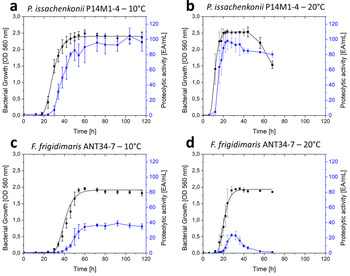
Liquid medium cultures showed protease production at 10°C and 20°C for both strains. For P. issachenkonii P14M1-4 fermentation broth, proteolytic activity was observed to be relatively constant at both temperatures, reaching ~100 EA/ml after 60 h of incubation at 10°C. At 20°C, proteolytic activity reached 100 EA/ml after 24 h of incubation; however, in the following hours, the activity decreased to 80 EA/ml (Fig. 1a & b). For F. frigidimaris ANT34-7 fermentation broth, the proteolytic activity was different: at 10°C it reached its maximum value (40 EA/ml) at 60 h of incubation, but at 20°C there was a peak of proteolytic activity of 25 EA/ml at 30 h, which decreased in the next hours and reached no activity at 68 h of incubation (Fig. 1c & d). Hence, the optimal culture conditions for protease production in liquid media, for both strains, were obtained at 10°C with at least 60 h of incubation.
Bacterial growth (black lines) and proteolytic activity (blue lines) produced by Pseudoalteromonas issachenkonii P14M1-4 at a. 10°C and b. 20°C and Flavobacterium frigidimaris ANT34-7 at c. 10°C and d. 20°C. EA = enzymatic activity; OD = optical density.

Identification of proteases
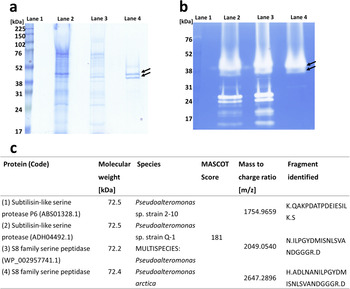
From the purification steps of the P. issachenkonii P14M1-4 culture, two protein bands were obtained, with estimated molecular weights of 40 and 43 kDa (Fig. 2a). Zymograms showed the same pattern of proteolytic activity (Fig. 2b). Identification by mass spectrometry showed similar m/z peaks in both protein bands. MASCOT also suggests that these two proteins are subtilisin-like S8 serine protease. In addition, all other enzymes that match the peptide fragments found are proteases from different Pseudoalteromonas sp. strains (Fig. 2c). The pattern obtained suggests that both 40 and 43 kDa protein bands are actually the same enzyme.
Purification and identification of Pseudoalteromonas issachenkonii P14M1-4 protease. a. SDS-PAGE and b. zymogram of samples obtained in different steps of the purification process. Lane 1: protein molecular weight markers. Lane 2: culture medium supernatant. Lane 3: ammonium sulphate precipitation. Lane 4: anion exchange chromatography fraction with proteolytic activity. Arrows indicate the purified proteases selected for identification. c. MASCOT identification of the protein bands.

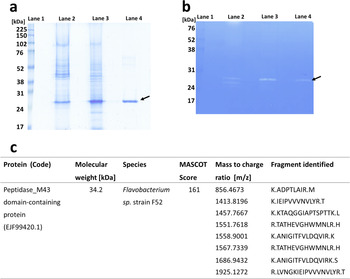
One protein band was obtained from the purification steps of F. frigidimaris ANT34-7, with an estimated molecular weight of 28 kDa (Fig. 3a). Zymograms also showed the same pattern of proteolytic activity (Fig. 3b). Identification by mass spectroscopy and MASCOT showed that this enzyme is a protein with an M43 peptidase domain (corresponding a metalloprotease) from a Flavobacterium sp. strain (Fig. 3c).
Purification and identification of Flavobacterium frigidimaris ANT34-7 protease. a. SDS-PAGE and b. zymogram of samples obtained in different steps of the purification process. Lane 1: protein molecular weight markers. Lane 2: culture medium supernatant. Lane 3: ammonium sulphate precipitation. Lane 4: anion exchange chromatography fraction with proteolytic activity. Arrow indicates the purified protease selected for identification. c. MASCOT identification of the protein bands.

Enzyme characterization
The effect of pH and temperature on the proteolytic activity of purified proteases were analysed. The protease purified from the P. issachenkonii P14M1-4 strain was active in a neutral to alkaline pH range, with an optimum point at pH ~10.0 (Fig. 4a). Serine protease control (subtilisin) was optimal at pH 10.5. The protease purified from the F. frigidimaris ANT34-7 strain was also active in a neutral to alkaline pH range. The optimal pH point is unclear, achieving high activity from pH 7.5 to 10.0 (Fig. 4b). Metalloprotease control (thermolysin) was optimal at between pH 7.0 and 7.5.
Effect of pH and temperature on the proteolytic activity of purified enzymes a. Effect of pH on Pseudoalteromonas issachenkonii P14M1-4 protease. b. Effect of pH on Flavobacterium frigidimaris ANT34-7 protease. Due to the use of two different buffers in the pH studies, there are two discontinuous lines: MOPSO buffer (pH 6.0–7.5) and Tris/glycine buffer (pH 7.5–11.0). c. Effect of temperature on P. issachenkonii P14M1-4 protease. d. Effect of temperature on F. frigidimaris ANT34-7 protease. EA = enzymatic activity.

Regarding the optimum temperature, the protease purified from the P. issachenkonii P14M1-4 strain showed optimal activity at between 35°C and 40°C. At > 40°C, the proteolytic activity decreased rapidly (Fig. 4c). The activation energy for this enzyme was 47.9 ± 1.5 kJ mol-1 (obtained from the Arrhenius plot of the activity vs temperature chart). Serine protease control was optimal at > 60°C, demonstrating an activation energy of 53.8 ± 0.4 kJ mol-1. Remarkably, the protease purified from the F. frigidimaris ANT34-7 strain showed optimal activity at 35°C, with its proteolytic activity decreasing at higher temperatures (Fig. 4d). The activation energy for this enzyme was 27.6 ± 0.8 kJ mol-1. Metalloprotease control was optimal at ~55°C, demonstrating an activation energy of 29.9 ± 0.5 kJ mol-1.
Effect of enzyme inhibitors
The effect of enzyme inhibitors was evaluated. The protease purified from the P. issachenkonii P14M1-4 strain was mainly inhibited by EDTA and PMSF (> 96% reduction in residual activity). Pepstatin A was not an inhibitor of the purified protease (P = 0.25). 1,10-phenanthroline and benzamidine also decreased the residual activity (up to 23% reduction). The protease purified from the F. frigidimaris ANT34-7 strain was inhibited by EDTA and 1,10-phenanthroline (> 96% reduction in residual activity). Benzamidine was also an inhibitor (~74% reduction in residual activity). Serine protease control (subtilisin) was inhibited mainly by PMSF, while metalloprotease control (thermolysin) was inhibited mainly by EDTA and 1,10-phenanthroline (Table I).
Effect of inhibitors on the activity of proteases. The protease activity is presented as the residual activity percentage compared with the control without an inhibitory agent.

* Statistically significant differences (P < 0.05) between the residual activity value of the enzyme without the inhibitor (control) and that with the inhibitor agent.
EDTA = ethylenediaminetetraacetic acid; PMSF = phenylmethylsulfonyl fluoride.
Kinetic properties of the purified proteases
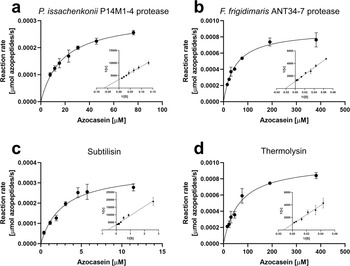
Kinetic constants are critical when comparing different enzymes of the same type. As is shown in Fig. 5 and Table II, using azocasein as the substrate, the proteases purified from the P. issachenkonii P14M1-4 strain and the F. frigidimaris ANT34-7 strain showed higher k cat values (~180 s-1) compared with control enzymes (between 50 and 86 s-1). On the other hand, a high range of KM values (from 2.7 to 64.9 μM) was observed. Finally, the kinetic efficiency (k cat/KM), which indicates how efficiently an enzyme can convert substrates into products, indicates subtilisin as the most efficient, followed by the P. issachenkonii P14M1-4 protease, the F. frigidimaris ANT34-7 protease and finally thermolysin as the least efficient protease.
Michaelis-Menten plots for each protease in this study: a. Pseudoalteromonas issachenkonii P14M1-4 protease; b. Flavobacterium frigidimaris ANT34-7 protease; c. subtilisin; d. thermolysin. In each plot, a small Lineweaver-Burk plot is also shown. Azocasein was used as the substrate.

Kinetic constants of the proteases.

BAEE = Nα-benzoyl-L-arginine ethyl ester.
BAEE is a substrate for serine proteases, only being effective with subtilisin and the P. issachenkonii P14M1-4 protease. This substrate can only be used at concentrations < 1 mM. The results showed reaction rates below the KM value, following from the shape of the Michaelis-Menten plot (see Fig. 6). At this point, it can be assumed that [S] <<< [KM], and the Michaelis-Menten equation changes as follows:
 $$v_i \approx \displaystyle{{v_{\rm max}} \over {K_M}} \times S$$
where v i is the reaction rate, v max is the maximum rate and S is the substrate concentration. From the slope and the enzyme concentration, k cat/KM can be obtained. As is shown in Table II, the kinetic efficiencies with BAEE were similar for both enzymes (2.3 × 10⁶ and 2.8 × 10⁶ M-1 s-1 for the P. issachenkonii protease and subtilisin, respectively).
Michaelis-Menten plots for a. Pseudoalteromonas issachenkonii P14M1-4 protease and b. Subtilisin. Due to [S] <<< KM (first section of the saturation curve), the v max/KM value is derived from the slope. Nα-Benzoyl-L-arginine ethyl ester (BAEE) was used as the substrate.

Discussion
Antarctic bacteria can be classified according to their ability to grow at low temperatures. A psychrophile is a microbe with a growth range of 0–20°C, with an optimal growth temperature of ≤ 15°C. On the other hand, psychrotolerant (psychrotrophic) microorganisms can grow at low temperatures but show optimal growth at 20–40°C (Joshi & Satyanarayana Reference Joshi and Satyanarayana2013). Therefore, P. issachenkonii P14M1-4 can be classified as psychrotolerant, due to its capacity for growth at 4°C, 15°C and 30°C in solid media, as well as at 10°C and 20°C in liquid media. These results corroborate previous results: Ivanova et al. (Reference Ivanova, Sawabe, Alexeeva, Lysenko, Gorshkova and Hayashi2002) observed a temperature growth range from 4°C to 37°C. However, F. frigidimaris ANT34-7 can be classified as psychrophilic because of its growth capacity at 20°C (liquid media) but not at 30°C (solid media). Other studies of this species indicate a growth range from 2°C to 26°C, classifying it as psychrotolerant (Nogi et al. Reference Nogi, Soda and Oikawa2005).
The proteolytic activity of these bacteria was temperature dependent. The experiments showed proteolytic activity at temperatures up to 20°C, with the best activity levels obtained at mild to low temperatures in liquid and solid media. In biological systems, a rise in temperature can increase the reaction rate of each enzyme of the metabolism, leading to faster growth capacity and protein production. Conversely, temperature can also denature proteins, disrupting the system and leading to cell death. Previously, it has been shown that these strains are cold-adapted bacteria, so it is also feasible that increased enzyme production would occur at low temperatures (Furhan Reference Furhan2020).
After purification, the proteases secreted by the strains were identified. Two protein bands with proteolytic activity from P. issachenkonii P14M1-4 were observed using SDS-PAGE. These bands showed similarities in their m/z peaks from mass spectrometry, and MASCOT confirmed both bands as the same protein: a subtilisin-like serine protease from different Pseudoalteromonas sp. strains. The molecular weight of the matches is ~72 kDa, having almost double the molecular weight of purified protease (40–43 kDa). After searching the matched sequence in the UniProt server (www.uniprot.org), it was observed that there is a matched preproprotein that has a signal peptide, a S8 peptidase domain (where the catalytic triad is found) and two pre-peptidase C-terminal (PCC) domains. The structure of a cold-adapted protease from Pseudoalteromonas arctica with a molecular weight of 37 kDa, corresponding to the active domain of the protease, was recently reported (Park et al. Reference Park, Lee, Kim, Do, Han and Kim2018). Fragments found with MASCOT match the S8 peptidase domain, which means that the purified protein is actually the active enzyme. Searching the identified peptide sequences in Blast (https://blast.ncbi.nlm.nih.gov/) showed that all of the sequences are specific for S8 family serine protease.
SDS-PAGE of F. frigidimaris ANT34-7 showed one 28 kDa protein band with proteolytic activity. According to MASCOT, this enzyme is an M43 peptidase (metalloprotease) from a Flavobacterium sp. strain. Additionally, the peptide fragment with an m/z of 1551.7618 belongs to the active site of a metalloprotease due to the presence of a zinc-binding HEXXH motif. Although there is a difference in the molecular weight between the purified protease and the MASCOT match (34.2 kDa), this protein has to undergo cleavage before becoming an active enzyme. Other M43 peptidases showed similar features, such as ulilysin, from the archaea Methanosarcina acetivorans, where the proenzyme, a 38 kDa inactive protease precursor, undergoes autolytic activation, becoming a 29 kDa active protease (Tallant et al. Reference Tallant, García-Castellanos, Seco, Baumann and Gomis-Rüth2006). Searching the identified peptide sequences in Blast (https://blast.ncbi.nlm.nih.gov/) showed that all are sequences specific for zinc metalloproteases.
For a correct protease activity analysis (optimal pH and temperature, effects of inhibitors and catalytic constants), it is necessary to compare these proteases to an appropriate control from non-cold-adapted microorganisms. The serine protease control was subtilisin from B. licheniformis (Dong et al. Reference Dong, Chen, Wang, Tian, Jin and Liu2017) and the metalloprotease control was thermolysin from G. stearothermophilus (Kakagianni et al. Reference Kakagianni, Gougouli and Koutsoumanis2016).
Both purified proteases showed an optimal pH in the neutral to alkaline range. Usually, serine proteases (E.C. 3.4.21) and some metalloproteases (E.C. 3.4.24) tend to show this pH range in their activity, becoming ‘alkaline proteases’ (Sharma et al. Reference Sharma, Kumar, Panwar and Kumar2017). The enzyme controls showed an optimum pH activity in agreement with previous studies (Srimathi et al. Reference Srimathi, Jayaraman and Narayanan2006, Ceruso et al. Reference Ceruso, Howe and Malthouse2012). A specific pH range is necessary because the active sites for these enzymes need the side chain with a specific charge to be functional, in addition to their specific protein structure. For example, metalloproteases have a HEXXH motif for zinc coordination. The coordination needs two non-protonated histidine residues and one glutamic acid residue in this motif (Pelmenschikov et al. Reference Pelmenschikov, Blomberg and Siegbahn2002). This is fulfilled when the pH is greater than the pKa. A recent review of cold-adapted proteases reports that the optimum pH for their activity typically ranges between alkaline pH values of 7.0 and 10.0 (Furhan Reference Furhan2020).
Purified proteases from Antarctic bacteria showed an optimum temperature of ~35°C and 40°C, being at least 15°C lower than their protease controls. At 35°C, the proteolytic activity achieved by purified proteases was ~2500 EA mg-1 min-1; on the other hand, the proteolytic activity of controls was low, at between 500 and 800 EA mg-1 min-1. The activation energy for purified proteases was also low when compared to their controls (between 2 and 5 kJ mol-1); this means that there is less need for energy in the biochemical reaction (Lonhienne et al. Reference Lonhienne, Gerday and Feller2000, Gerday Reference Gerday2013). These features suggest that the purified proteases are cold-adapted enzymes, showing better performance than enzymes from mesophilic and thermophilic microorganisms at lower temperatures.
The effect of inhibitors on the proteolytic activity confirms the preliminary classification found with MASCOT. The purified protease from P. issachenkonii P14M1-4 showed an inhibitory pattern that fits with a metal-dependent serine protease (inhibitory effect of EDTA and PMSF). Its control, subtilisin, was inhibited by PMSF but not by EDTA, indicating subtilisin as being a serine protease. Other studies showed the presence of calcium ions in the subtilisin structure, as determined by X-ray crystallography (Luo et al. Reference Luo, Eaton, Hess, Phillips-Piro, Brewer and Fenlon2019). Calcium ions are also described as structural stabilizers in some enzymes, such as subtilisin and thermolysin. This stabilization could also improve their thermolability (Alexander et al. Reference Alexander, Ruan and Bryan2001). The purified protease from F. frigidimaris ANT34-7 was inhibited by EDTA, 1,10-phenanthroline and benzamidine. EDTA is a chelating agent with the ability to sequester many metal ions; 1,10-phenanthroline is also a chelating agent, but with a high affinity for Zn2+, the cofactor of metalloproteases. Benzamidine is a protease inhibitor that can inactivate trypsin-like serine proteases and some metalloproteases such as carboxypeptidase B and ulilysin (Tallant et al. Reference Tallant, García-Castellanos, Seco, Baumann and Gomis-Rüth2006). Ulilysin is also classified as an M43 metalloprotease, supporting the protease classification found by MASCOT.
Using azocasein as the substrate, the catalytic constants of all of the enzymes were obtained. The turnover number (k cat) for Antarctic proteases were two to three times greater than their controls (obtained at 25°C). Some authors describe that cold-adapted enzymes tend to have higher k cat values compared to their mesophilic and thermophilic counterparts (Feller Reference Feller2013, Gerday Reference Gerday2013, Bruno et al. Reference Bruno, Coppola, di Prisco, Giordano and Verde2019), suggesting that the purified proteases are actually cold-adapted enzymes. KM did not show any trend between the purified enzymes and their controls. Kinetic efficiency (k cat/KM) initially suggested better performance for subtilisin. However, other studies indicate that performance in enzymes depends on the [S]/KM ratio: at high substrate levels, enzyme performance is directly related to the turnover number value (Eisenthal et al. Reference Eisenthal, Danson and Hough2007), supporting the idea that a higher turnover number means better performance at high substrate concentrations. That work also suggested that kinetic efficiency is useful for studies that compare the same enzyme in different substrates.
The kinetic efficiencies obtained with BAEE as the substrate showed that the protease from P. issachenkonii P14M1-4 and subtilisin prefer azocasein as a substrate. This suggests that these enzymes have a preference for the peptide bonds found in azocasein (a non-specific substrate for proteases) than the C-terminal arginine peptide bonds found in BAEE (a specific substrate for proteases). It is necessary to perform further studies to determine the peptide bond specificity of these enzymes.
Conclusions
In summary, we conclude that P. issachenkonii P14M1-4 and F. frigidimaris ANT34-7, collected from King George Island, can be classified as psychrotolerant and psychrophilic, respectively. P. issachenkonii secretes a 40–43 kDa metal-dependent subtilisin-like protein, with optimal temperatures between 35°C and 40°C, an optimum pH of 10 and a KM of 17.8 μM (for azocasein), and F. frigidimaris secretes a 28 kDa metalloprotein with the same optimal temperatures, an optimum pH range of 7.5–10.0 and a KM of 48.1 μM (for azocasein). These proteases, compared with subtilisin (mesophile) and thermolysin (thermophile), show similar catalytic efficiencies but at lower temperatures. Their activation energies, catalytic constants and growth capacities at different temperatures categorize them as cold-adapted enzymes. These features make them useful for biotechnological purposes requiring high protease activity at low temperatures.
Acknowledgements
The authors thank two anonymous reviewers for their constructive comments.
Financial support
This study was supported by INNOVA Bío Bío project 12.63-EM.TES (12.250), the National Agency for Research and Development (ANID)/Scholarship Program/MAGISTER NACIONAL/2013 221320354 (for CP-F) and INACH grant T-17-08.
Author contributions
GG-R collected the Antarctic samples from King George Island and isolated the bacteria. CP-F and GG-R participated in the microbiological experiments and analyses. CP-F, JM-O and MB participated in experiments and analyses related to the isolation and characterization of the proteases. All authors contributed to the manuscript.