Introduction
The extraction of starch from corn, its hydrolysis to glucose and subsequent isomerisation to fructose had major economic benefits in the 20th century Reference Deveaud, Beauvoit, Salin, Schaeffer and Rigoulet1,Reference Tappy and Lê2,Reference White3 . Globally, today, fructose poses great health and economic risks as it predisposes individuals to metabolic dysfunction which encompasses visceral adiposity, hypertriglyceridaemia, insulin resistance and non-alcoholic fatty liver disease (NAFLD) among others Reference Alberti and Zimmet4,Reference Genel, Aurelia, Donca and Emanuela5,Reference Jegatheesan and De Bandt6 . According to Alberti et al. Reference Alberti, Eckel and Grundy7 , the occurrence of any three constituents of metabolic dysfunction concurrently culminates in the metabolic syndrome (MS). Increased fructose consumption in the last few decades has coincided with an increase in metabolic dysfunction Reference Marriott, Cole and Lee8 . Studies by Lonardo et al. Reference Lonardo, Ballestri, Marchesini, Angulo and Loria9 suggest that consumption of fructose beyond the normal physiological range alters crucial regulatory steps in the fructose metabolic pathway. Under the normal physiological range, fructose is converted to glucose in the small intestine. Glucose can be converted into triose phosphates, the precursors for lipogenesis. This conversion, however, is tightly regulated by the enzyme phosphofructokinase-1 Reference Berg, Tymoczko and Stryer10 . Excess fructose intake facilitates conversion to triose phosphates, and this process, unlike that of glucose, is highly unregulated Reference Tappy and Lê2 . This altered metabolism promotes de novo lipogenesis making fructose a potent precursor of metabolic dysfunction Reference Basaranoglu, Basaranoglu and Bugianesi11 .
High caloric diets Reference Basaranoglu, Basaranoglu and Bugianesi12,Reference Softic, Cohen and Kahn13 , genetics Reference Li14,Reference Ziki and Mani15 , epigenetics Reference Kunes, Vaneckova, Mikulaskova, Behuliak, Maletínská and Zicha16,Reference Lee, Friso and Choi17 and early-life environmental factors Reference Marciniak, Patro-Małysza, Kimber-Trojnar, Marciniak, Oleszczuk and Leszczyńska-Gorzelak18,Reference Wesolowski, Kasmi, Jonscher and Friedman19 are thought to be instrumental in the development and progression of metabolic dysfunction. The alarmingly increasing occurrence (in both children and adults) of metabolic dysfunction suggests that genetics and lifestyle factors contribute modestly to these conditions Reference Kochhar and Martin20,Reference Lillycrop and Burdge21 . Current focus, therefore, is on developmental programming which describes how the early-life environment, particularly nutrition, may affect metabolism and ultimately health in adulthood Reference Li, Reynolds, Segovia, Gray and Vickers22,Reference Vickers23,Reference Wesolowski, El Kasmi, Jonscher and Friedman24 . According to current theories, the development and progression of metabolic disorders follows a ‘multiple hit’ hypothesis. Briefly, a primary intervention (‘first-hit’) leads to physiological changes which may be immediately expressed as diseased or suppressed. The suppressed effects are then unmasked by one or more subsequent interventions (‘second-hit’ or ‘multiple-hits’), leading to disease or amplified disease states of the ‘first hit’, respectively Reference Buzzetti, Pinzani and Tsochatzis25,Reference Heindel, Balbus and Birnbaum26 . Several factors have been identified as causal or risks to the development of NAFLD, these include gut microbiota Reference Soderborg, Clark and Mulligan27 and endocrine disruptors Reference Treviño and Katz28 .
Lifestyle modifications including increased physical activity are used as first-line therapy as they improve all facets of metabolic dysfunction Reference de Lorgeril29 . With enhanced severity of metabolic dysfunction, pharmaceutical agents that act to improve specific aspects of metabolic dysfunction are also used Reference Rubio-Ruiz, Hafidi, Perez-Torres, Banos and Guarner30 . Examples include metformin and statins that improve insulin sensitivity and reduce low-density lipoprotein (LDL) concentrations, respectively Reference Michos, Sibley, Baer, Blaha and Blumenthal31,Reference Song32 . Unfortunately, high cost, low efficacy and adverse side effects are hindering the use of most pharmaceutical agents Reference Kaur33,Reference Marvasti and Adeli34 . Research focus has shifted to alternative therapies including phytochemicals which are critical in the provision of primary health care in developing countries Reference Johnson and HOLTZ35,Reference Payyappallimana36,37 . Pentacyclic triterpenes are an example of phytochemicals being widely investigated in the fight against metabolic dysfunction.
Pentacyclic triterpenes such as ursolic acid (UA) Reference Li, Meng and Liao38 , oleanolic acid Reference Nyakudya, Mukwevho, Nkomozepi and Erlwanger39 and α-amyrin Reference Prabhakar, Reeta, Maulik, Dinda and Gupta40 have been shown to protect against hepatic lipid accumulation, dyslipidaemia and insulin resistance. UA is found in fruits including apples Reference He and Liu41 and medicinal herbs including sage Reference Le Men and Pourrat42 and thyme Reference Ismaili, Tortora and Sosa43 . Various studies have shown UA to exhibit anti-hyperglycaemic Reference Kang, Song and Gu44 , anti-hyperlipidaemic Reference Li, Kang, Li, Kong, Liu and Sun45 , hepatoprotective Reference Li, Wang, Sun, Zhang and Zheng46 and anti-cancer properties Reference Kim, Ryu and Lee47 . Although UA and other pentacyclic triterpenes have been shown to possess a myriad of beneficial effects on metabolic dysfunction, there is a paucity of data on the potential use of UA during developmental programming to protect against the development of metabolic dysfunction in adulthood. The period of developmental programming is characterised by developmental plasticity and physiological sensitivity Reference Gluckman and Hanson48,Reference Langley-Evans49 . Dietary interventions during this period can have either beneficial or adverse health effects in adulthood Reference Monaghan and Haussmann50,Reference Vickers23 . Of the few studies describing perinatal treatments with phytochemicals in rats, the majority have been done in males, but there are reports that features of metabolic dysfunction are expressed differently between the sexes Reference Beigh and Jain51,Reference Tsai, Wu and Hsu52 . Studies by Korićanac et al. Reference Korićanac, Đorđević and Žakula53 show that sex hormones confer differential levels of protectiveness and permissiveness to metabolic dysfunction with male rats being more susceptible to cardiovascular impairments while female rats are more susceptible to metabolic impairments. Additionally, Crescenzo et al. Reference Crescenzo, Cigliano and Mazzoli54 also highlight that the timing of fructose feeding as well as the age of the rats has an impact on normal physiology. Using the ‘multiple-hit’ hypothesis model, we therefore designed a study to investigate the potential of administering UA, in the period of developmental plasticity, to protect against the subsequent development of fructose-induced metabolic dysfunction much later in life in both male and female rats.
Materials and methods
All animal experiments were carried out according to the protocols approved by the Animal Ethics Screening Committee (AESC) of the University of the Witwatersrand, AESC number 2014/49/D.
Experimental animals
One hundred and seven male and female Sprague Dawley rats, acquired from the Central Animal Services (CAS) of the University of the Witwatersrand, Johannesburg, were used in the study. Rats were housed in acrylic cages lined with wood shavings in a temperature-controlled room (ambient temperature 24°C ± 2°C) and on a 12 h light/dark cycle (lights on at 0700 h clock time). Commercial rat chow (Epol®, Johannesburg, South Africa) and clean drinking water were provided ad libitum for the dams. Upon weaning, the rat pups were housed individually as described above. For the treatments described below, fructose (20% w/v) was prepared by dissolving 200 g of fructose in tap water and making it up to 1000 ml. Fructose (50% w/v) was prepared by dissolving 50 g of fructose in distilled water and making it up to 100 ml. Glucose solution (50% w/v; Radchem, South Africa) was made by dissolving 5 g of glucose in distilled water and filling it up to the 10 ml mark.
Chemicals and reagents
We used dimethylsulphoxide (DMSO; Sigma-Aldrich, France) as a vehicle to solubilise the UA Reference Sundaresan, Harini and Viswanathan55 in this study, which was reconstituted in distilled water to a final concentration of 0.5%. UA (Sigma-Aldrich, France) was dissolved in DMSO and distilled water to a final concentration of 0.05%. The UA solution used throughout the study was prepared in bulk and stored as 2 ml aliquots at −20°C until use. Fructose (Nature’s choice, South Africa) was used to induce metabolic dysfunction. The fructose drinking solution was prepared based on a weight/volume (w/v) formula to final concentrations of 50% w/v (first phase) and 20% w/v (adulthood). A drop of food colouring (no nutritional value, Robertsons, Retailer Brands (Pty) Ltd, South Africa) was added to 5 litres of the drinking fluids and used to distinguish the fluids from one another.
Study design
The study consisted of three phases and was designed to simulate a ‘multiple-hit’ interventional study. In the first phase of the study (from postnatal day 6 (P6) to P20), the first nutritional insult (‘first-hit’) was introduced to induce developmental programming. The 6-day-old suckling pups were assigned randomly to four treatment groups, each with a minimum of 26 pups. The rat pups received an oral administration (orogastric gavage) daily of one of the following solutions; Group 1 (control): 0.5% DMSO (10 ml/kg b.w) (n = 27). Group 2: UA (10 mg/kg b.w) (n =27) reconstituted in DMSO. This dose of UA was found to be effective in reversing the symptoms of MS (visceral adiposity, blood glucose concentrations and plasma lipids) in mice fed a high fat diet Reference Rao, De Melo and Queiroz56 . Group 3: 50% fructose solution (10 ml/kg b.w) (n = 27). Group 4: UA (10 mg/kg b.w) + 50% fructose solution (n = 26). In this phase, the pups were weighed (Snowrex Electronic Scale, Clover Scales, Johannesburg) daily to ensure that the correct dosage of the various treatments was administered. The dams were also weighed twice every week as part of routine health checks. Post-weaning, the rats were housed as described above and weighed twice every week to assess growth.
In the second non-interventional phase (from P21 to P69), the animals were fed normal commercial rat chow and had plain drinking water until adulthood. In the third and final phase of the study (from P70 to P126), half of the animals in each group were given either plain drinking water or a 20% fructose solution as drinking fluid for 8 weeks. Dietary choices in adulthood can predispose individuals to metabolic dysfunction Reference Suliga, Kozieł, Cieśla, Rębak and Głuszek57 . As such, we wanted to ascertain if early-life administration of UA could protect against fructose-induced metabolic dysfunction in adulthood. Additionally, we wanted to investigate if fructose consumption in adulthood would ameliorate or worsen the effects of neonatal fructose consumption. According to Sengupta Reference Sengupta58 , rats reach adulthood between P63 and P70 while Reference Mamikutty, Thent, Sapri, Sahruddin, Mohd Yusof and Haji Suhaimi59 found 8 weeks of fructose feeding in adulthood to cause metabolic dysfunction. As such, the first phase allowed for developmental programming (‘first-hit’), whereas the non-interventional phase was to allow the rats to reach adulthood. The third stage was to investigate the beneficial or harmful effects of the early-life programming (‘multiple hits’). The period P70–P126 is 8 weeks into adulthood and was therefore used in the current study. Food, fluid and total calorie intake were measured during this period using modified Mamikutty et al. Reference Mamikutty, Thent, Sapri, Sahruddin, Mohd Yusof and Haji Suhaimi59 formulae.
Average daily food intake = [initial feed mass (g) – final feed mass (g)]/number of days the feed was supplied.
Average daily fluid intake = [initial fluid volume (ml) – final fluid volume (ml)]/number of days the fluid was supplied.
Total calorie intake = average daily food intake (g) multiplied by constant + average daily fluid intake (ml) multiplied by constant.
On P126, fasting glucose and triglyceride concentrations were measured using a glucometer (Ascensia, Ireland) and triglyceride meter (Roche Diagnostics, Germany) from blood obtained from the tail vein Reference Parasuraman, Raveendran and Kesavan60 . The rats were euthanised on P129 using sodium pentobarbitone (200 mg/kg b.w; Euthapent; Kyron laboratories South Africa) and tissues were collected.
Tissue collection
Additional blood was collected via cardiac puncture into heparinised tubes (BD Vacutainer, Plymouth, UK), centrifuged at 4000 G for 15 min (Rotofix 32A, Hettich Zentrifugen, Germany) and the supernatant was stored at −20°C before being used for further analysis. The liver and visceral fat pads (VFP) were removed and weighed on a balance (Presica 310M, Switzerland). The caudate lobe of the liver was cut and stored in 10% formalin for use in histomorphological analyses. The remaining liver was stored at −20°C before it was used to determine hepatic lipid content by solvent extraction.
Determination of hepatic lipid content
Determination of the liver lipid content was done by solvent extraction at the Agricultural Research Council (Irene Analytical Services Laboratory) using the Tecator Soxtec method (Official Methods of Analysis of Analytical Chemists, 2005). Stored liver samples were freeze-dried, milled and 1 g was placed into a pre-weighed extraction thimble. The thimble was plugged using fat-free cotton wool placed on a thimble holder. After addition of petroleum ether extraction cups, the cups were placed on heating pads. Extraction proceeded as follows: boiling (30 min), rinsing (25 min), petroleum ether recovery (10 min) and drying (30 min at 90°C ± 5°C). The extraction cups were then cooled in a desiccator and then the amount of oil was determined using the following formula:
 $$\% {\mkern 1mu} {\rm{fat = 100}}[({\rm{mass}}{\mkern 1mu} \,{\rm{of}}{\mkern 1mu} {\rm{cup}}\,{\rm{plus}}\,{\rm{fat - mass}}\,{\mkern 1mu} {\rm{of}}\,{\rm{cup}}){\rm{/}}({\rm{mass}}{\mkern 1mu} \,{\rm{of}}\,{\rm{sample}})]$$
The test was done in triplicate.
Surrogate markers of liver function
Stored plasma samples were thawed to room temperature and processed using an IDEXX VetTest Chemistry Analyser (IDEXX VetTest® Clinical Chemistry Analyser, IDEXX Laboratories Inc., USA) as per manufacturer’s specifications. Serum alanine aminotransferase (ALT) and alkaline phosphatase (ALP) activities and albumin (ALB) concentrations were measured.
Liver histology
Following fixation, liver samples were processed overnight using an automatic tissue processor (MICROM STP 120, ThermoScientific, UK), embedded in paraffin wax and sectioned at 3 μm thickness using a rotary microtome (Leica RM2125 RTS, Leica Biosystems, USA). From each liver sample, 3 tissue sections that were 30 μm apart from each other were stained with haematoxylin and eosin (H&E) to assess hepatocellular changes according to standard protocols as described by Bancroft and Gamble Reference Bancroft and Gamble61 . To avoid sampling errors, liver samples for histology were obtained from the caudate lobe and a histologist who was blinded to the animal treatments semi-quantitatively assessed all the histological features. To assess the hepatocellular changes, three random camera fields per slide were viewed under a light microscope at 20× magnification. The semi-quantitative NAFLD activity score (NAS) method was used to assess the progression and severity of the NAFLD Reference Liang, Menke and Driessen62 .
Representative photomicrographs of the stained sections were acquired using a high-definition video (Leica ICC50, Leica Biosystems, USA) camera linked to a compound microscope (Leica DM 500, Leica Biosystems, USA). Composite images were prepared with CorelDraw X3 Software (Version 13, Corel Corporation, Ottawa, Canada). No pixelation adjustments of the captured photomicrographs were undertaken except for adjustment of contrast and brightness.
Statistical analysis
All data are expressed as mean and standard deviation and were analysed using Graph Pad Prism 8 (Graph Pad Software, San Diego, California, USA). Statistical significance was set at 5%. To assess the effects of both treatment and sex, body mass, food, fluid and total calorie intake, concentrations of circulating metabolites, visceral adiposity, liver lipids, surrogate markers of liver function and actual percentages of micro and macrosteatosis, hypertrophy and inflammation were analysed using two-way analysis of variance (ANOVA). The Bonferroni post hoc test was used to detect differences between and/or within groups whenever the ANOVA showed significant differences or significant main effects.
Results
In the rest of this paper, with regard to fructose consumption, ‘first hit’ may be described as a ‘single- hit’, an ‘early hit’ and a ‘late hit’ depending on how many times the fructose was consumed and/or when the fructose was consumed, respectively. Consumption of fructose both in early life and in adulthood, ‘multiple hits’, is described as a ‘double hit’.
Effect of ursolic acid administration on body mass
Fig. 1 and Supplementary Table 1 show the body masses of male and female rats at termination. No significant differences in body mass were observed across the treatment groups (p > 0.05) in both sexes. UA (both alone and in combination with fructose) had no apparent effects on body mass in male and female rats. Overall, male rats had significantly greater terminal body mass than female rats (main effects of sex (p < 0.0001), treatment (p = 0.0095) and their interaction (p = 0.3317).
Terminal body masses of male and female rats. All data presented as mean ± standard deviation. β = significantly lower terminal masses in female rats than their male counterparts (p < 0.05). DMSO + PW = 10 mg/kg b.w dimethylsulphoxide in early life + plain water in adulthood (n = 14; 8 M, 6 F); DMSO + FW = 10 mg/kg b.w dimethylsulphoxide + 20% fructose solution as drinking fluid (n = 13; 7 M, 6 F); UA + PW = 10 mg/kg b.w ursolic acid + plain water (n = 14; 7 M, 7 F); UA + FW = 10 mg/kg b.w ursolic acid + 20% fructose as drinking fluid (n = 13; 7 M, 6 F); FR + PW = 10 mg/kg b.w fructose + plain water (n = 13; 6 M, 7 F); FR + FW = 10 mg/kg b.w fructose + 20% fructose as drinking fluid (n = 14; 6 M, 8 F); UAFR + PW = 10 mg/kg b.w ursolic acid and fructose + plain water (n = 14; 7 M, 7 F); UAFR + FW = 10 mg/kg b.w ursolic acid and fructose + 20% fructose as drinking fluid (n = 12; 6 M, 6 F).

Effect of ursolic acid on fluid, food and total calorie intake
The food intake of male and female rats is shown in Fig. 2 and Supplementary Table 2. In both sexes, rats receiving DMSO in early life and fructose in drinking water in adulthood, UA in early life and fructose in drinking water in adulthood and a combination of UA and fructose in early life and fructose in drinking water in adulthood (DMSO + FW, UA + FW, FR + FW and UAFR + FW) had significantly lower food intake than their counterparts receiving plain drinking water in adulthood (DMSO + PW, UA + PW, FR + PW and UAFR + PW; main effects of sex (p = 0.0003), treatment (p < 0.0001) and their interaction (p = 0.4527). Early administration of UA had no apparent effects on food intake (p > 0.05). No sex differences were observed between the sexes (p > 0.05).
Average daily food intake of male and female rats in adulthood. All data presented as mean ± standard deviation. µ = significantly (p < 0.05) greater food intake in male and female rats receiving dimethylsulphoxide in early life and plain drinking water in adulthood, ursolic acid in early life and plain drinking water in adulthood, fructose in early life and plain drinking water in adulthood, a combination of ursolic acid and fructose in early life and plain drinking water in adulthood (DMSO + PW, UA + PW, FR + PW and UAFR + PW) compared to their counterparts receiving dimethylsulphoxide in early life and fructose in drinking water in adulthood, ursolic acid in early life and fructose in drinking water in adulthood, fructose in early life and fructose in drinking water in adulthood, a combination of ursolic acid and fructose in early life and fructose in drinking water in adulthood (DMSO + FW, UA + FW, FR + FW and UAFR + FW). DMSO + PW = 10 mg/kg b.w dimethylsulphoxide in early life + plain water in adulthood (n = 14; 8 M, 6 F); DMSO + FW = 10 mg/kg b.w dimethylsulphoxide + 20% fructose solution as drinking fluid (n = 13; 7 M, 6 F); UA + PW = 10 mg/kg b.w ursolic acid + plain water (n = 14; 7 M, 7 F); UA + FW = 10 mg/kg b.w ursolic acid + 20% fructose as drinking fluid (n = 13; 7 M, 6 F); FR + PW = 10 mg/kg b.w fructose + plain water (n = 13; 6 M, 7 F); FR + FW = 10 mg/kg b.w fructose + 20% fructose as drinking fluid (n = 14; 6 M, 8 F); UAFR + PW = 10 mg/kg b.w ursolic acid and fructose + plain water (n = 14; 7 M, 7 F); UAFR + FW = 10 mg/kg b.w ursolic acid and fructose + 20% fructose as drinking fluid (n = 12; 6 M, 6 F).

Fig. 3 and Supplementary Table 2 show the fluid intake of male and female rats. Although male rats receiving fructose in adulthood across the treatment groups (DMSO + FW, UA + FW, FR + FW and UAFR + FW) had seemingly increased fluid intake compared to their counterparts receiving plain drinking water in adulthood (DMSO + PW, UA + PW, FR + PW and UAFR + PW), these were not statistically significant (p > 0.05). A similar trend was observed in female rats with the exception of rats receiving DMSO in early life and fructose in drinking water in adulthood (DMSO + FW) which had significantly greater fluid intake than rats receiving DMSO in early life and plain drinking water in adulthood (DMSO + PW; p < 0.05). No sex differences were observed between the sexes (p > 0.05). For fluid intake, main effects of sex (p < 0.0001), treatment (p < 0.0001) and their interaction (p = 0.6891).
Average daily fluid intake of male and female rats in adulthood. All data presented as mean ± standard deviation. µ = significantly greater fluid intake in female rats receiving dimethylsulphoxide in early life and fructose in drinking water in adulthood (DMSO + FW; p < 0.05) compared to female rats receiving dimethylsulphoxide in early life and plain drinking water in adulthood (DMSO + PW). DMSO + PW = 10 mg/kg b.w dimethylsulphoxide in early life + plain water in adulthood (n = 14; 8 M, 6 F); DMSO + FW = 10 mg/kg b.w dimethylsulphoxide + 20% fructose solution as drinking fluid (n = 13; 7 M, 6 F); UA + PW = 10 mg/kg b.w ursolic acid + plain water (n = 14; 7 M, 7 F); UA + FW = 10 mg/kg b.w ursolic acid + 20% fructose as drinking fluid (n = 13; 7 M, 6 F); FR + PW = 10 mg/kg b.w fructose + plain water (n = 13; 6 M, 7 F); FR + FW = 10 mg/kg b.w fructose + 20% fructose as drinking fluid (n = 14; 6 M, 8 F); UAFR + PW = 10 mg/kg b.w ursolic acid and fructose + plain water (n = 14; 7 M, 7 F); UAFR + FW = 10 mg/kg b.w ursolic acid and fructose + 20% fructose as drinking fluid (n = 12; 6 M, 6 F).

Fig. 4 and Supplementary Table 2 show the total calorie intake corrected to body mass. In both male and female rats, no significant differences were observed across the treatment groups (p > 0.05). UA administration did not have any apparent effects on feed intake in both sexes (p > 0.05). With the exception of female rats receiving DMSO in early life and fructose in drinking water in adulthood (DMSO + FW) having greater total calorie intake than their male counterparts (p = 0.0010), no other sex differences were observed between the groups (main effects of sex (p < 0.0001), treatment (p = 0.0107) and their interaction (p = 0.0921).
Average daily total calorie intake of male and female rats in adulthood. All data presented as mean ± standard deviation. β = significantly greater total calorie intake in female rats receiving dimethylsulphoxide in early life and fructose in drinking water in adulthood (DMSO + FW; p = 0.0010) than their male counterparts. DMSO + PW = 10 mg/kg b.w dimethylsulphoxide in early life + plain water in adulthood (n = 14; 8 M, 6 F); DMSO + FW = 10 mg/kg b.w dimethylsulphoxide + 20% fructose solution as drinking fluid (n = 13; 7 M, 6 F); UA + PW = 10 mg/kg b.w ursolic acid + plain water (n = 14; 7 M, 7 F); UA + FW = 10 mg/kg b.w ursolic acid + 20% fructose as drinking fluid (n = 13; 7 M, 6 F); FR + PW = 10 mg/kg b.w fructose + plain water (n = 13; 6 M, 7 F); FR + FW = 10 mg/kg b.w fructose + 20% fructose as drinking fluid (n = 14; 6 M, 8 F); UAFR + PW = 10 mg/kg b.w ursolic acid and fructose + plain water (n = 14; 7 M, 7 F); UAFR + FW = 10 mg/kg b.w ursolic acid and fructose + 20% fructose as drinking fluid (n = 12; 6 M, 6 F).

Effect of ursolic acid on concentrations of circulating metabolites
The effects of UA on metabolic variables; circulating concentrations of triglycerides, cholesterol and glucose are shown in Figs. 5, 6 and 7, respectively. Additional data on cholesterol are also shown in Supplementary Table 3. In both male and female rats, no significant differences were observed in concentrations of circulating triglycerides, cholesterol and glucose across the treatment groups (p > 0.05). UA had no apparent effects on the concentrations of circulating metabolites in both sexes (p > 0.05). While no significant differences were observed between the sexes in circulating triglyceride (main effects of sex (p =0.9166), treatment (p = 0.0014) and their interaction (p = 9542) and glucose concentrations (main effects of sex (p = 0.1815), treatment (p = 0.6241) and their interaction (p = 0.7130), female rats receiving DMSO in early life and fructose in drinking water in adulthood (DMSO + FW) had significantly greater cholesterol concentration than their male counterparts (p < 0.05, main effects of sex (p < 0.0001), treatment (p = 0.2227) and interaction (p = 0.3935).
Plasma triglyceride concentration in male and female rats. All data presented as mean ± standard deviation. DMSO + PW = 10 mg/kg b.w dimethylsulphoxide in early life + plain water in adulthood (n = 14; 8 M, 6 F); DMSO + FW = 10 mg/kg b.w dimethylsulphoxide + 20% fructose solution as drinking fluid (n = 13; 7 M, 6 F); UA + PW = 10 mg/kg b.w ursolic acid + plain water (n = 14; 7 M, 7 F); UA + FW =10 mg/kg b.w ursolic acid + 20% fructose as drinking fluid (n = 13; 7 M, 6 F); FR + PW = 10 mg/kg b.w fructose + plain water (n = 13; 6 M, 7 F); FR + FW =10 mg/kg b.w fructose + 20% fructose as drinking fluid (n = 14; 6 M, 8 F); UAFR + PW = 10 mg/kg b.w ursolic acid and fructose + plain water (n = 14; 7 M, 7 F); UAFR + FW = 10 mg/kg b.w ursolic acid and fructose + 20% fructose as drinking fluid (n = 12; 6 M, 6 F).

Plasma total cholesterol concentration in male and female rats. All data presented as mean ± standard deviation. β = significantly greater cholesterol concentration in female rats receiving dimethylsulphoxide in early life and fructose in drinking water in adulthood (DMSO + FW; p < 0.05) compared to their male counterparts. DMSO + PW = 10 mg/kg b.w dimethylsulphoxide in early life + plain water in adulthood (n = 14; 8 M, 6 F); DMSO + FW = 10 mg/kg b.w dimethylsulphoxide + 20% fructose solution as drinking fluid (n = 13; 7 M, 6 F); UA + PW = 10 mg/kg b.w ursolic acid + plain water (n = 14; 7 M, 7 F); UA + FW = 10 mg/kg b.w ursolic acid + 20% fructose as drinking fluid (n = 13; 7 M, 6 F); FR + PW = 10 mg/kg b.w fructose + plain water (n = 13; 6 M, 7 F); FR + FW = 10 mg/kg b.w fructose + 20% fructose as drinking fluid (n = 14; 6 M, 8 F); UAFR + PW = 10 mg/kg b.w ursolic acid and fructose + plain water (n = 14; 7 M, 7 F); UAFR + FW = 10 mg/kg b.w ursolic acid and fructose + 20% fructose as drinking fluid (n = 12; 6 M, 6 F).

Blood glucose concentration in male and female rats. All data presented as mean ± standard deviation. DMSO + PW = 10 mg/kg b.w dimethylsulphoxide in early life + plain water in adulthood (n = 14; 8 M, 6 F); DMSO + FW = 10 mg/kg b.w dimethylsulphoxide + 20% fructose solution as drinking fluid (n = 13; 7 M, 6 F); UA + PW = 10 mg/kg b.w ursolic acid + plain water (n = 14; 7 M, 7 F); UA + FW =10 mg/kg b.w ursolic acid + 20% fructose as drinking fluid (n = 13; 7 M, 6 F); FR + PW = 10 mg/kg b.w fructose + plain water (n = 13; 6 M, 7 F); FR + FW = 10 mg/kg b.w fructose + 20% fructose as drinking fluid (n = 14; 6 M, 8 F); UAFR + PW = 10 mg/kg b.w ursolic acid and fructose + plain water (n = 14; 7 M, 7 F); UAFR + FW = 10 mg/kg b.w ursolic acid and fructose + 20% fructose as drinking fluid (n = 12; 6 M, 6 F).

Effect of ursolic acid on visceral fat
Fig. 8 and Supplementary Table 3 show the visceral fat pad masses of male and female rats. In male rats, although rats receiving DMSO in early life and fructose in drinking water in adulthood, UA in early life and fructose in drinking water in adulthood, fructose in early life and fructose in drinking water in adulthood and a combination of UA and fructose in drinking water in early life and fructose in drinking water in adulthood (DMSO + FW, FR + FW and UAFR + FW) had seemingly greater visceral fat accumulation compared to their counterparts receiving DMSO in early life and plain drinking water in adulthood, UA in early life and plain drinking water in adulthood, fructose in early life and plain drinking water in adulthood and a combination of UA and fructose in early life and plain drinking water in adulthood (DMSO + PW, FR + PW and UAFR + PW), no statistically significant differences were observed across the treatment groups (p > 0.05). Female rats receiving DMSO in early life and fructose in drinking water in adulthood, fructose in early life and fructose in drinking water in adulthood and a combination of UA and fructose in early life and fructose in drinking water in adulthood (DMSO + FW, FR + FW and UAFR + FW) had significantly (p < 0.05) greater visceral fat accumulation than those receiving DMSO in early life and fructose in drinking water in adulthood, fructose in early life and fructose in drinking water in adulthood and a combination of ursolic and fructose in early life and plain drinking water in adulthood (DMSO + PW, FR + PW and UAFR + PW). In both male and female rats, UA had no apparent effect on visceral fat (p > 0.05). Female rats receiving DMSO in early life and fructose in drinking water in adulthood and a combination of UA and fructose in early life and fructose in drinking water in adulthood (DMSO + FW and UAFR + FW) had significantly greater (p < 0.05) visceral fat accumulation compared to their male counterparts (DMSO + PW, FR + PW and UAFR + PW) although these sex differences were not observed in the remaining groups (main effects of sex (p < 0.0001), treatment (p < 0.0001) and interaction (p = 0.5034)).
Visceral fat content in male and female rats. All data presented as mean ± standard deviation μ = significantly greater visceral fat accumulation in female rats receiving DMSO in early life and fructose as adults (DMSO + FW), fructose in early life and fructose in drinking water in adulthood (FR + FW) and those receiving a combination of ursolic acid and fructose in early life and fructose in drinking water in adulthood (UAFR + FW, respectively, compared to their counterparts receiving DMSO in early life and plain water for the rest of their lives (DMSO + PW; p < 0.05), fructose in early life and plain drinking water in adulthood (FR + PW; p < 0.05) and those receiving a combination of ursolic acid and fructose in early life and plain drinking water in adulthood (UAFR + PW; p < 0.05). β = significantly greater visceral fat accumulation in female rats receiving DMSO in early life and fructose as adults (DMSO + FW) and those receiving a combination of ursolic acid and fructose in early life and fructose in drinking water in adulthood (UAFR + FW), respectively, compared to their male counterparts (p < 0.05). DMSO + PW = 10 mg/kg b.w dimethylsulphoxide in early life + plain water in adulthood (n = 14; 8 M, 6 F); DMSO + FW = 10 mg/kg b.w dimethylsulphoxide + 20% fructose as drinking fluid (n = 13; 7 M, 6 F); UA + PW = 10 mg/kg b.w ursolic acid + plain water (n = 14; 7 M, 7 F); UA + FW = 10 mg/kg b.w ursolic acid + 20% fructose as drinking fluid (n = 13; 7 M, 6 F); FR + PW = 10 mg/kg b.w fructose + plain water (n = 13; 6 M, 7 F); FR + FW = 10 mg/kg b.w fructose + 20% fructose as drinking fluid (n = 14; 6 M, 8 F); UAFR + PW = 10 mg/kg b.w ursolic acid and fructose + plain water (n = 14; 7 M, 7 F); UAFR + FW = 10 mg/kg b.w ursolic acid and fructose + 20% fructose as drinking fluid (n = 12; 6 M, 6 F), % BM = per cent body mass.

Effect of ursolic acid on hepatic parameters
Hepatic lipid accumulation
The effects of UA administration on hepatic lipid accumulation (as determined by solvent extraction) are shown in Fig. 9 and Supplementary Table 4. In male rats, consumption of fructose both in early life and in adulthood (FR + FW; ‘double hit’) resulted in lower lipid accumulation compared to male rats receiving DMSO in early life and fructose in adulthood (DMSO + FW; p < 0.05). Hepatic lipid accumulation in male rats was below 5% across all the treatment groups; early life fructose consumption (FR + PW) resulted in lipid accumulation of 4% of liver weight, fructose consumption in adulthood 4.5% of liver weight, whilst fructose consumption both in early life and in adulthood resulted in 3.9% hepatic lipid content. In females, fructose consumption in adulthood only (DMSO + FW; ‘late single hit’) resulted in increased hepatic lipid accumulation (~6% hepatic lipid content of liver weight) which was not observed in in female rats which consumed fructose only in early life (FR + PW; ‘early single hit’, p < 0.001) and was ~4% hepatic lipid content of liver weight. However, fructose when consumed in early life and then later in adulthood (FR + FW; ‘double-hit’) resulted in even greater lipid accumulation (~12% hepatic lipid content of liver weight) compared to the late single hit (DMSO + FW; p < 0.001) in female rats. Early-life administration of a combination of UA and fructose with subsequent plain water consumption in adulthood (UAFR + PW) resulted in greater lipid accumulation in female rats receiving DMSO, UA and fructose alone in early life and plain water in adulthood (DMSO + PW, UA + PW and FR + PW, respectively; p < 0.0001). Additionally, the same rats had greater hepatic lipid accumulation than rats receiving DMSO, UA and a combination of UA and fructose in early life and fructose in drinking water as adults (DMSO + FW, UA + FW and UAFR + FW; p < 0.05) although they had lesser hepatic lipid accumulation than rats receiving fructose as in early life and fructose in drinking water in adulthood (FR + FW; p < 0.0001). With the exception of rats receiving DMSO in early life and plain drinking water in adulthood, UA in early life and plain drinking water in adulthood and fructose in early life and plain drinking water in adulthood (DMSO + PW, UA + PW and FR + PW; p > 0.05), sex differences were observed with female rats having greater percentages of hepatic lipid accumulation compared to their male counterparts (main effects of sex (p < 0.0001), treatments (p < 0.0001) and their interaction (p < 0.0001).
Liver lipid content in male and female rats. All data presented as mean ± standard deviation. κ = significantly increased hepatic lipids in female rats receiving fructose in early life and fructose in drinking water as adults (FR + FW) compared to those receiving dimethylsulphoxide in early life and fructose in drinking water as adults (DMSO + FW; p < 0.0001) and those receiving a combination of ursolic acid and fructose in early life and fructose in drinking water in adulthood (UAFR + FW; p < 0.0001). μ = significantly lower hepatic lipid content in male rats receiving fructose in early life and fructose as adults (FR + FW; p < 0.05), female rats receiving ursolic acid in early life and fructose as adults (UA + FW; p < 0.05) and rats receiving a combination of ursolic acid and fructose in early life and fructose as adults (UAFR + FW; males; p < 0.0001, females; p < 0.001) compared to rats receiving dimethylsulphoxide in early life and fructose as adults (DMSO + FW). ε = significantly lower hepatic lipid content in male rats receiving a combination of ursolic acid and fructose in early life and fructose as adults (UAFR + FW) than those receiving dimethylsulphoxide in early life and plain water for the rest of their life (DMSO + PW; p < 0.05). ρ = significantly higher hepatic lipid content in female rats receiving dimethylsulphoxide in early life and fructose as adults (DMSO + FW) compared to those receiving dimethylsulphoxide in early life and plain water for the rest of their life (DMSO + PW; p < 0.05), male and female rats receiving ursolic acid in early life and fructose as adults (UA + FW) compared to their counterparts receiving ursolic acid in early life and plain drinking water in adulthood (UA + PW, males; p < 0.05, females; p < 0.0001) and female rats receiving fructose early in life and fructose in drinking water in adulthood compared to those receiving fructose in early life and plain drinking water in adulthood (FR + FW; p < 0.0001). σ = significantly higher hepatic lipid accumulation in female rats receiving a combination of ursolic acid and fructose in early life and plain water in adulthood (UAFR + PW) compared to those receiving dimethylsulphoxide, fructose and ursolic acid in early life and plain water in adulthood (DMSO + PW, FR + PW and UA + PW, respectively; p < 0.05). ω = significantly greater hepatic lipid accumulation in male and female rats receiving dimethylsulphoxide in early life and plain drinking water in adulthood (DMSO + PW) compared to male rats receiving a combination of ursolic acid and fructose in early life and plain drinking water in adulthood (UAFR + PW; p < 0.0001) and female rats receiving ursolic acid in early life and plain drinking water in adulthood, respectively (UA + PW; p < 0.05). ν = significantly higher hepatic lipid accumulation in rats receiving a combination of ursolic acid and fructose in early life and plain water in adulthood (UAFR + PW) compared to those receiving a combination of ursolic acid and fructose in early life and fructose in drinking water in adulthood (UAFR + FW, males; p < 0.05, females; p < 0.0001). β = significantly higher hepatic lipids in female rats compared to their male counterparts (p < 0.05). DMSO + PW = 10 mg/kg b.w dimethylsulphoxide in early life + plain water in adulthood (n = 14; 8 M, 6 F); DMSO + FW = 10 mg/kg b.w dimethylsulphoxide + 20% fructose in drinking water (n =13; 7 M, 6 F); UA + PW = 10 mg/kg b.w ursolic acid + plain water (n = 14; 7 M, 7 F); UA + FW = 10 mg/kg b.w ursolic acid + 20% fructose as drinking fluid (n = 13; 7 M, 6 F); FR + PW = 10 mg/kg b.w fructose + plain water (n = 13; 6 M, 7 F); FR + FW = 10 mg/kg b.w fructose + 20% fructose as drinking fluid (n = 14; 6 M, 8 F); UAFR + PW = 10 mg/kg b.w ursolic acid and fructose + plain water (n = 14; 7 M, 7 F); UAFR + FW = 10 mg/kg b.w ursolic acid and fructose + 20% fructose as drinking fluid (n = 12; 6 M, 6 F).

Although an early fructose hit (FR +PW), a late fructose hit (DMSO + FW) and a double fructose hit (FR + FW) had no significant adverse effects in male rats, UA administration in combination with fructose with subsequent fructose consumption in adulthood (UAFR + FW) resulted in lower hepatic lipid content compared to the groups receiving DMSO in early life and fructose in drinking water in adulthood (late single hit, DMSO + FW) (p < 0.05). In female rats, administration of UA led to significantly decreased accumulation of lipids within the liver. Early-life UA administration alone followed by a late hit with fructose in adulthood (UA + FW) as well as UA administration in combination with fructose in early life and subsequent fructose feeding in adulthood (UAFR + FW) prevented the accumulation of lipids as a result of a single late hit of fructose (p < 0.05) and a double hit of fructose (p < 0.0001).
Surrogate markers of liver function
Table 1 and Supplementary Table 5 show the effect of neonatal UA administration on surrogate markers of liver function; ALT, non-tissue specific ALP and albumin (ALB). Fructose consumption in early life and in adulthood had no apparent effects on the surrogate markers of liver function: ALT (main effects of sex (p = 0.0211), treatment (p = 0.5135) and their interaction (p = 0.5341), ALP (main effects of sex (p = 0.1175), treatment (p < 0.0001) and their interaction (p = 0.9734)) and ALB (main effects of sex (p = 0.1472), treatment (p = 0.1887) and interaction (p = 0.2996)). UA administration and fructose consumption had no significant effects on the markers (p > 0.05). There were no differences in concentrations of surrogate markers of liver function (p > 0.05) between the sexes.
Effect of neonatal administration of ursolic acid on surrogate markers of liver function

All data presented as mean ± standard deviation. DMSO + PW = 10 mg/kg b.w dimethylsulphoxide in early life + plain water in adulthood (n = 14; 8 M, 6 F); DMSO + FW = 10 mg/kg b.w dimethylsulphoxide + 20% fructose as drinking fluid (n = 13; 7 M, 6 F); UA + PW = 10 mg/kg b.w ursolic acid + plain water (n = 14; 7 M, 7 F); UA + FW = 10 mg/kg b.w ursolic acid + 20% fructose as drinking fluid (n = 13; 7 M, 6 F); FR + PW = 10 mg/kg b.w fructose + plain water (n = 13; 6 M, 7 F); FR + FW = 10 mg/kg b.w fructose + 20% fructose as drinking fluid (n = 14; 6 M, 8 F); UAFR + PW = 10 mg/kg b.w ursolic acid and fructose + plain water (n = 14; 7 M, 7 F); UAFR + FW = 10 mg/kg b.w ursolic acid and fructose + 20% fructose as drinking fluid (n = 12; 6 M, 6 F).
Hepatic histomorphometry
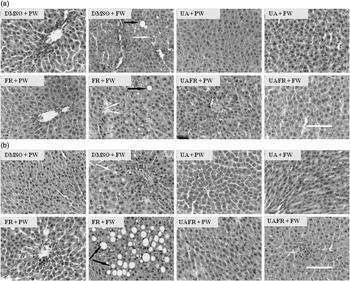
Table 2, Figs. 10a and 10b and Supplementary Table 6 show data from the assessment of hepatic histomorphometry. In both sexes, rats receiving DMSO in early life and fructose in adulthood (DMSO + FW) had significantly increased steatosis (micro and macro) and hypertrophy than rats receiving DMSO in early life and plain water as adults (DMSO + PW; p < 0.05). In male rats, there was significantly increased hypertrophy and microvesicular and macrovesicular steatosis in rats receiving fructose in early life and fructose in drinking water in adulthood (FR + FW) than in rats receiving UA in early life and fructose in adulthood (UA + FW; p < 0.05) and in rats receiving a combination of UA and fructose in early life and fructose in adulthood (UAFR + FW; p < 0.05). A ‘double hit’ of fructose (FR + FW) resulted in increased steatosis and hypertrophy compared to a ‘late hit’ (DMSO + FW; p < 0.05) in female rats but this was not observed in male rats (p > 0.05). Fructose consumption did not have any apparent effects on inflammation in both sexes (p > 0.05).
Effect of ursolic acid on hepatic micro and macrovesicular steatosis, hypertrophy and inflammation (actual percentages)

* Steatosis.
All data presented as mean ± standard deviation.
a Significantly increased hypertrophy and microvesicular and macrovesicular steatosis in animals receiving DMSO in early life and fructose in adulthood (DMSO + FW) compared to those receiving DMSO in early life and plain water for the rest of their life (DMSO + PW; p < 0.05).
b Significantly lower hypertrophy, microvesicular and macrovesicular steatosis in rats receiving ursolic acid in early life and fructose in adulthood (UA + FW, males; p < 0.05), females; p < 0.05) and rats receiving a combination of ursolic acid and fructose and fructose as adults (UAFR + FW, males; p < 0.05, females; p < 0.05) compared to rats receiving DMSO in early life and fructose in adulthood (DMSO + FW).
c Significantly increased hypertrophy and microvesicular and macrovesicular steatosis in rats receiving fructose as neonates and fructose as adults (FR + FW) than in rats receiving ursolic acid as neonates and fructose as adults (UA + FW; p < 0.05) and in rats receiving a combination of ursolic acid and fructose as neonates and fructose as adults (UAFR + FW; p < 0.05). DMSO + PW = 10 mg/kg b.w dimethylsulphoxide in early life + plain water in adulthood (n = 10; 5 M, 5 F); DMSO + FW = 10 mg/kg b.w dimethylsulphoxide + 20% fructose as drinking fluid (n = 10; 5 M, 5 F); UA + PW = 10 mg/kg b.w ursolic acid + plain water (n = 10; 5 M, 5 F); UA + FW = 10 mg/kg b.w ursolic acid + 20% fructose as drinking fluid (n = 10; 5 M, 5 F); FR + PW = 10 mg/kg b.w fructose + plain water (n = 10; 5 M, 5 F); FR + FW = 10 mg/kg b.w fructose + 20% fructose as drinking fluid (n = 10; 5 M, 5 F); UAFR + PW = 10 mg/kg b.w ursolic acid and fructose + plain water (n = 10; 5 M, 5 F); UAFR + FW = 10 mg/kg b.w ursolic acid and fructose + 20% fructose as drinking fluid (n = 10; 5 M, 5 F).
(a) Photomicrographs showing histopathological features of representative liver sections of male rats from each treatment group (H&E; ×40). (b) Photomicrographs showing histopathological features of representative liver sections of female rats from each treatment group (H&E; ×40). DMSO +PW = 10 mg/kg b.w dimethylsulphoxide in early life + plain water in adulthood (n = 5); DMSO + FW =10 mg/kg b.w dimethylsulphoxide + 20% fructose in drinking water (n = 5); UA +PW = 10 mg/kg b.w ursolic acid + plain water (n = 5); UA + FW = 10 mg/kg b.w ursolic acid + 20% fructose as drinking fluid (n = 5); FR + PW = 10 mg/kg b.w fructose + plain water (n = 5); FR + FW = 10 mg/kg b.w fructose + 20% fructose as drinking fluid (n = 5); UAFR + PW = 10 mg/kg b.w ursolic acid and fructose + plain water (n = 5); UAFR + FW = 10 mg/kg b.w ursolic acid and fructose + 20% fructose in drinking water (n = 5). Black arrows = macrosteatosis, white arrows = microsteatosis and grey arrow = inflammatory aggregates. Scale bar: 30 µm.

UA administration in early life and fructose consumption in adulthood (UA + FW) led to decreased hypertrophy, microvesicular and macrovesicular steatosis in both male and female rats compared to rats receiving DMSO in early life and fructose in adulthood (DMSO + FW; p < 0.05). In female rats receiving a combination of UA and fructose in early life and fructose in adulthood (UAFR + FW), there was decreased hypertrophy, microvesicular and macrovesicular steatosis compared to rats receiving DMSO in early life and fructose in adulthood (DMSO + FW; p < 0.05). Male rats receiving the same treatment (UAFR + FW), however, had decreased macrovesicular steatosis alone compared to rats receiving DMSO as neonates and fructose as adults (DMSO + FW, p < 0.05). In both sexes, UA administration had no apparent effects on inflammation (p > 0.05). No sex differences were observed across the treatment groups for all histomorphological parameters; microvesicular steatosis (main effects of sex (p = 0.7836), treatments (p < 0.0001) and their interaction (p = 0.7082), macrovesicular steatosis (main effects of sex (p = 0.0041), treatments (p < 0.001) and their interaction (p = 0.3575), hypertrophy (main effects of sex (p = 0.1462), treatments (p < 0.0001) and their interaction (p = 0.1672) and inflammation (main effects of sex (p = 0.3285), treatments (p < 0.0001) and their interaction (p = 0.8892).
Discussion
We investigated the potential protective role of UA in the period of developmental plasticity against metabolic dysfunction. In the first phase (P6–P20), the ‘first hit’ was to promote developmental programming, while in the last phase (P70–P128), the subsequent ‘multiple hit’ was to induce metabolic dysfunction and determine whether early interventions with UA had protective effects. Overall, we found the metabolic effects of both fructose and UA to be dependent on the time of consumption and/or administration as well as the sex of the rats. In both sexes, fructose administration in the developmental programming stage only (early fructose hit) had no apparent effects on metabolic dysfunction. A late fructose hit (fructose administration in adulthood only) resulted in differences in food and fluid intake and visceral adiposity in female rats. There was increased hepatic lipid accumulation as a result of fructose administration both in early life and in adulthood (double fructose hit), particularly in female rats. Early-life administration of UA exhibited hepatoprotective properties as it attenuated hepatic lipid accumulation in both sexes.
The late fructose hit resulted in increased fluid intake, particularly in female rats and decreased food intake in both male and female rats. The increased fluid intake could be due to enhanced palatability of fructose due to its sweetness which ultimately promotes overconsumption while suppressing satiety signals Reference Äijälä, Malo and Ukkola63,Reference Lindqvist, Baelemans and Erlanson-Albertsson64 . Total calorie intake, however, was not significantly different across the treatment groups in both sexes. This could have contributed to the similarities in body mass across the treatment groups which differs from other rodent studies Reference Barros, Lessa and Grechi65,Reference Mamikutty, Thent, Sapri, Sahruddin, Mohd Yusof and Haji Suhaimi59 , where consumption of 20% fructose promoted body mass gains.
In both sexes, fructose consumption did not lead to statistically significant changes in triglyceride and total cholesterol plasma concentration. This agrees with studies by Mamikutty et al. Reference Mamikutty, Thent and Haji Suhaimi66 using a similar feeding model in Wistar rats. A clinical study by Stanhope et al. Reference Stanhope, Bremer and Medici67 , however, found fructose feeding to increase total cholesterol concentration. Studies by Seneff et al. Reference Seneff, Wainwright and Mascitelli68 and Jameel et al. Reference Jameel, Phang, Wood and Garg69 largely attributed the observed increase to fructose-induced LDL elevation. The higher concentrations of total cholesterol in female rats receiving a late fructose hit compared to their male counterparts could have been due to oestrogen elevating high-density lipoprotein (HDL) Reference Shen and Shi70,Reference Tara, Souza, Aronovitz, Obin, Fried and Greenberg71 . Although both LDL and HDL were not assayed separately in this study, they could prove valuable in future fructose studies. Fructose feeding had no apparent effects on fasting plasma glucose levels in both sexes and between the sexes. UA administration did not alter the concentrations of circulating metabolites although Wang et al. Reference Wang, Li, Wang and Xiang72 and Yuliang et al. Reference Yuliang, Zejian, Hanlin, Ming and Kexuan73 found UA to reduce levels of circulating cholesterol when used alone or in combination in rabbits and rats, respectively.
In the present study, female rats receiving a fructose ‘late hit’ in adulthood and those receiving a fructose ‘double hit’ in both early life and in adulthood had increased visceral adiposity. Although a similar trend was observed in male rats, the differences were not statistically different. Mechanistically, fructose metabolism favours unregulated production of triose phosphates which promote lipogenesis Reference Tappy and Lê2 . Clinical and animal studies show that fructose overconsumption triggers inflammation, which ultimately results in increased visceral fat deposition Reference Dinicolantonio, Mehta, Onkaramurthy and O’keefe74,Reference Kovačević, Nestorov, Matić and Elaković75 which although not investigated in our study, may have contributed to the observed changes. Female rats receiving a late fructose hit had greater visceral obesity compared to their male counterparts. This is in agreement with Korićanac et al. Reference Korićanac, Đorđević and Žakula53 who found visceral adiposity to be a sex-dependent trait with fructose-consuming females being more predisposed.
While no differences were noted in total calorie intake across the treatments in both sexes, fluid intake was increased in animals receiving fructose in adulthood (Fig. 3). Furthermore, we found fructose consumption to alter its metabolism is characterised by hepatic biochemical and histomorphological changes (Figs. 9, 10a and 10b). It is well-established that fructose metabolism differs from glucose metabolism which has sparked the debate; are all calories the same? Reference Basaranoglu, Basaranoglu and Bugianesi11,Reference Softic, Gupta and Wang76 . The liver, being responsible for ~90% of fructose metabolism, is vulnerable to the effects of chronic fructose consumption Reference Tappy and Lê2 . Among ‘hits’ that promote liver fat accumulation such as genetic factors Reference Browning, Szczepaniak and Dobbins77 , inflammatory pathways Reference Cai, Yuan and Frantz78 and gut-liver dysfunction Reference Poeta, Pierri and Vajro79 , fructose has also been implicated Reference Jensen, Abdelmalek and Sullivan80 . In our study, the late but not early fructose hit promoted hepatic lipid accumulation, hypertrophy, microvesicular and macrovesicular steatosis in male and female rats. Interestingly, in female rats, fructose when consumed in early life and then later in adulthood caused even more pronounced lipid accumulation, hypertrophy, microvesicular and macrovesicular steatosis giving support to the multiple-hit hypothesis. In male rats, however, this was not observed. While not investigated in this study, some of the mechanisms responsible for the lipid accumulation include mitochondrial dysfunction Reference Crescenzo, Bianco, Falcone, Coppola, Liverini and Iossa81,Reference Mamikutty, Thent and Haji Suhaimi66 , inhibition of autophagy Reference Baena, Sangüesa and Hutter82 and oxidative stress Reference Choi, Abdelmegeed and Song83 . There were some inflammatory aggregates present in fructose consuming rats, but these were not statistically significant suggesting that the hepatic lipid accumulation progression to fibrosis was in its infancy.
In the present study, fructose feeding did not significantly alter surrogate markers of liver function. Animal Reference Mamikutty, Thent and Haji Suhaimi66 and human Reference Mofrad, Contos and Haque84,Reference Verma, Jensen, Hart and Mohanty85 studies have shown that normal concentrations of liver enzymes can be present regardless of altered hepatic lipid metabolism. Additionally, this suggests that at the dosage used in our study, UA did not exhibit any hepatotoxicity and can safely be considered.
Administration of UA to suckling rats greatly reduced fructose-induced hepatic lipid accumulation in both male female rats, as shown in Figs. 9, 10a and 10b. In a similar study, oleanolic acid, an isomer of UA, was also found to be hepatoprotective against fructose-induced hepatosteatosis Reference Nyakudya, Mukwevho, Nkomozepi and Erlwanger39 . The hepatic lipid-lowering effect of UA may be due to the fact that, like fenofibrate, UA induces hepatic autophagy as it is a peroxisome proliferator-activated receptor alpha (PPARα) agonist Reference Jia, Bhuiyan and Jun86 . Studies by Jia et al. Reference Jia, Kim and Kim87 and Singh et al. Reference Singh, Kaushik and Wang88 show that by inducing hepatic autophagy, UA can enable the breakdown of lipid droplets resulting in a reduction in lipid concentrations. These mechanisms, however, need to be investigated further.
Female rats receiving a combination of UA and fructose early in life and water in adulthood, however, had greater hepatic lipid accumulation than their counterparts receiving fructose in adulthood. This trend was also noticed among the same rats compared to rats that had early-life intervention with DMSO, UA and fructose alone and plain water in adulthood. Does this imply that UA may have a deleterious lipid-elevating effect in females when combined with fructose? We believe not, greater accumulation may not imply deleterious unless the lipid profile is determined. For instance, fenofibrate lowers LDL while at the same time increasing HDL Reference Keating89 .
Female rats receiving a combination of UA and fructose in adulthood had significantly greater hepatic lipid accumulation than their male counterparts. Aside from the protective role of female sex hormones Reference Korićanac, Đorđević and Žakula53 , the observed sex differences could be due to differential expression of enzymes involved in hepatic lipid regulatory pathways. Female Sprague Dawley rats have been found to have greater expression of the enzyme elongation of very long chain fatty acid-like elongase 6 (Elovl6), a key enzyme in lipid metabolism Reference Marks, Kitson and Stark90 . Although not assayed for in the current study, it may account for the observed differences and needs to be further explored.
With metabolic conditions such as NAFLD and the MS predicted to increase at an exponential rate globally, there is a need to focus on preventative measures. To date, there have been increased awareness programs encouraging people to be mindful of what and how they eat, be physically active and get adequate sleep among other beneficial lifestyle modifications. Additionally, some states and nations such as France, United Arab Emirates and South Africa have introduced ‘sugar tax’ on sugar sweetened beverages to help curb some of their potential harmful effects on the health of individuals. The period of developmental programming, characterised by developmental plasticity, provides another opportune window for dietary intervention which may promote health. With NAFLD being a progressive condition, early intervention is crucial. While the lack of mechanistic studies was a limitation of our study, we showed the potential hepatoprotective effects of UA which may be considered in the fight against NAFLD, the MS and its metabolic sequalae and warrant further investigation.
Supplementary material
For supplementary material for this article, please visit https://doi.org/10.1017/S2040174420000124
Acknowledgements
We would like to thank the staff of the CAS and the Department of Anatomical Sciences at the University of the Witwatersrand for all their technical assistance. We are also grateful for the services and support of Monica Gomez, Davison Moyo, Busisani Lembede, Trevor Nyakudya, Kasimu Ibrahim, Ingrid Malebana, Nomagugu Ndlovu, Ninette Lotter, Jeanette Joubert and Karabo Rathebe.
Financial support
This work was supported by the University of the Witwatersrand Faculty of Health Sciences Research Committee (NCM, grant number; 0014018521105121105RMPHSL015) and the National Research Foundation (KHE, grant numbers; CPRR93456 and INCEN 103425). We are also grateful for the support from the National University of Science and Technology, Zimbabwe (Staff Development Fellowship) and University of the Witwatersrand, South Africa (Postgraduate Merit Award) towards Nyasha Mukonowenzou’s studies.
Conflicts of interest
The authors declare no conflict of interest.
Ethical standards
The authors assert that all the procedures contributing to this work comply with the ethical standards of the relevant national guides on the care and use of laboratory animals (Sprague Dawley rats) and has been approved by the institutional committee (Animal Ethics Screening Committee (AESC) of the University of the Witwatersrand, AESC number 2014/49/D).