Introduction
The context of in vitro fertilization (IVF)
Infertility elicits an enormous physical, social and financial toll on society. Alarming figures indicate that infertility has risen to 16% of couples (in Canada), tripling since 1984 (54,000). These couples are turning to assisted reproductive technologies (ARTs) to fulfill their desire to have a family. In doing so, they incur a huge emotional burden as children conceived by ARTs are at increased risk for fetal growth restriction, premature birth, low birth weight, congenital anomalies, perinatal complications, and possibly genomic imprinting syndrome.Reference Davies, Moore and Willson 1 To reduce these risks, it is paramount to determine which aspects of infertility treatment may lead to adverse effects so they may be modified for improved safety. Assisted reproduction technologies generate suboptimal environments for developing gametes and embryos, potentially leading to aberrant epigenetic gene regulation. Thus, genome-scale analyses are required to determine the epigenetic instabilities resulting from these suboptimal environments. Using newly developed technological platforms that enable global gene expression and global DNA methylation profiling, we evaluated epigenome perturbations caused by ARTs in an animal model where these procedures are used on a regular basis, the bovine.
The history of bovine IVF
Bovine IVF was introduced as an experimental procedure in 1981using quite a complex surgical procedureReference Bousquet and Brackett 2 and then became functional after a laparoscopic approach was developed to recover oocytes from infertile femalesReference Sirard and Lambert 3 and the production of several calves following embryo transfer.Reference Sirard and Lambert 4 The method improved rapidly due to the availability of in vitro maturation (IVM) of oocytes recovered at slaughterhouses.Reference Sirard, Parrish, Ware, Leibfried-Rutledge and First 5 Soon the method was adapted to be used not only on infertile cows, but also on any animal as a faster means to obtain embryos of high genetic value in dairy and beef breeds. More than 400,000 animals are produced each year through IVM, IVF, in vitro culture and embryo transfer to recipients. While there is no systematic phenotyping of these animals, a higher rate of disorders has been observed sometimes referred to as large calf, or large offspring, syndrome; therefore, modifications were made to the culture conditions to minimize this problem.Reference Farin, Farin and Piedrahita 6 Embryo transfer following IVF production in cattle is associated with pregnancy rates of ~60%.Reference Mapletoft and Bo 7 However, there is a critical difference between routine IVF in humans and cattle: in humans, the embryos are transferred back into the same patient the eggs originated from, while in cattle, they are transferred to several fertile and healthy female recipients.Reference de Mello Bianchi, Serafini and Monteiro da Rocha 8 This capacity, in bovine, to distinguish between an ovarian and a fertilization effect v. a uterine effect, is very powerful. Although surrogate mothers are often used in humans, experiments such as the manipulation of oocyte quality, which are regularly performed in cows, cannot be performed in women.
The epigenome
The epigenome is simplistically the response of the genome to the environment without modifications of the DNA sequence. Although the genome is constantly influenced by environmental signals that trigger cellular responses via the action of transcription factors, the epigenome defines the specificity of cells in their capabilities to react to these triggers. The impact of the epigenome occurs in two distinct timeframes. The initial responsiveness is characterized by transient modulations of the chromatin structure either granting or restricting access of the transcription machinery to the DNA. The second timeframe involves a more permanent management of the chromatin where each cell is defined by a cell type-specific epigenomic signature established during embryonic and fetal development. Therefore, epigenomic events regulate short- and long-term responses of cells and tissues to their environment.Reference Alabert and Groth 9
It is generally accepted that the more a cell becomes specialized, the epigenomic signature becomes more specific, allowing only particular genes to be activated or inhibited. As such, gamete production and early embryogenesis fall under a paradox as very specialized cells are produced (the gametes) that, following fertilization, lead to the development of stem cells with the potential to establish the full spectrum of cell lineages. This switch in epigenomic programming is believed to be crucial as improper de- or reprogramming can have direct consequences as is sometimes observed following somatic cloning in mammalian models.
Medically ARTs are applied either during gametogenesis and/or early embryogenesis thus having the potential to impact the establishment of the epigenomic signature of embryonic stem cells either indirectly via alterations in the gametes or directly following insults occurring during stem cell genesis. The study of the potential impacts of ARTs on the establishment of the epigenome is therefore of prime importance in human reproduction. Furthermore, the fact that aberrant epigenomic marks can potentially be carried over several generations is troubling.Reference Lowdon, Jang and Wang 10 So far, the literature contains many conflicting reports regarding epidemiological surveys of children born from ARTs.Reference Ludwig, Katalinic and Gross 11 Some reports are alarming as epigenetic and developmental differences were observed, whereas others did not detect any significant differences between children born from ARTs and children born from natural conceptions.Reference Pinborg, Wennerholm and Romundstad 12 We believe that the wide variation in the ARTs protocols used in different clinics and the lack of proper survey tools may be the causes of diverging points of views. Indeed, compiling results obtained with different protocols may cause sufficient background in data quality to lead to an inconclusive situation. The fertility status and life history of couples are also important factors as significant differences are observed between donors.
For any long-term impact to be observed, aberrations in the epigenetic marks must occur at the early embryonic stage. Furthermore, for a specific phenotype to be observed, such as adult hypertension for example, it is expected that these aberrations should not appear at random.Reference Seggers, Haadsma and La Bastide-Van Gemert 13 So far, very few studies have performed a comprehensive analysis of global epigenomic patterns in human embryos (none) or placentas subjected to the environmental stresses of ARTs.Reference Melamed, Choufani, Wilkins-Haug, Koren and Weksberg 14 This is primarily due to the lack of appropriate technological platforms as well as ethical restrictions. Instead, most studies targeted a subset of imprinted genes as their deregulation is known to cause disorders, such as Beckwith–Wiedemann and Angelman syndromes, which are more prevalent in children conceived via assisted reproduction.Reference van Montfoort, Hanssen and de Sutter 15 A similar syndrome is also observed following bovine IVF and cloning: the large calf syndrome, which is believed to result from similar environmental causes leading to deregulation of the early embryo programming.Reference Farin, Farin and Piedrahita 6 , Reference Miles, Farin, Rodriguez, Alexander and Farin 16 Although the level of dysregulation is quite different in clone animals v. IVF, showing more stochastic changes in clones and more reproducible changes in IVF, some phenotypes appears to be common.Reference Wang, Zhang and Duan 17 , Reference Rooke, McEvoy and Ashworth 18 Other differences between IVF and cloning can be observed in the endometrium reaction to these two types of embryos which differ significantly supporting a difference in the embryo programming earlier on.Reference Mansouri-Attia, Sandra and Aubert 19 , Reference Sandra, Mansouri-Attia and Lea 20 Therefore, the epigenome brings forth a new perspective that challenges the current conception of genetic determinism. Indeed, the epigenome is now considered as an ‘environmental memory,’ an adaptive measure for the genome to cope with changing conditions.Reference Jablonka and Lamb 21 , Reference Jablonka and Raz 22 Because of the fixed nature of the genomic sequence, such an adaptation would otherwise not be possible during an organism’s lifetime. Epidemiological studies in humans and experimental data in mice have demonstrated the reliability of epigenomic factors as predictors of pathologies related to complex traits such as diabetes.Reference Hanson and Godfrey 23
Studies in the mouse are showing that the mother’s metabolic status at the time of conception may impact the metabolic profile of the next generation and also the ovarian reserve and physiology.Reference Fullston, Shehadeh and Sandeman 24 A similar phenomenon was also described in cows by Walsh et al.Reference Walsh, Mossa and Butler 25 and was also demonstrated in rats.Reference Chan, Tsoulis and Sloboda 26 The reduced energy diet around conception and for 100 days post artificial insemination (AI) resulted in heifer calves with diminished ovarian reserves at 2 years of ageReference Mossa, Carter and Walsh 27 and potentially reduced fertility.Reference Parr, Crowe and Lonergan 28 Reduced ovarian reserve (low anti-mullerian hormone) is a growing problem in dairy cows and a serious infertility associated with subsequent culling of the animal factor.Reference Jimenez-Krassel, Scheetz and Neuder 29 Again on the female side, Gonzalez-Recio,Reference Gonzalez-Recio, Ugarte and Bach 30 showed that heifers conceived from milking cows had lower milk production than if the mother was not milking at the time of AI. These non-ART environment-phenotype associations are a demonstration that bovine, like most studied mammals so far, are sensitive to the metabolic environment early in development. This review will focus on the forms of ART that may impact the epigenetic signature, like ovarian stimulation and embryo culture as example of programming conditions.
Results and discussion
The importance of early environment on embryo phenotype
Information regarding how the rest of the genome reacts to the stress of ARTs is still scarce. The development of more affordable high throughput sequencing platforms now enables the efficient survey of cohorts of samples to study the impact of reproductive technologies on global patterns of epigenetic marks.Reference Seli, Robert and Sirard 31 , Reference Shojaei Saadi, O’Doherty and Gagne 32
The mechanistic control of the establishment of the epigenome in early blastomeres has only recently shed light at the global perspective. Reprogramming of the male and female pronuclei is directed by different mechanisms and the demethylation rate differs between parental genomes.Reference Wang, Zhang and Duan 17 Imprinted genes escape the demethylation process, preserving their methylation marks which are then used downstream to direct the proper methylation and expression of the appropriate parental allele; however, the mechanisms by which this allele is chosen are not understood. Also, the management of the preimplantation epigenomic program for the rest of the genome is poorly understood.Reference Lowdon, Jang and Wang 10 The current hypothesis is that long non-coding RNAs may act in cis or trans to direct DNA methylation in the early blastomeres.Reference MacDonald and Mann 33
Comparisons of gene expression in bovine blastocysts produced under diverse culture conditions showed that the abundance of long messenger RNAs is profoundly impacted by the artificial environment.Reference Gad, Besenfelder and Rings 34 By conducting gene expression and DNA methylation profiling using our microarray-based technological platform, it was possible to integrate these two layers: protein-coding gene expression and DNA methylation patterns, to more precisely study the impact of ARTs.Reference Salilew-Wondim, Fournier and Hoelker 35
The study of bovine embryo quality using the EmbryoGENE platform
As mentioned above, the first manifestations of the potential non-lethal effects of the environment on embryo quality are visible at the gene expression level and genomic technologies now allow the amplification of the transcriptome (used exome) even from very small samples such as mammalian embryos.Reference Robert, Nieminen and Dufort 36 The first comparison (which is impossible to do in humans) contrasted in vivo-derived embryos with in vitro-derived embryos incubated either completely in vitro (IVM–IVF and IVC), or partially exposed to in vitro conditions (IVM only, IVM–IVF only, up to four cells, or up to morula in vitro and then transferred to the oviducts of synchronized recipients until the blastocyst stage or day 7.5 in bovine). The transcriptomic profiles were publishedReference Gad, Hoelker and Besenfelder 37 and the general conclusion is that ART does result in different transcriptomes in bovine embryos with the two most sensitive periods being the four-cell and the morula stages. At these stages, the embryo seems particularly sensitive to metabolic cues from the oviduct and the uterus respectively in order to undergo the embryo genomic activation and the first step of trophoblast differentiation, respectively. While it is expected that the embryo has the capacity to adapt to the environment and that the in vitro environment cannot completely mimic the in vivo situation, it is not known what is a good adaptive response and what may have later consequences. Not surprisingly the most affected pathway in in vitro-produced embryos is the NRF2 (nuclear factor erythroid 2-related factor 2) pathway probably as a response to the high oxygen-higher metabolism situation created by the culture conditions.Reference Amin, Gad and Salilew-Wondim 38 Moreover, the oxygen level affected histone post transcription modifications on the chromatin of blastocysts which might impact gene expression, while the presence of serum in the media was without effects on chromatin despite a higher developmental rate in vitro.Reference Gaspar, Arnold and Correa 39 Indeed the culture conditions like higher glucose can stimulate, sometime excessively, embryo metabolism,Reference Cagnone, Dufort, Vigneault and Sirard 40 creating a phenotype similar to the ones induced by excess intra- or extracellular free radical species during that same period.Reference Cagnone and Sirard 41 It is interesting to analyze the different responses to metabolic stresses like glucose, free radicals or lipids to realize that the most obvious victim is the mitochondria.Reference Cagnone and Sirard 42 To integrate such data, a recent paper from our group presented a table of embryonic stresses associated with culture conditions and the comparison with human and mouse revealed some conserved pathways in the response of embryos.Reference Cagnone and Sirard 43
The quality of bovine oocytes obtained after ovarian stimulation (comparable with humans) is different.Reference Chu, Dufort and Sirard 44 The same is true if the oocytes are recovered immature and matured in vitro after follicular coasting.Reference Labrecque and Sirard 45 , Reference Labrecque, Vigneault, Blondin and Sirard 46 These results illustrate that embryos generated in vitro are different in many ways which may explain the lower pregnancy rates obtained with these compared with in vivo generated.Reference Page-Lariviere and Sirard 47 It is worth mentioning that in bovine, ovarian stimulation, followed by insemination and uterine flushing to generate multiple embryos for transfer to recipients, have been used by veterinarians for a long time. These embryos are a good control for epigenetic studies as they are exposed to ovarian stimulation but not to embryo culture. Several decades of commercial activity worldwide with this procedure have not produced a significant compromised phenotype as far as we can tell from animal records, indicating that ovarian stimulation per se may reduce the quality of embryos but the ones that survive and subsequent offspring have no visible differences compared with inseminated controls.
DNA methylation analysis with the EmbryoGENE platform
The DNA methylation analysis was recently partially published as the dataset is comprised of 12 different contrasts of triplicates of pooled blastocysts from all the same stages as for transcriptional analysis.Reference Salilew-Wondim, Fournier and Hoelker 35 The first obvious observation is that the longer the embryo is exposed to in vitro conditions, the more changes are observed in the level of methylation at the blastocyst stage. The changes are visible in both directions: hyper and hypomethylation, indicating a more complex response than a simple delay in either demethylation or re-methylation. The bovine embryo, as other mammalian embryos, goes through a rapid demethylationReference Dean, Santos and Stojkovic 48 beginning at the pronuclei stage and probably associated with the ten-eleven translocation 3 process as demonstrated by the presence of the protein by immunohistochemistry.Reference Page-Lariviere and Sirard 47 The next few cell cycles are associated with a more passive demethylation by the exclusion of DNA methyl transferase 1 from the nucleus, directly diluting both the maternal and the paternal residual methylation on each chromosome. There is no data available yet on the site-specific methylation changes before the blastocyst stage in bovine, but the picture we obtained at the end of the process indicates a cumulative influence of the in vitro environment on gene expressionReference Gad, Besenfelder and Rings 34 and DNA patternsReference Wang, Zhang and Duan 17 (see Fig. 1). Our analysis indicated that in addition to the increase in differently methylated regions (DMR), stage-specific methylation changes were also observed. For example, the pattern of distribution of changes in relation to genic-promoter and intergenic regions was different in embryo exposed to in vitro conditions at the zygotic stage compared with embryos exposed at the morula stage.Reference Salilew-Wondim, Fournier and Hoelker 35 The number of DMR unique to individual stages was 137 in zygotes, 624 in four-cell embryos, 1180 in 16-cell embryos and 3086 for embryos cultured in vitro for all the steps. The methylated sites were distributed non-randomly in the promotor-coding and non-coding or repetitive elements showing a locus specific effect of culture. Our epigenomic platform is genome-wide and includes imprinted genes which are differently methylated depending on whether they are coming from the maternal or paternal chromosome allele. The in vitro conditions affected the methylation status of several of them including IGF2, IXIST, NAPIL5, MEST, DGAT1, H19.Reference Salilew-Wondim, Fournier and Hoelker 35 Some of these genes are associated with the problems observed in human IVF infants such as Beckwith–Wiedemann and Angelman syndromes.Reference Ludwig, Katalinic and Gross 11
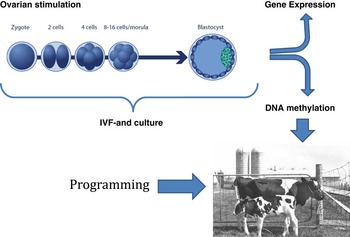
This figure illustrates the importance of ovarian stimulation and the window of sensitivity to culture conditions which result in changes in gene expression (transcriptomic) or DNA methylation which results in epigenetic changes. The pictures represent the first in vitro fertilized (IVF) calf made from in vivo matured oocytes recovered by laparoscopy in 1985.Reference Sirard and Lambert 4

Even when we changed the methyl donor conditions (with S-adenosyl methionine) in the culture media we still observed a non-random distribution of changes.Reference Shojaei Saadi, Gagne and Fournier 49 The analysis of the gene regions associated with the DMR indicated that several functions might be affected immediately in the blastocyst and potentially further downstream in development. In transcriptomic analysis of cultured embryos, affected pathways are often associated with energy metabolism and regulation of cell morphogenesis. Surprisingly a very small proportion of DMR was associated with changes in the transcriptome from the same embryos at the same stage. This observation means that either we do not understand well the effect of methylation at each position on accessibility to the chromatin, or the chromatin changes (histones modifications and lncRNA which ofen act in cis like the x inactivation) are still controlling the polymerase access and the DNA methylation pattern will follow in the days to come. In addition, due to impacts of promoters downstream or upstream, it is likely that a difference in methylation at a given locus/in a given region will not obligatory affect the closest gene in the sequence but is susceptible to affect also the function of other genes. Indeed the blastocyst represents the stage with the minimum amount of methylation other than the gonad germ cellsReference Wang, Zhang and Duan 17 and the patterns observed are quite dynamic at such stage making the prediction of gene expression difficult. The markers observed due to culture have not been validated in any tissues at birth yet but the placenta is certainly a good place to start looking for such signatures.Reference Grigoriu, Ferreira and Choufani 50 , Reference Su, Yang and Wang 51
Oocyte–embryo culture and the post-natal phenotype
Although the production of IVF–IVC embryos had reached a commercial scale in the 1990s, data on offspring had been limited by the capacity to follow up these animals in real life. The most obvious and observed phenotype has been the ‘large calf syndrome’ which is associated with larger than normal calves at birth and often also with a longer than normal pregnancy when compared with AI without IVF.Reference Farin, Farin and Piedrahita 6 , Reference Farin and Farin 52 , Reference Young, Sinclair and Wilmut 53 Such problems have been resolved through the omission of serum during the critical part of embryo culture and remain a possible but rare event today. Other problems seen are: a decreased intensity of labor, increases in abortions, congenital malformations, perinatal mortality and on the mother side an increase in hydro allantoides conditions.Reference Farin and Farin 52 , Reference McEvoy, Ashworth, Rooke and Sinclair 54 The use of systematic cesarean section reduced perinatal mortality to 2% supporting the hypothesis of the delayed parturition as the possible cause of larger weight for those calvesReference Behboodi, Anderson and BonDurant 55 although the syndrome seems to begin during gestation as Farin observed the enlarged phenotype in 7-month-old fetus (compared for gestational age), the complete physiopathology has not been clarified.Reference Farin, Farin and Piedrahita 6 Such alterations are likely to be associated with placental programming as observed in other species, especially the sheep. The presence of serum during sheep embryo culture was also associated with larger animals at birth (up to 20%)Reference Thompson, Gardner, Pugh, McMillan and Tervit 56 but was shown to be stage specific during culture.Reference Rooke, McEvoy and Ashworth 18
The context of cloning or somatic cell nuclear transfer in understanding the in vitro effects
Somatic cell nuclear transfer (SCNT) based on the procedure that resulted in the birth of DollyReference Wilmut, Schnieke, McWhir, Kind and Campbell 57 has been used in domestic species for several purposes such as research (gene insertion), conservation (to expand rare breeds using closely related oocytes), or for commercial outcomes to expand selected valuable animals (mostly bulls).
The SCNT process is not very efficient as losses occur during early embryo development but more importantly at all stages of gestation.Reference Smith and Monteiro da Rocha 58 Blastocysts produced by SCNT are associated with a huge incidence of pregnancy failure throughout gestation.Reference Young, Sinclair and Wilmut 53 Most embryonic losses are observed around implantation and analysis of tissues indicated faulty vascularization and structure anomalies of the placenta.Reference Smith and Monteiro da Rocha 58 The most obvious phenotype is the birth of oversized calves which are born following and extended gestation (1–2 weeks) and often requiring a cesarean section.Reference Miles, Farin, Rodriguez, Alexander and Farin 16 The animals are also weak at birth and may rapidly die of respiratory insufficiency and overall weakness. Out of 25 clones only three were apparently in good health and did not display respiratory problems.Reference Brisville, Fecteau and Boysen 59 The survival rate is lower than with non-cloned animals and some phenotypic differences are maintained throughout life. The use of clones to generate a second generation of clones does result in significant problems.Reference Wang, Zhang and Zhao 60 The most supported hypothesis to explain the phenotype of cloned animals is an incomplete demethylation of the somatic nuclei used for SCNT.Reference Hosseini, Dufort and Nieminen 61 In support of such mechanism, the use of cells with lower methylation status such as embryonic cells from two-cell embryos to morula (32 cells) allowed much higher embryo survival rates and far fewer anomalies.Reference Willadsen and Polge 62 Moreover, the treatment of somatic cells with de-acetylase inhibitors such trichostatin A creates a more permissive chromatin conformation also associated with lower methylation level.Reference Hosseini, Dufort and Nieminen 61 A recent study analyzed four of the clone-copies of Dolly born 11 years after the famous first clone and aged 7–9 years for insulin, blood pressure, and other assessments. No significant health problems were noticed in these four copies compared with Dolly who had a few problems with osteoarthritis. The better health of these four animals is probably due to improvements in SCNT procedures since 2007.Reference Sinclair, Corr and Gutierrez 63
Conclusion
The use of IVF in the bovine species provides an interesting perspective as the different ART procedures may be evaluated separately. Indeed, the aspiration of immature oocytes from stimulated (superovulation) v. non-stimulated animals suggests that the stimulation does not cause obvious deviant phenotypes although the genomic analysis of oocytes indicates a small difference. The use of embryo recipients different from the oocyte donors also allows us to decipher the respective effects of embryo culture conditions and of the environment of the oocyte as possible sources of epigenetic disturbances. These modifications are initially observed at the embryo level both in transcriptomic and epigenetic signatures, but generally without obvious later-in-life significant phenotypes. Nevertheless it would be interesting to better assess the adult metabolic profiles of IVF animals to see if any of the profiles observed in humans are also present in bovine.
Acknowledgments
This work was supported by the EMBRYOGENE network funded by NSERC Natural Sciences and Engineering Research Council of Canada) and the Canadian Research Chair program to Dr Sirard.
Conflicts of Interest
None.