Prevalence rates show that depression and generalised anxiety disorder (GAD) are among the most common mental disorders in older adults (Beekman et al., Reference Beekman, Bremmer, Deeg, Van Balkom, Smit, De Beurs, Van Dyck and Van Tilburg1998; Kessler, Chiu, Demier, & Walters, Reference Kessler, Chiu, Demier and Walters2005). Even so, research consistently demonstrates that older adults (60+ years) experience less worry and depression than younger adults (18–25 years; e.g. Hunt, Wisocki, & Yanko, Reference Hunt, Wisocki and Yanko2003; Jorm et al., Reference Jorm, Windsor, Dear, Anstey, Christensen and Rodgers2005). It is unclear why the prevalence of anxiety and depression is lower in older adults. A number of psychosocial factors could explain these age differences in levels of worry and depression, including differences in the frequency of negative thinking and the use of coping skills; however, research has not yet determined the role of these potential mediators.
Beck (Reference Beck1967) postulated that negative thoughts about oneself, the world and the future — what he called the ‘negative triad’ — were the main features of depressive symptoms. Since then, negative schemas and ‘negative self-thinking’ (a combination of negative cognitive bias, appraisals and rumination) in particular have been associated with depression (Evans, Heron, Lewis, Araya, & Wolke, Reference Evans, Heron, Lewis, Araya and Wolke2005), along with GAD (Wells, Reference Wells2005). Nolen-Hoeksema, Wisco, and Lyubomirsky (Reference Nolen-Hoeksema, Wisco and Lyubomirsky2008) suggested that rumination (a repetitive form of negative thinking) exacerbates negative thinking, impairs problem solving, reduces social supports, and interacts with negative cognitive styles. Verplanken, Friborg, Wang, Trafimow, and Woolf, (Reference Verplanken, Friborg, Wang, Trafimow and Woolf2007) made a distinction between the content and process aspects of negative self-thinking. They argued that studying the automaticity of negative thoughts (a process aspect) tells us about both state and trait low self-esteem, which is associated with depression. From this it can be inferred how automatic negative thinking occurs in an individual, and therefore whether they may be vulnerable to developing depressive symptoms. Using a student sample, Verplanken et al. (Reference Verplanken, Friborg, Wang, Trafimow and Woolf2007) indeed found that negative self-thinking was a good predictor of anxious and depressive symptoms. Although older adults have been found to report less negative affect than younger adults (Meeks, Woodruff-Borden, & Depp, Reference Meeks, Woodruff-Borden and Depp2003), the relationship of habitual negative self-thinking and symptoms such as depression and worry have not yet been investigated among older age groups. In fact, habitual negative thinking is one potential factor mediating the relationship between age, depression and worry.
Another factor that could mediate the relationship between age and depression are differences in the coping strategies that older and younger people use when faced with stress. Lazarus (Reference Lazarus1993) proposed a difference between emotion-focused coping (i.e., changing the way in which one attends to/appraises a stressful situation) and problem-focused coping (i.e., changing the stressful situation by acting on the environment/oneself). Coping has also commonly been split into three factor strategies such as ‘support seeking’, ‘avoidance’, and ‘problem solving’ (Amirkhan, Reference Amirkhan1990). Friedman and Silver (Reference Friedman and Silver2007) suggested that coping by avoiding is generally unhelpful when dealing with threat, as it simply postpones the stressful experience and does nothing to reduce its impact. Alternatively, both support seeking and problem solving represent effective ways of coping, but to different degrees, based on individual factors (i.e., gender, personality).
Past research on coping and mental health found that age was negatively correlated with the use of escapist/avoidance strategies (Moos, Brennan, Schutte, & Moos, Reference Moos, Brennan, Schutte and Moos2006). Gooding, Hurst, Johnson, and Tarrier (Reference Gooding, Hurst, Johnson and Tarrier2012) also found that older adults used more problem-solving coping than younger adults, while other research has found that younger adults tend to use a greater number and variety of coping strategies than older adults (Hunt et al., Reference Hunt, Wisocki and Yanko2003). This could imply that older adults are less capable of trying different strategies, or conversely that they use fewer coping strategies to better effect than younger adults. It could also suggest that age-related decreases in depression and worry are linked to the use of problem-solving coping. Given the vast life experience of older adults, it is possible that over time they have learned to discard maladaptive coping strategies and instead focus on using coping strategies that have worked for them in the past.
Given research indicates that both habitual negative thinking and coping strategies are related to symptoms of depression and anxiety, these two factors may be important for mediating the relationship between age and symptoms of depression and worry. This study aimed to investigate the differences in self-reported worry and depression between an older and younger adult sample to determine the degree to which negative self-thinking and coping style account for this relationship. It was hypothesised that older adults would have lower scores of worry and depression compared to younger adults, replicating previous findings. Second, it was hypothesised that negative self-thinking and coping style would mediate the relationship with worry and depression differently for older and younger adults.
Method
Participants
The older adult sample consisted of 45 older adult volunteers (age range = 60–89 years; M = 73.5, SD = 7.5; female = 33). Participants were recruited from senior community groups and centres in Sydney, Australia. The seniors’ groups included: a creative writing class for women, a men's discussion group, a religious discussion group, a women's support group, and a mixed activity group. The younger adult sample consisted of 60 first-year psychology undergraduates at Macquarie University, Sydney, Australia (age range = 18–24 years; M = 19.1, SD = 1.3; female = 51). Students volunteered for the study and received course credit in exchange for participation.
Materials
Penn State Worry Questionnaire (PSWQ; Meyer, Miller, Metzger, & Borkovec, Reference Meyer, Miller, Metzger and Borkovec1990)
The PSWQ is a 16-item scale measuring trait-like tendency to worry (e.g., ‘I have been a worrier all my life’), and uses a 5-point rating scale from not at all typical of me to very typical of me, with higher scores suggesting higher feelings of worry. The PSWQ has been shown to have high internal consistency and good test–retest reliability (Meyer, et al., Reference Meyer, Miller, Metzger and Borkovec1990). It has also been shown to have adequate convergent validity in adults and the elderly (Meyer et al., Reference Meyer, Miller, Metzger and Borkovec1990; Stanley, Novy, Bourland, Beck, & Averill, Reference Stanley, Novy, Bourland, Beck and Averill2001; Wuthrich, Johnco, & Knight, Reference Wuthrich, Johnco and Knight2014;). A cut-off score of 45 is indicative of pathological worry or GAD in adults (Behar, Alcaine, Zuellig, & Borkovec, Reference Behar, Alcaine, Zuellig and Borkovec2003) or a cut-off of 50 in older adults (Stanley et al., Reference Stanley, Diefenbach, Hopko, Novy, Kunik, Wilson and Wagener2003; Wuthrich et al., Reference Wuthrich, Johnco and Knight2014). In this study, Cronbach's alpha demonstrated good internal consistency with alpha = 92 for the younger sample, and alpha = .88 for the older sample.
Centre for Epidemiological Studies — Depression (CES-D; Radloff, Reference Radloff1977)
The CES-D is a 20-item measure assessing frequency of depressive symptoms experienced over the past week (e.g., ‘I had crying spells’), with a 4-point Likert scale from rarely or none of the time to most or all of the time, and higher scores (>16) indicating clinically significant depressive symptoms (Radloff, Reference Radloff1977). It has been shown to have adequate reliability and validity in both younger and older samples (Dozeman et al., Reference Dozeman, van Schaik, van Marwijk, Stek, van der Horst and Beekman2011; Radloff & Locke, Reference Radloff, Locke, Rush, First and Black2000). In the current study, Cronbach's alpha was good: alpha = .85 for younger sample and alpha = .85 for the older sample.
Habit Index of Negative Thinking (HINT; Verplanken et al., Reference Verplanken, Friborg, Wang, Trafimow and Woolf2007)
The HINT is a 12-item measure adapted from the Self-Report Habit Index (Verplanken & Orbell, Reference Verplanken and Orbell2003) used to measure the strength of a negative self-thinking habit (e.g., ‘Thinking negatively about myself is something I do automatically’). Ratings are made on a 5-point Likert response scale (1 = strongly agree; 5 = strongly disagree), with high ratings indicating a tendency to ruminate. The scale has high internal reliability (Verplanken et al., Reference Verplanken, Friborg, Wang, Trafimow and Woolf2007). Cronbach's alpha for the current study was adequate: alpha = .94 for both younger and older samples.
Billings & Moos Coping Measure (Billings & Moos, Reference Billings and Moos1984)
The Billings and Moos Coping Measure is a 32-item scale used to identify various ways of coping with problems/stress and the frequency of using these strategies. Strategies can be categorised into ‘problem solving’ (e.g., ‘I consider several alternative solutions for handling the problem’), ‘turning to others’ (e.g., ‘I talk with a friend about the problem’) and ‘avoidance’ (e.g., ‘I make myself busy with other things to keep my mind off the problem’). Ratings are made on a 4-point Likert scale from 1 = never to 4 = often. Cronbach's alpha for the current study were alpha = .79 (younger adults) and alpha = .84 (older adults) for the problem-solving subscale; alpha = .70 (younger adults) and alpha = .69 (older adults) for the turning to others subscale; and alpha = .54 (younger adults) and alpha = .35 (older adults) for the avoidance subscale. Due to unreliability in our sample, the avoidance subscale was dropped from further analyses.
Procedure
Ethics approval for the study was gained from the ethics committees of Macquarie University, Sydney, Australia and Bath University, Bath, United Kingdom. To recruit older adults, community club organisers were asked via phone and email for permission to approach community members during/after group meetings with information and a consent form asking them to volunteer for the study. Participants returned their de-identified questionnaires in provided envelopes for confidentiality. Students completed the de-identified questionnaires during a testing session held at the university and placed completed questionnaires into a box.
Results
Demographics
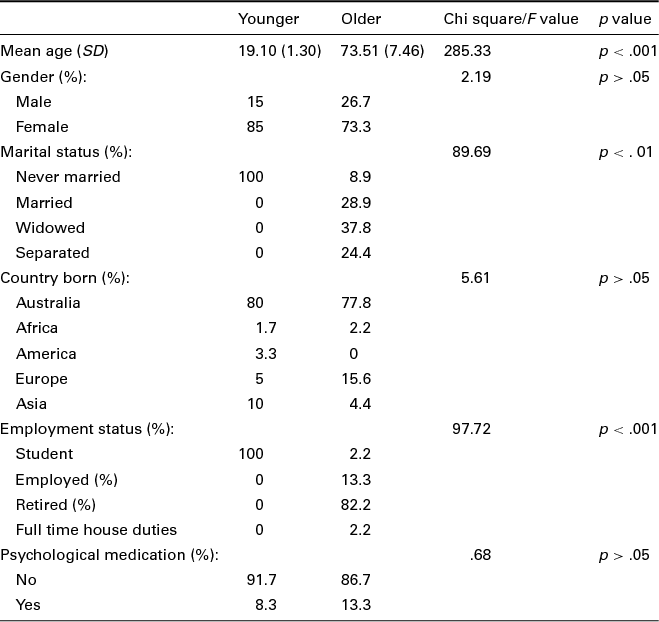
Age group was used as a dichotomous variable for all analyses. As expected, significant differences were found between the two groups in terms of age, marital and employment status. Non-significant differences were found for gender, country of birth and the use of psychological medication. See Table 1 for more information.
Demographic Information

Correlational Analysis
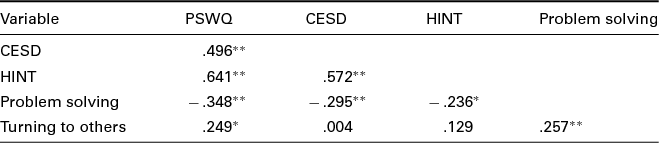
The self-report measures were all significantly correlated (p < .05) except for the turning to others subscale with HINT and CESD scores. See Table 2 for more details.
Correlational Analyses
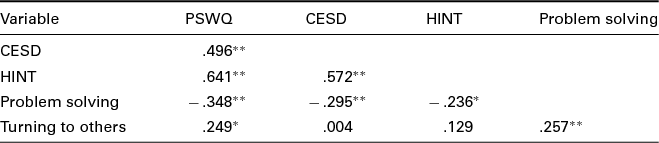
Note: **= p < .01, *= p < .05; PSWQ = Penn State Worry Questionnaire; CESD = Centre for Epidemiological Studies Depression Scale; HINT = Habitual Negative Thinking Scale.
Age Group Differences on Questionnaire Measures
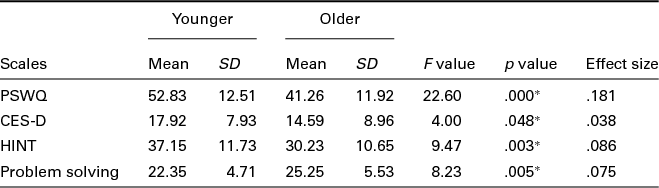
A one-way ANOVA was performed to compare differences between the younger and older groups on depression and worry. Younger adults were found to have significantly higher worry scores, F(1,103) = 22.60, p < .001, and higher depression scores, F(1,102) = 4.00, p = .048. This finding replicates previous research (Hunt et al., Reference Hunt, Wisocki and Yanko2003). A one-way ANOVA also indicated that younger adults used significantly more habitual negative thinking than older adults, F(1,102) = 9.47, p = .003, and significantly less problem solving than older adults, F(1,102) = 8.23, p = .005. The differences between younger and older adults on the turning to others subscale of the Billings and Moos Coping Measure was not significant but showed a trend towards younger adults using more social support, F(1,101) = 3.780, p = .055. See Table 3.
Descriptive Data Comparing Scores on PSWQ, HINT, CES-D, and Problem Solving for Younger and Older Adults
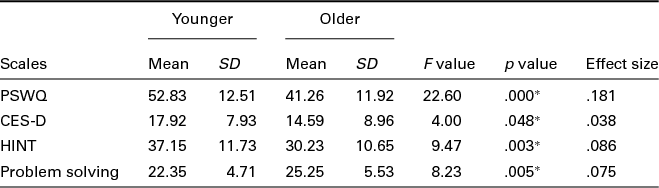
Note: *significant findings (p < .05); PSWQ = Penn State Worry Questionnaire; CES-D = Centre for Epidemiological Studies — Depression; HINT = Habit Index of Negative Thinking
Relationship Between Mediators, Worry and Depression
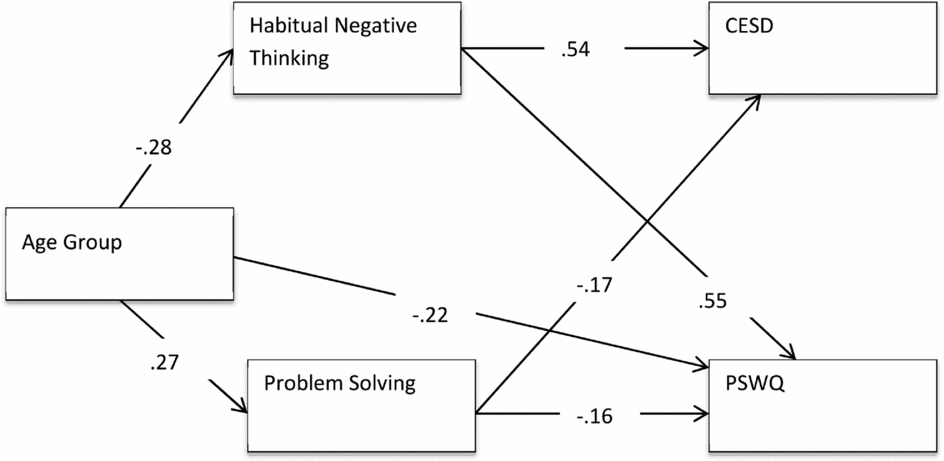
Given the findings that there were significant age differences between younger and older adult samples for HINT and problem solving, mediational analyses were conducted using structural equation modelling in AMOS (IBM, 2010) with 1,000 bootstrap samples using bias-corrected and accelerated 95% confidence intervals to see if these two variables mediated the relationship between the younger and older sample and worry and depression symptoms. As the relationship between turning to others and age group was non-significant, no further analyses were conducted for this variable. A mediational model in which problem solving and habitual negative thinking mediated the relationship between group and worry and depression was tested using confirmatory factor analysis.
We used maximum likelihood estimation to assess model fit. Model significance was determined using chi-squared statistic (with a non-significant result desirable). Model fit was determined using the root means square error of approximation (RSMEA, Steiger & Lind, Reference Steiger and Lind1980) statistics ≤.08, Bentler's (Reference Bentler1990) Comparative Fit Index (CFI) ≥ .95, and the Tucker Lewis Index (TLI; Tucker & Lewis, Reference Tucker and Lewis1973) ≥.90. The initial model in which age group had paths to HINT, problem solving, CES-D and PSWQ, and paths from HINT and problem solving to both CES-D and PSWQ was close to significant. However, the standarised loading of age group onto CES-D was zero and non-significant (p > .9), and therefore this path was removed from the model. The final model (shown in Figure 1) resulted in an adequate fit on the following variables, χ2(3, N = 105) = 5.91, p = .116, (CFI = .976, TLI = .920, AIC = 39.906), but was a marginal fit on the RSMEA if the rule of <1.0 for a fair fit (MacCallum, Browne, & Sugawara, Reference MacCallum, Browne and Sugawara1996) was applied (RSMEA = .099, 90% CI .000 to .217). The failure to fit on the RSMEA may be related to the small N.
Standardised estimates of mediational analysis using structural equation model with bootstapping.
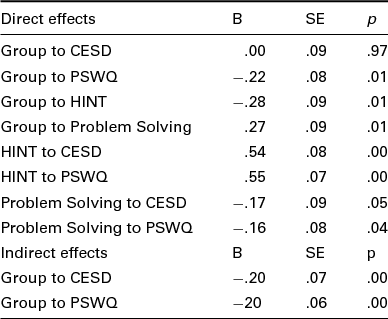
Therefore, the results generally indicated that the relationship between age group and worry, and age group and depression was significantly mediated by problem solving and habitual negative thinking. In this model, problem solving and habitual negative thinking partially mediated the effect on worry, and problem solving and habitual negative thinking fully mediated the relationship with depression (see Table 4).
Mediational Analysis: Standardised Estimates, Standard Error and p Values
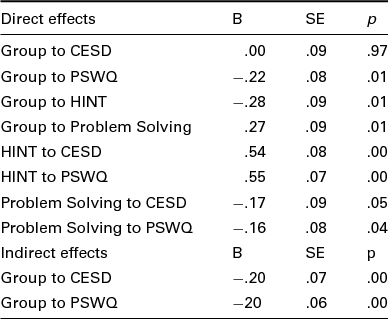
Note: PSWQ = Penn State Worry Questionnaire; CESD = Centre for Epidemiological Studies Depression scale; HINT = Habit Index of Negative Thinking.
Discussion
This study compared self-reported worry, depression, negative self-thinking and coping strategies in an older and younger adult sample. The relationship between these factors was then explored with the aim of further understanding age group related differences in worry and depression. The results replicated previous findings (e.g., Hunt et al., Reference Hunt, Wisocki and Yanko2003) that older adults are less depressed and worried than younger adults, and that university students have elevated mean scores for anxiety and depression (Stewart-Brown et al., Reference Stewart-Brown, Evans, Patterson, Petersen, Doll, Balding and Regis2008). Elevated scores in university students may be accounted for by the use of first-year students who are perhaps still adjusting to the demands of university life, and are likely to be influenced by the timing of testing (e.g., more anxiety and depression might be present around examination times). In addition, it was found that older adults use more problem-solving skills than younger adults, also replicating previous results (Gooding et al., Reference Gooding, Hurst, Johnson and Tarrier2012). In our sample, we found that younger and older adults did not differ in their reported use of turning to others for social support, although there was a trend for younger adults to be more likely to turn to others for support. Given the relatively small sample size of this study, differences in the use of turning to others for support should be investigated in larger samples. Interestingly, this is the first study to examine the use of habitual negative thinking in an older sample, and as predicted we found that older adults engaged in significantly less habitual negative thinking. Therefore, the role of habitual negative thinking in depression symptoms in older adults is particularly interesting.
Of particular interest were the findings that age group related changes in worry and depression severity could be mediated by habitual negative thinking and use of problem-solving strategies. Habitual negative thinking and problem solving fully mediated the relationship between age group and depression, and partially mediated the relationship between age group and worry. Habitual negative thinking accounted for the most variance in both worry and depression scores and successfully extends previous research that demonstrated that negative self-thinking could significantly predict anxious and depressed symptoms in college students (Verplanken et al., Reference Verplanken, Friborg, Wang, Trafimow and Woolf2007). The results suggest that if frequent and automatic negative thoughts about oneself are associated with an increased risk of becoming worried and depressed, it perhaps leads to feelings of helplessness or withdrawal behaviour, irrespective of age group. Nevertheless, as older adults are less likely to have these automatic negative thoughts, they are less likely to be depressed. Further research should aim to identify the factors that result in natural decreases in the frequency of habitual negative thinking in older adults as it is likely to provide more clues as to why the frequency of depression decreases in older adults.
Problem solving also partially mediated the relationship with age group and worry and depression. Problem solving has generally been described as an adaptive approach to dealing with stress compared with other coping styles such as avoidance (Friedman & Silver, Reference Friedman and Silver2007). Possibly, older adults use more problem-solving skills in reaction to stressful situations as they draw on past experiences of successful and unsuccessful solutions in prior situations. For example, older adults with financial worries are likely to have faced this problem before and so can consider their past actions and evaluate the effectiveness of different paths of action. Conversely, many issues faced by younger adults are more likely to be relatively novel and therefore they may be inclined to use other less effective coping strategies to try and deal with them. These results also fit well with current knowledge about effective psychological treatments for worry and depression that are aimed at improving problem-solving skills and cognitive therapy to identify and challenge negative thinking.
While both problem solving and habitual negative thinking were significant mediators in this sample, additional factors such as personality, health, cognitive ability and life events are also likely to mediate depression and worry and should be included in future research. Recent research suggests that personality factors such as self-criticism, dependency and neuroticism decrease with age and may contribute significantly to the declines in depression (Allemand, Zimprich, & Hendriks, Reference Allemand, Zimprich and Hendriks2008; Kopala-Sibley, Mongrain, & Zuroff, Reference Kopala-Sibley, Mongrain and Zuroff2013).
There are several limitations to this study. First, this study is a cross-sectional design and therefore can only explain differences between the age groups, and does not tell us about temporal changes in worry and depression. Large longitudinal studies are ultimately needed to address this issue further. Second, both the older and younger samples were community samples and not clinical populations. Although the group mean was in the clinically interfering range for worry and depression for the young sample, this research is not generalisable to clinical populations. Third, both samples were relatively small, with the younger sample comprised of first-year psychology students, and the older adult sample comprised of older adults belonging to social groups, and so the results may not be generalised to other younger and older samples. Fourth, given the large differences in age between the two groups, there were also differences between the two groups in terms of marital status and employment. Therefore, these and other cohort factors might also account for some of the effects, and more research with samples with a continuous age range are needed to rule out these factors. For example, education would be important to control for in future studies, although Hunt et al. (Reference Hunt, Wisocki and Yanko2003) previously found no relationship between education and PSWQ in a university and older adult sample. It is also important to note that the groups differed in the diversity of the age range included, with an age range of 29 years (age 60–89) in the older sample, but an age range of only 6 years (18–24) in the younger sample. Given the large age range in the older sample, the relationship between habitual negative thinking and coping style on worry and depression might vary for the oldest age groups (e.g., age 80 years and above). Further, although there were no overall gender differences between the two samples on the measures, both samples had a high proportion of females to males and therefore these results may be more relevant to females.
In conclusion, negative self-thinking and problem solving proved to be significant predictors of worry and depression, explaining the relationship between age group and worry, and the relationship between age group and depression. These findings have important implications for the development of psychological treatment and prevention of depression and worry for both older and younger adults, and more research should be done to understand the reasons for the natural declines in these mediators as people age.