


Introduction
Attention deficit hyperactivity disorder (ADHD) is a neuropsychiatric disorder characterized by developmentally inappropriate inattention and/or hyperactivity and poor adaptation of behavior to the social/environmental context. One important aspect of behavioral adaptation involves the capacity to regulate the way in which we respond to environmental demands by flexibly modulating speed and accuracy. In particular, increasing response speed is normally associated with decline in performance accuracy and vice versa (Speed-Accuracy Trade off [SAT]; Franks, Dornhaus, Fitzsimmons, & Stevens, Reference Franks, Dornhaus, Fitzsimmons and Stevens2003). ADHD patients show difficulties in adapting their behavior to environmental demands and show a tendency to make impulsive and hasty decisions (Barkley, Reference Barkley1997; Mulder et al., Reference Mulder, Bos, Weusten, van Belle, van Dijk, Simen and Durston2010).
Previous studies have already tried to characterize the relation between attention deficits and SAT. Children with poor attention made more errors, but did not differ in the time to make a correct response compared to children with good attention (Cornish, Wilding, & Hollis, Reference Cornish, Wilding and Hollis2008). Mulder et al. (Reference Mulder, Bos, Weusten, van Belle, van Dijk, Simen and Durston2010) studied whether non–drug-naïve ADHD children were able to balance the speed and accuracy of decisions in perceptual decision-making. Despite matched overall performance between groups, ADHD children did not optimize SAT as compared to controls: they made faster decisions during accuracy sessions and had higher accuracy during speed sessions. This study also showed that impairments in SAT optimization were predicted by hyperactive/impulsive symptoms but not by inattentive ones.
However, accuracy and speed were previously stressed either between-subjects (Cornish et al., Reference Cornish, Wilding and Hollis2008) or block-wise (Mulder et al., Reference Mulder, Bos, Weusten, van Belle, van Dijk, Simen and Durston2010). Thus, it remains unclear if ADHD is associated with a deficit in dynamically switching the speed-accuracy strategy according to task demands which change trial-by-trial. By focusing on sequential effects produced by random administration of speed/accuracy instructions, the aim of the present study is to investigate how children with ADHD are able to switch from one strategy to another in perceptual decision-making.
Vallesi, McIntosh, Crescentini, and Stuss (Reference Vallesi, McIntosh, Crescentini and Stuss2012) documented that preparing to specifically switch from speed to accuracy involves the left dorsolateral prefrontal cortex. Although there is no fMRI study on speed-accuracy switching in children, one could expect that similar neural mechanisms would be engaged developmentally.
Based on previous studies and the behavioral symptoms of ADHD, such as impulsivity (Curatolo, D'Agati, & Moavero, Reference Curatolo, D'Agati and Moavero2010; Dickstein, Bannon, Castellanos, & Milham, Reference Dickstein, Bannon, Castellanos and Milham2006) and lack of cognitive flexibility (Cepeda, Cepeda, & Kramer, Reference Cepeda, Cepeda and Kramer2000), we predicted that ADHD children would show difficulties in the frontally based capacity to switch from speed to accuracy (i.e., inability to increase accuracy and decrease speed). No deficit was expected for the accuracy-to-speed switching condition, given that an increase in speed and a decrease in accuracy is compatible with impulsivity in ADHD.
Method
Participants
Thirty-one drug-naive boys with ADHD and 33 healthy boys were recruited for the study (demographic characteristics in Table 1). The two groups were matched for age (t test p = .7) and IQ (t test p = .57).
Demographic and clinical characteristics of ADHD and healthy children
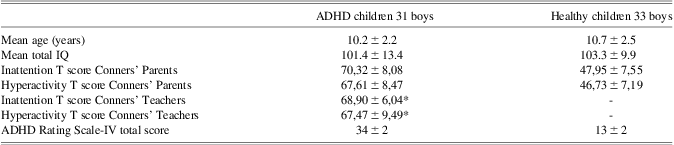
*Data available for 21 ADHD children.
ADHD children were consecutive referrals at the Child Psychiatry Unit of “Tor Vergata” University, Rome. Included children had no history of stimulant treatment. The ADHD diagnosis was made in accordance with DSM-IV-TR criteria (APA, 2000). The Conners’ Parents Rating Scale (CPRS), the Conners’ Teachers Rating Scale (CTRS) (Conners, Reference Conners2007), when possible, and the ADHD Rating Scale-IV were used to support the diagnosis and to define the ADHD subtype. The Kiddie Schedule of Affective Disorders (K-SADS) screening interviews were used to investigate the presence of ADHD during childhood and to exclude other psychiatric comorbidities to have a homogenous sample. Inclusion criteria were: diagnosis of ADHD combined-type, no mental retardation, brain trauma, neurological diseases or physical impairment, no comorbid mental disorders (investigated using K-SADS), except for learning disabilities (LD). ADHD children were evaluated for learning abilities with the “Battery for the Diagnosis of Developmental Dyslexia” (Sartori, Job, & Tressoldi, Reference Sartori, Job and Tressoldi1995), and the “Battery for the Diagnosis of Developmental Dyscalculia” (Biancardi & Nicoletti, Reference Biancardi and Nicoletti2004). Children who received a standardized score below the cut-off for their school grade (<5° percentile) were given a diagnosis of dyslexia and/or dyscalculia. N = 12 participants with ADHD additionally suffered from mixed LD.
Healthy controls were recruited from local schools in Rome. None of them had a history of neurological/psychiatric disease or LD documented by interviewing children's parents. A diagnosis of ADHD, according to the DSM-IV-TR criteria, was excluded in all control participants using the ADHD Rating Scale-IV and CPRS with parents.
All participants had an IQ ranging from 80 to 139, which was assessed using the WISC-III (Wechsler, Reference Wechsler1991). At the time of testing, no participant was taking medications known to affect the central nervous system. All participants had normal or corrected-to-normal vision. We assume that there were no marked socio-demographic differences between patients and controls given that all subjects attended public schools and lived in the same area of Rome (although this was not explicitly tested). The study procedure was approved by the Child Psychiatry and Neurology Institute Ethical Committee of our University. Before testing each child, a parent/legal guardian signed a written informed consent form.
Task and materials
Participants were asked to judge whether the predominant color in a target square was white or black by responding with the index and middle fingers of their writing hand (keys “B” and “N” of the laptop keyboard, covered with black and white labels). The color-response association was counterbalanced between-subjects. In a first baseline run (32 trials), participants simply performed this task with no speed-accuracy instructions or feedback. The aim of this baseline run was to familiarize the participants with the task and to calculate average RT and standard deviation (SD) used in establishing the type of feedback during subsequent runs (see below). During the following eight practice trials, participants were required to stress either speed (i.e., “try to be as fast as possible”) or accuracy (i.e., “try to avoid errors”), according to the type of cue at the trial onset. After the practice, participants performed two experimental runs with cues and visual feedback (80 trials each). Figure 1 shows examples of these trials. Apart from the first baseline run without cues, in all the other runs the four combinations of current cue type and previous cue type (accuracy vs. speed) were presented pseudo-randomly and equiprobably.
Two typical trials in the experimental task are shown in Panels A and B. Panel A shows an example of an accuracy trial with positive feedback, while Panel B shows a speed trial with negative feedback. Mean accuracy and response times (and standard errors of the mean) are shown in Panels C and D, respectively, according to group (columns), preceding cue (lines) and cue (x-axis).

Target stimuli were squares of 100 mm2 presented centrally against a constantly grey background. A stylized line-drawing of a man with lenses and another of a running man were used as instructional cues for accuracy and speed trials, respectively (see Figure 1). Black and white pixels were randomly dispersed in the square in various ratios (40/60, 46/54, 54/46, 60/40) to form target stimuli (adapted from Vallesi et al., Reference Vallesi, McIntosh, Crescentini and Stuss2012). Cues appeared on the top of the screen 1000 ms before the target presentation and disappeared with the target offset. The target lasted 4000 ms or until the participant's response, whichever occurred first. A 500 ms blank screen followed the target offset. In addition to these events, participants received visual feedback at the end of each speed/accuracy cued trial. This feedback depended on the participants’ performance in relation to the trial type (speed vs. accuracy). In particular, a sad face was presented if participants were too slow (RT longer than the average RT in the first baseline run plus 1 SD, calculated for each individual) during a speed trial, or if they made a mistake during an accuracy trial. A happy face was presented otherwise. The feedback face was presented centrally for 1500 ms.
Data analysis
Trials with no response or with excessively long (>3500 ms; 0.58%) or short (<100 ms; 0.95%) RTs, trials from the baseline and practice runs, and the first trial of each experimental run were discarded. The RT analysis was run on both correct and incorrect trials.
Preliminary analyses on both RTs and accuracy including the difficulty factor (two levels given by the different proportions of white/black pixels in the targets) did not show significant effects for any interaction involving the group factor and was therefore collapsed in the analyses reported here. Both RT and accuracy data were submitted to 2 × 2 × 2 mixed ANOVAs, with preceding and current cue (accuracy, speed) as within-subject factors, and group (ADHD, Controls) as a between subjects factor. Fisher's LSD test was used in post hoc tests.
In the ADHD group, Pearson's correlation analyses between the Hyperactivity and Inattention scores of the Conners’ scales (CPRS and CTRS) and performance data (speed and accuracy) on each switch/no-switch condition were additionally run and reported for the effects of interest. While all the ADHD children had parents’ Conners’ scores, only 21 had teachers’ scores.
Results
Accuracy
A t test on the baseline run showed a non-significant tendency for ADHD children to be less accurate than controls (p = .086). Figure 1C shows accuracy data for the experimental runs with speed-accuracy manipulations. The ADHD group was on average less accurate than the control group [F(1,62) = 12.6; p < .001; ηp2 = .169]. A preceding cue by current cue interaction [F(1,62) = 4.1; p = .048; ηp2 = .061] showed that participants were more accurate for accuracy than for speed trials only when those trials were preceded by another accuracy trial (p = .010), while no difference was observed if they were preceded by a speed trial (p = .91).
A three-way interaction [F(1,62) = 4.7; p = .035; ηp2 = .07] indicated that the two groups modulated differently their accuracy according to the preceding and current speed-accuracy cues. The ADHD participants were more accurate for accuracy trials than for speed ones if an accuracy instruction also occurred in the preceding trial (p = .039). Importantly, they were more accurate for speed trials than for accuracy trials if they had been required to stress speed in the preceding trial (p < .0497). If we look at the comparisons between conditions from a different perspective, strong sequential effects emerge for the ADHD children, whose accuracy level dropped significantly when they had to switch from speed to accuracy with respect to when they had to maintain an accuracy strategy from one trial to the next (p = .006). No significant difference was found on accuracy in the ADHD group between accuracy-to-speed and speed-to-speed (p = .2) trials, suggesting asymmetric sequential effects.
No significant sequential effects occurred in the control children. They only showed a non-significant tendency to be more accurate when accuracy (vs. speed) was stressed in the current trial, after both speed (p = .1) and accuracy trials (p = .078). Importantly, the only condition in which the two groups differed was when an accuracy trial was preceded by a speed trial, in which case ADHD children were significantly less accurate than controls (p < .008). Switching costs, defined as a reduction in accuracy when comparing accuracy-to-accuracy and speed-to-accuracy trial sequences, occurred significantly more often in the ADHD group (23/31) than in the controls (14/33) (χ21 = 6.6; p = 0.01).
Response times
RTs did not differ between groups in the first baseline run, as shown by a preliminary t test (p = .21). Figure 1D shows RT data for the experimental runs. Despite the ADHD group's responses being numerically slower than the control group's ones, there was no significant RT difference (group main effect, p > .138). Participants were generally faster after a speed trial than after an accuracy one [F(1,62) = 4.; p = .041; ηp2 = .065]. They were also faster for current speed trials than for current accuracy ones [F(1,62) = 17.64; p < .001; ηp2 = .221].
Correlations with Conners’ scores
We ran correlations between the performance measures (Accuracy and RT) in each of the four experimental conditions and the Conners’ scores on each subscale obtained from the parents (n = 31) and teachers (n = 21) in the ADHD group. The Conners’ Teachers hyperactivity score was negatively correlated with accuracy in the two switching sequences, that is accuracy-to-speed (r = -.49; p = .022) and speed-to-accuracy (r = -.45; p = .041). Higher hyperactivity scores were associated with lower accuracy in switching conditions. These correlations had an exploratory nature and should be interpreted with caution since they would not survive multiple comparison correction. No other planned correlation (see Data Analysis section) was significant (for all, p ≥ .1).
Discussion
In this study, we asked ADHD and control children to dynamically switch speed-accuracy strategy according to task demands on a trial-to-trial basis during a perceptual decision-making task. We focused on the possible influence of speed-accuracy instructions given in the preceding trial on the performance on the current trial. By investigating these sequential effects, we could reveal a dysfunction of cognitive flexibility in drug-naïve ADHD children in the context of speed-accuracy regulations. Using this paradigm, we found that the main difficulty for the ADHD group with respect to healthy controls was encountered in the condition in which they had to switch from speed (trial n-1) to accuracy (trial n). In this condition, indeed, their accuracy dropped significantly when compared to the accuracy level of the control group.
Drug-naïve ADHD children show difficulty in cognitive flexibility (Cepeda et al., Reference Cepeda, Cepeda and Kramer2000), while these deficits are attenuated or not present in ADHD children under medication (Corbett, Constantine, Hendren, Rocke, & Ozonoff, Reference Corbett, Constantine, Hendren, Rocke and Ozonoff2009) or who discontinued medication just before (≥20 hr) testing (Geurts, Verte, Oosterlaan, Roeyers, & Sergeant, Reference Geurts, Verte, Oosterlaan, Roeyers and Sergeant2004). These differences emphasize the advantage of testing drug-free ADHD children to understand the effect of ADHD on cognitive flexibility. Accuracy in the two switch sequences was negatively correlated with the Conners’ Teachers hyperactivity score. This switching deficit was associated with hyperactivity/impulsivity symptoms and not with inattention ones. No significant correlations were found between performance measures and the Conners’ Parent scores. It is worth noting here that the teachers’ ratings generally outperform parents’ ratings when considering sensitivity, specificity, and overall classification accuracy (Tripp, Schaughency, & Clarke, Reference Tripp, Schaughency and Clarke2006).
Although existing neuropsychological studies provide only limited support for differentiating ADHD subtypes (Goodyear & Hynd, Reference Goodyear and Hynd1992), future studies should try to use ADHD patients of different subtypes with this type of task to further dissociate the contribution of hyperactivity/impulsivity and inattention symptoms to deficits in speed-accuracy regulation.
Our ADHD group did not show any RT deficit, in line with previous findings (Mulder et al., Reference Mulder, Bos, Weusten, van Belle, van Dijk, Simen and Durston2010), and with the tendency to produce hasty responses in ADHD (Douglas, Reference Douglas1988). Measures of task accuracy are more discriminative in the differentiation of children with ADHD from healthy participants than measures of RT or processing speed (Albrecht et al., Reference Albrecht, Rothenberger, Sergeant, Tannock, Uebel and Banaschewski2008). Future studies with more power should also combine speed and accuracy through diffusion models to reach a more fine-grained understanding of ADHD deficits in speed-accuracy trade-off.
A possible limitation of our study is that twelve ADHD children had LD and we cannot rule out that differences in LD between groups might have affected our results. Furthermore, the relatively small clinical sample of boys with ADHD may not generalize to the whole ADHD population.
In conclusion, the present study shows that drug-naïve ADHD children were less able than healthy controls to switch from quick to accurate decision making, when required by the task demands. This difficulty demonstrates a problem in the flexible regulation of strategic behavior and shows that the emergence of impulsivity symptoms in ADHD depends on the task demands. Our results have implications for methods of remediation of attentional weaknesses. Remedial strategies need to focus on reducing responses to inappropriate stimuli, encouraging the child to “slow down and think,” and developing methods to inhibit inappropriate responses could be the focus of individualized rehabilitation programs aimed at specifically training this strategic capacity in ADHD children.
Acknowledgments
This research received no specific grant from any funding agency, commercial or not-for-profit sectors. The authors thank Laura Babcock for kindly proof-reading the manuscript. The authors report no conflict of interest. Drs. Vallesi and D'Agati contributed equally to this work.



