Usage-based studies maintain that language use shapes language structure. Speakers possess fine-grained, detailed knowledge of forms, meanings, and contexts of use of linguistic units (Pierrehumbert, Reference Pierrehumbert, Bybee and Hopper2001), and such knowledge affects acquisition, usage patterns, and language change. Findings from research into patterns of use for words, as well as for combinations of words in constructions, allow us to view the lexicon and grammar not as two separate entities, but rather as highly intertwined (e.g., Beckner, Blythe, Bybee, Christiansen, Croft, Ellis, Holland, Ke, Larsen-Freeman, & Schoenamann, 2009; Bybee, Reference Bybee2001; Chang, Dell, & Bock, Reference Chang, Dell and Bock2006; Goldberg, Reference Goldberg1995; Langacker, Reference Langacker1987). Representations of words in memory, thus, include lexical information regarding phonological shape and semantic content, but also facts regarding contextual discourse patterns (Bybee, Reference Bybee2002), and this knowledge, in turn, affects use.
A linguistic factor known to play a determinative role in language variation and change is probabilistic linguistic knowledge. For instance, it has been shown that speakers' phonotactic knowledge reflects more than only licit and illicit phone combinations, but also exhibits emergent probabilistic knowledge of likely and unlikely phone-to-phone transitions or combinations within one's language (Frisch, Large, & Pisoni, Reference Frisch, Large and Pisoni2000). This type of phone bigram probability affects language processing and language production (Raymond, Dautricourt, & Hume, Reference Raymond, Dautricourt and Hume2006), where predictable forms reduce more readily. Similarly, transitional probability effects are noted for words (Bush, Reference Bush, Bybee and Hopper2001; Jurafsky, Bell, Gregory, & Raymond, Reference Jurafsky, Bell, Gregory, Raymond, Bybee and Hopper2001; Bell, Brenier, Gregory, Girand, & Jurafsky, Reference Bell, Brenier, Gregory, Girand and Jurafsky2009), where words with high predicted probability from their context exhibit increased phonological reduction. Such variation in phonological production suggests probabilistic knowledge may be stored lexically for phones and words.
Gahl and Garnsey (Reference Gahl and Garnsey2004:748) demonstrated, however, that “word-to-word or sound-to-sound probabilities” are not the only examples of probabilistic knowledge to form part of grammar. These authors argued, based on an analysis of subcategorization-based probabilities in English –t/d deletion, that speakers possess knowledge of syntactic probabilities. Gahl and Garnsey (Reference Gahl and Garnsey2004) found that rates of word final –t/d deletion in verbs reflect the probability that a certain syntactic structure (i.e., direct object versus sentential complement) will follow each verb. Verbs followed by syntactic structures of high probability are more likely to exhibit final –t/d deletion than are verbs followed by a syntactic structure of low probability. As such, in addition to frequency and probabilistic measures of words and phones, Gahl and Garnsey (Reference Gahl and Garnsey2004) and subsequently Tily, Gahl, Arnon, Snider, Kothari, and Bresnan (Reference Tily, Gahl, Arnon, Snider, Kothari and Bresnan2009) established that probabilistic knowledge of abstract grammatical structure and categories form part of speakers' grammar.
This evidence for the role of verb biases in pronunciation variation implicates the lexicon and supports the notion that lexical organization into exemplars and exemplar clusters reflects not just linguistic form and meaning, but also contexts of use (Beckner et al., Reference Beckner, Blythe, Bybee, Christiansen, Croft, Ellis, Holland, Ke, Larsen-Freeman and Schoenemann2009; Bybee, Reference Bybee2002; Pierrehumbert, Reference Pierrehumbert, Bybee and Hopper2001). That is, lexical representation of verbs includes the probability of use with syntactic patterns including nominal direct objects or clausal complements. Such knowledge is derived through use and reflects a speaker's experience with language (Bybee, Reference Bybee2010). Are other syntactic probabilities stored lexically?
This current analysis extends Gahl and Garnsey's (2004) finding to examine noun phrase (NP) syntactic patterns. The probabilities considered here are based on grammatical relation probabilities for the noun: the likelihood that each noun will act as a subject of a sentence in overall usage. The role of cumulative use with specific grammatical relations (e.g., subject, object) has not been tested in production. This study uses variationist methodology (Poplack & Meechan, Reference Poplack and Meechan1998; Poplack & Tagliamonte, Reference Poplack and Tagliamonte2001) and data from corpora of spoken Puerto Rican Spanish to examine a case of morphosyntactic variation concerning the presentative verb haber (‘there (be)’) that entails a process of regularization by analogy. Results of this current study provide evidence for lexicalized noun grammatical relation-based probabilities. Therefore, the implications of this work are twofold. Specifically, this work contributes a new perspective and innovative methodology to the widely studied problem in Hispanic linguistics of haber ‘there (be)’ regularization in Spanish. Also, importantly, findings in this work contribute to the development of usage-based models of language variation and change by testing new types of probabilistic knowledge and probability measurements.
The present paper is organized as follows. We first detail previous research that informs our discussion of syntactic probability and analogical processes. We next summarize salient aspects of research on haber regularization in Spanish that is the source of the data for the current analysis. We then discuss data and methods, followed by results of our quantitative and variable rule analyses. Lastly, we present a discussion of the theoretical and methodological ramifications of the findings.
BACKGROUND
Mechanisms of morphosyntactic change
Studies on morphosyntactic change (Campbell, Reference Campbell1998; Harris & Campbell, Reference Harris and Campbell1995; Hopper & Traugott, Reference Hopper and Traugott2003) have identified two major mechanisms through which morphosyntactic change takes place: analogy and reanalysis.Footnote 1 Most examples of analogy are cases of analogical leveling. In analogical leveling an alternation in a paradigm is lost, which yields more uniform paradigms. For this reason, analogical leveling is very often associated with processes of regularization in which unusual (and irregular) forms are replaced by more common (regular) forms. For example, the Spanish verb cocer ‘to cook’ had a strong/irregular preterit form coxe ‘I cooked’, which eventually disappeared, and this verb now follows the regular verb pattern (cocí ‘I cooked’).
Traditionally, analogy is described as an arbitrary process; it unpredictably applies to some forms and not others. Bybee (Reference Bybee2001, Reference Bybee2010), however, showed that analogical change is not arbitrary but is generally based on phonological or semantic similarity with existing forms.Footnote 2 For example, throughout the history of English, some originally regular verbs have developed irregular forms: sling-slung, sting-stung, string-strung, fling-flung, hang-hung (Bybee, Reference Bybee2001:127). These forms arise by analogical extension because of the (semiproductive) pattern of alternation seen in verbs such as swim-swam, ring-rang, and drink-drank. All these forms share a nasal or velar-final infinitive. Similarly, all the new members of this paradigm (sling, sting, string, fling, hang) also end in a velar sound. In this example, analogical extension arises through a “gang effect” (Bybee, Reference Bybee2001:13). This “gang” is established because of the high phonological similarity of the members of the paradigm, and a word's probability of participating in this analogical change (sling, for example) is driven by the phonological shape of the word.
An example in which analogical change extends via semantic similarity of new forms with existing forms is seen in the resultative construction subject + [drive] [X (usually me)] mad (Bybee, Reference Bybee2010:58). Instead of mad, other adjectives or prepositional phrases may occur in the same syntactic slot, but all of them (crazy, up the wall, nuts) are semantically related. As a result, happy is very unlikely to occur in this position, because it is a semantic opposite of mad. Thus, similar to the effect of phonological similarity, the probability of a word occurring in the position of mad is determined by similarity (semantic in this case) to existing forms.
Recent studies (Bybee, Reference Bybee2010; Bybee & Torres Cacoullos, Reference Bybee, Torres Cacoullos, Corrigan, A. Moravcsik and Wheatley2009; Torres Cacoullos & Walker, Reference Torres Cacoullos and Walker2009; Vergara Wilson, Reference Vergara Wilson, Corrigan, Moravcsik and Wheatley2009) have also shown that the distribution of lexical items in grammaticalizing constructions is skewed; that is to say, not all the examples of the construction become grammaticalized at the same pace. Rather, grammaticalization processes are promoted by conventionalized combinations of words, also called prefabs.Footnote 3 As Bybee (Reference Bybee2010:35) pointed out, prefabs may be regarded as chunks or multiword strings that are created through repetition and acquired lexical strength through their frequency of use. Chunks are stored in the lexicon as any morphologically complex word would be and therefore, may be accessed holistically. As a result, they lose compositionality, which contributes to the semantic bleaching of their constituent parts, which in turn advances the whole grammaticalization process.Footnote 4 In addition, prefabs also contribute to the productivity of the grammaticalizing construction because they may attract other verbs in the same semantic class to the construction (e.g., Bybee & Torres Cacoullos, Reference Bybee, Torres Cacoullos, Corrigan, A. Moravcsik and Wheatley2009).
Previous usage-based studies, therefore, have shown how processes of language change are shaped by the speaker's experience with language. At the morphological level, innovative forms are very often created on the basis of phonological similarity with preexisting forms, whereas at the morphosyntatic-constructional level, grammaticalization processes are led by prefabs, multiword strings that are accessed holistically by the speaker and that contribute to the general productivity of the grammaticalizing construction by attracting other semantically similar linguistic forms to the same construction. In this study, we will use an example of a grammatical variable taken from Spanish: the pluralization (regularization) of the presentative verb haber ‘there (be)’ in the [haber + NP] construction. Results show that the probability of use with a specific grammatical relation (i.e., subject) for each noun shapes the regularization process of haber. Thus, an important contribution of this study is to show that syntactic probability, and not just phonological and semantic similarity, can shape analogical processes.
An example of an analogical process: pluralization of existential haber in Spanish
In Spanish, haber ‘there (be)’ is a one-argument verb that has a presentative function. The sole argument of this verb or presentatum typically occurs in postverbal position and introduces new information in the discourse (Ashby & Bentivoglio, Reference Ashby, Bentivoglio, Hammond and MacDonald1997:16), that is, information that is inactive in the hearer's mind (Chafe, Reference Chafe and S Tomlin1987). Consider the following excerpt:
(1) Interview 1, 9
I: A Utuado fui en, . . . hombre hace tiempo que no voy. Y este año no hubo fiestas patronales debido a, el alcalde de Utuado dijo debido y que a los sucesos del 11 de, de septiembre no hubo fiestas patronales en Utuado, yo no sé qué tiene que ver las twin towers con Utuado, pero anyhow.
I: I went to Utuado in . . . well, it's been a while since I've been there. And this year there weren't celebrations [literally: there wasn't celebrations] of their patron saint's holiday, because of, the mayor of Utuado said, because of the events of September 11, they didn't celebrate their patron saint's holiday in Utuado, I don't understand what the twin towers have to do with Utuado, but anyhow.
In (1), the preterit form of haber is followed by its sole argument, the NP fiestas patronales, which introduces new information in the discourse. Traditionally, the sole argument of haber is regarded as the direct object of the construction, because it does not trigger verbal concord [verb (third-person singular), NP (plural)] and it may be replaced by a direct object clitic (the accusative feminine singular pronoun las: no las hubo). Haber is in this way regarded as an impersonal or unipersonal verb (Alarcos Llorach, Reference Alarcos Llorach1994).
However, in many varieties of Spanish, including Puerto Rican Spanish, this construction coexists with another one in which the verb haber agrees in person and number with its sole argument, as (2) illustrates:
(2) Interview 16, 80
M:Hubieron fi-, hubieron fiestas en todos los pueblos menos en ése.
M: There were celebrations of their patron saint's holiday in all towns except in that one.
In (2), the verb haber occurs in the third-person plural past tense (hubieron), in agreement with its sole argument (fiestas), which is also in the third-person plural. In cases such as these, it may be argued that the presentatum is actually the subject of the construction, since it displays agreement with the verb. In this respect, haber behaves like other presentational verbs (e.g., existir ‘to exist’ and ser ‘to be’).
In present-day Spanish, then, both agreement and nonagreement are possible with haber, sometimes even in the speech of the same speaker, as (3) illustrates. Haber is used three times in (3) with the same plural noun (accidentes ‘accidents’), twice in singular form (hubo, ha habido) and once in the plural (hubieron).
(3) Interview 1, 3
I: Aquí hubo muchos accidentes, a pesar de que ha habido menos muertes de, de, de accidentes de automóviles, últimamente ha habido unos accidentes que son-, el mismo día hubieron tres accidentes.
I: Here there were a lot of accidents, even though there have been fewer casualties in car accidents. Lately there have been some accidents that are . . . one and the same day there were three accidents.
According to Fontanella de Weinberg (Reference Fontanella de and María1992) and Hernández Díaz (Reference Hernández Díaz and Company2006), the variable haber agreement that is attested in present-day Spanish forms part of a larger diachronic change concerning the verb haber, which, from a possessive-transitive verb, became a presentational-impersonal verb, and later a presentational-intransitive verb. In Latin, habēre ‘to have’ was a transitive verb that was used to convey possession. This construction was transferred from Latin to Spanish and it survived until the 17th century (Fontanella de Weinberg, Reference Fontanella de and María1992:38) and in some fixed expressions until the 19th century. In addition, late Latin developed a new construction in which habēre always occurred in the third-person singular and was followed by an NP in the accusative case. This construction gave rise to the presentational-impersonal uses of haber. Later on, in the 18th century, the presentational-intransitive construction arose, in which the verb haber agrees in person and number with its presentatum.Footnote 5 As Fontanella de Weinberg (Reference Fontanella de and María1992:39) pointed out, this construction became more and more common in the 19th and 20th centuries. The presentational-intransitive construction is therefore the more innovative of the two. Both the presentational-impersonal construction and the presentational-intransitive construction co-occur in present-day Spanish.
D'Aquino Ruiz (Reference D'Aquino Ruiz2008), Díaz-Campos (Reference Díaz-Campos2003), Hernández Díaz (Reference Hernández Díaz and Company2006), and Montes de Oca-Sicilia (Reference Montes de Oca-Sicilia1994) maintained that the presentative haber construction is undergoing a change in progress whereby the construction in which haber agrees with its sole argument is likely to eventually replace the impersonal construction. However, other researchers such as Quintanilla-Aguilar (Reference Quintanilla-Aguilar2009) argued that there is not enough evidence (in data from El Salvador) to determine that haber regularization represents a change in progress. With our current data, we cannot argue for or against change in progress as opposed to stable variation. Therefore, we will discuss this phenomenon as a case of linguistic variation in present-day Spanish, even though the regularized construction is more innovative than the impersonal construction is.
On this basis, and in line with Waltereit and Detges (Reference Waltereit, Detges, Waltereit and Detges2008:26), we argue that the presentative haber construction has undergone a process of reanalysis through which the sole argument of haber is interpreted as the subject of the construction. This process of reanalysis is possible because of the existence of constructions such as (4), in which both haber and the NP argument occur in the singular form. Constructions such as this are open to both interpretations: the NP argument may be regarded as the subject or the direct object of the construction:
(4) Interview 1, 20
E: ¿Había agua caliente, J.?
E: Was there any hot water, J.?
The type of reanalysis that haber has undergone in this construction entails a change in the grammatical relation of its sole NP argument, that is, the direct object is reanalyzed as the subject of the construction.Footnote 6 The existence of constructions such as (5) in which haber occurs in the plural, in agreement with its presentatum, indicates that reanalysis has taken place:
(5) Interview 15, 157
I: No, pero habían muchas hormigas y esas hormigas son de las que pican bueno.
I: No, but there were a lot of ants and they were of the kind that really bites.
The haber example in this excerpt shows that, by analogy, the NP argument-verb agreement that we have in (4) is also extended to those contexts in which the NP argument occurs in the plural, as in (5). As is noted by Montes de Oca-Sicilia (Reference Montes de Oca-Sicilia1994:16), haber undergoes a process of analogical regularization that, by displaying agreement with its subject, levels haber with other Spanish verbs. In this study, we will examine the way in which this analogical extension varies, and we will demonstrate that syntactic frequencies of the nouns play a key role.
A process such as the regularization of haber in Spanish, whereby plural conjugated forms co-occur with plural NPs, can aptly be described as a case of analogy. A minor construction, the impersonal construction [haber + NP], is being replaced by a major construction, the intransitive construction, in which there is person/number agreement between the verb and its sole NP argument, and the plural forms of haber are modeled off of existing forms in the inflectional verbal paradigm of Spanish. However, the regularization of haber is variable; not all plural NPs co-occur with plural forms of haber. There is, in other words, variation. What accounts for this variation?
Usage-based theories have shown that how we use language shapes language structure. We hypothesized that, as part of this regularization process, nouns would play an influential role. Specifically, we hypothesized that nouns typically used with a subject function, and thus typically agreeing with the verb in person and number, would be more apt to promote regularization of haber than would nouns that do not typically agree with the verb. Conversely, nouns with a low probability of serving as the subject of a sentence would be less likely to promote haber regularization. For instance, in the oral section of Davies (Reference Davies2002–), estudiantes ‘students’ is used with subject function in 55% of the 973 occurrences compared with directores ‘managers’, which has a subject function in only 9% of its 742 occurrences. Our hypothesis would therefore predict that estudiantes ‘students’, which has a high probability of appearing in subject function, is more likely to trigger haber regularization than is directores ‘managers’, which presents a very low probability of functioning as subject.
DATA AND METHODS
A primary goal of this study is to demonstrate a statistically significant effect of a nontested notion of grammatical relation probability. To show this effect with a corpus-based approach and statistical model, we also include linguistic factors that have been previously considered for analysis with the variable under study. If a statistically significant effect of this new cumulative, probabilistic measure is found, while controlling other independent factors known to constrain variable agreement of haber, then the results bring new evidence to the study of probabilistic measures.
To determine the linguistic factors that contribute to the regularization of haber in Puerto Rican Spanish, we conduct a quantitative analysis in two separate corpora of spoken Puerto Rican Spanish.Footnote 7 The first corpus (Cortés-Torres, Reference Cortés-Torres2005), henceforth CT, contains approximately 370,000 words of spoken Puerto Rican Spanish representing roughly 27 hours of conversational data from 33 native speakers. These conversations were collected and transcribed by a native speaker in Caguas, Cayey, and San Juan, Puerto Rico in 2000 (Cortés-Torres, Reference Cortés-Torres2005). Speakers range in age from 24 to 90 years. Interviews range in duration from one-half hour to three hours and represent sociolinguistic interviews. The second corpus is the Habla Culta: San Juan data from the Corpus del español (Davies, Reference Davies2002–), henceforth CE. This second corpus contains approximately 200,000 words of spoken Puerto Rican Spanish. The data in the Habla Culta: San Juan portion represent the speech of men and women 25 years and older. All speakers were born and/or raised from a young age in San Juan, lived in this city for at least three quarters of their life, and obtained a degree in higher education. Four types of data collection methodology were employed (DeMello, Reference DeMello1991:446n2): recorded conversations between interviewer and one or more informants, “free conversation” between two informants, secret recordings of spontaneous conversations, and formal language taken from a variety of contexts (e.g., speeches, lectures). The data was compiled throughout the 1970s.
We extract all cases of haber with presentational uses with plural nouns for a total of 97 examples from CT and 93 examples from CE. This excludes cases of present indicative form hay (1140 in CT and 635 in the CE corpus), which shows no variation in this variety of Spanish. Building on previous analyses of Spanish haber regularization and usage-based studies of variation, we code for 10 linguistic factors: (1) proportion of noun in subject function, (2) proportion of instances of noun use in the [haber + NP] construction, (3) verbal forms, (4) logarithm of word frequency per million, (5) polarity, (6) word order, (7) presence or absence of a quantifier, (8) definiteness of the NP, (9) human or nonhuman referent of the presentatum, (10) corpus.
Proportion of noun in subject function
Previous analyses (Bentivoglio & Sedano, Reference Bentivoglio and Sedano1989; D'Aquino, 2004; DeMello, Reference DeMello1991; Díaz-Campos, Reference Díaz-Campos1999–2000; Domínguez, Guzmán, Moros, Pabón, & Vilaín, Reference Domínguez, Guzmán, Moros, Pabón and Vilaín1998) alluded to the important potential role the noun plays in haber regularization. Linguistic factors attributed to the noun, and argued to constrain the occurrence of the innovative haber form, include animacy and definiteness of the noun argument, as well as the presence of a quantifier within the NP. Notwithstanding potential effects of these identified factors, we hypothesize that the information regarding syntactic usage patterns (grammatical relation probability) will constrain variation. This probabilistic information, which we will argue is lexicalized, can affect use of the [haber + NP] construction, the result being a tendency to promote verbal agreement (haber regularization) for nouns with a high probability of use with subject function.
To test this, we devise a measure for the grammatical relation probability for each noun. Calculations of probabilistic measures, particularly measures of cumulative patterns of use such as the one we are testing, can be more reliably determined by examining multiple instances of use. For this reason, we base our calculations on the oral section of Davies (Reference Davies2002–), which includes Spanish varieties other than Puerto Rican and has approximately 5 million words. We use the lemma frequency calculation for each noun. For each noun, we determine the number of occurrences it has with subject function as determined by its use in context. For nouns with a textual frequency high enough to provide representation values in our CT corpus (arbitrarily set at greater than 500 tokens), we use the CT corpus as opposed to the CE corpus (Davies, Reference Davies2002–). The number of noun examples used with subject function is divided by the total occurrences of the same noun overall in the corpus. The result is a proportion of noun instances that occur with subject function in the corpus, expressed as a percentage (similar to methods used in determining verb biases from large corpora). For example, the noun lemma poeta ‘poet’ occurs 322 times in the oral section of Davies (Reference Davies2002–). Of these, 75 instances of the noun are used with subject function (e.g., Los poetas, sin embargo, siempre han sido más respetados ‘poets, however, have always been more respected’ [entrevista ABC]). Thus, the noun poeta is given a value for its proportion of noun subject use of 23% (75 of 322).
This measure can be taken as the syntactic probability for each noun (independently of other semantic characteristics such as +/– human), and, importantly, this measure is distinct from the probability of occurring with or without a pluralized verb. This differentiates our measurement from other common measures of probability (Bock, Reference Bock1986; Chang, Dell, & Bock, Reference Chang, Dell and Bock2006; Jaeger, Reference Jaeger2010; Szmrecsányi, Reference Szmrecsányi2005; Tily et al., Reference Tily, Gahl, Arnon, Snider, Kothari and Bresnan2009) in which the dependent variable (the predicted linguistic form) and the probabilistic measure predicting the linguistic outcome are derived from the same context, and thus such contextually dependent effects can be seen as occurring online.
In discretizing the continuous data, the tokens were sorted numerically lowest to highest with the goal of grouping the same number of tokens (approximately 63; one-third of the total 190) in each category (low, mid, high). Identical numerical values or lexical items were not sorted into distinct groups. Rather, in such a case, the division between groups was set at the closest previous or subsequent token in the sorted list with a different numerical value. Tokens with a proportion of noun in subject function falling in the bottom third are considered low frequency (the noun is used relatively infrequently with a subject function in discourse), those in the middle third are coded as medium frequency, and those in the highest third are considered high frequency. This same procedure for grouping continuous values was used for the proportion of instances of noun use in the [haber + NP] construction and log of word frequency factors.
Proportion of instances of noun use (generally in the language) in the [haber + NP] construction
In cases of language variation, it has been shown that lexical representations of patterns are strengthened through high frequency. Such strong lexical representations make linguistic forms more resistant to regularizing patterns (Bybee, Reference Bybee1985). Thus, we code individual noun lexical frequencies in the [haber + NP] construction in order to test whether certain frequent [haber + NP] units could be stored holistically as chunks through repeated use. Usage-based approaches would lead us to hypothesize that the more often a noun occurs with haber (and its irregular nonagreement pattern), the less likely it would be to regularize in accord with the conserving effect of frequency of use (Bybee & Thompson, Reference Bybee and Thompson1997).
To determine the strength of this linguistic factor in constraining variable agreement of haber, we use methods similar to those outlined for the proportion of noun as subject calculation. For each noun lemma, we calculate the number of occurrences with any form of presentational haber in the oral section of Davies (Reference Davies2002–). For nouns with a textual frequency high enough to provide representation values in our CT corpus (again, arbitrarily set at greater than 500 tokens), we use the CT corpus as opposed to the CE corpus. In line with previous methodological approaches to morphosyntactic constructions (see Bybee & Torres Cacoullos, Reference Bybee, Torres Cacoullos, Corrigan, A. Moravcsik and Wheatley2009, for the Spanish progressive estar ‘to be’ + gerund), each instance of the noun in the [haber + NP] construction is counted together irrespective of the tense or aspect of the verb haber (e.g., había, hubo, hay) and without differentiating cases with and without lexical material intervening between the noun and haber. The number of noun examples used with a form of haber is divided by the total occurrences in the corpus. The result is a proportion of noun instances that occur with haber in the corpus, expressed as a percentage. For example, poeta ‘poet’ occurs 322 times in the oral Davies (Reference Davies2002–) corpus, and is used with haber 9 times (e.g., pero hay poetas, fíjate, como la Gabriela Mistral que . . . ‘but there are poets, you know, like Gabriela Mistral who . . .’ [Habla Culta: Santiago]). Thus, poeta has a proportion of noun use with haber of 3%. This measure can be taken as a gauge of the construction strength with the specific noun, or the likelihood that it is stored lexically as a chunk. Tokens with a percentage falling within the range in the bottom third of our data are considered low frequency (noun occurs relatively infrequently in the [haber + NP] construction), those in the middle third are coded as medium frequency, and those in the highest third are considered high frequency.
Verbal forms
Hernández Díaz (Reference Hernández Díaz and Company2006) maintained that compound forms of haber (e.g., tienen que haber ‘there have to be’, han habido ‘there have been’) are more likely to regularize than are simple forms of haber because in compound forms agreement is placed on the auxiliary verb and not directly on the haber form. However, results from previous quantitative studies do not support Hernández Díaz's predictions. For example, D'Aquino Ruiz (Reference D'Aquino Ruiz2004), in a quantitative analysis of haber regularization in Venezuelan Spanish, showed that compound forms disfavor the innovative form, whereas all simple forms of haber favor pluralization except the preterit. This may be because, as is noted by Freites Barros (Reference Freites Barros2004), the plural preterit form hubieron is stigmatized in Venezuelan Spanish. In contrast, Vaquero (Reference Vaquero1978) suggested the same is not true for Puerto Rican Spanish. Therefore, we code verbal forms into two groups: simple forms (imperfect, preterit, present subjunctive) and compound forms (modal uses, periphrastic future, and perfect tenses).
Log of word frequency per million
Previous usage-based studies (e.g., Bybee, Reference Bybee2001) have shown that lexical frequency affects rates of change. If the regularization pattern we find for haber in Spanish were propelled by a frequent noun (regardless of how often it appears as a subject or in a construction with haber), an analysis of noun word frequency could reveal this. Thus, for each noun, we find the lemma frequency per million in the oral Davies (Reference Davies2002–) corpus and use the log(10) of the frequencies in the analysis. Nouns in the bottom third of tokens are coded as low frequency, those in the middle third are coded as having medium frequency, and nouns in the highest third are coded as high frequency lexical items.
Polarity
The rationale for considering this factor is that negative clauses contain nonreferential NPs. As Du Bois (Reference Du Bois and Chafe1980:208) pointed out, “a noun phrase is referential when it is used to speak about an object as an object, with continuous identity over time.” Nonreferential NPs typically refer to “the quality defined by the noun, rather than the potential of the noun for concrete meaning” (Du Bois Reference Du Bois and Chafe1980:209). Among the major categories of nonreferential NPs, Du Bois mentions negative clauses. Because NPs within the negative scope in a clause are nonreferential, the difference between singular and plural does not apply to them. Therefore, we would predict that negative clauses would be less apt to regularize than affirmative clauses would. This prediction is supported by previous studies, such as D'Aquino Ruiz (Reference D'Aquino Ruiz2004), who found that affirmative polarity favors regularization. Thus, we code each example for affirmative or negative polarity.
Word order
Spanish is considered a flexible subject-verb-object language (López Meirama, Reference López Meirama1997). Yet in conversational Puerto Rican Spanish, the vast majority of subjects (96%) occur in preverbal position (Subject-Verb-Object) (Brown & Rivas, Reference Brown and Rivas2011). Therefore, in order to test whether speakers interpret the preverbal NP as subject, due to the overwhelming frequency of subjects in this position in this particular variety, we code the position of the NP in relation to the conjugated form of haber. That is, if speakers regard the order NP + verb (in this case haber) as indicative of the syntactic pattern subject + verb, we would predict increased regularization in preverbal (as opposed to postverbal or null) NPs. This would be evidence of syntactic priming (e.g., Bock, Reference Bock1986; Szmrecsányi, Reference Szmrecsányi2005). We distinguish between preverbal uses, postverbal uses, and nonapplicable in cases in which the NP is not overt (null).
Presence or absence of a quantifier
Bentivoglio and Sedano (Reference Bentivoglio and Sedano1989) and D'Aquino Ruiz (Reference D'Aquino Ruiz2004), using data from Venezuela, argued that the presence of a numeral in the presentatum contributes to the pluralization of haber as do other surface markers of plurality such as those found in indefinite quantifiers (muchos ‘many’, algunos ‘some’). In contrast, in her study of Mexican Spanish, Castillo-Trelles (Reference Castillo-Trelles, Holmquist, Lorenzino and Sayahi2007) reported that the presence of a quantifier disfavors pluralization of haber, whereas the absence of a quantifier favors agreement. To test whether the presence of a quantifier has any effect on pluralization in our Puerto Rican data, we code each instance of haber for the presence of a numeral, the presence of an indefinite quantifier, or the absence of any such markers.
Definiteness of the NP
As has been shown in typological studies (Comrie, Reference Comrie1989; Dixon, Reference Dixon2010; Rivas, Reference Rivas2004), prototypical subjects have human and definite referents. Because agreement is one of the defining characteristics of subjects in Spanish, and the innovative forms of haber entail agreement with their NP argument, we hypothesize that definite referents will favor the phenomenon of pluralization. Following Du Bois (Reference Du Bois and Chafe1980), we consider definite NPs to be those with a definite article, demonstrative or possessive marker, and indefinite to be all other cases. Definiteness is in this way regarded as a grammatical category and not a pragmatic category.
Human or nonhuman referent of the presentatum
DeMello (Reference DeMello1991) showed that in Puerto Rican Spanish, NPs with a human referent favor the use of the plural form, at least in the imperfect. Studies on Venezuelan Spanish (Bentivoglio & Sedano, Reference Bentivoglio and Sedano1989; Díaz-Campos, Reference Díaz-Campos1999–2000; Domínguez et al., Reference Domínguez, Guzmán, Moros, Pabón and Vilaín1998) also pointed out that a human NP favors pluralization of the verb. Thus, we code each token for human or nonhuman, according to the referent of the NP.
Corpus
All tokens were coded as to whether they were extracted from the CT corpus (Cortés-Torres, Reference Cortés-Torres2005) or the CE corpus (Davies, Reference Davies2002–).
We submit our coded data to variable rule analysis using Varbrul (Rand & Sankoff, Reference Rand and Sankoff2001). The following section presents the results of our quantitative and variable rule analyses.
RESULTS
Table 1 provides the total number of examples (N = 190) of presentational haber in which variation is possible (i.e., haber used with a plural NP argument) in the two corpora we are considering.Footnote 8 As can be seen in Table 1, in those contexts in which haber introduces a plural NP,Footnote 9 44% of the examples present plural forms of haber.
Forms of haber with plural NP in Puerto Rican data

To determine which of the coded factors make a significant contribution to the regularization of haber, we submit our data to a variable rule analysis using Varbrul (Rand & Sankoff, Reference Rand and Sankoff2001). This enables us to determine the independent contribution of each factor group while controlling for all the other independent variables (Guy, Reference Guy and Preston1993). Through this analysis, we are able to determine the statistical significance of each factor group—determined by both a p value and by the log likelihood (Sankoff, Reference Sankoff, Ammon, Dittmar and Mattheier1988). Further, Varbrul enables us to determine the relative strength of each factor group. The greater the range of the factor group, the greater the magnitude of effect. Therefore, the factor group with the greatest range is the group that contributes most significantly to constraining the plural form of haber. Lastly, we can determine a constraint hierarchy through the Varbrul analyses. Within each factor group, the individual factors are ranked according to their factor weight. These weights reflect the degree to which they favor (>.50) or disfavor (<.50) the application of the dependent variable.
We include the following linguistic variables in the variable rule analyses: proportion of noun in subject function (low, mid, high), proportion of noun use with haber (low, mid, high), verbal form (simple versus compound), log of the word frequency per million of the noun (low, mid, high), polarity (positive versus negative), word order (preverbal, postverbal, null), quantifier (numeric, other quantifier, none), definiteness (definite NP versus indefinite NP), human referent (yes or no), and corpus (CT, CE).
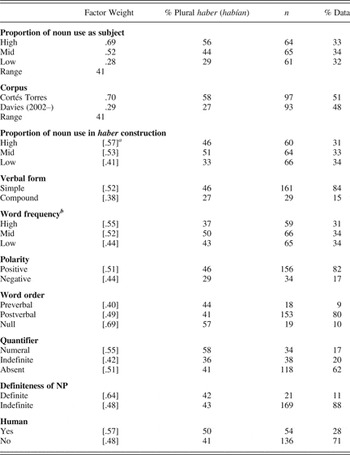
We summarize the findings of the variable rule analysis in Table 2. Of the 10 factor groups considered for analysis, Varbrul selected as significant just two: the proportion of noun use as subject and the corpus (CT, CE). No other linguistic factor group was selected as significant for haber regularization in Puerto Rican Spanish. The only significant linguistic factor is the previously unidentified and unanalyzed factor group pertaining to the syntactic probability of the noun. The likelihood of haber regularization directly reflects the degree to which the noun being presented is used with subject function in spoken Spanish. That is, nouns with a low rate of usage with subject function trigger haber regularization less than do nouns with a high rate of usage with subject function.
Factors favoring haber regularization in Puerto Rican oral Spanish Input: .42, N = 190 χ2 per cell = .9678

Notes: a Factor weights between brackets are not significant. b We noted the crossover between factor weight and percentage pluralization for high-token frequency nouns. Following Paolillo (Reference Paolillo2002:89–91), we identified a suspected interaction between word frequency and corpus. The bulk of the high-token frequency words (76%, n = 45 of 59) come from the Davies corpus, which has a significantly lower percentage of pluralization (27% versus 58%). The low- and mid-frequency words only have 34% (n = 22 of 65) and 39% (n = 26 of 66) of their tokens from the Davies corpus. We did runs on the corpora separately (see note 11) and found no evidence of crossovers or interactions.
If the noun being presented has a low proportion of use as a subject, regularization of haber is disfavored with a factor weight of .28 (e.g., casas ‘houses’, Entonces, también, no había en Río Piedras las casas de hospedaje tan buenas que hay hoy día ‘So then, also, there weren't the great boarding houses like the ones we have nowadays in Río Piedras’[Davies, 2002–, Habla Culta: San Juan]). The verb haber is expressed in the plural with these low proportion nouns with a rate of 29%. The factor weight for plural nouns used with subject function with middle range frequency hovers close to .50 (.52), and regularization for these tokens occurs in 44% of the instances of use. Additionally, if the noun has a high frequency of use in spoken Spanish with a subject function, regularization of haber is strongly favored with a factor weight of .69 (e.g., estudiantes ‘students’, Como habían estudiantes de bachillerato. . ., ‘Since there were high school students . . .’ [Davies, 2002–, Habla Culta: San Juan]). With this class of nouns, haber regularizes in 56% of the instances.
This innovative probabilistic measure (subject grammatical relation probability) is found to be significant while controlling for multiple factors implicated in this regularization process. In this process of reanalyzing the object NP as a subject NP in the haber construction, individual nouns and their probabilistic features significantly constrain the variation. We argue that in addition to semantic and phonological information being stored lexically (exemplar model; Bybee, Reference Bybee2001), individual nouns, through repeated use with specific grammatical functions, acquire a grammatical relation probability. It is the probabilistic features of individual nouns that trigger haber regularization and not the abstract grammatical relation of subject itself. In other words, these results do not argue that haber projects two separate constructions: [haber + object NP] (not pluralized) and [haber + subject NP] (pluralized), and that a token with high proportion of use in subject function is more likely to occur in the latter construction. If it were the case that nouns more likely to be used as subjects in the grammar were also more likely to be used as subjects in the pluralized construction, then we would anticipate that the majority of nouns with a high proportion of use in subject function would occur with a pluralized haber form. In fact, the rate of use of both mid and high proportion nouns is roughly equal in both pluralized and nonpluralized forms.Footnote 10
This study contributes a new probabilistic measure to the study of variation. However, the measurement we introduce is also innovative in how it views the predictive power of probabilities. Typically, the probabilistic measurement and the predicted linguistic outcome (e.g., durational shortening, syntactic reduction) are both contextually determined. That is, the probabilistic measurement is calculated based on the probability of use in the very specific context where the linguistic outcome is being predicted. Conversely, in the present analysis, the probability measurement (proportion of noun use as subject) is context-independent. That is, the linguistic outcome (pluralized haber forms) is not determined by the likelihood that a noun type of low, mid, or high proportion of use in subject function occurs in a pluralized (unambiguously subject) or a nonpluralized construction. Rather, the significant result we report in Table 2 reflects speakers' awareness of a cumulative probability based on their overall experience with the noun usage patterns generally in the language, in line with studies reporting significant effects of cumulative measures of frequency and probabilities on phonological reduction (Brown & Raymond, Reference Brown and Raymond2012; Bybee, Reference Bybee2002; Raymond & Brown, Reference Raymond, Brown, Gries and Divjak2012).
As also is evident in Table 2, haber pluralization is favored in the CT corpus (factor weight .70) compared with the CE (Davies, 2002–) (factor weight .29). Indeed, in the CT corpus, most tokens of haber regularize (58%), whereas in the CE corpus, regularization is less common (27%).Footnote 11 This result likely reflects the type of data represented in each of the corpora: one being spontaneous recorded conversations among friends and family (CT), and the other representing more formal registers. Further, if haber regularization is, indeed, a change in progress as some suggest (D'Aquino Ruiz, Reference D'Aquino Ruiz2008; Díaz-Campos, Reference Díaz-Campos2003; Hernández Díaz, Reference Hernández Díaz and Company2006; Montes de Oca-Sicilia, Reference Montes de Oca-Sicilia1994), it is noteworthy that the CE data represent speech from the 1970s, whereas the CT data was recorded in 2000, thus providing indirect evidence in support of viewing this phenomenon as change. The potential role of extralinguistic factors in the variable realization of plural haber with presentative function lies outside the focus of this study.
DISCUSSION AND CONCLUSIONS
This study presents results of a previously untested notion regarding the role of syntactic probabilities in analogical processes. We have shown that the frequency of occurrence of a noun as subject in language usage conditions the regularization of haber. This suggests for each noun, therefore, that the speaker not only stores semantic information (such as gender, number, and count/mass), but also associates the noun with certain grammatical relations (propensity to be subject, for instance). This knowledge of usage patterns affects production and may guide analogical processes.
This syntactic probability measure was applied to the widely studied phenomenon of haber regularization in Spanish specifically. The quantitative analysis of each occurrence of variable presentational haber in oral Puerto Rican Spanish did not support previously held assumptions regarding the linguistic factors that constrain the variation of haber (verbal form, presence/absence of quantifiers, polarity, and human NP) determined from analyses of other varieties of Spanish. Rather, the innovative methodology employed in this analysis revealed that haber regularization is affected by speakers' probabilistic knowledge of grammatical relations. Nouns with a higher probability of use in discourse with a subject function promote haber regularization, whereas nouns with low probability of subject use disfavor haber pluralization.
This effect of proportion of noun use as subject may have been detected via correlation in previous research (Bentivoglio & Sedano, Reference Bentivoglio and Sedano1989; DeMello, Reference DeMello1991; Díaz-Campos, 1999–2000; Domínguez et al., Reference Domínguez, Guzmán, Moros, Pabón and Vilaín1998) that found that human referents significantly favor the regularized form over nonhuman referents. Haber is used in our corpus to present both human (e.g., había pasajeros ‘there were passengers’) and nonhuman NP referents (e.g., había un restaurante ‘there was a restaurant’), albeit not with the same frequency. Haber is used more frequently in our corpus to present a nonhuman NP referent (96 types, 136 tokens) than a human NP referent (32 types, 54 tokens). However, the rate of haber regularization is higher (50%) for plural human NP referents than for plural nonhuman NP referents (41%). This results ties in with a tendency for human entities to function as subjects. As is noted by Coco and Keller (Reference Coco, Keller, Taatgen and van Rijn2009:275):
Animacy is known to play a role in language production; in particular, it can influence the assignment of grammatical functions and word order. . . . Animate entities are conceptually more accessible than inanimate ones . . . and therefore privileged during syntactic encoding. This is reflected by the fact that animate entities are more likely to be encoded with the grammatical function subject, while inanimate entities occur mostly with the function object.
It is true that, for the NP referents in our data, the human NPs have a higher probability on average of functioning as subjects than do nonhuman NPs (26% and 13%, respectively). However, to attribute the human/nonhuman distinction a causal function in the regularization of haber fails to capture the bigger picture. That is to say, the human NPs act as subject more than nonhuman NPs do, but our results suggest this effect is gradient and that the binary +/– human distinction used in previous analyses captures less precisely the regularization process.Footnote 12
Indeed, if the explanation for haber regularization were simply a matter of the categorization of the NP referent as human or nonhuman, we would not expect to see different rates of regularization within one of those categories. That is to say, all NPs with a human referent would display similar rates of pluralization, as would NPs with nonhuman referents. This is not the case in our data. For instance, if we examine the plural, nonhuman NP referents, there is a significant difference (p = .002) in rates of haber regularization for the group of NPs infrequently used as subject (e.g., ventanas ‘windows’) compared with the group of NPs most often used with subject function (e.g., chismes ‘gossip’). This is summarized in Table 3.Footnote 13 Within the group of nonhuman NP plural referents, there is haber regularization in 29% of the cases with nouns used infrequently as subjects. This rate of regularization is significantly lower than the 67% regularization for the group of nouns used frequently in discourse with a subject function. Thus, the lexical effect of the noun's cumulative syntactic function probability is also evident for nonhuman NP referents.
Noun referents coded as nonhuman

Note: Difference between low and high: p = .0016, χ2 = 10.13767; difference between mid and high: p = .0232, χ2 = 5.154286; difference between low and mid: not significant.
Another usage-based factor group we examined in this study (the proportion of use of noun in the haber construction) was not selected as significant. In line with Goldberg (Reference Goldberg1995, Reference Goldberg2006) and Croft (Reference Croft2001), in this study [haber + NP] is described as a construction. This construction has a direct form (V-haber + NP) ~ function (presentational) pairing in which the verb slot is fixed, as it is always occupied by a form of haber, and the NP slot is open. We predicted, based on Bybee and Thompson (Reference Bybee and Thompson1997) and Bybee (Reference Bybee, Joseph and Janda2003), that the innovative haber construction could be promoted with nouns that are used infrequently in the [haber + NP] construction. As Bybee (Reference Bybee, Joseph and Janda2003) argued, analogical leveling affects low frequency items first. Thus, NP arguments frequently occurring in the [haber + NP] construction would be predicted to be more resistant to regularization due to the conserving effect of frequency (Bybee & Thompson, Reference Bybee and Thompson1997).Footnote 14 If the loss of the unusual presentative construction were the result of analogical leveling with the regularized pattern of NP subject + verb agreement, we would expect that the innovative construction would arise in contexts in which the NP argument is infrequent in the haber construction. Our results show, however, that the regularization of haber we find in our Puerto Rican data does not reflect this tendency.
Much of the theory and method of this study builds largely on usage-based theory generally (e.g., Bybee, Reference Bybee2001, Reference Bybee2002, Reference Bybee2010) and the growing body of literature on the effects of linguistic probabilities. We argue that the lexical representation of words contains information regarding syntactic probabilities. Gahl and Garnsey (Reference Gahl and Garnsey2004:751) identified three different criteria that data must meet to be considered part of the grammar:
First, one would certainly ask that the relevant probabilities be based on phrase types, rather than specific lexical items; second, they should make reference to syntactic relationships, rather than simple adjacency or cooccurrence of syntactic phrases; and third, they should be distinguishable from probabilities based on real-world plausibility, that is, the likelihood that a given sentence may be true.
Our data meets these three criteria. First, the probabilistic measure we report, rather than phrase type, refers to grammatical relation and not to particular lexical items or identified lexical effects such as word frequency, which was not selected as significant in our variable rule analyses. Second, our measure is not contingent on co-occurrence frequencies. Recall, the frequency with which the noun occurs in the [haber + NP] construction is not significant in this regularization process in Puerto Rican Spanish. Lastly, we argue the syntactic probability effect we report is lexicalized and not based solely on real-world plausibility. It could be argued that the high syntactic probability for humans to be subjects is determined by the extralinguistic (real-world) tendency for humans to act as agents. And, as Comrie (Reference Comrie1989) pointed out, prototypical subjects are agents, and therefore haber regularization could reflect online cognitive processes and not lexicalized probabilities.Footnote 15 Evidence against this argument lies in usage patterns detected in the corpus (Davies, 2002–) regarding classes of nouns (i.e., human versus nonhuman). For instance, two seemingly comparable nouns describing groups of professionals (abogados ‘lawyers’, maestros ‘teachers’) could feasibly, in plausible terms, act as subjects with equal likelihood. However, it is the actual grammatical probability that predicts the regularization pattern and not the mere possibility of acting as a subject. These nouns vary significantly (p = .0000, χ 2 = 164.6702) in their grammatical relations; in this illustration, abogados is used in subject function in only 13% of cases (N = 579), whereas maestros is used with subject function in 45% of cases (N = 896), and these probabilities are tied to specific nouns.
This significant result of high proportion of noun use in subject function favoring haber pluralization we have interpreted as a lexical effect, that is, having to do with information about syntactic contexts of use stored with lexical items. Other analyses of syntactic probabilities employ an information-theoretic approach to language production, as illustrated, for example, in Jaeger (Reference Jaeger2010) and Tily et al. (Reference Tily, Gahl, Arnon, Snider, Kothari and Bresnan2009). These authors propose the principle of Uniform Information Density (UID), where information is “measured in such a way that the more probable an item in a sequence, the less informative it is, and conversely the less probable, the more informative” (Bresnan & Ford, Reference Bresnan and Ford2009:57). The UID principle assumes if “the rate at which information is conveyed in the speech stream is roughly constant, then more predictable words, which carry little information, should take less time to pronounce during production than less predictable words” (Bresnan & Ford, Reference Bresnan and Ford2009:57). As such, the UID principle is straightforwardly applied to the study of reductive processes. Although we analyze a case of analogy that does not involve a reductive process (but perhaps the opposite), our results might lend partial support to the UID proposal (Jaeger, Reference Jaeger2010). If we consider that a less predictable noun for the haber construction can be interpreted as one typically used as subject, and not object, then our findings could be accounted for within this view. Tokens with low proportion of noun use as subject do not favor regularization with the accompanying additional phonological material entailed by the morphological expression of plural.
Other explanations for our results might appeal to lexical access during speech production. For instance, using a connectionist model of sentence production, Chang et al. (Reference Chang, Dell and Bock2006:246) argued that thematic role distinctions contribute to the selection of structures in language production. On this basis, these authors consider the possibility that lexical items may be closely linked with syntactic knowledge. We support this view in our analyses, and our data demonstrate a significant effect of grammatical relation distinctions among nouns. As Chang et al. (Reference Chang, Dell and Bock2006:243) pointed out, speech production involves “incremental competition between words that are activated by the message. The sequencing system attempts to make a grammatical sequence out of the winners of this competition.” Such competition between nouns with different proportion of uses as subject and their relative activation may thus bias production and the morphological form of haber.
In this analysis, we provide statistical control for both previously identified linguistic factors attributed to the haber regularization in Spanish, as well as novel factors, and find that the proportion of nouns in subject function significantly constrains variable agreement of haber. We would not advocate a view that any one source alone could account for the pluralization pattern we observe for haber and acknowledge a need for future tests of this factor that we identify. For instance, we lack control for lexical and/or syntactic priming in the current analysis. Given the multifaceted ways in which priming is shown to have effects on all levels of language production (e.g., Chang et al., Reference Chang, Dell and Bock2006; Gries, Reference Gries2005; Szmrecsányi, Reference Szmrecsányi2005; Torres Cacoullos & Travis Reference Torres Cacoullos, Travis, Rivera-Mills and Villa2010), future analysis should test for potential effects of syntactic and lexical priming.
The results reported here, therefore, describe a new type of linguistic information stored in the lexicon. The spread of this analogical process (haber regularization in Spanish) is not determined by phonological and/or semantic similarity as has been shown for other changes. Rather, syntactic probabilities of nouns in subject function are shown to significantly constrain this variation. This type of probabilistic information attributed to lexical items should be tested on other linguistic variables to determine how pervasive it is in processes of language variation and change.