World's most famous archaeological replica, Lascaux II was replaced in December 2016 by Lascaux IV. IV deserves to inherit the reputation, but it is already struggling to cope as it seeks to outdo II's tally of visitors. The ironies are manifold.
Lascaux Cave overlooks the Vézère Valley, in south-western France's popular Dordogne region. The interior was painted and engraved, during the Upper Palaeolithic, with sweeping compositions of animal art (Aujolat Reference Aujolat2005). Sometimes, alone in there, confided Norbert Aujolat (Reference Aujolat2005: 265), “it all became too emotional”: “this special world was [. . .] bewitching”. The amount of work is astonishing too: Lascaux has some ten per cent of all France's known Palaeolithic cave art.
In 1963, 18 years after opening to the public, the Cave was closed for the sake of preserving the pictures. In compensation, the National Museum of Archaeology mounted a copy of the spectacular Hall of Bulls in 1980; and Lascaux II opened three years later.
Why do we value Lascaux? There is the wonderful ‘art’. More fundamentally, the Palaeolithic offers a salutary perspective in its contrasts with our own era, but that is difficult for most people to understand. So, if Lascaux IV, at last, helps better to preserve the Cave's pictures, there remains the problem of how to explain the Upper Palaeolithic.
Lascaux IV is France's second new replica of a decorated Palaeolithic cave. The Caverne du Pont d'Arc was opened in 2015 in order to preserve Chauvet Cave, in the Ardèche Valley in south-eastern France (James Reference James2016). The comparison helps to clarify the issues.
Values
Lascaux Cave has been treated as a national asset ever since the pictures were discovered soon after France fell to the Axis invasions of 1940. Fascinated by such ancient images deep underground, and traumatised by war and occupation, a first generation of intellectuals read them as expressions of timeless verities (Smith Reference Smith2004). Assessing how and why such interpretations have been deployed, Demoule (Reference Demoule and Nora1998: 189) found that, unlike places such as Gergovie, with historical associations, “prehistoric sites are [. . .] empty forms that can be filled with whatever concepts, emotions, or symbols we like”. The French, he affirmed, have succumbed to an “anxiety about roots”, with Lascaux now a “generic symbol of France's lost prehistoric memory” (Demoule Reference Demoule and Nora1998: 165, 185). Would that change, we could ask today, were the Front National to win the next general election? Nor, of course, can any one meaning necessarily be attributed to the images, as Norbert Aujolat's solitary experience implies.
Along with symbolism, most monuments have aesthetic and economic values as well as archaeological importance (Lipe Reference Lipe and Cleere1984). Demoule barely finds need to mention the art, but, pointing out how we always think of its young finders, he confirms, first, that Lascaux is a source for fantasies of revelation—the myth of the boys’ dog, Robot, a classic instance (Daniel Reference Daniel1978: 6); second, that Lascaux and its replica are an asset for the local tourism economy; and then that prehistorians value the Cave as a record of the past. Much the same goes for Chauvet Cave. The problem in presenting both replicas is that, while the art's human value does look obvious, visitors tend to find the archaeological technicalities hard to grasp.
Are something of the values intended for Lascaux IV, and the priorities among them, reflected in how the project was funded? With about two thirds of its budget covered by local, regional and central government, and most of the rest by the European Union, the new attraction was proclaimed as a “moteur d'une riche offre touristique” for the district (Lascaux 2016: 9, 11). The press release for the opening did mention art, yet archaeology, indeed, was only acknowledged by implication (Lascaux 2016). For the Caverne du Pont d'Arc, both budget and funding were much the same, but, perhaps owing to excitement about Chauvet Cave's putative dates, the Caverne is advertised as archaeological (Ardeche 2015; James Reference James2016).
The generosity of public funding is propitious. But will Lascaux IV do justice to archaeology as a record of the Palaeolithic and as a resource for thinking about that era? Or are the replica and the idea of the Cave itself presented as artistic features of contemporary ‘heritage’ (Carman Reference Carman2002: 17–19)?
Dilemmas
The gravest irony would be if visitors were to admire Lascaux IV without considering the Cave itself or understanding why it is closed. It would be a small instance of the ‘misrecognitions’, on which, according to neo-Marxist analysis, the present capitalist order depends. Thus, for MacCannell (Reference MacCannell2013: 2, 13), “tourist attractions are [. . .] analogous to the religious symbolism of primitive peoples” [sic]: “sightseeing is a ritual performed to the differentiations of society”. That “there is something more than meets the eye” in a tourist attraction is perceived by MacCannell as a key to exposing our division of labour (MacCannell Reference MacCannell2013: 93). With regard to art, he takes issue with Walter Benjamin's account of ‘aura’, arguing that a work “becomes ‘authentic’ only after the first copy [. . .] is produced”; and that the ‘ritual’ springs “from the relationship between the original object and its socially constructed importance” (MacCannell Reference MacCannell2013: 48). As few can appraise the Cave itself, Lascaux, then, readily acquires mystique. One way to control that would be to ‘distance’ visitors from their own assumptions by exposing the sociology of tourism. Less disconcerting would be to explain the Cave as archaeology; but there the challenge is to help visitors to understand archaeological evidence and inference.
Lascaux Cave was closed because, exposed to outside air, to the warmth, breath and moisture of a million visitors, and to microbes perhaps carried in with them, the walls had been invaded by bacteria, films of fungus and lichens and, in places, by fresh solutions of lime and other minerals (Coye Reference Coye2011). Built some 300m downhill from the Cave, Lascaux II faithfully reproduced the topography and art of the Bulls Hall and the intensely decorated Axial Gallery. It even evoked the Cave's damp cold. Yet problems proliferated in the Cave itself, partly on account of the very measures undertaken to protect it (Coye Reference Coye2011); and, latterly, fumes seeping in from Lascaux II's car park added to the conservators’ nightmare (Vie Publique 2014). So IV has been built at the foot of the hill, beside the little town of Montignac.
Lascaux III, meanwhile, is a travelling exhibition that shows full scale three-dimensional copies of selected parts of the painted walls. After touring France and the USA, it has now reached East Asia, no doubt encouraging even more people to explore the Vézère Valley and its deep archaeology.
What, then, should visitors expect of Lascaux IV? Broadly, we should have the opportunity to witness the ancient thinkers’ and designers’ imagery or messages. More specifically, visitors should expect to learn something of the images’ context, so different from the modern world, in the Palaeolithic of the surrounding district. At the same time, they could expect to learn how archaeologists make their discoveries and interpret them. For, without sufficient appreciation of the archaeology, however visitors relate to the art, their “concepts, emotions, or symbols” (Demoule Reference Demoule and Nora1998: 189) may obscure how the Upper Palaeolithic differed from our world—and how, by implication, the future may differ too.
Of these principles, historical context is the most difficult to convey by replication. Books and films or museums and experimental archaeology may work better; and they can explain methodology too. Yet they lack the compelling quality of experience in the replica of a site or some part of it. On the other hand, as a novelty—which, for many, is probably one source of its appeal—life-sized replication has to allow both for visitors’ awareness of artifice and for their sense of each other in sharing the experience (Urry & Larsen Reference Urry and Larsen2011: 99–100; James Reference James2016). The conditions for learning, in this sense, tend to remain implicit in more familiar settings such as museums and classrooms. Moreover, for replicas, there was anxiety, a generation ago, about ramifying implications for significance and meanings, unnoticed, unintended and unnecessary (MacCannell Reference MacCannell2013: 43–48). Has Lascaux IV resolved these problems by alerting visitors to the Palaeolithic, framing or ‘marking’ itself adequately as a source for prehistory as well as an attraction for today (MacCannell Reference MacCannell2013: 109–33)?
Nor is novelty the only challenge. If we imagine that their Palaeolithic visitors used caves such as Lascaux and Chauvet to concentrate on thought or ritual, then should we, like Norbert Aujolat, seek something of the ancient ideas; it follows that we need a silent “romantic gaze”: “solitude, privacy and a personal, semi-spiritual relationship with the object of the gaze” (Urry & Larsen Reference Urry and Larsen2011: 19). Lascaux II received some 270 000 visitors in 2013—perhaps a lean year but more than three times as many as the National Museum of Prehistory in Les Eyzies, a short drive down the valley (Périgord Noir n.d.). IV was on course at once to meet its target of 400 000 a year (Chassain Reference Chassain2017). The replica for Chauvet Cave, the Caverne, has exceeded that rate already (Bommelaer Reference Bommelaer2017). The Caverne and Lascaux IV are of similar dimensions. Would crowding prevent a sense of the Palaeolithic mood?
The visit
Lascaux IV—formally, the Centre International de l'Art Pariétal or International Centre for Cave Art—is in six parts. Twisting like the roofline ahead, a footpath leads from the car parks to the building that houses the replica. The elevation is composed of planes in white concrete and glass that evoke the surrounding karst and that bend to match the wooded ridge above, where lies the Cave. Grass camouflages the roof against the trees. The building respects its setting in the same spirit as the Caverne for Chauvet Cave or Stonehenge's new visitor centre—“sense of place, identity [. . .] and relationship to the physical spaces we inhabit”, the motto of Lascaux IV's architects (Chippindale et al. Reference Chippindale, Gosden, James, Pitts and Scarre2014: 647; James Reference James2016: 523; Snøhetta 2017). The entrance opens into an airy foyer backed by a high white wall like a limestone cliff. Having collected our tickets, we wait there until guides gather us for going in to the replica. As at the Caverne (and cave monuments), guided tours are normally the only means of entry. After the replica come supplementary displays including a gallery or ‘atelier’ for following up on aspects of the archaeology. Last are a shop (mostly books) and a good (if pricey) brasserie.
Surprisingly, the way to the replica is by a lift to the top of the building. There we are shown the valley in a view like that of the Cave's of old, but now with trees, fields and buildings. The guides tell us that the Vézère drainage has 41 archaeological sites, including 15 on the World Heritage List. They explain the main features of the Palaeolithic way of life. Summing up its archaeological value, they go on to recount why Lascaux Cave is closed. Then we are shown a brief video reconstruction of the ancient landscape and its wildlife before a short dark passage brings us to a mock-up of the talus down which the paintings’ finders first slid into the Cave.
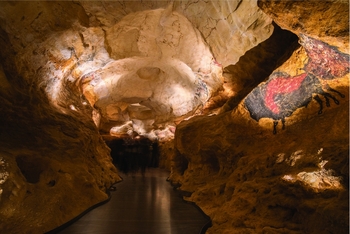
The replica is made of the same sort of ‘landscape’ concrete used in the Caverne for Chauvet Cave, and the walls and images are reproduced by the same techniques of scanning, casting and painting (Figure 1). Lascaux IV shows nearly all of the Cave's imagery. We see the Bulls Hall and Axial Gallery, the Apse and the Nave; but, as in the Caverne, parts of the topography are truncated. The footpath is broad enough for a wheelchair (we are urged not to step off it). A steel grill carries us over the narrow floor at the end of the Nave. The display is dimly lit and the guides use laser pointers to pick details out. The commentaries, both those of the guides’ and the recorded information, are transmitted to visitors’ headsets by radio. The walk through the replica takes about 50 minutes, a bit longer than Lascaux II's, a bit less than the Caverne's.
In the replica: the Nave, Crossed Bison to the right (photograph by Dan Courtice, Semitour Périgord).

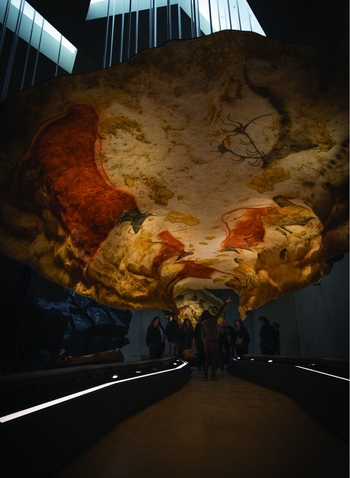
We step out of the replica into a passage between two more high white walls where the guide sums up and fields questions for a few minutes. We then go on to the atelier unaccompanied. The atelier amplifies the information in the replica. It shows eight life-sized three-dimensional copies of selected groups of the paintings (Figure 2), a scale model of the cave system, displays about the geology and the Cave's changing atmosphere, and photographs of the first investigators. Some of the copies reveal the designs more clearly than can the replica, partly because we can stand closer to them in the atelier and because the lighting is more conducive; partly because, unlike the replica, we can set our own pace here, more or less; and partly because some of the images are projected selectively to distinguish them from each other. Touch screens reinforce details of the guides’ information, such as the chronology. One display helps to explain how the ancient images were created, and there is a set of replica pigments and tools, including the elegant lamp that was found. Commentaries are provided through the same gadget used for hearing the guide (which not everyone finds easy to use). Next to the atelier, a cinema shows short films about the history of research up to the discovery of the paintings and since. There is also a gallery to compare the ancient work with ‘Modern artists’, and another for temporary exhibitions.
In the atelier, the Axial Gallery's entrance (photograph by Dan Courtice, Semitour Périgord).

Conditions for learning
The replica's bold, enigmatic images are impressive but, whether or not on account of brighter lighting, the experience seems less other-worldly, for better or worse, than in Lascaux II. On the other hand, the twisting path to the unusual building, followed by the foyer, the lift and especially the little tunnel to the replica and the passage between the replica and the atelier do frame or ‘mark’ Lascaux IV as a distinct experience.
The atelier complements the guides’ account just as the ‘Aurignacian Gallery’ supplements their colleagues’ in the Chauvet Caverne, but its purpose is different. Where the Aurignacian Gallery describes aspects of the Palaeolithic environment and way of life, the atelier is limited to the art. As for learning about the research on Lascaux, the cinema gives a brief impression, with laudable emphasis on theory. Certainly, we can learn about both prehistory and archaeological investigation at other sites in the district or at the National Museum of Prehistory and the interpretation centre, the Pôle International de la Préhistoire, also in Les Eyzies; but Lascaux IV's exhibitions do little to explain archaeological evidence as such, and many more visitors come here than elsewhere. Everyone does know that the cave paintings are very old, but the display of Modern art, in particular, begs questions about how different the Palaeolithic was from our own era. Has Lascaux been copied so carefully only to address contemporary preoccupations?
The replica, of course, is the critical component. To judge from those in the party joined by this reviewer, it does work as archaeologists would hope. Participants followed each detail of the presentation intently. Questions for the guide were observant and thoughtful, both during the exploration and in discussion with him as he concluded. As in the Caverne, visitors evidently do accept that the Cave itself is closed, and they appreciate what the replica shows. The presentation does not conflate the replica with the Cave: Lascaux IV is clearly about the Cave and distinct from it.
These achievements depend, in large part, on the guides. It was the same for Lascaux II. It is the same in the Caverne and, for that matter, the same normally goes for all cave art open to the public in France. Fretting about mediation, Urry and Larsen (Reference Urry and Larsen2011: 204) remark that “Since the guide constantly points out what to see and how to understand and value it, people are rarely left to draw their own interpretations [. . .] They are [. . .] advised against individual exploration [. . .] and ‘monitored’ by [. . .] co-participants”. Perhaps, in so far as Lascaux Cave's value is aesthetic, Urry and Larsen are right to imply that such presentation, so ‘ritualised’, can be frustrating, but, by precluding a ‘romantic gaze’, could it encourage visitors to produce interpretations of equivalent archaeological value, whether tacitly or even expressly? Lascaux IV's general press release does include pictures of families admiring the walls together—only misleading in failing to show their guides.
To appreciate Lascaux in an archaeological sense, the guides are indispensable. They are evidently trained in both what to say and how to say it. The commentary is apt and sensible, explaining the patterns of images and pointing out enigmas such as the selection of animal species or the rectangular signs that punctuate some of the compositions. The guides also acknowledge issues that cannot be settled from the evidence. To be sure, few other guides can be so able as the one joined for the present review, managing his group with authority and with an awareness of each participant, coherently balancing detail and timing so as to engage us with the walls throughout, and purveying his material as well as any archaeologist could. Indeed, this guide is the author of a substantial assessment of interpretations of France's Palaeolithic cave art (Rigal Reference Rigal2016).
There is another irony, however: Lascaux IV does depend on visitor management as well as the quality of replication and explanation. The tours through the replica run on a time schedule, but parties can number as many as 30. Such a group moves slowly, so a smaller one behind is apt to catch up. When that happens, not only is the latter seen in the background, but the other guide can also be heard; and then, in the passage between the replica and the atelier, guides have to coordinate to prevent their parties from colliding. It must be especially difficult, in these conditions, to impart enough information. The atelier too can become as crowded as a popular museum exhibition. The Chauvet Caverne suffers similar and related problems (James Reference James2016: 523). Nor is it only in constricted spaces that numbers jeopardise appreciation (James Reference James2009: 1150). Crowding is unconducive to learning about the archaeology, let alone to a ‘romantic gaze’.
Can Lascaux IV's guides prevail consistently enough over the distractions of our own teeming world to focus visitors on the Palaeolithic? If the guides cannot explain more, inside the replica, about what the evidence is or how we unearth it, then the atelier should be developed. The Aurignacian Gallery for Chauvet Cave and some of the secondary displays in the atelier itself show how that could be done. Lascaux's best lessons are in the archaeology, not the art alone.
Acknowledgements
Clémence Djoudi courteously arranged for my visit and provided the images used herein. I am grateful too to Sally Gaucheron for commenting most helpfully on drafts of this review.