Introduction
There are two main approaches in the literature to explain how morphologically complex words are represented and processed. First, the account of Obligatory Decomposition, put forth by Taft and his colleagues (e.g., Taft, Reference Taft1979, Reference Taft2004; Taft & Ardasinski, Reference Taft and Ardasinski2006; Taft & Forster, Reference Taft and Forster1975), argues that decomposition is necessary for most morphological structures (e.g., affixed words). In contrast, advocates of the Dual Pathways account (Baayen, Dijkstra & Schreuder, Reference Baayen, Dijkstra and Schreuder1997; Bertram, Schreuder & Baayen, Reference Bertram, Schreuder and Baayen2000) propose two possible processes in recognizing an affixed word: one via whole-word representation and the other via its stem representation following decomposition. This latter account mainly postulates that either storage (i.e., whole-word form) or computation (i.e., parsing) is used for complex words, depending on factors such as regularity (e.g., regular past tense or irregular past tense) and frequency. For example, the Morphological Race Model (Shreuder & Baayen, Reference Schreuder, Baayen and Feldman1995) is a parallel dual-route model that assumes that both the whole-word route and decomposition route exist in parallel. This model posits that whole-word processing will be faster for known words, whereas a decomposition process occurs for novel words.
The Obligatory Decomposition and Dual Pathway accounts are differentiated by using a lexical decision task where the stem frequency and whole-word frequency (the surface frequency) are manipulated. According to the Obligatory Decomposition account, stem frequency effect exists in both low surface frequency and high surface frequency words whereas Dual Pathway account posits no stem frequency effect for high surface frequency words. Although the debate about which approach provides a better explanation of complex word processing is beyond the scope of the current study, presumably decomposition (or parsing) is a robust mechanism underlying morphological processing, based on consistent findings from a number of studies using various languages such as English (Taft & Forster, Reference Taft and Forster1975), French (Longtin & Meunier, Reference Longtin and Meunier2005), German (Clahsen, Sonnenstuhl & Blevins, Reference Clahsen, Sonnenstuhl, Blevins, Baayen and Schreuder2003), and Italian (Caramazza, Laudanna & Romani, Reference Caramazza, Laudanna and Romani1988), and different experimental methods such as lexical decision (e.g., Taft, Reference Taft2004), eye-movement (e.g., Juhasz, Starr, Inhoff & Placke, Reference Juhasz, Starr, Inhoff and Placke2003), and neuro-imaging (e.g., Devlin, Jamison, Matthews & Gonnerman, Reference Devlin, Jamison, Matthews and Gonnerman2004; Fiorentiono & Poeppel, Reference Fiorentino and Poeppel2007; Gold & Rastle, Reference Gold and Rastle2007; Stockall & Marantz, Reference Stockall and Marantz2006).
Marslen-Wilson, Tyler, Waksler and Older (Reference Marslen-Wilson, Tyler, Waksler and Older1994) investigated the lexical processing of morphologically complex words in English using a series of auditory-visual cross-modal repetition priming experiments. Participants heard a spoken prime which was immediately followed by a visually presented target word on which they were required to make a lexical decision. One of their main results was that decomposition reliably occurred when the relationship between primes and targets was semantically transparent (i.e., when there was a significant contribution from the meanings of the constituents to the meaning of the word, e.g., happy/happily – transparent, depart/department – non-transparent or opaque), regardless of phonological transparency (i.e., whether there is any pronunciation shift from the stem to its affixed form, e.g., pirate/piracy – transparent, sign/signal – non-transparent). Specifically, a semantically transparent derived word (e.g., punishment) significantly reduced the latency of its stem words (e.g., PUNISH), but the same effect did not consistently occur when the relationship between primes and targets was semantically opaque (e.g., casualty–CASUAL). Therefore, the researchers suggested that the semantically transparent derivational words have decomposed lexical representations, but the opaque derivational words are processed as whole-word forms.
However, several studies (e.g., Longtin, Segui & Hallé, Reference Longtin, Segui and Hallé2003; Rastle, Davis & New, Reference Rastle, Davis and New2004) suggest that this argument of semantically based decomposition should be modified. For instance, Longtin et al. (Reference Longtin, Segui and Hallé2003) used a visual masked priming task, and showed that a monomorphemic word in French was recognized faster if it was preceded by a morphologically transparent (gaufrette–GARFRE “wafer/waffle”), a morphologically opaque (fauvette–FAUVE “warbler/wildcat”), or a pseudo-derived word (baguette–BAGUE “little stick/ring”), as compared to an unrelated word. An orthographically related word (abricot–ABRI “apricot/shelter”) did not induce a faster latency in lexical judgment, as compared to a control item. When Longtin et al. changed the task to a cross-modal priming task (Experiment 2), only the condition of semantically transparent derived word significantly primed its related target, similar to what Marslen-Wilson et al. (Reference Marslen-Wilson, Tyler, Waksler and Older1994) had found. Along the same line, Rastle et al. (Reference Rastle, Davis and New2004) show that morphological decomposition occurs based on morpho-orthographic segmentation in words (e.g., corner–CORN, but not brothel–BROTH). Since both studies – Longtin et al. (Reference Longtin, Segui and Hallé2003) (in Experiment 1) and Rastle et al. (Reference Rastle, Davis and New2004) – used masked priming, their results were more likely a result of automatic processes rather than possible conscious strategies that might have contributed to the findings in Marslen-Wilson et al. (Reference Marslen-Wilson, Tyler, Waksler and Older1994).
This decomposability issue was later carefully investigated with some variations in the types of materials by Longtin and Meunier (Reference Longtin and Meunier2005), who found strong priming effects for derived words on stems in French. The researchers varied the relationships between primes and targets in four conditions: existing derived words (e.g., canaliser–>CANAL), interpretable derived pseudowords (e.g., canaleur–CANAL), non-interpretable derived pseudowords (e.g., canalitude–CANAL), and non-morphological ending pseudowords (i.e., illegal combination of a stem and an orthographic ending, e.g., canalare–CANAL). Significant priming effects of existing derived words and pseudowords with illegal combination of a stem and a suffix, regardless of interpretability of the prime, were observed. However, there was no effect for non-morphological ending pseudowords as compared to unrelated words. Therefore, it was concluded that the morphological structure of words plays a critical role in the early stage of word recognition, regardless of lexicality or interpretability.
While the previous research mostly relied on the form and semantic level of representation in interpreting the morphological priming effect, Taft (Reference Taft2004, Reference Taft and Andrews2006) and Taft and Nguyen-Hoan (Reference Taft and Nguyen-Hoan2010) proposed an intermediate level of representation that captures the morphological relationships, namely, the lemma level. This lemma level represents the correlation between form (i.e., orthography in the reading task) and function (i.e., meaning and syntax), and mediates between the two. The intermediate lemma level, according to Taft and colleagues, captures the representation of morphological structure. In the present study, Korean L1 derived words are used to prime their translated English L2 stems. The decomposability of Korean derived words was tested. We varied prime condition: real derived, interpretable derived pseudowords (Experiment 1), non-morphological ending pseudowords (Experiment 2), and non-interpretable derived pseudowords (Experiment 3), to test the hypothesis that morphological parsing occurs at the intermediate lemma level, reflecting an additional level of awareness beyond orthographic and semantic relatedness.
Bilingual mental lexicon
There have been several approaches to explain how the two lexical systems in bilinguals are connected to each other and to conceptual information (see Kroll & Tokowicz, Reference Kroll, Tokowicz, Kroll and De Groot2005, for a review). The word association hypothesis assumes a direct association between the two languages’ lexical information, with concepts linked solely to L1 words (Potter, So, Von EcKardt & Feldman, Reference Potter, So, Eckardt and Feldman1984). The concept mediation hypothesis proposes that an L2 word is associated directly with the relevant concept and is thereby only indirectly associated with the L1 word. This hypothesis therefore posits no direct links between L1 and L2 lexical form information (Potter et al., Reference Potter, So, Eckardt and Feldman1984). Kroll and Stewart (Reference Kroll and Stewart1994) further modified this conceptualization, proposing the Revised Hierarchical Model (RHM) in order to take into account the difference between less proficient L2 learners and proficient bilinguals. The RHM posits that the lexical link from L2 to L1 is stronger than the lexical link from L1 to L2 because L2-to-L1 is the direction in which L2 learners first acquire the translations of new L2 words. The links between L1 words and concepts are postulated to be strong. In contrast, the link between L2 words and concepts is weak. However, the strength of this direct link between L2 words and concepts increases as a bilingual reader becomes more proficient in L2.
In line with the RHM, findings from several experiments using masked or unmasked priming paradigm have pointed to two critical aspects of the bilingual lexicon. Note that the difference between masked priming and unmasked priming is whether or not the prime is made visible by the presence of either a forward mask, or both a forward mask and a backward mask. First, at the lexical form level, cross-language activation reliably occurs with the asymmetric pattern of strengths between L1 and L2 depending on the direction of the links (Basnight-Brown & Altarriba, Reference Basnight-Brown and Altarriba2007; De Groot & Nas, Reference De Groot and Nas1991; Gollan, Forster & Frost, Reference Gollan, Forster and Frost1997; Jiang, Reference Jiang1999; Jiang & Forster, Reference Jiang and Forster2001; Keatley, Spinks & de Gelder, Reference Keatley, Spinks and de Gelder1994; Kiran & Lebel, Reference Kiran and Lebel2007). Although there is some variation in the significance of each directional priming effect, the priming effect of L1-to-L2 is a robust finding. For instance, Jiang (Reference Jiang1999) conducted masked priming experiments using Chinese–English bilingual readers. He found that the participants’ response times (RTs) were faster when the L2 targets were preceded by their L1 translation equivalents (i.e., L1 primes L2, for example,  “law” primes law), compared with those when the L1 targets were preceded by their L2 translation equivalents (i.e., L2 primes L1, for example, law primes ). This translation priming effect was also shown in other experiments with different bilingual populations such as Dutch–English (De Groot & Nas, Reference De Groot and Nas1991; for example, vriend–friend) and Spanish–English (Basnight-Brown & Altarriba, Reference Basnight-Brown and Altarriba2007; for example, luna–moon).
Second, there is a significant cross-language semantic priming effect in some of the studies (Basnight-Brown & Altarriba, Reference Basnight-Brown and Altarriba2007; De Groot & Nas, Reference De Groot and Nas1991; Keatley & de Gelder, Reference Keatley and de Gelder1992; Perea, Duñabeitia & Carreiras, Reference Perea, Duñabeitia and Carreiras2008). However, the size of the effect was smaller and less consistent than the translation priming effect across studies (see Kiran & Lebel, Reference Kiran and Lebel2007, for a review). For instance, Basnight-Brown and Altarriba (Reference Basnight-Brown and Altarriba2007) examined both translation and semantic priming effects with an unmasked or a forward masked priming lexical decision task, and the researchers used morphologically less complex words with Spanish–English bilingual readers (e.g., luna–moon for translation priming and día–night for semantic priming). The difference between the unmasked and masked condition in Basnight-Brown and Altarriba (Reference Basnight-Brown and Altarriba2007) is the presence or absence of a forward mask. Results from this study indicated that translation priming effects were consistently significant regardless of language direction (i.e., from Spanish to English or from English to Spanish) and the presence of a forward mask (i.e., masked or unmasked). There was a semantic priming effect with unmasked primes (the prime duration = 100 ms). However, this effect occurred only in one direction (from the dominant language to the non-dominant language, i.e., from English to Spanish), and it became non-significant when the mask was presented prior to the prime (i.e., forward masked priming) with the same duration of the prime (i.e., 100 ms).
Kroll and De Groot (Reference Kroll, De Groot, De Groot and Kroll1997) proposed their Distributed Lexical/Conceptual Feature Model, including a lemma level of representation that forms the interconnection between the forms and conceptual mappings across the two languages. In this model, there are shared lexical forms and conceptual features across the two languages. However, the lemmas are language-specific. Concerning morphologically complex words in the bilingual lexicon, both the constituent morphemes and whole words are represented at the lemma level. Limited previous studies have tested this model. The present study provides evidence regarding the lemma level representation of morphologically complex words and their constituent morphemes in bilinguals, as well as cross-language activation of translation equivalents.
Characteristics of Korean morphological system
Much of previous morphological or bilingual research has concentrated on English or other Indo-European languages (Libben & Jarema, Reference Libben and Jarema2004). However, one should be cautious when attempting to generalize lexical representation across different orthographies. Korean is a typical agglutinative language (Sohn, Reference Sohn1999). Korean has its own alphabetic system, Hangul. Thus, the different scripts in Korean and English do not allow cognates and orthographic representations to overlap in the two languages. Note that there are loan words from English in Korean, but they are excluded from the present study. Several studies showed the effect of cognates on the latencies of lexical decision and picture naming in L2 (e.g., De Groot & Nas, Reference De Groot and Nas1991; Hoshino & Kroll, Reference Hoshino and Kroll2008). For instance, the study of De Groot and Nas (Reference De Groot and Nas1991) with Dutch–English bilinguals provided evidence that the responses on cognates were faster than those on non-cognates in their priming tasks. Moreover, with masked primes, the translation priming effect on cognates is larger than that on non-cognates, and the associative-priming effect disappeared for non-cognates under the between-language condition. Since neither cognates nor loan words were used in the present study, the possibility of cognates or orthographic overlap as a confounding factor can be excluded.
The present study
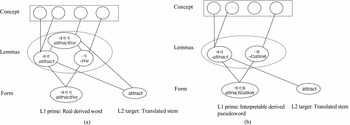
Not many studies have examined morphological processing in bilinguals; the present study contributes to our better understanding of bilingual mental lexicon. As one of the initial works on this issue, this study focuses on cross-language activation of derived words in the direction from L1 to L2 (i.e., L1 primes L2). A Korean–English bilingual population with a relatively more proficient L1 (Korean) compared to their L2 (English) was recruited. In Experiments 1, 2 and 3, we vary L1 prime types including real derived words, derived pseudowords, non-morphological ending pseudowords, and non-interpretable derived pseudowords. The target words are the translated stem words in L2. Based on Taft and colleagues’ morphological processing model and Longtin and Meunier's (Reference Longtin and Meunier2005) findings, we hypothesize that a priming effect would be observed for the real derived words, derived interpretable and non-intrepretable pseudowords, but not for non-morphological ending pseudowords. Figure 1 presents a schematic, hypothetical model of cross-language activation via decomposition based on this hypothesis. If a L1 prime contains a morphological structure and decomposition occurs, it should, regardless of its lexicality and interpretation, facilitate the latency of the access to the translated L2 stem (see Figure 1a for real derived words and Figure 1b for derived pseudowords including the interpretable and non-interpretable ones). However, if an L1 prime is not morphologically decomposable, then the access to the translated stem should not be facilitated. As the first investigation on the processing of derived words in Korean–English bilinguals, we concentrate on only one type of the derived forms: suffixed words.
A schematic model of cross-language activation via decomposition: (a) real derived words, (b) derived pseudowords, including the interpretable and non-interpretable ones. The schematic model in (b) can be used to explain the priming effect from the non-interpretable pseudoword condition.

Experiment 1
The first experiment was designed to examine the priming effects of Korean derived words and interpretable derived pseudowords on their English-translated stems. If decomposition occurs, regardless of whether prime words are real words or derived pseudowords, then bilingual readers should access the stem of their L1 primes rapidly, thereby inducing faster response times to a corresponding translated stem in their L2. Such priming effect is reasonable to be observed in a real derived word, however, several previous studies also showed a reliable priming effect with pseudo-complex words in monolingual populations (Caramazza, Laudanna & Romani, Reference Caramazza, Laudanna and Romani1988; Longtin & Meunier, Reference Longtin and Meunier2005; Marslen-Wilson, Bozic & Randall, Reference Marslen-Wilson, Bozic and Randall2008). The general consensus is that decomposition occurs when a given word consists of morphological structure, regardless of its lexicality. Therefore, we hypothesize that both derived words and interpretable derived pseudowords in L1 (i.e., Korean) would facilitate the latencies for lexical judgments of translated stems in L2 (i.e., English).
Pre-experiment tasks
Two pre-experiment tasks, a translation task (from Korean to English) and an interpretability rating task for derived pseudowords were conducted to generate experimental stimuli, using two separate Korean–English bilingual groups.
Translation task
In order to select word pairs of primes (Korean) and targets (English), a translation task was administered to nine Korean–English bilingual speakers whose length of U.S. residence ranged from one to five years. They were asked to read a list of 80 Korean words and translate each word into an appropriate English word. They were allowed to write up to three translated words. Korean–English translation pairs were selected if 80% of the participants provided a translation for their first, second, or third choice. The agreement rate of responses from selected pairs increased from 65% only for the first choice of translation, to 74% including the second choice, and to 89% including the third choice.
Interpretability rating task
The purpose of this rating task was to select reliably interpretable derived pseudowords for one of the prime conditions. The stem parts from each word in the list were illegally combined with real suffixes, that is, the combination of a real word and a real suffix produces an interpretable word that does not exist in the dictionary. For example, 매력화 /mayleykhwa/ is generated simply by combining a real stem 매력 “attract” /mayleyk/ and a real suffix 화 “-ization” /hwa/, and it is not a real word according to the Korean dictionary. In the case of English, this word is similar to a pseudoword such as attractization, which is illegally made up of a real stem and a real suffix. Although this type of derived pseudowords does not exist in the mental lexicon, its meaning can be interpreted to some degree by combining the meanings of the stem and the suffix. One stem could have more than one derived pseudoword by alternating the combinations with various suffixes. This interpretability rating task was administered to eight Korean–English bilingual speakers who have spent from one to five years in the U.S. This group did not participate in the translation task. They were asked to respond whether or not the word presented seemed interpretable in Korean on a 1–7 rating scale (1 = not interpretable at all; 7 = very likely interpretable). Mean of selected items’ interpretability was 6.02 (Range = 5–6.71, SD = 0.48).
Priming lexical decision task
Participants
Twenty-one Korean–English bilingual speakers (thirteen males and eight females) at a Mid-Atlantic State University participated in this experiment. The mean age of participants was 30.8 (SD = 3.3), and the majority of them were graduate students. All of the participants had normal or corrected-to-normal vision. They were paid for their participation.
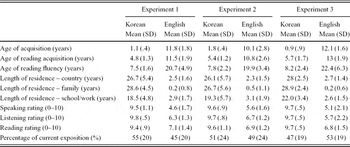
Prior to the experimental session, participants were asked to fill out the Language Experience and Proficiency Questionnaire (Marian, Blumenfeld & Kaushanskaya, Reference Marian, Blumenfeld and Kaushanskaya2007). Participants reported information on general education backgrounds and language-related backgrounds on this questionnaire. The average length of formal education of the participants was 19.5 years (SD = 2.7). Korean was their native and dominant language, and English was the second language for all participants. The average age at which they began acquiring English was 11.8 years (SD = 1.83). Participants’ subjective ratings of their proficiency levels for reading and speaking Korean and English reflected their language dominance. Details of the participants’ language profile in Experiment 1 and the subsequent Experiments 2 and 3 are summarized in Table 1. Analyses on the data from Experiment 1 showed that three component skills were rated as being significantly better in Korean than English (speaking, t(20) = 9.7, p < .001; listening, t(20) = 12.8, p < .001; reading, t(20) = 6.38, p < .001, respectively).
Means and standard deviations of self-rated proficiency and language profiles of participants in each experiment.

Design and materials
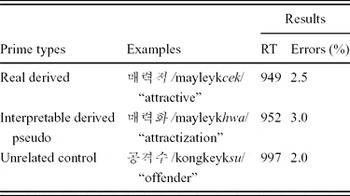
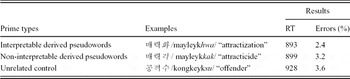
Based on the results from the translation and the interpretability rating tasks, 60 pairs of primes (i.e., 30 real derived and 30 interpretable derived pseudowords in Korean) and targets (i.e., translated English stems) were generated. In addition, we selected an unrelated word as the control condition. The targets remained the same across the prime conditions. Word length across prime conditions was fixed as three syllables. Word frequency for both a real derived word and an unrelated word preceding the same target was also controlled. For example, for the target attract in English, both the real derived word 매력적 /mayleykcek/, which means “attractive”, and the unrelated word 공격수 /kongkeyksu/, which means “offender”, were controlled for their frequencies and word length. Average of log surface frequencies for real derived words, unrelated words, and target words were, respectively, 1.13, 1.15, and 4.3, based on the Korean Word Database (2001) (a frequency count of one per 1.5 million) and the Collins Cobuild corpus (see Sinclair Reference Sinclair1996; a frequency count of one per 3.2 million). A t-test revealed that there was no statistical difference between the real derived word and unrelated word (t < 1). In addition, the means of suffix log frequencies for real derived word, derived pseudoword and unrelated word were 2.7 (SD = .43), 2.33 (SD = .27) and 2.5 (SD = .6), respectively. There was no statistical difference across these conditions. An example list of three types of primes (i.e., real derived words, interpretable derived pseudowords, and unrelated words) and targets are presented in Table 2.
Examples and mean response times (ms) and error rates by priming condition in Experiment 1.

The 90 test pairs (3 prime conditions × 30 targets) were split into three lists. In each list, one third of the targets were preceded by a real derived word prime, one third of the targets were preceded by an interpretable derived pseudoword prime, and one third by an unrelated control word prime. Twenty-one participants were randomly assigned to one of three stimuli lists (7 participants for each list). The three lists were counterbalanced so that each target was preceded by the three primes across lists but appeared only once in each list. Ninety filler pairs were added to each list. Among these, 30 filler pairs were unrelated word pairs of Korean and English (complex words in Korean and monomorphemic or complex words in English) and 60 filler pairs were unrelated word/nonword pairs of Korean and English (monomorphemic, real derived or derive pseudowords in Korean and nonwords in English) to block as much as possible any processing strategy and expectation. Therefore, each participant was given 120 English targets, 60 words and 60 nonwords. In total, the proportion of related prime–target pairs in the stimuli list was 0.25. In addition, prior to an experimental session, they were given 10 trials during a practice session.
As shown in the Appendix, several suffixes were repeatedly used within and across conditions. Since the Latin Square design was employed in stimuli presentation, the actual repetition of certain suffixes was largely decreased. For example, one affix (-적 /cek/) repeats 20 times in the real derived prime condition; however, the repetition number was reduced to six or seven times depending on the stimuli list. It is also worth noting that there was a null effect of the stimuli list across all experiments reported in the present study.
Procedure
Participants were seated in front of a computer screen in a quiet room. They received written instructions about the task to perform. The presence of a visual prime was not mentioned at this time. Participants were informed that they would see a string of letters on the screen one at a time and that they would have to respond as quickly and as accurately as possible whether the letter string was an English word or not.
During the experimental session, a priming lexical decision task procedure similar to that used by Forster and Davis (Reference Forster and Davis1984) was employed. For each trial, a fixation sign (+) was presented for 500 ms, and then a forward mask (########) appeared in the center of the screen for 500 ms. This forward mask was immediately followed by the prime (e.g., 매력적 /mayleykcek/ for a real derived word, 매력화 /mayleykhwa/ for an interpretable derived pseudoword), displayed for 150 ms, and immediately followed by the target (i.e., attract). The target remained on the screen for 3000 ms or until the participant responded. Reaction times were measured from the onset of the target to the time point when the response was made. Primes in Korean and targets in English were displayed in 20-point Courier font in black on a white background. The experiment was run on a PC, using E-prime software (Psychology Software Inc., Pittsburgh, PA) with a random trial order. Responses were given via keyboard (“x” key for the “yes” response and “m” key for the “no” response). The total duration of the experiment was about 10 minutes.
Results and discussion
All response times for target words that were more than 2 SDs from the mean of each participant (4%) were excluded from data analyses. Incorrect responses were removed for the RT analysis (2.8%). One item was excluded from the item analysis due to its high error rate (33%). Preliminary analyses showed that the accuracy of the filler items was as high as 92%, suggesting that the bilingual participants were able to identify English words competently.
Mean RTs and error rates are summarized in Table 2. Results from a 3 (prime type: real derived prime, interpretable derived pseudo-prime, and unrelated prime) × 3 (stimuli list version: list 1, 2, and 3) analyses of variance (ANOVAs) for both subject and item analyses were reported for this experiment and subsequent experiments. In the analyses, prime type was treated as a within-subject factor, and stimuli list version was treated as a between-subjects factor. We focused on the results from subject analyses for our decision of significance. A main effect of prime types was significant for the subject analysis, F 1(2,36) = 4.57, p = .017, and marginally significant for the item analysis, F 2(2,52) = 2.55, p = .088. Planned comparisons showed that the 48ms facilitation effect between the real derived word and the unrelated condition was significant for the subject analysis, F 1(1,18) = 7.63, p = .013, but not significant for the item analysis, F 2(1,26) = 2.40, p = .134. In addition, the 45 ms facilitation effect between the interpretable derived pseudoword condition and the unrelated condition was also significant for the subject analysis, F 1(1,18) = 4.75, p = .043, and marginally significant for the item analysis, F 2(1,26) = 3.40, p = .077. Therefore, Korean real derived words and Korean interpretable derived pseudowords facilitated the latencies of their English translated stems, compared to unrelated words. In addition, planned comparisons showed that priming effect from the real derived as compared to the interpretable derived pseudowords were not significant for both analyses (F 1 and F 2 < 1). Error rates were very low (at or below 3%). Error data analyses showed no statistical differences across the priming conditions (F 1 and F 2 < 1).
These results support our hypothesis that real derived words and interpretable derived pseudowords in L1 (i.e., Korean) facilitated the latencies of the lexical judgments of translated stems in L2 (i.e., English). These findings are interesting in three aspects. First, they provide clear evidence that morphologically complex words in Korean L1 are decomposed. Our results indicate that Korean–English readers obligatorily decompose a given complex Korean word into its stem and suffix, and this decomposition leads to facilitation in lexical judgment of the translated stem in English. Second, the same priming effect from real derived words and interpretable derived pseudowords implies that this decomposition occurs regardless of lexicality. It is the morphological information embedded in the complex words not their lexicality that determines the decomposition process. This is consistent with the findings from morphological processing in monolingual populations (e.g., Longtin & Meunier, Reference Longtin and Meunier2005; Meunier & Longtin, Reference Meunier and Longtin2007). When processing a word (or nonword), monolingual readers decompose a given word and access the meaning of the stripped-off stem. Third, cross-language activation occurs in bilingual readers who use two different scripts. This is consistent with the translation priming effect from several previous studies on morphologically less complex words (De Groot & Nas, Reference De Groot and Nas1991; Gollan et al., Reference Gollan, Forster and Frost1997; Jiang, Reference Jiang1999; Jiang & Forster, Reference Jiang and Forster2001; Kiran & Lebel, Reference Kiran and Lebel2007). When bilinguals process an L2 word, the appearance of the L1 translated word even for a very brief period of time is beneficial for accessing the given L2 word. These findings suggest that the two languages in bilingual lexicon are connected with each other (Kroll & Stewart, Reference Kroll and Stewart1994; see also Figure 1).
In our Experiment 1, the L1 prime was a morphologically complex word. The participants were engaged in a two-step process. The first step was the decomposition of the morphological structure in the L1 prime; in the second step, the decomposed stem then facilitated the response to the L2 translated target. These findings contribute to the understanding of how complex words are represented and processed in the bilingual mental lexicon. Since previous studies only addressed the decomposition process among monolingual readers and bilingual cross-language priming studies were centered only on morphologically less complex words (De Groot & Nas, Reference De Groot and Nas1991; Gollan et al., Reference Gollan, Forster and Frost1997; Jiang, Reference Jiang1999; Jiang & Forster, Reference Jiang and Forster2001; Kiran & Lebel, Reference Kiran and Lebel2007), our study is one of the first attempts to fill in the gap in the literature between morphological processing and the bilingual lexicon.
Experiment 2
The goal of the second experiment was to examine whether the facilitation effect in Experiment 1 was due to visual salience during the identification of stem parts in the primes. Longtin and Meunier (Reference Longtin and Meunier2005) employed a non-morphological ending pseudoword condition in one of their priming experiments to test whether the priming effects for real derived words and derived pseudowords were due to the orthographic overlap between primes and targets, simply because stems are shared by each other. Longtin and Meunier (Reference Longtin and Meunier2005) speculated that if the processing of a derived pseudoword is not morphological but orthographic in a left-to-right manner, then a facilitation effect should be obtained as well for a non-morphological ending pseudoword.
The Korean writing system is an alphabetic syllabary. It is uniquely designed to combine consonants and vowels into syllabic blocks. Thus a Korean word has a space between syllables. For instance, 매력적 has three syllables, there is a clear boundary between each syllable. It can be divided into a stem (i.e., 매력) and a suffix (i.e., -적). One may argue that due to its distinctive syllable space, the stem can be perceived as a salient unit. If this argument is true, the ending of a word may not play any role in its priming of the target words, regardless of its types (e.g., real suffixes or not). Therefore, it is possible that non-morphological ending pseudowords would have the same priming effect as that of real derived words or interpretable derived pseudowords on latencies for targets. In order to test whether the priming effect in Experiment 1 was indeed due to morphological decomposition, not visual salience of the stem in a Korean derived word, a new condition was added in Experiment 2: non-morphological ending pseudowords.
Participants
Eighteen Korean–English bilingual speakers (seven females and eleven males) at a Mid-Atlantic State University, the same bilingual pool, participated in this experiment. The mean age of participants was 29.9 years (SD = 4.5), and the majority of them were graduate students. All the participants had normal or corrected-to-normal vision. They were paid for their participation. They did not participate in Experiment 1. The Language Experience and Proficiency Questionnaire (Marian et al., Reference Marian, Blumenfeld and Kaushanskaya2007) was administered to obtain information about the participants’ general education and language-related backgrounds (see Table 1 above). The average length of formal education of the participants was 18.9 years (SD = 2.9). Korean was the native language and English was the second language for all participants. Analyses of these data showed that three component skills were rated as being significantly better in Korean than English (speaking, t(17) = 14.4, p < .001; listening, t(17) = 11.2, p < .001; reading, t(17) = 7.38, p < .001, respectively).
Stimuli
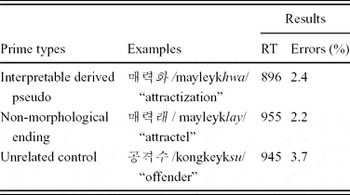
Three conditions were included, an interpretable derived pseudoword condition, a non-morphological ending pseudoword condition and unrelated condition. An example of stimuli list is shown in Table 3. The non-morphological endings were selected from a Korean word database provided by the Korean Word Database (2001) with frequency information, and each of these orthographic endings was combined with a real stem. Three Korean native speakers rated whether the combined forms seemed to be neither a real word nor an interpretable pseudoword. If one of the raters did not agree, a new combination was created by adding another ending until all raters agreed that the combination did not look like an interpretable pseudoword. The purpose of this agreement process was to ensure that non-morphological ending pseudowords selected were not interpretable pseudowords. It is possible that certain combinations of a stem and non-morphological endings can be considered as interpretable words. For example, 매력록 /mayleyklok/ can be interpreted in Korean as a list of attractive objects.
Examples and mean response times (ms) and error rates by priming condition in Experiment 2.

Procedure
The procedure was the same as that in Experiment 1.
Results and discussion
All response times for target words that were more than 2 SDs from the mean of each participant were excluded from data analyses (5%). Incorrect responses were removed for the RT analysis (3.3%). Again, the accuracy of the filler items in this experiment was as high as 93% ensuring that the bilingual participants were able to identify English words competently. As in Experiment 1, results from a 3 (prime type: interpretable derived pseudo-prime, non-morphological ending prime, and unrelated prime) × 3 (stimuli list version: list 1, 2, and 3) analyses of variance (ANOVAs) for both subject and item analyses were performed.
Results of RTs and error rates are summarized in Table 3. A main effect of prime types in RT was significant for both the subject analysis F 1(2,30) = 4.96, p = .014, and for the item analysis F 2(2,54) = 4.99, p = .01. RTs obtained in interpretable derived pseudowords showed a significant 49ms facilitation effect compared to the unrelated word condition on the subject analysis, F 1(1,15) = 5.09, p = .039, and on the item analysis, F 2(1,27) = 5.06, p = .033. Also, the 59 ms facilitation effect of the derived pseudowords compared to the non-morphological ending pseudoword condition was also significant for the subject analysis F 1(1,15) = 6.76, p = .02 and for the item analysis, F 2(1,27) = 10.07, p = .004, respectively. In addition, planned comparisons showed that priming effect from the non-morphological ending pseudowords compared to the unrelated words was not significant for both analyses (F 1 and F 2 < 1). Therefore, only Korean interpretable derived pseudowords facilitated the latencies of their English-translated stems, compared to non-morphological words and unrelated words. Error rates were very low (all below 4%). Error data analyses showed no significant differences across priming conditions (F 1 and F 2 < 1). Note that the error rate in the non-morphological ending condition was similar to that in the interpretable derived pseudoword condition (2.2% vs. 2.4%), despite the faster RT for the derived pseudoword condition (896 ms vs. 955 ms). One possible interpretation for this trend is that the decomposability of the primes affected the RT only, and not the accuracy. Non-morphological ending primes did not have an effect on judgment accuracy. The slightly lower error rate in the non-morphological ending condition compared to the unrelated condition (2.2% vs. 3.7%) could be due to the fact that the unrelated primes might lead to some interference in accurate judgment of the targets, whereas the non-morphological ending primes did not lead to the interference because of the lack of its lexicality.
These results are consistent with previous monolingual studies (Caramazza, Laudanna & Romani, Reference Caramazza, Laudanna and Romani1988; Longtin & Meunier, Reference Longtin and Meunier2005), which did not show any significant priming effect for the non-morphological ending pseudowords. Our findings support the hypothesis that Korean L1 readers are sensitive to morphological structure during processing morphologically complex words, but not to visual cues such as the spaces between syllables in Korean words. These results suggest that a morpheme is a critical unit in lexical access and that the decomposition process based on this morphological structure occurs in Korean L1 readers as well.
Experiment 3
The results from Experiments 1 and 2 demonstrated significant priming effects of real derived words and interpretable derived pseudowords. In particular, the facilitation from interpretable derived pseudoword primes to targets provided strong evidence for the decomposition of constituent morphemes, given that the whole-word based lexical representation of the interpretable derived pseudowords was not likely to be available. We suggest that Korean–English bilinguals are sensitive to morphological structures regardless of their lexicality. However, there is a possibility that the morphological priming effect of interpretable derived pseudowords was due to their interpretability. That is, if a derived pseudoword used as a prime in Korean is interpretable, then the activated meaning based on the interpretable whole-word form may affect the latency of accessing its stem as a target in English. In order to test this possibility, we included non-interpretable derived pseudowords (illegal combination of a real stem and a real suffix, e.g., attracticide in English) in this experiment.
Participants
Twenty-seven Korean–English bilingual speakers from the same bilingual participant pool as in Experiments 1 and 2, participated in this experiment. The Language Experience and Proficiency Questionnaire (Marian et al., Reference Marian, Blumenfeld and Kaushanskaya2007) showed that the participants had similar language backgrounds and experiences of their two languages as those in Experiments 1 and 2 (see Table 1). The mean age of participants was 30.5 (SD = 2.6). They did not participate in the previous experiments.
Stimuli
Three conditions were included, an interpretable derived pseudoword condition, a non-interpretable derived pseudoword condition and an unrelated condition. An example of the stimuli lists is shown in Table 4. In order to construct a list of non-interpretable derived pseudowords, the same interpretability rating task as in Experiment 1 was administered. Ten Korean–English bilingual speakers who had spent from one to six years in the U.S were recruited and asked to respond whether or not the word presented seemed interpretable in Korean on a 1–7 rating scale (1 = not interpretable at all; 7 = very likely interpretable). Average interpretability was 1.92 (Range = 1.3–2.9, SD = 0.41). The interpretable items were the same as in Experiments 1 and 2. Examples are listed in Table 4.
Examples and mean response times (ms) and error rates by priming condition in Experiment 3.

Procedure
The procedure was the same as that in Experiments 1 and 2.
Results and discussion
All response times for target words that were more than 2 SDs from the mean of each participant were excluded from data analyses (4.5%). Incorrect responses were removed for the RT analysis (3%). Two items were excluded from the analysis due to the high error rate (33% and 38%, respectively). Again, the accuracy of the filler items in this experiment was averaged 92% across participants, ensuring that the bilingual participants were able to identify English words competently. Results from a 3 (prime type: interpretable derived pseudo-prime, non-interpretable pseudo-prime, and unrelated prime) × 3 (stimuli list version: list 1, 2, and 3) analysis of variance (ANOVAs) for both subject and item analyses are reported.
Results of RTs and error rates are summarized in Table 4. A main effect of prime types in RT was significant for both the subject analysis F 1(2,48) = 9.910, p = .001, and for the item analysis F 2(2,50) = 6.077, p = .006. RTs obtained in interpretable derived pseudowords showed a significant 35 ms facilitation effect compared to the unrelated word condition on the subject analysis, F 1(1,26) = 3.755, p = .001, and on the item analysis, F 2(1,27) = 2.99, p = .006. The 29 ms facilitation effect of the non-interpretable derived pseudowords compared to the unrelated condition was also significant for the subject analysis F 1(1,26) = 3.097, p = .005, and the item analysis, F 2(1,27) = 2.47, p = .020, respectively. The interpretable and non-interpretable conditions were not statistically significant from each other. Error rates were again very low (all below 4%). Error data analyses showed no difference across priming conditions (F 1 and F 2 < 1). Note that the error rate in the non-interpretable condition was higher than that in the interpretable condition (3.2% vs. 2.4%). It seems that the interpretability of the primes affected the judgment accuracy. When the primes were not interpretable, the error rate tended to be slightly higher.
These results are consistent with the previous study by Longtin and Meunier (Reference Longtin and Meunier2005), which showed a significant priming effect for non-interpretable derived pseudowords in monolingual French speakers. Our finding suggests that Korean–English bilingual readers are sensitive to the morphological structure in L1 primes in processing morphologically complex words, regardless of semantic interpretability. The RT results show that the cross-language priming effect observed with the non-interpretable derived pseudowords is significant, although it is smaller than the effect obtained with interpretable derived pseudowords.
General discussion
The present study addressed a much less studied question regarding how morphologically complex words are processed by bilingual readers. The results of Experiments 1, 2 and 3 demonstrate that cross-language activation occurs when Korean L1 derived words serve as primes and English L2 translated stems serve as targets. This result is consistent with previous bilingual studies using morphologically less complex word (e.g., Basnight-Brown & Altarriba, Reference Basnight-Brown and Altarriba2007; Jiang & Forster, Reference Jiang and Forster2001; Jin, Reference Jin1990). This result supports the existing bilingual lexicon models such as the RHM, which postulate that there is a connection between the lexical representations in the two languages. The present study offers the novel contribution of demonstrating that bilingual readers are able to decompose morphologically complex words used as L1 primes and utilize the constituent morphemes to facilitate lexical judgment of the translated stem words in L2. This two-step process has not been documented in the previous literature.
The fact that there was a significant priming effect of interpretable and non-interpretable derived pseudowords on target stem words suggests that decomposition and cross-language activation of derived words in L1 are independent of their lexicality and interpretability. Furthermore, the fact that the non-morphological ending pseudowords did not prime the target words suggests that it is the morphological structure that determines decomposability, consistent with the findings in monolingual studies (e.g., Longtin et al., Reference Longtin, Segui and Hallé2003; Longtin & Meunier, Reference Longtin and Meunier2005; Rastle et al., Reference Rastle, Davis and New2004). In relation to monolingual studies, the present study offers the novel contribution of using two different scripts (Korean vs. English) as the primes and targets, hence the physical overlap between the primes and targets was maximally reduced.
The findings in our study can also be interpreted using the morphological processing model (e.g., Taft & Nguyen-Hoan, Reference Taft and Nguyen-Hoan2010) and the Distributed Lexical/Conceptual Feature Model (e.g., Kroll & De Groot, Reference Kroll, De Groot, De Groot and Kroll1997) that incorporate lemma level representations. As shown in Figures 1a and 1b, the derived L1 primes underwent decomposition at the lemma level, where both the constituent morphemes and the whole derived word are stored. In the case of real derived primes, the decomposed stem and the whole word could produce a combined priming effect on the translated L2 stem word. In the case of interpretable and non-interpretable derived pseudowords, only the decomposed stem facilitated the translated L2 stem judgment. Non-morphological ending words did not move any further up from the visual form level, therefore, no priming effect occurred.
In terms of comparability of participants in bilingual mental lexicon research, previous studies have mostly focused on Indo-European language combinations such as Spanish and English (Basnight-Brown & Altarriba, Reference Basnight-Brown and Altarriba2007; Kiran & Lebel, Reference Kiran and Lebel2007) and Dutch and English (De Groot & Nas, Reference De Groot and Nas1991). As a result, the languages in these studies tended to have similar scripts. There were a few studies focused on cross-language interaction among bilinguals who used different scripts (e.g., Basnight-Brown, Chen, Shu, Kostiç & Feldman, Reference Basnight-Brown, Chen, Shu, Kostiç and Feldman2007; Hoshino & Kroll, Reference Hoshino and Kroll2008; Silva & Clahsen, Reference Silva and Clahsen2008). For example, Basnight-Brown et al. (Reference Basnight-Brown, Chen, Shu, Kostiç and Feldman2007) studied the processing of regular and irregular English L2 verbs among Serbian–English and Chinese–English bilinguals using a cross-modal priming paradigm. Their study examined the differential influence of L1 on L2 inflectional morphology processing, with a focus on L2 processing only. Cross-language activation was not addressed. Research on morphological processing in Korean–English bilinguals sheds light on linguistically universal properties across different scripts. Korean has a non-Roman alphabetic orthography. There are barely cognates in Korean and English (except for loan words) and there is no orthographical overlap between Korean and English. The current study of Korean–English bilinguals’ processing of derived words (L1 primes L2) is thus able to examine how two languages are connected to each other while avoiding potential confounding relationships that often exist between two languages from the same language family, such as phonological or orthographic cues.
Methodologically, the present experiments used an unmasked priming paradigmFootnote 1 with a 150 ms SOA (stimulus onset asynchrony). According to the review by Kiran and Lebel (Reference Kiran and Lebel2007), the range of SOAs used in the previous translation priming experiments with bilingual populations was varied (13–1000 ms). SOA broadens to between 50 ms and 4500 ms in semantic priming experiments (for details, see Kiran & Lebel, Reference Kiran and Lebel2007). SOAs with lengths of less than 300 ms were considered reasonable for blocking any strategic processing, and a 100 ms prime duration was regarded as sufficient for masked priming in bilingual populations (Basnight-Brown & Altarriba, Reference Basnight-Brown and Altarriba2007). However, 300 ms is considered unacceptable in some research, based on the argument that strategic priming can still operate at such SOAs (e.g., Jiang & Forster, Reference Jiang and Forster2001). In addition, at a long prime duration (e.g., 150 ms), participants who would be operating in bilingual mode (Grosjean, Reference Grosjean and Nicol2001) may be able to identify whether the primes and the targets originate from the same language or different languages.
Hutchison, Neely and Johnson (Reference Hutchison, Neely and Johnson2001) reported that strategic processing during an unmasked priming task was not feasible when the SOA was decreased from 300 ms (i.e., a 150 ms prime duration and an 150 ms inter-stimulus interval (ISI)) to 167 ms (i.e., an 150 ms prime duration and a 17 ms ISI). They suggested that SOAs of this length or shorter may be needed if one is to measure pure automatic processing. In this case, the proportion of related prime–target pairs should also be maintained at 0.25 to block strategic processing. We used this recommended ratio in our experiments. Furthermore, in the case of priming task with a bilingual population, Dong, Gui and MacWhinney (Reference Dong, Gui and McWhinney2005) used 200 ms as SOA, and they suggested that up to 200 ms could be an adequate duration for blocking any strategies in a priming experiment with bilinguals. However, it would be informative to further manipulate the SOAs in future research. For instance, with the same SOA (150 ms), prime duration can be adjusted to shorter than 150 ms or to very short durations such as 36 ms to form masked priming. Shorter SOAs or shorter prime durations in combination with longer durations would allow us to examine the time course of decomposition and to ensure that any morphological priming that might be observed is automatic (i.e., obligatory).
Another important question for future research is to investigate whether cross-language activation extends to the semantic/conceptual level. A semantic priming paradigm could be employed in which the target translated L2 stem is replaced by a semantically related word (e.g., the target word attract is replaced by pretty). Caution needs to be given to several factors in selecting the prime–target pairs. First, the degree of the semantic relatedness between the primes and targets could affect the priming effect. Higher semantic relatedness could produce a greater priming effect in comparison to relatively lower one. Second, the congruency of the grammatical class in the prime–target pairs could also play a role. Derivation frequently induces change of the grammatical class (e.g., hunt–hunter). Sunderman & Kroll (Reference Sunderman and Kroll2006) found that there was no semantic interference when the L1 and L2 words were from different grammatical classes in their translation recognition task in which subjects judged whether or not two words were translations of each other in the two languages. This finding implies that there might be different magnitude of semantic priming depending on whether primes and targets are within the same grammatical class. Third, De Groot (Reference De Groot, Frost and Katz1992) and Kroll and De Groot (Reference Kroll, De Groot, De Groot and Kroll1997) proposed the Distributed Lexical/Conceptual Feature Model to explain how words in each of bilingual's two languages activate corresponding sets of conceptual features. The shared subsets of conceptual features in two words are determined by word types (e.g., cognate words vs. non-cognate words or concrete words vs. abstract words). Their research (e.g., De Groot & Nas, Reference De Groot and Nas1991) and others (e.g., Jin, Reference Jin1990) demonstrated the difference in semantic priming effect between cognates and non-cognates and between concrete words and abstract words. Cognates and concrete words had stronger associative priming effect compared to non-cognates and abstract words.
In summary, our experiments provide novel evidence in supporting cross-language activation and morphological decomposition in the bilingual lexicon. L1 derived words as primes facilitate lexical decision on L2 translated stems as targets. This cross-language activation and morphological decomposition is dependent upon the decomposability of the L1 primes, not on their lexicality and interpretability. Further research is needed to examine the potential cross-language activation and morphological decomposition at the semantic/conceptual level.
Appendix. Stimuli of experiments
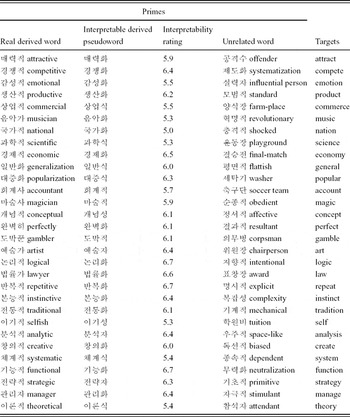
Stimuli of Experiment 1.

Note. Interpretability was based on 1–7 rating scale (1 = not interpretable at all; 7 = very likely interpretable).
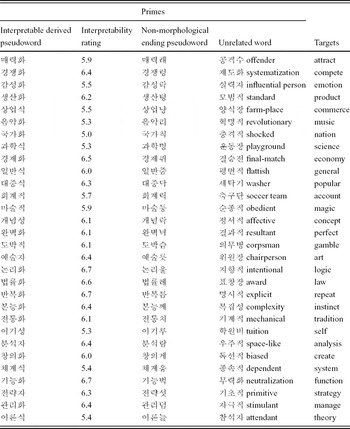
Stimuli of Experiment 2.

Note. Interpretability was based on 1–7 rating scale (1 = not interpretable at all; 7 = very likely interpretable).
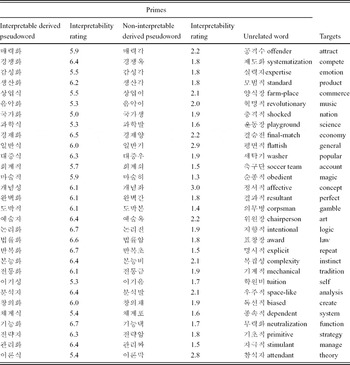
Stimuli of Experiment 3.

Note. Interpretability was based on 1–7 rating scale (1 = not interpretable at all; 7 = very likely interpretable).