It has been recognized for many years that pregnancy and calving are pre-requisites to bovine lactation. The shape of the lactation curve (a rapid rise to a peak followed by a gradual decline) has hitherto meant that milk production is optimized by re-breeding to achieve a 12-month calving pattern (Holmann et al. Reference Holmann, Shumway, Blake, Schwart and Sudweeks1984). Milk yields have increased considerably over several decades through genetic selection and improved nutrition, to the point where the highest yielding Holstein herds in the USA have an average annual production of more than 14 000 kg/cow (Kellogg et al. Reference Kellogg, Johnson and Pennington2001), several-fold greater than those cows for which the 12-month strategy was originally devised. Food intake has risen to a lesser extent (Veerkamp et al. Reference Veerkamp, Simm and Oldham1995), so the need to mobilize body reserves has increased. Partly as a consequence, fertility has declined (Royal et al. Reference Royal, Mann and Flint2000) and health has tended to deteriorate (Pryce et al. Reference Pryce, Veerkamp, Thompson, Hill and Simm1997). The notion that high-yielding dairy cows are metabolically stressed (Nielsen, Reference Nielsen1999) has prompted a desire to explore alternative strategies that could combine economic viability with improved animal welfare. One such strategy is extended lactation, whereby re-breeding is delayed and management emphasis is given to maximizing lactation persistency (inverse of the rate of decline in yield with time) rather than peak yield. The welfare rationale is evident when one considers lifetime health. Some 65% of health incidents occur in the first 45 d of lactation (Erb et al. Reference Erb, Smith, Hillman, Powers, Smith, White and Pearson1984), hence, the fewer times that a cow calves the less she is exposed to risk. At its simplest, if the three 12-month lactation cycles typical of the lifetime of intensively managed dairy cattle could be replaced by two extended lactation cycles of 18-months duration, exposure to risk would be reduced by one-third. It seems inevitable that extended lactation would benefit welfare, although this has not yet been rigorously tested.
The economic argument for extended lactation is more debatable. Recent evidence suggests that high-yielding cows perform better in 14-month lactation cycles than in 12-month cycles, but exhibit abnormally long dry periods if managed for 18-month lactation cycles (Ratnayake et al. Reference Ratnayake, Berglund, Bertilsson, Forsberg and Gustafsson1998). In neither of these studies was any attempt made to alter lactation persistency, so the reason for the long dry periods was that yield had declined to an economically non-viable level. Similarly, modelling analysis of ‘extended lactations’ done retrospectively from national databases (Vargas et al. Reference Vargas, Koops, Herrero and Van Arendonk2000; Grossman & Koops, Reference Grossman and Koops2003) invariably uses data from cows that have failed to re-breed, not cows that have been deliberately managed for extended lactation. There can be little doubt that if lactation persistency could be improved, extended lactations would become profitable. Using the same comparison of three 12-month v. two 18-month lactations referred to previously, it is inevitable that, at some degree of improved persistency, the extended lactation scenario will perform better because it requires only one dry period rather than two.
Whilst it is evident from simple comparison of heifer and cow lactations that persistency is variable, very little systematic effort has been made to manipulate it (McFadden, Reference McFadden, Welch, Burns, Davis, Popay and Prosser1997). We have begun to address this deficiency, by examining the effects of altered nutrition, calving season and milking frequency on lactation persistency in cows managed for 18-month lactation cycles. Since late lactation milk is sometimes associated with poor milk quality (Lucey, Reference Lucey1996) we also determined casein number as a measure of processing quality.
Materials and Methods
Cows
The experiment was conducted at the former Hannah Research Institute. A total of 25 Holstein:Friesian cows were used in a factorial design to study the effects of milking frequency, calving season and nutrition on lactation characteristics during a total of 36, 18-month extended lactation cycles. Experimental cows were selected from cows calving between 24 March and 23 May 1996 (for the Spring group) or between 14 October and 10 December 1996 (for the Winter group). Parity ranged from 1 to 5 at the outset. All cows were fed a grass silage-based total mixed ration containing 15% crude protein (CP) during winter months and grazed pasture during summer supplemented with sugar-beet pulp during times of poor grass quality. In addition, in-parlour concentrate containing 18% CP was fed according to milk yield or experimental design. Re-breeding was allowed after week 32 post partum. Cows were inseminated when seen in oestrus. Cows were dried-off 8 weeks before expected parturition or when milk yield dropped below 3·5 kg/d for the lowest-yielding udder half, whichever was the earlier.
Experimental design
Initially there were two calving groups, Spring (n=12, mean parity 2·4), and Winter (n=12, mean parity 2·4). Eleven of the Spring group were then studied during their consecutive extended lactation (Second), calving between September 1997 and January 1998 (i.e they were now winter-calving), a twelfth previously unstudied cow being added to maintain the size of this group. Commencing in lactation week 9 (9·5±0·64), half of each calving group were fed an additional 3 kg/d of 18% CP in-parlour concentrate (High) whilst the remainder continued to be fed according to milk yield following standard practice for the herd (Low). Cows were blocked onto treatment as they reached lactation week 9. Allocation to High or Low took into account parity, body weight, body condition score and milk yield. Starting at the same time, half of the udder (diagonally opposed quarters) was milked thrice daily (3X) at intervals of 8 h whilst the other half continued on twice-daily milking (2X: 8:16-h intervals). This milking treatment was applied to every cow and continued for the remainder of the lactation. The experimental design thus comprised three calving groups (Spring, Winter, Second n=12), two levels of nutrition (High, Low, n=18) and two milking frequencies (3X, 2X, n=36).
Measurements
Milking was performed in a parlour equipped to collect milk separately from half-udders (diagonally opposed quarters) and to weigh the milk electronically at every milking to a precision of 100 g. Half-udder milk samples were collected at monthly intervals from the Spring cows during both of their extended lactations, i.e. Spring and Second groups, each sample being a proportionally bulked composite sample from all milkings in one day. Milk samples from all cows were analysed for fat and lactose using infra-red technology (MilkoScan, Foss, DK 3400 Hillerød, Denmark) and for somatic cell count (SCC) using flow cytometry (FossoMatic) by Livestock Services (UK) Ltd, Paisley PA3 1TJ. In the first lactation additional analysis of total protein and detailed analyses of casein protein were performed on samples bulked according to treatment according to methods described in Brown et al. (Reference Brown, Law and Knight1995). In the second lactation all protein analyses were done on samples from individual cows. In the earlier parts of the experiment cows were weighed weekly; in the latter parts weighing was performed through an automated weigh-bridge after each milking. Body condition score was measured weekly using a five-point scale where 1 is extremely thin and 5 extremely fat.
Statistical analysis
Statistical analysis was performed using analysis of variance in Genstat 5 Release 4.1, Lawes Agricultural Trust, Rothamsted, UK or Minitab Release11, Minitab Inc, State College, PA16801 USA. Factors included in the model were cow, calving group, nutritional treatment and, for milk yield and composition data only, milking frequency. Lactation persistency was defined as the slope of the decline in milk yield from week 9 of lactation onwards, and calculated using best-fit linear regression of weekly averaged milk yields. Other curve-fits were examined but, with the possible exception of a ninth-grade polynomial, did not produce better fits to the data. Slopes obtained were analysed with peak milk yield included as a co-variate. Effects of milking frequency were analysed within-cow, other factors were analysed between-cow. Effects of pregnancy on lactation persistency were analysed by residual maximum likelihood (REML) owing to an unbalanced design.
Results
Lactation characteristics and milk yield
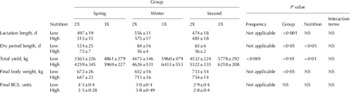
Half-udder whole-lactation milk yield was significantly increased by milking more frequently (by 33% overall, Table 1) and by nutritional supplementation (by 11%) and differed between calving groups. Yield was greater in winter calving cows than in spring calving (by 15%) and in the second extended lactation of cows that first calved in the spring and then in the winter (by 17%). Cows were dried off in both udder-halves at the same time, hence milking frequency is not a factor in analysis of lactation length or dry period length. Lactation length was not affected by nutrition, but differed between calving groups (Table 1). Second extended lactations were shorter than others, not because of lower yield but because of a shorter calving interval as a result of an improved first-service to conception interval. Dry periods were shorter in Second and were also shorter in High compared with Low, because fewer cows were dried off early as a result of low yield. Body weight and body condition score are cow characteristics and thus independent of the milking frequency treatment, and cows were allocated to nutritional treatments taking into account pretreatment body weight and condition score so there were no differences at the start of treatment. Body weight and condition score both increased during the course of lactation. Final body weight (i.e. at the end of lactation) was higher in Second than in Spring or Winter, but nutrition had no effect on either final body weight or final body condition score (Table 1).
Lactation length, days dry, final body weight and condition score and total lactation milk yield in cows calving in different seasons, fed conventionally (Low) or supplemented (High) and milked by half-udder either twice (2X) or thrice (3X) daily. Milk yields are half-udder. Values are means±se., n=12 per group

Annualized milk production was calculated for the eleven cows that completed two consecutive extended lactations (Spring then Second). The time taken to produce the milk was taken to be the length of the two lactations plus one dry period (data in Table 1). On a whole-cow basis (ie 2X+3X udder halves) annual milk production for the Low and High input groups was 6531±243 and 7501±216 kg, respectively. On the basis of production data for the 3X udder half, the most that might have been produced (had both halves of the udder been milked thrice daily and achieved the same level of output) was 7453±327 and 8463±227 kg/year for Low and High, respectively.
Lactation persistency
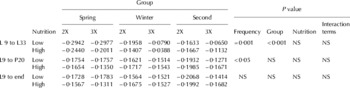
Persistency was significantly and negatively correlated with peak milk yield (r 2=0·49, P<0·001) but was not significantly correlated with any measure of body weight or body composition score. When persistency slopes were recalculated by week of recurring pregnancy rather than by week of lactation, it was evident that persistency was reduced significantly in the last third of pregnancy (slopes of −0·1649, −0·1408, −0·1038 and −0·3215 for the 10 weeks before conception and the first, second and third 10-week blocks of pregnancy, respectively, sed 0·043, P<0·001, analysis of variance). Accordingly, subsequent analyses included peak yield as a covariate and were run separately for the periods up to week 33 of lactation (when re-breeding commenced) and up to week 20 of recurring pregnancy (i.e. excluding the last 10 weeks) as well as for the whole of the lactation (Table 2). Within lactation groups there were highly significant correlations between the various measures of persistency, and between 2X and 3X udder-halves. Persistency in the first extended lactation of Spring cows was only a modest predictor of persistency in their subsequent lactation (Second). Correlation coefficients of −0·11 (NS), 0·42 (P<0·05) and 0·54 (P=0·01) were obtained for persistency slopes running from weeks 9 to lactation 33, pregnancy 20 and end of lactation, respectively.
Lactation persistency slopes in cows calving in different seasons, fed conventionally (Low) or supplemented (High) and milked by half-udder either twice (2X) or thrice (3X) daily. Slopes are calculated by best-fit linear regression analysis of weekly yields between week 9 of lactation (L9) and either week 33 of lactation (L33), week 20 of concurrent pregnancy (P20) or the end of lactation. A less negative value indicates greater persistency. All values are adjusted for peak yield as covariate. Values are means, n=12 per group. All individual se 0·01 or less

Up until week 33 of lactation, persistency was significantly improved by milking more frequently and Winter cows were more persistent than either Second or Spring (Table 2). Supplementary feeding also tended to improve persistency, although this effect was not significant (Table 2). When analysis was extended to week 20 of pregnancy the only significant effect was a positive one of frequent milking (Table 2) and analysis through to the end of lactation failed to detect any significant differences due to treatments. Slopes for weeks 9–20 were extrapolated to a half-udder yield of 5 kg/d to calculate the theoretical effect of improved persistency on lactation length in the absence of recurring pregnancy. Frequent milking increased theoretical lactation length from 68±3 to 102±8 weeks (P<0·001), whilst other treatments had no significant effect.
Milk composition
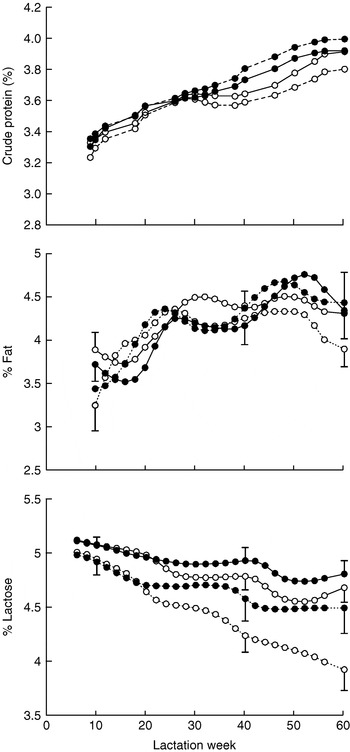
Milk compositional analysis was restricted to the Spring and Second groups, i.e. the first and second consecutive extended lactations of the same cows. Results are shown in Fig. 1. For all major components, changes occurring across the course of lactation were of greater magnitude than differences due to treatment effects. Protein (crude protein and casein protein) and fat contents increased as lactation advanced whilst lactose decreased (Fig. 1). Nutritional supplementation slightly but significantly increased the contents of casein protein, fat and lactose and frequent milking increased fat and lactose but not protein. There were few differences between the first and second lactations apart from increased lactose content in the latter. The 2X udder halves of the Low nutrition group consistently showed the greatest decrease in lactose content in later lactation (Fig. 1) and the smallest increase in casein protein content (results not shown).
Milk composition of Spring cows managed for extended lactation cycles of 18-months duration, fed conventionally (open symbols) or supplemented with additional concentrate (closed symbols) and milked (on a half-udder basis) twice daily (dashed lines) or thrice daily (continuous lines). For clarity, values are presented as smoothed means (smooth function in Minitab Release 11) with representative se shown for fat and lactose. Protein was measured in pooled samples. Analysis was performed on unsmoothed means.

Milk quality
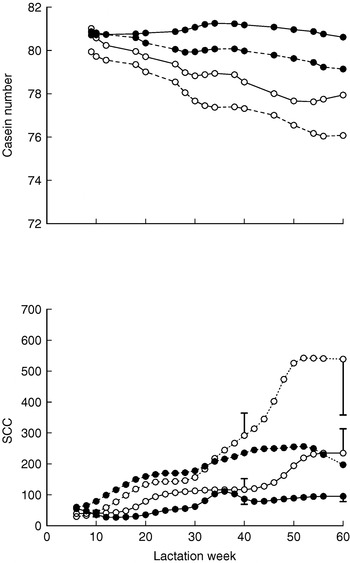
The processing quality of the milk was assessed by calculating casein number, which is casein protein as a percentage of total protein. The hygienic quality of the milk was assessed by measuring SCC, which is commonly used as an indicator of the health status of the mammary gland. Results are in Fig. 2. Both quality indicators tended to worsen across the course of lactation: casein number fell and SCC increased. These changes were most evident in the unsupplemented cows and 2X udder halves, so were especially evident in Low 2X (Fig. 2). The beneficial effects of frequent milking and nutritional supplementation were both highly significant (P<0·001). There were also significant differences between the two lactations, with better milk quality being recorded in the first lactation. Used as a measure of mastitis, SCC in excess of 200 000 is regarded as being indicative of a disease condition. At no time during either lactation did SCC exceed 200 000 in the 3X udder-halves of supplemented cows (Fig. 2).
Milk quality attributes of Spring cows managed for extended lactation cycles of 18-months duration, fed conventionally (open symbols) or supplemented with additional concentrate (closed symbols) and milked (on a half-udder basis) twice daily (dashed lines) or thrice daily (continuous lines). Casein number (top panel) is casein expressed as a percentage of total protein and is a measure of processing quality. SCC is somatic cell count and is conventionally used as a measure of health status (but see text). For clarity, values are presented as smoothed means (smooth function in Minitab Release 11) with representative se for SCC. Analysis was performed on unsmoothed means.

Discussion
Extended lactation has the potential to become a welfare-friendly alternative to intensive lactation cycles (Knight, Reference Knight1984), but for it to achieve economic viability lactation persistency (the slope of decline in milk yield after peak lactation) must be amenable to improvement (Knight & Mainland, Reference Knight and Mainland1995). It is evident from the results presented here that bovine lactation persistency is indeed plastic and can be improved by simple management procedures. In particular, persistency was increased by milking thrice daily rather than twice daily. Persistency varied between cows in a way that we could not predict from weight or body condition score measured in early lactation, but the effect of milking frequency was seen in all cows. The overall effect would be to increase calculated annual yield from a herd average of around 6000 kg to almost 8500 kg per cow, a considerably greater increase than the 10–15% usually associated with thrice-daily milking. Whilst there have been numerous studies of lactation persistency modelled retrospectively from commercial yield records where the reason for the lactation being long is unknown, to our knowledge this is the first report of a prospective study specifically designed to manipulate persistency under UK conditions. Van Amburgh et al. (Reference Van Amburgh, Galton, Bauman and Everett1997) have reported on extended lactations using rbST in commercial dairy herds in the USA, and showed that persistency was markedly increased in heifers that were not re-bred. Milking frequency was not reported. Planned calving intervals of 12, 15 and 18 months have been compared experimentally in Swedish cattle, some of which were milked three times daily. Only a preliminary and incomplete report of milk yield responses has been published (Bertilsson et al. Reference Bertilsson, Berglund, Ratnayake, Svennersten-Sjaunja and Wiktorsson1997), but there was no evidence that persistency was altered by milking frequency. Analysis was apparently done on the whole of the lactation, i.e. including all of the concurrent pregnancy. Comparison of Moshave (family) herds and Kibbutz herds using data from the Israeli national database has also failed to identify differences in persistency, even though at the time of analysis Kibbutz usually milked thrice daily whilst Moshave milked twice daily (CH Knight and E Maltz, unpublished observations). However, the standard management practice in both categories of herd would have included 12-month calving intervals. In the present study persistency was greater in 3X until the last 10 weeks of the recurring pregnancy, at which time the negative effect of the pregnancy overcame the positive effect of frequent milking. Hence these data are not at variance with our own observations and the overall conclusion appears clear: persistency is responsive to milking frequency, but the effects are negated by recurring pregnancy. The importance of milking frequency is reinforced by the observation that milking infrequently (once daily) decreases lactation persistency (Hickson et al. Reference Hickson, Lopez-Villalobos, Dalley, Clark and Holmes2006). The proposed mechanism underlying the effect of increased milking frequency involves the combined action of growth hormone (GH) and prolactin in stimulating the local secretion of IGF1, a mammary secretory cell-survival factor, whilst inhibiting local production of IGFBP5, which inhibits this activity (Flint & Knight, Reference Flint and Knight1997). The net effect is decreased apoptosis, thus increased persistency. The control of lactation persistency has been considered in more detail elsewhere (McFadden, Reference McFadden, Welch, Burns, Davis, Popay and Prosser1997; Knight, Reference Knight2000; Capuco et al. Reference Capuco, Ellis, Hale, Long, Erdman, Zhao and Paape2003).
Increased interest in persistency (15 papers listed by PubMed in 2006 compared with an average of 3 a year during the 1990s) reflects a realization that re-breeding at around 60 d post partum may no longer represent optimal management, on either welfare or economic grounds. In a recent theoretical modelling analysis, a 30% improvement in persistency resulted in economically optimal re-breeding times of greater than 450 d for heifers and around 200 d for second lactation cows (De Vries, Reference De Vries2006). For cows on standard nutrition in their second extended lactation we observed a 34% difference in persistency between 2X and 3X udder halves. The overall improvement attributable to 3X milking was around half this figure and we cannot exclude that 3X milking of one udder half caused a decrease in the other half rather than an increase in itself, nevertheless the basic observation of a significant difference in persistency as a result of a management intervention remains valid and our results provide quantitative support for the assumptions made in the model.
The proposed benefits of extended lactation cycles include reduced disease incidence and fewer reproductive problems. Allore & Erb (Reference Allore and Erb2000) modelled the effect of extending the voluntary wait period (VWP) by 100 d, equivalent to 15-month extended lactation cycles, on the incidence of 10 diseases including mastitis, metabolic and reproductive diseases. All were reduced. The modelled effect of increasing the VWP by 100 d was to increase lactation length by 89 d, as a result of improved fertility later in lactation (Allore & Erb, Reference Allore and Erb2000). Whilst the negative effect of peak yield on fertility is well established, there is little documented evidence to support the expected improvement later in lactation. An improvement in conception to first insemination in cows inseminated at 120–150 d compared with 35–59 d was noted by Schindler et al. (Reference Schindler, Eger, Davidson, Ochowski, Schermerhorn and Foote1991) but the same study showed no difference in heifers and in the Swedish comparison of cows re-bred for 12, 15 or 18-month calving intervals reproductive success did not differ between groups (Ratnayake et al. Reference Ratnayake, Berglund, Bertilsson, Forsberg and Gustafsson1998). The present study was not designed to enable statistical analysis of health or reproductive parameters; the number of cows used was too small. We encountered very few health problems and re-breeding success was similar to the herd average, but more work is needed to properly quantify these variables.
For extended lactation to be profitable it is important that milk quality is not compromised. The increases in total protein and fat content that we observed across the course of the lactation are not unexpected (see Knight et al. Reference Knight, Sorensen and Muir2000 for review) and are likely to represent increased rather than decreased income for the farmer. However, the quality of the milk to the processor is related more to casein content than to protein content, and can be measured as casein number. Casein number typically declines during the course of normal lactations, especially in low-input systems where it can compromise the processing qualities of late-lactation milk (Lucey, Reference Lucey1996). We observed a significant decline that was ameliorated by increased nutrition and by increased frequency, such that 3X milked glands of high input cows maintained a constant or nearly constant casein number throughout. The decline is a consequence of influx of serum proteins and consequential proteolysis of secreted casein; the major proteolytic enzymes are serum-derived and arise in stored milk as a result of paracellular flux through ‘leaky’ tight junctions (Politis et al. Reference Politis, Lachance, Block and Turner1988), hence casein number is directly related to epithelial integrity. Integrity was measured in the Spring cows using the ratio of sodium to potassium (Sorensen et al. Reference Sorensen, Muir and Knight2001) and was shown to deteriorate significantly more in 2X than in 3X, hence the observed differences in casein number. From a commercial point of view this is good news; the same treatments that increased persistency also maintained milk processing quality. Interestingly, a ‘salty’ taste was observed in late lactation milk from extended-lactation cows in the Swedish study (Bertilsson et al. Reference Bertilsson, Berglund, Ratnayake, Svennersten-Sjaunja and Wiktorsson1997), suggesting that the treatments used had failed to maintain junctional integrity such that the ionic composition of the milk had moved towards the higher sodium, lower potassium content of plasma. The high casein number that we observed is extremely important, associated as it is with higher cheese yield, improved structure in fermented milks, improved stability of evaporated milk and, as a consequence of decreased plasmin activity, improved stability of UHT milk, cream and cream liqueurs.
SCC is often used as an index of udder health, and in the EU a maximum limit for saleable milk is set at 400 000 cells/ml. On this basis, milk from low input, 2X udder-halves would have failed from around week 50 of lactation onwards. It is important to recognize that mastitis only accounts for a quarter to a third of observed variation in SCC (Morris, Reference Morris1975) and, like proteolytic enzymes, the majority of somatic cells get into milk through tight junctions that have lost patency (Lin et al. Reference Lin, Xia, Turner and Zhao1995). The gradual increase that we observed in SCC across the course of lactation is related to declining epithelial integrity, not to disease. There were few clinical cases of mastitis and incidence did not increase in late lactation. Importantly, in the same way that frequent milking and increased nutrition prevented the deterioration in processing quality, they also prevented the rise in SCC.
In conclusion, the results provide support for the use of extended 18-month lactation cycles as an alternative to 12-month intensive lactation cycles, provided frequent milking can be practised. Economic and welfare benefits would be expected but have not yet been demonstrated in practice. More research is needed to quantify both aspects.
This research was funded by Department for Environment, Food and Rural Affairs. The Hannah Institute was in receipt of grant-in-aid from Scottish Executive Environment and Rural Affairs Department. We are grateful to John Munro and his staff for care of the animals. The skilled technical support of Stuart Robertson, Jean Thomson, Andrew Law, Eleanor Noble, Sandra Hodge and Julie Currie is gratefully acknowledged. Statistical advice in experimental design and analysis was provided by Tony Hunter and Ian Nevison of BIOSS, for which we are indebted. CHK is grateful to his late father, Brian Knight, for providing a number of the cows used in the work.