INTRODUCTION
The family Muricidae comprises more than 1150 species distributed worldwide (Vokes, Reference Vokes1996). However, despite this high number of known species (some of them with commercial interest), detailed knowledge on the muricids reproductive cycle is relatively scarce (Ramón & Amor, Reference Ramón and Amor2002). Some literature exists on diverse aspects of the reproduction of the banded murex, Hexaplex (Trunculariopsis) trunculus (Linnaeus, 1758), namely descriptions of the spawning behaviour and egg-laying pattern, egg-masses and egg-capsules, embryonic and early post-metamorphic development (Fischer & Raffy, Reference Fischer and Raffy1933; Dulzetto, Reference Dulzetto1946, Reference Dulzetto1950; Wondrak, Reference Wondrak1974; Bandel, Reference Bandel1975; Barash & Zenziper, Reference Barash and Zenziper1980; Vasconcelos et al., Reference Vasconcelos, Gaspar, Joaquim, Matias and Castro2004; Lahbib et al., Reference Lahbib, Trigui El-Menif, Le Pennec and Boumaiza2006). In comparison, the information available on the gonadal cycle and gametogenesis of T. trunculus is scarcer and restricted to Mediterranean populations of this species, disseminated in studies published by Schitz (Reference Schitz1920), Bolognari et al. (Reference Bolognari, Albanese-Carmignani, Zaccone and Calabrò1979, Reference Bolognari, Albanese-Carmignani, Calabrò and Zaccone1981), Albanese et al. (Reference Albanese, Calabrò and Acosta Pomar1983), Martoja & Bouquegneau (Reference Martoja and Bouquegneau1988), Tirado et al. (Reference Tirado, Rodríguez de la Rúa, Bruzón, López, Salas and Márquez2002) and Lahbib et al. (Reference Lahbib, Trigui El-Menif, Le Pennec and Boumaiza2004).
The banded murex is fished for human consumption both in the Mediterranean and in the Atlantic, namely in the Ria Formosa lagoon (Algarve coast, southern Portugal), where T. trunculus is the target species of a locally important fishery undertaken with an illegal and artisanal fishing gear known as ‘wallet-line’. In the eventuality of the legalization of this fishing activity in the near future, the availability of information on the T. trunculus reproductive cycle is fundamental for the proposal and implementation of management measures (namely seasonal closures of the fishery) that could ultimately contribute to the long-term sustainable exploitation of this fishing resource. In this context, the present study aimed to describe the gametogenic cycle of T. trunculus from the Ria Formosa lagoon, through macro- and microscopic analyses of the gonads.
MATERIALS AND METHODS
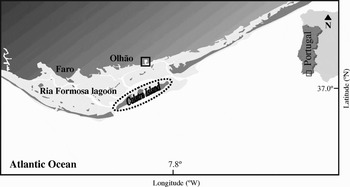
During a 1-year study period (March 2003–February 2004), approximately 100 specimens of Hexaplex (Trunculariopsis) trunculus from commercial samples caught in the vicinity of Culatra Island (Algarve coast, southern Portugal) (Figure 1) were sampled monthly. Seawater temperature was monitored daily at the Olhão Fish Culture Experimental Station, which receives water directly from the adjacent Ria Formosa lagoon and intimately resembles the surrounding natural environment in terms of seawater temperature.
Map of the Ria Formosa lagoon (Algarve coast, southern Portugal), showing Culatra Island (dotted ellipse) where Hexaplex (Trunculariopsis) trunculus was caught and the Olhão Fish Culture Experimental Station where seawater temperature was monitored (solid square).

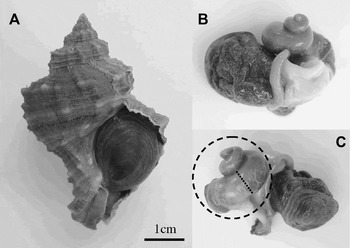
Initially, T. trunculus specimens (Figure 2A) were measured for shell length (SL, mm) with a digital calliper (precision of 0.01 mm) and weighed for total weight (TW, g) on a top-loading digital balance (precision of 0.01 g). Specimens' size (SL and TW) was compared between sexes using a Z-test with statistical significance considered at P < 0.05 (Zar, Reference Zar1996). Since T. trunculus lacks external sexual dimorphism, shells were broken in a bench vice to allow for the removal of the soft parts of the organism, exposition of the mantle cavity and observation of the sexual organs (Figure 2B). However, due to the occurrence of imposex in T. trunculus in the studied area (for details see Vasconcelos et al., Reference Vasconcelos, Gaspar and Castro2006), males were identified by the presence of a penis and lack of capsule gland, and females were identified by the presence of a vagina and capsule gland. The sex ratio (expressed as the number of males per female: F:M) was determined and statistically significant deviations from a balanced sexual proportion of 1/1 were assessed by the χ2-test, with statistical significance considered at P < 0.05 (Zar, Reference Zar1996).
(A) The banded murex, Hexaplex (Trunculariopsis) trunculus; (B) soft part of the organism, showing the mantle cavity for sexual identification of the specimen; and (C) location of the digestive gland and gonad complex (dotted circle), illustrating the transverse cut (dotted line) made for histological purposes on the medial zone of the visceral coil (behind the gastric caecum).

The gonad of T. trunculus lies on the dorsal side of the digestive gland to which it is intimately associated, constituting the visceral coil (digestive gland and gonad complex) (Figure 2C). Since the gonadal material of both sexes was normally distinguishable from the brownish coloration of the adjacent digestive gland, the external appearance and colour of the gonads were examined macroscopically to evaluate the degree of individual maturation, and whenever the gonads could not be distinguished from the digestive gland, individuals were considered as immature. Simultaneously, the macroscopic aspect of other organs of the female reproductive system, namely the sperm-ingesting gland (receptaculum seminis) and the capsule gland, was also observed to determine their significance for the assessment of sexual maturity and reproductive stage.
Because the gonad is intimately associated with the digestive gland, neither the testis nor the ovary could be dissected from the visceral mass to employ standard histological methods (20 individuals per month). To avoid excessive damage to the gonadal tissue, this assemblage of tissues (digestive gland and gonad complex) was fixed in Davidson solution for 24–48 h, preserved in 70% ethanol and only then a transverse cut (2–3 mm thick section) was made on the medial zone of the visceral coil, immediately behind the gastric caecum (Figure 2C). Samples were dehydrated in a graded ethanol series, infiltrated and embedded in paraffin wax. The gonads were cut into 7 µm thick sections, stained with Harris's haematoxylin–eosin, mounted between a glass slide and a cover slip with synthetic resin, and examined under an optical microscope connected to an imaging system.
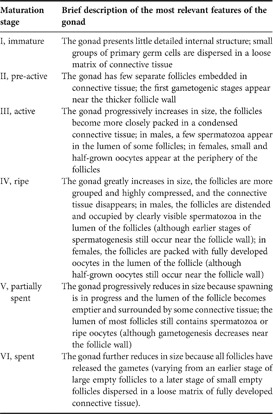
The identification of the different developmental stages of gametogenesis through the microscopic observation of histological sections of the gonads of both sexes was based on a maturation scale (briefly described in Table 1) adapted from the works by Albanese et al. (Reference Albanese, Calabrò and Acosta Pomar1983), Barroso & Moreira (Reference Barroso and Moreira1998) and Tirado et al. (Reference Tirado, Rodríguez de la Rúa, Bruzón, López, Salas and Márquez2002). Whenever multiple gametogenic stages were observed simultaneously within each gonad histological section, the individual was assigned to the prevalent maturation stage (the condition in the majority of the section).
Maturation scale used to assess the gametogenic development of the gonads of the banded murex, Hexaplex (Trunculariopsis) trunculus.

RESULTS
Sexual proportion
A total of 1183 specimens of Hexaplex (Trunculariopsis) trunculus (621 males and 562 females) were sampled between March 2003 and February 2004. Specimens presented a broad size-range, both in terms of shell length (40.17–82.84 mm) and total weight (5.28–48.84 g), and on average females were significantly larger and heavier (57.84 ± 6.30 mm and 18.11 ± 6.91 g, respectively) than males (55.64 ± 5.50 mm and 16.86 ± 5.69 g, respectively) (Z-test; P < 0.05).
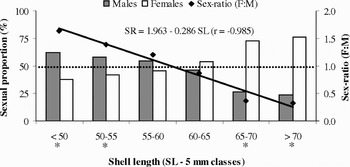
The overall sex ratio (F:M = 1:1.10) was not significantly divergent from parity (F:M = 1:1, χ2-test, P < 0.05). In order to detect variations in the sexual proportion as a function of specimen size, data were grouped into size-classes (5 mm SL) (Figure 3). Males dominated the smaller individuals (below 55 mm SL), both sexes were statistically balanced in intermediate size-classes (between 55 and 65 mm SL), while females predominated the larger size-classes (above 65 mm SL) (χ2-test, P < 0.05). The strong negative correlation (r = −0.985) obtained in the linear regression established between shell length size-classes (SL, 5 mm classes) and the respective sex ratios (F:M) further emphasizes the decreasing proportions of males per female with increasing size-classes (Figure 3).
Variation of sexual proportion (%) and sex ratio (F:M) according to specimen size (grouped in shell length size-classes, 5 mm SL). The dotted line illustrates unbiased sexual proportion (F:M= 1:1) and asterisks denote size-classes with unbalanced sex ratio (χ2-test, P< 0.05).

Macroscopic observation of the sexual organs
The dimensions of the gonads of both sexes varied according to the reproductive stage of T. trunculus, reaching a considerable size (frequently greater than the digestive gland) during the reproductive season and almost disappearing in the period of lowest reproductive activity. The testis and the ovary were easily distinguishable from the brownish digestive gland, except in very young (immature) and in older specimens in absolute gonadal regression (resting phase), both presenting vestigial or undifferentiated gonads with greyish or brownish coloration. The coloration of the ovary and testis were fairly variable depending on age and sexual maturation, with females presenting pale-creamy yellow, light yellow, orange or salmon gonads, and males presenting light yellow, dark yellow, mustard yellow or light brown gonads (the latter quite similar to the brownish digestive gland).
In females, behind the complex capsule gland/albumen gland, is located the inconspicuous sperm-ingesting gland, responsible for storing the sperm obtained during copulation. However, being frequently almost unnoticeable, the examination of its general aspect was not very useful as a descriptor of the specimen's reproductive stage. Nevertheless, the sperm-ingesting gland occasionally presented a visible whitish mass, indicative of copulation and subsequent storage of sperm.
Located in the pallial oviduct, the capsule gland presents a characteristic vase-shaped and bi-lobed structure, being circular in transverse section and broadest in the middle section. The capsule gland and the albumen gland form an almost continuous structure, being only distinguishable among each other due to a small difference in opacity. The dimensions, opacity and coloration of the capsule gland of T. trunculus varied considerably during maturation, growing in size, increasing its opacity and viscosity, and evolving from a whitish to a yellowish coloration before the spawning season.
Microscopic analysis of the gonads
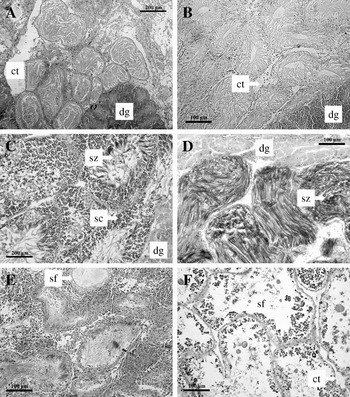
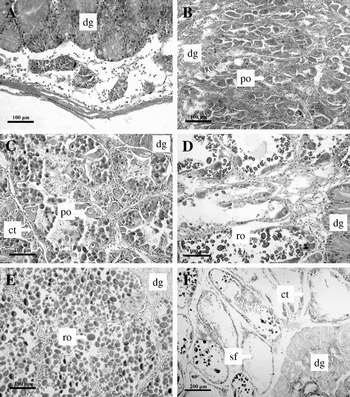
The most relevant features of gametogenesis observed in the histological sections of T. trunculus male and female gonads at each maturation stage are illustrated in Figures 4 and 5, respectively. The histology of the gonads revealed that all specimens analysed were gonochoristic (hermaphrodites or sex reversals were not detected) and with a normal development of the gametogenic cycle.
Photographs of histological sections showing the distinct stages of spermatogenesis in Hexaplex (Trunculariopsis) trunculus: (A) Stage I, immature; (B) Stage II, pre-active; (C) Stage III, active: (D) Stage IV, ripe; (E) Stage V, partially spent; and (F) Stage VI, spent. Abbreviations: ct, connective tissue; dg, digestive gland; sc, spermatocytes; sf, empty spent follicle; sz, spermatozoa.

Photographs of histological sections showing the distinct stages of oogenesis in Hexaplex (Trunculariopsis) trunculus: (A) Stage I, immature; (B) Stage II, pre-active; (C) Stage III, active; (D) Stage IV, ripe; (E) Stage V, partially spent; and (F) Stage VI, spent. Abbreviations: ct, connective tissue; dg, digestive gland; po, previtellogenic oocyte; ro, ripe oocyte; sf, empty spent follicle.

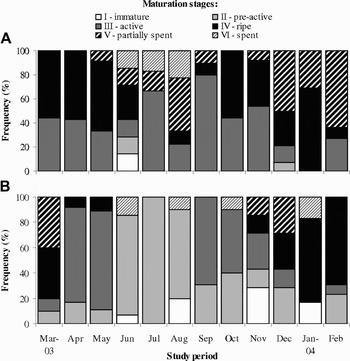
The monthly percentages of occurrence of T. trunculus males and females at each maturation stage are presented in Figure 6. The most evident feature of the gametogenic cycle of this species is the simultaneous occurrence of distinct developmental stages of gametogenesis in almost every month, reaching a maximum of six stages of spermatogenesis in June 2003 (Figure 6A) and five stages of oogenesis in November 2003 (Figure 6B). Males presented reproductive activity almost year-round, with active, ripe or partially spent gonads being found during all sampling periods. The highest frequencies of ripe male gonads were observed from March to June 2003 and from October 2003 to January 2004 (Figure 6A). Females presented a more intense reproductive activity in certain periods of the year, with active, ripe or partially spent gonads being found from March to May 2003 and from September 2003 to February 2004 (ripe gonads were only observed from March to May 2003 and from November 2003 to February 2004). A phase of lower reproductive effort was detected from June to August 2003, with the prevalence of immature, pre-active and spent gonads (Figure 6B).
Percentage occurrence of different developmental stages of gametogenesis in Hexaplex (Trunculariopsis) trunculus during the study period: (A) frequency of males at each spermatogenic stage; and (B) frequency of females at each oogenic stage.

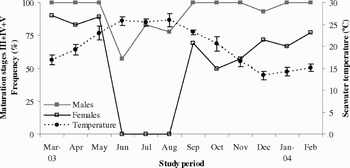
Due to the simultaneous occurrence of the most developed stages of gametogenesis (III, active + IV, ripe + V, partially spent) in each gonad during the greater part of the study period, the percentage occurrence of these maturation stages were grouped together in order to better discriminate the periods of highest reproductive activity of T. trunculus (Figure 7). During all the study period, males presented a higher frequency of active, ripe and partially spent gonads (attaining 100% from March to May 2003, from September to November 2003 and from January to February 2004). Females exhibited a lower frequency of active, ripe and partially spent gonads, with higher percentages found between March and May 2003 (80–90%), in September 2003 (≈70%) and from December 2003 to February 2004 (60–80%). Between June and August 2003 female gonads in the most developed stages of gametogenesis were not observed. During the study period, seawater temperature ranged from a minimum of 13.4 ± 1.0°C (December 2003) and a maximum of 26.0 ± 1.5°C (August 2003). The main periods of gametogenesis (between March and May 2003) and spawning (from May to June 2003) were roughly synchronous between sexes and were apparently triggered by the rising seawater temperature during spring. The resting phase also occurred simultaneously in both sexes and coincided with the period of highest seawater temperature during summer (between June and August 2003) (Figure 7).
Relationship between the percentage occurrence of the most developed stages of gametogenesis (III, active + IV, ripe + V, partially spent) in males and females of Hexaplex (Trunculariopsis) trunculus and seawater temperature in the Ria Formosa lagoon during the study period.

DISCUSSION
Sexual proportion
In the present study, a statistically balanced sex ratio was found in the overall samples, which is in agreement with a similar study made in a T. trunculus population from Spain by Tirado et al. (Reference Tirado, Rodríguez de la Rúa, Bruzón, López, Salas and Márquez2002). However, males dominated among smaller individuals, while females predominated the larger size-classes. On the contrary, another muricid species (Bolinus brandaris) from Spain (western Mediterranean) presented a female-biased population, but the size structure was similar in both sexes (Ramón & Amor, Reference Ramón and Amor2002). Generally, females are more common in older populations of gonochoristic molluscs (Fretter & Graham, Reference Fretter, Graham and Wilbur1964), and this increasing proportion of females with increasing specimen size is probably explained by differential growth between sexes, with females allocating higher energy expenditure towards growth than for reproduction. Moreover, in imposex-affected T. trunculus females, reduced reproductive effort leads to increased somatic growth, i.e. less energy is shifted towards reproduction than towards growth (Axiak et al., Reference Axiak, Vella, Micallef, Chircop and Mintoff1995; Rilov et al., Reference Rilov, Gasith, Evans and Benayahu2000).
Macroscopic observation of the sexual organs
Despite the coloration of the ovary and testis being frequently distinguishable from the brownish adjacent digestive gland, the assessment of sexual maturation based exclusively on the coloration of T. trunculus gonads could be subjective and/or inaccurate. Actually, with the exception of the dark yellow or mustard yellow gonads (mature males) and orange or salmon gonads (mature females), some yellowish and brownish gradations (the latter hardly distinguishable from the digestive gland) might make the evaluation of the maturation stage difficult. Moreover, besides the fact that young and immature individuals have incipient gonads, the reproductive cycle of T. trunculus comprises gonadal regression (resting phase with undifferentiated gonads) that makes unfeasible the assessment of sexual maturation by macroscopical observation, therefore requiring histological examination of the gonads (Martoja & Bouquegneau, Reference Martoja and Bouquegneau1988; Tirado et al., Reference Tirado, Rodríguez de la Rúa, Bruzón, López, Salas and Márquez2002). Furthermore, as stated by Martoja & Bouquegneau (Reference Martoja and Bouquegneau1988), in some individuals of both sexes occurs a ‘mixture’ of activity and neutral zones in the gonads, which present a ‘mosaic’ coloration. In contrast, the macroscopic examination of the gonads provided enough information about the reproductive cycle of B. brandaris from Spain (Ramón & Amor, Reference Ramón and Amor2002). Nevertheless, because the gonad dimensions in T. trunculus presented clear fluctuation throughout the reproductive cycle, they have a remarkable potential for usage as an index of female reproductive activity, specifically for monitoring the spawning season (authors unpublished data).
In females, the sperm-ingesting gland is the structure responsible for storing the sperm obtained from copulation during long periods (with the spermatozoids oriented and nourished by the female) (Fretter & Graham, Reference Fretter and Graham1994; Tirado et al., Reference Tirado, Rodríguez de la Rúa, Bruzón, López, Salas and Márquez2002). In fact, T. trunculus can store viable sperm for a considerable period of time (Spanier & Karmon, Reference Spanier, Karmon and Spanier1987), as confirmed by circumstantial evidence of females that spawned in the laboratory two months after being isolated from congeners (P. Vasconcelos, personal observation) to two years after being kept without companions (Wondrak, Reference Wondrak1974).
The capsule gland is responsible for the formation of the capsules that enclose the eggs and developing embryos. In T. trunculus, besides differentiation in coloration, opacity and viscosity, the capsule gland size varied markedly during the reproductive cycle, reaching a considerable dimension in the reproductive season and sharply decreasing immediately after spawning. For this reason, the capsule gland dimensions present a high potential for usage as an index of female reproductive activity, specifically for monitoring the spawning season (authors unpublished data).
Microscopic analysis of the gonads
One of the most evident features of the T. trunculus gametogenic cycle was the simultaneous occurrence of distinct developmental stages of gametogenesis in both sexes almost year-round. This coexistence of specimens in distinct gametogenic stages was also found in T. trunculus populations from Spain (Tirado et al., Reference Tirado, Rodríguez de la Rúa, Bruzón, López, Salas and Márquez2002) and from Tunisia (Lahbib et al., Reference Lahbib, Trigui El-Menif, Le Pennec and Boumaiza2004). Similarly, B. brandaris from Spain had variable proportions of all the gametogenic stages throughout the year, but their relative importance varied during the reproductive cycle (Ramón & Amor, Reference Ramón and Amor2002).
The gametogenic cycle of T. trunculus in the Ria Formosa lagoon comprised an extensive period of gonadal activity, with males presenting gonads with a higher frequency of more developed stages of gametogenesis than females during the whole study period. An extended period of gametogenic activity was also detected in T. trunculus populations from Spain (Tirado et al., Reference Tirado, Rodríguez de la Rúa, Bruzón, López, Salas and Márquez2002), France (Martoja & Bouquegneau, Reference Martoja and Bouquegneau1988), Italy (Albanese et al., Reference Albanese, Calabrò and Acosta Pomar1983) and Tunisia (Lahbib et al., Reference Lahbib, Trigui El-Menif, Le Pennec and Boumaiza2004), also with males generally presenting longer periods of gonadal activity and more developed gametogenic stages than females (Albanese et al., Reference Albanese, Calabrò and Acosta Pomar1983; Tirado et al., Reference Tirado, Rodríguez de la Rúa, Bruzón, López, Salas and Márquez2002).
In the present study, T. trunculus males and females undertook a roughly synchronous gonadal development, a phenomenon that has also been observed in populations of this species from Spain (Tirado et al., Reference Tirado, Rodríguez de la Rúa, Bruzón, López, Salas and Márquez2002), France (Martoja & Bouquegneau, Reference Martoja and Bouquegneau1988) and Tunisia (Lahbib et al., Reference Lahbib, Trigui El-Menif, Le Pennec and Boumaiza2004). Nevertheless, males presented a longer period of maturity, a higher frequency of more developed gonads than females, and ripe males occurred in periods when mature females were absent. In this particular, the remarkable ability of T. trunculus females to store viable sperm in the sperm-ingesting gland during long periods, might contribute to the slight asynchrony in the gametogenic development and spawning periods between sexes and also explain the occurrence of partial spawning episodes in specimens held in captivity (P. Vasconcelos, personal observation). A relatively similar trend (different timing of gonadal development, longer period of male maturity, and mature males when females were not ripe) was also observed in B. brandaris from Spain and interpreted as a strategy to increase the reproductive success through a higher number of copulas (after copulation the sperm is stored in the receptaculum seminis before fecundation and spawning) (Ramón & Amor, Reference Ramón and Amor2002).
The phases of gametogenesis and spawning in T. trunculus from the Ria Formosa lagoon were apparently triggered by the rising seawater temperatures during spring. Generally, the breeding activity of T. trunculus starts between early spring and the beginning of summer, being probably activated by the increasing seawater temperature and not day length (Spanier & Karmon, Reference Spanier, Karmon and Spanier1987). In fact, on the Israel coast, as well as in laboratory aquaria, T. trunculus reproductive activity started when the seawater temperature reached 19°C (Spanier, Reference Spanier and Shuval1981; Spanier & Karmon, Reference Spanier, Karmon and Spanier1987).
In the present study, T. trunculus had a short resting phase that occurred simultaneously in both sexes and coincided with the period of warmest seawater temperatures (from June to August 2003). Similarly, short resting phases were detected in T. trunculus populations from Spain (females in July and males in July and August) (Tirado et al., Reference Tirado, Rodríguez de la Rúa, Bruzón, López, Salas and Márquez2002) and in Italy (both sexes in August and September) (Albanese et al., Reference Albanese, Calabrò and Acosta Pomar1983), while a longer resting phase was observed in France (from August to January) (Martoja & Bouquegneau, Reference Martoja and Bouquegneau1988).
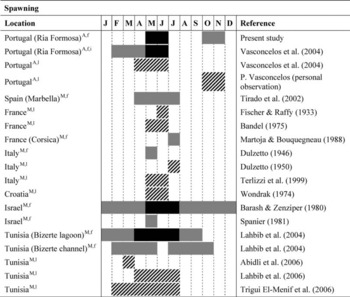
In the Ria Formosa lagoon, T. trunculus spawning occurred mainly between May and June 2003. According to local fishermen, T. trunculus spawns may be found in the Ria Formosa lagoon between February and June, but are more frequent and abundant in May and June (Vasconcelos et al., Reference Vasconcelos, Gaspar, Joaquim, Matias and Castro2004). Furthermore, T. trunculus maintained in captivity spawn regularly between late April and early June (Vasconcelos et al., Reference Vasconcelos, Gaspar, Joaquim, Matias and Castro2004), but sporadic and minor spawning events may occur in October–November (P. Vasconcelos, personal observation). The information available on the spawning season of T. trunculus from various localities throughout its distributional range is summarized in Table 2. As reported in several studies undertaken with populations from the Mediterranean Sea, T. trunculus spawning in the field generally occurs in late spring–early summer (more frequently between May and July). Similarly, but under laboratory conditions with a temperature regime resembling the natural environment, the spawning events of T. trunculus occurred approximately in the same period. Nevertheless, in some localities in the Mediterranean Sea T. trunculus exhibited more than one spawning period or even an unusually broad spawning season. In Tunisian waters three spawning periods were identified (Lahbib et al., Reference Lahbib, Trigui El-Menif, Le Pennec and Boumaiza2004), whereas on the Israel coast (which has the warmest seawater temperature within the distributional range of this species) spawns cast ashore are especially abundant in May–July, but are commonly found all year-round (Barash & Zenziper, Reference Barash and Zenziper1980).
Spawning season (grey), peak of spawning season (black) and spawning events under laboratory conditions (stripes) observed in different localities throughout the distributional range of the banded murex, Hexaplex (Trunculariopsis) trunculus.

AAtlantic Ocean; MMediterranean Sea; ffield/natural environment; iinformation from inquiries made to local fishermen; llaboratory conditions with temperature regime resembling the natural environment.
Implications for fishery management and molluscan aquaculture
In the last five years there has been pressure from fishermen involved in the fishery for the banded murex in the Ria Formosa lagoon to legalize the use of the ‘wallet-line’. The information gathered in this study is essential for the proposal of adequate management measures for this fishing activity, including specific technical measures for the protection of the crucial phases of the T. trunculus reproductive cycle. In this particular, management measures should focus mainly on the protection of the female broodstock and collective spawns, through the implementation of a closed season in the fishing activity during the main spawning period of T. trunculus (May and June).
Acknowledgements
The authors thank the technical staff of IPIMAR–CRIPSul for their collaboration in sampling procedures. Thanks are also due to Pedro Pousão-Ferreira for providing the data on the seawater temperature monitored at the Olhão Fish Culture Experimental Station and to João Cúrdia for his help in photographing the histological sections of the gonads. The authors are also grateful to the anonymous referees whose suggestions greatly improved the manuscript. This study was partially funded by a PhD grant from the Fundação para a Ciência e Tecnologia (FCT: SFRH/BD/5139/2001).