Introduction
Planococcus citri (Risso) (Hemiptera: Pseudococcidae), the citrus mealybug, is globally distributed and has been reported as a serious pest of citrus in Africa (Hattingh & Tate, Reference Hattingh and Tate1996; Hattingh et al., Reference Hattingh, Cilliers, Bedford, Bedford, Van den Berg and De Villiers1998; Wakgari & Giliomee, Reference Wakgari and Giliomee2003), Australia (Smith et al., Reference Smith, Beattie and Broadle1997; Gullan, Reference Gullan2000), the Mediterranean Basin (Blumberg et al., Reference Blumberg, Klein and Mendel1995; Franco et al., Reference Franco, Suma, Da Silva, Blumberg and Mendel2004), as well as North, Central and South America (Bartlett & Lloyed, Reference Bartlett and Lloyed1958). Planococcus citri is able to reproduce rapidly under optimal environmental conditions, potentially infesting up to 100% of fruit, even when spring populations could hardly be detected (Hattingh & Moore, Reference Hattingh, Moore and Grout2003). Mealybugs, in general, are difficult to control chemically, as they display cryptic behaviour, are covered with protective waxes (Michelakis & Hamid, Reference Michelakis and Hamid1995; Franco et al., Reference Franco, Suma, Da Silva, Blumberg and Mendel2004), and have been reported to develop resistance to insecticides (Blumberg & Van Driesche, Reference Blumberg and Van Driesche2001; Mahfoudhi & Dhouibi, Reference Mahfoudhi and Dhouibi2009). The use of chemical control is also undesirable, because insecticides disrupt natural enemy populations (Hattingh, Reference Hattingh1993; Hattingh & Tate, Reference Hattingh and Tate1995, Reference Hattingh and Tate1996; Hattingh et al., Reference Hattingh, Cilliers, Bedford, Bedford, Van den Berg and De Villiers1998; Hattingh & Moore, Reference Hattingh, Moore and Grout2003) and have detrimental effects on the environment.
Entomopathogenic nematodes (EPNs) are used as biological control agents for a wide range of economically important insect pests (Grewal et al., Reference Grewal, Ehlers and Shapiro-Ilan2005) and could be an alternative to the chemical control of P. citri. The nematodes have an active host-seeking ability, which enables them to reach hosts in cryptic habitats (Gaugler & Boush, Reference Gaugler and Boush1979). However, as above-ground conditions are not optimal for nematode survival (Mráček, Reference Mráček and Upadhyay2002; Tomalak et al., Reference Tomalak, Piggott, Jagdale, Grewal, Ehlers and Shapiro-Ilan2005), successful control of mealybugs on citrus using EPN is extremely challenging. Abiotic factors, including temperature (Lacey et al., Reference Lacey, Neven, Headrick and Fritts2005), ultraviolet radiation (Gaugler & Boush, Reference Gaugler and Boush1978; Gaugler et al., Reference Gaugler, Bednarek and Campbell1992), wind and ambient humidity (Unruh & Lacey, Reference Unruh and Lacey2001), individually and combined, can limit the efficacy of EPNs as biological control agents when used above ground.
Desiccation, which is accelerated by low humidity levels and high wind speed, is the most limiting abiotic factor, as nematodes require a water film to maintain mobility and ensure survival (Wright et al., Reference Wright, Peters, Schroer, Fife, Grewal, Ehlers and Shapiro-Ilan2005). Schroer et al. (Reference Schroer, Ziermann and Ehlers2005) evaluated whether various surfactant–polymer formulations improved the ability of Steinernema carpocapsae (Weiser 1955) Wouts, Mráček, Gerdin & Bedding, 1982 to control the diamondback moth, Plutella xylostella (Linnaeus) (Lepidoptera: Plutellidae) on cabbage leaves at above-ground conditions. A formulation containing 0.3% Rimulgan® (a surfactant) and 0.3% of the polymer xanthan (an antidesiccant) obtained the best control, causing >90% diamondback moth mortality at 80% relative humidity (RH) and >70% mortality at 60% RH. Schroer & Ehlers (Reference Schroer and Ehlers2005) tested the same formulation for the control of diamondback moth on cabbage leaf bioassays under suboptimal conditions for nematode survival. Their results showed that the survival time of S. carpocapsae applied with the formulation was 22 h longer at 80% RH and 17 h longer at 60% RH than when the nematodes were applied with water only.
Van Niekerk & Malan (Reference Van Niekerk and Malan2012) screened six local South African EPN species for virulence against P. citri and found both Steinernema yirgalemense Tesfamariam, Gozel, Gaugler & Adams, 2005 and Heterorhabditis zealandica Poinar, 1990 to be highly effective at a concentration of 50 infective juveniles (IJ) per insect. They found, in a water activity bioassay, that S. yirgalemense was two times more tolerant to lower levels of free water and that this species was also able locate and infect P. citri faster than H. zealandica.
The objective of the present study was to evaluate the effect of adding adjuvants to aqueous suspensions of two nematode species. The effect on P. citri mortality and EPN deposition on citrus leaves was investigated, as well as the effect of two polymers on the sedimentation of nematodes in aqueous suspensions.
Materials and methods
Source of nematodes and insects
Experiments were conducted using H. zealandica (SF41; EU699436) originally isolated from soil collected in Baviaanskloof near Patensie, Eastern Cape, South Africa (Malan et al., Reference Malan, Nguyen and Addison2006) and S. yirgalemense (157-C; EU625295), originally isolated from soil collected from a citrus orchard near Friedenheim, Mpumalanga, South Africa (Malan et al., Reference Malan, Knoetze and Moore2011). IJs were cultured according to the procedures described by Kaya & Stock (Reference Kaya, Stock and Lacey1997) using Tenebrio molitor (Linnaeus) (Coleoptera: Tenebrionidae) larvae, at room temperature. Nematodes were harvested within the first week of emergence and stored in 150 ml distilled water in 500-ml vented culture flasks. The flasks were stored horizontally at 14°C and shaken weekly to improve aeration. IJs were used for experiments within the first 3 weeks after harvest. Concentrations used in experiments were quantified by using the method developed by Navon & Ascher (Reference Navon and Ascher2000). Mealybugs were cultured on butternuts. The identity of P. citri used in this study was verified using morphological (Wakgari & Giliomee, Reference Wakgari and Giliomee2005) and molecular techniques (Pieterse et al., Reference Pieterse, Muller and Jansen van Vuuren2010).
Effect of two polymers on P. citri mortality
Bioassays were conducted using multiwell bioassay plates (24 wells, flat bottom, Nunc™ Cat. No.144530, Sigma-Aldrich Pty. Ltd, Johannesburg, South Africa). Polymer products, Zeba® [starch-g-poly (2-propenamide-co-2-propenoic acid) potassium salt, Tongaat Hulett Starch, Germiston, South Africa] and Xanthan gum [polysaccharide (C35H49O29)], were added to nematode suspensions containing either H. zealandica or S. yirgalemense, and mealybug mortality was determined at 60% and 80% RH. Five treatment plates and five control plates, each containing ten evenly distributed adult female mealybugs (n= 50) were prepared for each treatment. Each well was lined with a circular paper disc (3 mm diameter) before mealybugs were added. Mealybugs were then inoculated individually with 50 μl containing either H. zealandica or S. yirgalemense at a concentration of 80 IJs/insect for each of three treatments; Zeba® at a concentration of 3 g/l; Xanthan gum at a concentration of 2 g/l; and distilled water. Each treatment received its own control, in which mealybugs were treated with 50 μl of the treatment formulation containing no nematodes. Multiwell plates were covered with fine netting, which allowed airflow while preventing mealybugs from escaping. To achieve the required RH, airtight containers with solutions of glycerol (60% RH) and KNO3 (80% RH) were prepared (Winston & Bates, Reference Winston and Bates1960). After treatment, plates with mealybugs were placed in humidity chambers and kept in a growth chamber with a day cycle starting at 22°C for 14 h and 11°C for 11 h. Mealybug mortality was determined after 72 h. The experiment was repeated on a separate date.
Effect of adjuvants on nematode deposition and sedimentation
Heterorhabditis zealandica suspensions containing: (1) nematodes in water only; (2) Nu-Film-P® (poly-1-p-menthene, spreader, sticker; Hydrotech, Pretoria, South Africa) at a concentration of 0.6 ml/l+nematodes; (3) Zeba® at a concentration of 3 g/l+nematodes; and (4) Nu-Film-P® +Zeba®+nematodes were applied to citrus trees at the Welgevallen experimental farm, Stellenbosch, Western Cape. Each treatment was applied to randomly selected leaves on individual trees, with a spacing of two untreated trees between the treated trees. Nematodes were applied at a concentration of 1000 IJs/ml with the aid of calibrated hand-held spray applicators. Leaves were left for 3 min to allow excess fluid to run off before randomly selected leaves were removed from the application area. Two 2-cm2 discs were cut out from each of the five leaves for each treatment tested (n= 10). Each leaf disc was individually rinsed off in 5 ml tap water, and the number of nematodes present in each suspension was documented. The experiment was repeated on a separate date. The data of both experiments were pooled for analysis.
Zeba® and Xanthan gum were evaluated in terms of their ability to retard sedimentation of H. zealandica in a water suspension. Zeba®, at a concentration of 0.1, 0.2 or 0.3%, and Xanthan gum, at a concentration of 0.1 or 0.2%, were added to a nematode concentration of 1000 IJs/ml. Both polymers were compared to a control that contained nematodes in water only. Treatments were added to 25-ml measuring cylinders (of diameter 1.5 cm) and stirred thoroughly to ensure that the nematodes were evenly distributed. To estimate sedimentation time, a 50 μl sample of the suspension was collected from a depth of 2 cm after 0-, 3-, 10-, 20-, 30- and 60-min intervals from each of three cylinders prepared per treatment (n= 3) and the number of nematodes determined. The experiment was repeated on a separate date.
Data analysis
All statistical analyses were performed using STATISTICA 9.0 software (StatSoft Inc., Tulsa, Oklahoma, USA). Data were analysed using ANOVA, with post-hoc comparison of means using Bonferroni's method, or with a bootstrap multi-comparison if residuals were not normally distributed (Efron & Tibshirani, Reference Efron and Tibshirani1993). Significant differences were determined on a 95% probability level. The data of control plates were used to prepare data of treatment plates with Abbott's formula before analysis, in order to compensate for mealybugs that died of causes other than nematode infection (Abbott, Reference Abbott1925). Nematode percentages for the effect of two polymers on nematode sedimentation were calculated as a percentage of the initial number of nematodes recorded directly after stirring had ceased.
Results
Effect of two polymers on P. citri mortality
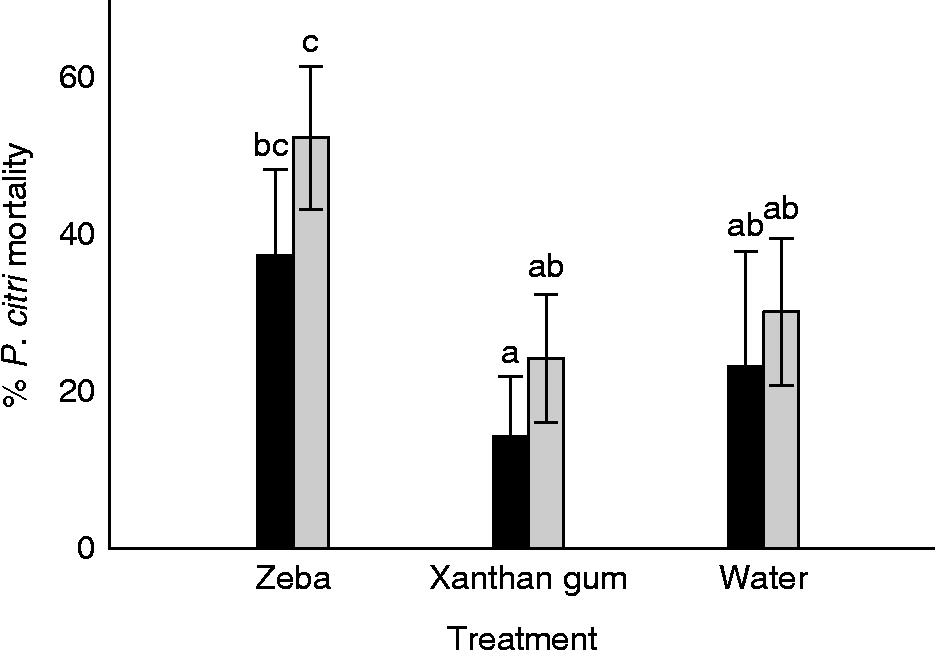
Results of the effect of a suspension containing H. zealandica with 0.3% Zeba® or 0.2% Xanthan gum on mealybug mortality at 60% and 80% RH showed no interaction between main effects humidity (two levels; 60% and 80% RH) and adjuvants (two levels; Zeba® and Xanthan gum) (F (2,54)= 0.38; P= 0.67). The concentration means differ from each other at each time point. The increase in mortality of P. citri with the addition of Zeba® was not significant at 60% RH (fig. 1). The same formulation significantly increased mortality by 22 ± 13% at 80% RH (P= 0.001). The Xanthan gum formulation performed worse than did the control (nematodes only), obtaining 14 ± 3.5% mortality at 60% RH and 24 ± 3.5% mortality at 80% RH, compared with the control which obtained 23 ± 6.6% mortality at RH 60% and 30 ± 4.11% mortality at RH 80%. Data for both humidity levels were pooled together for further analysis using a one-way ANOVA (F (2,57)= 15.27; P< 0.01), which confirmed that the Zeba® formulation obtained significantly higher mortality (50 ± 3.6%) than did either the Xanthan gum formulation (19 ± 2.7%) or the control (27 ± 3.8%).
Percentage mortality (95% confidence interval) of Planococcus citri after exposure to 80 infective juveniles per insect of Heterorhabditis zealandica in a suspension of Zeba®, Xanthan gum or water only at 60% (black bars) and 80% (grey bars) relative humidity (two-way ANOVA (F (2,54)= 0.38; P= 0.67)). Different letters above vertical bars indicate significant differences.

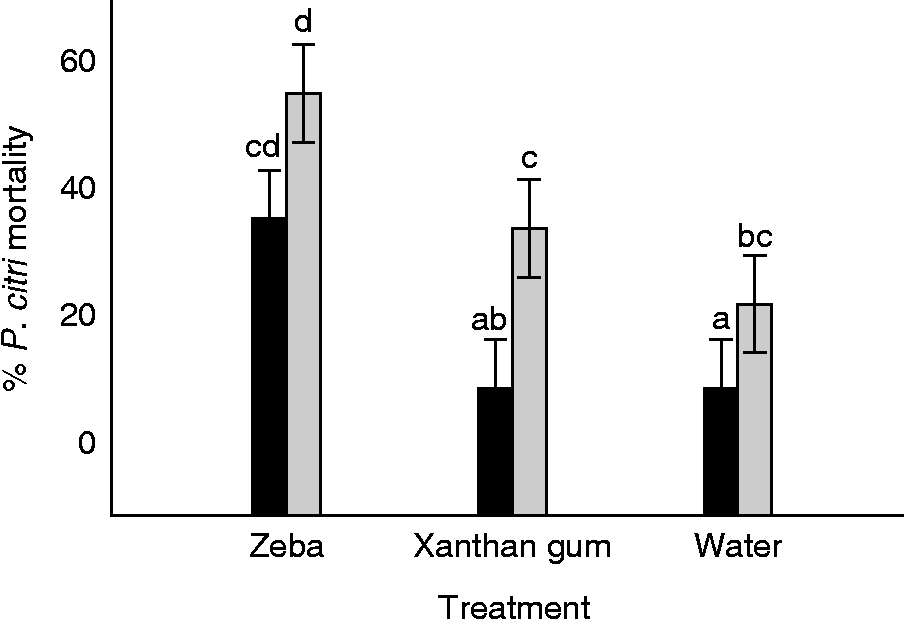
Results of the effect of a suspension containing S. yirgalemense and 0.3% Zeba® or 0.2% Xanthan gum on mealybug mortality at 60% and 80% RH showed no interaction between main effects humidity (two levels; 60% and 80% RH) and adjuvants (two levels; Zeba® and Xanthan gum) (F (2,54)= 0.22; P= 0.30). The concentration means differ from each other at each time point. The Zeba® formulation obtained significantly higher mortality of 36 ± 3.8% at a RH of 60% and of 55 ± 3.8% at 80% RH compared with the Xanthan gum formulation (9 ± 17%) mortality at 60% RH and 34 ± 2.2% mortality at 80% RH and control formulation (9 ± 2.8%) mortality at 60% RH and 22 ± 4.11% mortality at 80% RH (fig. 2). Data for both humidity levels were pooled for further analysis which confirmed that the Zeba® formulation obtained significantly higher mortality (46 ± 3.3%) than did either the Xanthan gum formulation (22 ± 4.0% mortality) or the control (16 ± 2.9% mortality).
Percentage mortality (95% confidence interval) of Planococcus citri after exposure to 80 infective juveniles per insect of Steinernema yirgalemense in a suspension of Zeba®, Xanthan gum or water only at 60% (black bars) and 80% (grey bars) relative humidity (RH) (two-way ANOVA (F (2,54)= 0.22; P= 0.30)). Different letters above vertical bars indicate significant differences.
Data for all control plates used for Abbott's formula for corrected mortality were pooled to determine whether Zeba® or Xanthan gum had a toxic effect on mealybugs. Results showed no significant differences (F (2,117)= 0.32; P= 0.72) for mortality of mealybugs treated with Zeba®, Xanthan gum or water. Zeba® and Xanthan gum proved not to be toxic to mealybugs, as less than 2.5% mortality was obtained after mealybugs were treated with Zeba® or Xanthan gum, and did not obtain significantly higher mortality than was obtained with mealybugs treated with water only. Due to the poor performance of Xanthan gum, it was not evaluated further for improvement of nematode deposition on citrus leaves.
Effect of adjuvants on nematode deposition and sedimentation
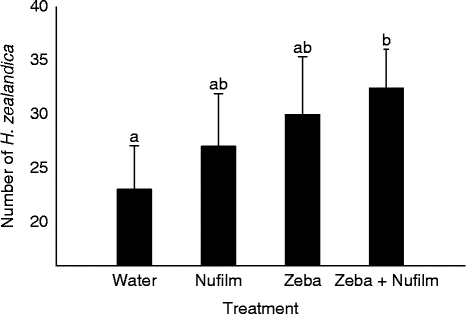
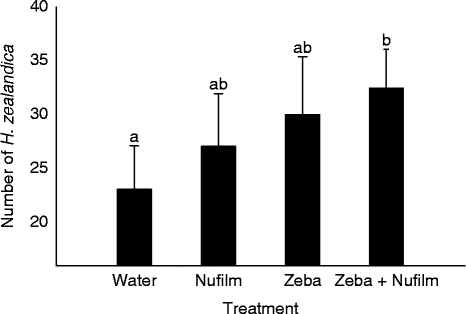
Significant differences were obtained for numbers of H. zealandica present on leaf surfaces (F (3,76)= 3.03; P< 0.05). The addition of Nu-Film-P® and Zeba® to nematode application formulations did not significantly increase the average number of nematodes deposited on 2-cm2 leaf discs. Only the combined formulation of Nu-Film-P® and Zeba® significantly increased the average number of nematodes deposited on leaf discs, with 10 ± 1.1 nematodes (P= 0.009) compared to the control. However, the increase observed was not significantly higher than that observed with the other two formulations tested (fig. 3).
Mean number (95% confidence interval) on 2-cm2 discs of citrus leaf sprayed with a suspension containing Heterorhabditis zealandica infective juveniles with Nu-Film-P®, Zeba®, Zeba® and Nu-Film-P®, or water only (one-way ANOVA (F (3,76)= 3.03; P< 0.05)).
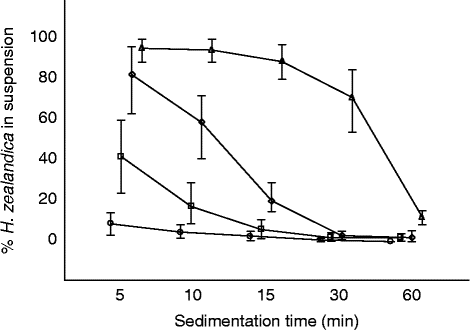
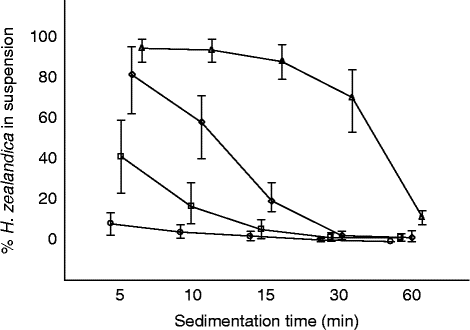
Without the addition of a polymer, 91 ± 6% of H. zealandica were recorded beyond a depth of 2 cm after 5 min. A repeated measures ANOVA for Zeba® showed interaction between main effects concentration (four levels; 0, 0.1, 0.2 and 0.3%) and time (five levels; 5, 10, 15, 30 and 60 min) (F (12,80)= 28.36; P= 0.001). The concentration means differ from each other at each time point. Compared to the control, none of the polymer concentration levels tested was able to retard sedimentation significantly 1 h after stirring had ceased. Only the 0.3% Zeba® formulation was able to retard sedimentation significantly (P= 0.001) after 30 min sedimentation, with 71 ± 1.2% of the initial nematode number of 52 nematodes recorded (fig. 4).
Percentage infective juveniles of Heterorhabditis zealandica recorded at a depth of 2 cm after stirring (95% confidence interval) at set time intervals for different concentrations (○ = 0%; □ = 0.1%; ⋄ = 0.2%; △ = 0.3%) of the polymer product Zeba® (repeated measures ANOVA (F (12,80)= 28.36; P= 0.001)).
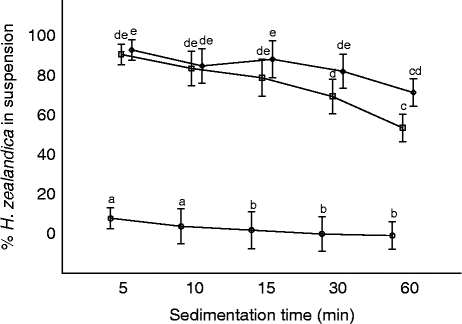
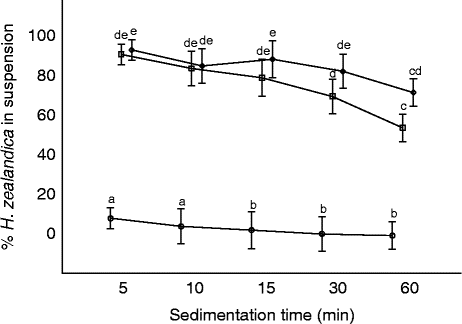
A repeated measures ANOVA for Xanthan gum showed interaction between main effects concentration (three levels; 0, 0.1 and 0.2%) and time (five levels; 5, 10, 15, 30 and 60 min) (F (12,60)= 5.45; P= 0.001). The concentration means differ from each other at each time point. Both Xanthan gum concentrations tested were able to retard H. zealandica sedimentation significantly at all the time intervals, compared to the control (fig. 5). No significant difference between the addition of 0.1 and 0.2% Xanthan gum was observed at any of the time intervals recorded. After 60 min sedimentation, 9, 54 and 72% of the initial nematode number were recorded for 0, 0.1 and 0.2% Xanthan gum, respectively.
Percentage infective juveniles of Heterorhabditis zealandica recorded at a depth of 2 cm after stirring (95% confidence interval) at set time intervals for different concentrations (○ = 0%; □ = 0.1%; ◇ = 0.2%) of Xanthan gum (repeated measures ANOVA (F (12,60)= 5.45; P= 0.001)). Data points indicated with the same lettering are not significantly different.
Discussion
Planococcus citri is an important pest of citrus in South Africa, with the potential of infesting a high percentage of fruit under certain environmental conditions (Hattingh & Moore, Reference Hattingh, Moore and Grout2003). The addition of Xanthan gum to nematode suspensions caused no significant increase in P. citri mortality in any of the bioassays. No significant increase in mortality with the addition of Zeba® to H. zealandica was obtained at 60% RH, but at 80% RH the same formulation significantly increased mortality. The addition of Zeba® to suspensions of S. yirgalemense increased mortality significantly at 60% and 80% RH. De Waal et al. (Reference De Waal, Malan and Addison2013) tested Zeba® to improve control of diapausing codling moth, Cydia pomonella (Linnaeus) in tree trunk bioassays with H. zealandica, showing Zeba® to increase mortality significantly at both 60% and 80% RH.
Citrus leaves and fruit have a waxy cuticle and, therefore, the ability of nematode suspensions to stick to their surfaces is greatly impaired. The possibility of using the surfactant Nu-Film-P®, and the polymer product Zeba®, to stick IJs to leaf surfaces showed that the individual addition of Nu-Film-P® and Zeba® had no significant effect. However, a significant increase was obtained when using the combination of the two adjuvants. Although nematodes will move to the same protected habitats as those occupied by P. citri, the additions of such adjuvants would not only increase their numbers on the leaves, but also protect them against desiccation on the exposed leaf area, which would be advantageous to movement and survival of the nematodes.
In an aqueous suspension, nematodes quickly settle to the bottom of spray tanks, causing uneven distribution. Sedimentation time is an important factor to consider when nematodes are applied through an irrigation system, especially when deciding if larger nematodes can be used. The polymer products Zeba® and Xanthan gum were evaluated at various concentrations for their ability to retard sedimentation of IJs. Xanthan gum was not evaluated at the highest concentration of 0.3%, as the suspension became too thick to pass through spray nodules, making its use impractical. Heterorhabditis zealandica was used in the sedimentation experiment, because IJs of this species have an average length of 685 μm and are larger than those of S. yirgalemense, with an average length of 635 μm (Nguyen, Reference Nguyen, Nguyen and Hunt2007). Results of the sedimentation trial showed H. zealandica to settle quickly to the bottom of 25-ml measuring cylinders with only 9 ± 2.4% of the initial nematode number recorded at a depth of 2 cm, 5 min after stirring. None of the Zeba® concentrations tested were able to retard sedimentation significantly after 1 h. Only the 0.3% Zeba® formulation was able to retard sedimentation significantly after 30 min, with 71 ± 1.2% of the initial nematode number recorded. Nematode suspensions containing Xanthan gum were able to retard sedimentation significantly at both concentration levels, tested after 1 h sedimentation. The above-mentioned results are similar to those obtained by Schroer et al. (Reference Schroer, Ziermann and Ehlers2005), which showed Xanthan gum (0.1 and 0.2%) to retard sedimentation of S. carpocapsae. Results also showed S. carpocapsae to settle quickly in water, with 50% and 10% of the initial nematode number recorded at a depth of 2 cm after 5 min and 1 h of sedimentation, respectively. IJs of S. carpocapsae are of length 558 μm and would settle much more slowly than the larger IJs (685 μm length) of H. zealandica (Nguyen, Reference Nguyen, Nguyen and Hunt2007), with 9 and 0% of the initial nematode number being recorded for H. zealandica after 5 min and 1 h, respectively.
The cryptic life style of P. citri and their ability to develop resistance to pesticides necessitates research towards alternative control methods. EPNs, which are lethal pathogens with a wide host range, are considered as a valuable biological control method for a variety of insect pest species. The results from a previous study (Van Niekerk & Malan, Reference Van Niekerk and Malan2012) stressed the need to improve nematode application formulations in order to increase control of P. citri under variable environmental conditions. In the current study, suboptimal conditions for nematode infection, with regard to nematode concentration and humidity, were maintained to simulate field conditions.
This investigation has shown that the addition of 0.3% Zeba® increased mealybug mortality in bioassays at 60% and 80% RH by retarding desiccation, extending nematode survival and improving mobility. Furthermore, the combined addition of both Nu-Film-P® and Zeba® increased application deposits on leaf surfaces, reducing the loss of nematodes by runoff. The same adjuvant to nematode suspensions effectively hindered their sedimentation, resulting in a more even distribution. To further determine the ability of such adjuvants to improve the control of P. citri on citrus by nematodes, they should be tested under glasshouse and field conditions. Further improvement of nematode application formulations, aimed at the control of above-ground citrus pests, should be done by testing different surfactant and polymer combinations. The application of nematodes to control above-ground pests on a commercial scale is a relatively new field of study and there is much room for improvement of application techniques and technology.
Acknowledgements
The authors would like to thank Daan Nel and Ken Pringle for assistance with statistical analysis.
Financial support
The authors would also like to thank Citrus Research International (CRI), the National Research Foundation of South Africa (NRF-THRIP TP2011060100026) and the Citrus Academy for funding of the project.
Conflict of interest
None.