Introduction
Flavonoids are important compounds in plants with quercetin (3, 3′, 4′, 5, 7- pentahydroxyflavone) being one of the most abundant flavonoids (Biesaga & Pyrzynska, Reference Biesaga and Pyrzynska2009). However, little is known about the interactions between insects and this structurally simple phenol until now. It was reported that this naturally occurring chemical is able to decrease egg hatching (Sharma & Sohal, Reference Sharma and Sohal2013), inhibit growth (War et al., Reference War, Paulraj, Hussain, Buhroo, Savarimuthu and Sharma2013), reduce pupation and adult emergence rate (Sharma & Sohal, Reference Sharma and Sohal2013), cause mortality (Lindroth & Peterson, Reference Lindroth and Peterson1988; War et al., Reference War, Paulraj, Hussain, Buhroo, Savarimuthu and Sharma2013), and modulate feeding and oviposition behaviour (Simmonds, Reference Simmonds2001).
In general, insects fight against toxic xenobiotics primarily through enzymatic detoxificative processes (Johnson et al., Reference Johnson, Mao, Pollock, Niu, Schuler and Berenbaum2012). Cytochrome P450 monooxygenases (P450s) are a superfamily of haem-thiolate proteins, and they play crucial roles in the metabolism of xenobiotic compounds (Feyereisen, Reference Feyereisen and Gilbert2012). P450-mediated detoxification has been well known to be responsible for plant adaptation in herbivores generally (Schuler, Reference Schuler2011), and elevated P450 activities (most often caused by overexpression of a specific P450 gene(s)) have been documented to confer insecticide resistance (Feyereisen, Reference Feyereisen and Gilbert2012). However, the interactions between specific P450s and the flavonoid quercetin have been investigated only in a few insect species. For example, baculovirus expressed P450 enzymes, including CYP6B8 from Helicoverpa zea (Li et al., Reference Li, Baudry, Berenbaum and Schuler2004), four CYP6AS subfamily P450s (CYP6AS1, CYP6AS3, CYP6AS4, and CYP6AS10) and two CYP9Q subfamily P450s from Apis mellifera (L.) were proven to be capable of metabolizing quercetin (Mao et al., Reference Mao, Rupasinghe, Johnson, Zangerl, Schuler and Berenbaum2009, Reference Mao, Schuler and Berenbaum2011). On the other hand, caterpillars exhibited increased P450 gene expression (Stevens et al., Reference Stevens, Snyder, Koener and Feyereisen2000), as well as elevated P450 enzymatic activity (Yu, Reference Yu1983; Liu et al., Reference Liu, Liang, Gao and Shi2006; Zhang et al., Reference Zhang, Ma, Feng, Lai, Chen, Xu, Yu and Zhang2012) after dietary exposure to quercetin. Regulation of P450 enzymes by plant secondary metabolites is of practical significance, because change of P450 levels may influence insects' tolerance to insecticides and the efficacy of pest control (Feyereisen, Reference Feyereisen and Gilbert2012).
The cotton bollworm Helicoverpa armigera is a dreaded pest that has caused severe crop losses (Wu & Guo, Reference Wu and Guo2005). One key factor leads to the outbreak of this insect is its wide host-plant range. H. armigera is highly polyphagous, 60 cultivated and 34 wild plant species distributed in 24 families were recorded as host plant in the cotton regions along the Huaihe River Valley in Jiangsu Province of China (Bai et al., Reference Bai, Sun, Sun and Su1997). It can encounter quercetin in its host plants. Liu et al. (Reference Liu, Liang, Gao and Shi2006) reported that the O-demethylase activity of sixth-instar larvae was induced by quercetin, whereas no correlation between the concentrations of quercetin and the expression levels of CYP6B6 mRNA was observed. Further, the effect of quercetin on the expression levels of other H. armigera P450s remains to be investigated. Considering the economic importance of the cotton bollworm in agriculture, the roles of P450s in host adaptation and insecticide metabolism, and the ubiquitous but differential occurrence of quercetin in the host plants, we attempted to investigate the possible effects of quercetin on performance of cotton bollworm larvae and on P450 expression in this study. We believe these pursuits could increase our understanding about insect adaptation and obtain fundamental knowledge for a smart pest control.
Materials and methods
Insects
A colony of cotton bollworm H. armigera (Hübner) was established from a field collection from Hebei Province, China and was maintained in the laboratory. Larvae were individually reared in glass tubes on wheat-germ-based artificial diets (Wu & Gong, Reference Wu and Gong1997), at 25 ± 1°C and relative humidity of 70% with a photoperiod of 16-h light/8-h dark. Adults were kept under the same temperature and light conditions, and provided with a 10% honey solution.
Bioassay
To determine the effects of quercetin on performance of the cotton bollworm, 3rd instar caterpillars were exposed to quercetin (Sigma , St. Louis, MO, USA) at a dose of 0 (control), 0.01% (0.1 mg g−1), 0.3% (3 mg g−1), 1% (10 mg g−1) and weight gain, developmental time, pupation rate, and adult emergence rate were recorded. To see if P450s are involved in quercetin adaptation, 5th instar newly moulted caterpillars were provided with diets containing the P450 general inhibitor piperonyl butoxide (PBO, Sigma, St. Louis, MO, USA) (1 mg g−1), and diets containing both PBO (1 mg g−1) and quercetin (10 mg g−1), and weight gain of the larvae of each treatment group was recorded at 48 h. For all these exposure experiments, ten synchronous individuals were used for each treatment and three biological replicates were performed for all the experiments.
Quercetin metabolism
The gut tissues without gut content of 5th instar larvae were homogenized in 0.1 m phosphate buffer (pH 7.4). The homogenates were centrifuged at 10,000 g for 15 min. These crude gut extracts were used for the following metabolism experiments.
Reaction mixture for the quercetin metabolism contained 5 µg ml−1 quercetin and the crude gut extract in 0.1 m phosphate buffer (pH 7.4) in a total volume of 200 µl. After incubation at 30°C for 30 min in a shaking bath, each reaction was added to an equal volume of acetone and centrifuged at 13,000 g for 10 min after votexing for 10 min. Quercetin and its metabolites were analysed with a reverse phase column (ZORBAX 300SB-C18 StableBond Analytical 4.6 × 250 mm 5-μm, Agilent) using a high-performance liquid chromatography (HPLC) apparatus (Agilent 1260 Infinity series) equipped with a DAD detector (wavelength range 190–950 nm). The mobile phase A was 0.1% acetic acid, and mobile phase B was acetonitrile, respectively. The elution gradient was set up as 0 min, 15% B; 35 min, 75% B at 1 ml min−1. Absorbance was monitored at 373 nm. Boiled extract (100°C, 5 min) was used as a control. This experiment was repeated twice.
Real-time PCR
To test if quercetin affects the transcriptional expression of P450 genes, we detected the mRNA levels of 15 P450 genes and its redox partner NADPH-dependent cytochrome P450 reductase (haCPR). Newly moulted 5th instar caterpillars were fed with diets containing quercetin at a dose (w/w) of 0 (control), 0.1, 1, and 10 mg g−1 (wet weight) respectively. After 48 h, three tissues (midgut, Malpighian tubules, and fatbody) were dissected for RNA extraction.
Total RNA was extracted from the three dissected tissues of the 5th instar larvae of H. armigera using TRIzol (Invitrogen, CA, USA) according to the manufacture's protocol. First-strand cDNA was synthesized from total RNA (1 µg) using the oligo(dT) primer and the MLV reverse transcriptase according to the manufacturer's instructions (Takara, Dalian, China).
The expression levels of the 15 P450 genes and the haCPR were determined by quantitative RT–PCR (qRT–PCR) using an Mx3005P qPCR System (Stratagene, USA) and SYBR® Premix Ex Taq ™ II realtime PCR Kit (Takara, Japan). The elongation factor-1α gene (EF-1α, qEF-F/qEF-R primer set; table S1) was used as a reference gene (Zhou et al., Reference Zhou, Sheng, Li, Wan, Liu and Qiu2010b ). The primers used and the annealing temperature for each primer set are showed in table 1. qRT–PCR was run in triplicate for each RNA sample in a 20 µl reaction containing 10 µl 2 ×SYBR® Premix Ex Taq ™ II, 0.4 µl 50× ROX II, 0.4 µl each of the corresponding forward and reverse primers (10 µm), 3.8 µl ddH2O, and 5 µl cDNA. The qRT–PCR cycling parameters were: 95°C for 15 s, followed by 40 cycles of 95°C for 5 s, 55–60°C for 30 s, and one cycle of 95°C 1 min and 55°C 30 s. The specificity of the PCR amplification was checked by a melt curve analysis (MxPro 4.0 programme, Stratagene) as well as running the product onto 2% agarose gel. The PCR fidelity was checked by sequencing PCR products. For each gene, a serial dilution from 1- to 1000-fold of each cDNA template was performed to assess their PCR amplification efficiency. The relative expression level of each gene was calculated by the comparative CT method (Schmittgen & Livak, Reference Schmittgen and Livak2008). Results were expressed as mean expression ratio (±SEM) of three biological replicates.
Performance of H. armigera larvae after dietary exposure to different doses of quercetin.

Data expression as means ± SE. Means with the same lowercase letters are not significantly different (ANOVA, P < 0.05, n = 3).
Data analysis
All percentage data were arcsine transformed before being subjected to analysis of variance. The data (mean ± SEM) were statistically analysed using one-way analysis of variance (ANOVA) followed by Fisher's LSD test (P < 0.05). The real-time PCR data were statistically analysed using a Bonferroni correction. Non-overlap of 95% confidence limits was the criterion for significance of difference in both treated and untreated larvae for each parameter.
Results
Effect of quercetin exposure on performance of H. armigera
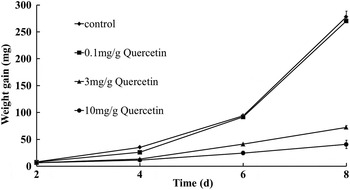
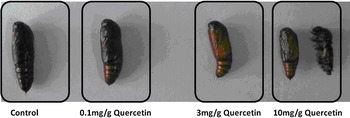
When the larvae were exposed to 0.1 mg g−1 quercetin since 3rd instar, no significant difference in performance was observed (fig. 1 and table 1). However, higher doses of quercetin (3 and 10 mg g−1) inhibited the growth of larvae, caused death, extended the development time, and reduced the pupation rate and adult emergence rate significantly. All the examined effects increased as the content of quercetin increased. We also observed deformed pupae in the 10 mg g−1 quercetin treatment (fig. 2).
Effects of quercetin on weight gain of H. armigera caterpillars. The weight gain of H. armigera was calculated as the difference of the weight of the larvae at each specific day from the initial weight of the inoculated 3rd instar larvae. The average weight gain and standard errors are presented.

The representative pupae of H. armigera from larvae exposed to different doses of quercetin.

Effect of PBO on quercetin toxicity against H. armigera
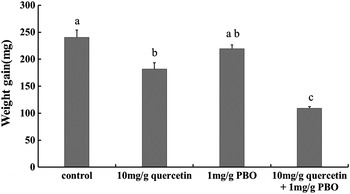
When 5th instar larvae were exposed to 10 mg g−1 quercetin, larval growth was retarded. This effect was synergized by the incorporation of PBO in their diets (fig. 3).
PBO effect on the toxicity of quercetin to 5th instar larvae of H. armigera. The weight gain of H. armigera was calculated as the final weight from the initial weight of the larvae after exposure to different diets for 48 h. The average weight gain and standard errors are presented. Bars marked with different letters are significantly different at P < 0.05 (n = 3).

Quercetin metabolism by H. armigera larvae
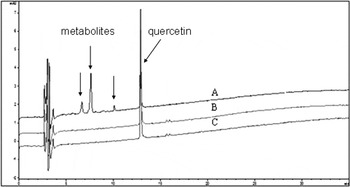
Three distinct peaks were observed in the reactions with crude gut extract when compared with controls (fig. 4). This indicates that the quercetin was transformed to three different metabolites, but their chemical structures were not determined in this study. Around 58% of quercetin was transformed by the crude extract (one individual gut equivalent) in 30 min. No significant depletion of quercetin was observed in the controls.
Representative HPLC profiles of metabolites of quercetin incubated with crude gut extract of 5th instar larvae of H. armigera. Quercetin was incubated with: (A) crude gut extract, (B) boiled crude gut extract, and (C) without crude gut extract.

Effect of quercetin exposure on the expression of P450s in H. armigera
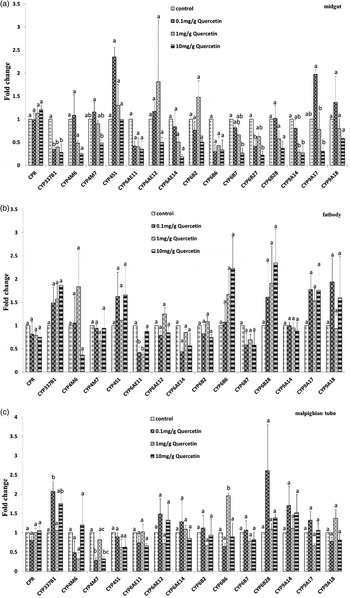
The relative expression levels of 16 genes are shown in fig. 5. CYP6B27 was not detectable in the fat body and Malpighian tubules, thus did not included in the respective subfigures. Specifically, quercetin did not significantly change the expression of CPR at the concentrations we used. Overall, tissue-specific regulation of P450s was obvious, and repression was more commonly observed than induction. Amongst the 15 P450s analysed, four (CYP337B1, CYP6B7, CYP6B27, and CYP9A14) were repressed in the midgut. Specifically, 10 mg g−1 quercetin down-regulated four P450s (CYP337B1, CYP6B7, CYP6B27, and CYP9A14); quercetin repressed the expression of CYP337B1 at all treatment concentrations; 0.1 and 1 mg g−1 quercetin repressed the expression of CYP6B27 and CYP9A14, respectively. For fat body, only the expression of CYP6AE11 was repressed by 0.1 and 1 mg g−1 quercetin. For Malpighian tubules, 0.1 and 1 mg g−1 quercetin significantly up-regulated the expression of CYP337B1 and CYP6B6, respectively, whereas 0.1 and 10 mg g−1 quercetin significantly repressed the expression of CYP4M7. Amongst the three tissues, the midgut seems more sensitive to quercetin, with more P450 genes being influenced than the fat body and Malpighian tubules, probably because the midgut was the first tissue absorbing the orally administrated quercetin.
Relative mRNA levels of P450 and CPR genes in the midgut (A), fat body (B), and Malpighian tubules (C) of 5th instar larvae of H. armigera after exposure to different doses of quercetin for 48 h. The average expression levels and standard errors are presented. Bars marked with different letters are significantly different between different doses of quercetin for each gene (n = 3).

Discussion
Deleterious effects of quercetin on the performance of the cotton bollworm (including growth, survival, pupation, and adult emergence) were observed after 3rd instar larvae were exposed to 3 and 10 mg g−1 quercetin in this study (figs 1 and 2, table 1). Toxicity of quercetin has been also documented in other insects (Lindroth & Peterson, Reference Lindroth and Peterson1988; Zhang et al., Reference Zhang, Ma, Feng, Lai, Chen, Xu, Yu and Zhang2012; Sharma & Sohal, Reference Sharma and Sohal2013; War et al., Reference War, Paulraj, Hussain, Buhroo, Savarimuthu and Sharma2013). In contrast to higher dose, quercetin at a content of 0.1 mg g−1 in the diets showed no significant effects on the performance of the cotton bollworm larvae (table 1), consistent with the results of southern armyworm Spodoptera eridania (Lindroth & Peterson, Reference Lindroth and Peterson1988).
Until now, the mode of action of quercetin in insects is not fully understood. Previous studies have demonstrated that quercetin is able to affect mitochondrial transhydrogenase of Manduca sexta (Vandock et al., Reference Vandock, Mitchell and Fioravanti2012), inhibit insect ecdysone 20-monooxygenase (Mitchell et al., Reference Mitchell, Keogh, Crooks and Smith1993) and glutathione S-transferases (Chen et al., Reference Chen, Zhang and Gao2007). A study in our group has illustrated that quercetin is a potent inhibitor of haCPR of the cotton bollworm (Liu et al., Reference Liu, Zhou, Li, Zhu and Qiu2014). These results indicate a role of quercetin as a non-specific enzyme inhibitor. Pupal deformities observed at the highest quercetin dose treatment (10 mg g−1) in this research may be partially explained by the interference of 20-monooxygenase activity caused by quercetin as identified in a previous study (Mitchell et al., Reference Mitchell, Keogh, Crooks and Smith1993).
No significant toxic effect was observed when 3rd instar larvae were exposed to 0.1 mg g−1 quercetin (table 1), a content higher than that in most of its host plants (Lin et al., Reference Lin, Wu, Lu, Zhang, Qang and Wu2011; USDA, 2011). Furthermore, when 5th instar larvae were administrated with quercetin at a dose as high as 10 mg g−1 in their diets for 48 h, their weight gain reached 75% of that of larvae in the control group (fig. 3). These results suggest that the polyphagous cotton bollworm has well adapted to quercetin. Although it is known that insects are able to sequester and metabolize phenolic compounds from their host plants (Ferreres et al., Reference Ferreres, Fernandes, Pereira, Pereira, Valentao and Andrade2009), the knowledge about how insects cope with dietary quercetin is very limited thus far. A recent study on the metabolism of quercetin in oriental armyworm Mythimna separata larvae identified two metabolites (quercetin-4′-O- sulphate and quercetin 3-O-gludoside). The authors stated that sulfation could be important in detoxification and/or excretion of quercetin (Aboshi et al., Reference Aboshi, Ishida, Matsushita, Hirano, Nishida and Mori2014). In addition, 5-O-glucoside of quercetin was identified in the midgut tissues of silkworm Bombyx mori larvae after oral administration of quercetin, while quercetin 5,4′-di-O-glucoside was the major constituent in the haemolymph and silk glands (Hirayama et al., Reference Hirayama, Ono, Tamura, Konno and Nakamura2008). Another reported reaction occurring in quercetin metabolism is methylation. For example, methylation of the hydroxy groups reduced the activity of flavonoids (Elliger et al., Reference Elliger, Chan and Waiss1980), and methylation of the 7-hydroxyl of quercetin resulted in the loss of biological activity against S. eridania (Lindroth & Peterson, Reference Lindroth and Peterson1988). These findings indicate that quercetin extensively undergoes phase II metabolism, and diverse metabolites may be produced. Our metabolism analysis showed that quercetin was rapidly transformed to three metabolites by gut enzymes of the cotton bollworm larvae (fig. 4), indicating that enzymatic metabolism is an important pathway in quercetin elimination. The chemical structures of the three metabolites may worth to be identified in the future. In addition, our result shows that PBO treatment enhanced toxicity of quercetin (fig. 3), suggests a possible involvement of P450s (phase I enzymes) in the quercetin detoxification in H. armigera, although we could not exclude the involvement of esterase (PBO also known as inhibitor of esterase). The role of P450s in the metabolism of quercetin has been elucidated using the reconstituted monooxygenases of several P450s from A. mellifera (L.) (Mao et al., Reference Mao, Rupasinghe, Johnson, Zangerl, Schuler and Berenbaum2009, Reference Mao, Schuler and Berenbaum2011), and CYP6B8 from H. zea (Li et al., Reference Li, Baudry, Berenbaum and Schuler2004). Further investigations are needed to reveal the metabolic fate of quercetin, and it is worthy of our efforts to pinpoint the key enzymes responsible for quercetin transformation in the cotton bollworm.
Inducible defence has been recognized as an energy-efficient strategy in dealing with xenobiotics by insects. P450s are well known to be inducible when insects have to cope with toxic xenobiotics (Schuler, Reference Schuler2011; Feyereisen, Reference Feyereisen and Gilbert2012). However, whether quercetin exposure affects P450 expression in the cotton bollworm is not fully explored. Due to the unavailability of whole-genome sequences of H. armigera at the time we conducted this study, we included 15 P450s belonging to CYP4, CYP6, CYP9, and CYP337 families, which were identified or predicted to be involved in xenobiotics detoxification, and their redox partner, haCPR in this work. Our qRT–PCR results showed that the effect of quercetin on P450 expression was tissue- and dose-specific, a pattern well known in the regulation of insect P450s (Zhou et al., Reference Zhou, Ma, Sheng, Liu, Gong and Qiu2010a , Reference Zhou, Sheng, Li, Wan, Liu and Qiu b ; Giraudo et al., Reference Giraudo, Hilliou, Fricaux, Audant, Feyereisen and Goff2014). Quercetin was showed to serve as P450 inducer or repressor or both for some CYPs in the cotton bollworm (fig. 5). Among the 14 P450 genes examined in this study, only CYP337B1 and CYP6B6 were induced by around 2-fold in the Malpighian tubules, suggesting that quecertin is neither a general nor a potent P450 inducer. Similarly, Liu et al. (Reference Liu, Liang, Gao and Shi2006) also found that quercetin had no effect on the CYP6B6 mRNA expression level in the midgut and fat body in the cotton bollworm. In addition, a microarray analysis showed that the number of P450 genes inducible by quercetin was much less than that by xanthotoxin and gossypol (Tao et al., Reference Tao, Xue, Huang, Chen and Mao2012). Zhang et al. (Reference Zhang, Ma, Feng, Lai, Chen, Xu, Yu and Zhang2012) examined the transcriptional response of eight silkworm P450s belonging to CYP6 and CYP9 families, only two P450s (CYP6AB5 and CYP6B29) were observed to be inducible (Zhang et al., Reference Zhang, Ma, Feng, Lai, Chen, Xu, Yu and Zhang2012).
Notably, quercetin was shown to down-regulate several P450 genes, including CYP4M7 and CYP6B7 (fig. 5). Similarly, 1 mg g−1 quercetin was reported to repress the expression of five out of six P450 genes examined in the silk worm (Li et al., Reference Li, Zhang, Ni, Wang, Li, Xu, Shen, Xia and Zhao2014). CYP4M7 and CYP6B7 have been observed to be overexpressed in H. armigera strains resistant to pyrethroid insecticides (Brun-Barale et al., Reference Brun-Barale, Héma, Martin, Suraporn, Audant, Sezutsu and Feyereisen2010; Zhang et al., Reference Zhang, Tang, Cheng, Shui, Zhang and Qiu2010). These findings raise the possibility that quercetin exposure may increase the susceptibility of cotton bollworm to pyrethroids.
In summary, quercetin as one of the most abundant flavonoids in plants is able to cause toxic effects at a high dose against H. armigera. This simple flavonol appears not to be a potent factor in the regulation of P450 expression, although differential and mild influence it may pose. We hypothesize that the cotton bollworm has well adapted to quercetin via enzymatic transformation and quercetin may not be a major factor in the inducible P450-mediated xenobiotics defence in this polyphagous pest.
Supplementary material
The supplementary material for this article can be found at http://dx.doi.org/10.1017/S0007485315000760.
Acknowledgements
This work was supported by grants from the National Basic Research Programme of China (973 Programme, No. 2012CB114103), National Natural Science Foundation of China (No. 31471796), and the State Key Laboratory of Integrated Management of Pest Insects and Rodents (ChineseIPM1408) to X. Qiu.