Invasive procedures such as surgery or cardiac catheterisation generate preoperative anxiety, notably in children, among whom 60% showed signs of anxiety in one study. Reference Sola, Lefauconnier, Bringuier, Raux, Capdevila and Dadure1 Children with congenital heart disease (CHD) often need open-heart surgery or endovascular repair by catheterisation, as well as multiple cardiac catheterisations. Reference Butler, Sadhwani, Stopp, Singer, Wypij and Dunbar-Masterson2 Preoperative anxiety may manifest itself as verbalisation of fear or as agitation, crying, or refusal of care. Negative interpretation bias is common, with the children remembering the pain as more severe than it was. Reference Noel, Rosenbloom, Pavlova, Campbell, Isaac and Pagé3 There may be long-term adverse effects such as the onset of new separation anxiety, nightmares, eating disorder, or enuresis. Reference Kain, Mayes and O’Connor4
The child’s strategies for adapting to preoperative anxiety vary with age. Children younger than 5 years of age often have difficulty understanding the explanations given about the procedure and are consequently more likely to develop separation anxiety. However, even young children respond to distraction and reassurance. Reference Kain, Mayes and O’Connor4–Reference Vetter6
Among reported factors related to the child that are associated with worse preoperative anxiety are a shy or anxious temperament, female sex, history of hospitalisation, previous traumatic experience with the medical environment, not receiving information, not receiving premedication, and separation from parents. Reference Kain, Mayes and O’Connor4,Reference Kain, Mayes, Weisman and Hofstadter7,Reference Charana, Tripsianis, Matziou, Vaos, Iatrou and Chloropoulou8 The presence of an anxious parent increases the child’s anxiety: a correlation has been demonstrated between the level of anxiety in the parent and that of the child at anaesthesia induction. Reference Kain, Mayes and O’Connor4,Reference Kain, Mayes, Weisman and Hofstadter7
Currently, pharmacological agents such as midazolam are used to reduce preoperative anxiety in children. Midazolam has been proven to reduce preoperative anxiety, Reference Watson and Visram9,Reference Manso, Guittet, Vandenhende and Granier10 decrease the drug doses required for anaesthetic induction, and reduce the risk of separation anxiety and post-operative eating disorders. Reference Watson and Visram9 However, midazolam has a dose-dependent risk of respiratory depression, ataxia, dysphoria, hypotension, and paradoxical reaction with agitation and aggression. Reference Manso, Guittet, Vandenhende and Granier10
Non-pharmacological tools have recently been evaluated as means of decreasing anxiety in children. Distraction with an electronic tablet decreased preoperative anxiety to a greater extent than did midazolam. Reference Stewart, Cazzell and Pearcy11 The toy car is a recent tool whose impact on child anxiety has been little studied. Reference Liu, Sun, Wu, Xu, Zhang and Zheng12 This playful tool involves the child through play, like the other distracting tools currently available, but also makes the child an actor of his own care.
The objective of our randomised controlled trial was to assess the potential anxiety-alleviating effect on the child and parents of having the child drive an electric ride-on car from the ward to the cardiac catheterisation laboratory versus being taken on a gurney.
Methods
Study design
This trial was approved by the French ethics committee (N°19.02.18.67521) and was registered prior to patient enrolment in agreement with French legislation (ID-RCB: 2019-A00459-48). Written informed consent was obtained from the parents before inclusion of each child. This manuscript adheres to the applicable CONSORT guidelines.
Between March 2019 and March 2020, we conducted a single-centre, randomised, controlled, single-blind, parallel-group, trial with 1:1 allocation at the Marie Lannelongue Hospital. Consecutive patients between 3 and 10 years of age admitted for cardiac catheterisation to assess CHD were eligible, based on the manufacturer’s recommendations on the use of the car. Exclusion criteria were body weight greater than 30 kg (upper limit for which using the car was approved), cognitive or psychiatric disorder, neurosensory pathology making the child unable to drive the car, lack of understanding of French, and parental refusal. For eligible patients meeting none of these criteria, inclusion in the study was proposed on the day before catheterisation, after a full explanation of the procedure, and study protocol had been given to the parents and children.
Interventions
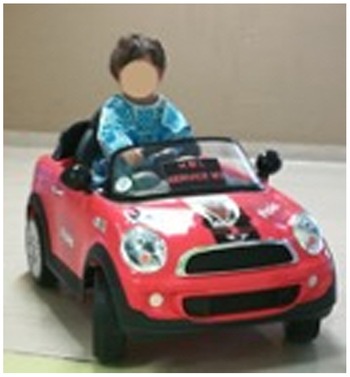
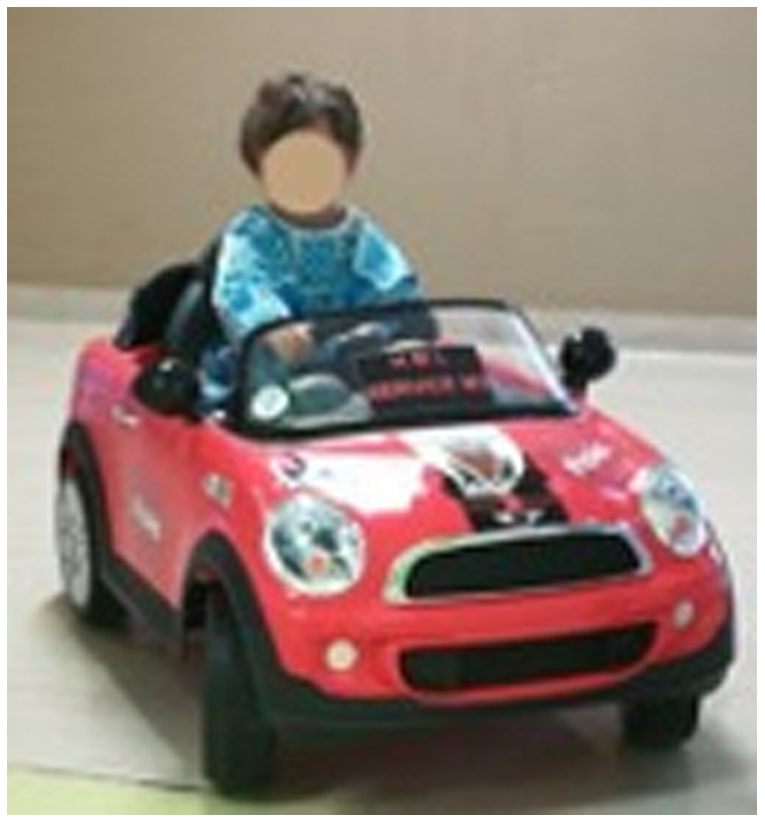
The study intervention consisted in having the child drive a toy electric ride-on car from the ward to the catheterisation laboratory (Fig 1). On the day before the intervention, the physician in charge of each patient randomised to the intervention group provided the child with accurate and playful explanations about the car and how it would be used. In the control group, the children were taken to the catheterisation as usual lying supine on a gurney. In both groups, the parents and an orderly accompanied the child. In the intervention group, the orderly had received training about the car and have a remote control that could override the child’s actions, to ensure safety.
The electric ride-on toy car.
All children in both groups received standardised preoperative information from a nurse, who used a play kit with figurines to represent the operating room and the course of the operation. No premedication was given in either group. Children in either group who exhibited extreme symptoms of anxiety deemed incompatible with the study protocol were excluded from the study and given vigilant sedation adapted to the level of anxiety.
Once at the catheterisation laboratory, the child was separated from the car and parents and given anaesthesia promptly. The mode of anaesthesia was at the discretion of the anaesthesiologist in both groups. A standardised anaesthesia protocol was not necessary since we did not measure post-procedural status (e.g. post-emergence delirium).
Anxiety assessment
Anxiety in the child and parents was assessed on the day before the procedure, in the child’s room (T0) and on the day of the procedure just before anaesthesia induction (T1). The T1 assessment took place after the child was separated from the parents. We used two scales, the short form of the modified Yale Preoperative Anxiety Scale (mYPAS-SF) Reference Jenkins, Fortier, Kaplan, Mayes and Kain13 and the visual analogue scale for anxiety (VAS-A). Both scales are validated for assessing anxiety in children and adults. Reference Berghmans, Poley, van der Ende, Weber, Van de Velde and Adriaenssens14,Reference Facco, Stellini, Bacci, Manani, Pavan and Cavallin15
The mYPAS-SF is validated for children 2 years of age and older. Reference Kühlmann, Lahdo, Staals and van Dijk16 The level of anxiety is proportional to the score. The minimum score is 22/100 and scores above 30/100 reflect anxiety. Reference Jenkins, Fortier, Kaplan, Mayes and Kain13 The scale has four categories illustrating the different forms of expression of anxiety (activity, verbal behaviour, expression, and arousal), each containing four to six items.
The VAS-A can be used for children aged 6 years or older. For younger children, the scale is marked by the parents. The level of anxiety is indicated by placing a mark on a line from 0 to 100. Scores taken to indicate clinically significant anxiety have ranged across studies from 30 to 50/100. Reference Berghmans, Poley, van der Ende, Weber, Van de Velde and Adriaenssens14,Reference Facco, Stellini, Bacci, Manani, Pavan and Cavallin15 We used a cut-off of 30/100. Thus in this trial, we considered a child to be anxious if the mYPAS-SF or the VAS-A-child score was above 30. The parents also completed the VAS-A to reflect their own level of anxiety. We defined anxious parents as parents with a VAS-A-parent score above 30.
Thus, anxiety was assessed by three scores (mYPAS-SF, VAS-A-child, and VAS-A-parent), by the same blinded investigator, at T0 and T1. The difference between the T1 and T0 scores was taken to reflect anxiety induced by the proximity of the procedure.
Outcomes
The primary outcome was the median mYPAS-SF score at T1. Secondary outcomes were the median VAS-A-child score at T1, the median VAS-A-parent score at T1, and the median differences between T1 and T0 (ΔT1-T0) in the mYPAS-SF, VAS-A-child, and VAS-A-parent scores.
Randomisation
The randomisation sequence was generated by a central computer (STATA® Software) in blocks of 4 by a statistician. On the day before catheterisation, each patient was enrolled in the study and allocated to one of the two groups by a clinical research associate, with a sealed envelope technique to one of the two groups.
Blinding of the healthcare professionals was not feasible. A physician who had no other role in the study and was unaware of the allocation group conducted the anxiety evaluations and recorded the anonymised results.
Sample size calculation
The mYPAS-SF, VAS-A-child, and VAS-A-parent scores were considered to indicate anxiety if greater than 30/100. Based on a previous comparable study, we hypothesised that the median T1 mYPAS-SF score would be 60/100 in the control group and 45/100 in the intervention group. Reference Liu, Sun, Wu, Xu, Zhang and Zheng12 With a standard deviation of 15, an alpha risk of 0.05, and a beta risk of 0.10, 22 patients were required in each group to detect a statistically significant difference in the median mYPAS-SF score at T1 (primary outcome) between the two groups.
Statistical analysis
The statistical analysis was carried out using the per-protocol approach. Non-normal and ordinal values were described as median [interquartile range]. Quantitative non-normal values, such as the mYPAS-SF score, were compared using the non-parametric Mann–Whitney U-test. Qualitative variables were described as percentages and compared using Fisher’s exact test. Quantitative normally distributed variables were compared using the Wilcoxon rank test. P values < 0.05 were considered significant.
Results
Flow chart and study population
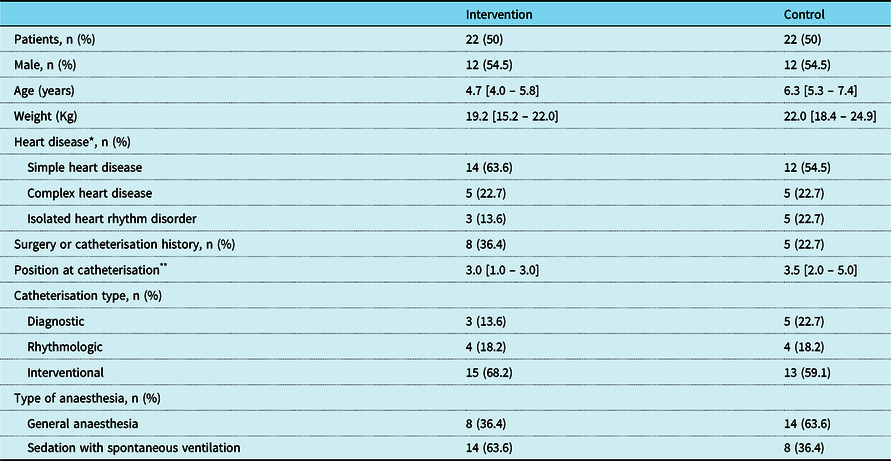
We identified 63 patients meeting our inclusion criteria between March 2019 and March 2020. Fifteen children were excluded before randomisation for the following reasons: delayed psychomotor development (eight children), deafness (one child), and weight over 30 kg (six children). A total of 48 patients were randomised. Four children were excluded after randomisation: one child because of parental refusal to continue the study and three children requiring sedation before transfer to the catheterisation laboratory (one child in the intervention group and two children in the control group). Among them, 44 were finally analysed in the study, 22 in each group. Table 1 reports their main features.
Main features of the study patients
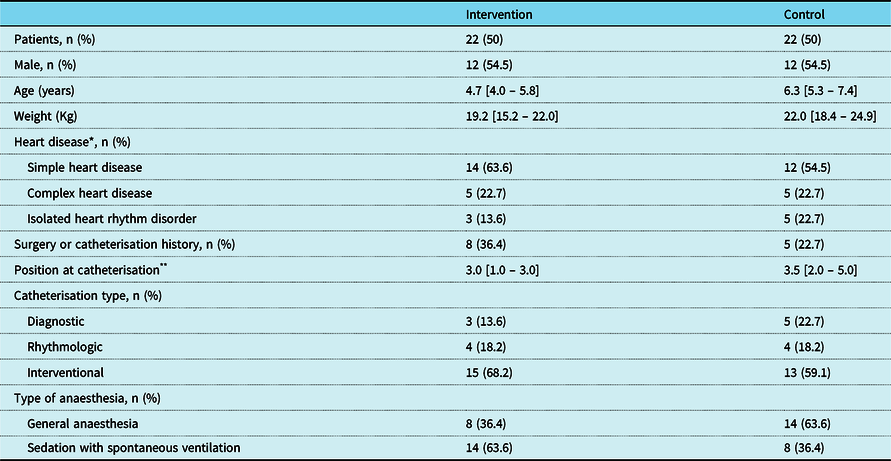
* According to the classification of the rare diseases M3C network for complex CHD. 25 26 (59.0%) patients had a simple CHD (patent ductus arteriosus, atrial septal defect, ventricular septal defect, or pulmonary valvular stenosis), and 10 (22.7%) patients had a complex heart disease (tetralogy of Fallot; single ventricle; common arterial trunk; double-issue right ventricle; and combined transposition of the great arteries, ventricular septal defect, and pulmonary stenosis). Eight patients (18.2%) had a structurally healthy heart and were admitted for ablative therapy by catheterisation (electrophysiological study) to treat tachycardia.
** Position at catheterisation depends on the number of patients previously admitted to the catheterisation laboratory.
Anxiety in the children
Across both groups at T0, 38.6% of the children met our definition for anxiety (mYPAS-SF or VAS-A-child score above 30): 36.4% in the intervention group and 40.9% in the control group, without significant difference between groups. At T1, there was 81.8% of anxious children (72.7% in the intervention group and 90.9% in the control group), again with no significant between-group difference.
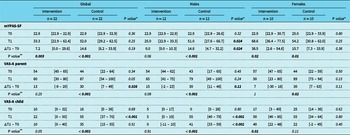
Table 2 lists the child anxiety scores at T0 and T1. The median mYPAS-SF score at T1 (primary outcome) was not significantly different between the two groups. At T1, the VAS-A-child score, however, was significantly lower in the intervention than the control group.
The T1 scores were significantly higher than the T0 scores in both groups, with no significant difference.
In a separate evaluation of patients under 6.5 years old, the median mYPAS-SF score at T1 was not significantly different between the intervention and the control group (33.3 [23.9 – 62.4] and 56.2 [26.1 – 66.7], p = 0.47, respectively). Also, in patients older than 6.5 years, the median mYPAS-SF score at T1 was not significantly different between the two groups (respectively 22.9 [22.9 – 42.2] and 50.0 [32.3 – 62.5], p = 0.29).
Parental anxiety
At T0, 72.7% of parents in both groups had anxiety according to our definition (81.8% in the intervention group and 63.6% in the control group, p = 0.31). At T1, 77.2% of all parents reported anxiety (68.2% in the intervention group and 86.4% in the control group, p = 0.28). The number of parents with anxiety was not significantly higher at T1 than at T0. However, the increase in the VAS-A-parent score at T1 compared to T0 was significant in the control group but not in the intervention group.
Separate evaluation of male and female patients
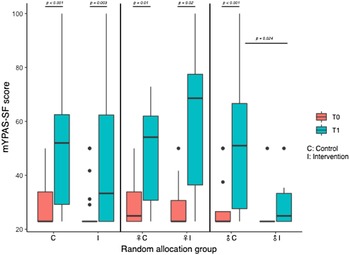
Among boys, the median mYPAS-SF score at T1 (primary outcome) was significantly lower in the intervention group than in the control group (Table 2, Fig 2). The boys’ median VAS-A-child score was also significantly lower in the intervention group. Furthermore, for boys, the increases in both scores from T0 to T1 were significant in the control group but not in the intervention group. The increase in the male VAS-A-parent score between T0 and T1 was significant in the control group but not in the intervention group. There was no significant difference in the VAS-A-parent scores at T0 and T1 between the two groups.
Values of the mYPAS-SF, VAS-A in children, and VAS-A in parents on the day before the procedure (T0) and just before anaesthesia induction (T1). T0, day before the procedure; T1, just before anaesthesia induction, after separation from the parents; ΔT1-T0, increase in anxiety between the two time points
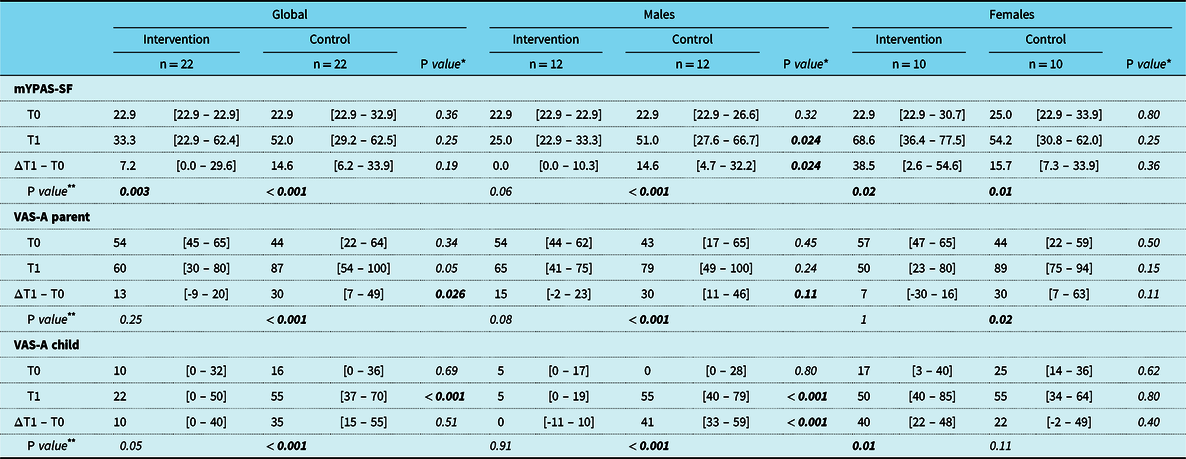
* for the comparison of the two groups.
** for the comparison of the two time points.
Changes in the mYPAS-SF score in the two groups, overall, and for boys and girls separately.
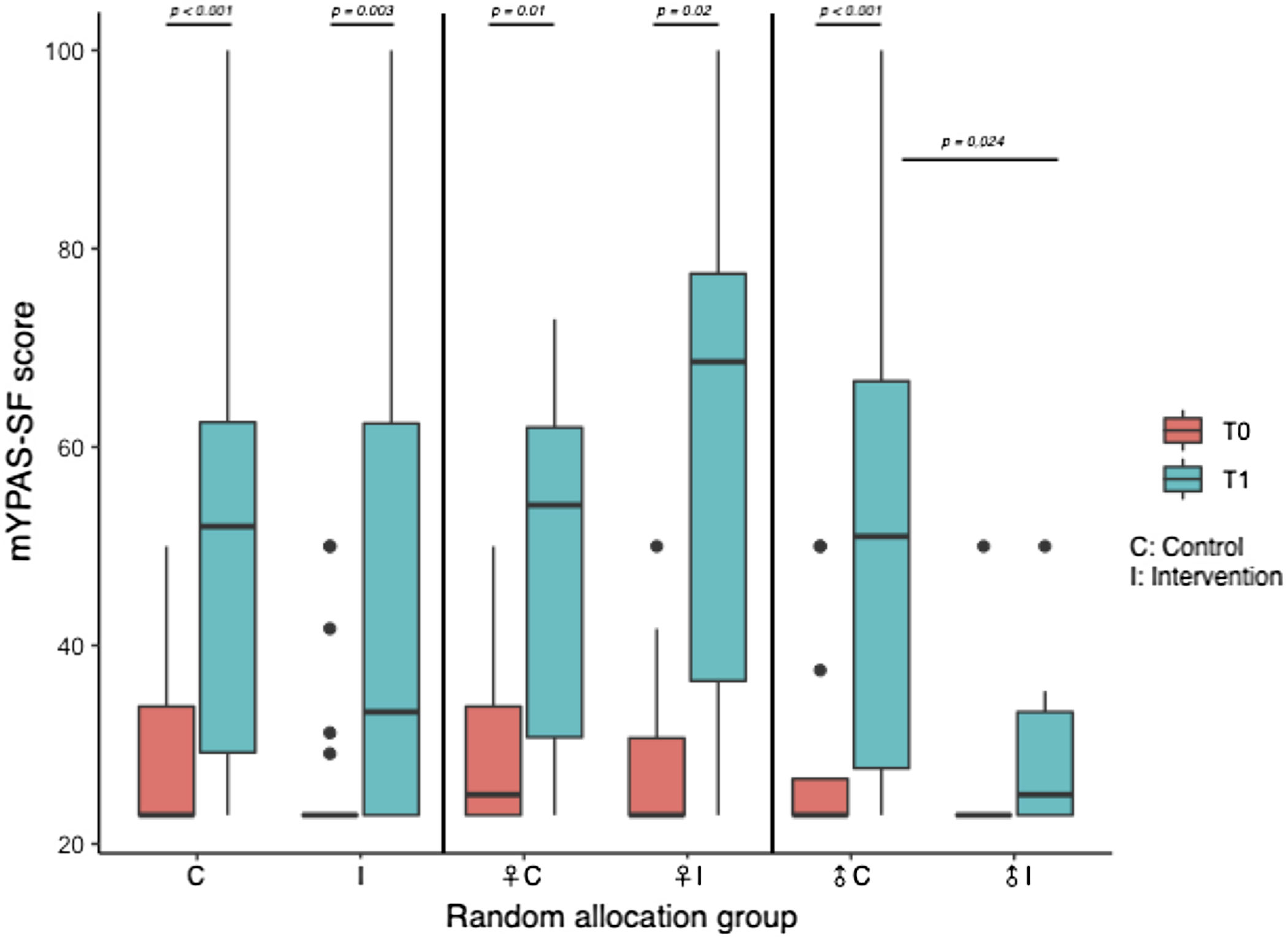
Among girls, the median mYPAS-SF score at T1 (primary outcome) was not significantly different between the two groups (Table 2, Fig 2). Neither was the girls’ median VAS-A-child score at T1 significantly different between groups. The increase in the mYPAS-SF score from T0 to T1 was significant in both groups. The increase in the girls’ VAS-A-child score was significant in the intervention group but not in the control group. There was no significant difference in the female VAS-A-parent score at T0 and T1 between the two groups. However, the increase in the VAS-A-parent score from T0 to T1 was significant in the female control group but not in the intervention group.
Discussion
In this randomised controlled trial assessing the effect on pre-procedural anxiety of a non-pharmacological intervention based on distraction and active participation, the median mYPAS-SF score at T1 was not significantly different in the two groups when males and females were combined. In the boys, however, the median mYPAS-SF score at T1 was significantly lower in the intervention than in the control group. Furthermore, the boys, but not the girls, had a significantly smaller increase from T0 to T1 on both the mYPAS-SF and VAS-A-child scores. Thus, our intervention was effective in the boys but not in the girls. There were no age-related differences in the intervention. The VAS-A-parent score increased significantly less from T0 to T1 in the intervention group.
Overall, 38.6% of children met our definition of anxiety on the day before the procedure compared to 81.8% at the time of transfer to the catheterisation laboratory. This very high prevalence of anxiety is of concern. However, it should be noted that we chose a low cut-off of 30/100 on the VAS-A scale to define anxiety in both children and parents. Also, our patients had CHDs that often require multiple invasive investigations and corrective procedures, which feed a constant level of anxiety in the entire family. Thus, parental anxiety was also very common in our study, with nearly three-fourths of parents being anxious at both time points. The number of parents with anxiety at T1 in our study was lower compared to T0 in the intervention group and higher in the control group. Thus, the toy car seems to have had a distractive effect on the parents also. Alleviating parental anxiety is important, as anxiety in the parents increases stress in the child. Reference Vetter6,Reference Charana, Tripsianis, Matziou, Vaos, Iatrou and Chloropoulou8 Therapeutic education and adapted parental information before heart surgery, for example, have been proven effective in decreasing parental anxiety. Reference Kumar, Das, Chauhan, Kiran and Satapathy17
A randomised controlled trial from China that used the same assessment tools as we did enrolled children aged 2 to 5 years undergoing their first corrective surgery for CHD. Reference Liu, Sun, Wu, Xu, Zhang and Zheng12 The children in the intervention group were taken to the operating room in a manual toy car pushed by an orderly, instead of being transported supine on a gurney. The anxiety scores in the children were significantly lower in the car group than in the gurney group. This study also had a midazolam arm, in which the scores were comparable to those in the car arm. The initial anxiety scores (T0) were similar to those in our study. However, the scores at induction (T1) were slightly lower in our study, perhaps due to our use of figurines to explain the procedure to the children, to the type of intervention (open-heart surgery versus cardiac catheterisation), and/or to the younger patient age in the Chinese study.
Other methods of distraction designed to alleviate preoperative anxiety have been used. A meta-analysis showed that a preoperative clown intervention alleviated anxiety in both children and parents. Reference Zhang, Yang, Lau, Garg and Lao18 Video games and interactive games have also been evaluated for reducing stress and pain levels and appear to be the most effective distractors. Reference Chow, Van Lieshout, Schmidt, Dobson and Buckley19 Exposure to a virtual reality experience of the operating room also failed to reduce anxiety or pain in children 4 to 12 years of age. Reference Eijlers, Dierckx, Staals, Berghmans, van der Schroeff and Strabbing20 In contrast, storytelling and colouring was not inferior to midazolam in alleviating children’s preoperative anxiety. Reference Al-Yateem, Brenner, Shorrab and Docherty21
The use of audiovisual information tools has also been shown to alleviate preoperative anxiety in children. Reference Dai and Livesley22 In another randomised trial, distraction by using an interactive tablet was more effective than midazolam sedation in alleviating anxiety at induction, decreasing emergence delirium, and allowing earlier extubation, and earlier hospital discharge. Reference Stewart, Cazzell and Pearcy11 Therapeutic play before surgery, for example, using a doll to explain the procedure, has had variable effects depending on the study population, mode of play, and type of surgery (outpatient or conventional, and depending on the organ operated on). Reference He, Zhu, Chan, Klainin-Yobas and Wang23
Our study has several limitations. First, we did not choose a gender-neutral or two gender-specific distracting activities. In a 2020 meta-analysis that looked at 113 effect sizes from 75 studies of toy preference, boys preferred vehicles and this effect was large and statistically significant. Reference Davis24 This explains the significantly lower median mYPAS-SF score at T1 in the intervention group in the boys but not in the girls in our study. Second, we did not collect data on the anaesthetic drug doses, quality of awakening, or post-operative anxiety. Third, combination of the car ride with other activities before the transfer to the catheterisation room might have produced greater effects on anxiety. Finally, we did not assess the children or parents for trait anxiety. Such an assessment might be useful to identify children and parents who are at high risk for anxiety and therefore require special efforts to lessen preoperative and post-operative anxiety.
Conclusion
Playful distraction by means of having the child ride on an electric toy car to go to the operating room was effective in lessening preoperative anxiety at the time of induction in boys but not in girls. Further studies are warranted using gender-specific and/or gender-neutral toys or activities for a longer period before cardiac catheterisation.
Acknowledgement
We thank the town of Tancarville, which donated the electric toy car. We are also grateful to the nurses and orderlies who participated in the study.
Financial support
There is no financial support to declare.
Conflict of interest
The authors have no conflicts of interest to declare.