INTRODUCTION
Syllidae is one of the most important polychaete families in Chilean waters, with 48 species (Álvarez-Campos & Verdes, Reference Álvarez-Campos and Verdes2017; San Martín et al., Reference San Martín, Rozbaczylo and Díaz-Díazin press). However, the knowledge of this family is poor with most records and descriptions from older studies (e. g. Ehlers, Reference Ehlers1897; Hartmann-Schröder, Reference Hartmann-Schröder1962, Reference Hartmann-Schröder1965; Wesenberg-Lund, Reference Wesenberg-Lund1962; Hartman, Reference Hartman1964). With the exception of a study made by Álvarez-Campos & Verdes (Reference Álvarez-Campos and Verdes2017) in central Chile (33°S), there is no specific taxonomic research on this family. San Martín et al. (Reference San Martín, Rozbaczylo and Díaz-Díazin press) have summarized the knowledge of Syllidae in Chile. Moreover, the records of Syllidae in the Patagonian region of Chile (41°–55°S) are mainly related to ecological works indicating the presence of species for different localities such as Aysén fjord, Los Chonos Archipelago, Magellan Strait and Beagle Channel (Cañete et al., Reference Cañete, Leighton and Aguilera1999; Gambi & Mariani, Reference Gambi and Mariani1999; Thatje & Brown, Reference Thatje and Brown2009; Soto & Paterson, Reference Soto and Paterson2010; Montiel et al., Reference Montiel, Quiroga and Gerdes2011). Currently, 24 species of syllids have been reported in Chilean Patagonia showing that Syllis is the most diverse genus with eight species (San Martin et al., Reference San Martín, Rozbaczylo and Díaz-Díazin press).
In the current study, six species of syllids are reported: Nudisyllis sp., a new record of the genus for Chile; Brachysyllis infuscata (Ehlers, Reference Ehlers1901a), a new record for continental Chile; Syllides japonica Imajima, Reference Imajima1966 recorded for the first time in Chile and Paraehlersia kawesqar sp. nov., a new species; Syllides articulosa Ehlers, Reference Ehlers1897 and Epigamia sp. have previously been reported from Chilean Patagonia. Previous works highlighted within Eusyllinae the presence of Odontosyllis magnanuchalata Hartmann-Schröder, Reference Hartmann-Schröder1965, Eusyllis nuchalata Hartmann-Schröder, Reference Hartmann-Schröder1965 and Pionosyllis kerguelensis (McIntosh, Reference McIntosh1885). Within the Anoplosyllinae Syllides articulosa Ehlers, Reference Ehlers1897 was recorded and from the Autolytinae the species Autolytus charcoti Gravier, Reference Gravier1906, Autolytus maclearanus McIntosh, Reference McIntosh1885, Myrianida simplex Ehlers, 1900 and Proceraea micropedata Hartmann-Schröder, Reference Hartmann-Schröder1962, have been reported. Incertae sedis species previously found was Amblyosyllis granosa Ehlers, Reference Ehlers1897.
MATERIALS AND METHODS
The study area was the zone of fjords, channels and ice-fields located in the Chilean Patagonia region (41°–55°S, South-east Pacific). The specimens were obtained by the Intertidal and subtidal Marine Biotopes Project (Soto et al., Reference Soto, Báez, Ramírez, Letelier, Naretto and Rebolledo2012, Reference Soto, Báez, Ramírez, Letelier, Naretto and Rebolledo2015; Letelier et al., Reference Letelier, Báez, Ramírez, Rebolledo, Soto and Naretto2013) undertaken between 2009 and 2010 as part of CIMAR 15 and 16 Oceanographic Cruises (Silva & Palma, Reference Silva and Palma2006) supported by the Chilean Navy.
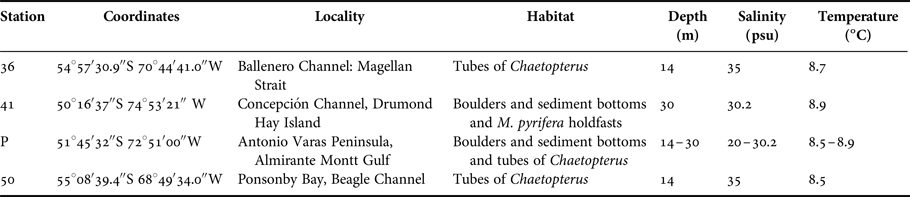
Polychaetes were collected in four sampling stations from intertidal rocky-shores and beaches by mean of manual methods and from the subtidal zone (up to 30 m depth) using scuba diving. From these environments boulders and sediments, as well as biological structures such as Macrocystis pyrifera kelp holdfasts and Chaetopterus cf. variopedatus tubes in the subtidal zone, were targeted for polychaetes. From each site (sampling station) environmental parameters such as salinity and temperature were measured in situ using a HANNA Instruments multiparameter sensor. For information on stations and environmental parameters see Table 1. For further details of study area see Soto et al. (Reference Soto, Báez, Ramírez, Letelier, Naretto and Rebolledo2012) and Letelier et al. (Reference Letelier, Báez, Ramírez, Rebolledo, Soto and Naretto2013).
Sampling stations, position, locality and related environmental parameters.

The collected specimens were fixed in 10% formaldehyde–seawater solution and later transferred to 75% alcohol solution. The individuals were examined using both dissecting and compound light microscopes, the latter equipped with interference contrast optics (Nomarski). Drawings were made using a camera-lucida drawing tube attached. Scanning electron microscope procedures and digitalization of images in some key species were made in the SIDI (Servicio Interdepartamental de Investigación) of the Universidad Autónoma de Madrid, Spain. Body width was measured across the proventricle and does not include parapodial lobes. Biological material is deposited at the Museo Nacional de Ciencias Naturales de Madrid (MNCNM), Spain, Museo Nacional de Historia Natural de Santiago de Chile (MNHN) and Laboratorio de Bentos, Universidad de Valparaíso (LBUV). For general morphology and biology of the family Syllidae see San Martín (Reference San Martín and Ramos2003), San Martín & Aguado (Reference San Martín, Aguado and Schmidt-Rhaesa2014) and San Martín & Worsfold (Reference San Martín and Worsfold2015). For each species, the station numbers are given along with the numbers of specimens in parentheses in the Material Examined section.
RESULTS
Family SYLLIDAE Grube, Reference Grube1850
Subfamily Eusyllinae Malaquin, 1893
Genus Nudisyllis Knox & Cameron, Reference Knox and Cameron1970
Nudisyllis Knox & Cameron, Reference Knox and Cameron1970: 77. Emended by San Martín & Hutchings (Reference San Martín and Hutchings2006): 280. Diagnosis follows San Martín et al. (Reference San Martín, López and Aguado2009).
Nudisyllis sp.
MATERIAL EXAMINED
Station 36 (1) (LBUV)
DISTRIBUTION
Southern Magellan Strait at Chilean Patagonia.
HABITAT
Inside tubes of Chaetopterus cf. variopedatus in fjords and channels from Chilean Patagonia (this study).
REMARKS
The only specimen is in poor condition, incomplete. The dorsum is strongly pigmented with black transversal bands, and the compound chaetae are elongated, distally hooked and unidentate. This specimen probably represents an undescribed species; however, it is a single, damaged specimen. This study represents the first report of the genus from Chile.
Incertae sedis (sensu Aguado et al., Reference Aguado, San Martín and Siddall2012)
Genus Paraehlersia San Martín, Reference San Martín and Ramos2003
Paraehlersia San Martín, Reference San Martín and Ramos2003: 61.
Diagnosis follows San Martín & Hutchings (Reference San Martín and Hutchings2006).
Paraehlersia kawesqar sp. nov.
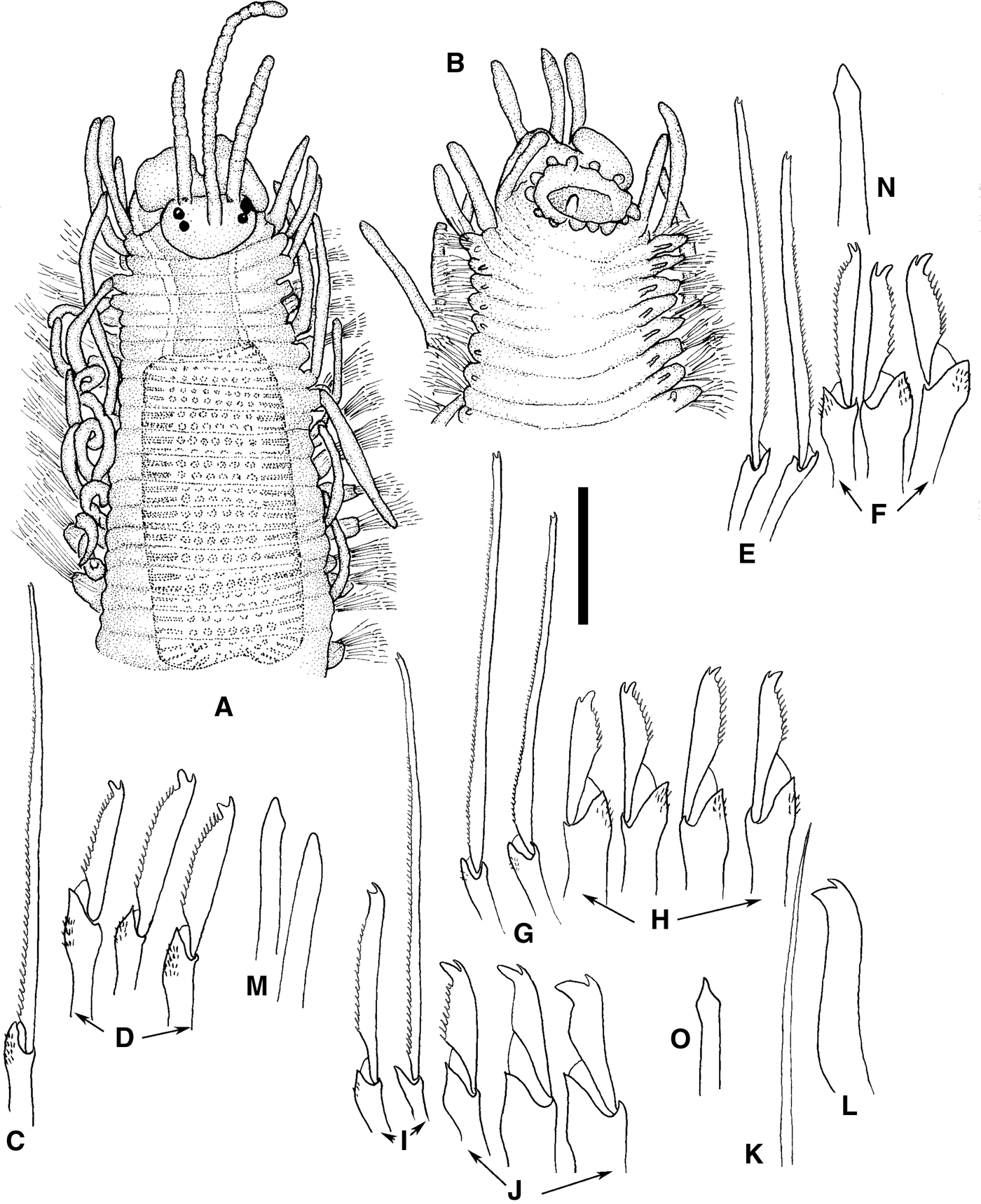
Figures 1–4
Paraehlersia kawesqar sp. nov. Holotype. (A) Anterior end, dorsal view. (B) Anterior end, ventral view. (C) Spiniger-like compound chaetae, most anterior parapodia. (D) Falcigers, most anterior parapodia. (E) Spiniger-like chaetae, anterior parapodia. (F) Falcigers, anterior parapodia. (G) Spiniger-like chaetae, midbody parapodia. (H) Falcigers, midbody parapodia. (I) Spiniger-like chaetae, posterior parapodia. (J) Falcigers, posterior parapodia. (K) Dorsal simple chaetae. (L) Ventral simple chaetae. (M) Aciculae, anterior parapodia. (N, O) Aciculae, posterior parapodia. Scale bars. A, B: 0.4 mm. C–O: 20 µm.

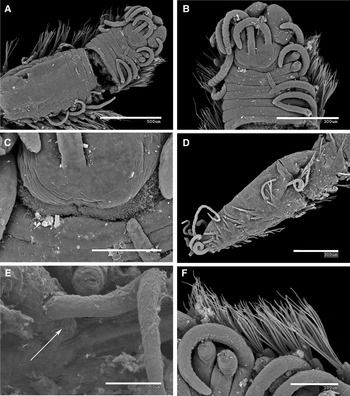
Paraehlersia kawesqar sp. nov. SEM. (A) Anterior end, dorsal view. (B) Prostomium and most anterior segments. (C) Prostomium and nuchal organs. (D) Posterior end, lateral view. (E) Subcirral papilla. (F) Most anterior compound chaetae.

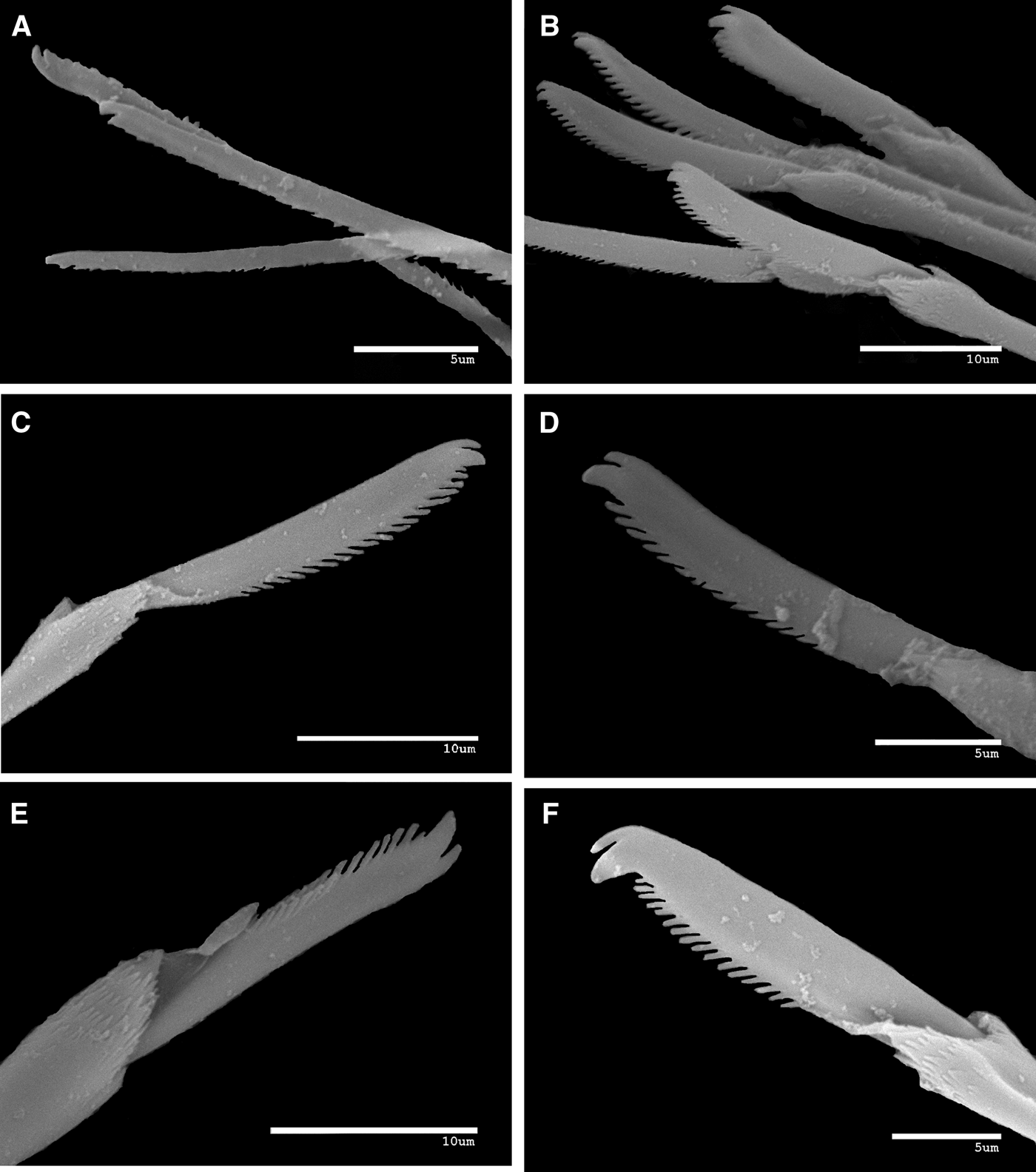
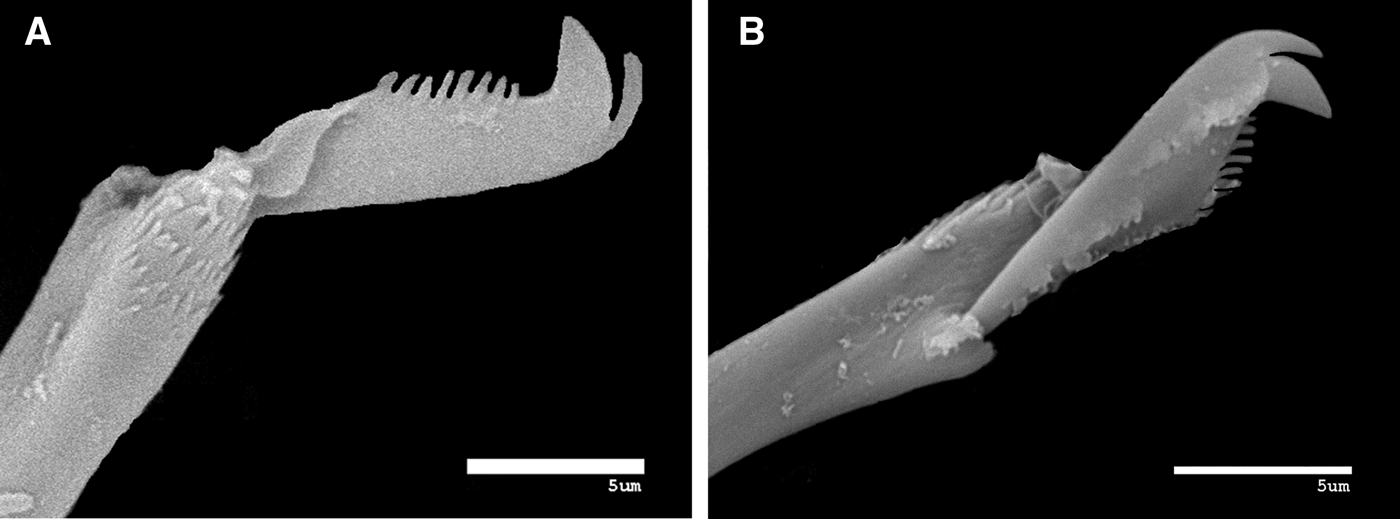
Paraehlersia kawesqar sp. nov. SEM. (A) Distal part of blades, spiniger-like compound chaetae. (B) Falcigers, most anterior parapodia. (C, D) Falcigers, anterior parapodia. (E, F) Falcigers, midbody parapodia.

Paraehlersia kawesqar sp. nov. SEM. (A, B) Falcigers, posterior parapodia.

MATERIAL EXAMINED
Station 41, Holotype (MNCNM pending code) and two Paratypes (1 SEM) (MNCN 16.01/17771). Three Paratypes (MNHN and LBUV).
DESCRIPTION
Body long, cylindrical, fragile, without colour markings, broad anteriorly (Figures 1A & 2A, B, D). Holotype, a pre-epigamic female, almost complete, broken into 5 pieces, 6 mm long, 0.4 mm wide, with 58 chaetigers. Paratypes between 55 and 60 chaetigers. Prostomium circular, large, covering dorsal part of peristomium and almost reaching chaetiger 1 (Figures 1A & 2A–C); 4 eyes arranged in open trapezoidal pattern and 2 anterior eyespots (Figure 1A). Median antenna long, slender, irregularly wrinkled, 2–2.5 times longer than combined length of prostomium and palps, inserted in the middle of the prostomium. Lateral antennae same shape as median one, but shorter, inserted in front of anterior eyes (Figure 1A), near to the anterior margin of prostomium (Figure 2A, B). Palps large, slightly longer than prostomium, broad (Figures 1A & 2A, B). Peristomium dorsally reduced, covered by prostomium, but laterally well developed (Figures 1A, B & 2A, B). The tentacular cirri similar to lateral antennae in shape, while dorsal tentacular cirri slightly longer than ventral ones. Nuchal organs densely ciliated between posterior part of prostomium and anterior part of peristomium (Figure 2B, C). Segments short, about 8 times wider than long (Figures 1A, B & 2A, B). Anterior dorsal cirri slightly wrinkled, remaining ones totally smooth (Figures 1A & 2A, B, D–F). Dorsal cirri relatively short in comparison with other species of the genus, anteriorly longer than body width and decreasing in length to the end of the body; they are shorter than body width. Row of cilia on dorsum of segments apparently absent (Figure 2A, D). Subcirral papilla small (Figure 2E, arrow), difficult to see, present on anterior and midbody segments. Parapodial lobes sub-rectangular to conical. Ventral cirri digitiform, distinctly shorter than parapodial lobes (Figures 1B & 2D). Parapodia with 2–3 compound chaetae with spiniger-like blades, and 8–10 falcigers. Spiniger-like chaetae with slender, smooth shafts, or with minute subdistal spines, and thin, slender, distally bidentate blades, with short spines on margin (Figures 1E, C, G & 3A). In most posterior parapodia there are two spiniger-like chaetae; one long and another one with shorter blade, but longer than falcigers (Figure 1I). Blades of spiniger-like chaetae with different sizes in same parapodium, most anterior ones of similar size, 72 µm (Figure 1C), and later usually one long and another shorter, 56/48 µm long on anterior parapodia, 64/52 µm long on midbody and posterior parapodia. Falcigers with shafts distally spinulate; blades elongated, with short spines on margin, and proximal tooth distinctly larger than distal tooth; blades of falcigers anteriorly elongated and slender, becoming progressively shorter and wider to posterior body, with lower number of spines on margin, even smooth, and proportionally larger on proximal tooth (Figures 1D, F, H, J, 3B–F & 4A, B). Blades of falcigers 26 µm long above, 20 µm long below on most anterior parapodia (Figures 1D & 3B); 24 µm long above, 18 µm long below on anterior (Figures 1F & 3C, D) and midbody parapodia (Figures 1H & 3E, F); 20 µm long on posterior parapodia (Figures 1J & 4A, B). Dorsal simple chaetae from mid-posterior segments, very slender, smooth, distally pointed (Figure 1K). Ventral simple chaetae present only on posterior segments, smooth, strongly bidentate with long and robust proximal tooth and with small distal tooth (Figure 1L). Anterior parapodia each with 2 aciculae (Figure 1M), reducing to 1 from midbody, distally acuminate (Figure 1N, O). Pharynx through 7 segments when everted and reaching until 9 segments relaxed; pharyngeal tooth on anterior margin, surrounded by crown of 10–13 soft papillae (Figure 1B). Proventricle through 14–15 segments, with about 27 muscle cell rows. Pygidium small, with two long, smooth, filiform anal cirri (Figure 2D).
REMARKS
According to Fukuda et al. (Reference Fukuda, Centurión, Nogueira and San Martín2012), there are seven described species of Paraehlersia: P. articulata (Kudenov & Harris, Reference Kudenov, Harris, Blake, Hilbig and Scott1995), from N Pacific (California and Panamá); P. dionisi (Núñez & San Martín, Reference Núñez and San Martín1991) (Canary Islands, Elephant Island and W Mediterranean); P. ehlersiaeformis (Augener, Reference Augener1913) (Western Australia); P. ferrugina (Langerhans, Reference Langerhans1881) (E Atlantic, Mediterranean, Gulf of Mexico); P. longichaetosa Fukuda, Centurión, Nogueira & San Martín, Reference Fukuda, Centurión, Nogueira and San Martín2012 (Brazil and Argentina, from Rio de Janeiro to Banco Sarmiento); P. martapolae Fukuda, Centurión, Nogueira & San Martín, Reference Fukuda, Centurión, Nogueira and San Martín2012 (similar distribution); and P. weismannioides (Augener, Reference Augener1913) (Australia and Eastern Mediterranean). These authors discuss the characters useful to segregate these species. One of the most useful is the shape of the dorsal simple chaetae. Paraehlersia kawesqar sp. nov. is the only species with a slender, distally pointed dorsal simple chaeta, whereas this chaeta is bidentate, distally rounded or truncate in the other species. Also, P. kawesqar sp. nov. is characterized by the falcigers of the most posterior parapaodia, which are large, smooth or with very small spines on margin, with the proximal tooth much longer than distal tooth. Paraehlersia kawesqar sp. nov. also differs from all other species of the genus in having falcigers with larger proximal tooth than distal tooth from most anterior segments; in the remaining species, anterior falcigers have both teeth similar in size. Furthermore, P. kawesqar sp. nov. seems to lack row of cilia on dorsum, a distinct character present in all other species of the genus studied under SEM.
DISTRIBUTION
Chilean Patagonia, South-east Pacific.
HABITAT
Boulders and sediments from shallow subtidal (30 m depth) and Macrocystis pyrifera holdfasts in fjords and channels from Patagonia.
TYPE LOCALITY
Canal Concepción, Isla Drumond Hay near I. Madre de Dios (Chilean Patagonia). 30 m depth. Position: 50°16′37″S 74°53′21″W.
ETYMOLOGY
This species is named to honour the ‘Kawesqar’ people that inhabited the south of Chilean Patagonia.
Genus Brachysyllis Imajima & Hartman, Reference Imajima and Hartman1964
Brachysyllis Imajima & Hartman, Reference Imajima and Hartman1964: 108.
Diagnosis follows Aguado & San Martín (Reference Aguado and San Martín2008).
Brachysyllis infuscata (Ehlers, Reference Ehlers1901a)
Amblyosyllis infuscata Ehlers, Reference Ehlers1901a: 258; (Reference Ehlers1901b): 100, pl. 11, figs 4–9.
Brachysyllis infuscata Aguado & San Martín (Reference Aguado and San Martín2008): 40, figs 3–4.
MATERIAL EXAMINED
Station 41 (1) (LBUV).
REMARKS
This study represents the first report of the species from continental Chile.
DISTRIBUTION
Juan Fernández Island at South-east Pacific Ocean, Chile (Ehlers, Reference Ehlers1901b) and Chilean Patagonia, Canal Concepción, Isla Drumond Hay (this study).
HABITAT
Subtidal 36.5 m (Ehlers, Reference Ehlers1901b). Boulders and sediment bottoms from shallow subtidal (30 m depth) and Macrocystis pyrifera holdfasts in fjords and channels from Patagonia (this study).
Subfamily Anoplosyllinae Aguado & San Martín, Reference Aguado and San Martín2009
Genus Syllides Ørsted, Reference Ørsted1845
Syllides Ørsted, Reference Ørsted1845: 408. Diagnosis follows San Martín & Hutchings (Reference San Martín and Hutchings2006).
Syllides japonica Imajima, Reference Imajima1966
Figure 5A, B
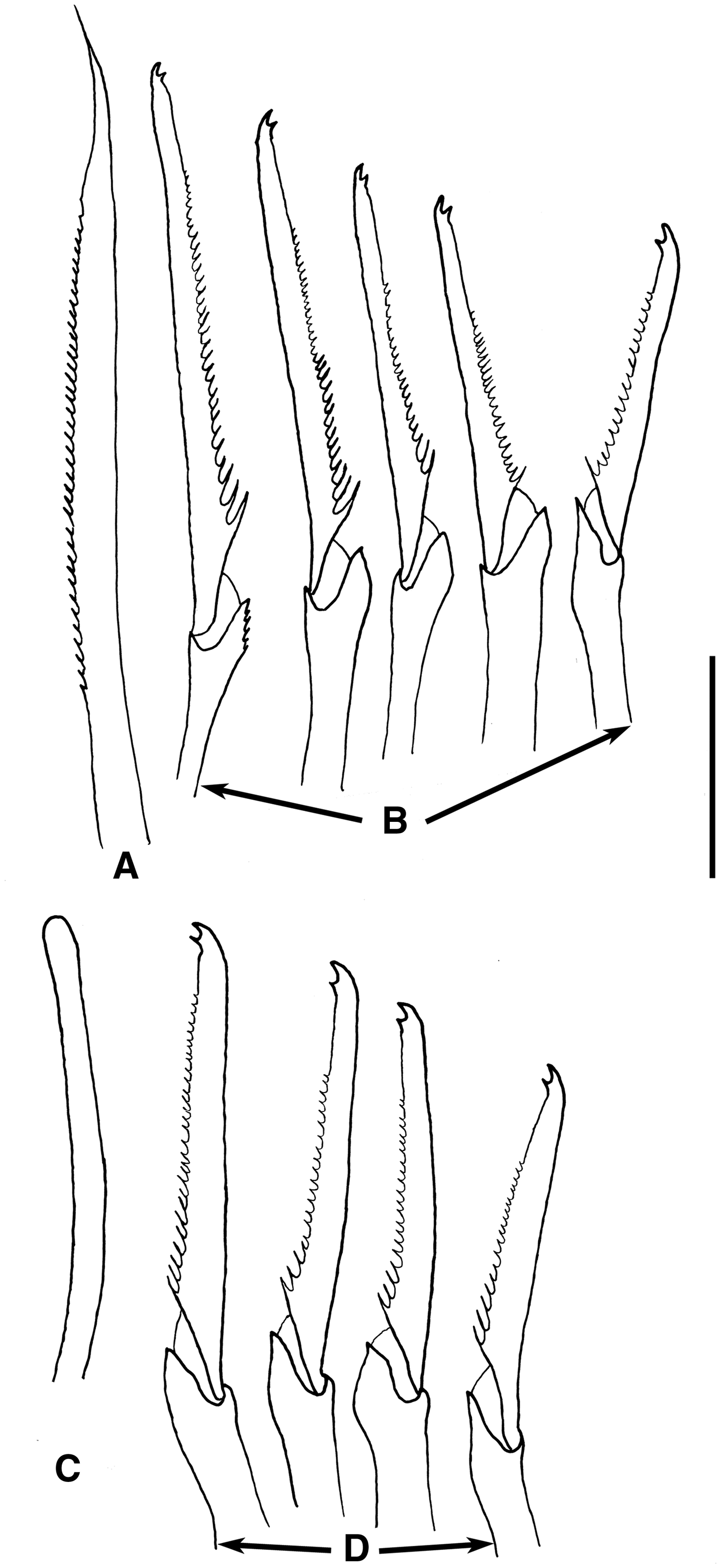
Syllides japonica Imajima, Reference Imajima1966. (A) Dorsal simple chaetae. (B) Compound chaetae, midbody parapodium. Syllides articulosa Ehlers, Reference Ehlers1897. (C) Dorsal simple chaeta. (D) Compound chaetae, midbody parapodium. Scale bars. 20 µm.

Syllides japonicus Imajima, Reference Imajima1966: 112, text- fig. 36. San Martín (Reference San Martín and Ramos2003): 142, fig. 69. San Martín & Hutchings (Reference San Martín and Hutchings2006): 360, figs 86C-F, 87.
Syllides japonica Banse (Reference Banse1971): 1477, fig. 5.
MATERIAL EXAMINED
Station 36 (2) (LBUV), Station 41 (2) (LBUV), Station P (1) (LBUV).
REMARKS
This species is characterized by having slender, distally pointed dorsal simple chaetae (Figure 5A) and compound chaetae with 1–3 basal spines moderately long and curved on the longer blades, absent on shorter ones (Figure 5B). First report from Chile (Patagonia).
DISTRIBUTION
Widely distributed. This species has been reported from Japan, Western Mediterranean, Atlantic coast of USA (Massachusetts) and Australia (San Martín & Hutchings, Reference San Martín and Hutchings2006). Chilean Patagonia (several localities, see Table 1) (this study).
HABITAT
Sand, sandy mud, rhizomes of seagrasses, algae and sponges, in shallow depths (San Martín & Hutchings, Reference San Martín and Hutchings2006). Boulders and sediment bottoms from shallow subtidal (14–30 m depth) and Macrocystis pyrifera holdfasts in fjords and channels from Patagonia. Also inside tubes of Chaetopterus cf. variopedatus (this study).
Syllides articulosa Ehlers, Reference Ehlers1897
Figure 5C, D
Syllides articulosus Ehlers, Reference Ehlers1897: 42, pl. 2, figs 48–52; (Reference Ehlers1912): 18; (Reference Ehlers1913): 487, pl. 31, figs. 4, 5. Hartman (Reference Hartman1964): 89, pl. 28, figs 6, 7. Hartmann-Schröder (Reference Hartmann-Schröder1965): 111, figs 71–73.
Syllides articulosa Banse, Reference Banse1971: 1475.
MATERIAL EXAMINED
Station 36 (1) (LBUV).
REMARKS
This species is characterized by having relatively thick, distally stout dorsal simple chaetae, with compound chaetae lacking basal spurs or long spines, all the spines on margin short (Figure 5C, D). The report of this species in the Western Mediterranean by Somaschini & San Martín (Reference Somaschini and San Martín1997) is probably wrong and should be referred to a different, undescribed species.
DISTRIBUTION
Subantarctic islands. Strait of Magellan area. South Chile (Ehlers, Reference Ehlers1897). Magellan Strait, Chilean Patagonia (this study).
HABITAT
Sand, rhizoids of kelps, sublittoral to 84 m depth (Hartmann-Schröder, Reference Hartmann-Schröder1965). Inside tubes of Chaetopterus cf. variopedatus (this study).
Subfamily Autolytinae Langerhans, 1879
Genus Epigamia Nygren, Reference Nygren2004
Epigamia sp.
(?) Autolytus charcoti Gravier, Reference Gravier1906: 283–285.
Autolytus gibber non Ehlers, Reference Ehlers1897, Hartmann-Schröder (Reference Hartmann-Schröder1965): 129, figs 96–98.
(?) Epigamia charcoti Nygren (Reference Nygren2004): 169, figs 85A–E.
MATERIAL EXAMINED
Station 50 (1) (LBUV).
REMARKS
The specimen agrees with Hartmann-Schröder's (Reference Hartmann-Schröder1965) description of Autolytus gibber non Ehlers, Reference Ehlers1897 from Chile and Argentina. According to Nygren (Reference Nygren2004), this report could likely represent the species E. charcoti or a very close species. Our specimen does not match the description of Autolytus gibber Ehlers, Reference Ehlers1897, considered by Nygren (2014) as a junior synonym of Autolytus maclearanus McIntosh, Reference McIntosh1885. We only have a single specimen so cannot contribute to better identification of this species, however the morphological characters are those of the genus Epigamia.
DISTRIBUTION
Antarctica and subantarctic islands (?) (Nygren, Reference Nygren2004). Chile and Argentina (Ehlers, Reference Ehlers1897). Beagle Channel at Chilean Patagonia (this study).
HABITAT
Fine sand with algae and detritus. 50–174 m depth (Hartmann-Schröder, Reference Hartmann-Schröder1965). Sublittoral. Inside tubes of Chaetopterus cf. variopedatus in fjords and channels (this study).
CONCLUDING REMARKS
The current research improves the taxonomic knowledge of Syllidae family in Chile as well as adding to the marine biodiversity knowledge of the Patagonian region. The number of species of syllids recorded for continental Chile increases to 51. Biological structures have demonstrated to accommodate a high number of polychaete species (Martin & Britayev, Reference Martin and Britayev1998; Pabis & Sicinski, Reference Pabis and Sicinski2010) as well as syllid species (Martins et al., Reference Martins, Magalhaes, Peter, San Martin, Rodrigues and Quintino2013; Álvarez-Campos & Verdes, Reference Álvarez-Campos and Verdes2017). In the same way the studied biological structures such as Macrocystis pyrifera kelp holdfasts and Chaetopterus cf. variopedatus (Renier, Reference Renier1804) tubes (Annelida, Chaetopteridae) appear to be suitable habitats for species of the Syllidae. Chaetopterus tubes are a new habitat for syllids and appear to yield a higher species diversity in comparison to other structures. Syllids possibly colonize these tubes for reproduction, development and/or shelter. Habitats such as Chaetopterus tubes appear to be a solution to the scarcity of suitable places for living due to permanent environmental extreme conditions (strong winds, low temperatures and salinity and surficial ice-cover) found in the fjords and channels region of Chilean Patagonia.
ACKNOWLEDGEMENTS
We thank the crew of BO ‘AGOR Vidal Gormaz’ belonging to the Chilean Navy for support in the CIMAR 15 Oceanographic Cruise and to the crew of ‘Abbate Molina’ belonging to the IFOP for assistance on CIMAR 16 Oceanographic Cruise. We also thank Javier Naretto, Sergio Letelier and two anonymous divers from the Chilean Navy for collecting samples. Many thanks also to Enrique Rodríguez and Esperanza Salvador for help with SEM observations at SIDI, UAM. Finally, the authors thank Matías Peñaloza (Universidad de Valparaiso) for his support on the Paraehlersia drawings and Dr Gordon Paterson for improving the English language of this manuscript.
FINANCIAL SUPPORT
This work was partially supported by Academic Division of Universidad de Valparaiso through Competition of Academic Stays in the country or overseas for Universidad de Valparaiso Academicians. The National Oceanographic Committee funded the Marine Biotopes Project.