INTRODUCTION
Organisms belonging to very distant taxa can converge in the use of ecological resources (Barnes Reference BARNES2003, Hochberg & Lawton Reference HOCHBERG and LAWTON1990, Schluter Reference SCHLUTER1986), and increasing taxonomic divergence may promote increasing mutual intransigence and displacement (Diamond Reference DIAMOND1987). Interaction in the use of food sources or suitable habitats is not negligible and may occur between representatives of different phyla or even kingdoms (Brown et al. Reference BROWN, REICHMAN and DAVIDSON1979, Carpenter Reference CARPENTER1979, Hochberg & Lawton Reference HOCHBERG and LAWTON1990, Kodric-Brown & Brown Reference KODRIC-BROWN and BROWN1979, Schluter Reference SCHLUTER1986).
A major ecological resource for secondary cavity nesters belonging to a variety of taxa is a suitable tree cavity. The influence of the abundance of tree cavities on the density of cavity-nesting birds and the importance of other aspects of nest site availability on shaping avian forest communities has been repeatedly addressed (Löhmus & Remm Reference LÖHMUS and REMM2005, Newton Reference NEWTON1994, Remm et al. Reference REMM, LÖHMUS and ROSENVALD2008, Robles et al. Reference ROBLES, CIUDAD and MATTHYSEN2012, van Balen et al. Reference VAN BALEN, BOOY, VAN FRANEKER and OSIECK1982, von Haartman Reference VON HAARTMAN, FARNER and KING1971, Wesolowski Reference WESOLOWSKI2007) and the same is probably true for cavity nesters belonging to other taxa (Goldingay Reference GOLDINGAY2011, Juskaitis Reference JUSKAITIS1995, Sara et al. Reference SARA, MILAZZO, FALLETA and BELLIA2005). In the tropics the scenario may be more complex because a variety of animals belonging to distant taxa may converge in their interest to use tree cavities. Social hymenopterans, ants, bees and wasps, are abundant in tropical ecosystems and routinely use tree cavities for breeding (Johnsson et al. Reference JOHNSSON, NILSSON and TJERNBERG1993, Oldroyd et al. Reference OLDROYD, LAWLER and CROZIER1994), so they have the potential to interact with vertebrates and between them (Blem & Blem Reference BLEM and BLEM1991, Coelho & Sullivan Reference COELHO and SULLIVAN1994, Juskaitis Reference JUSKAITIS1995, McAtee Reference MCATEE1931, Prange & Nelson Reference PRANGE and NELSON2007, Stanback et al. Reference STANBACK, MERCADANTE, ANDERSON, BURKE and JAMESON2009, Twedt & Henne-Kerr Reference TWEDT and HENNE-KERR2001).
The availability of cavities is crucial in determining the importance that competition for space may have in tropical ecosystems. This fact has been highlighted in studies conducted in mature temperate forest where competition among passerines for natural cavities is practically non-existent, in marked contrast to managed forest areas where the scarcity of tree cavities promotes strong competition (Cornelius et al. Reference CORNELIUS, COCKLE, POLITI, BERKUNSKY, SANDOVAL, OJEDA, RIVERA, HUNTER and MARTIN2008, Wesolowski Reference WESOLOWSKI2007, reviewed by Wiebe Reference WIEBE2011). Similarly, the availability of nest cavities is strongly reduced in savanna in relation to forest in the tropical ecosystems considered in this study (pers. obs.). Most users of tree cavities also show a marked tendency to use nest-boxes as a substitute (Lambrechts et al. Reference LAMBRECHTS, ADRIAENSEN, ARDIA, ARTEMYEV, ATIENZAR, BANBURA, BARBA, BOUVIER, CAMPRODON, COOPER, DAWSON, EENS, EEVA, FAIVRE, GARAMSZEGI, GOODENOUGH, GOSLER, GREGOIRE, GRIFFITH, GUSTAFSSON, JOHNSON, KANIA, KEISS, LLAMBIAS, MAINWARING, MAND, MASSA, MAZGAJSKI, MøLLER, MORENO, NAEF-DAENZER, NILSSON, NORTE, ORELL, OTTER, PARK, PERRINS, PINOWSKI, PORKERT, POTTI, REMES, RICHNER, RYTKONEN, SHIAO, SILVERIN, SLAGSVOLD, SMITH, SORACE, STENNING, STEWART, THOMPSON, TRYJANOWSKI, TOROK, VAN NOORDWIJK, WINKLER and ZIANE2010). Thus, for several decades, nest-boxes have been used as a useful tool to mimic natural cavities and a practical procedure to study cavity-nester communities (Beyer & Goldingay Reference BEYER and GOLDINGAY2006, Fokidis & Risch Reference FOKIDIS and RISCH2005, Goldingay & Stevens Reference GOLDINGAY and STEVENS2009, Koenig et al. Reference KOENIG, GOWATY and DICKINSON1995, van Balen Reference VAN BALEN1984).
In the present study we quantify the occupation of nest-boxes by different taxonomic groups in relation to habitat and season and document potential interactions among taxa in the use of cavities in East African tropical ecosystems. We propose that organisms belonging to distant taxa converge in the use of suitable nesting habitat (nest-boxes), which creates a potential for interaction that may be an important factor in shaping the cavity-nester community. If there are dominance relationships among different taxa, we should expect interdependent spatial and temporal variation in the frequencies with which they occupy nest-boxes. For example, if birds and mammals compete with wasps and between them (Juskaitis Reference JUSKAITIS1995, Sara et al. Reference SARA, MILAZZO, FALLETA and BELLIA2005, Stanback et al. Reference STANBACK, MERCADANTE, ANDERSON, BURKE and JAMESON2009), we would expect that subordinate groups reduce their occupation frequencies during the season and localities where the dominant group occupies more boxes. On the other hand, if competitive interaction occurs, we expect that the percentage of unoccupied boxes will be smaller in savanna, where the availability of tree cavities is lower than in forest. In addition, if some groups can exclude others from nest-boxes, we will find that members of the two groups do not simultaneously use a nest-box.
STUDY AREA AND METHODS
We placed 241 nest boxes in seven localities of Central and Western Kenya that include several of the most representative habitats (forest and savanna) of this African region. We placed the nest-boxes from September–October 2006 (96%) to April–May 2010 and they were checked from 2007 to 2011. We used nest-boxes of three different sizes. Size 1: volume 3890 cm3, entrance-hole diameter of 4.3 cm; size 2: volume 7650 cm3, entrance-hole diameter of 5.4 cm; and size 3: volume 15340 cm3, with a wide rectangular entrance (23 × 8 cm).
The study was conducted in the following areas: (1) Kakamega Forest National Reserve (KA): this is Kenya's largest remnant of the Guinea–Congolian equatorial tropical rain forest found in the western part of the country in Kakamega County. There are numerous grassy clearings and glades. Parts of the forest also contain unique and rich highland ecosystems. Annual precipitation averages 1869 mm and temperature averages 21.3 °C. We placed 40 nest-boxes (14 of size 1, 21 of size 2 and 5 of size 3) in several plots with dense tree cover in 2006 and checked them in 2007 and 2011. (2) Mount Kenya National Park (MK): this is a mountain park in Central Kenya whose habitats include forest, bamboo–Hypericum zone, alpine moorlands, glaciers, tarns, glacial moraines, and ice and rock zones. Annual precipitation averages 1625 mm and temperature averages 12.8 °C. We placed 30 nest-boxes (13 of size 1 and 17 of size 2) in several plots with dense forest in 2007 at an altitude of c. 2200 m asl and checked them from 2008 to 2011. (3) Aberdares National Park (AB): it covers the higher areas of the Aberdares Mountain Range (also known as Nyandarua Mountains) of Central Kenya. It is mostly a forest park with a variety of habitats including a closed canopy highland montane forest, glades, riverine gallery, swamps, bamboo–Hagenia and alpine moorland. We put boxes in several plots with dense forest. Annual precipitation averages 1350 mm and temperature averages 13.8 °C. We placed 30 nest-boxes (13 of size 1 and 17 of size 2) on 2006 in the Salient region of the park at an altitude of c. 2200 m asl and checked them from 2007 to 2011. (4) Lake Naivasha (NA): it is at the highest elevation of the Kenyan Rift Valley in a complex geological combination of volcanic rocks and sedimentary deposits. We established several box plots in private properties throughout the riparian woodlands in the Lake basin. This area is predominantly an open forest of yellow fever acacia (Acacia xanthophloea Benth.). Annual precipitation averages 723 mm and temperature averages 20 °C. We placed 27 nest-boxes (22 of size 2 and 5 of size 3) in 2007 and checked them from 2008 to 2011. (5) Lewa Wildlife Conservancy (LE): this is a private ranch located in Laikipia Plains in North-Central Kenya at the bottom of the northern slopes of Mount Kenya. The vegetation is characteristic of semi-arid savannas: a wooded grassland with scattered trees, mostly belonging to the genera Acacia and Boscia, interspersed with some scarce patches covered with an open forest of yellow fever acacias. Annual precipitation averages 625 mm and temperature averages 20.7 °C. We placed 30 nest-boxes (size 2) in 2010 and added 4 more in 2011. We checked them in 2010 and 2011. (6) Mpala Research Centre (MP): this is also a private ranch in the eastern part of the Laikipia region. The vegetation is also a semi-arid savanna and resembles that of LE, although the density of trees is in general higher in MP. A riverine forest of yellow fever acacias fringes the eastern and part of the northwestern boundaries of this ranch. The altitude of MA is higher than that of LE so that mean temperatures are lower in this locality. Annual precipitation averages 575 mm and temperature averages 18 °C. We placed 40 nest-boxes (35 of size 2 and 5 of size 3) in 2006 and checked them from 2008 to 2011. (7) Samburu National Reserve (SA): it is located in the semi-arid regions that extend northwards from the Laikipia plateau. It is a semi-arid savanna more hot and dry than those on LE and MP. A riverine forest is also present on the reserve. Annual precipitation averages 440 mm and temperature averages 23 °C. We placed 40 nest-boxes (35 of size 2 and 5 of size 3) in 2006 and checked them from 2008 to 2011.
Weather information had several sources. For the Laikipia area we have used the information available in the web page of the Mpala Research Centre (http://www.mpala.org/Maps.php), which comes from the dataset obtained with 70 gauges for measuring rainfall and 3–14 for temperatures distributed around the basin, with approximately 40 y of records (1960–2002). For the Naivasha area we have used the information provided by the private measurements of Ms Sarah Higgins made on her property, close to Naivasha Lake, during the period 1977–2011. For the forest areas, we have used the information for the period 1950–2011, available at http://research.microsoft.com/en-us/projects/fetchclimate/default.aspx.
In general, there is a bimodal rainfall pattern in the Central highlands of Kenya, one during March–May and the other during October–December (Bennun & Njoroge Reference BENNUN and NJOROGE1999). Our checking protocol that involved two visits per year was scheduled to maximize the number of nest-boxes that were occupied as it is well known that for most birds (and indeed for most other animals) reproductive activity in tropical East Africa occurs during these two rainy periods (seasons hereafter), although in some areas, breeding of different species could be recorded throughout the year (Wamiti et al. Reference WAMITI, MALAKI, KIMNI, NALIANYA, KARIUKI and WAGURA2010).
For analytical purposes and based on annual precipitation level and vegetation physiognomy, we have grouped the study localities in two major habitat types: forest and savanna. KA, MK and AB have precipitation well above 1000 mm y−1. The three have a typical forest physiognomy with a relatively high density of big and tall trees. MK and AB have similar trees such as Podocarpus sp., Calodendrum capensis (L.f.) Thunb., Ocotea usambarensis Engl., Juniperus procera Hochst. ex Endl., Vitex keniensis Turill, Croton macrostachyus Hochst. ex Delile and Ficus sp. KA dominant tree genera include Croton, Celtis, Trema, Antiaris, Bequartiodendron and Zanthoxylum. NA receives less precipitation (less than 1000 mm) and the main physiognomy is an open forest chiefly constituted by the yellow fever acacia. We have included all these four localities under the category forest, although in some instances we find convenient to refer to NA as open forest. LE, MP and SA have precipitation rates that range between 625 mm in LE and 440 in SA. The typical physiognomy of these localities is a semi-arid landscape with scattered trees interspersed in a more or less well-developed grassland. We have included these three localities under the category savanna. In total, we put 127 nest-boxes in forest (40 of size 1, 77 of size 2 and 10 of size 3) and 114 in savanna (104 of size 2 and 10 of size 3).
We checked nest-boxes twice a year; once during April–May and once during September–October. We usually spent 2 days in each locality. We noted whether the nest-box was occupied or not and tried to identify as precisely as possible the animals present inside the box. In some cases occupants were not present in the nest-box but their nest structures constituted evidence that they had recently nested there. This happened with bees, paper wasps, mud-dauber wasps and most vertebrates. Wasps always construct typical nest structures that can be easily identified as belonging to a particular species or genus. Vertebrates always leave remains of the nests constructed inside the box. The active occupation by the honeybee (Apis mellifera) was evident in all instances even without opening the nest-box and abandoned combs enabled us to know if the box had been recently occupied. When we found an abandoned nest we tried to establish as accurately as possible if it had been recently abandoned (i.e. it was used in the current season) or earlier. Using this information we classified each nest-box as occupied or not in the current season. The bushbaby (Galago senegalensis) did not build a typical nesting structure as did other groups. However, they usually put a layer of green leaves on the floor of the boxes suggesting that they were occupied for some time as a nesting site or permanent diurnal shelter. In the case of honeybees, it was not infrequent that a comb that was not yet built in the preceding visit (season) was not currently in use when we made the nest-box check. In this case, we considered that it had been occupied during less than one season.
As the study progressed, attrition of the boxes occurred due to a variety of causes. In most instances human honey harvesters stole the nest-boxes, reducing drastically their number in some localities. In addition, it was frequent that boxes were found on the ground because the tree or the branch where it was hung fell due to natural causes. In some instances, boxes were broken or fell down due to an elephant browsing action. More so, it was not infrequent that some boxes could not be checked due to the presence of dangerous animals close to them; because the growth of the vegetation near the tree bearing the box precluded the approach to it; or because the tracks used to gain access to the focal sampling areas were impassable by car or on foot. Although we replaced some lost boxes, the total number available to users steadily decreased as the study advanced. Especially severe was the disappearance of boxes in MP where, since 2009, the number of nest-boxes decreased to less than 10. Thus, we only considered information from 2007 and 2008 for addressing tendencies in continued occupation in this locality.
Our skill for accurately classifying nest-box occupants in the field varied with the taxa. While in some cases we were able to identify species (e.g. honeybees, bushbabies, hornbill species), in most instances we only were able to assign the box occupant to wider taxonomic groups (e.g. ants, rodents, birds, etc.). Based on the evidence found in the boxes, which frequently did not involve an occupant, we established the following groups that enabled us a rapid and unambiguous identification of occupants: ants, honeybees, paper wasps, mud-dauber wasps, rodents, hornbills, starlings, other birds and bushbabies. In some cases, we were able to get a finer classification, for example in the case of ants and birds where we were frequently able to determine genus and/or species. However, the groups described above are enough for the purposes of our working hypothesis, which pursues to compare wide taxonomic groups.
When we address continued occupation of nest-boxes, we consider that a nest-box was occupied without interruption when it was used in two or more consecutive checking seasons by individuals of the same group among those established above. However, to prevent the dilution of the sample size among too many groups we have merged several of these groups to reduce the number of taxonomic categories in the analyses to the following: bees, wasps and vertebrates. Ants have not been considered in this analysis because breeding colonies were present mostly in KA, but this locality was not regularly checked. Data on continued occupation may be biased due to two main circumstances: respectively, more nest-boxes were stolen in savanna than in forest, thus reducing the time they were available to potential users, and the sampling was concluded when part of the boxes were still occupied. Thus, to prevent this bias we compared the occupation periods in forest and savanna by performing a three-factor log-linear analysis including only those instances in which a nest-box was occupied by individuals of the groups considered (bees, wasps or vertebrates) until it was left by its current occupant or reoccupied by individuals of a different group.
RESULTS
Annual, seasonal and habitat variation in the proportion of unoccupied nest-boxes
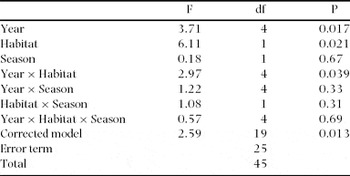
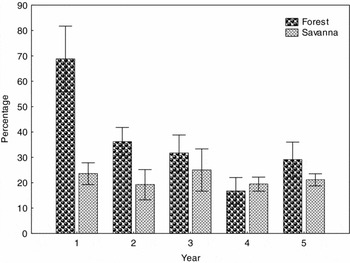
The percentage of unoccupied boxes varied significantly with the year and with the habitat but was not dependent on the season (Table 1). Overall, the percentage of nest-boxes that remained unoccupied was higher in forest than in savanna. However, the difference in the non-occupation values between the two habitat categories was dependent on the number of years elapsed after box placement. The percentage of unoccupied nest-boxes in forest decreased sharply between the first and the second year after nest-box placement and then it tended to become stabilized (Figure 1). This decrease was not recorded in savanna. The percentage of unoccupied boxes was much lower in savanna than in forest in the first year but the occupation figures gradually approached each other and became similar by the third year (Figure 1).
Analysis of variance of the percentage of the nest-boxes that remained unoccupied by hymenopterans or vertebrates in relation to year, habitat (forest/savanna) and season (April–May/September–October) in Kenya. The dependent variable is arcsine-transformed.

Percentage of unoccupied nest-boxes in forest and savanna habitats of Kenya in relation to the number of years elapsed after they were placed. Mean and SE are shown.

Nest-box occupation in relation to habitat and season
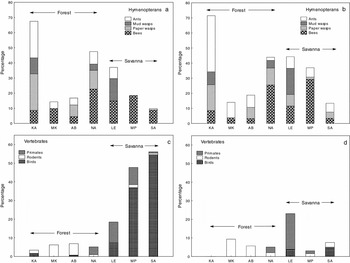
Overall, the hymenopterans occupied a higher proportion of boxes in forest than in savanna (Figure 2), but occupation figures were relatively low in the forests of AB and MK probably because of the prevailing low temperatures. The occupation figures of the most hot and dry savanna (SA) were very low (Figure 2).
Percentage of nest-boxes occupied by hymenopterans (ants, mud-dauber wasps, paper wasps and honeybees) during April–May (a) and September–October (b), and vertebrates (primates, rodents and birds) during April–May (c) and September–October (d) in Kenya. KA: Kakamega Forest; MK: Mount Kenya National Park; AB: Aberdares National Park; NA: Naivasha Lake; LE: Lewa Wildlife Conservancy; MP: Mpala Research Centre; SA: Samburu National Reserve.

Ants appeared linked to forest ecosystems and especially to the KA tropical rain forest (Figure 2). Only in 18 out of 87 boxes in which we detected ants were they nesting inside. Nine of these ant nests were found in KA and three more in the montane forests of AB and MK. In five cases in which the nesting ants could be identified, they belonged to the genus Camponotus. In most instances, ants were not nesting but apparently feeding on remains present inside the nest-box and frequently were identified as Dorylus molestus and Crematogaster sp., which are species that do not nest inside the boxes. In general, the presence of ants in the nest-boxes was more frequent in September–October than in April–May (Figure 2).
We grouped the wasps nesting in the nest-boxes in two groups: paper wasps and mud-dauber wasps. Paper wasps belong to the family Vespidae. Most paper wasp nests were constructed inside the box fixed to its upper part. Paper wasps appeared most frequently in forest although they also occupied some nest-boxes in savanna during September–October (Figure 2). Mud-daubers appeared with similar frequencies in forest and savanna localities. However, they seem to avoid the cool forests of AB and MK and the driest savannas, where they were completely absent (Figure 2).
The honeybee constructed combs in the nest-boxes both in forest and savanna, although they seem to prefer open forest (NA) and savannas that are not extremely dry nor hot (LE and MP). Honeybees occupied nest-boxes in both seasons with very similar frequencies (Figure 2).
Among vertebrates, birds and mammals were almost the only occupants of the nest-boxes. Some geckos have not been included among nest-box occupants because they always were found in the hollows between the box and the tree. Birds rarely nested in nest-boxes placed in forest. Even in open forest (NA) we did not detect avian breeding (Figure 2). The scarce breeding attempts recorded in KA and AB in April–May corresponded to the great blue-eared starling (Lamprotornis chalybaeus) and to an unknown species. However, birds frequently used nest-boxes in savanna. Birds were especially prone to use nest-boxes in more arid and hot savannas and mostly during April–May. More than 90% of bird nesting attempts in savanna were due to hornbills (Von der Decken's hornbill (Tockus deckeni), red-billed hornbill (T. erythrorhynchus) and eastern yellow-billed hornbill (T. flavirostris)). Other species identified as breeders were the great blue-eared starling, Hildebrandt's starling (Lamprotornis hildebrandti), grey-headed sparrow (Passer griseus) and an unidentified dove (Columbidae). Nest-box occupation during September–October was occasional in savanna and seemed to happen only in years with relatively heavy and prolonged rains (pers. obs.).
The mammals present in the nest-boxes belonged to the orders Rodentia and Primates. Only on one occasion did a slender mongoose (Herpestes sanguineus) breed in a nest-box. The rodents observed were several undetermined species of tree squirrels and mice. They constructed nests inside the nest-boxes and we confirmed the presence of litters on several occasions. Rodents were detected in all localities with the exception of LE, but they were recorded more frequently in forest than in savanna. The occupation values by rodents varied only slightly between seasons suggesting that they bred on the nest-boxes across the year (Figure 2). Thus, among vertebrates, rodents predominate in the nest-boxes placed in forest while birds are the main occupants in savanna.
The bushbaby was the only primate observed to use the boxes. It occupied nest-boxes in open forest (NA) and savanna, although occupation figures were very low on dry and hot savannas (SA). No bushbaby was detected in rain forests (KA) or montane forests (MK, AB). Occupation figures varied slightly between seasons indicating that they probably used the boxes throughout the entire year.
Length and simultaneity of nest-box occupation
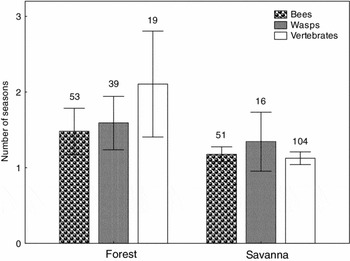
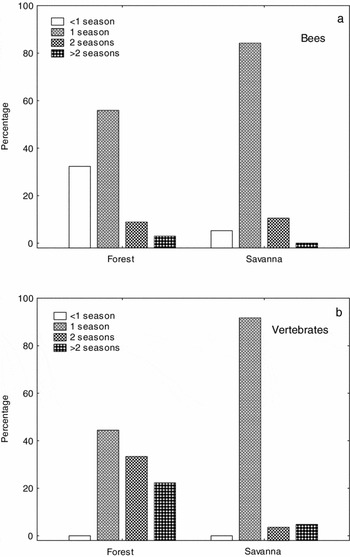
Each of the three groups considered occupied the nest-boxes during a longer period in forest than in savanna (Figure 3). There was a significant three-factor interaction between taxon, habitat and number of seasons in which a nest-box remained occupied by members of the same group. This indicates that the occupation lapse varied between the three focal groups (χ2 = 52.5, df = 2, P < 0.0001). The occupation lapse was dependent on the habitat for bees and vertebrates (bees: χ2 = 15.2, df = 1, P = 0.0001; vertebrates: χ2 = 140, df = 1, P < 0.0001) but not for wasps (χ2 = 0.055, df = 1, P = 0.81). Bees in forest occupied a nest-box during one season in more than 50% of the cases and frequently the combs lasted less than one season (Figure 4). In savanna, the occupation was longer: in nearly 90% of the instances, it lasted one season while cases of shorter periods were not detected. However, bees only occasionally kept a nest-box for more than two consecutive seasons. Occupation by vertebrates was in general longer than by hymenopterans and lasted more in forest than in savanna (Figure 4).
Number of consecutive seasons in which nest-boxes remained occupied by the same taxonomic group in forest and savanna habitats of Kenya. Mean and SD are shown. Number of nest-boxes is given above bars.

Duration of nest-box occupation in relation to habitat in Kenya. The percentage of nest-boxes occupied in relation to the length of the continuous stay is given for honeybees (a) and vertebrates (b); results for wasps are not given because they did not show significant variation with respect to habitat.

In 18 instances in which we detected ant colonies breeding in the nest-boxes we observed no other hymenopterans or vertebrates occupying the same box simultaneously. In the case of wasps, we recorded 93 cases in which the nest-box was occupied by a single species and four cases in which two different species of wasp shared the box. Honeybees did not enable us to check inside the nest-box, so that we assume that no wasp, ant or vertebrate was able to use a nest-box simultaneously with a colony of bees (133 active combs were observed). We recorded 172 cases in which a vertebrate species occupied a nest-box to breed. In all these cases, no other hymenopteran or vertebrate was breeding inside. We observed, however, that ants of the genera Dorylus and Crematogaster frequently foraged inside the nest-boxes.
DISCUSSION
Does nest-box occupation reveal competitive interaction between taxa?
A variety of social insects and vertebrates occupied nest-boxes, suggesting that many phylogenetically distant organisms can use tree cavities in the tropical ecosystems of East Africa. The results also suggest that interaction between distant taxa is an important determinant of the occupation patterns recorded in this study. It is remarkable that only in a very low number of cases did we detect individuals belonging to the groups here considered sharing the same nest-box. This result contrasts with the fact that other arthropods were usually found in the same box where social insects or vertebrates were breeding (pers. obs.). This suggests that hymenopterans and vertebrates are more intolerant between them than with other animal groups and that they are presumably competing for space. This result, however, does not tell us anything about who wins in these struggles. The phenomenon of occupation precedence or prior residence often influences an individual's probability of gaining resources in territorial systems of many invertebrate and vertebrate taxa (Austad Reference AUSTAD1983, Bentley et al. Reference BENTLEY, HULL, HARDY and GOUBAULT2009, Chellappa et al. Reference CHELLAPPA, YAMAMOTO, CACHO and HUNTINGFORD1999, Eden Reference EDEN1987, Figler et al. Reference FIGLER, KLEIN and PEEKE1976, Kemp & Wiklund Reference KEMP and WIKLUND2001, Koivula et al. Reference KOIVULA, LAHTI, ORELL and RYTKöNEN1993, Snell-Rood & Cristol Reference SNELL-ROOD and CRISTOL2005, Tricarico & Gherardi Reference TRICARICO and GHERARDI2010). However, assuming that the resolution of the conflict also depends on the value of the disputed resource and on the resource-holding potential of contenders (sensu Maynard-Smith & Parker Reference MAYNARD-SMITH and PARKER1976), the outcome of interactions in our study might be consequence of the varied skills of the groups competing for the nest-boxes.
For example the honeybee, which has the greatest potential among the social hymenoptera to hurt and even kill a big animal, once having established a comb in a cavity the colony does not tolerate another hymenopteran or vertebrate species inside or too close to it and restrains the opportunities of other potential users to occupy the cavity until they decide to leave. We have observed that honeybees remained longer in boxes in savanna than in forest once the effect of nest-box availability was allowed for. This tendency may be caused by a more stable food supply in savanna or by a higher incidence of comb parasites and unfavourable weather conditions in forest. It is known that colonies departing after a long stay frequently left barren combs behind, suggesting they had probably moved out in response to deteriorating resources (Dyer & Seeley Reference DYER and SEELEY1994). On the other hand, honeybee colonies show intrinsic nest relocation that is characterized by periodical departure for another similar nesting environment as part of their life history (McGlynn Reference MCGLYNN2012, McNally & Schneider Reference MCNALLY and SCHNEIDER1992), which frequently makes available their nesting cavities. However, whether some of the potential competitors of bees may in some unknown way force a swarm to leave a comb or bees are able to take over a cavity already occupied by a colony of ants, wasps or by a vertebrate is not yet known.
The case with other hymenopterans may be different. For example, paper wasps may constitute nesting colonies of many individuals. Such concentrations may be discouraging for other insects or even vertebrates. In temperate areas it has been stated that birds may win in the competition with the social golden paper wasp (Polistes fuscatus) (Stanback et al. Reference STANBACK, MERCADANTE, ANDERSON, BURKE and JAMESON2009), but high nest-site tenacity has been described in the hornet (Vespa crabro) competing with birds and mammals for nest-boxes (Langowska et al. Reference LANGOWSKA, EKNER, SKORKA, TOVOLKA and TRYJANOWSKI2010). We have shown that paper wasps are practically absent from savanna boxes during April–May, the best season for bird breeding, but not in September–October, which strongly suggests that birds displace paper wasps from the boxes. It is possible that paper wasps breed mostly during September–October in savanna not to avoid nesting birds but because they can find more food after the dry season. In temperate areas, there is some evidence that nest-boxes occupied by wasps and hornets are not used by a small rodent, the common dormouse (Muscardinus avellanarius) (Juskaitis Reference JUSKAITIS1995). We do not have enough data to discuss if rodents are discouraged from using nest-boxes by the presence of wasps in tropical ecosystems though it seems likely that competitive interactions between vertebrates and paper wasps may have very different outcomes in tropical areas, where nest initiations for mammals, birds and wasps are less likely to be synchronized (Stanback et al. Reference STANBACK, MERCADANTE, ANDERSON, BURKE and JAMESON2009). In some cases, we have found mud-daubers and paper wasps nesting together in the same box suggesting that they may be relatively tolerant of each other. Nevertheless, we have not found active nests of mud-daubers in boxes occupied by vertebrates, which suggests that vertebrates eject wasps or that wasps are reluctant to share cavities with them.
It is not clear who dominates among vertebrates in the eventual competition to access cavities. Within classes, dominance is mostly based on size or mass hierarchy (Drummond Reference DRUMMOND2006, Hsu et al. Reference HSU, EARLEY and WOLF2006), but the rules may be different between classes because of the different skills of each class member. Our results indicate that rodents occupy boxes mostly in forest where the availability of natural cavities is very high and few birds used boxes. On the other hand, in savanna, where many rodents are potential users of boxes, the occupation by members of this group was surprisingly low. It is possible that hornbills (the most frequent occupant of boxes among birds), having a robust bill, are able to successfully displace rodents from boxes or they occupy them earlier so that they have an advantage based on precedence. Interestingly, rodents appear, although in low numbers, in savanna during September–October, when birds no longer hold control on boxes. In temperate ecosystems, it has been stated that several rodent species may negatively affect densities of cavity-nesting birds but the effects seems to depend on the aggressiveness of the species involved (Juskaitis Reference JUSKAITIS1995, Koppmann-Rumpf et al. Reference KOPPMANN-RUMPF, HEBERER and SCHMIDT2003, Sara et al. Reference SARA, MILAZZO, FALLETA and BELLIA2005). In any case, the existence of competition between birds and rodents, and perhaps other mammals, for nest-boxes seems warranted.
Interaction between taxa and the limitation of cavity nester populations
The eventual existence of competition for space among distantly related cavity nesters is probably closely dependent on the regular availability of adequate nesting cavities. For example, in avian communities of temperate and subtropical areas, competition for nesting sites is very low in mature forest but strong in secondary serial or managed forests where the number of cavities is drastically reduced (Cornelius et al. Reference CORNELIUS, COCKLE, POLITI, BERKUNSKY, SANDOVAL, OJEDA, RIVERA, HUNTER and MARTIN2008, Wesolowski Reference WESOLOWSKI2007, but see Löhmus & Remm Reference LÖHMUS and REMM2005). Our results in tropical areas show that nest-box occupation by birds was lower in forest than in savanna at least during the first 2 y of our study, which may be a direct consequence of the abundance of tree cavities in forest ecosystems that minimizes the competition for nesting sites among obligate cavity nesters. However, not all boxes had to be evaluated by potential occupants as optimal nesting sites because several characteristics such as orientation, sunshine exposure, parasites and predation risk can differ between them. It is important to consider cavity quality when assessing cavity availability and nest-site limitation (Cornelius et al. Reference CORNELIUS, COCKLE, POLITI, BERKUNSKY, SANDOVAL, OJEDA, RIVERA, HUNTER and MARTIN2008, Johnsson et al. Reference JOHNSSON, NILSSON and TJERNBERG1993, Löhmus & Remm Reference LÖHMUS and REMM2005). Thus, the existence of unoccupied nest-boxes in both forest and savanna does not imply necessarily that the nesting sites are not limited for tropical cavity-nester communities.
A crucial issue is to establish whether eventual competition between distantly related cavity-nester taxa have a role in limiting their populations. Our study is limited in this respect because the range of nest-box sizes and entrance holes only covers a part of those existing in nature, which reduces our view of the problem. Honeybees for example usually need relatively large cavities to establish a comb and can compete with vertebrates bigger than those using our nest-boxes. It has been documented that honeybees may usurp boxes otherwise used by screech owls and great crested flycatchers (Twedt & Henne-Kerr Reference TWEDT and HENNE-KERR2001). At the other extreme, some studies have established that honeybees can use cavities as small as 5000 cm3 (Prange & Nelson Reference PRANGE and NELSON2007) and we have found combs in our smallest boxes (3890 cm3). These results indicate that bees may be a serious competitor of many animals impeding the access to a great variety of cavity sizes, and in places where they are abundant they might limit the numbers of other cavity nesters (pers. obs.).
The impact that competition for nesting sites may have on limiting population numbers relies on the degree of synchrony in its use by potential competitors (Stanback et al. Reference STANBACK, MERCADANTE, ANDERSON, BURKE and JAMESON2009). In temperate areas, the production of food resources is clumped on a short season for most animals. However, in tropical ecosystems food availability is evenly distributed across the year and the breeding season is frequently protracted. Our results indicate that in most instances, the ownership of nest-boxes were kept for only one season suggesting that nest-boxes may be used serially by members of several taxonomic groups therefore minimizing competition between them. However, it was not infrequent, especially in mammals, that boxes were retained over several years. As prolonged ownership probably gives an advantage in retaining the box even against stronger competitors (Arnott & Elwood Reference ARNOTT and ELWOOD2008, Snell-Rood & Cristol Reference SNELL-ROOD and CRISTOL2005, Takeuchi Reference TAKEUCHI2006, Takeuchi & Honda Reference TAKEUCHI and HONDA2009), this permanent occupation may represent a strategy to secure long-term nest-site ownership. Some of our results also suggest that some taxa limit the occupation by others. Rodents occupied nest-boxes mostly in forest, where hornbills did not use boxes, although the latter bred in high numbers within natural cavities on this habitat. However, rodents were practically absent in savanna boxes during April–May, when they were intensively used by hornbills, but some individuals used them in September–October when boxes were no longer used by birds.
Management implications
A variety of animals can use nest-boxes to breed or as a temporary shelter in tropical ecosystems of East Africa. Nest-boxes have proved to be a useful tool for enhancing population levels of cavity-nesting birds in temperate areas (Cockle et al. Reference COCKLE, MARTIN and DREVER2010, Twedt & Henne-Kerr Reference TWEDT and HENNE-KERR2001) and our study suggests that a similar result can be attained in tropical areas. Bushbabies regularly used the boxes and frequently bred in them. These primates may, in savanna habitats, experience the same shortage of suitable cavities as birds so the provisioning of nest-boxes is a potential measure to increase reproductive efficiency of this little-studied primate (Obaldia et al. Reference OBALDIA, OTERO, MARIN, APARICIO and CISNEROS2011). Predators and possibly bigger mammals can also breed within appropriate size of nest-boxes. In fact, the variety of occupants can undoubtedly be increased by expanding the types and sizes of boxes used (Lambrechts et al. Reference LAMBRECHTS, ADRIAENSEN, ARDIA, ARTEMYEV, ATIENZAR, BANBURA, BARBA, BOUVIER, CAMPRODON, COOPER, DAWSON, EENS, EEVA, FAIVRE, GARAMSZEGI, GOODENOUGH, GOSLER, GREGOIRE, GRIFFITH, GUSTAFSSON, JOHNSON, KANIA, KEISS, LLAMBIAS, MAINWARING, MAND, MASSA, MAZGAJSKI, MøLLER, MORENO, NAEF-DAENZER, NILSSON, NORTE, ORELL, OTTER, PARK, PERRINS, PINOWSKI, PORKERT, POTTI, REMES, RICHNER, RYTKONEN, SHIAO, SILVERIN, SLAGSVOLD, SMITH, SORACE, STENNING, STEWART, THOMPSON, TRYJANOWSKI, TOROK, VAN NOORDWIJK, WINKLER and ZIANE2010). On the other hand, the high occupation of nest-boxes by honeybees is evidence that even simple and small boxes can attract swarms. Populations of honeybees are experiencing a general decrease throughout the world (Ellis et al. Reference ELLIS, EVANS and PETTIS2010, Neumann & Carreck Reference NEUMANN and CARRECK2010, Potts et al. Reference POTTS, BIESMEIJER, KREMEN, NEUMANN, SCHWEIGER and KUNIN2010, van Engelsdorp & Meixner Reference VAN ENGELSDORP and MEIXNER2010, van Engelsdorp et al. Reference VAN ENGELSDORP, HAYES, UNDERWOOD, CARON and PETTIS2011, but see Steffan-Dewenter et al. Reference STEFFAN-DEWENTER, POTTS and PACKER2005) so the use of simple and cheap boxes may be a handy way to help this species. Special designs of nest-boxes that selectively attract some groups or species can be tried (Beyer & Goldingay Reference BEYER and GOLDINGAY2006, Catal et al. Reference CATAL, ODOM, BANGMA, BARRETT and BARRETT2011, Ciechanowski Reference CIECHANOWSKI2005, Goldingay et al. Reference GOLDINGAY, GRIMSON and SMITH2007, Goldingay & Stevens Reference GOLDINGAY and STEVENS2009, Rhodes & Jones Reference RHODES, JONES, LAW, LUNNEY and LUMSDEN2011) and the implementation of defences against nest predators can greatly improve the effect of nest-boxes on focal populations (Greene & Jones Reference GREENE and JONES2003, Yamaguchi et al. Reference YAMAGUCHI, KAWANO, YAMAGUCHI and SAITO2005).
ACKNOWLEDGEMENTS
We are greatly indebted to the following institutions and landowners for allowing us to carry out this study on their properties: Kenya Wildlife Service, Samburu County Council, Lewa Wildlife Conservancy, Mpala Research Centre; and in Naivasha Lake, Oserian, Little Owls Sanctuary, Elsamere Field Study Centre, Crater Lake Sanctuary and Camp Carnelly's. Special thanks to Ms Sarah Higgins for sharing her weather data. We cannot forget the kind assistance received from the many field assistants who worked with us from the Ornithology and Invertebrate Zoology Sections of the National Museums of Kenya and all the field stations. Many other people, not mentioned here, helped in various valuable ways. We also thank R. Goldingay and an anonymous reviewer for their constructive criticism. This research has been carried out with the financial support from the Spanish Government, projects CGL2004-00126/BOS, CGL2005-05611-C02-01, CGL2008-02843 and CGL2011-28095.