


Introduction
The evidence base for using cognitive behavioural therapy (CBT) with people with intellectual disabilities is growing (e.g. Willner et al., Reference Willner, Rose, Jahoda, Stenfert Kroese, Felce and MacMahon2013) and recently studies have begun to report aspects of therapeutic process for this client group. For example, Jahoda et al. (Reference Jahoda, Selkirk, Trower, Pert, Kroese and Dagnan2009) examined the balance of power within 15 therapy dyads involving people with mild intellectual disabilities at therapy sessions 4 and 9. The analyses of the pattern of interaction showed that whilst the therapists asked significantly more questions, the clients contributed to the content and flow of therapy and played an active part in dialogues. This paper suggests that therapists’ use of questions may be an important area to study in order to understand how a collaborative and equal experience is achieved in cognitive therapy with people with intellectual disabilities.
James, Morse and Howarth (Reference James, Morse and Howarth2010) described a taxonomy of question types in CBT. They also discuss how the context of therapy will change the types of questions that a therapist may use, giving the example of the need for short, clear and concrete questions when working with someone who is depressed. The present paper describes the development and initial application of this taxonomy of question types to CBT with people with intellectual disabilities.
Method
Participants
Data were available from a larger study of interactions in CBT (Jahoda et al., Reference Jahoda, Selkirk, Trower, Pert, Kroese and Dagnan2009) for people with intellectual disabilities, who were referred with a primary presenting problem of anger, anxiety or depression and where two therapy sessions (sessions 4 and 9) for 15 therapy dyads were digitally recorded and fully transcribed. The clients were eight men and seven women, with a mean age of 35.7 (SD = 9.3) and a mean IQ score of 66.7 (SD = 8.98). The client and therapist characteristics are fully described in Jahoda et al. (Reference Jahoda, Selkirk, Trower, Pert, Kroese and Dagnan2009). The interventions were carried out by six clinical psychologists with experience of using CBT with people who have intellectual disabilities. A formulation driven CBT approach was used and fidelity data is reported fully in Jahoda et al. (Reference Jahoda, Selkirk, Trower, Pert, Kroese and Dagnan2009).
Measures
The coding scheme by James et al. (Reference James, Morse and Howarth2010) described 16 question types and gives a definition and example of each question type; the second and third authors used this to code example interactions (from the beginning, middle and end of each transcript) from three therapy sessions that were not part of the subsequent data set. The coding scheme was then developed to reduce the discrepancies found between raters. The raters then coded a further three transcripts and the above process was repeated. The revised definitions and example questions are presented in the extended report that is available from the first author.
Data coding
All therapy transcripts were coded by the third author. Each therapy transcript was divided into quarters based upon the therapy duration; the total number of questions, the number of each question type for the full transcript and for each quarter was thus available for analysis.
Results
Fifteen randomly selected transcriptions were coded for reliability by the second author. The agreement on whether an utterance was a question was calculated using the utterances identified as questions by rater one and comparing them to the utterances identified as questions by rater two (percentage agreement = 96.1%). Percentage reliability and kappa were then calculated across all 16 question types for each transcription based upon the questions identified by the second author. Percentage agreement and kappa for the coding was calculated (percentage agreement mean = 70.0%, range 61.4% - 89.4%; kappa mean = 0.65, range 0.56–0.87).
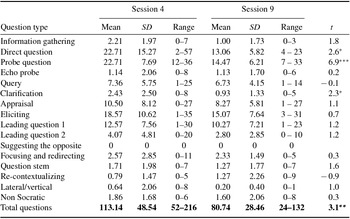
Table 1 shows the mean number of each question type in the 15 pairs of transcripts analysed. The three most frequent question types in sessions 4 and 9 are “direct questions” (concrete questions), “probes” (follow-up questions to elicit more detail), and “eliciting questions” (questions to elicit thoughts and assumptions). Some question types were rarely observed in these sessions, in particular “suggesting the opposite” (deliberately suggesting an extreme view to engage the client in reflecting on the issues), “re-contextualizing” (questions containing contextual information in the question to aid recall facts about past events) and lateral/vertical questions (looking for current and historical themes associated with a client's difficulties).
Means, Standard Deviation (SD) and Range for question types in session 4 and session 9; t values for repeated measures t-test comparing session 4 and 9

*p < .05; **p < .01; ***p < .001)
Table 1 shows that the number of questions asked in session 4 were significantly greater than in session 9 (t = 3.05, df = 13, p < .01) and there is a significant correlation between the total number of questions asked at both time points (r = 0.54, df = 13, p < .05). Table 1 shows the number of each question type at each time point; only “direct questions”, “probes” and “clarifications” individually show a significant difference between time points. It is possible that the greater use of questions at session 4 is a product of there being more “turns” in earlier sessions; however, the mean total number of turns in Session 4 was 454.4 (SD = 204.4) and in session 9 was 394.8 (SD = 175.9; t = 1.1, df = 14, ns). The total number of questions asked by the therapist was significantly correlated with the total number of turns at session 4 (r = 0.67, df = 13, p <.01) but not at session 9 (r = 0.35, df = 13, ns).
The total number of questions in each quarter of the session was compared. In session 4 there was a mean of 28.1 (SD = 13. 3) questions in quarter 1, 28.8 (SD = 11.7) in quarter 2, 28.1 (SD = 12.8) in quarter 3 and 20.8 (SD = 11.5) in quarter 4; a repeated measures ANOVA identifies a significant difference in the number of questions across the quarters (F = 3.35, df = 3, p < .05), with less questions being asked in quarter 4. In session 9 there was a mean of 21.1 (SD = 8.4) questions in quarter 1, 21.4 (SD = 11.2) in quarter 2, 21.5 (SD = 6.1) in quarter 3 and 13.8 (SD = 7.4) in quarter 4; there was a significant difference in the number of questions across the quarters in session 9 (F = 5.96, df = 3, p < .01), with less questions being asked in quarter 4.
Correlations were carried out using the three most common question types (“direct” questions, “probes” and “eliciting” questions) and the total number of questions with IQ score, age and gender. At session 4 there was a significant correlation of “eliciting” questions with age (r = 0.63, df = 13, p < .05); these variables were not significantly correlated at session 9 (r = 0.29, df = 12, ns). There was a significant correlation between IQ scores and total number of questions at session 4 (r = 0.58, df = 11, p < .05), at session 9 this association was not significant (r = −0.14, df = 11, ns); there are no significant correlations between IQ and total number of turns at either time point. There were no significant correlations of gender and total questions or question type.
Discussion
The categorization of questions from James et al. (Reference James, Morse and Howarth2010) was adapted and applied to cognitive behaviour therapy transcriptions involving people with intellectual disabilities with moderate to substantial levels of agreement (Landis and Koch, Reference Landis and Koch1977). It is possible that further refinement of the taxonomy might result in even greater reliability; however the level of reliability achieved is impressive given the complexity of the taxonomy. There are some simple effects within and across sessions; significantly fewer questions asked between the fourth and ninth sessions and there is a smaller correlation between the number of turns and the number of questions at the ninth compared to the fourth sessions. The question types that show a reduction in usage between time points 4 and 9 are those concerned with information gathering. There is a slight reduction in the total number of turns between time points, but this is not significant. These data suggest that therapists use more processing than recall questions in later sessions (Hargie and Dickson, Reference Hargie and Dickson2004), suggesting a more active engagement in therapy change processes. Therapists also use significantly fewer questions in the final quarter of the sessions at both time points, which suggest that they bring less new material into sessions in the closing stages.
There is positive correlation between number of questions and IQ score at session 4, but not between IQ score and number of turns in the session. Thus more turns are spent in question-focused interaction for those with higher ability in early sessions; this suggests that therapists are adapting their therapeutic style based upon ability in the early stages of therapy.
There is considerable potential for the further analysis of therapy interactions with people with intellectual disabilities. Therapy process research is well developed with people without intellectual disabilities although clear links between process and outcome have proven hard to establish (Llewelyn and Hardy, Reference Llewelyn and Hardy2001). Llewelyn and Hardy suggest three broad types of process research: studies that are primarily descriptive studies, studies that examine theoretically driven links between process and outcome, and studies that examine the relationship between psychotherapy specific process and theories of change. The therapy literature for people with intellectual disabilities is still at a stage where descriptive process research adds richness to our understanding of therapy with this client group. The descriptive coding scheme presented here will be useful in future studies; for example in comparing how questioning styles differ in CBT for people with anxiety and depression, in studying the questioning style of therapists with greater and lesser experience, and in exploring more complex sequences of questions such as Socratic questions (James et al., Reference James, Morse and Howarth2010).
Acknowledgements
The authors assert that all procedures contributing to this work comply with the ethical standards of the relevant national and institutional committees on human experimentation and with the Helsinki Declaration of 1975, as revised in 2008.
Data collection for this study was funded by the Chief Scientist's Office at the Scottish Executive (CZH/4/181).
Conflict of interest
None.
Supplementary materials
To view supplementary material for this article, please visit http://dx.doi.org/10.1017/S1352465815000193




Comments
No Comments have been published for this article.