Introduction
A significant number of youth have mental health difficulties (Costello et al. Reference Costello, Egger and Angold2005), but are not receiving treatment (Ravens-Sieberer et al. Reference Ravens-Sieberer, Willie, Erhart, Bettge, Wittchen, Rothenberger, Herpertz-Dahlmann, Resch, Holling, Bullinger, Barkmann, Schulte-Markwort and Dopfner2008). A major research review reported a prevalence rate of 12% for child and adolescent mental health disorders (Costello et al. Reference Costello, Egger and Angold2005), but it is difficult to ascertain rates specifically for adolescents as many studies include children and adolescents (Patel et al. Reference Patel, Flisher, Hetrick and Mc Gorry2007).
In the literature different terminology is used to describe adolescent mental health difficulties depending on whether a dimensional or categorical approach was used in the study (Ford Reference Ford2008). Some studies report general emotional and behaviour difficulties, which indicate the young person may be at risk of a mental health disorder (e.g. Barkman & Schulte-Markwort Reference Barkman and Schulte-Markwort2005), while other studies report rates of clinically diagnosed mental disorders (e.g. Costello et al. Reference Costello, Angold, Burns, Stangl, Tweed, Erkanli and Worthman1996). In keeping with the dimensional approach, two groups of emotional and behavioural problems, termed internalising and externalising difficulties have been recognised by Achenbach and Rescorla (Reference Achenbach and Rescorla2001). Internalising difficulties are defined as ‘problems mainly within the self’ and denote emotional problems such as anxiety and depression, (Achenbach & Rescorla Reference Achenbach and Rescorla2001, p. 24). Externalising difficulties can be defined as conduct problems such as aggression and rule-breaking behaviour. These groupings of emotional and behavioural problems are indicative of potential long-term mental health problems and clinical disorders (Gyllenberg et al. Reference Gyllenberg, Sourander, Niemela, Helenius, Sillanmaki, Oiha, Kumpulainen., Tamminen, Moilanen and Almqvist2010; Morcillo et al. Reference Morcillo, Duarte, Sala, Wang, Lejuez, Kerridge and Blanco2012). They also cause disruption to social life and academic success (Patel et al. Reference Patel, Flisher, Hetrick and Mc Gorry2007). This study aims to identify those adolescents who are experiencing mental health problems, as opposed to those actually diagnosed with a mental health disorder, and thus will utilise a dimensional approach to assess mental health problems.
Adolescent depression, deliberate self-harm and suicide
Depressive disorders increase in prevalence in adolescence and this is also the period of time when a gender difference emerges, for example there are greater rates of depression among girls around the age of 13–14 years (Nolen-Hoeksema Reference Nolen-Hoeksema1990; Duggal et al. Reference Duggal, Carlson, Sruofe and Egeland2001). A meta-analysis of epidemiological studies found that 5.6% of adolescents received a diagnosis of depression (Costello et al. Reference Costello, Erkanli and Angold2006). Suicidal thoughts are among the key symptoms of depression (DSM-5; American Psychiatric Association 2013). Adolescent females generally report more suicidal ideation and deliberate self-harm (DSH) than males (Morey et al. Reference Morey, Corcoran, Arensman and Perry2008), yet males are significantly more likely to die by suicide [National Office for Suicide Prevention (NOSP) 2009]. As depression is a significant risk factor for adolescent self-harm and suicide (Pagliaro Reference Pagliaro1995; Hawton et al. Reference Hawton, Kingsbury, Steinhardt, James and Fagg1999; Fliege et al. Reference Fliege, Lee, Grimm and Klapp2009), early identification and treatment programmes are vital (Kessler et al. Reference Kessler, Berglund, Demler, Jin, Merikangas and Walters2005). Community studies on the prevalence of adolescent DSH are essential as most episodes of adolescent self-harm do not come to hospital attention (Hawton & Rodham, Reference Hawton and Rodham2006; Madge et al. Reference Madge, Hewitt, Hawton, de Wilde, Corcoran, Fekete, van Heeringen, Deleo and Ystgaard2008). In terms of accessing services, adolescents may fear seeking help for mental health difficulties due to concerns about lack of anonymity, and the stigma attached to mental illness (Booth et al. Reference Booth, Bernard, Quine, Kang, Usherwood, Alperstein and Bennett2004; Boyd et al. Reference Boyd, Francis, Aisbett, Newnham, Sewell, Dawes and Nurse2007).
Risk factors for mental health difficulties in adolescents
While it is important to quantify rates of mental health difficulties, we also need to identify risk factors in order to deliver appropriate interventions (Weisz & Hawley Reference Weisz and Hawley2002). Some of the factors that are found to be associated with poorer mental health include certain coping skills, family dysfunction and academic difficulties (McWilliams et al. Reference McWilliams, Cox and Enns2003; Ford et al. Reference Ford, Goodman and Meltzer2004; Myklestad et al. Reference Myklestad, Roysamb and Tambs2012).
Coping strategies
There is a growing body of international research linking particular coping strategies with poorer mental health (e.g. Endler & Parker Reference Endler and Parker1990b; McWilliams et al. Reference McWilliams, Cox and Enns2003). Specifically, emotion-focussed coping (i.e. rumination, self-blame, anger and crying) has been linked to depression (McWilliams et al. Reference McWilliams, Cox and Enns2003) and anxiety (Endler & Parker Reference Endler and Parker1990b).
Academic competence
Another area of influence on mental health is competence (Cole et al. Reference Cole, Jacquez and Maschman2001). A lack of academic competence has been a suggested risk factor for the development of externalising problems (Reinke & Herman Reference Reinke and Herman2002). A longitudinal study in Norway found academic difficulties were a significant risk factor for mental health difficulties in adolescents (Myklestad et al. Reference Myklestad, Roysamb and Tambs2012). Specifically, reading difficulties have been shown to contribute to the development of conduct disorder (Bennett et al. Reference Bennett, Brown, Boyle, Racine and Offord2003). A competency based model of depression (Cole Reference Cole1991) proposed that negative perceptions of competence starting in childhood are linked to future depression. According to this model, negative feedback in childhood about ones competence prevents the development of positive self-schema, causing the negative thought processes that are central to depression (Cole Reference Cole1991). There is now significant research evidence to endorse this model (e.g. Cole et al. Reference Cole, Jacquez and Maschman2001; Uhrlass & Gibb Reference Uhrlass and Gibb2007; Herman et al. Reference Herman, Lambert, Reinke and Ialongo2008).
Family functioning
Additionally, there is a large body of international research linking family dysfunction to various mental health difficulties such as conduct difficulties (e.g. Chang Reference Chang2003; Ford et al. Reference Ford, Goodman and Meltzer2004), depression (e.g. Keitner & Miller Reference Keitner and Miller1990), anorexia (Wallin & Hansson Reference Wallin and Hansson1999) and schizophrenia (Leff &Vaughan Reference Leff and Vaughan1985). Social learning theory has been prominent in relation to conduct difficulties (Bandura & Walters Reference Bandura and Walters1959) suggesting that children learn to be aggressive by modelling aggressive parents (Bandura & Walters Reference Bandura and Walters1959). Research has shown that youth with conduct disorder come from homes where aggression and coercive cycles of interaction between parents and children predominate (Dadds et al. Reference Dadds, Sanders, Morrison and Rebgetz1992).
There is a dearth of mental health research on the 16 and 17-year age group, a vulnerable cohort in transition from childhood to adulthood, who are dealing with many stresses associated with this change, for example, exam pressure, making career choices and possibly leaving home for the first time. In Ireland, this is the age range when many adolescents sit their final secondary school state exams. In terms of mental health, this is also the age at which adolescent suicidal ideation increases (Fedorowicz & Fombonne Reference Fedorowiwicz and Fombonne2007) and there is the greatest risk of youth suicide attempts (Boeninger et al. Reference Boeninger, Masyn, Feldman and Conger2010). An additional rationale for the study arose from deficits in Irish mental health services for this age group. For years, this cohort has fallen between child and adult mental health services, arguably, without adequate provision from either. Until recently Child and Adolescent Mental Health Services (CAMHS) would only see new adolescent cases up to the age of 16 years. Adult mental health services reluctantly filled the gap, seeing 16–17 year olds as outpatients and in the community. However, this was often in inappropriate and non adolescent friendly settings. As a result of the Mental Health Act 2001 (which defines childhood as ending at 18 years) and was fully implemented in 2006, CAMHS services have now been obliged to take on this age group. During this transition, these youth could remain in a vulnerable position. In order to plan for a comprehensive adolescent mental health service we need accurate data on the current level of service demand.
While there have been some prevalence studies on the rates of mental health difficulties and suicidal ideation among Irish children and adolescents spanning different ranges (e.g. Lynch et al. Reference Lynch, Mills, Daly and Fitzgerald2004; 12–15 years; Martin et al. Reference Martin, Carr, Burke, Carroll and Byrne2006, ages 0–18 years); to date, no Irish study has focussed exclusively on the 16 and 17-year age group at one point in time. The prevalence study by Lynch et al. (Reference Lynch, Mills, Daly and Fitzgerald2004) found 19.4% of 12–15 year olds were at risk of a psychiatric disorder, while a subsequent study by Martin et al. (Reference Martin, Carr, Burke, Carroll and Byrne2006) found that 18.7% of children under 18 years had psychological difficulties. The last prevalence study on 16 year olds was conducted over a decade ago (Lawlor & James Reference Lawlor and James2000), with a 1 year follow-up study published in 2004 (James et al. Reference James, Lawlor and Sofroniou2004). The study by Lawlor & James (Reference Lawlor and James2000) found that 21% of 16 years olds had psychological problems which persisted from age 16 to 17 years (James et al. Reference James, Lawlor and Sofroniou2004). However, there have been no Irish studies which have combined measures of mental health, depression, suicidal ideation/self-harm among this cohort within one study. Therefore the present study is methodologically different from all previous studies. In terms of risk factors for adolescent mental health difficulties, there are no Irish studies that have examined the relationship between coping skills, competence, family functioning and mental health, among this age group. Studies which have included risk factors have not explored them in depth and were primarily concerned with prevalence rates (e.g. Lynch et al. Reference Lynch, Mills, Daly and Fitzgerald2004; Martin et al. Reference Martin, Carr, Burke, Carroll and Byrne2006). Therefore this study is broader in focus than previous work. Although there is a growing body of international research on risk factors for adolescent mental health (especially coping skills and family factors), Irish studies have not been forthcoming. Studies on adolescent mental health in rural settings are extremely limited. Therefore the present study sought to address these gaps in the literature and help point to areas of potential clinical intervention. Based on previous literature it was hypothesised that: (1) females would report more internalising difficulties, suicidal ideation and self-harm than males and that males would report more externalising difficulties; (2) family dysfunction and emotion-focussed coping would predict mental health difficulties and depression when controlling for other variables.
Method
The sample
The population of interest consisted of all Secondary schools and Youth Reach training centres (YRC’s – which cater for adolescents who have dropped out of school) in one county in the west of Ireland. In terms of socio-economic class, the county is generally comparable to the national profile but has fewer managers and higher professionals and more farmers than the national percentage (Census 2011).
Of a total 663 adolescents invited to participate in this study, 286 returned consent forms and participated (response rate 43%). Even though schools were asked to invite only those adolescents aged 16 and 17 years to participate, 21 cases were found to be outside the age range. Excessive missing data on some questionnaires led to the removal of a further 28 cases. The final sample consisted of 237 adolescents, corresponding to a final response rate of 36%, (91 males, 146 females) of predominately Caucasian ethnicity. One hundred and forty (59.1%) were aged 16 years, 97 (40.9%) were aged 17 years. The vast majority (85.7%) lived in two parent families. Most students were in their 5th year (52.2%), followed by transition year (26.4%), and leaving cert year (17.2%). The remainder (3.8%) were either on a ‘Fetac’ training course (training offered in YRC’s), doing the leaving cert applied course, or in junior cert. Only 3.4% of participants were receiving professional help (attending a therapist/psychologist) for psychological problems.
Procedure
The study received ethical approval from the ethics committee of the Health Service Executive (HSE, West) in Ireland and the University of Essex, UK. Principals of the eight schools and two YRC’s in one county were approached to participate. One school declined to participate due to limited resources. This did not affect the demographic makeup of the sample. Consent to participate was obtained in writing from parents and adolescents. Questionnaires were completed anonymously in classroom settings with one of the researchers available to answer questions. A debrief and psycho-education session was provided to all schools and YRCs on completion of the data collection. Psychological support was available on site if needed.
Measures
The questionnaire compendium consisted of generic questions relating to demographic information, use of mental health services and four standardised questionnaires.
The Youth Self-Report (YSR (Achenbach & Rescorla Reference Achenbach and Rescorla2001) measures a young person’s competencies and mental health. It contains 119 questions including two on suicide ideation/self-harm. Respondents rate each problem on a three-point scale as follows: 0=not true, 1=somewhat/ sometimes true, 2=very/often true. The YSR can assess eight problem areas (subscales), which are grouped into internalising, externalising difficulties and a total problem score. It also provides a measure of competence (social and academic). Only academic competence was used in this study. The YSR has satisfactory reliability and validity (Achenbach & Rescorla Reference Achenbach and Rescorla2001). Cronbach’s α of the YSR total score in this study was 0.946. Cronbach’s αs for the internalising and externalising scales were 0.895 and 0.905, respectively. Scores on the YSR were collapsed into three categories: normal range (T Score ⩽59, percentile 83); borderline range (T Score 60–63, 84th−90th percentile); and clinical range (T Score ⩾64, percentile 90), for the total score, internalising scale, and the externalising scale, according to Achenbach and Rescorla (Reference Achenbach and Rescorla2001).
The Children’s Depression Inventory (CDI (Kovacs Reference Kovacs1992) was used to measure depression. It can be used to measure depressive symptoms up to the age of 17 years. It contains 27 items, one of which asks about suicidal ideation. Respondents pick the sentence that best describes them in the past 2 weeks, for example, ‘I am sad once in a while’ (scored 0), ‘I am sad many times’ (scored 1), ‘I am sad all the time’ (scored 2). The CDI has good internal consistency, validity (Knight et al. Reference Knight, Hensley and Waters1988) and reliability (Smucker et al. Reference Smucker, Craighead, Craighead and Green1986). The CDI had a Cronbach α of 0.85 for the total depression score in this study. The CDI does not categorise borderline scores, thus there were two categories ‘Normal’ and ‘Clinical’. The cut-off score for the clinical range was T Scores>65, percentile 93 (Kovacs Reference Kovacs1992). The American norms quoted in the CDI manual by Kovacs (Reference Kovacs1992) were used to establish clinical cut-off scores.
The Coping Inventory for Stressful Situations-Adolescent Version 2ndEdition (CISS-A; Endler & Parker Reference Endler and Parker1999) was used to measure coping strategies. It has 48 items, comprising four scales: task-focussed coping (focussed efforts to solve the problem) emotion-focussed coping (ruminating, self-blame, crying) and avoidance coping – subdivided into social diversion (social support) and distraction. Respondents indicate the frequency with which they cope with stressful situations in the way outlined in each item on a five-point Likert scale, for example, 1=not at all to 5=very much. High internal consistency and moderate-high test-re-test reliability are reported (Endler & Parker Reference Endler and Parker1999). Cronbach’s αs for the CISS-A scales ranged from 0.702–0.901 in this study.
The General Functioning Scale of the Family Assessment Device (FAD; Epstein et al. Reference Epstein, Baldwin and Bishop1983) was used to measure family dysfunction. The 12 items of the general functioning subscale of the FAD can be used as a measure of global family functioning. Respondents rate how well each statement describes their family on a four-point Likert scale, ranging from strongly agree to strongly disagree, which are scored 1–4. The scale has good reliability and validity (Byles et al. Reference Byles, Byrne, Boyle and Offord1988). Cronbach’s α for the FAD in this study was 0.90.
Data analysis
Data was analysed using SPSS v. 16. A sample size was estimated using Soper’s (Reference Soper2014) online sample size calculator for multiple regression. For six predictors, power of 0.80, α of 0.05 and a medium effect size (based on previous literature) 97 participants would be required. Descriptive statistics were used to report percentages of clinical levels of total problems, internalising, externalising, depression and suicidal ideation/DSH. Between subjects analyses were used to analyse gender differences. Correlation and multiple regression were conducted to identify potential risk factors for mental health difficulties. The assumptions of multiple regression were explored for each model, before the analysis. Multicollinearity was not evident. A couple of outliers were found but this did not significantly affect the models.
Results
Prevalence of mental health difficulties
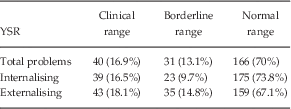
As expected in this community sample (see Table 1 below) the majority of participants fell in the normal category on all three scales of the YSR. Total problem score, M=46.73, (s.d.=24.19), Median=42, internalising score M=12.84 (s.d.= 8.97), Median=10 and externalising score M=13.97 (s.d.=9.32), Median=12.
Numbers (percentages) within the normal, borderline and clinical ranges on the YSR
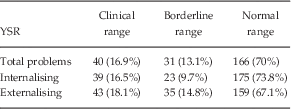
YSR, Youth Self-Report.
The prevalence of depression, suicidal ideation and self–harm
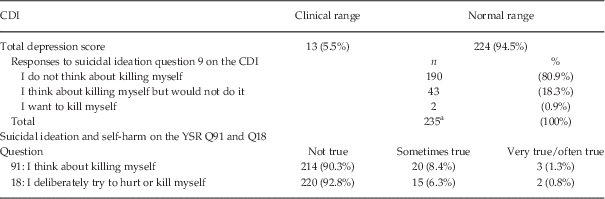
As shown in Table 2, the percentage of adolescents with depression scores within the clinical range was 5.5% (M=8.72, s.d.=6.40, Median=7.00). Also in Table 2 we see that 19.2% of adolescents expressed suicidal thoughts on the CDI (18.3% had thoughts of suicide, although only 0.9% had possible suicidal intent). On the YSR, 9.7% reported suicidal thoughts. Additionally, 7.2% reported self-harming sometimes or often.
Depression, suicidal ideation and self-harm
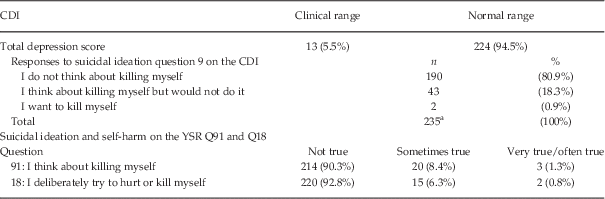
CDI, Children’s Depression Inventory; YSR, Youth Self-Report
a 2 cases missing, n=235.
Gender differences in mental health difficulties, suicidal ideation/self-harm
Due to the skewed distribution of scores, Mann–Whitney between groups analysis was used to test for gender differences on the YSR and CDI (Tables 3 and 4). On the YSR there was no statistically significant difference between males and females on total problem score (U=6617, z=−0.051, p=0. 960). However, females had significantly higher scores than males on the internalising scale (U=4973, z=−3.257, p=0.001) and males had significantly higher externalising scores than females (U=4846, z=−3.504, p=0.000). In addition females scored significantly higher than males on CDI depression scores (U=5312, z=−2.597, p=0.009).
Youth Self-Report gender differences

** p<.01.
Child Depression Inventory (CDI) gender differences

Suicidal ideation and self-harm
On the CDI, 18.9% of males reported suicidal ideation, versus 19.3% of females. Whereas, on the YSR 9.9% of males reported suicidal ideation, versus 9.6% of females. Slightly more females (8.9%) reported self-harm than males (4.4%) but none of the χ 2 analyses indicated a significant gender difference.
Factors associated with mental health difficulties
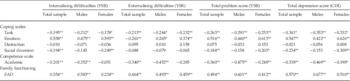
Due to the gender differences found on the YSR and CDI, we ran all further analyses on males and females separately to explore whether the predictors of mental health difficulties were the same for both genders. Correlation analyses were used to initially explore the relationship between coping, competence, family functioning and mental health difficulties. Due to some subscales being non-normally distributed when split by gender both Pearson’s and Spearman’s correlations were conducted. There were only two significant associations found for the Spearman’s analyses that were not identified in the Pearson’s analysis; for females, the distraction subscale significantly correlated with externalising (r s=0.193) and total problem scores on the YSR (r s=0.211). Only Pearson’s correlations are reported in Table 5 due to the similarity in findings. The main findings were that emotion-focussed coping, poor academic competence and family dysfunction were significantly associated with poorer mental health in adolescents.
Pearson’s correlations between coping strategies, competence, family functioning and mental health difficulties for the total sample and males and females

YSR, Youth Self-Report; CDI, Children’s Depression Inventory; FAD, Family Assessment Device.
*Significant at 0.05 level (two-tailed test), **significant at 0.01 level (two-tailed test).
Risk factors for mental health difficulties
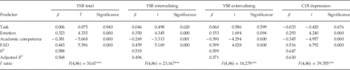
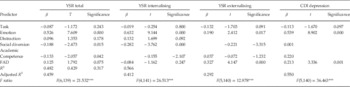
Multiple regression analyses were conducted, using variables that had significant bivariate associations with the dependent variable (from the Pearson’s or Spearman’s correlation). Results are shown in Tables 6 and 7.
Summary of multiple regression results for predictors of mental health problems in males

YSR, Youth Self-Report; CDI, Children’s Depression Inventory; FAD, Family Assessment Device.
*** p<.001.
Summary of multiple regression results for predictors of mental health problems in females

YSR, Youth Self-Report; CDI, Children’s Depression Inventory; FAD, Family Assessment Device.
***p<0.001.
Males
Predictors of YSR total problem score
Family dysfunction (FAD) made the largest unique contribution to the overall variance, β=0.444, p<0.001, followed by academic competence, β=−0.381, p<0.001, and emotion-focussed coping, β=0.323, p<0.001. Task-focussed coping did not make a significant unique contribution to the overall variance. This model explained 58.8% of the variance in total YSR scores for males F(4,86)=30.669, p<0.0005.
Predictors of YSR internalising difficulties
Family dysfunction (FAD) made the largest unique contribution to the total variance, β=0.459, p<0.001, followed by emotion-focussed coping, β=0.350, p<0.001 and academic competence, β=−0.269, p<0.001. Task-focussed coping did not make a unique contribution to the variance. This model accounted for 51.9% of the total variance in internalising scores for males, F(4,86)=23.167, p<0.001.
Predictors of YSR externalising difficulties
Family dysfunction made the largest unique significant contribution to the total variance in externalising scores, β=0.399, p<0.001, followed by academic competence, β=−0.390, p<0.001 but neither task nor emotion-focussed coping contributed significantly to the model, which accounted for 39.9% of the variance in male externalising scores, F(4,86)=14.279, p<0.001.
Predictors of depression (CDI) scores
Family dysfunction made the largest unique contribution to the overall variance in depression, β=0.516, p=0.000, followed by academic competence, β=−0.345, p=0.000 and emotion-focussed coping, β=0.293, p=0.000. Task focussed coping did not contribute significantly. This model explained 64.7% of the total variance in CDI scores for males, F(4,86)=39.355, p<0.001.
Females
Predictors of YSR total problem scores
Emotion-focussed coping made the largest unique contribution to the overall variance in total problem scores for females, β=0.526, p<0.001, followed by social diversion, β=−0.188, p=0.015, and academic competence, β=−0.133, p=0.042. Neither distraction, family dysfunction, nor task focussed coping made a unique contribution to the variance. This model explained 48.2% of the variance in total YSR score for females, F(6,139)=21.532, p<0.001.
Predictors of YSR internalising scores
Emotion-focussed coping made the largest significant unique contribution to the overall variance in internalising scores, β=0.632, p<0.001, followed by social diversion to a lesser degree, β=−0.282, p<0.001. Neither task-focussed coping nor family dysfunction contributed significantly to this model. This model accounted for 42.9% of the total variance in female internalising scores, F(4,141)=26.513, p<0.001.
Predictors of YSR externalising scores
Family dysfunction made the largest significant unique contribution to the variance, β=0.327, p<0.001. Emotion- focussed coping, β=0.190, p=0.017, and academic competence β=−0.166, p=0.037 also made significant contributions to the total variance. Neither task-focussed coping nor distraction contributed significantly to this model. This model explained 31.7% of the variance in female externalising scores, F(5,140)=12.978, p<0.001.
Predictors of depression (CDI) scores
Emotion-focussed coping made the largest unique contribution to the overall variance in CDI scores, β=0.539, p<0.001, followed by social diversion, β=−0.221, p<0.001 and then family functioning, β=0.213, p<0.001. Task-focussed coping did not contribute significantly to the variance. This model accounted for 56.6% of the variance in female CDI scores and was statistically significant, F(5,140)=36.463, p<0.001.
Discussion
The prevalence of mental health difficulties
This study found that 16.9% of 16 and 17 year olds living in a rural county in the West of Ireland reported mental health difficulties within the clinical range on the total problem score of the YSR, indicating they are at risk of a mental health disorder. If those adolescents scoring within the borderline clinical range are included, the prevalence rate rises to 29.9%. In comparison with international prevalence rates, the mean scores on total problems, externalising and internalising scores are similar to those obtained by Heyerdahl et al. (Reference Heyerdahl, Kvernmo and Wichstrom2004). When compared to previous Irish studies, the percentage scoring within the clinical range is slightly less than Lawlor and James (Reference Lawlor and James2000) who found ~20% of adolescents aged 16 years were within the clinical range on the YSR total problem scale. In the Lawlor and James (Reference Lawlor and James2000) study, the inclusion of town areas in their sample may have affected their findings, as rural populations tend to show less psychological distress (Fitzgerald & Kinsella Reference Fitzgerald and Kinsella1987; Fitzpatrick & Deehan Reference Fitzpatrick and Deehan1999). As suggested by Fitzgerald and Kinsella (Reference Fitzgerald and Kinsella1987), this is possibly due to less economic disadvantage, which has been associated with increased risk of mental health difficulties in children and adolescents (Stern et al. Reference Stern, Smith and Jang1999; Rijlaarsdam et al. Reference Rijlaarsdam, Stevens, vanderEnde, Hofman, Jaddoe, Mackenbach, Verhulst and Tiemeir2013). While we have not controlled for social economic status within this study this is something that researchers may wish to take account of in future studies in order to explore this further.
We found that 5.5% of adolescents had scores within the clinical range on the CDI, indicating the possibility of a depressive disorder. This rate is slightly higher than that of Lynch et al. (Reference Lynch, Mills, Daly and Fitzgerald2004) but similar to Costello et al. (Reference Costello, Foley and Angold2006) who reported prevalence rate of 5.6% for 13–18 year olds.
An interesting finding was the higher percentage of adolescents scoring within the clinical range for total problems (16.9%), internalising (16.5%) and externalising (18.1%) on the YSR than expected from the American norms (10%) from which the cut-off scores were taken (Achenbach & Rescorla Reference Achenbach and Rescorla2001). However, on the CDI, our finding of 5.5% within the clinical range was slightly less than the normative study of Kovacs (Reference Kovacs1992) who found 7% within the clinical range. One explanation for these differences might be the higher proportion of females in our study compared to the US normative study of the YSR as higher rates of emotional difficulties in females may inflate the scores on internalising difficulties (a spectrum of emotional difficulties including anxiety, depressed mood and somatic problems). Another reason for the disparity might be the severe economic recession in Ireland from 2008 onwards causing increased stress on families and adolescents. As the YSR internalising scale measures anxiety and somatic complaints, this scale may be more affected by environmental factors, which may cause stress but not depression. Additionally, it is possible that cultural differences may also affect the results in how adolescents react to stress without necessarily becoming depressed.
Suicidal ideation and reported self-harm
The percentage of students endorsing suicidal ideation ranged from 9.7% (YSR) to 19.2% (CDI) with 7.2% reporting self-harm. This highlights the level of distress experienced by some of the young people. Similar rates of self-harm were reported by Morey et al. (Reference Morey, Corcoran, Arensman and Perry2008).
Some researchers (e.g. Safer Reference Safer1997; Ivarsson et al. Reference James and Lawlor2002; Evans et al. Reference Evans, Hawton, Rodham and Deeks2005) have suggested that the differences in rates of suicidal ideation may be due to the differences in wording used in the questionnaire and whether the survey is anonymous., with higher rates reported on anonymous questionnaires (Evans et al. Reference Evans, Hawton, Rodham and Deeks2005). It is possible that the first suicide statement on the CDI ‘I do not think about killing myself’ makes it more permissive/less threatening to admit suicidal thoughts because it is phased in the negative so even a single thought of suicide would not permit you to answer in the affirmative. On the second CDI statement, students may have felt more free to answer ‘yes’, because of the proviso ‘but I would not do it’, as opposed to the very stringent third statement ‘I want to kill myself’ which indicates definite intention. In contrast, the more direct suicide question on the YSR ‘I think about killing myself’, ‘Not True’, ‘Sometimes True’ or ‘Very True’ may lead to more careful answers.
Gender differences in mental health difficulties
There was no significant gender difference on total problem score on the YSR. This is consistent with Fitzpatrick and Deehan (Reference Fitzpatrick and Deehan1999), but contrasts with Lawlor and James (Reference Lawlor and James2000) who found girls had higher overall problem scores. Males had significantly higher scores than females on the externalising scale, whereas females had significant higher scores on the internalising scale. The gender difference is in line with the general pattern of international research of girls tending to report more internalising problems and boys more externalising problems (e.g. Heyerdahl et al. Reference Heyerdahl, Kvernmo and Wichstrom2004). This is in accordance with the belief that males are more likely to externalise their distress, for example, through rule-breaking and aggression whereas females are more inclined to internalise their feelings and become depressed, or anxious (Rutter & Smith Reference Rutter and Smith1995). This could reflect society’s attitude which tends to accept females expressing feelings and emotions, whereas males are perceived as weak or ‘not manly’ if they do.
Consistent with other studies (e.g. Galambos et al. Reference Galambos, Leadbeater and Barker2004) females had significantly higher scores than males on total depression scores. The lack of a significant gender difference in suicidal ideation/self-harm contrasts with previous studies, which have found increased rates among girls (e.g. Lawlor & James Reference Lawlor and James2000; James & Lawlor 2001; Madge et al. Reference Madge, Hewitt, Hawton, de Wilde, Corcoran, Fekete, van Heeringen, Deleo and Ystgaard2008). However, a recent Irish report has shown that the difference between males and females appears to be narrowing in relation to deliberate self-harm [National Registry of Deliberate Self-Harm Ireland-Annual Report (NRDSH) 2010].
Factors predicting mental health difficulties in males
In relation to males, family dysfunction was the strongest predictor of total problem score, internalising, externalising and depression scores when controlling for other variables (coping/competence). A dysfunctional family may be particularly stressful for adolescent boys, who, unlike girls, may not have supports outside the home, such as friends with whom they can discuss their problems. Poorer academic competence and emotion-focussed coping also made a significant independent contribution to the variance. Task-focussed coping did not significantly predict mental health difficulties when other variables were controlled, similar to findings by Horwitz et al.’s (Reference Horwitz, Ryan and King2011) for adolescent depression.
Factors predicting mental health difficulties for females
In relation to females, emotion-focussed coping and family dysfunction predicted greater levels of mental health difficulties, while social diversion and academic competence were predictive of less mental health difficulties. Of these variables, emotion-focussed coping was the strongest predictor of internalising difficulties and depression. This supports the results of other studies which suggest that emotion-focussed coping (i.e. ruminating, dwelling on symptoms, self-blame) is counterproductive and related to poorer mental health (e.g. Billings & Moos Reference Billings and Moos1984). Our findings suggest this is especially true of adolescent girls.
On the other hand, similar to males, family dysfunction was the strongest predictor of externalising difficulties. Thus, a dysfunctional home increases the likelihood of aggression and rule-breaking behaviours in girls. Interestingly, task-focussed coping was not a significant predictor of mental health difficulties for females either. Social diversion emerged as the second strongest predictor of less depression and less internalising scores for females. The benefits of social support for adolescents with mental health problems was previously reported by Higgins and Endler (Reference Higgins and Endler1995) and Esposito and Clum (Reference Esposito and Clum2003).
Access to services
Only a small minority of adolescents in this study were currently attending mental health services, suggesting that the needs of this group with mental health difficulties is not being met. Interestingly, ‘attendance at therapist/psychologist’ was the predominant type of professional health service being used by the few adolescents who were accessing help. This suggests that talking therapy with one individual may be more acceptable to them. Therefore, primary care psychology services may be a good option to help deliver one-to-one therapy in a non-threatening environment which is easily accessible and could help with early detection and intervention of mental health difficulties.
Implications for clinical practice
In line with recommendations by Horwitz et al. (Reference Horwitz, Ryan and King2011), it is advocated that therapy (especially with young women) should focus on eliminating poor coping strategies such as ruminating and emotional responses. Accessing social support when under stress should be encouraged. Male adolescents should be encouraged to share upsetting thoughts/feelings and seek help if distressed. Family dysfunction was the most significant predictor of externalising difficulties in both genders but had a greater impact on all measures of male mental health. The findings of the present study suggest that individual therapy with adolescents is unlikely to be successful unless the contextual family factors are addressed. Therefore, clinicians should, as a rule, enquire about family dynamics during assessments and parents/families should be included as much as possible and involved in interventions. Also, it is recommended that family therapy might be increasingly used in therapy for adolescents, particularly for males. There is evidence to show that family intervention can improve the mental health of adolescents from dysfunctional families (e.g. Kumpfer et al. Reference Kumpfer, Whiteside, Ahearn Greene and Cofrin Allen2010). In this study a lack of academic competence was a significant predictor of externalising difficulties and generally poorer mental health. Thus, providing learning support for those struggling academically is very important for their psychological well-being.
Limitations
As this study was a cross sectional design, we cannot make conclusions about causation. Additionally, the study consisted of predominately white adolescents from mainly two-parent households living in rural settings, and thus may not be generalisable to other adolescent populations. As there are no definitive Irish norms for the YSR or the CDI we referred to the American norms. This may lead to some over or under estimation of prevalence in an Irish sample; however, this is the best available literature for comparison purposes at the current time. A study by Houghton et al. (Reference Houghton, Crowley, Houghton and Kelleher2004) sought to establish Irish norms for the CDI; however a definitive cut-off score was not determined, indicating that more research is needed to establish reliable norms. Thus it is recommended that future research carries out norming studies for these measures within an Irish population.
As the study involved minors it was deemed necessary to obtain written consent to ‘opt in’ from parents and adolescents. The response rate was somewhat low but this type of consent can greatly reduce numbers, and potentially cause selection bias (Tigges Baldwin Reference Tigges Baldwin2003) as it is a more rigorous form of consent (Blom-Hoffman et al. Reference Blom-Hoffman, Leff, Franko, Weinstein, Beakley and Power2009). Thus, the sample may not be representative of the county as a whole. In particular, the percentage of males within the sample was 38.4% which is proportionally fewer 16 and 17-year-old males than within the county as a whole (49.6%, Census 2011). So again, we urge caution in generalising our results and suggest researchers consider strategies for increased recruitment from adolescent males in future studies.
Conclusions
To our knowledge, this is the first in-depth Irish study to profile the mental health of this age group. This study has corroborated some previous findings regarding rates of mental health difficulties. A new and significant finding is the strong association that family dysfunction has with poorer mental health in males. Future studies may wish to explore further why this gender difference exists. Our study also found no gender difference in suicidal ideation or self-harm which contrasts with previous studies and may represent a change in prevalence. Future research should consider gender as an important factor in adolescent mental health.
Acknowledgements
The authors wish to thank the Schools/Youth Reach Centres and adolescents who participated in this study.
Conflict of Interest
None.