




No CrossRef data available.
Article contents
English as a second language learner differences in anaphoric resolution: Reading to learn in the academic context
Published online by Cambridge University Press: 01 November 2005
Abstract
To succeed at a university, students need to read expository texts effectively and meaningfully to access and understand information, and internalize it for study purposes. An important component of the comprehension process is the reader's ability to integrate current information with information mentioned earlier in a text. One aspect of this integration process involves anaphoric resolution. This paper reports on findings from a study that investigated anaphoric resolution by first-year English as a second language students during the reading of expository texts. The relationship between skill in anaphoric resolution, academic performance, and language proficiency was examined. Linguistic and textual factors such as type and inference strength of anaphoric tie were also taken into account to examine differential resolution effects. The findings showed that students who were not performing well academically were not skilled at resolving anaphors. Anaphoric resolution was also affected by linguistic and textual differences. Differences in anaphoric resolution diminished as proficiency in English increased. Anaphoric resolution was also affected by the strength of the anaphoric tie; successful anaphoric resolution dropped when the anaphoric tie required greater inferential processing. This was particularly evident among the academically weaker students. The findings suggest that anaphoric resolution in expository texts plays an important role in reading to learn. The implications of these findings are briefly discussed for English as a second language students.
Information
- Type
- Articles
- Information
- Copyright
- © 2005 Cambridge University Press
In South Africa, as in many other countries in Africa, most students at secondary and tertiary level study through the medium of a language that is not their primary language. As a result of these linguistic barriers, many find it difficult to perform well academically. Despite political liberation, the entry of underprepared students into tertiary education and their struggle to cope with their tertiary studies remains a persistent and pervasive problem. The problem of poor academic performance is obviously a complex and multilayered one. Although many of the contributory factors to this problem, as it manifests itself in the South Africa context in particular, have their origins in the deleterious educational policies and practices under apartheid, there are also aspects of this problem that are common among students all over the world who study through the medium of a second language (L2). There are also common features of this problem shared by students all over the world who come from largely oral communities where reading for pleasure is not an integral part of everyday life. In such communities, reading is largely associated with formal study and as a result, many of these students do not read in their primary language; reading typically occurs in the L2, the language of schooling. To succeed in the academic context, students need to read expository texts effectively and meaningfully to access and understand information, and internalize it for study purposes.
Current models of reading comprehension generally assume that during the reading process, readers use their linguistic and text knowledge as well as their background knowledge to create a coherent mental representation of what the text is about (e.g., Just & Carpenter, 1987; Grabe, 1991). Vital in the establishment of this text representation is the integration of incoming information with information already given in the text, as well as information that forms part of the reader's background knowledge. An important aspect of this integration process is anaphoric resolution. This enables the reader to integrate incoming information with given information by identifying and tracking referential continuity and focus in the text, as well as shifts in focus. Successful anaphoric resolution enables the reader to continuously update the text representation. Webber (1980, p. 142) states categorically that “if a reader cannot handle an anaphoric expression as the writer intended, there is no way that he or she can correctly update his or her discourse model in response to it.”
Because anaphoric resolution is important for tracking referents and topic continuity in a text, it helps readers access and understand written information more accurately, and is thus viewed as an integral part of reading skill. It is therefore natural to assume that students who can resolve anaphoric ties successfully have a better understanding of their textbooks, which in turn, affords them a better chance of performing well academically. This paper reports on a study that examined the relationship between anaphoric resolution during the reading of expository texts and academic performance among first-year university students who were studying through the medium of English, which was not their primary language.
ANAPHORA
Lexical and syntactic devices that refer back to textually given or previously mentioned information are called anaphoric devices. In other words, a referent relating to a person, entity, event, state, or idea that is introduced into a discourse is again referred to later, either by means of repetition of the same linguistic item or by means of another linguistic item. An antecedent may consist of a single word or a stretch of discourse such as a phrase, a whole sentence, or even an idea/event/state of affairs mentioned in one or more preceding paragraphs. In English, anaphoric devices include zero anaphor, pronouns, demonstratives, ellipsis, substitution, and lexical anaphors that include proper names, definite noun phrases1
There are many definite noun phrases in English that do not always have discourse antecedents and therefore do not always function as anaphoric devices. In fact, a large corpus study found that 60% of definite noun phrases in English did not have discourse antecedents (Fraurud, 1990, in Garrod & Sanford 1994, p. 678).
Anaphoric resolution requires a reader to perform a text-connecting task across textual units by successfully linking an appropriate antecedent (among several prior antecedents) with a specific anaphoric referent. In this way the mental text representation is continuously updated from incoming information. Because anaphora is always backward referring, anaphoric resolution is often referred to as a “bridging” or backward inference evoking “given” information. Given information can refer to information that has either already occurred explicitly in the text, or to information that is recoverable from the context, as in Example 1.
1. Hercules rode at a furious pace toward Thebes. The horse was exhausted on arrival.
The information that Hercules rode a horse is evoked from the context, although the definite noun phase The horse does not have an explicit antecedent. Often the given information relies on information that the speaker/writer assumes is shared background knowledge, as in the case of Example 2.
2. Pollini has invested the polonaizes with vigor and lyrical introspection. The pianist has indeed provided a bold interpretation.
Anaphoric devices vary in terms of their degree of referential rigidity, that is, their lexical specificity as well as the extent to which their interpretation is determined by the context (Garrod & Sanford, 1994, p. 678). For example, a proper name or repeated noun phrase is likely to refer to the same referent, whereas pronouns are more fluid and their resolution depends on shifts in discourse focus.
Anaphora is a major source of cohesion in texts, which deals with explicit or surface structure ties that link up sentences or propositions into coherent discourse, as represented in the seminal work of Halliday and Hasan (1976). In other words, sentences are cohesive to the extent that they contain linguistic items or referential expressions whose interpretation depends on the interpretation of prior items or expressions in the text. A large group of these anaphoric references fall under two categories of cohesive devices classified by Halliday and Hasan (1976), namely, reference cohesion and lexical cohesion. Reference cohesion includes pronouns and determiners whereas lexical cohesion includes repetition, synonymy, antonymy, hyponymy, and lexical collocation.
Anaphoric resolution is traditionally assumed to be part of inferencing, and since the 1970s it has occupied a fairly robust niche in the history of the study of inferencing in language processing in general. Like inferencing, anaphora can be perceived as occurring on a continuum, involving greater or lesser cognitive activity, depending on both text-based and reader-based variables. Furthermore, it is possible that anaphoric resolution in an L2 may involve greater inferential activity because the text-connecting tasks are less familiar and more opaque.
Research into anaphoric resolution
Much of the reading research into inferencing has centered on anaphoric resolution, especially that of pronouns. Anaphoric resolution is usually tested by means of reading times, response times, and, more recently, eye-tracking measures. Most of the studies assume a memory-based view of anaphoric resolution, whereby current information in working memory is assumed to activate relevant information that occurred earlier in the discourse.
Research findings indicate that there are several syntactic, semantic, textual, and pragmatic variables that affect anaphoric resolution. Three factors in particular have been shown to influence anaphoric resolution: ease of antecedent identifiability, topic continuity/discourse focus, and distance between anaphor and antecedent.
Antecedent identifiability refers to the ease with which an antecedent can be successfully linked to an anaphoric item. This factor includes featural overlap between the antecedent and the anaphor, as well as strength of association between them. There have been several studies whose findings support the hypothesis that the more features that the antecedent and the anaphoric item share, the easier will be the resolution of the anaphor tie (e.g., McKoon & Ratcliff, 1980; Gernsbacher, 1989). Reduced referring expressions such as pronouns provide less information about their referents than full anaphors. This makes it possible to match pronouns up, in theory at least, with several potential antecedents. Gernsbacher (1989) argues that coreferential nouns activate appropriate memory representations more effectively than pronouns, precisely because there is a better match to the memory representation. Similarly, Gallini and Spires (1992) found that subjects recalled more macro and micro idea units in passages involving anaphor repetition than in passages involving pronominal, substitution, and ellipsis anaphora.
However, ease of antecedent identification does not always adequately account for pronominal resolution, nor does it successfully account for the comprehension of many definite noun phrases or antecedents evoked by the context. Clearly, the absence of an explicit antecedent does not always exact a comprehension penalty in terms of reading time or comprehension. Garrod and Sanford (1994, p. 680) argue that coherence mechanisms as much as cohesion mechanisms play a role in directing comprehension processes.
Factors such as focus and topic continuity also have an effect on anaphoric resolution. Not all readers have problems resolving pronominal anaphors, and there are studies that have shown that in certain discourse contexts, repeated anaphors rather than reduced anaphors may, in fact, disrupt skilled readers. For example, Gordon, Grosz, and Gilliom (1993) found that reading times for repeated anaphor (i.e., name–name) was significantly longer than for pronoun–pronoun or name–pronoun conditions. These results were replicated by Kennison and Gordon (1997), who used eye-tracking experiments. Several scholars have suggested that readers resolve pronouns in terms of a restricted number of antecedents that are in focus in working memory. The term focusing was used by Grosz and Sidner (1985), although the term centering was used by Gordon et al. (1993). These studies indicate that if the incoming information continues the current topic, then the anaphoric item is resolved more quickly than when the incoming message incurs a shift in topic (e.g., Grosz, Joshi, & Weinstein, 1995). In his study, Hoover (1997) found shorter reading times for coherent texts when protagonists were pronominalized as opposed to versions in which nonprotagonists were pronominalized. Studies such as these all suggest that anaphoric resolution is sensitive to the focused state of the antecedent, for focused antecedents are the ones that are currently active in working memory. Repeated anaphoric forms are not always quicker to resolve because they tend to be associated with the reintroduction of referents that were introduced much earlier in the text and went out of discourse focus.
However, it is also possible that repeated anaphors have different resolution effects depending on a reader's age and stage of reading development. For example, repeated anaphors, which are common in the early grade basal readers, may be helpful for young readers in the early stages of reading. They may also ease anaphoric resolution among L2 readers whose L2 reading skills and/or L2 proficiency is poor.
Anaphoric distance is another factor that has been shown to affect anaphoric resolution. The most recent referent is typically taken to offer the best match with the anaphoric item. Research (e.g., O'Brien, Raney, Albrecht, & Rayner, 1997) indicates that when the anaphoric item occurs soon after the antecedent, then the antecedent information still resonates in memory, and is therefore more easily and quickly recovered than when there is greater distance between the anaphor and the antecedent. The argument is that distant antecedents are no longer in active working memory and need to be reactivated to be resolved; hence, the longer resolution time. However, some researchers point out that the distance explanation is based largely on local effects and fails to take into account higher level text effects. For example, Hoover (1997, p. 201) argues that greater distance “often leads to a shift in focus such that the antecedent… is no longer in focus.”
It should be borne in mind that the majority of the studies referred to above involved skilled mother-tongue readers who are sensitive to top-level text effects. There seems to be far less research into anaphoric resolution among weak readers and L2 readers. Oakhill and Yuill (1986) and Ehrlich, Remond, and Tardieu (1999) found that less skilled readers are less successful at pronominal resolution than skilled readers. Packenham (1980) examined lexical anaphoric resolution among 39 advanced Latin American L2 learners of English at the tertiary level. He found that the subjects' ability to resolve anaphors correlated positively with their overall reading ability. His findings indicated that anaphoric reference involving repetition was easier to resolve than reference involving synonymy, which in turn, was easier to resolve than reference involving paraphrase. Using the same three categories, he then compared the L2 students' anaphoric resolution with that of 20 native speakers of English, and found that such differential effects did not occur with the first language (L1) readers of the same texts. Packenham concluded that even at the advanced level, L2 students of English depend far more on the surface lexical and syntactic features of the anaphoric items than do native English students. From the above discussion it is clear that anaphoric resolution in L2 reading is an area that merits closer scrutiny.
The aim of the present study was to examine more closely the anaphoric inferencing abilities of English as a second language (ESL) readers during their reading of expository texts. Because the ability to “read to learn” is important in the learning context, the role of anaphoric resolution during reading was examined in relation to academic performance. Three broad aims were set up to determine whether
- there was a relationship between anaphoric resolution and academic performance,
- there was a relationship between anaphoric resolution and L2 proficiency, and
- the different kinds of anaphoric ties that occur in expository texts had a differential effect on their resolution by ESL students.
In this study, anaphoric resolution is examined only with reference to anaphoric devices involving explicit coreferring anaphoric items whose textual antecedents occur across clause or sentence boundaries. The reason for this decision was to obviate test situations where anaphoric inferences depended on background knowledge and would therefore disadvantage ESL students who might lack that knowledge. Definite noun phrases that function anaphorically were also excluded on the grounds that definite noun phrases might not as easily trigger a backward search for an antecedent as a noun phrase preceded by a determiner such as this/that would.
METHOD
Participants
The subjects comprised a group of 68 first-year Medical (MbChB) students from the Medical University of South Africa (Medunsa). Medunsa has entrance qualification requirements that necessitate a Grade 12 matriculation exemption (i.e., entrance to university) and a pass in subjects such as mathematics, biology, and science. English, the language of instruction, was an L2 for all the participants. The students have to enroll for English and psychology during their first year of medical study. The students ranged in age from 17 to 29 years, with an average age of 18 years, 9 months (18;9).
Materials
The anaphoric test that the students wrote contained 30 paragraphs that included a total of 38 different anaphoric ties, with an average of eight items per anaphoric category. The paragraphs were taken from social and human science textbooks (e.g., Giddens, 1993), typical of the type of texts the medical students needed to read for their first-year psychology studies. Two paragraphs were taken from Packenham's (1980) study. The anaphoric test has an alpha (Cronbach) reliability score of .88.
The participants also wrote a norm-referenced L2 proficiency test developed for school leavers and adults by the Human Sciences Research Council in South Africa. The entire test consisted of 60 multiple-choice items. None of the items tested anaphoric resolution. The students took between 30 and 90 min to complete the test. The test has a K-R20 reliability score of .90.
Several months after the subjects had done the language proficiency and anaphoric tests, the results of their final year content subject examinations were obtained. To explore the relationship between anaphoric resolution and academic performance, four academic achievement groups were identified, based on the students' mean final examination results in two content subjects, such as psychology and anatomy.
- Fail. This group attained a mean of 49% or less for the two subjects in the final examination (officially, students need to obtain 50% or more to pass).
- At risk. This group attained between 50 and 59% in the final examination (they are often considered to be “borderline” students).
- Pass. This group attained between 60 and 74% in the final examination.
- Distinction. This group attained 75% or more in the final examination (officially, a mark of 75% or more is assigned distinction status).
Anaphoric testing procedure
The test on anaphoric resolution comprised “identification by underlining” tasks where all the paragraphs had specific anaphoric items underlined. The students were then asked to underline all those words/phrases or sentences that they thought the underlined words referred back to and to draw an arrow linking them. The test contained written instructions to the students on how to answer the anaphoric questions, and an example paragraph was given to show the students how to answer the questions. These instructions were repeated orally, an example was demonstrated on the overhead projector, and the students were urged to put up their hands if they had difficulty understanding what they needed to do. Although no time limit was set for the test, the researcher noted the time it took the first five students and the last five students in the group to complete the test.
To act as a control, seven skilled L1 and L2 readers (senior students and student assistants) were also administered the test individually, and the time it took each subject to complete the test was recorded.
Scoring of anaphoric responses
A fairly lenient scoring procedure was adopted whereby, to be given a full mark per item the student had to have underlined, at least partially, the appropriate antecedent. Because several of the antecedents were quite long, partial underlining refers to cases where, minimally, the head of the antecedent noun phrase and its primary modifiers were underlined.
The test was scored twice by the same marker, with a 2-week interim period between scoring. In the cases where a few discrepancies arose (these were all cases where antecedents had only been partially identified), two linguistic colleagues were consulted and consensus reached on the scoring.
Analytical tools: Categorization of anaphoric relations
Two analytical approaches were used to categorize different anaphoric ties to determine what patterns of resolution they yielded among ESL readers. In the first approach, traditional Hallidayan text linguistic categories of reference were adopted. These were placed on an inference continuum, on the basis of ease of recoverability afforded by the underlying linguistic features. In the second approach anaphoric relations were categorized into either low or high inference anaphors, depending on the relative amount of inferencing required to resolve them.
The linguistic categorization of anaphoric ties
The anaphoric ties were divided into the five Hallidayan linguistic categories of anaphoric ties, namely repetition, synonymy, paraphrase, pronominal, and determiner anaphoric ties. Although the paraphrase category is not strictly a Hallidayan one, it is borrowed from Packenham's (1980) study and can be said to include two Hallidayan types of referring expressions, namely, hyponymy and collocation. These five categories were placed on an inference continuum in terms of greater or lesser morphosyntactic and semantic opaqueness. The rationale for this continuum was based on featural overlap, namely, that the more morphosyntactic and semantic clues there were in the anaphoric tie, the more “apparent” the link would be, and hence, the more easily anaphoric resolution would occur. The fewer and more opaque the clues were, the less successful the resolution.
Repetition
The repetition category involves anaphoric ties where the anaphor is an exact repetition of an antecedent item or a close repetition, in that a derivational morphological change occurs, as in Example 3.
3. As a result of upbringing and personality, everyone in a society has preconceptions, positive or negative, about their fellow citizens. Usually these preconceptions are based on emotion rather than on reason. People are hostile to other social groups who are easily identifiable because they are different racially, religiously, or politically. In fact, modern history is full of examples that show how politicians, to divide people and realize their own selfish ambitions, have exploited this hostility.
Pronominal anaphoric ties
The pronominal ties included pronoun anaphors whose antecedents were either person noun phrases (as in he below) or noun phrases referring to constructs (as in they below). They were all in subject position.
4. The British sociologist, Barry Sugarman, related certain aspects of middle- and working-class subcultures to differences in educational achievement. He claims that many middle-class occupations provide an opportunity for continuous advancement in income and status. This encourages planning for the future, for example, the investment of time, energy, and money in training to meet the requirements of higher status jobs. By comparison, working-class jobs reach full earning capacity relatively quickly, but provide fewer promotion prospects and less income for investment. In addition, they are less secure.
English pronouns only share gender and number features with their coreferents, and could potentially be mapped onto several antecedent noun phrases in a preceding text. The African languages do not have a pronominal system like English, and many African ESL learners commonly make mistakes with pronouns in English. However, even though pronouns are indexical and can potentially map onto different antecedents, they have a very high frequency rate (e.g., it is the 10th most frequent word in English) and are probably the most frequent and familiar anaphoric referents for ESL readers. They were therefore placed second on the continuum: they have fewer overlapping features than the repetition category but were considered more familiar than the remaining three categories.
Synonymy
In this category, the anaphoric item is semantically related to the antecedent, but not morphologically.
5. It seems logical to assume that our periods of sleep must have some function. Moreover, because we spend so much time sleeping, it is reasonable to suppose that the function of sleep must be of considerable importance for us. The phenomenon of sleep has interested people for thousands of years. The idea that sleep gives the brain a rest is quite widespread. But modern research into sleep, which offers no strong evidence that brain activity decreases during sleep, apparently does not support this hypothesis.
This category of anaphoric tie thus has semantic but not morphological clues. It was therefore placed third on the anaphoric continuum.
Paraphrase
This anaphoric item consists of the determinerthis or such followed by a single noun that paraphrases or summarizes the contents of the antecedent. The antecedent may consist of a clause that functions as an object complement clause, or it may consist of an independent sentence on its own, as in Example 6.
6. How far are differences in the behavior of women and men due to biological differences? Opinions are radically opposed on this issue. Many authors hold that there are inbuilt differences of behavior between men and women that appear in all cultures. Some writers believe that the findings of sociobiology point strongly in this direction. They are likely to draw attention to the fact, for example, that in almost all cultures, men rather than women take part in hunting and warfare.
In this category, as Packenham (1980, p. 77) explains, the anaphoric item “is filled by a noun which cannot be seen to have a morphological and/or synonymous relationship with an identifying lexical item in the antecedent.” Pragmatic or strategic knowledge helps to make the link between the paraphrase anaphor and its antecedent. Paraphrase anaphoric ties contain no morphosyntactic or semantic cues and were placed fourth on the continuum.
Determiners
This tie consists of anaphors comprising only the determiner this (or these), the antecedent of which can be a noun phrase of varying length.
7. In the light of the ending of the Cold War, we can anticipate a reduction in the developed world's spending for military purposes. Arms-related expenditure has dropped sharply in Russia. The United States and other Western countries are scaling back defense expenditure over the next few years. However, this will increase the pressure to export arms to make up for lost domestic markets. It is not certain that the ending of the Cold War will reduce what Third World countries see as security requirements, which are as often internal as external.
The antecedent of a determiner can refer to a single concept or to a more complex unit of thought as expressed in an entire sentence or even a paragraph. Like the pronominals, the anaphoric items in this category are also indexical, but determiners in English only mark number. They therefore provide few morphosyntactic and no semantic or pragmatic cues for their antecedents. They were thus placed at the most opaque end of the continuum.
Strength of inference
To assess whether the amount of inferencing required to resolve anaphors is also affected by text factors, such as distance and length of antecedent, the anaphoric ties were also analyzed in terms of their inference “strength” and categorized along a second continuum into low and high inference anaphoric ties. To operationalize the concept of inference strength, an anaphoric inference index was set up in terms of four parameters: distance between antecedent and anaphor, length of antecedent item, grammatical functions of antecedent and anaphor, and featural overlap between antecedent and anaphor. Binary scores of 1 or 0 were used for each parameter (except for one parameter that included 1, 0.5, or 0 scores) giving a total score of 6. Items that obtained scores of 3.5 or more were classified as high-inference anaphoric ties, whereas those that obtained scores of 3 or less were classified as low inference anaphoric ties.
Distance between antecedent and anaphor
To measure distance between antecedent and anaphor, each of the paragraphs was analyzed into F units (i.e., clauses or clause equivalents that serve an identifiable rhetorical function in written discourse; Pretorius, 1996, p. 391). If an anaphoric item appeared in the F unit immediately following the F unit in which the antecedent item occurred, then it was classified as adjacent and assigned a 0 value. If one or more F units separated the antecedent and the anaphor, then the tie was classified as distant, and assigned a 1 value.
8. The British sociologist, Barry Sugarman, related certain aspects of middle- and working-class subcultures to differences in educational achievement.1/ He [a] claims that many middle-class occupations provide an opportunity for continuous advancement in income and status.2/ This encourages planning for the future,3/ for example, the investment of time, energy and money in training to meet the requirements of higher status jobs.4/ By comparison, working-class jobs reach full earning capacity relatively quickly,5/x but provide fewer promotion prospects and less income for investment.6/ In addition, they [b] are less secure.7/
The first F unit containing the antecedent The British sociologist, Barry Sugarman is followed by the second F unit containing the anaphoric itemHe[a]. Instead, in [b], the antecedent working-class jobs occurs in the fifth F unit, whereas the anaphoric item they occurs in the seventh F unit.
Length of antecedent
This parameter took the length of the antecedent into account. It was assumed that the shorter the antecedent, the easier it is to map the anaphoric item onto it. Shortness of antecedent was defined as consisting of a single noun or of Det + Mod(Mod) + Head(+Mod) and assigned a value of 0. If the antecedent item consisted of a more complex noun phrase comprising more than two modifiers or if it consisted of more than one F unit, then it was classified as long, and assigned a value of 1. For example, in Example 9 below, the antecedent is long, consisting of four entire F units.
9. Garrison (1979) found that female aspirations for high-status jobs rose by 7% between 1970 and 1976./ During the same time, male aspirations for such jobs declined 5%./ Lueptow (1981) found a similar decline in gender-typed occupational choices when he compared high school seniors of 1964 to high school seniors of 1975./ Although such evidence is encouraging, we must bear in mind that women still tend to be heavily over represented in traditional female jobs.
Featural overlap
Here, morphological, semantic, and pragmatic overlaps between antecedents and anaphoric items were counted. Items that had any of these features were given a 0 value, respectively; those without these features were given a value of 1. These features are similar to the ones used in the linguistic categorization of anaphoric ties.
Grammatical function of antecedent and anaphor
This parameter reflects the grammatical functions of the anaphoric tie, based on whether the antecedent and anaphor were in subject or object position. Three possibilities were identified: subject–subject, object–subject, and object–object. Anaphoric ties in subject–subject continue the discourse focus and were assigned a value of 0, those in object–subject position were assigned a value of 0.5, and those in object–object position are not in discourse focus and were assigned a value of 1.
In all, there were 16 low inference anaphoric ties in the test and 22 high inference anaphoric ties.
RESULTS
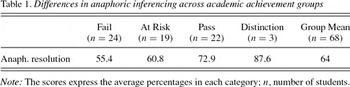
The control group completed the anaphoric test within a span of 13 to 19 min, with a 94% accuracy rate. In contrast, the ESL students were slower and less accurate; five of the students finished the test within 35 min, whereas the majority took about 45 to 50 min to complete the test. The mean performance was 64% (SD = 15.7).
The first research question examines differences in anaphoric inferencing ability in relation to academic performance. Table 1 shows how anaphoric inferencing ability is distributed across the different academic performance groups.

A one-way analysis of variance (ANOVA) was used to further explore the relationship between the four different academic groups with regard to their anaphoric inferencing abilities. The analysis yielded a highly significant effect, F (3, 64) = 10.27, p [les ] .001. A post hoc Scheffé test showed significant differences between the fail and at risk groups on the one hand, and the pass and distinction groups on the other hand. These results provide evidence for differences in anaphoric inferencing ability in relation to academic performance; the better the student's anaphoric inferencing ability is, the better his/her academic performance.
Because successful anaphoric resolution depends on the ability to make links between anaphoric items and their antecedents, it is natural to assume that students with higher levels of proficiency in the L2 will be sensitive to linguistic and textual cues that form the basis for anaphoric resolution than students with lower levels of L2 proficiency. The second research question thus examined the relationship between the subjects' ability in anaphoric inferencing and their L2 proficiency. The application of a Pearson product moment correlation showed a significant correlation of r = .737 (p < .001) between anaphoric resolution and L2 proficiency. There was also a significant correlation of r = .695 (p < .001) between anaphoric resolution and academic performance, and a significant correlation of r = .686 (p < .001) between L2 proficiency and academic performance. Using a stepwise regression analysis, a significant model emerged: adjusted R2 = .545; F(2, 64) = 40.465, p < .000. The predictor variables were L2 proficiency, β = .404, p < .002; anaphoric resolution, β = .399, p < .002. Together, L2 proficiency and anaphoric resolution contributed 54% of the variance in academic performance.
The third research question examined the effects of different types of anaphors on their resolution. The first step was to examine the distribution of successful anaphoric resolution among the five Hallidayan types of anaphoric ties. It was predicted that ease of resolution would be determined by the amount of morphosemantic featural overlap between the antecedent and the anaphor, and that successful anaphoric resolution would decrease in the order: repetition > pronominal > synonymy > paraphrase > determiner.
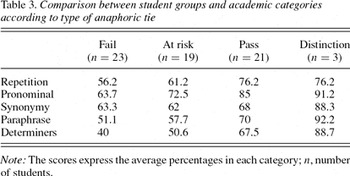
Contrary to expectations, the most successful resolution occurred in the pronominal rather than the repetition category. Surprisingly, the students also tended to resolve the synonymous anaphoric ties marginally more successfully than the repetition ties. As expected, the paraphrase and determiner categories proved to be the most challenging. The display of scores in Table 2 shows the distribution of anaphoric resolution across the different categories of anaphoric ties.

This pattern is maintained fairly consistently when these results are analyzed across the four academic groups, as displayed in Table 3.

One notes the fairly large difference in anaphoric inferencing ability between the pass and distinction groups. The latter are readers who obviously function at an independent level.
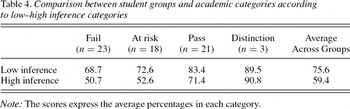
The next component of the research question examined anaphoric resolution in terms of both linguistic and text linguistic factors, and predicted that ease of resolution would be determined by whether the anaphoric tie was a low inference or a high inference tie.
The mean overall score for low inference anaphoric relations was 75.6%, whereas that of high inference relations was only 59.4%, clearly showing differences between the two types of anaphoric tie. The low inference anaphoric ties were resolved more successfully across all four groups. Successful anaphoric resolution dropped by about 17% when the anaphoric tie required greater inferential processing. This drop was particularly evident among the fail and at risk groups, whereas the distinction group maintained their skill irrespective of whether the anaphoric resolution required low or high inferential activity. Further analysis of the data showed that the expected pattern of anaphoric resolution obtained across the four academic groups, as reflected in Table 4.

The data were further analyzed in a split plot (repeated measures) 2 × 3 mixed ANOVA, with inferencing (low/high) as within-subjects and academic group (fail/at risk/pass) as between-subjects factors. (Because the distinction group was so small, it was combined with the pass group.) With regard to within-subjects effects, the analysis revealed a main effect of low/high anaphoric inference that was significant, F(1, 63) = 115.90, p < .000. The low/high inference by academic group interaction was not significant at the 5% level, but there appears to be some interaction (p = 0.086). With regard to between-subjects effects, there was a significant main effect of academic group F(2, 63) = 13.07, p < .000. A post hoc Scheffé test (p < .05) showed significant differences between the fail and pass groups (p < .000) and the at risk and pass groups (p < .002), but not between the fail and at risk groups. In other words, these latter two groups, the academically weaker students, behaved similarly. The results of the mixed ANOVA also showed that the low and high inference scores across the groups reflect an increasing linear trend. This trend is significant (p < .000).
DISCUSSION
Many of the ESL students who were tested had problems resolving anaphoric ties successfully. The majority of the subjects took a relatively long time to complete the test, and in general, did not achieve a very high success rate (with a mean of 64%), especially among the fail and at risk groups of students. This is cause for concern, because anaphoric inferencing is an integral component of skilled reading. Anaphoric resolution becomes even more unsuccessful when the anaphoric ties involve more complex forms of referring expressions such as those involving paraphrase and determiners, and low inference anaphoric ties were more successfully resolved than high inference anaphoric ties. In contrast, the skilled readers who served as a control completed the test quickly, had a very high success rate, and were equally good at resolving both low and high inference anaphora, as were the distinction students. The results suggest a strong relationship between anaphoric resolution and academic performance: although there were only a small group of distinction students, they showed obvious mastery in anaphoric inferencing, whereas students in the pass group inferred anaphors more successfully than those in the at risk group, who in turn inferred anaphors more successfully than those in the fail group.
Major differences emerged between the different types of anaphoric relations, suggesting that the ESL students who are not skilled readers are sensitive to the linguistic and textual features of anaphoric ties. In contrast, anaphoric inferencing by the skilled L1 and ESL readers in the control group and the ESL distinction students were not sensitive to such features, that is, resolution remained high irrespective of the type of anaphoric tie involved. This finding supports the results obtained in Packenham's study (1980). Pronominal ties were resolved most successfully. The high-frequency rate of pronominals across all genres of texts makes them a familiar feature of written texts, and this may account for their more successful resolution by the students. Yet, anaphoric ties involving synonymy, paraphrase, and determiners are features of expository texts in English and students therefore need to be able to resolve them successfully to access information effectively in the learning context.
The differential performance in anaphoric resolution suggests that the concept of an anaphoric continuum is a useful one for it is sensitive to the increasing number of linguistic and text-based factors involved in anaphoric resolution. However, the predictions made by the anaphoric continuum based on linguistic factors alone needs to be modified, for it fails in some respects to accommodate the complex interplay of linguistic and textual features. For example, anaphoric ties involving repetition of items with derivational changes (e.g., hostile > hostility) posed difficulty for many students, whereas anaphoric ties involving pronominals showed the highest success rate. The relatively high success rate of pronominal anaphoric resolution suggests that, despite the fact that pronouns are indexical and hence potentially opaque, the high frequency of pronominals in texts makes them a relatively familiar feature, even for less skilled ESL readers.
Although, as a group, the students fared better at inferring synonymous anaphoric inferences than those involving repetition, variance in performance occurred between the groups, because the pass students demonstrated the reverse (i.e., expected) pattern, whereas the at risk students were relatively equivalent in resolving these two types of ties. This differential effect may have been an artifact of the synonym items in the test itself and merits further exploration. However, the obtained response pattern, especially with the fail and at risk students, suggests a possible lack of attention given to morphological clues to aid anaphoric resolution. It may be that unskilled ESL students are more attuned to looking for semantic links rather than grammatical links when trying to find their way around text. As a result, they miss the grammatical clues that could guide them in constructing a more accurate mental representation of the text. Despite the morphological clues provided by the identical and nearly identical repetition ties, the students failed to pick them up.
As expected, the paraphrase and determiner categories of anaphoric relations proved to be the most challenging to infer. The resolution by ESL readers of lexical anaphoric ties in expository texts is obviously an area that requires further exploration. There are many factors that could play a role in making anaphors easier or more difficult to resolve, including low-frequency lexicon, unfamiliar topic and context, and obscure wording or grammatical structures. In fact, the most common errors in anaphoric resolution that occurred with the control group were those involving determiners. Determiners, particularly those that refer back to longer and more complex antecedents, are sometimes ambiguous to resolve, even for skilled L1 readers of English. This is a factor that writers of expository textbooks should bear in mind, especially when the intended audience comprises ESL readers.
The analysis of anaphoric resolution in terms of a continuum with low inference anaphoric ties lying along one end of the continuum and high inference ties inclining toward the other end is useful, for it clearly demonstrates the extent to which inferential demands affect anaphoric processing. Anaphoric resolution becomes increasingly challenging as the antecedents become longer and more complex, the cues become more opaque, and the anaphoric ties stretch over longer sections of discourse. However, a two-category continuum is not as nuanced as a more graded continuum, so this is an area that merits further research, both from a text linguistic as well as an applied linguistic perspective.
The findings indicate that differences in the successful resolution of different types of anaphoric reference diminish as proficiency in English increases. The poor performance of the students in anaphoric inferencing in general, and in particular, their poor performance in the lexical types of anaphoric references, could be a result of poor language proficiency: low levels of proficiency hamper the ability of ESL readers to perceive morphological or semantic similarities between linguistic items despite morphosyntactic changes. Similarly, it could be argued that the students have low levels of vocabulary, and this results in failure to identify antecedents of determiners or anaphoric relations involving paraphrase anaphora. As Packenham (1980, p. 168) points out, it is natural to assume that a basic prerequisite for successful anaphoric resolution is “an adequate knowledge of the meanings of the lexical items used as head nouns in anaphoric NPs or as identifying lexical elements in antecedents.”
To control the vocabulary factor, Packenham tested his subjects for vocabulary to ensure that they had adequate knowledge of the words in the test passages. Their scores on the vocabulary test indicated that they were familiar with the words used in the anaphoric reference ties. He concluded that “the subjects' ability to resolve anaphoric reference … was influenced by factors other than vocabulary knowledge” (Packenham, 1980, p. 169). Cooper (1999) examined the relationship between vocabulary levels and academic performance among first-year ESL students at two universities in South Africa. She found that the vocabulary levels of ESL first-year students were generally very low, in both basic and academic word categories. Although the students in the present study were not tested for vocabulary, it is reasonable to assume that many had low vocabulary levels. Further examination of the relationship between ESL students' vocabulary levels and the ease with which they resolve anaphors is an area that merits attention.
The students who scored higher on the L2 proficiency test also tended to be better readers. The stepwise regression indicated that although L2 proficiency and ability in anaphoric resolution are correlated, in the reading to learn context they both contribute to academic performance. Reading is not simply an extension of language proficiency. Reading develops specific cognitive–linguistic subskills, some of which include the ability to process chunks of meaning units in written texts, to make links between these meaning units, to attend to cues in the text to guide the chunking and linking, and to develop executive control processes such as knowing how and when to use appropriate reading strategies. Constant exposure to texts over the years enables readers to build up procedural or strategic knowledge that facilitates comprehension. Anaphoric resolution possibly relies not only on linguistic proficiency but also on general cognitive and memory abilities, as well as procedural knowledge of reading, which includes attending to and making use of cues in texts to construct meaning, and chunking information into meaningful units so that new information is integrated with given information. Increased skill in reading brings about increased skill in anaphoric resolution. Research into the effects of extensive reading indicates that increased skill in reading also brings about increased language proficiency (e.g., Elley, 1991; Krashen, 1993).
From the findings it seems that students who do not perform well academically are students who do not attend to text cues. Skill in anaphoric inferencing is particularly important in the learning context because readers need to rely on the cues in the text to comprehend texts that deal with topics about which they have little prior knowledge. Allen (1985, p. 613), for example, found that increased dependence on text cues is necessary for reading texts on unfamiliar contexts. Students who do not perform well academically may also be students who do not readily keep track of referents in the text, which means that they also cannot readily integrate incoming information to already given information. Good readers use strategies that “rely more on processing units of thought and less on word-by-word reading” (Nicaise & Gettinger, 1995, p. 287). Testing anaphoric resolution is a useful way of assessing the processing units that readers use when reading expository texts. It is beyond the scope of this paper to describe the nature of the errors that the students made when resolving anaphors. However, the analysis indicated that many of the subjects have difficulty in this area of reading because they do not identify and integrate the relevant antecedent “units of thought” that tie up with anaphoric devices. The units of thought they incorrectly identified in their responses were often either underspecified (i.e., identifying only part of the antecedent), overspecified (i.e., identifying a more generic idea for the anaphor), or irrelevant. This failure to focus on the appropriate information units, in turn, leads to difficulty in combining different portions of meaning units in texts. Consequently, the reader keeps “missing the point” or misinterpreting it, presumably resulting in faulty and fragmented comprehension, as reflected in their academic performance.
The poor performance of the students with regard to anaphoric resolution suggests that explicit attention should be given to the development of reading skills at tertiary level. Anaphoric resolution is a skill that develops as a result of repeated exposure to texts. Given the disadvantaged backgrounds from which many of the subjects come, it can be assumed that many, if not most, of the subjects in the study did not have adequate exposure to written discourse in either their L1 or their ESL in their primary and secondary school years. If one wishes to reduce Matthew effects in reading (e.g., Stanovich, 1986) and enable ESL students to become “richer,” one needs to tackle the issue of explicit skill instruction directly. Leaving these students to their own reading devices exacerbates Matthew effects.
Although there is not much in the literature dealing with the effects of explicit anaphoric instruction and practice, there is plenty of research indicating the efficacy of teaching students reading strategies in general (e.g., Nicaise & Gettinger, 1995; Pearson & Fielding, 1991) and inferencing strategies in particular. It is suggested that ESL students in general, and low achieving students in particular, be taught strategies that will raise their awareness of anaphoric ties and the way in which authors use various cohesive devices to relate new information to information already given in the text. Such strategies and exercises can be used in either language or reading classes, and should enable students to better attend to text cues and to try to map new information to given information with greater precision than these results reflect. For example, if students are made aware that the determiners this and these always signal the presence of already given information, then students can learn to backtrack and look for suitable antecedents onto which the determiners can be mapped. Cloze exercises and underline and arrow tasks, such as those used in the test, should provide awareness-raising exercises. Such strategies should also enable students to enrich their vocabularies over time, especially in the case of synonymy and paraphrase anaphors. In this way a student's academic vocabulary in particular can be helped to expand. Given the fairly extensive occurrence of nominalization and high lexical density in expository texts in English, helping students to develop strategies for resolving anaphoric relations empowers them to process these complex features of written text more easily. Teaching strategies to help students resolve anaphoric relations more successfully is a step toward curbing Matthew effects so that weaker readers can, in fact, grow richer through reading, and read to learn more effectively.
ACKNOWLEDGMENTS
The author thanks the medical students for their willing participation in the study, and their lecturers for making valuable time available to the researcher to assess the students. The research was performed as part of the author's doctoral work. Thanks are also extended to the anonymous reviewers who provided helpful comments on an earlier draft of this paper.
References
Allen J.
1985.
Inferential comprehension: The effects of text source, decoding ability, and mode.
Reading Research Quarterly,
20,
603–
615.Google Scholar
Cooper P. A.
1996.
In search of sufficient vocabulary: Testing the vocabulary levels of undergraduate students.
South African Journal of Linguistics, Supplement,
26,
25–
37.Google Scholar
Ehrlich M.-F.,
Remond M., &
Tardieu H.
1999.
Processing of anaphoric devices in young skilled and less skilled comprehenders: Differences in metacognitive monitoring.
Reading and Writing: An Interdisciplinary Journal,
11,
29–
63.Google Scholar
Elley W. B.
1991.
Acquiring literacy in a second language: The effect of book-based programmes.
Language Learning,
41,
375–
411.Google Scholar
Gallini J. K., &
Spires H. A.
1992.
The influence of anaphoric relations and departures from story grammar structure on text processing.
Reading Psychology,
13,
107–
130.Google Scholar
Garrod S., &
Sanford A.
1977.
Interpreting anaphoric relations: The integration of semantic information while reading.
Journal of Verbal Learning and Verbal Behavior,
16,
77–
90.Google Scholar
Garrod S. C., &
Sanford A. J.
1994.
Resolving sentences in a discourse context.
In M. A. Gernsbacher (Ed.),
Handbook of psycholinguistics
(pp. 675–
698).
New York:
Academic Press.
Gernsbacher M. A.
1989.
Mechanisms that improve referential access.
Cognition,
32,
99–
156.Google Scholar
Gordon P. C.,
Grosz B. J., &
Gilliom L. A.
1993.
Pronouns, names and the centring of attention in discourse.
Cognitive Science,
17,
311–
347.Google Scholar
Grosz B. J.,
Joshi A. K., &
Weinstein S.
1995.
Centring: A framework for modeling the local coherence of discourse.
Computational Linguistics,
21,
203–
225.Google Scholar
Grosz B. J., &
Sidner C. L.
1985.
Attention, intentions and the structure of discourse.
Computational Linguistics,
12,
175–
204.Google Scholar
Giddens A.
1993.
Sociology.
Cambridge:
Polity Press.
Grabe W.
1991.
Current developments in second language reading research.
TESOL Quarterly,
25,
375–
406.Google Scholar
Halliday M. A. K., &
Hasan R.
1976.
Cohesion in English.
London:
Longman.
Hoover M. L.
1997.
Effects of textual and cohesive structure on discourse processing.
Discourse Processes,
23,
193–
120.Google Scholar
Just M. A., &
Carpenter P. A.
1987.
The psychology of reading and language comprehension.
Boston, MA:
Allyn & Bacon.
Kennison S. M. &
Gordon P. C.
1997.
Comprehending referential expressions during reading: Evidence from eye tracking.
Discourse Processes,
24,
229–
252.Google Scholar
Krashen S.
1993.
The power of reading.
Englewood, CO:
Libraries Unlimited.
McKoon G., &
Ratcliff R.
1980.
The comprehension process and memory structures involved in anaphoric reference.
Journal of Verbal Learning and Verbal Behavior,
19,
668–
682.Google Scholar
Nicaise M., &
Gettinger M.
1995.
Fostering reading comprehension in college students.
Reading Psychology,
16,
283–
337.Google Scholar
Oakhill J., &
Yuill N.
1986.
Pronoun resolution in skilled and less-skilled comprehenders: Effects of memory load and inferential complexity.
Language and Speech,
29,
25–
37.Google Scholar
O'Brien E. J.,
Raney G. E.,
Albrecht J. E., &
Rayner K.
1997.
Processes involved in the resolution of explicit anaphors.
Discourse Processes,
23,
1–
24.Google Scholar
Packenham K. J.
1980.
The resolution of lexically-reinforced anaphoric reference and its relation to reading in English as a second language.
Unpublished doctoral dissertation,
University of Pittsburgh.
Pearson P. D., &
Fielding L.
1991.
Comprehension instruction.
In R. Barr,
M. L. Kamil,
P. Mosenthal, &
P. D. Pearson (Eds.),
Handbook of reading research
(Vol. II,
pp. 815–
860).
London:
Longman.
Pretorius E. J.
1996.
A profile of causal development amongst ten-year-olds: Implications for reading and writing.
Reading and Writing: An Interdisciplinary Journal,
8,
385–
406.Google Scholar
Stanovich K. E.
1986.
Matthew effects in reading: Some consequences of individual differences in the acquisition of literacy.
Reading Research Quarterly,
21,
360–
406.Google Scholar
Webber B. L.
1980.
Syntax beyond the sentence: Anaphora.
In R. J. Spiro,
B. C. Bruce, &
W. F. Brewer (Eds.),
Theoretical issues in reading comprehension
(pp. 141–
164).
Hillsdale, NJ:
Erlbaum.
Differences in anaphoric inferencing across academic achievement groups

Mean overall scores for anaphoric resolution among the five categories
Comparison between student groups and academic categories according to type of anaphoric tie
Comparison between student groups and academic categories according to low–high inference categories
 You have
Access
- 10
- Cited by